Hasta la Vista

It’s always fun to cross a border on a bike tour, even with a 24 hour ferry journey from Rome to Barcelona in between.

And Spain is very different to Italy.

Not just the parched, post-harvest, beige landscape but lots of other things that impact the life of a bicycle tourist.

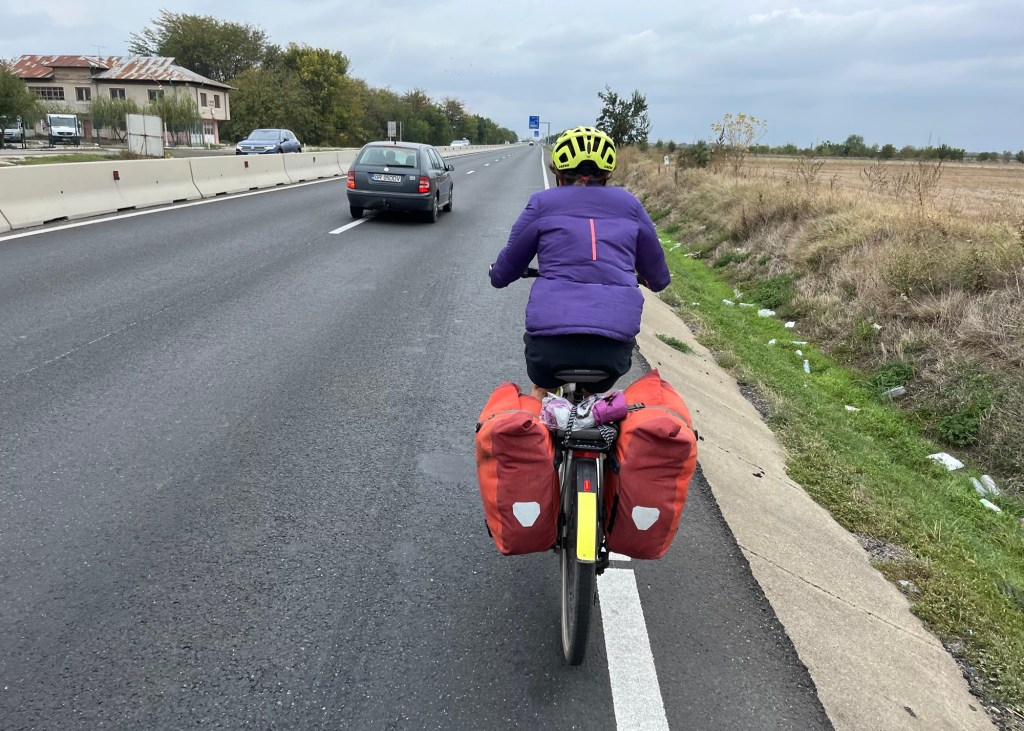
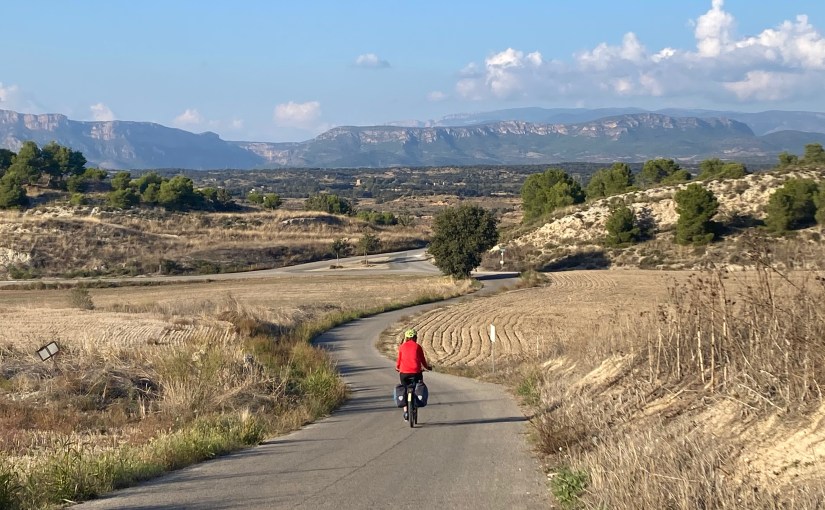
The roads for one. They’re as smooth as silk in Spain, wide with a huge hard shoulder (emergency lane) to help us feel safely tucked away from the traffic, a refreshing change from the bumpy, narrow roads of Italy.

The drivers for two. The only other touring cyclist we met in Spain was a Canadian who literally could not stop talking in amazement about how incredibly nice the drivers were. He was blown away, completely gobsmacked!

We simply told him not to go to Italy!

Spanish drivers hang back politely, they allow a wide berth when they overtake bicycles and they give way at every opportunity. They’re right at the top of the Clare & Andy Driver Courtesy League, together with the Irish and the Dutch. (The Italians are at the bottom, with the Argentinians.)
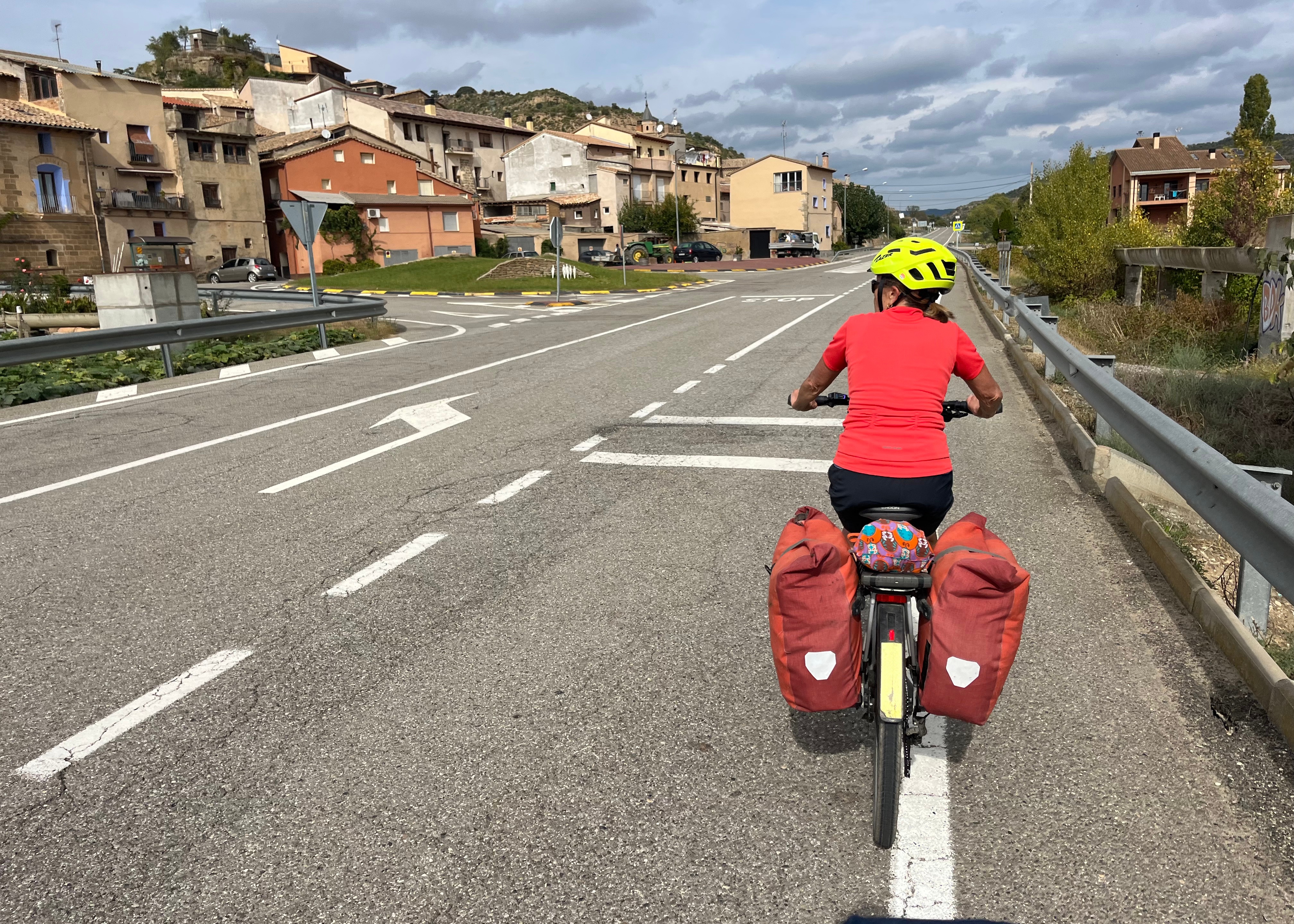
In fact the roads are so good and the drivers are so nice that the cycling can even become a tiny bit boring … there are simply so few potholes to avoid.

And then there’s the famously late local eating patterns in Spain. A choice of lunch at three o’clock or dinner at nine doesn’t easily fit into the rhythm of a bike touring day.

But this time we switched into the culinary timezone straight away. Our ferry from Rome arrived in Barcelona at half past eight at night. By the time we’d found our hotel, unpacked, showered and changed we were wandering out in search of tapas at just after 10 o’clock. Far too late in most countries but perfect in Spain.

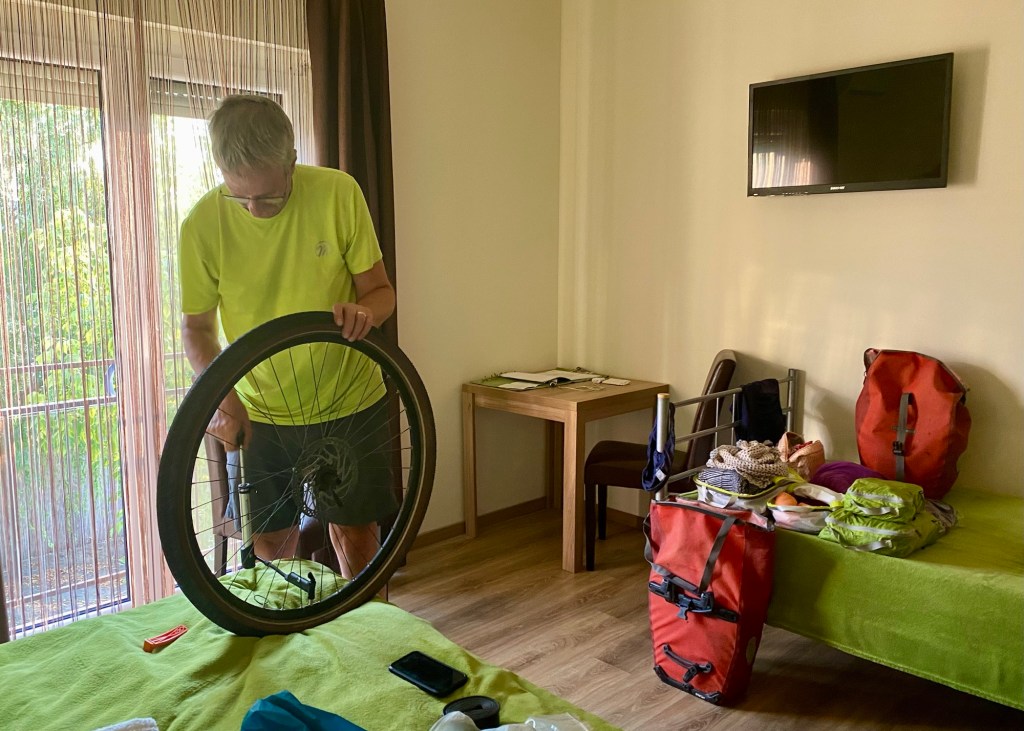
Having finished two previous bike tours in Barcelona in 2016 and 2021 we decided not to linger this time. After hurriedly doing the laundry and mending a puncture to Andy’s back wheel, we soon found ourselves nostalgically cycling up Avinguda Diagonal, this time out of the city.

Avinguda Diagonal

Past experience had made us pretty nervous about escaping Barcelona, as the geography channels all the roads into two narrow valleys, one to the north and one to the south. Once again, we chose the southern route and tried to suppress the bad memories from our first attempt in 2016.

Avoiding the busy Barcelona highways in 2016

But this time it was a dream – cycle paths all the way, then out onto a smooth, wide secondary road up into the hills towards our hostal in La Pobla de Claramunt.

Clare was both relieved and impressed. Andy’s navigation skills must have improved a bit over the years … or more likely, they were terrible back in 2016!

This time he asked her to do just one unusual thing, to push her fully loaded bike into a lift in order to avoid a busy junction … a first for us!

Taking the lift

Staying in a hostal in Spain does not mean sleeping in a shared dormitory with a bunch of smelly young travellers.

They are simple family run budget hotels, usually with a restaurant and other basic amenities, popular with workers but also great places for touring cyclists to stay.

Hostal Robert in La Pobla de Claramunt

The following morning, over a traditional Catalonian breakfast of Pa amb Tomàquet (crispy toast rubbed with garlic and ripe tomatoes, then drizzled with olive oil), Andy made a confession.

He had consistently told Clare that we didn’t need to worry about our Schengen days this year … we had loads left.

But, he now admitted that he’d left out of the calculations the ten days we’d spent cycling around the Normandy beaches in May. If we made it onto the ferry we’d booked from Bilbao there would only be one Schengen day in reserve.

And the next ferry was not until a week later.

Feeling a tiny but familiar knot develop in her stomach, Clare agreed that we’d have to crack on with some long cycling days. We might be able to turn north and explore the foothills of the Pyrenees later … IF and only IF we made good progress.

So Andy reluctantly replanned a route to follow the main roads, which were fast but dull. Even Clare started to find them a bit boring towards the end of the day, so as we neared Balaguer, our destination, she asked Andy to find a detour through the countryside instead.

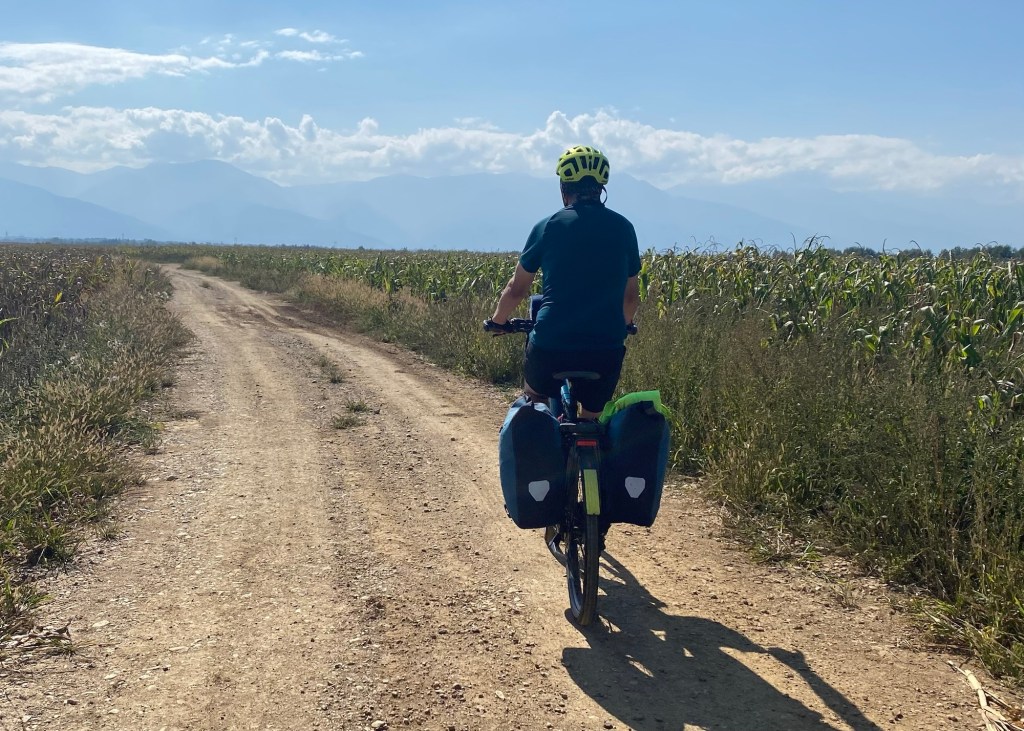
Surprised but delighted, Andy soon found a way to loop around some small country roads that only added an extra 10 kilometres or so. But he might have failed to mention that some of the detour would be on ripio … the infamous Spanish gravel.
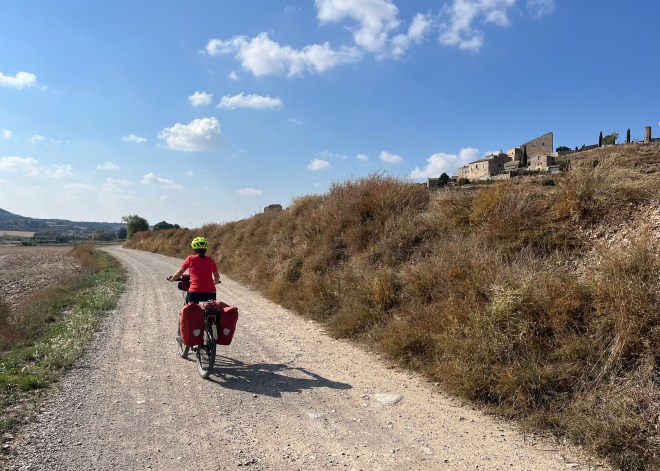
The gravel didn’t last too long and it became a glorious end to the day, the late afternoon sun warming our backs, the foothills of the Pyrenees beckoning us in the distance. A moment to reinforce the particular pleasure that only comes from enjoying a long bicycle tour together.

Not always such a dreadful detour

But the ripio came back to bite Andy when he woke up the next morning to find his front tyre completely flat, a tiny shard still embedded in the rubber. Surprisingly both our punctures have been in Spain, despite the quality of the roads!

This second puncture meant we’d now used up both our spare inner tubes in a matter of days. And there was likely to be more ripio to come.
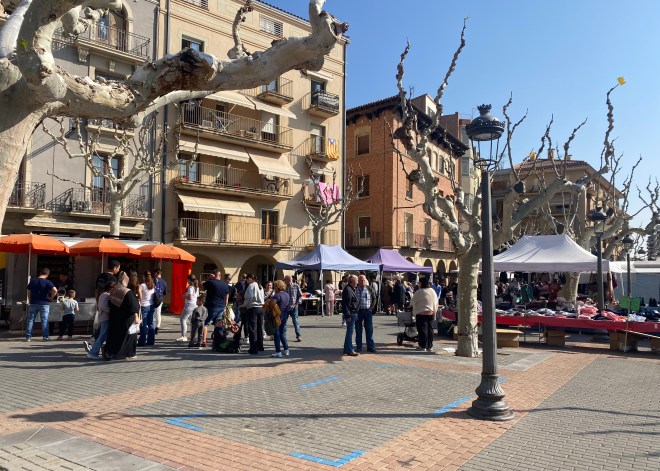
Market Day in Balaguer

As we wandered around the market, we were lucky to come across Cicles Perna, a tiny old-fashioned shop where several generations of the same family have been repairing bicycles since 1925.
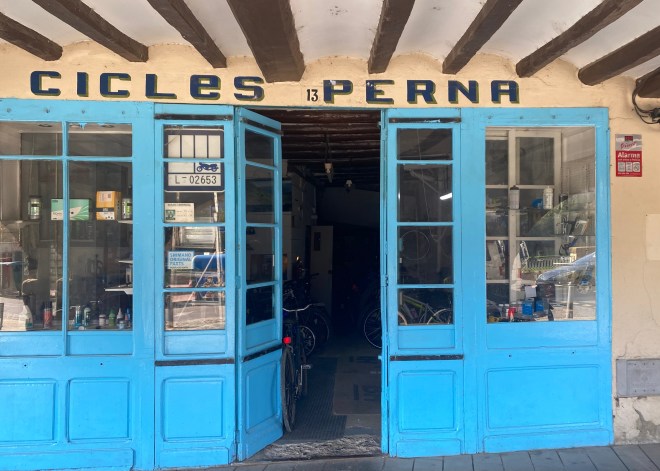
Despite the language barrier, Josep Maria Badia Perna soon understood what we were looking for and dashed around the corner to his storeroom, returning several minutes later with a huge smile and two new tubes in exactly the right size.

Those Pyrenean foothills continued to look extremely inviting, so a couple of days later we felt we were making enough progress to swing north into their warm embrace.

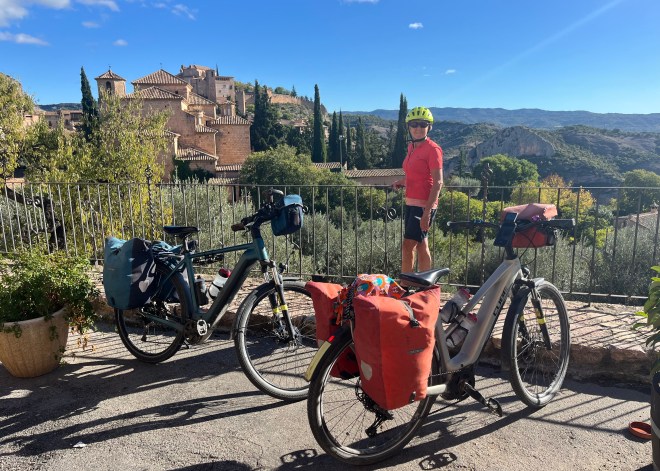
We crossed into Aragon and made our way up to the stunning hill fortress town of Alquézar, whose name originates from al qaçr, the Arabic word for fort or castle.

Alquézar

Despite our previous travels in Spain, we hadn’t appreciated that the 8th century conquest of Hispania by the Moors had penetrated this far north, right up to the natural barrier of the Pyrenees.

There were no ancient mosques to admire but we did come across an interesting story – the legend of Nunilo and Alodia, two young women from the 9th century.

Born to a Muslim father and a Christian mother of a wealthy family, these girls were raised as muslims at home but educated in a christian school. When their parents died they came under the care of their father’s brother, who tried to force them to renounce their mother’s faith and embrace Islam instead, including getting married to Muslim suitors.

They stubbornly refused, so the wicked uncle denounced them to the governor of Alquézar who had them imprisoned, before charging them with blasphemy and then chopping off their heads.

A bit harsh!
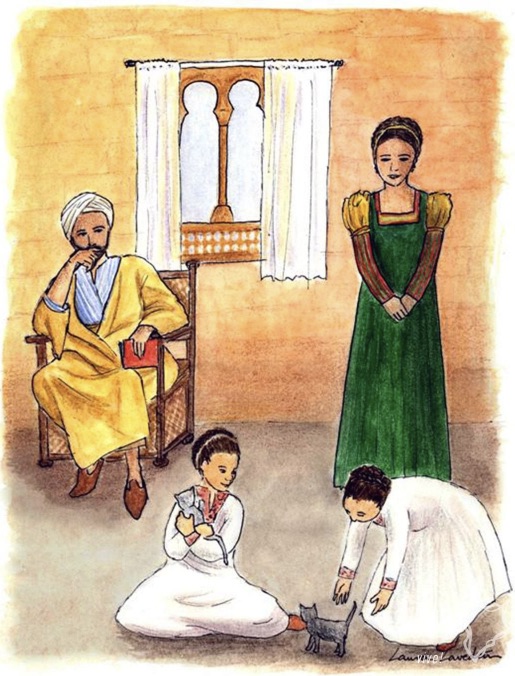
Nunilo and Alodia as young girls
Photocredit: Turismo Somontano

That’s when the miracles started. 

Left out in the wilderness for animals to eat, a miraculous light prevented any creature from touching their bodies. So their remains were dropped into a well … but the water from the well soon became known for its incredible curative powers.

This drew the attention of the Queen of nearby Navarre who snapped up the relics for the Monastery of Leyre, some 200 kilometres away. There, somewhat ironically, they were preserved in a famous ancient islamic casket that she had recently acquired as war booty.

Perhaps, even today, the people of Alquézar are still a bit sore at the loss of these bones, as their tourist information is happy to cast doubt on the efficacy of Nunilo and Alodia’s relics … or indeed any relics.

Instead of talking about miraculous cures, their information boards explain the economic importance of relics to medieval churches. The donations from grateful pilgrims were one of their main sources of income.

To attract more pilgrims and get more money, churches and monasteries had to outdo each other with ever more fantastical objects, even occasionally resorting to theft. Relics from martyrs such as Nunilo and Alodia were lucrative, but not nearly as lucrative as anything associated with Jesus.

Consequently there are hundreds of fragments from the True Cross, several burial shrouds and roughly three dozen Holy Nails spread around the world, including one we saw in Siena. In Medieval times several churches even claimed to offer a miraculous cure emanating from a piece of the Holy Foreskin, although these have subsequently disappeared.

But the tradition continues. In the Basilica of Santa Maria Maggiore in Rome we witnessed pilgrims queuing to receive protection from five pieces of sycamore twig, allegedly preserved from the Holy Manger itself.

The reliquary holding five sycamore twigs in Rome

Andy could have done with a miraculous cure from the bones of Nunilo and Alodia, as it was in Alquézar that he revealed he was suffering from problems with his feet. The main issue was an ingrown big toenail that had developed a nasty infection.

Of course, being a stoic but stubborn man, he hadn’t mentioned this painful problem to Clare until it was oozing pus and until we were in a remote village in the hills, far away from civilisation.

Trying to hide her frustration, Clare dutifully squeezed out the pus but it was clear that he needed medical attention before we could continue. Of course, this small historic village didn’t have a pharmacy, let alone a doctor. 

But Andy had a stroke of luck. The lovely 2* Hotel Santa Maria we were staying at is run by Daria, taking time out of her main career as a Spanish/English translator. She explained that there was a medical centre in Abiego, just 15km away. If that didn’t work we would have to cycle on to the hospital in Huesca, back down on the plain.

So we abandoned our rest day and rode through the hills to Abiego.

It was a Monday morning, normally an exceptionally busy time for British doctors after the weekend. Anticipating a long queue, we were amazed to discover that the medical centre was completely empty and we had the single doctor to ourselves. She didn’t speak any English but a combination of Clare’s Spanish and Google Translate helped us to understand her diagnosis and treatment.

An empty medical centre

The doctor prescribed antibiotic cream and a dressing to be picked up at the local pharmacy. Only problem? It was now midday and the pharmacy was closing for a nice long Spanish lunch, not opening again until 4pm.

Nervously, we jumped onto our bikes and dashed there as fast as we could, only to find that the doctor had already called ahead … so the pharmacist had delayed her lunch and was expecting us.

What great service! And all free, courtesy of our reciprocal health cards.

A quick call to Daria and we were soon back at the hotel, Andy’s toe enjoying a room with a view, Clare exploring the village.
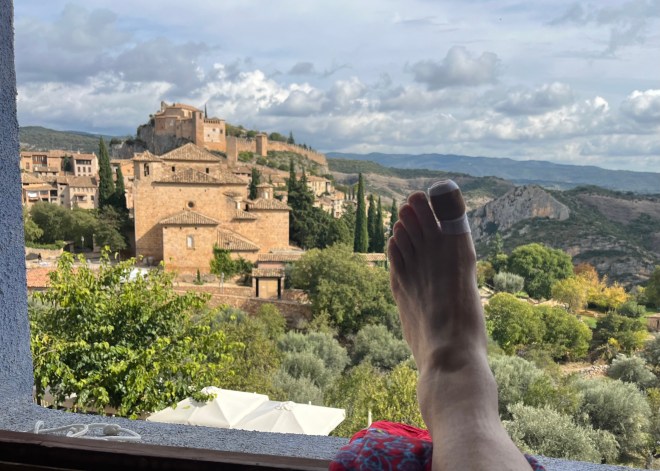
Toe with a view

Losing a rest day was not ideal as, despite our enjoyment of cycling in Spain, we were both starting to feel a bit bike weary and travel weary by now.

Rome had been our destination, our target, so psychologically this part of the journey always felt like a coda, a bit on the end. The kilometres in our legs and the constant packing and unpacking of our panniers were taking their toll.

As we ate dinner in the square that evening, we reflected that most of our rest days had been spent tramping around big cities, which however fascinating, added to the cumulative build up of exhaustion. The hills in Italy were a lot steeper than we’d expected and we’d reduced our daily distances as there were so many nice places to see … which meant more cycling days and less rest days.

We’d made a rooky error of not allowing ourselves enough days off the bike for proper relaxation. You’d have thought we’d have learnt that by now!
But the ride the next day through the canyons of Guara Natural Park to Boltana was enough to give any weary touring cyclist a second wind. It was stunning, one of our best days on a bike. Unlike the Pyrenees looming on the horizon, the wild beauty of this natural park does not lie in the height of its mountain tops but in the depth of its spectacular canyons, carved out by wind and water.
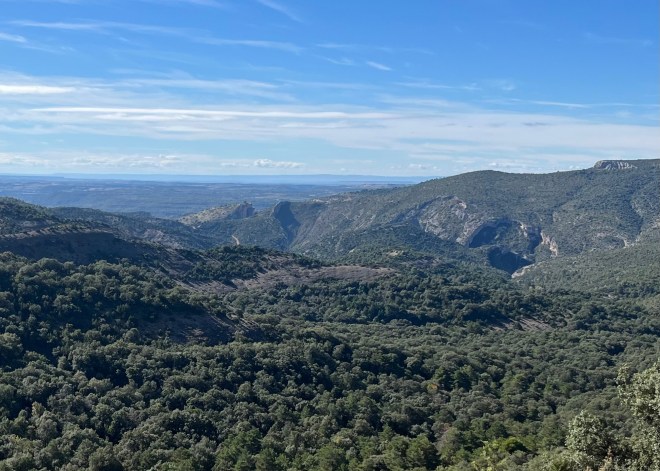
Guara Natural Park

In the summer Guara is a mecca for fans of adventure sports … canyoning, mountain biking, rock climbing … but also for geologists, palaeontologists and archaeologists interested in ancient cave art, of which there are many fine examples. 
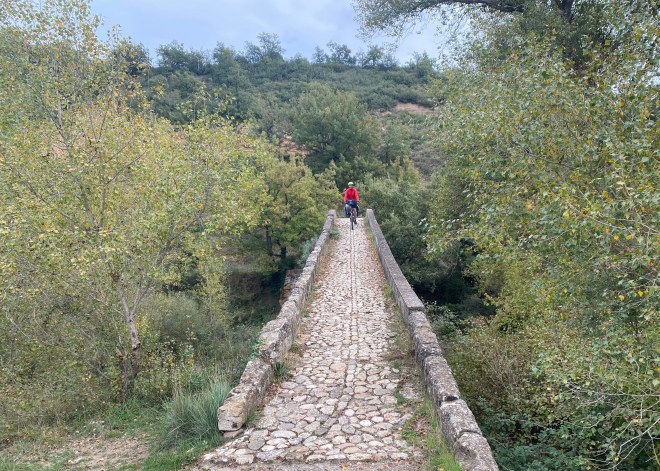
Crossing a narrow Medieval Bridge

We were simply content to pedal gently through the rugged landscape, to enjoy the golden eagles and Egyptian vultures soaring overhead and to peer down into the deep gorges.

Eventually we stopped for a picnic lunch in the tiny village of Arcusa. 

Everything was closed but it was a lovely little square for a picnic … and for a party, judging by the many murals!

The following morning the young hotel receptionist told us that he was a keen cyclist too and asked which way we were going to Jaca. He was horrified to learn we planned to stay on the main road … warning us about racing traffic, bad drivers and a long tunnel.

I go on the Cotefablo Pass instead, he said, eyeing us dubiously. Nice roads, but you need good legs. We didn’t admit we were on electric bikes.

Consulting Komoot, we discovered that the Cotefablo Pass added an extra 30km and a hell of a lot of climbing to the day. Despite her experience in the tunnel on the Gotthard pass, Clare insisted we stick to the main road this time. Andy could only agree, his toe was still quite tender in his cycling shoes.

It turned out to be an inspired decision. Obviously that young man had never been to Italy. Here in Spain, the road was wide and smooth, the traffic light, the drivers courteous and the Túnel de Petralba so good, it actually became a highlight of the day.

As soon as the cameras spotted us pedalling into the tunnel, signs popped up warning drivers of the presence of Bicicletas en el Tunel.
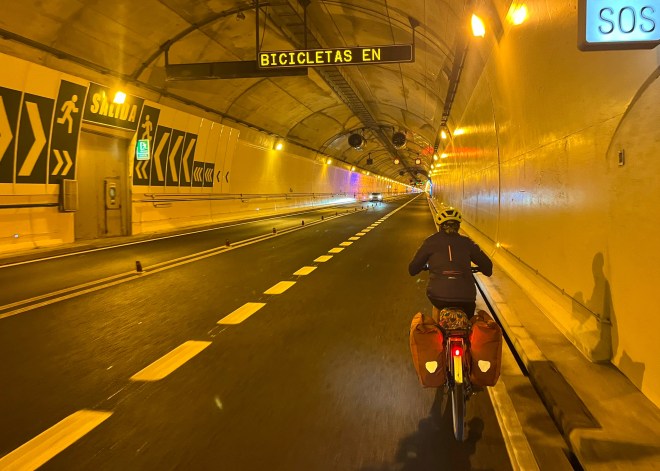
The speed limit was immediately reduced to 60km/hour. Just for us!!
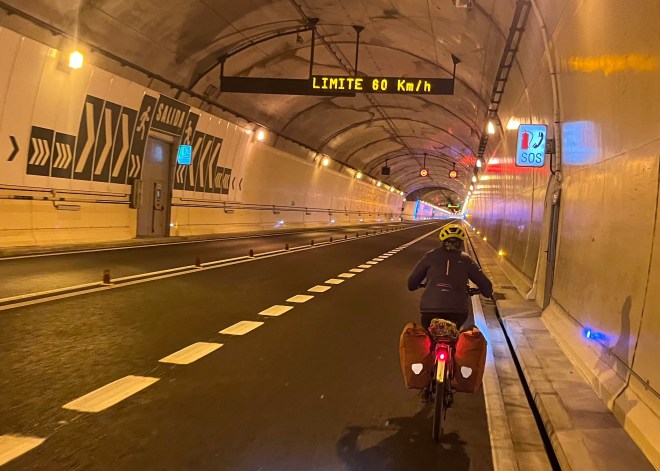
But there was hardly any traffic anyway … for most of the 3km we practically had this light, air conditioned tube to ourselves.

It was such a nice experience that we gave the controllers a cheery wave of thanks as we rode out through the cameras at the other end. Who cares if we were only waving at some artificial intelligence?
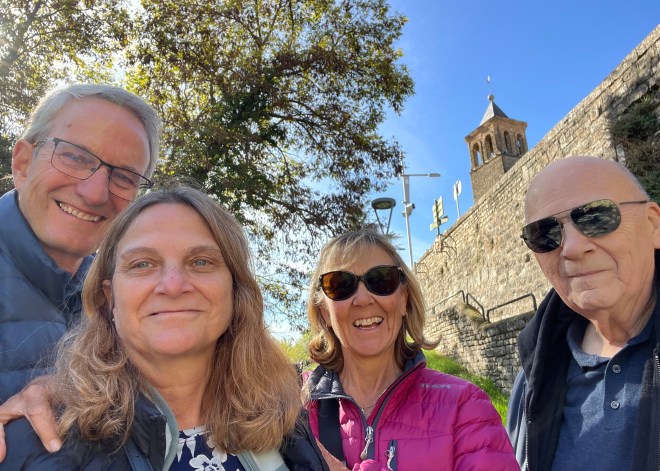
In Jaca another restorative treat awaited us. Lis, Andy’s sister, and her husband Ian had travelled all the way down to Spain on a first adventure in their new motorhome, just to see us for a day. There is nothing so rejuvenating as a long Spanish lunch with close family, catching up on news and laughing together. It was so good to see them, a proper rest day that got rid of any travel and cycling weariness for good.
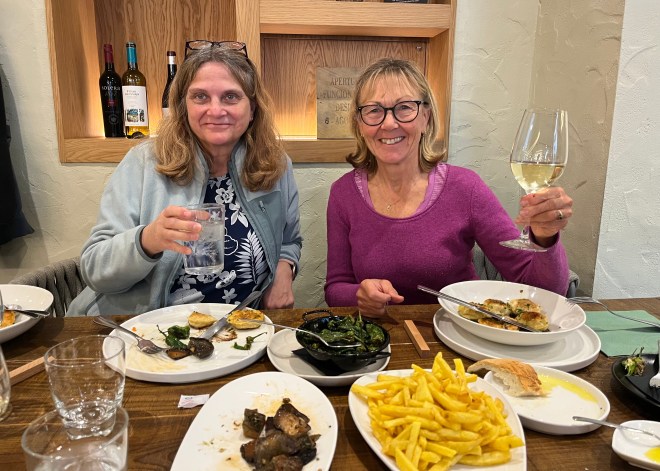
Leaving Jaca there was an abrupt change to the season when daylight saving ended, signalling the official end of summer. Clouds shrouded the mountain tops, atmospheric and wintery, the air felt sharp and cold as we descended into a wide open valley.

Our route took us past the ‘Sea of the Pyrenees‘, a large reservoir controversially created by a Franco era dam. Controversial because it flooded several villages and a famous thermal spa resort, popular since Roman times.

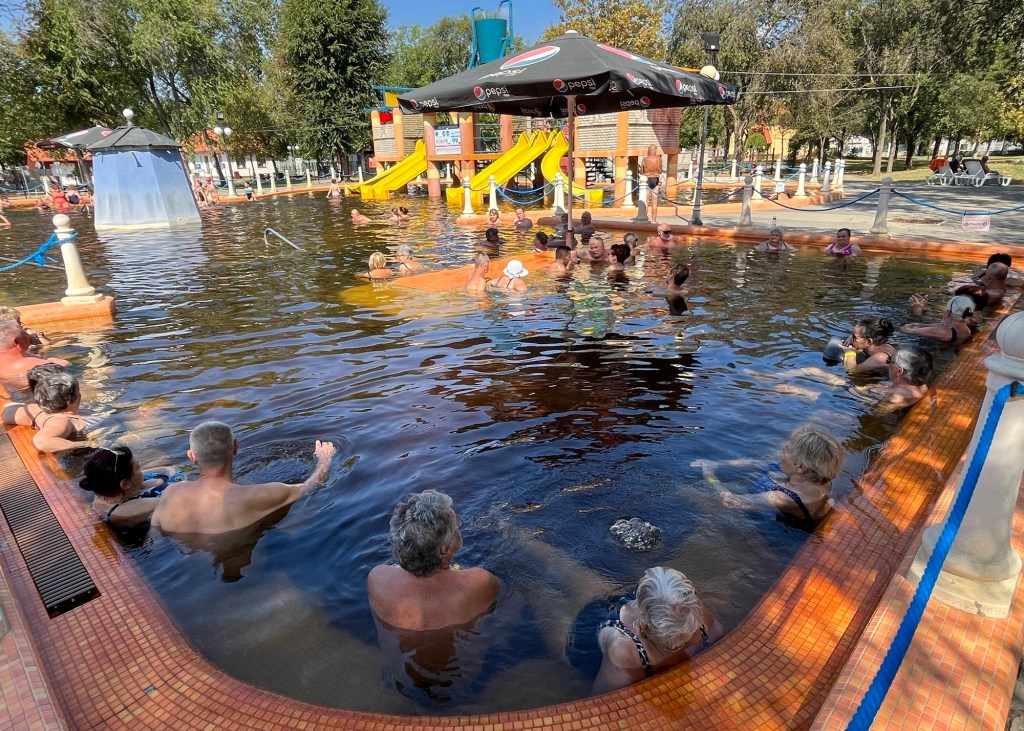
But this was a weekend in late October, when the reservoir was at its lowest, allowing people a brief period to still enjoy bathing in the sulphurous waters, all be it without the luxurious changing rooms, restaurant or soporific music.

Enjoying a spa amongst the ruins

Just beyond the dam was our 1* hostal in the tiny, nondescript town of Yesa. We arrived at half past three but the patron cheerily informed us that it was still early for lunch and that the best thing to do would be to enjoy their Menu del Dias before we unpacked.

He was right. With families still rolling in an hour later the food was both delicious and very reasonable, a local bottle of wine included for good cheer. It was the kind of experience you only get if you go off the beaten track a little.

And we weren’t driving … or pedalling!
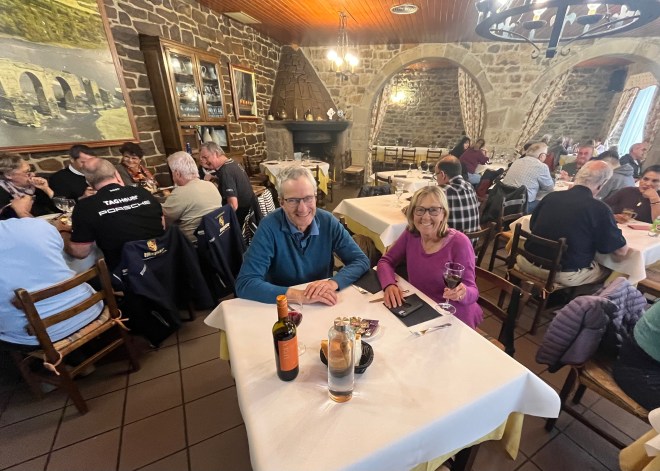
After Sunday morning coffee and croissants with the locals, an unremarkable ride took us to to Pamplona to enjoy wandering around the narrow streets of this lived-in city and to marvel at the madness of the famous running of the bulls.

Pamplona streets

By now we were feeling so restored and revived that Andy was happy to throw in a final detour on our last cycling day to Bilbao.

Ullíbarri-Gamboa reservoir

But once again, this was a detour that Clare actually enjoyed … around the contours of the Ullíbarri-Gamboa Reservoir on lakeside trails, wooded tracks and boardwalks. 
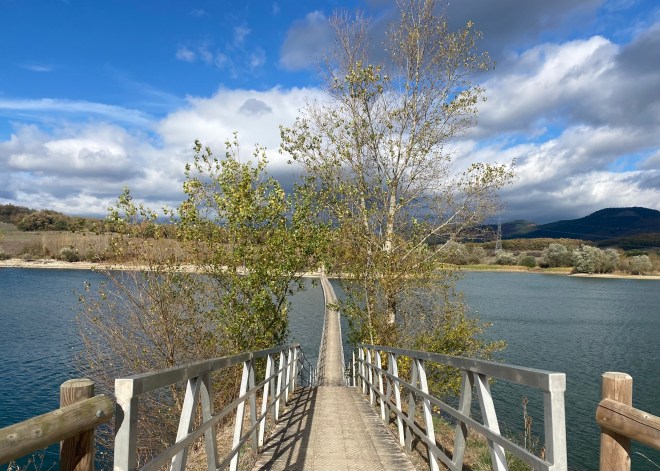
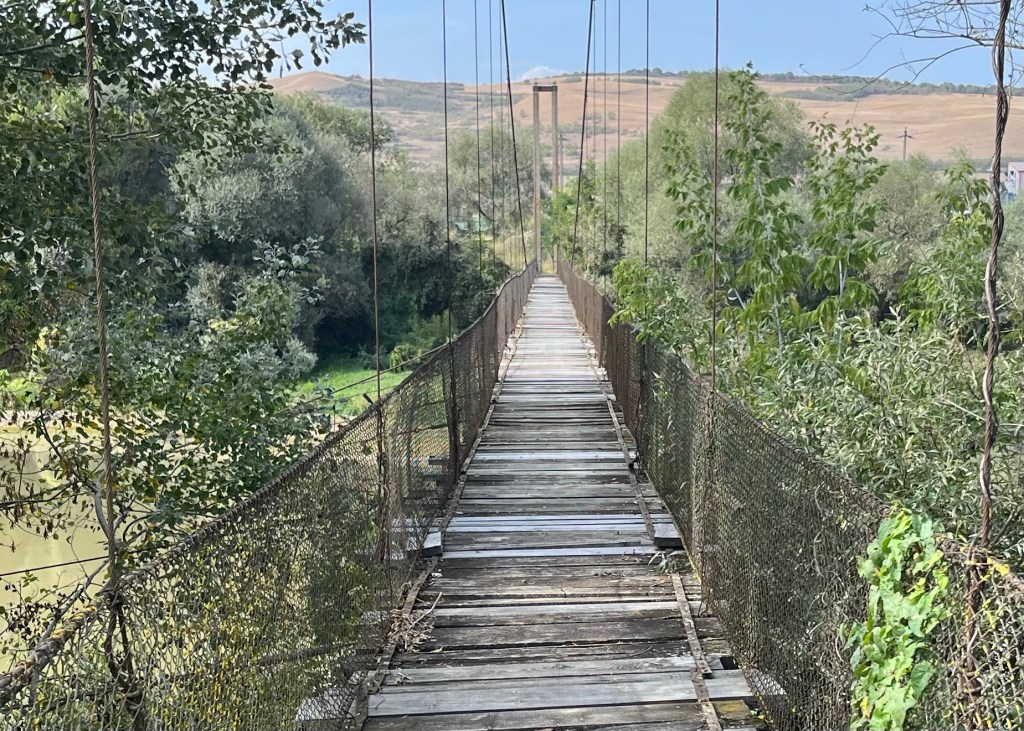
You mean we have to go across that?
Yes we can!

Much fuller for the time of year, this lake is a popular recreational area full of beaches, summer camps and water sports. We didn’t meet a soul, it was utterly delightful.
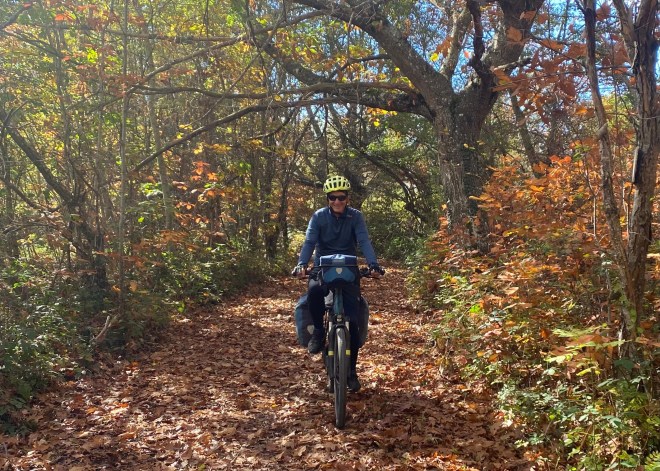
A carpet of leaves

Leaving the reservoir behind there was one final treat in store before we could celebrate the end of our journey outside the Guggenheim museum … a 15km descent down into the Nervión river valley towards Bilbao. Equally delightful and a wonderful finish.

As has often happened on all our bicycle tours, we were incredibly lucky to dodge the rain. Threatening all day, it poured down in a torrent just 15 minutes after we were safely tucked up in our hotel room.

Celebrating outside the Guggenheim before the rain

The famous Guggenheim properly lives up to its reputation, both the building (one of the most important architectural designs of the late 20th Century) and the impressive art collection, which is often on an enormous scale.
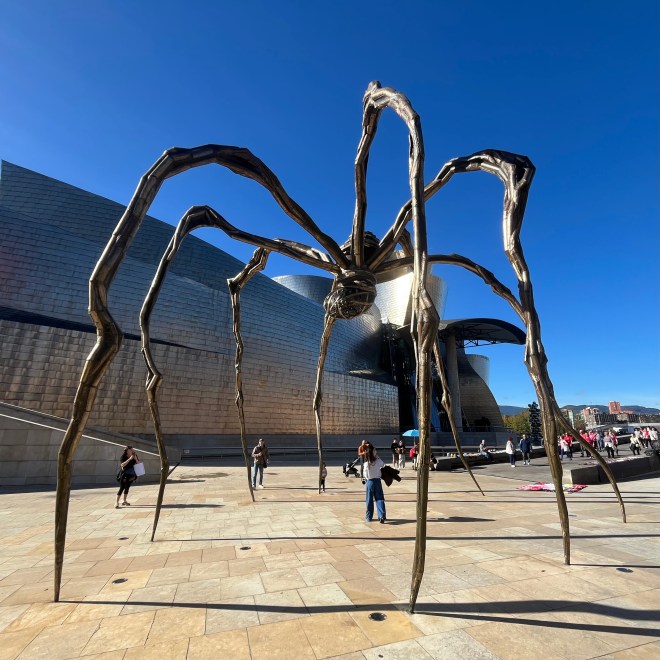
Maman by Louise Bourgeois … a tribute to her mother, a weaver. Strength and protection, yet vulnerable and fragile.
Puppy by Jeff Koons … a West Highland terrier carpeted in bedding plants. Dignified, optimistic, sentimental.
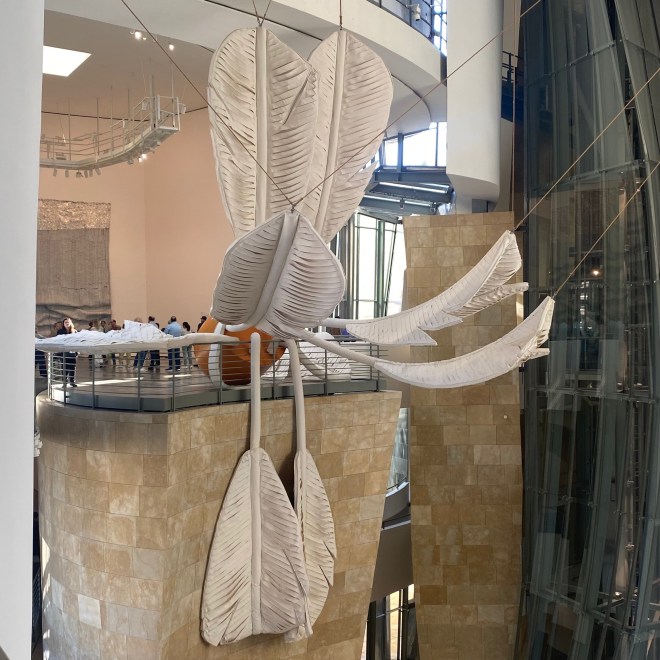
It took us a while to work out what this one is. It’s Soft Shuttlecock by Claes Oldenburg and Coosje van Brugge. Recreation in a cultural space. 

The Guggenheim makes Bilbao worth a visit on its own but the special Basque culture adds to the charm, especially as it has a surprisingly English twist. 

In the late 19th and early 20th centuries British ships would bring coal to Bilbao and return with iron and steel. In those ships came thousands of miners and engineers, many of them from north-east England, many deciding to stay, many passionate about the sport that had by now become so deeply ingrained in working class culture … football. Students from Bilbao travelled in the other direction to study and they quickly grew to love the game themselves.

Thus in 1898 a group of British migrant workers and returning Basque students founded Athletic Club (using the distinctly English spelling instead of Club Atlético). The football club has since become unique in the world for only signing players who have been born or developed in the Basque region, through its cantera (meaning quarry) of youth development and a deep talent spotting network in grass roots football.

Bilbao

Despite this self imposed constraint, Athletic Club is proud to be one of only three clubs (the other two being Barcelona and Real Madrid) that have never been relegated from La Liga, the top league in Spain. Champions 8 times, they’ve also won the Copa del Rey (the Spanish FA Cup) on 24 occasions, most recently in 2024.

The connection between Athletic Club and their English roots remains strong, with a special bond developing between their fans and those of Newcastle United after a match in 1994. Athletic won the game in Bilbao 1-0 for a 3-3 aggregate scoreline, winning the overall tie on away goals.

But immediately after the final whistle the Basque home fans invaded the pitch, not to make trouble, but to applaud the Geordies and then went on to entertain them late into the night. They were so kind. They laid out the red carpet for us and wouldn’t let us buy a single drink, reported one grateful Newcastle fan, I came back with as much money as I went out with.

This was all to repay a favour.

Apparently, some Athletic supporters had missed their transport back to Bilbao from Newcastle a couple of weeks earlier after the first leg. They had been put up by a family in Newcastle and the story of the warmth of Geordie hospitality had made its way back to Bilbao.

It’s an unusual friendship that endures to this day.
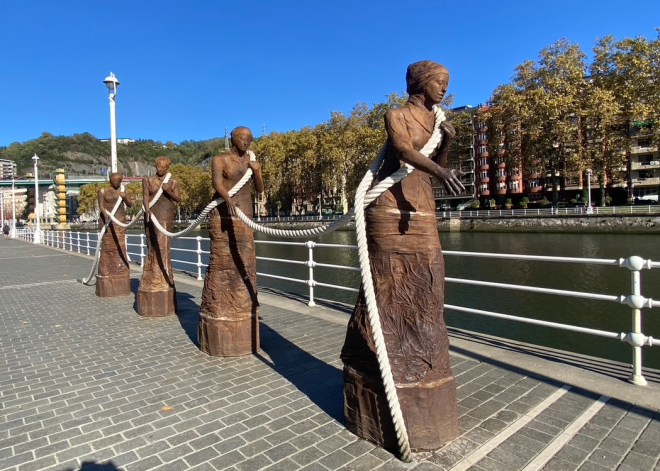
Las Sirgueras by Dora Salazar, a tribute to the 19th century ‘rope girls’ who pulled boats up the river whilst the men were away at war

As we weren’t wearing the famous black and white stripes of Newcastle United, we were happy to pay for our own celebratory drinks.

Celebrating boarding the ferry the next morning, just the one day inside our Schengen limit.

Celebrating that this was genuinely the end of our bike tour with no pedalling needed through two damp, cold November days to get back home from Portsmouth.

Clare’s brother, Matthew had kindly offered to meet us off the ferry in his campervan and even drive us back to Bath the following day. We stayed overnight with Matthew and his wife Nicola at their lovely home in the New Forest, enjoyed a delicious roast chicken dinner and, once again, felt rejuvenated by the warm embrace and easy conversation of close family.

From Bath to Rome (and back) we have pedalled 3,291 kilometres, our second longest bike tour.

It was also our 10th year of meandering slowly around different parts of the world on a bicycle.

In those ten years we’ve pedalled for just over 24,000 kilometres or just under 15,000 miles. 60% of that distance was on our faithful Ridgeback touring bikes, 40% on our new Cube e-bikes. We’ve climbed 229,000 metres which is roughly 26 Everests. We’ve ridden on 366 days, a leap year, with nearly 1500 hours in the saddle, cycling across 22 different countries on 5 continents. 

On the ferry back to the UK, we decided that maybe, just maybe, this is the right moment to hang up our panniers and do something else instead.  Whatever happens we have already made different travel plans for 2026, so we won’t be re-hitching our panniers to our worn out bike racks until 2027 at the earliest.

Like a sportswoman reluctant to retire from the sport she loves, that last day of cycling to Bilbao was enough to make Clare fall back in love with bicycle touring … so she is the one who is now pushing for more adventures.

She says there are a lot more iMax views from our handlebars to enjoy.

She’s suggested more Spain. She’s also suggested Slovenia and Central Europe.

But she’s given Andy an ultimatum … two months and 2000 kilometres is the absolute maximum!

If we do decide to hang up our panniers, then this is also our last Avoiding Potholes blogpost.

Thank you from the bottom of our hearts for following us through these little adventures, for all your comments and words of encouragement. We hope you’ve enjoyed it at least half as much as we have!

So … Hasta la Vista (until next time). Probably … possibly … who knows?

Clare and Andy

Bath to Rome (and back)

3,291 kilometres pedalled

31,146 metres climbed

173 hours in the saddle over 68 days

2 punctures, 1 broken seat post, 1 new set of brakes
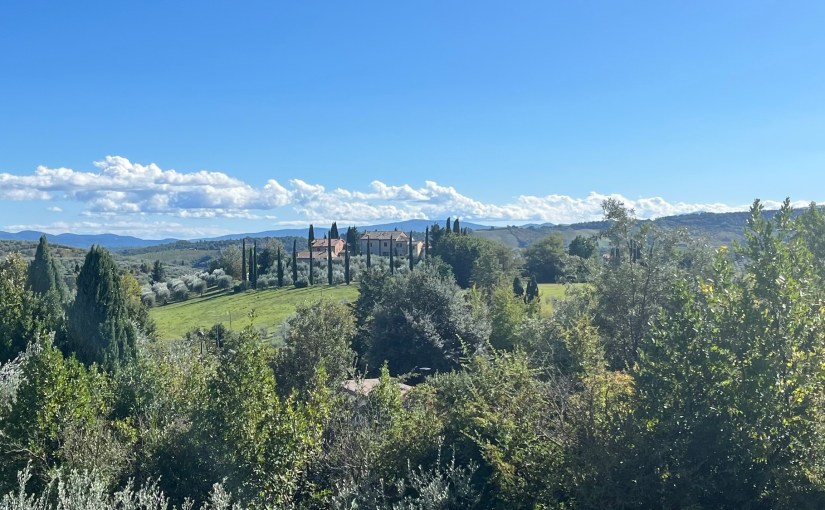
La Dolce Vita on Two Wheels (almost!)

Is there anywhere more perfect for a bicycle tour than Tuscany?

Riding through the famous rolling green hills, dotted with vineyards, olive groves and cypress trees makes it difficult to imagine that there is.
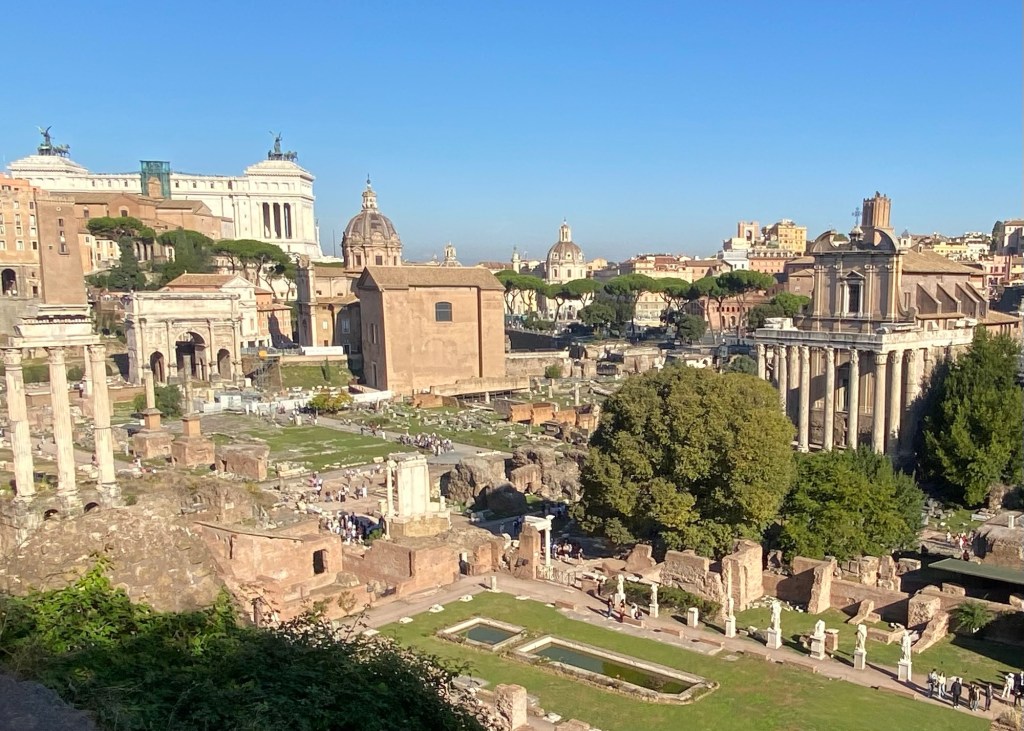
It’s difficult to imagine when pedalling slowly through yet another atmospheric village.

Or when marvelling at the renaissance art and buildings in a city like Siena.

Siena Duomo

Yes, Tuscany is the sweet bicycle touring life … the dolce vita on two wheels.

Well … almost … there’s always a but!

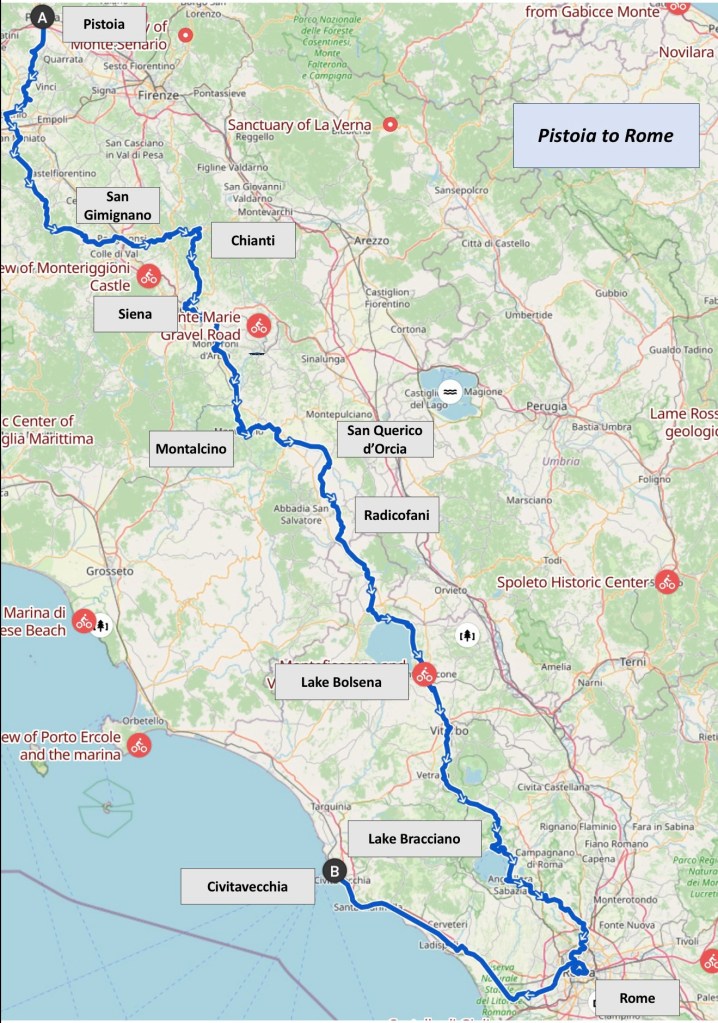
Rather than take the direct route to Siena, we decided to swing eastwards to San Gimignano and into the Chianti hills. It proved to be an inspired decision as the next two days were amongst our favourites. 

Sunny but unseasonably cool we had the ferociously steep hills to keep us warm.

Approaching San Gimignano

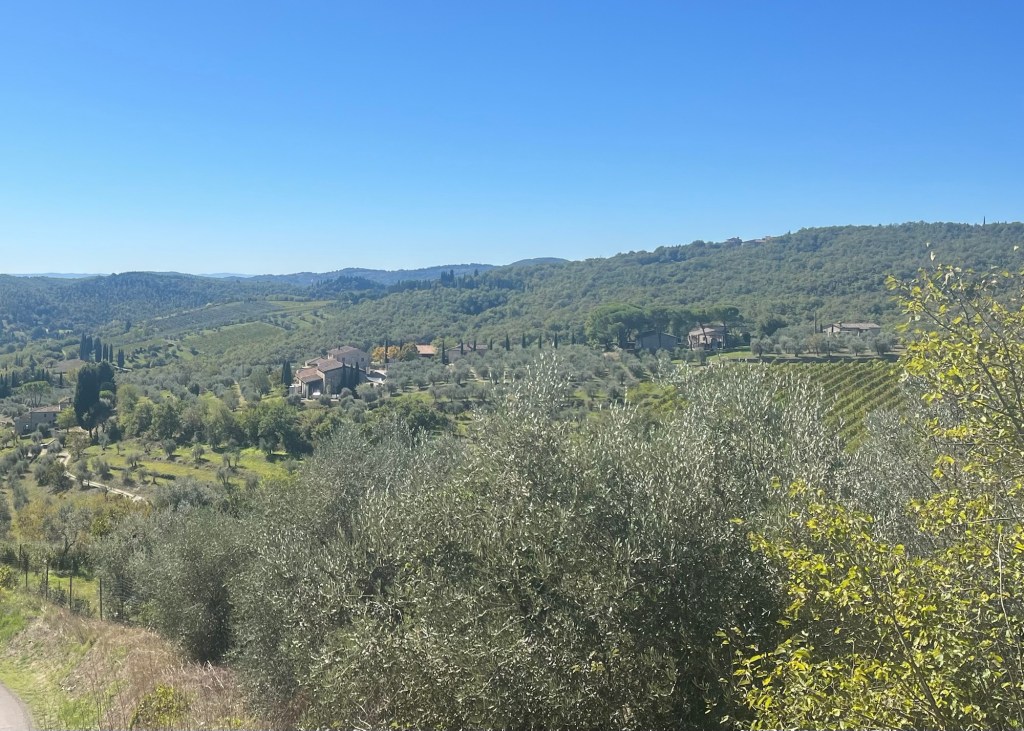
Chianti had a surprise in store … it’s covered in trees, lots of trees. The canopy of oak and chestnuts are punctuated by olive grove polka dots, stripes of vines and blocks of farmhouses guarded by rectangles of tall poplars … a tapestry in every shade of green.

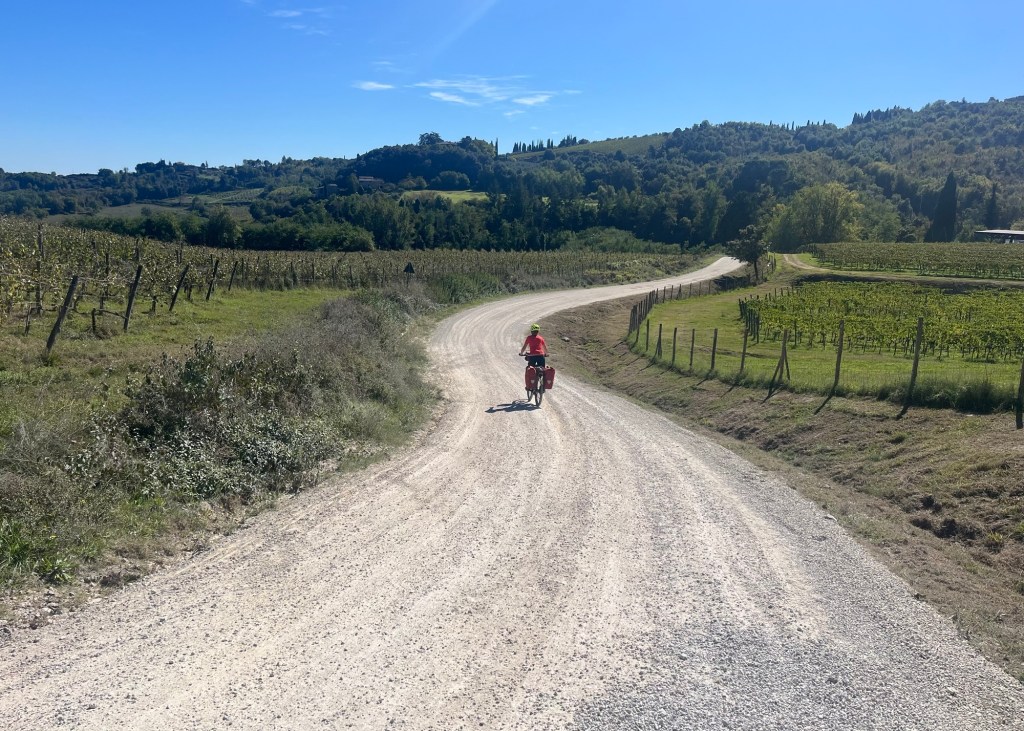
White ribbons of the famous Strade Bianchi (white roads) are then woven through this tapestry. Made from fine crushed limestone and beautifully groomed in this part of Tuscany, they led us from one hilltop village to the next. 

Groomed Strade Bianchi in Chianti

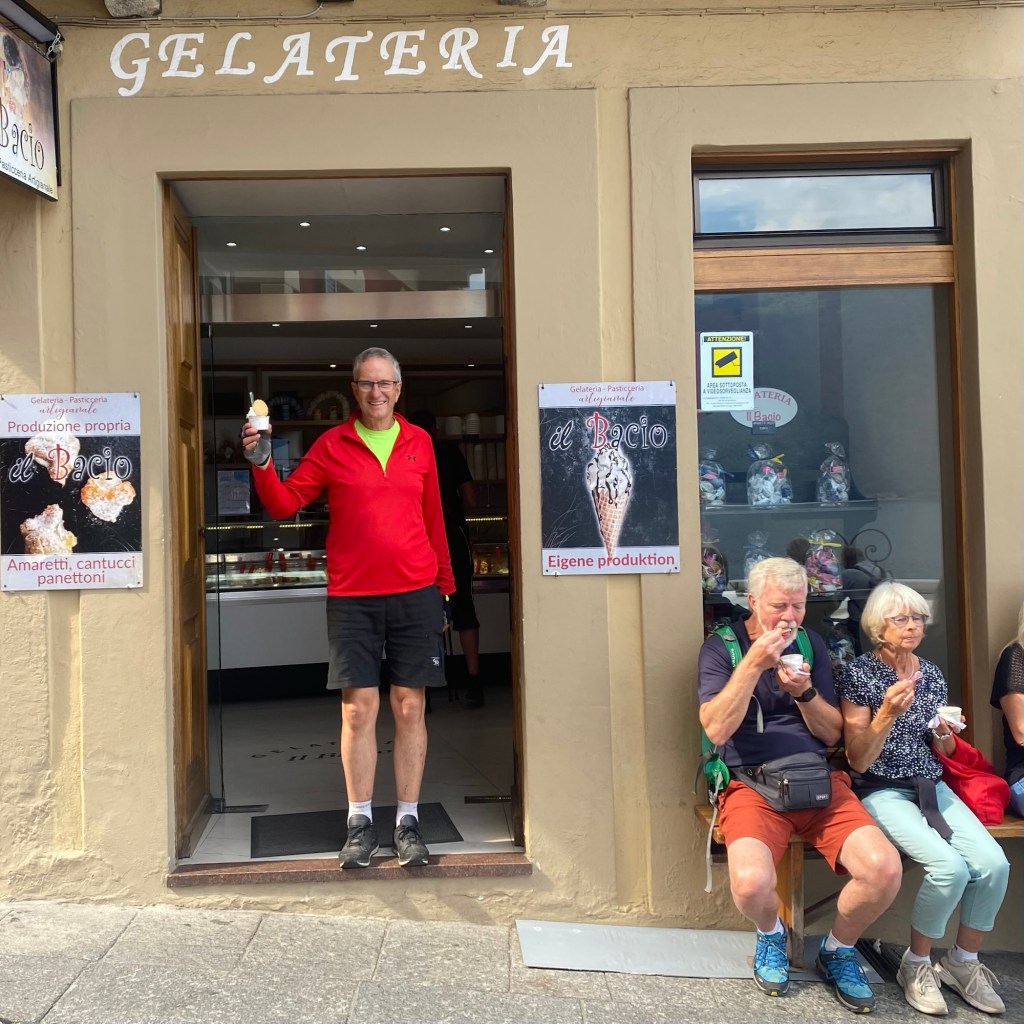
Our favourite stopover was Castellina-in-Chianti, a village with a single narrow street clinging to the ridge of a hill, full of ancient houses, restaurants, gelaterias, delicatessens and wine shops.

Trying to select a vintage in Castellina-in-Chianti

Whilst in Chianti it would have been rude not to stop at a vineyard to learn a little about the history of the wine … and, of course, to taste it.

As far back as 1716, Cosimo III de’ Medici, Grand Duke of Tuscany, decreed that only wine produced in a tiny area around Castellina could use the Chianti label, a state of affairs that happily continued until the 1930’s.

Then the Italian government of Mussolini decided to expand the Chianti region in order to export more wine around the world. Chianti became ubiquitous … cheap, poor quality plonk sold in those squat waxy bottles that were covered in a wicker flask and used as candle holders in every Italian restaurant. Ironically, the straw flask is called a fiasco in Italian.

As far as the winemakers around Castellina were concerned it was indeed a fiasco!

They fought back, launching Chianti Classico with very strict regulations on the grapes, the location of the vineyards, the type of soil and the winemaking techniques. The result was a wine of much higher quality that could be sold at a premium price, labelled with the coveted black rooster to separate it from the rough stuff.

Tasting the difference between Chianti and Chianti Classico

It was easy to tell them apart!

Sadly we could only try a couple of vintages as we still had to pedal to Siena that afternoon.

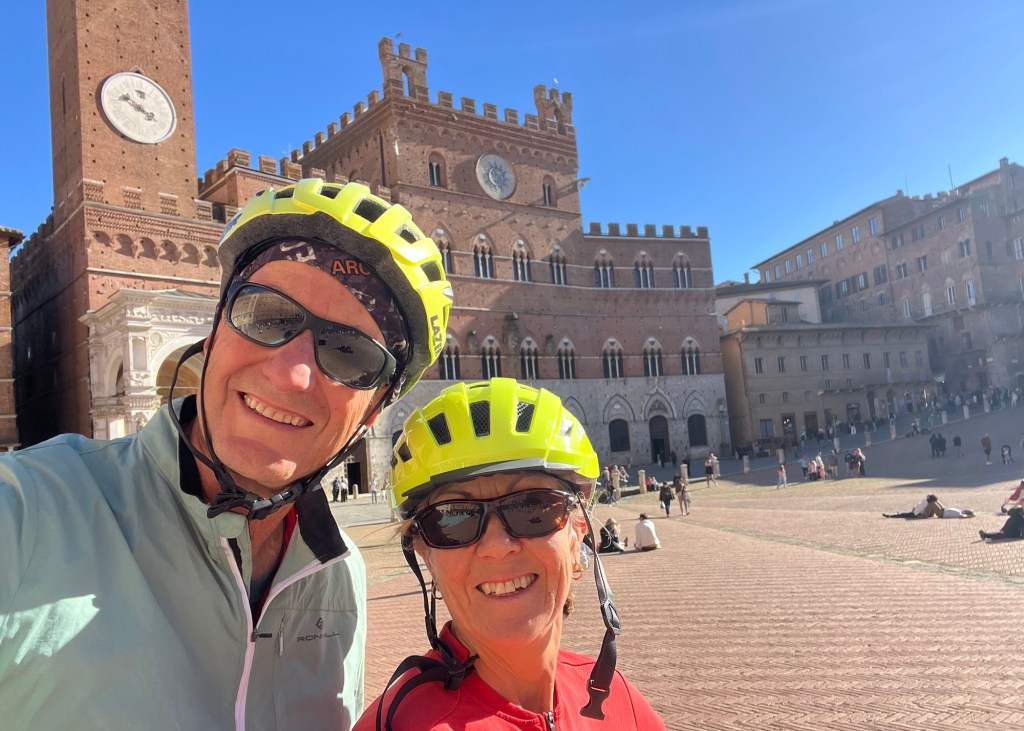
Arriving in Siena, post Chianti tasting

Siena would be a highlight of any visit to Tuscany.

To make it even more special we happened to be there during one of the short periods each year when the floor of Siena Duomo (Cathedral) is uncovered.

No other building has a floor which matches the scale and artistry of this one. Taking five centuries to complete, fifty six panels of marble mosaic inlay illustrate scenes from the bible but also from Greek and Roman mythology.

Siena Duomo Floor Photo Credit: Siena Duomo

It covers the whole floor of the cathedral. The effect is breathtaking!

Detail of one of the panels

The crypt of Siena Cathedral is also remarkable. This underground chamber was covered in religious paintings in the second half of 13th century before being abruptly sealed and filled with sand and earth.

Only re-discovered in 1999, those centuries buried underground have preserved the paint perfectly. This means that visitors today still get to experience the bright, vivid colours that the artists originally intended.

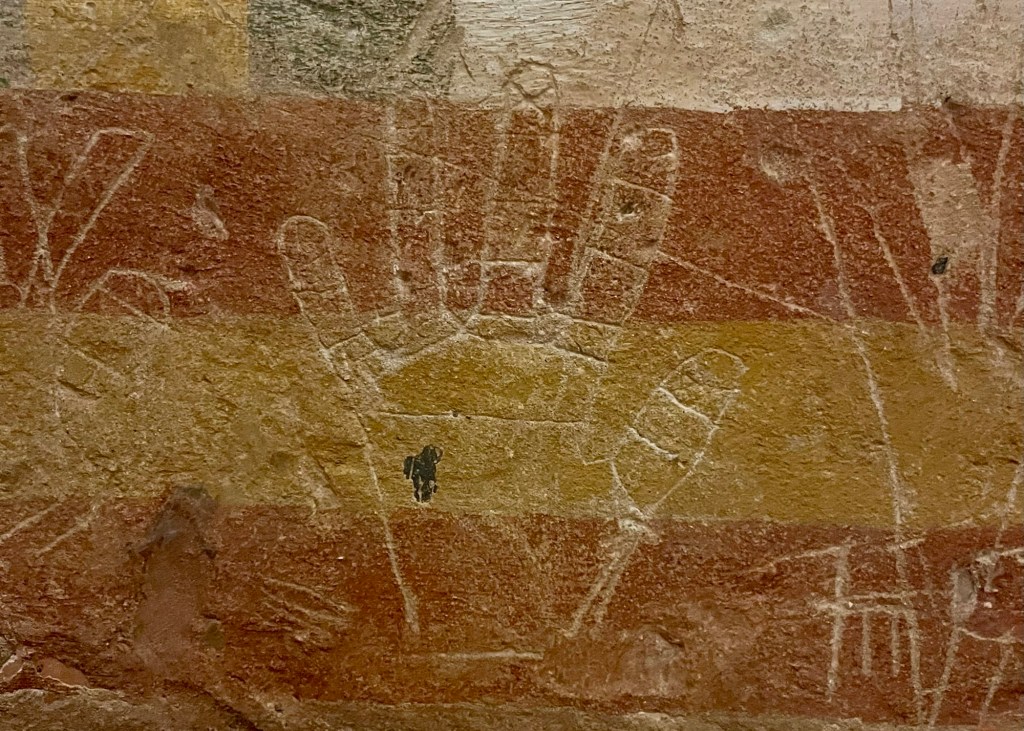
The lower part of the paintings are covered in graffiti, scratched into the limestone plaster.  This can only be graffiti from people living between the 1280’s when the painting were made and the 1350’s when the crypt was sealed and filled with sand.

It feels as if those people are calling out to us across the centuries … I’m alive. I’m here. I made this mark … look, this is my hand!

As usual with a museum or cathedral, the exit is through a gift shop. But only in an Italian cathedral does a gift shop look quite like this!

So why is Tuscany the dolce vita on two wheels (almost)? What’s the almost? What’s the but?

Well … it’s the roads … they really are as bad as their reputation.

And it’s the drivers. Italians are normally the warmest, friendliest people but put them behind the wheel of a car and they turn into crazy, impatient monsters.

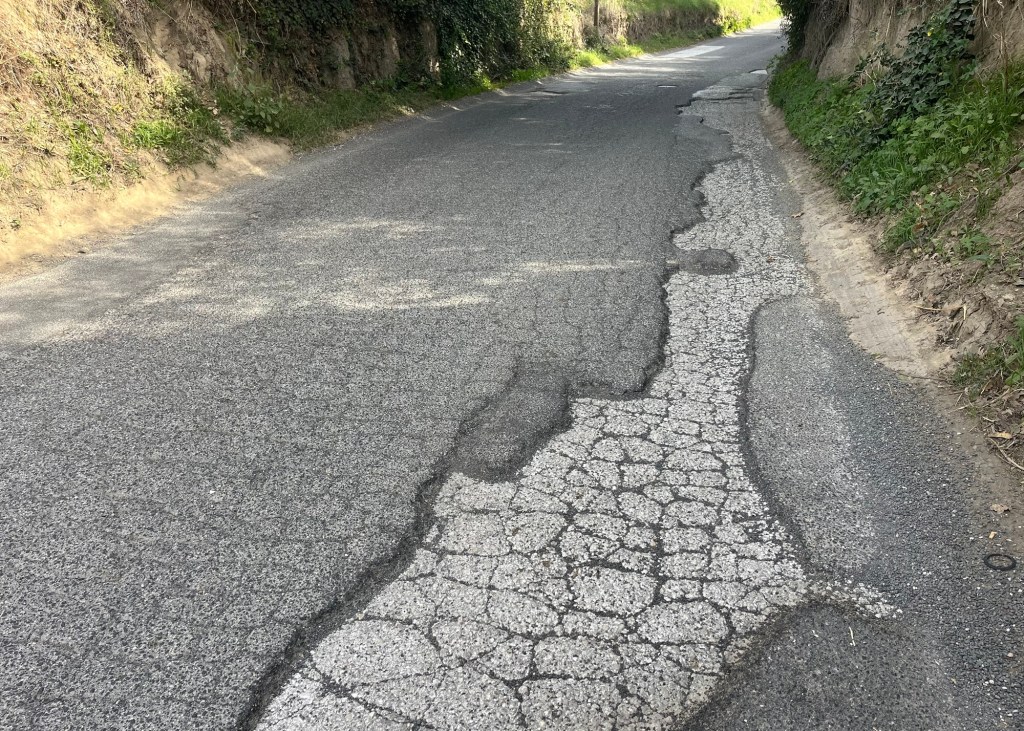
The roads feel like a bumpy obstacle course. As a cyclist, you can’t afford to drop your guard for a second.

Typical Italian country road

At any moment you might have to weave between the cracks. Or swerve to avoid a sudden pothole, or a tree root, or a deep manhole cover, or all manor of debris.

Which is a dangerous game as the roads are also very narrow and you probably have an impatient monster revving up behind you.

To be fair the bigger the vehicle, the more courteous the drivers are. Trucks and vans are fine. What you really have to watch out for are the crazy monsters nipping around in their Fiat 500s!

This means that for a bicycle tourist, Tuscany charms and terrifies in equal measure. We’d love to come back and explore more of the area but perhaps we’ll stick to four wheels next time … maybe hire a Fiat 500 and become crazy monsters too?!

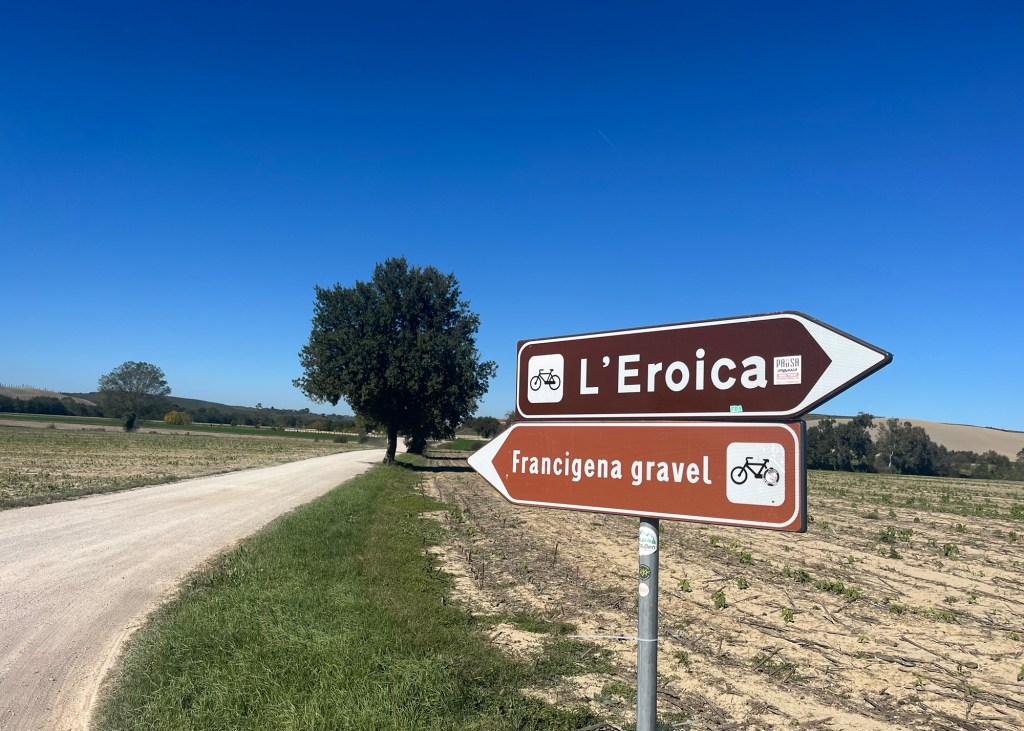
Since leaving Pistoia we’ve often been guided by an ancient pilgrimage route called the Via Francigena. It was an important medieval road for pilgrims travelling to Rome from as far away as Canterbury. Today, it’s still popular as a long distance walking and cycling trail, especially the section that runs through Tuscany.

We saw lots of people walking the Via Francigena

In turn, the Via Francigena often follows an even older Roman road, the Via Cassia, built to connect Rome to Florence. And the Via Cassia has since been used to plan the route of a major regional road.

For a touring cyclist this means the choice often comes down to a gravel track on the Via Francigena or the busy main road.

Clare hates gravel. Andy hates main roads.

Something had to give!.

Lunch stop in Radicofani

After a long climb up to a hilltop village called Radicofani for lunch, it was perhaps not Andy’s best idea to avoid the main road by choosing a long gravel descent down the other side.

This was not the same smooth gravel that Clare had enjoyed in Chianti. Much steeper. A lot bumpier. Very deep in places. Great for mountain bikers, not so great for touring cyclists. Lots of opportunities to skid and slide. 

And it lasted 20 kilometres!

Clare was not impressed. I didn’t spend hours struggling up that hill just to come down this ridiculous gravel. It’s so dangerous!

Predictably, about halfway way down there was one skid and slide too many.

“Stupid bloody gravel!”

Andy promised to take the road next time.

But the next day he pushed his luck even more by trying out a section of the original Via Cassia, still with the paving exactly as it was in Roman times.

It was even slower going but fortunately we both enjoyed the privilege of riding across the same stones that had carried the sandled feet of so many Roman legionaries marching off to yet another war.

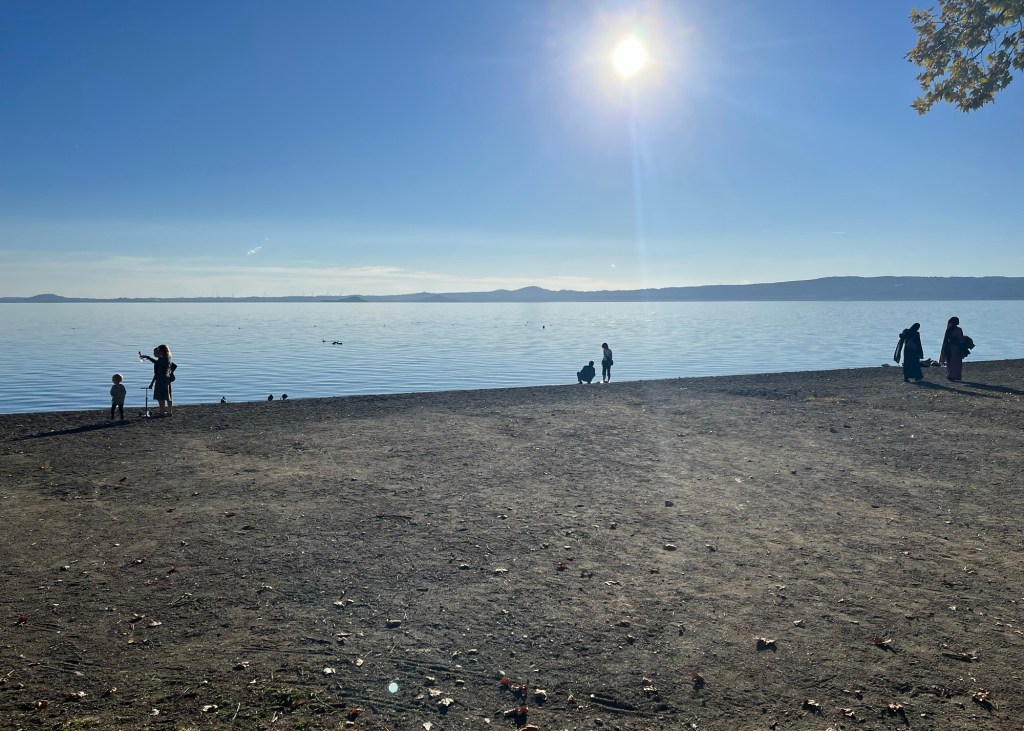
There was one last treat in store before reaching Rome … the Bolsena and Bracciano volcanic lakes, both very pleasant escapes from the rough and tumble of the city.

Lake Bolsena

We even enjoyed Lake Bolsena so much that we stayed an extra night.

Beer o’clock at Lake Bolsena

This meant that despite Rome being our destination, despite pedalling over 2500 kilometres to get there, we ended up spending just one day in the eternal city.

As well as the lake we had simply enjoyed Italy and especially Tuscany too much, slowing down, eating up the days we’d planned for Rome.

It proves yet again what Clare is always telling Andy … that a bicycle tour is about the journey, not the destination. Plus this was our third visit to the eternal city.

Getting into Rome gave us one final challenge, and it wasn’t only to dodge the crowds at the Colosseum.

Knowing that the Roman drivers are at yet another level of craziness to the rest of Italy, we decided the best way to enter the city would be along the River Tiber cycle path.

To get to it we had to cross the Veio Regional Park first, famous for its Etruscan ruins and slightly infamous for controversially reintroducing three packs of wolves into a park that is so close to a major city.

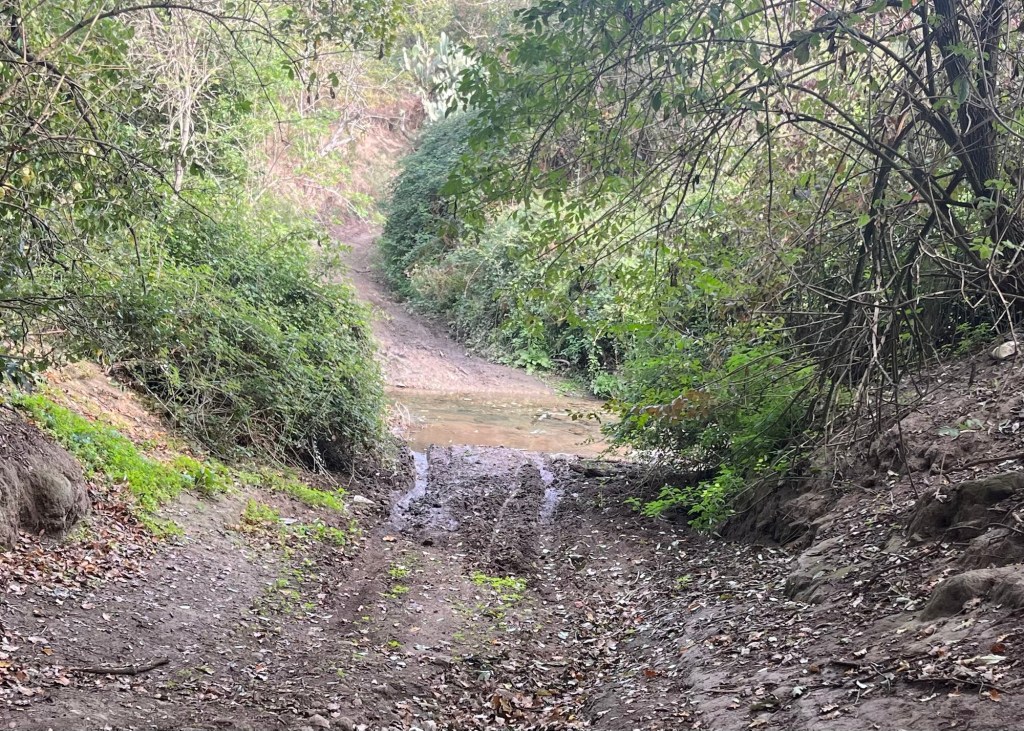
Komoot (our mapping app) guided us into the park on a nice road to start with. But that road became a track and then the track turned into this …

Whilst Andy was wondering how Clare might react, he came face to face with a wild boar just by the water. They stared at each other for a minute before the boar snuffled and quietly went about its business.

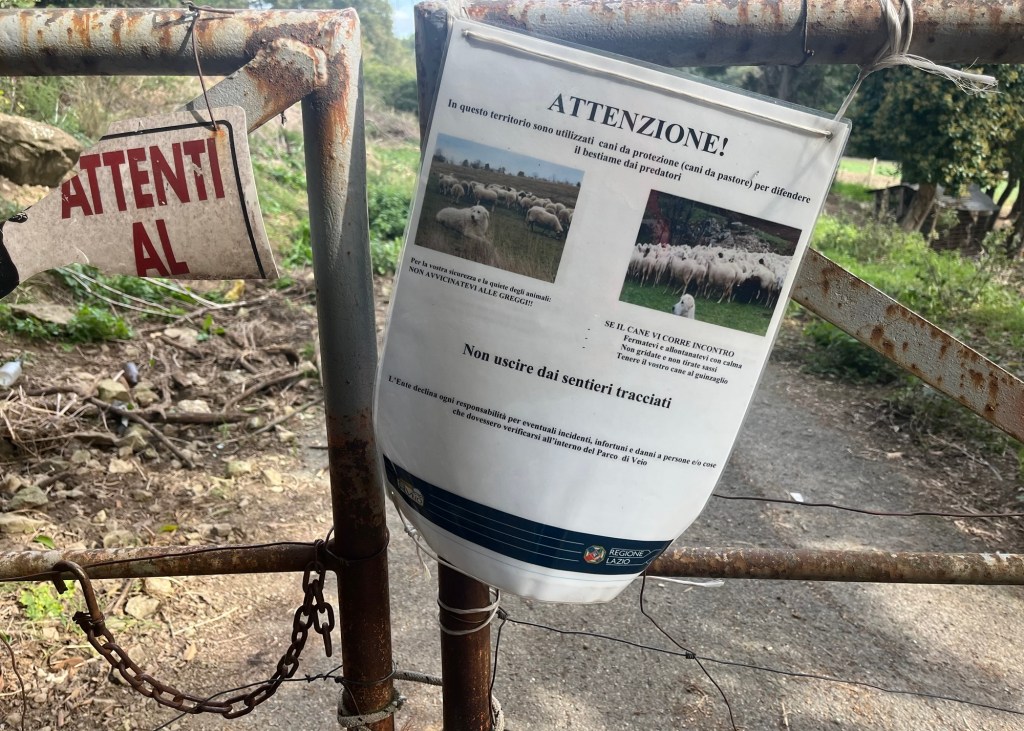
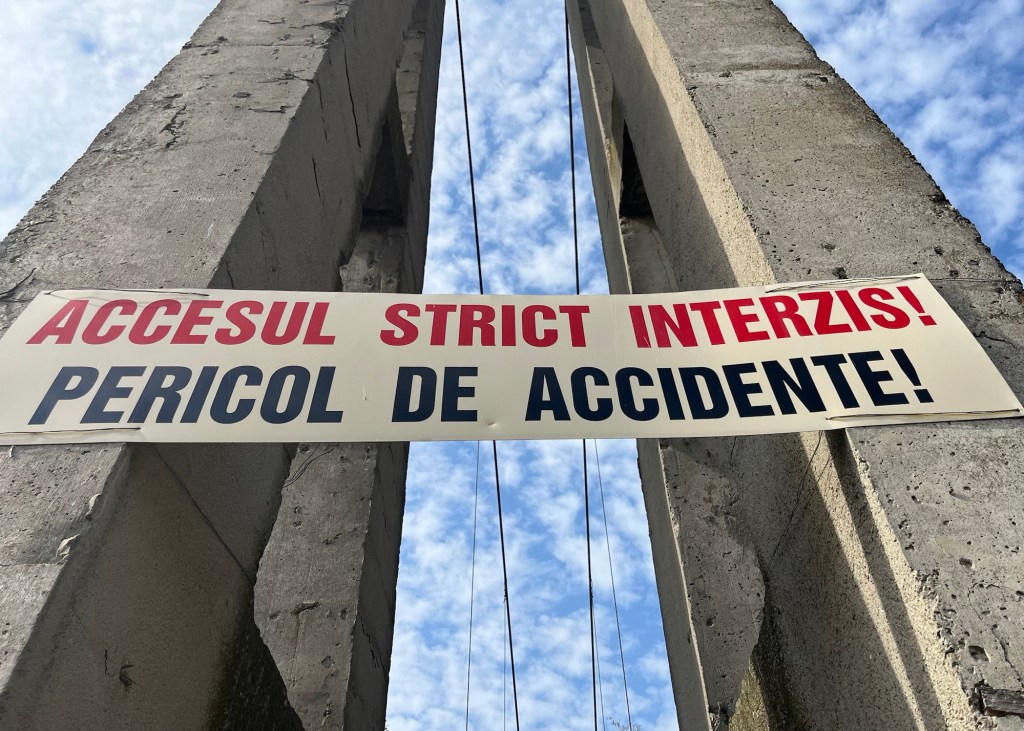
That was enough to convince Andy that crossing the muddy stream was a bad idea. The only alternative was a farm track blocked by a roped up gate that displayed this warning sign …

The sign explains to potential visitors that dogs are used to protect the sheep from the wolves. If a dog was to charge at us, we should not throw stones but walk away calmly.

Clare voted with her pedals and quickly headed back to the busy main road.

But Andy convinced her that if he could be Top Dog in Romania last year, he could still be Top Dog here. But even he had to admit … pedalling slowly across the field and up the hill was pretty nerve wracking. Fortunately the sheep and the dogs were in another field that day.

From the top of the hill it was a lovely cycle down to the river on some nice country roads and an even better ride along the best cycle path we’ve come across in Italy, all the way along the river and right into the heart of the city.

River Tiber Cycle Path

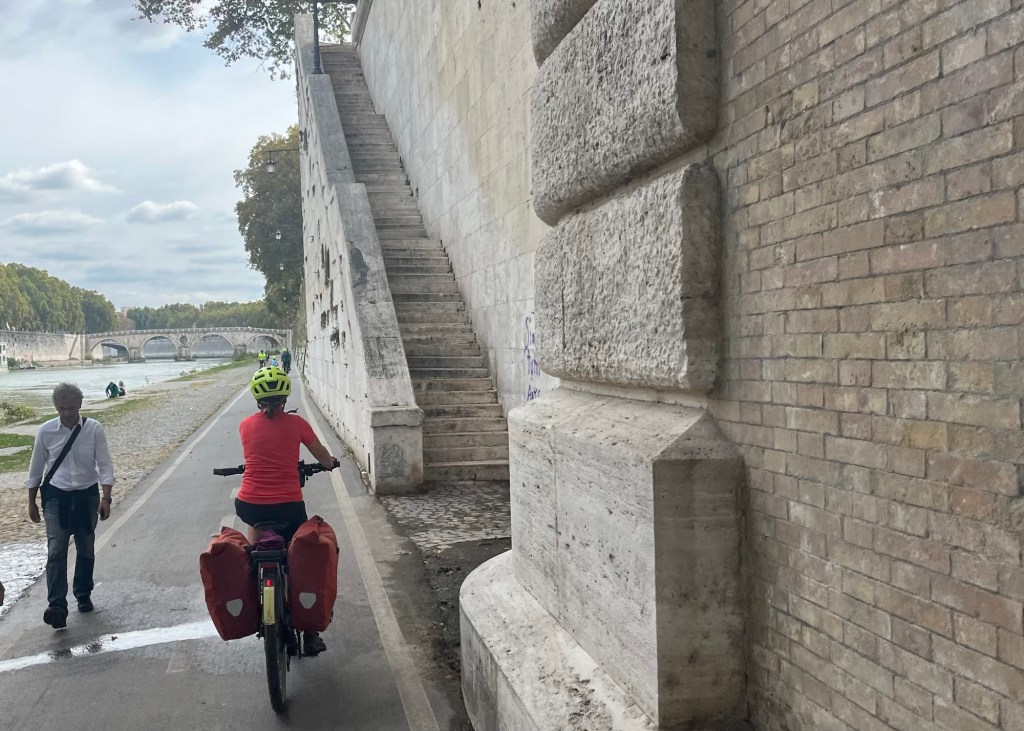
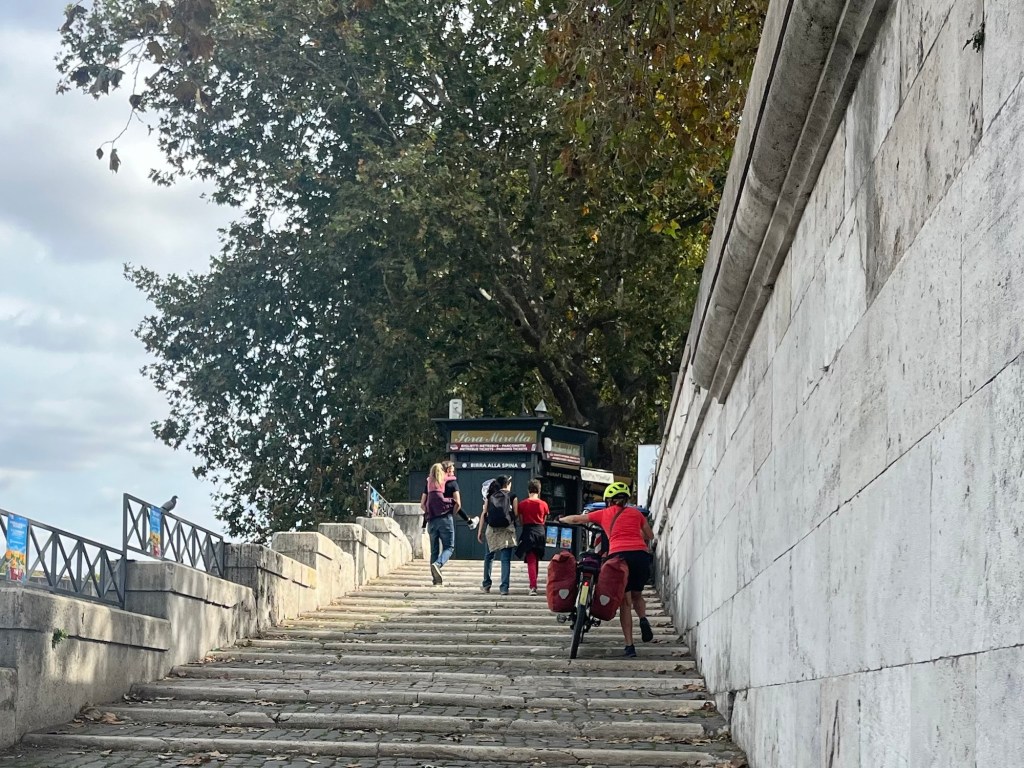
But once we reached the centre of Rome, we couldn’t escape. We were trapped on the Tiber by some very steep steps.

Trapped on the Tiber
Too steep for us

So we just kept going and going and going … until eventually we found some shallower steps.

So how to enjoy just one day in Rome?

First to celebrate completing the 2,541km journey with our bicycles outside the Colosseum!

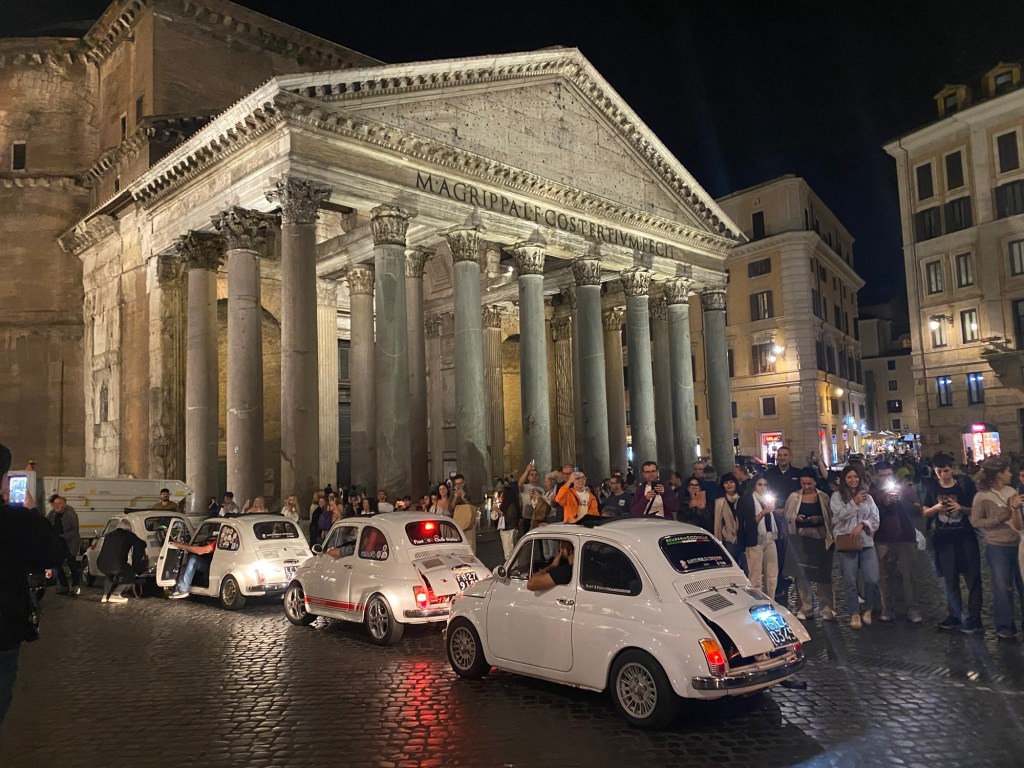
Then to revisit some old favourites … the Pantheon, Piazza Navona, Campo del Fiore.

A Fiat rally in front of the Pantheon

Then to enjoy one of the main attractions that we’ve somehow managed to miss in the past and take the senators walk down from the Palatine Hill to the Forum, following in the footsteps of Julius Caesar, Cicero and Augustus.

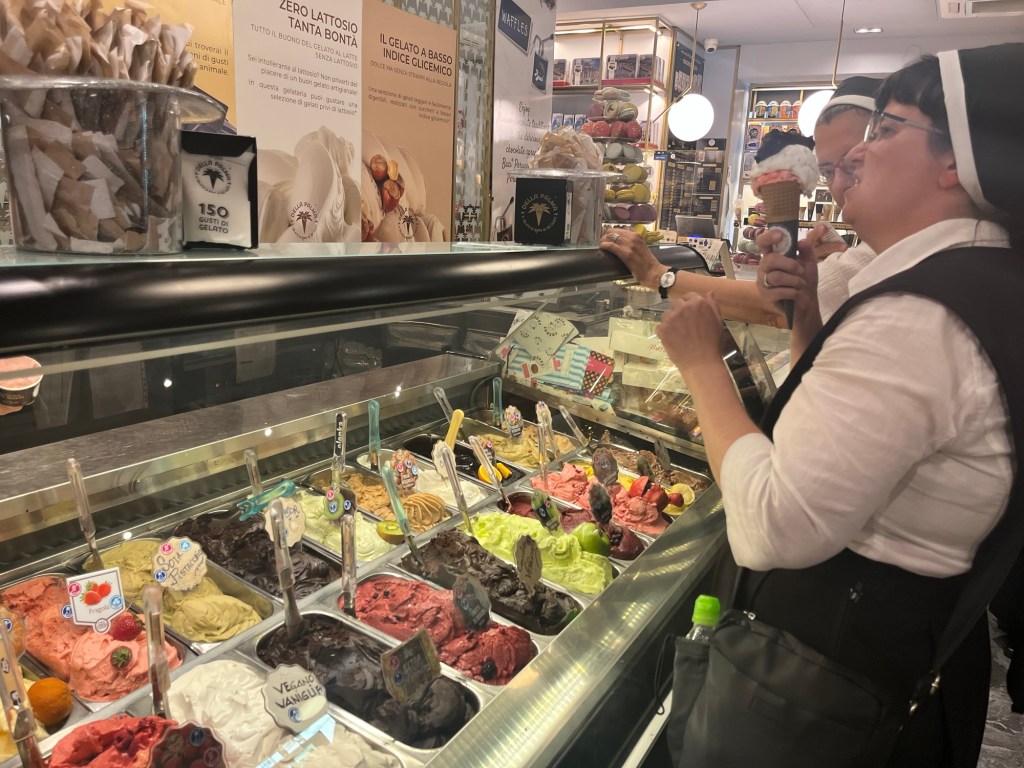
Then to revisit another old favourite and enjoy a gelato from Gelateria Della Palma, where they bamboozle you with over 150 flavours. No visit to Rome is complete without it.

Sharing the experience with some gelati loving nuns

And finally to do something new by paying our respects to Pope Francis, who died earlier this year, at his final resting place in Santa Maria Maggiore.

A beautifully simple tomb 

Rome has been a pilgrimage destination for centuries, many journeying to the eternal city on the Via Francigena. If all roads lead to Rome, perhaps all bike paths eventually do too.

So it’s a fitting end to this e-bicycle tour through England, France, Switzerland and Italy.

Accept it’s not the end. We still have to get home!

Now, where does the ferry to Barcelona leave from?

Clare and Andy

Bath to Rome

2,541 kilometres pedalled

22,656 metres climbed

135 hours in the saddle

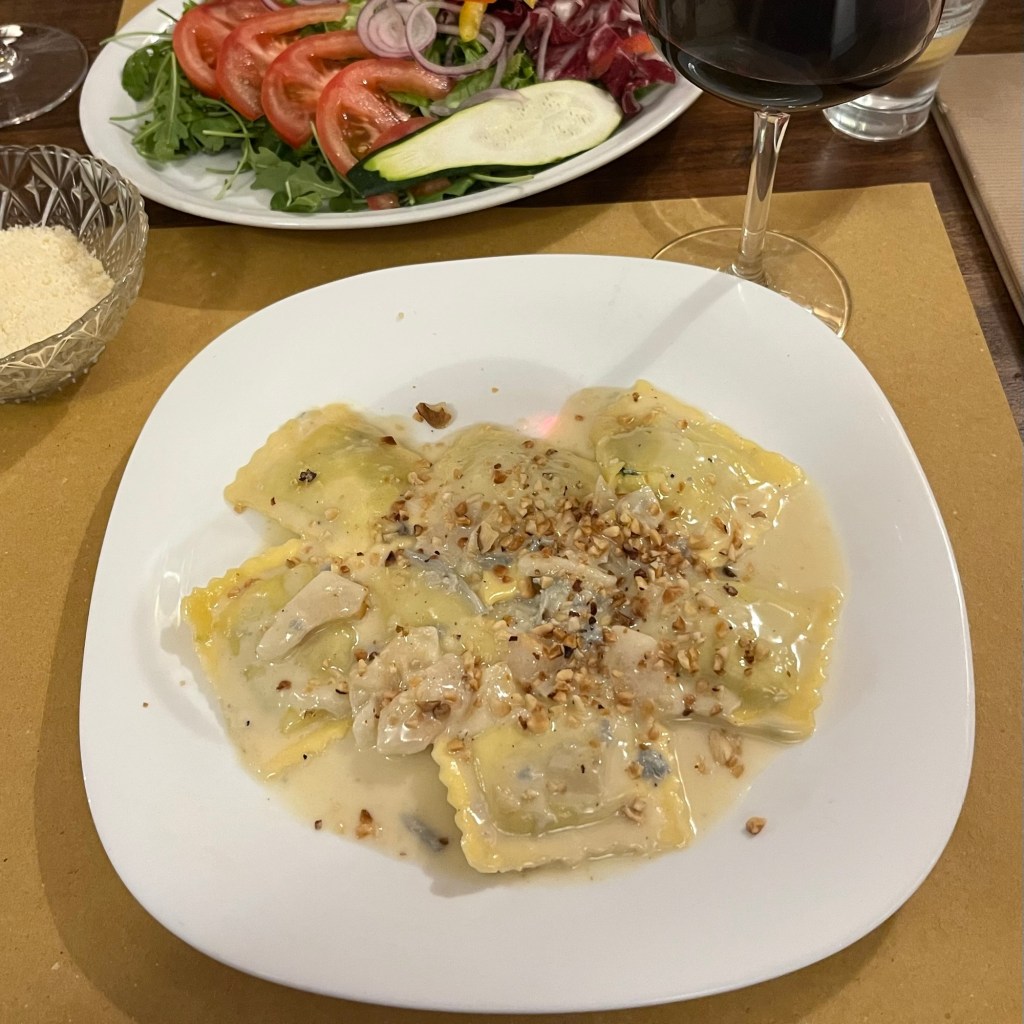
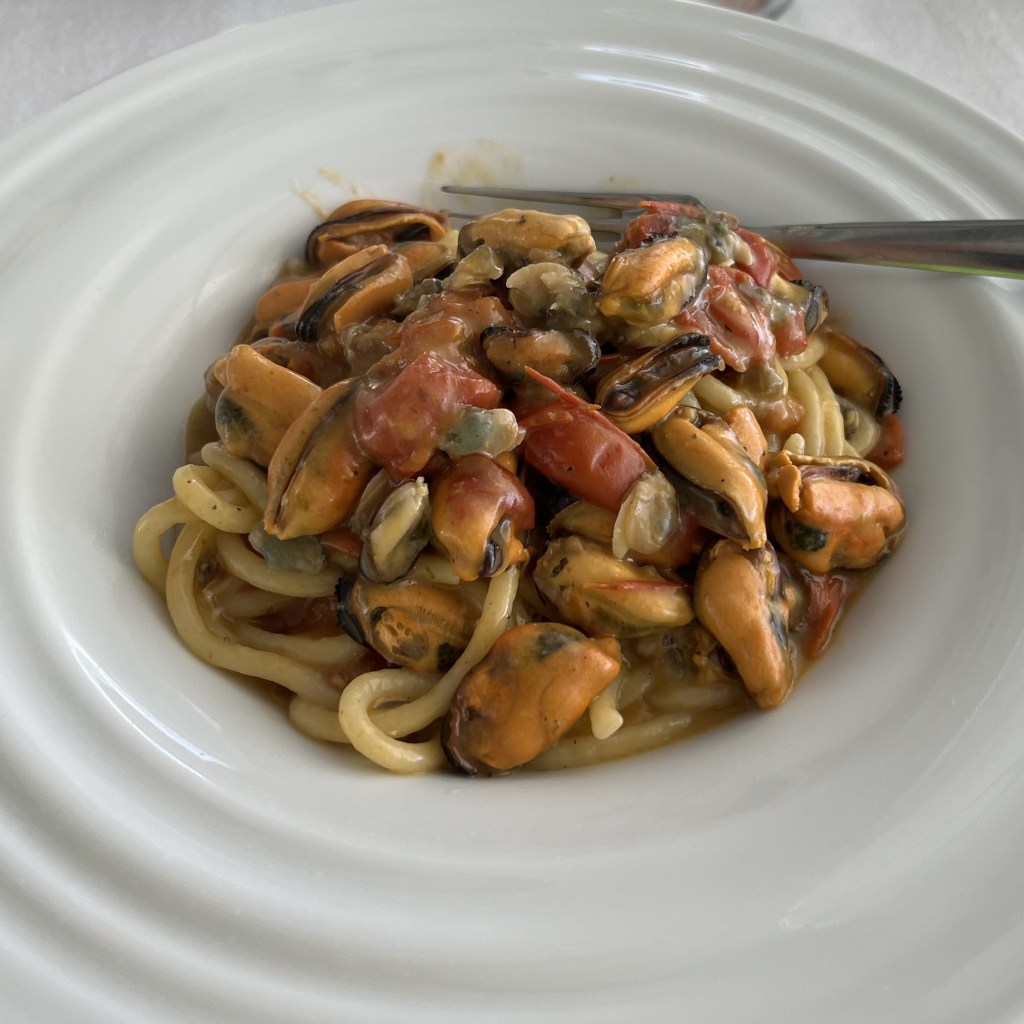
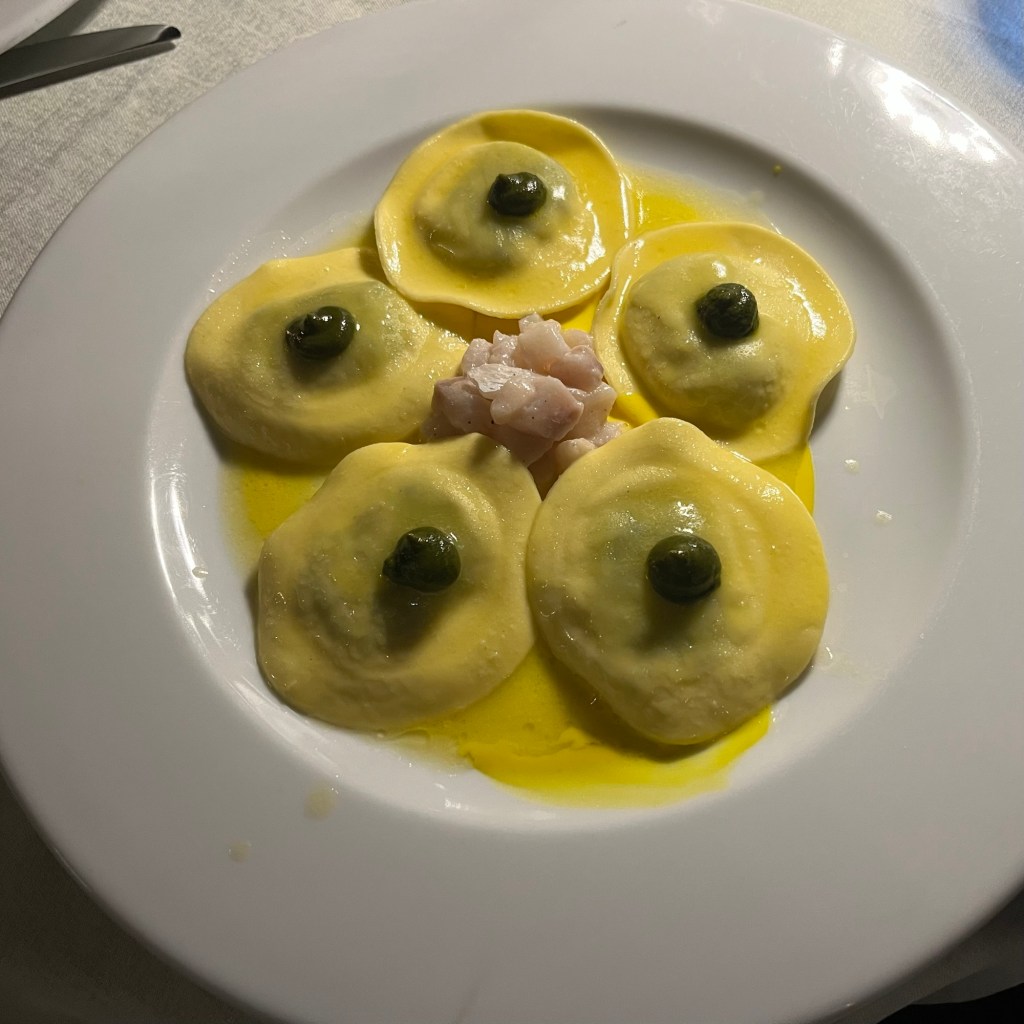
Those of you who love pasta may have been wondering where the pasta porn pictures are? After all, the opportunity to enjoy a mid-bikeride pasta lunch is one of the reasons we rode to Italy in the first place. So don’t worry … we’ve saved the best till last …

A Path less Travelled

If it’s snowing at the top of the Alps it’s likely to be raining in the Italian lakes.

Sure enough, the heavens opened and the rain poured immediately after we’d crossed the Gotthard Pass on that idyllic sunny day. A blizzard closed the pass for a week.

Feeling very lucky, we holed up in Verbania on Lake Maggiore watching the rain bounce off the cobblestones. It was a perfect opportunity to catch up on laundry, write a blog post and, of course, to start eating pasta and drinking wine.

Lake Maggiore

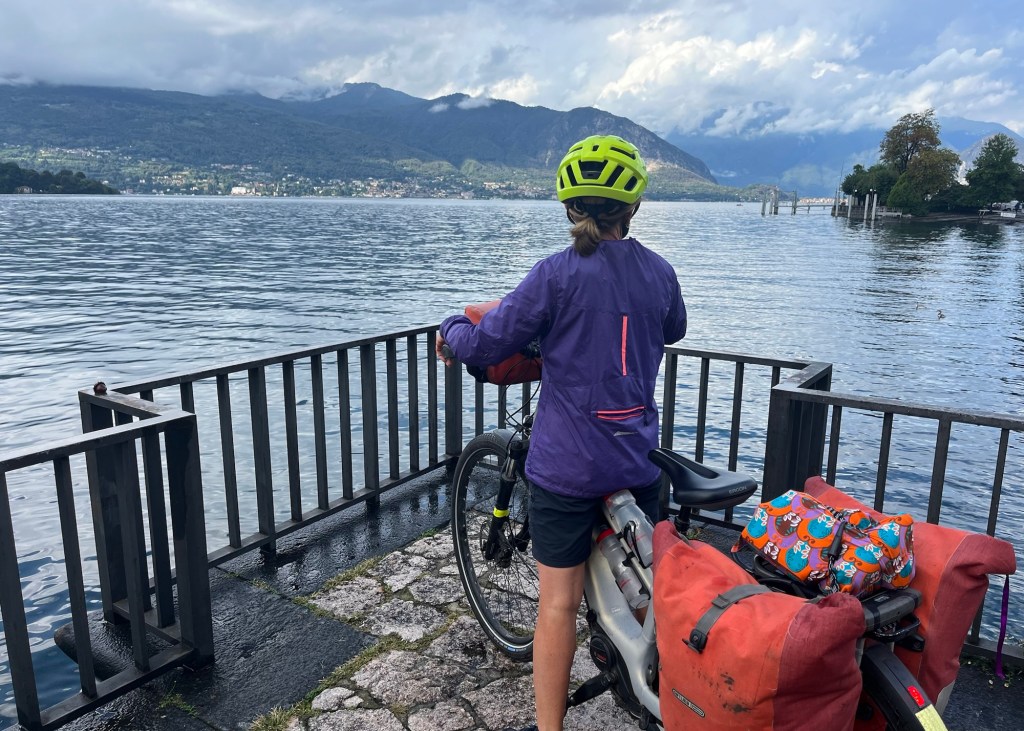
Then we moved the short distance to Lake Orta for another couple of days, a much smaller lake, less visited and a great tip from our friends Neil and Claire. They were right, it’s a beautiful and peaceful place made all the more mysterious and atmospheric by the rain clouds rolling down the mountains.

Lake Orta

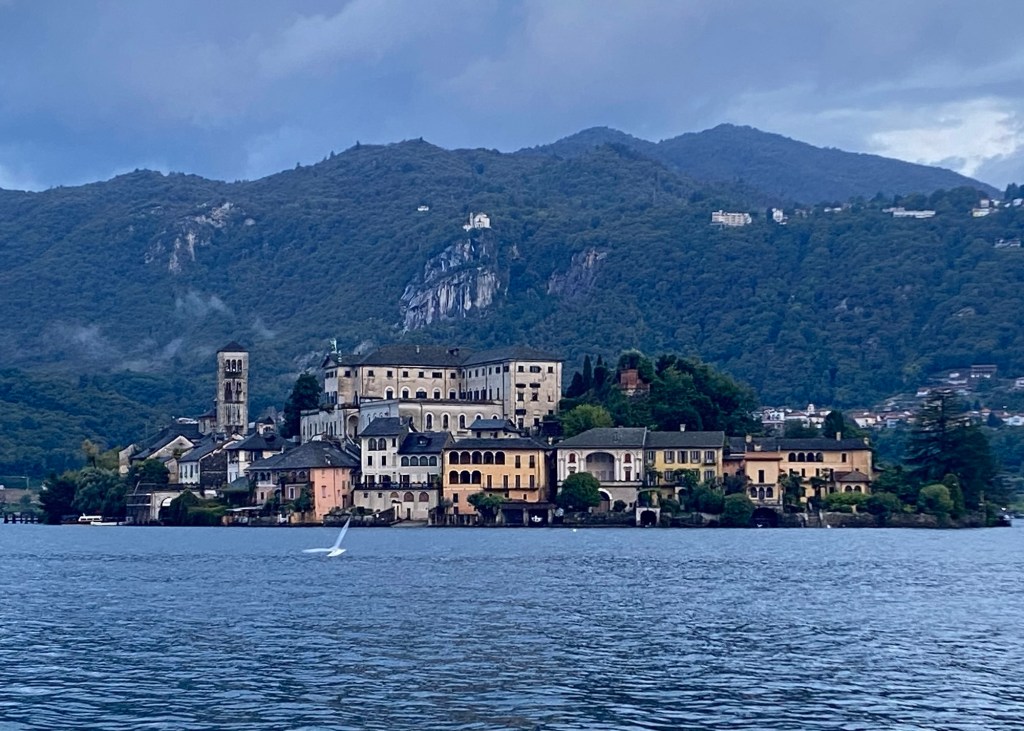
If Lake Orta is a hidden gem amongst the Italian lakes, then Orta San Guilio is its crown jewel. Built on a small promontory jutting out into the lake it’s considered to be one of Italy’s prettiest villages. Sitting in the main square whilst gazing across to the tiny island of Isola San Guilo felt like being part of a classic Italian movie set.

Isola San Guilo

But we didn’t just sit in the square, watching the world go by.

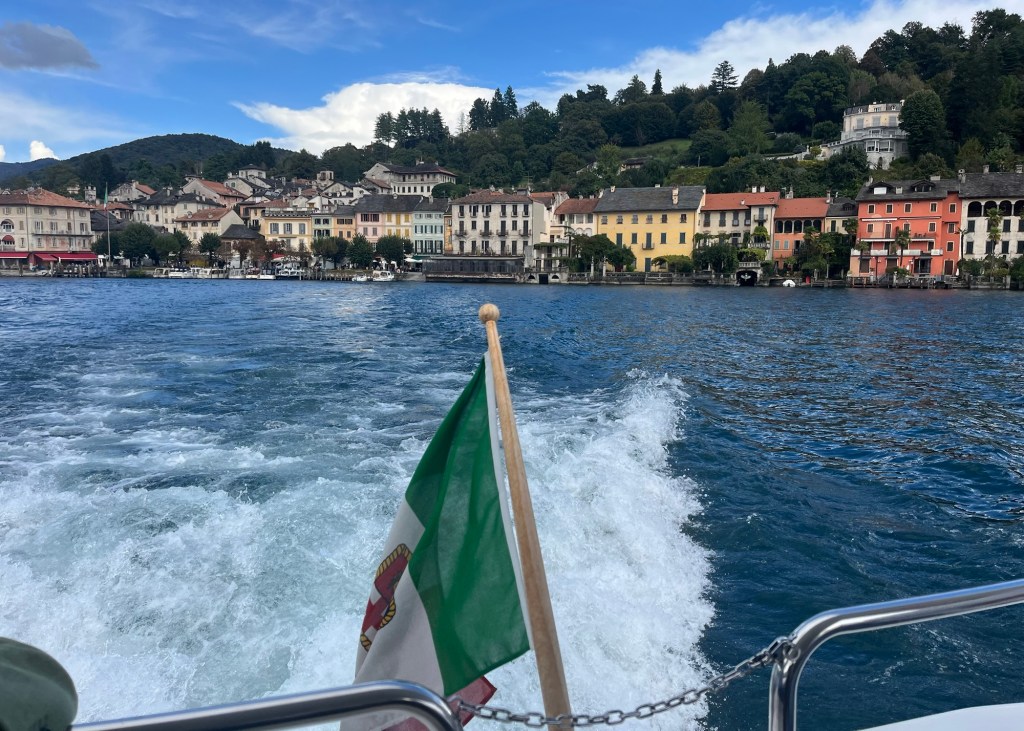
We took the five minute boat ride across to the island.

We had a pleasant evening stroll around the promontory until it was interrupted by a thunderstorm of almost biblical proportions.

A bit wet

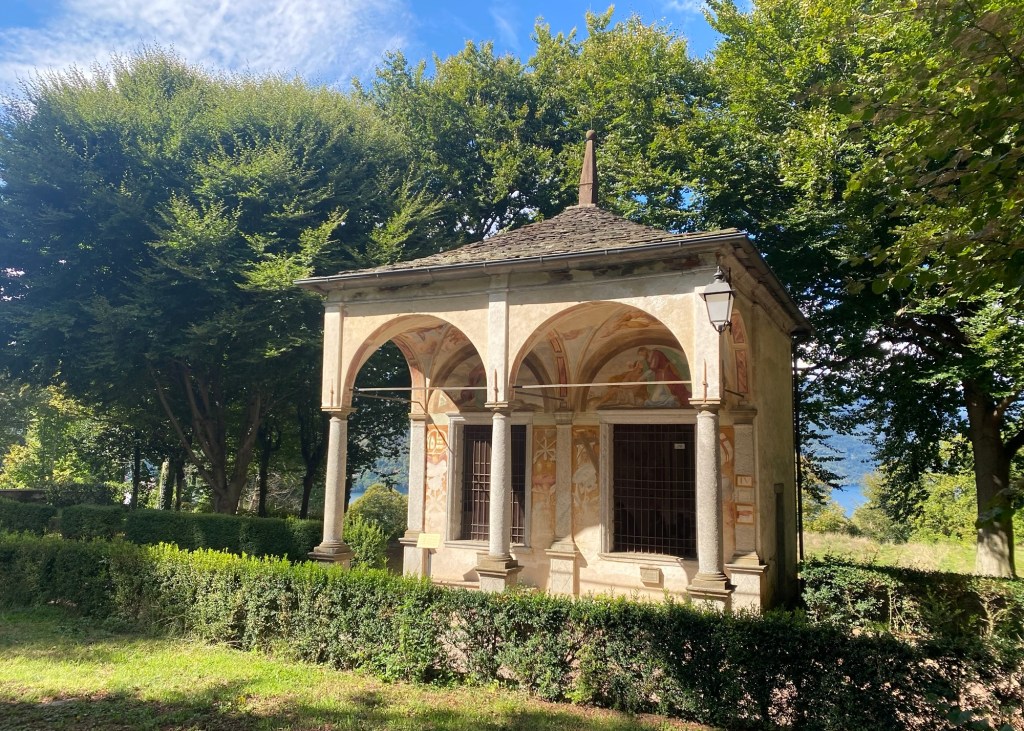
And we walked up the hill to wander around the Sacro Monte di Orta, a series of 20 (twenty!) chapels that tell the life story of St. Francis of Assisi. The first chapel was built in the late 1500’s but the complex was not completed for another 300 years, each one becoming bigger and more flamboyant over time, as if the benefactors were trying to outdo their predecessors in the eyes of God.

One of 20 Chapels at Sacro Monte di Orta

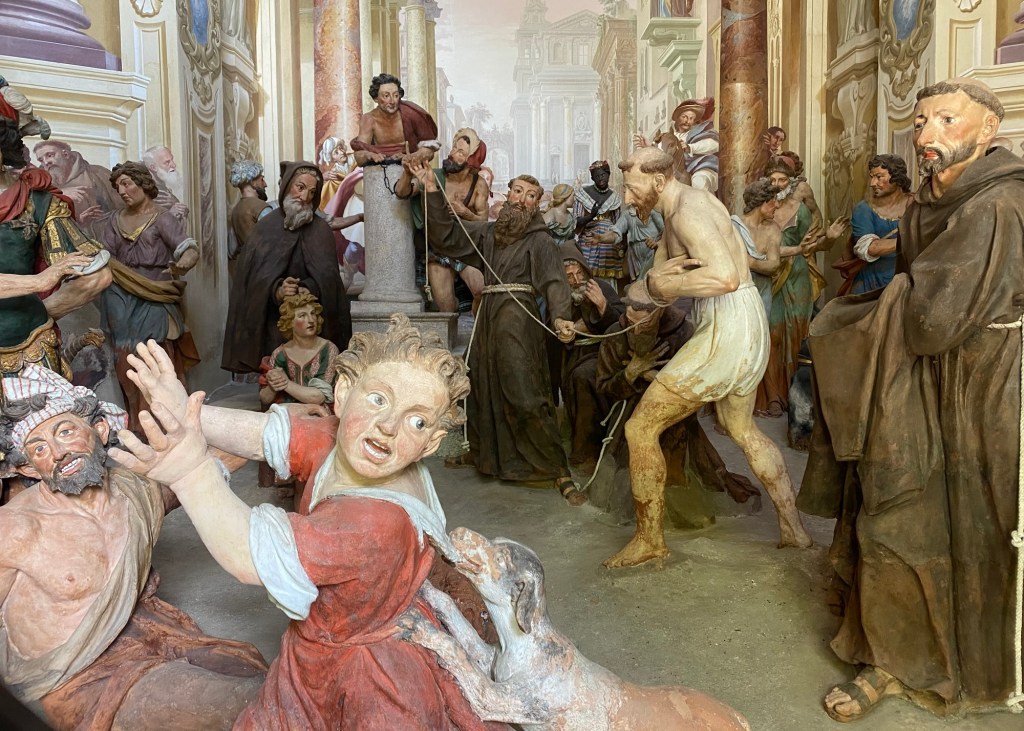
A guide in one of the many churches we’ve since visited in Italy explained the importance of art for religious propaganda in the Middle Ages. Sermons were preached in Latin (effectively a foreign language) and as most people couldn’t read, they learnt about the bible and the Holy Catholic message through art instead.

It was very easy to see how that happened at Sacro Monte di Orta. Frescoes on every wall surface set the background for life size figures acting out the story, each tableau created by an artistic master. It held our attention, so it must have been incredibly compelling in a world before magazines, cinema, television and the internet.

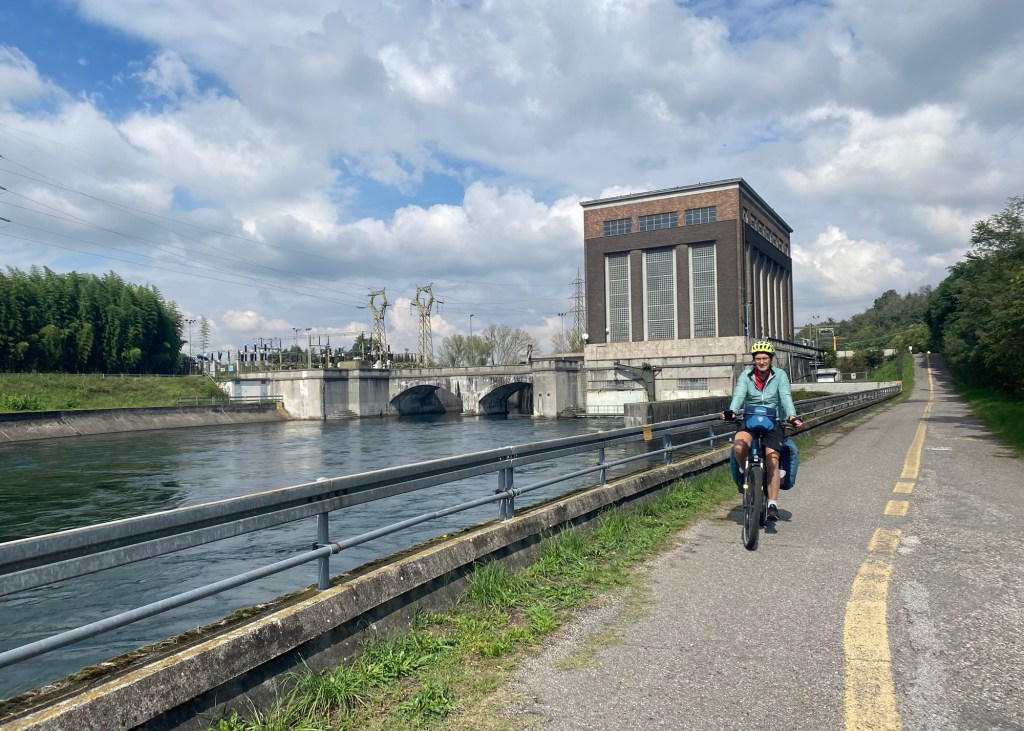
A break in the weather presented the opportunity to ride the 100 kilometres from the lakes down to Milan, following the Naviglio Grande (the Big Canal) for much of the way. You might think we were a bit fed up of canals but this was a particularly impressive one, some of the locks designed by no less an architect than Leonardo de Vinci.
Initially dug by hand as far back as the 12th century, it was enlarged from the 14th century in order to carry huge blocks of pinkish white marble needed to build the massive new Duomo di Milan (Cathedral). The marble travelled roughly the same route as us, all the way from a quarry near Lake Maggiore.

Naviglio Grande

Nobody would describe Milan as being on a path less travelled, especially during Milan fashion week. The city was jam packed with fashionistas as well as tourists.

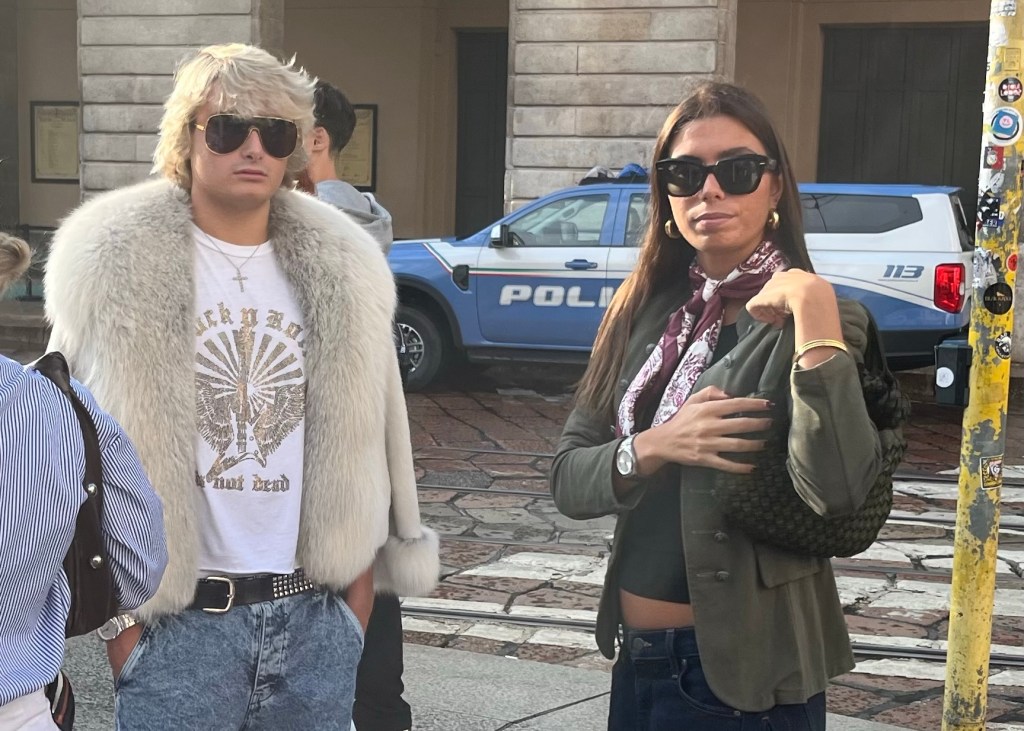
Fashion week made for some interesting people watching

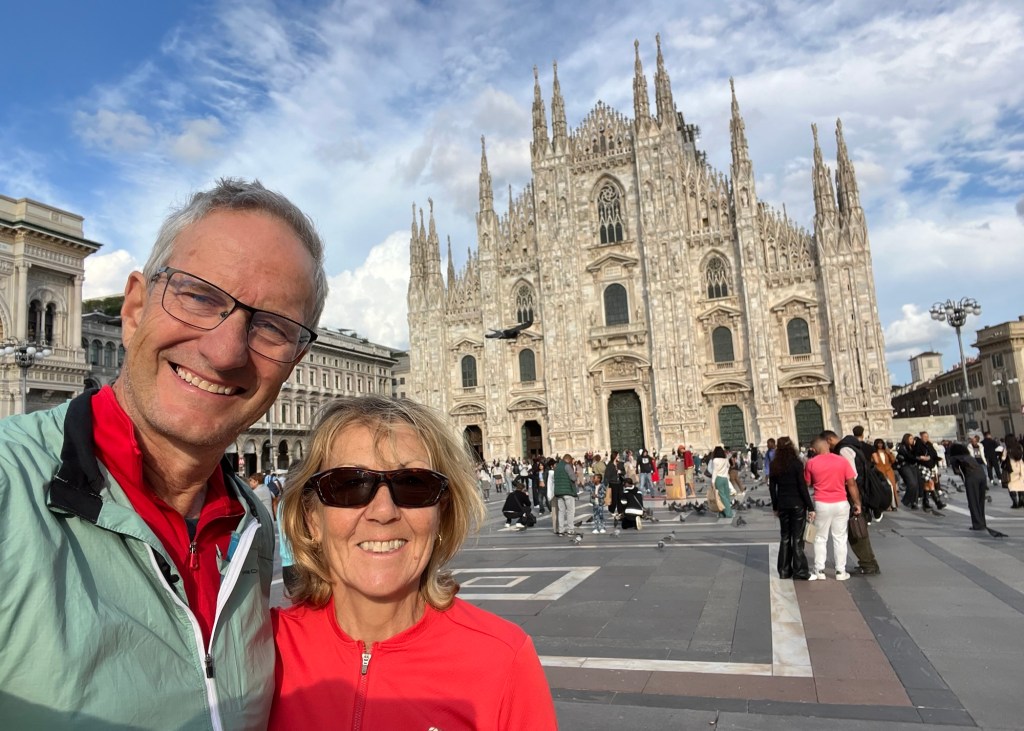
We were even treated to an impromptu fashion show right outside the Duomo.

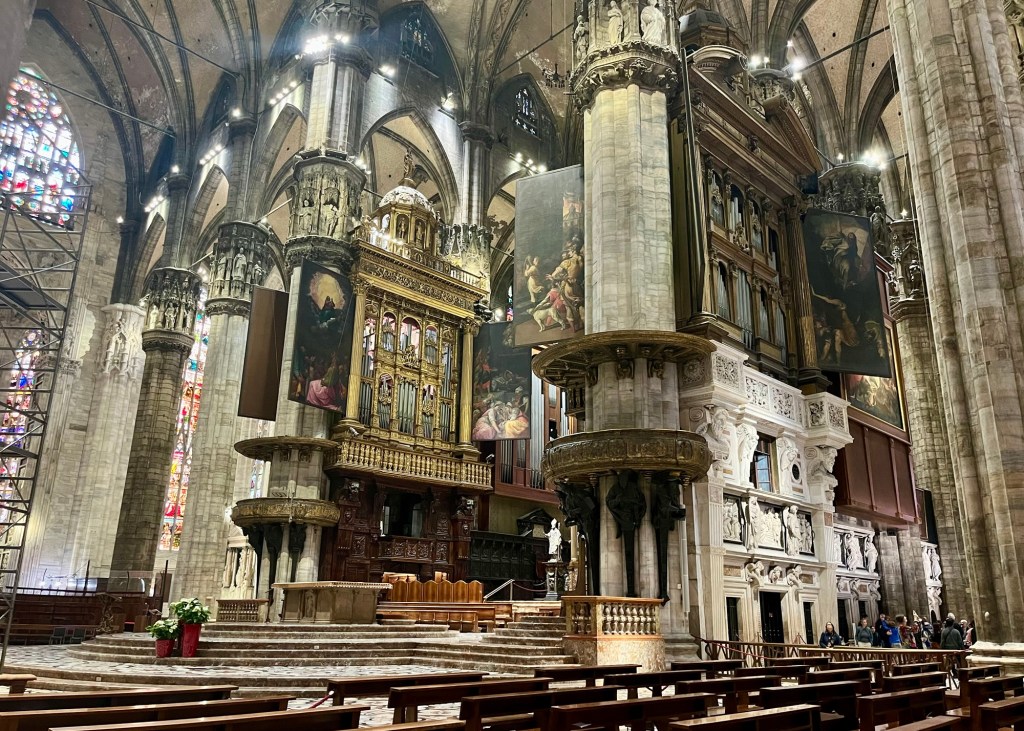
There’s no doubt that the Duomo is immensely impressive. Built over five centuries and not officially completed until 1965, it’s the 5th largest cathedral in the world with a capacity for 40,000 people and a world record number of statues … a staggering 3400 of them gaze down at all the visitors.
Inside the Duomo

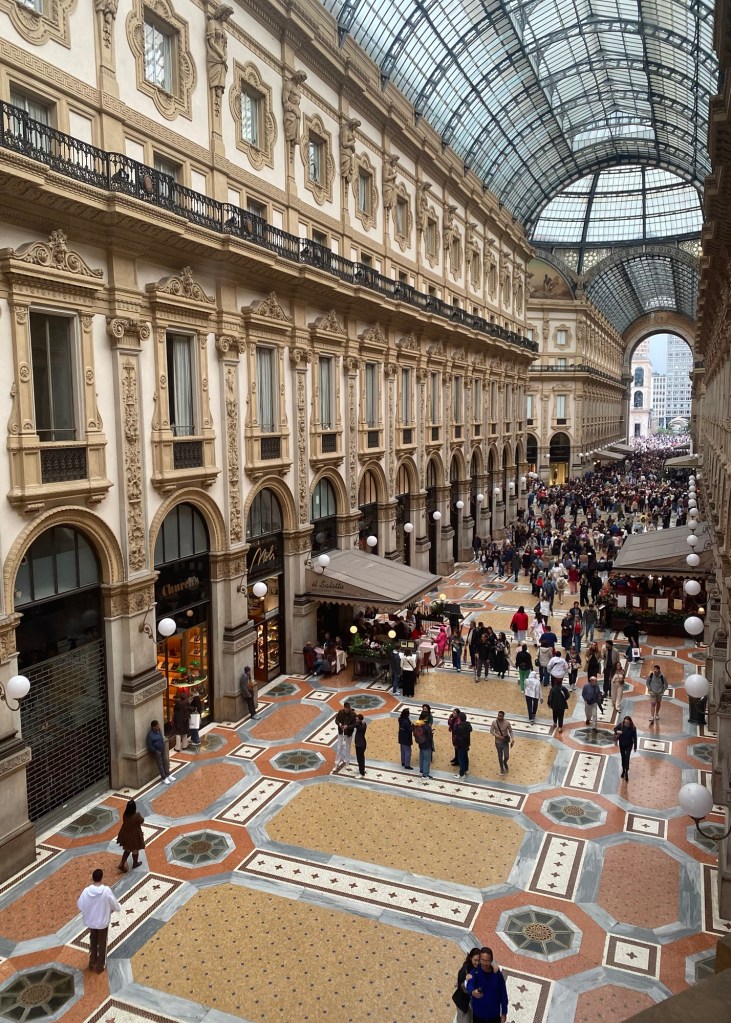
The Duomo is flanked by the other great cathedral in Milan … the Galleria Vittorio Emanuele II, a cathedral of fashion packed with luxury brand boutiques.

Inside the Galleria Vittorio Emanuele II

Sadly, we couldn’t squeeze any luxury items into our panniers, so we had to keep our credit cards in our pockets.

As we left Milan, the sun briefly came out again. Turning to look back, there was a thick ribbon of white snow covering the Alps, yet another reminder of our good fortune.

For a couple of days we pedalled gently across the Po Valley, a huge fertile plain that runs across Italy from the Western Alps to the Adriatic Sea and is home to a third of the Italian population.

Lunch stop in the Po valley

We paused in the delightful town of Piacenza where we spent a lovely evening with Erica from Nuremberg, a fellow touring cyclist who is also heading to Rome. It was great fun to talk bicycle touring for a bit, comparing notes on the most useful bits of kit and laughing about squeezing everything into two panniers.

Clare and Erica

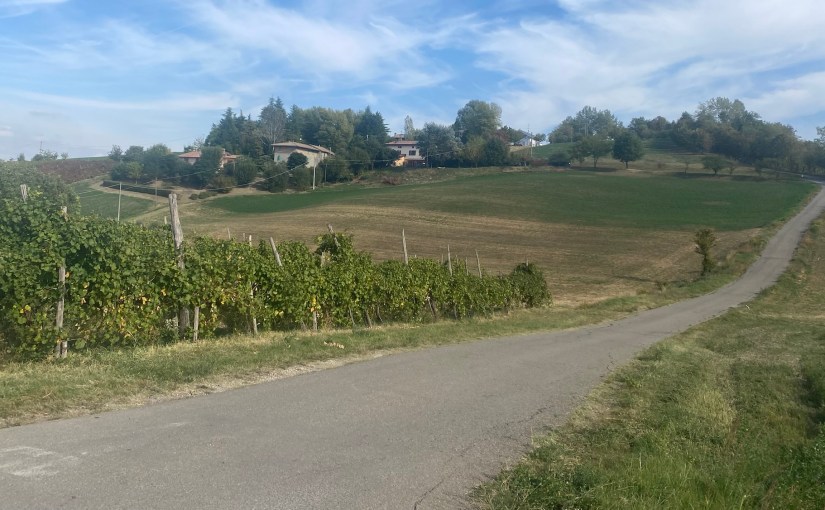
The following night we stayed at a small family vineyard just outside the town of Reggio Emilia where they proudly grow Lambrusco. Now we are of a British generation that is forever biased against this wine, considering it a cheap, sickly-sweet drink from a 1970’s party, alongside Babycham or some fizzy beer from a Watney’s Party Seven.

But it seems Lambrusco is much better than that. It’s delicate. It’s dry. It can have a delightful aroma of orange blossom, violets or watermelon.  It pairs particularly well with beef and lamb or with spicy Thai and Indian cuisine. And it’s recovering from the tarnished 1970’s legacy … as the Milan fashionistas would say “it’s having a moment”.

Over the next few days there was little else available so we threw ourselves into Lambrusco country with gusto, whatever we were eating.

Were we convinced?

Honestly … it’s pleasant enough but, nah … it’s still a fizzy red … which somehow just seems wrong!

Fine Lambrusco

Back in our formative years, when we were both just starting to dream about exploring the world, an inspiration for both of us was the travel writer Eric Newby … A Short Walk in the Hindu Kush (1958), Slowly Down the Ganges (1966), The Big Red Train Ride (1978) amongst others.

Our favourite was Love and War in the Apennines (1971) in which he described escaping from a prisoner-of-war camp near Parma during WWII, then hiding from the Germans in the very same hills we were now cycling through. There he was helped, at huge risk to themselves, by the local mountain people and in particular by Wanda, a young Slovenian lady and her father. Predictably Wanda and Eric fell in love. Less predictably they found each other after the war and remained happily married, travelling together on all their other adventures.

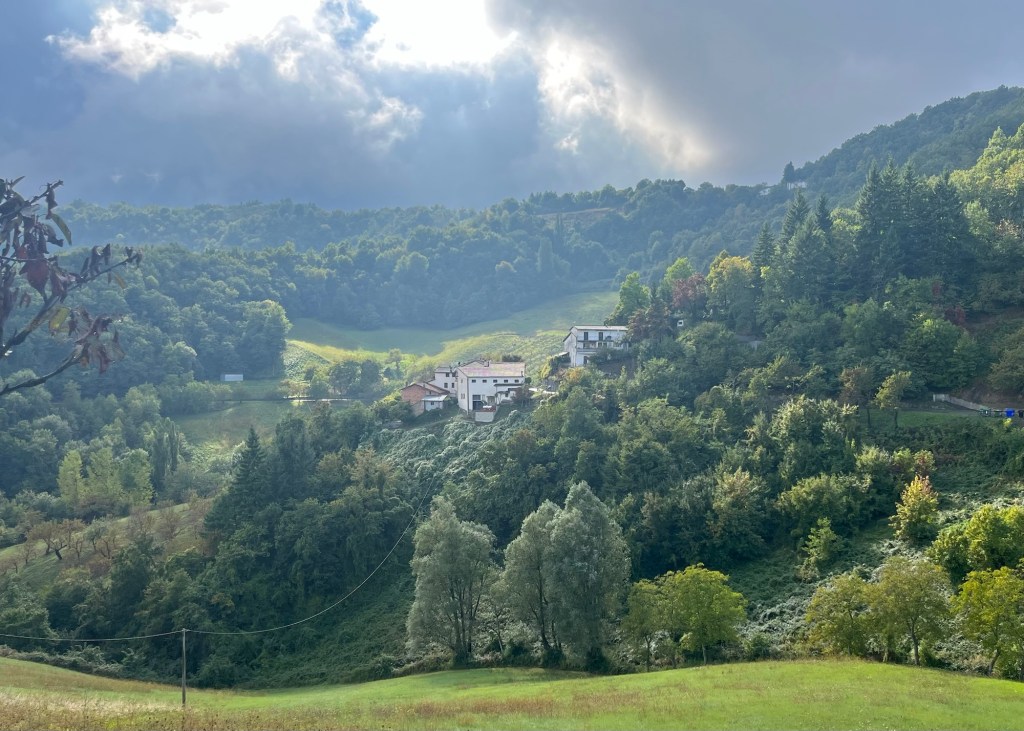
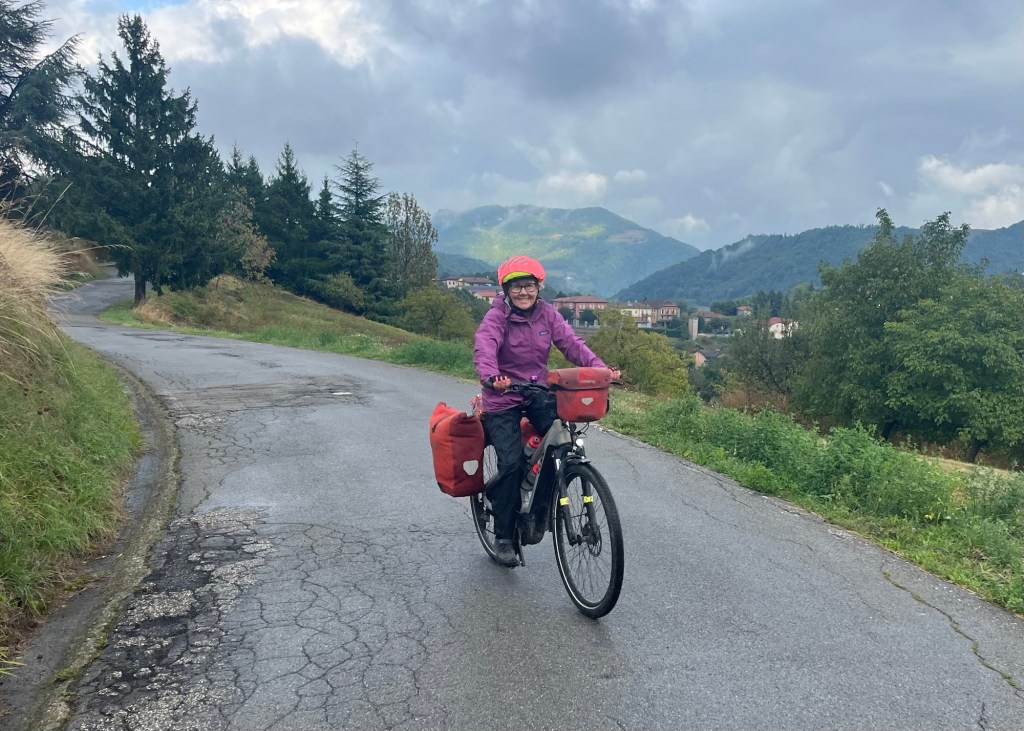
We thought a lot about Eric and Wanda as we pushed our way up through the hills,  moody with mist, coated in sweet chestnut trees, remote farmhouses illuminated by a shaft of light from the heavens.

Sweet Chestnuts

Of all the mountain ranges we’ve now cycled through, the Apennines are the steepest. They’re brutal, steeper than the Alps, steeper than the Pyrenees, steeper than the Andes.

Now we know you’re thinking we have nothing to complain about … we have motors and batteries to help get us up steep hills.

But as you watch your remaining battery percentage collapse before your eyes, there is NO WAY you can accept that riding a heavy e-bike up 15% inclines on rough roads is an easy option.

It’s still brutal!

We may not have needed the same life saving protection that was given to Eric Newby, but feeling as exhausted as our batteries, we were very relieved to be welcomed into the warm hospitality of a family run mountain B&B near Zocca. It’s since become firmly established as one of our favourite lodges from this trip, a simple but comfortable room and a cavernous restaurant warmed by a pizza oven and an open barbecue, dripping with large joints of meat.

The family invited in two bedraggled cyclists without a murmur and then encouraged us to stay on in our room until the following afternoon to wait out the last of the rain.

Hearing we were travelling to Zocca, the lady in the Lambrusco vineyard had become very excited. You go on Zocca? she said, it’s the home of my favourite singer. He’s Vasco Rossi. People go to Zocca from all over Italy. They hope to see him. Perhaps you will the be lucky ones!

Vasco Rossi is indeed a big cheese in Italy, with 30 albums to his name and regularly selling out stadium tours. But not everyone is going on a pilgrimage to Zocca, it turns out Italian fans either love him or hate him. As one critic put it …

According to his fans, he’s Bruce Springsteen, Freddie Mercury and Michael Jackson rolled up into one musical genius. According to his detractors, he’s just a sleazy package of average Italian mediocrity.

Zocca … not a Vasco in sight

As we’ve been lucky enough to visit Florence several times over the years we decided to take the path less travelled on emerging from the Apennines, and go to Pistoia instead … Florence’s little sister.

Screenshot

There might be a reason why it wasn’t visited very often in the past. For much of its history, Pistoia has been reviled as a dangerous, aggressive place.

The city’s metalsmiths were as famous for their daggers as the Pistoiesi were for stabbing each other.

The city reputedly lent its name to the Pistol.

Michelangelo even called the Pistoiesi the “enemies of heaven.”

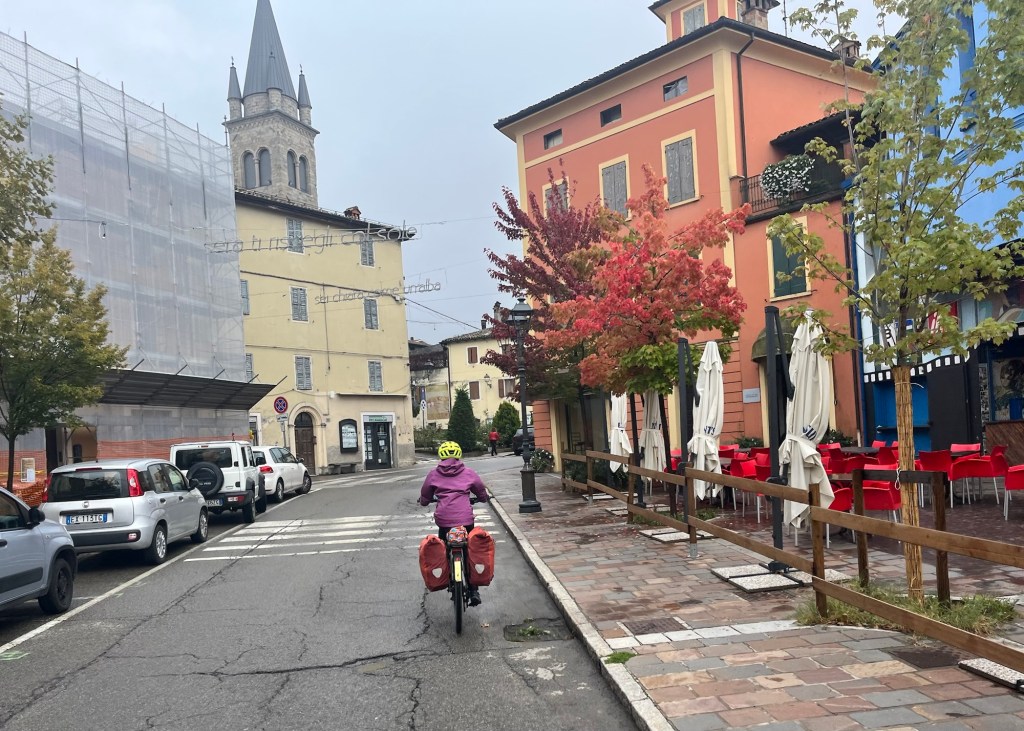
Pistoia

The most notorious incident of the Middle Ages happened when a massive feud that turned Florence into a war zone for centuries allegedly started in Pistoia.

Two boys were playing with wooden swords when one of them was inevitably hurt. The father of the perpetrator told his son to visit the family of the injured boy to apologise. But the victims father became so incensed that he took out his dagger and promptly cut off the boy’s hand, shouting that “Iron, not words, is the only remedy for sword wounds!” 

Tough judgement.

One thing led to another and before long it had snowballed into a much bigger battle between the Guelphs who supported the Pope in Rome, and the Ghibellines who wanted an independent Florence city-state.

Thousands died … no wonder Pistoia became so notorious.

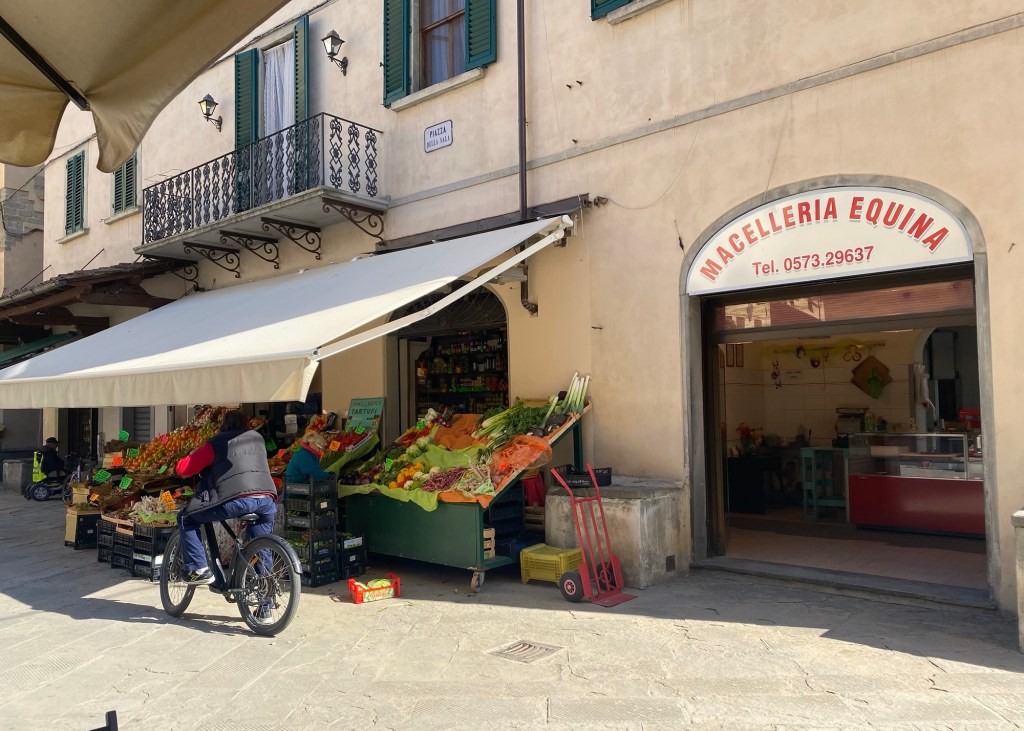
This butcher only sells horse meat!

That dangerous history might be responsible for keeping people away as today there are very few tourists in Pistoia and barely any hotels. Which is a shame as it’s a charming typical Tuscan town, full of interesting renaissance buildings, lots of art and the best Gelateria!

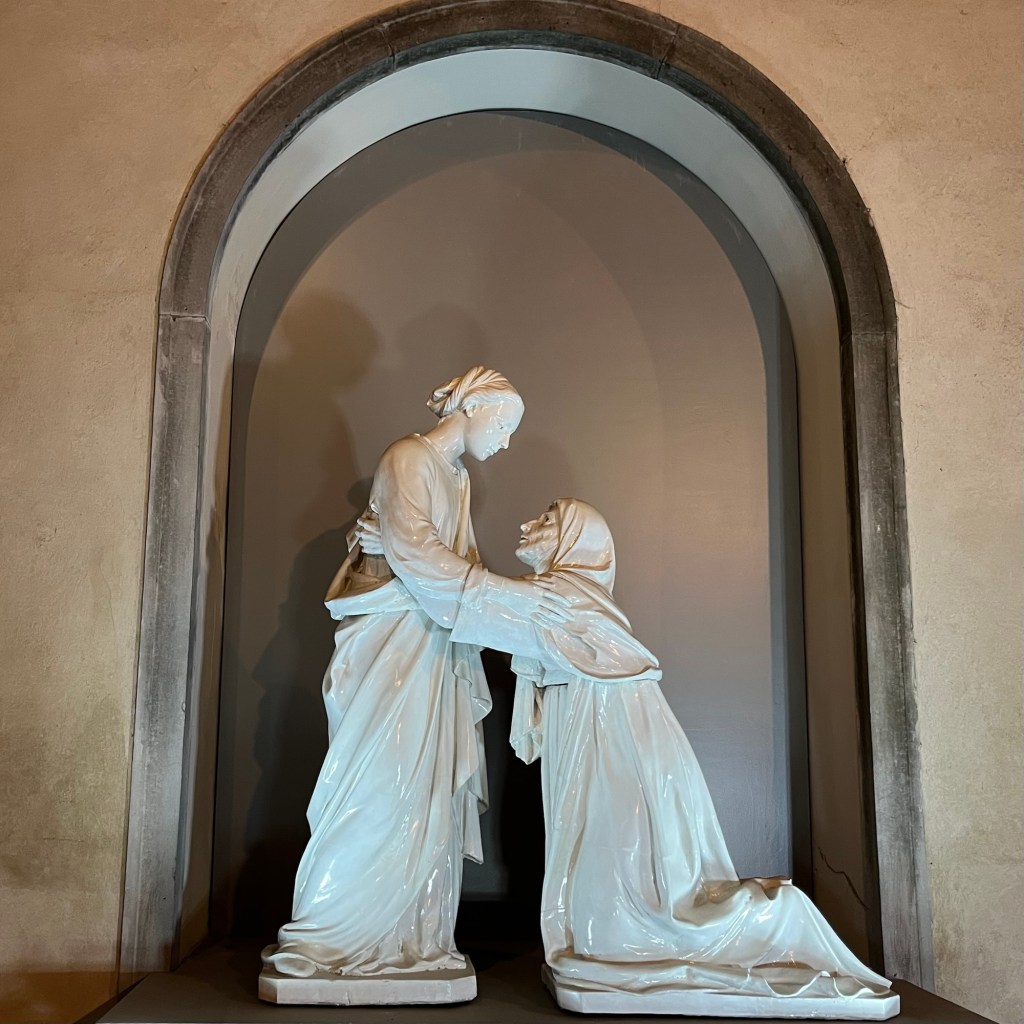
‘The Visitation’, Mary visiting Elizabeth, in glazed terracotta by 15th century artist Luca della Robbia

For bicycle tourists seeking the path less travelled, Pistoia was a perfect stopover and introduction to Tuscany.

So, as we enjoyed our gelati in the square, we could start to dream about the path ahead … rolling Tuscan hills punctuated by poplar trees and topped by medieval hilltop villages.

After all that’s the Italy we’d pedalled across half of Europe to explore.

Clare & Andy

Bath to Pistoia

1,991km pedalled

15,471m climbed

105 hours in the saddle

The Joy of Swiss Precision

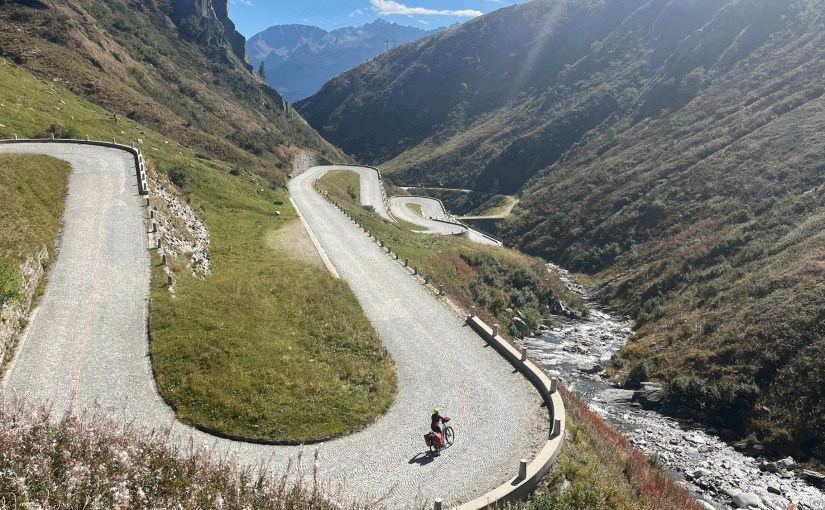
It’s not every day that a touring cyclist gets the chance to descend a 19th century cobbled road from the top of a famous Alpine pass, dropping 1000m over 15km and swooping around 37 hairpin bends.

Almost alone in the wild, rocky, mountain landscape.

Under a deep blue, cloudless sky.

This is the Tremola … the historic old road that runs down the southern side of the Gotthard Pass in Switzerland. Opened in 1830 it quickly became a vital trading route for horse drawn wagons and carriages travelling between Northern and Southern Europe.

Today the Gotthard Pass is still a major transport axis but most of the goods and people are carried through three huge tunnels, each one the world’s longest at the time of their construction. 

The 15km Gotthard Rail Tunnel (1882) still carries regular trains.

The 16.9km Gotthard Road Tunnel (1980) for freight and fast traffic. 

And the 57km Gotthard Base Tunnel (2016) for fast trains.

Most importantly for touring cyclists there’s also the Gotthard Pass Road (1977), which opens for tourist traffic in the summer and is preferred by road cyclists going down the hill, as their tyres are too narrow to bump down the cobbles.

So we practically had the Tremola to ourselves. With only red-faced road cyclists coming up the hill plus the occasional curious car or motorcycle for company.

Normally, touring cyclists hate cobbles! Rattling over them at the end of a long day, they shake your weary bones to the core as you search an historic town centre for your night’s resting place.

But these are Swiss cobbles!

Even in the early 19th century, the Swiss builders had placed the neat square stones so carefully and precisely together, they still made for an incredibly smooth ride down on our strong, thick tyres nearly 200 years later.

Perfectly precise cobbles

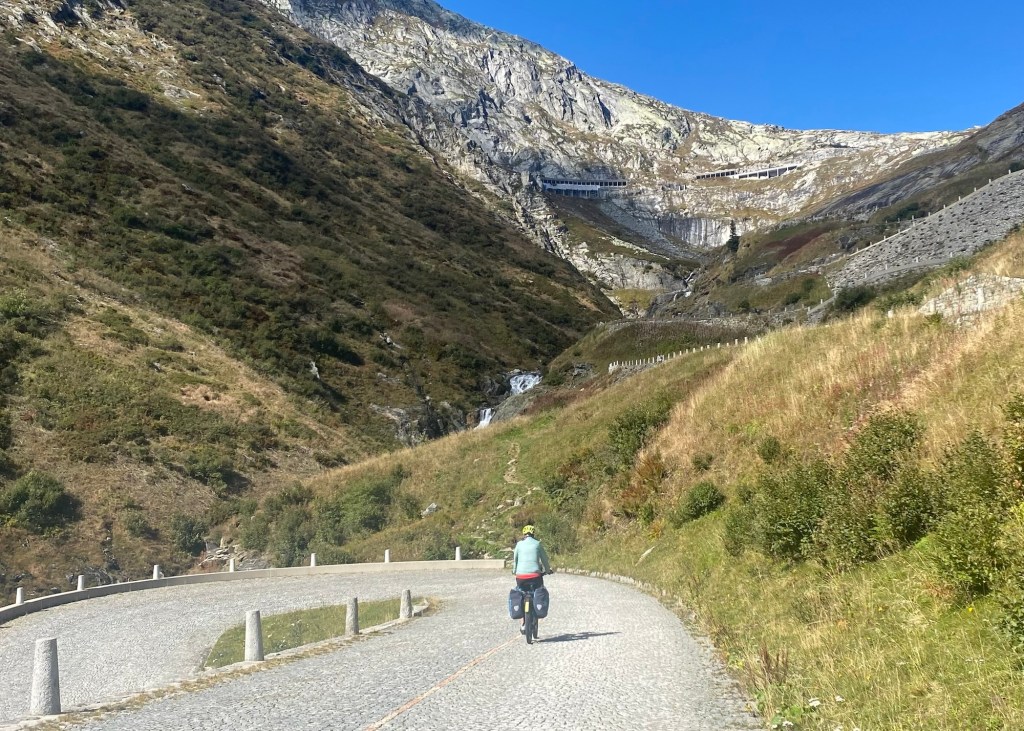
The ride up the north side of the Gotthard Pass hadn’t been quite so much fun, and that was nothing to do with the elevation!

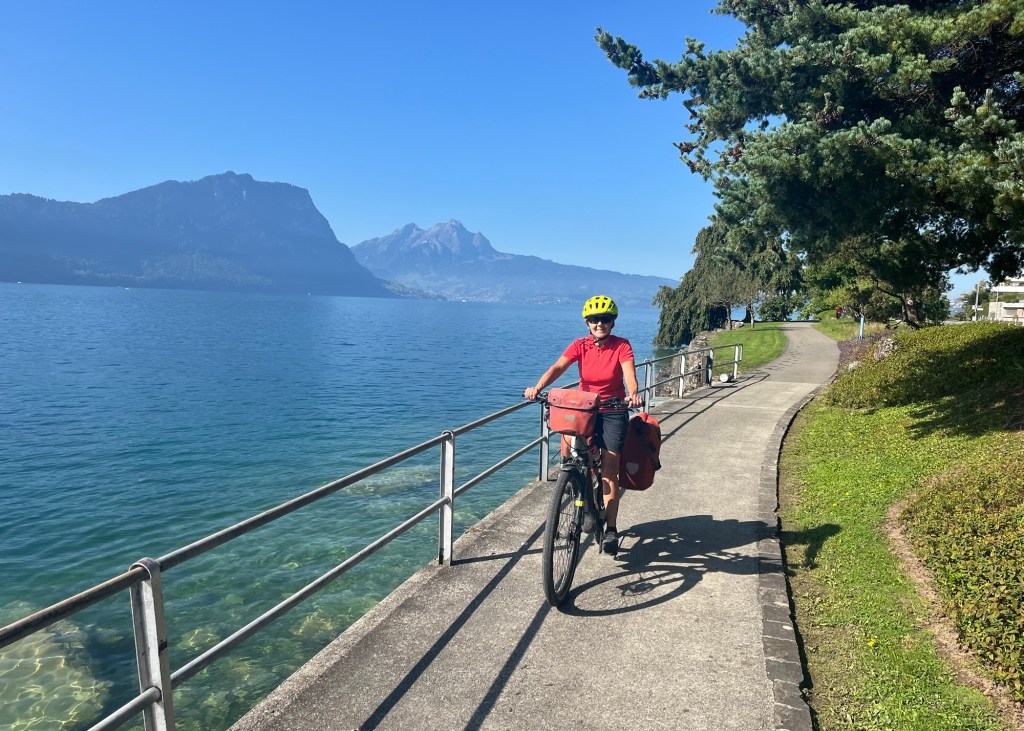
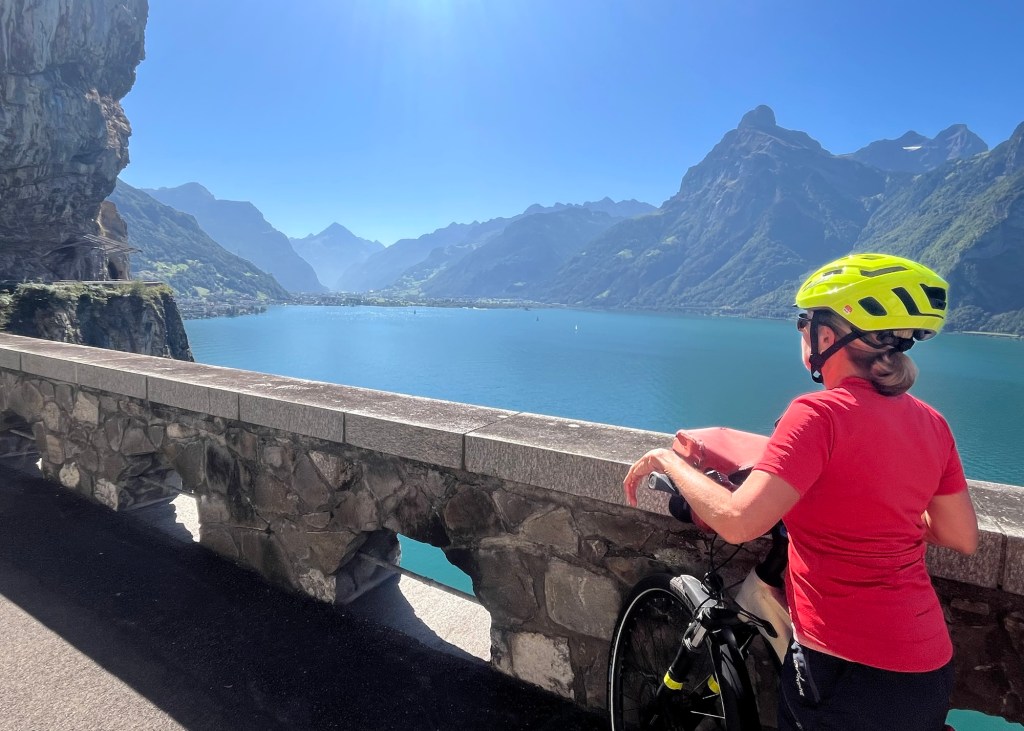
We had left Basel just three days earlier on another glorious late summer day, cycling across picture perfect countryside on picture perfect back roads and cycle paths to the picture perfect city of Lucerne and then onwards around the picture perfect lake.

It was stunningly beautiful. Breathtakingly beautiful.

Lucerne

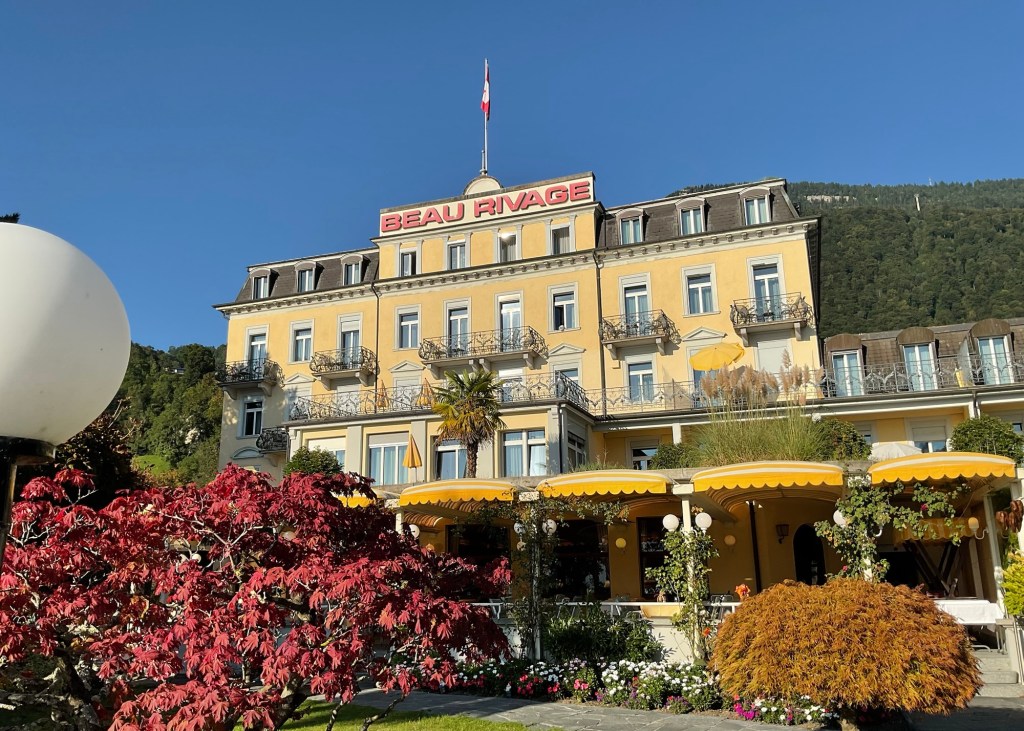
We stayed overnight at the Beau Rivage, a slightly faded small hotel on Lake Lucerne where Queen Victoria had once rested her weary head.

Hotel Beau Rivage
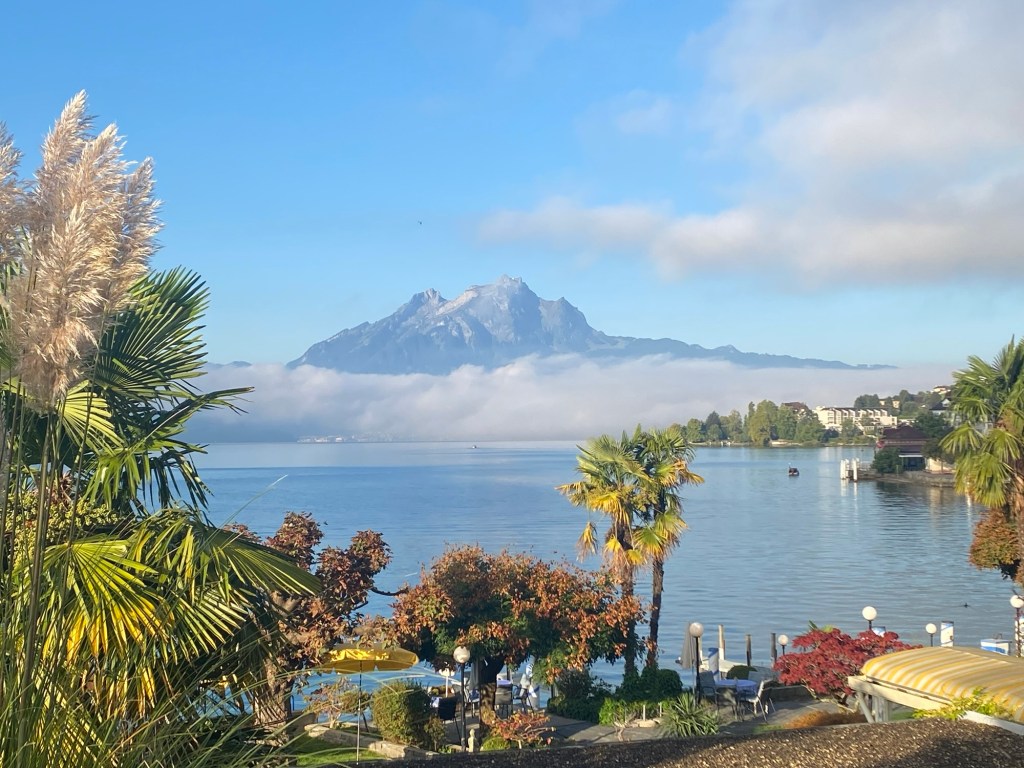
View from Hotel Beau Rivage

Leaving the hotel the following morning, the box of Swiss delights became even more sumptuous as we slowly pedalled around the contours of Lake Lucerne before stopping for a coffee in the small lakeside town of Brunnen.

Switzerland is a fascinating country. A small, landlocked oasis of peace, prosperity and neutrality in the heart of Europe, still with four official languages (German, French, Italian and Romansh) and as many distinct cultures.

It really is as clean, efficient and precise as its reputation.

No wonder the cycle paths are so clean
Which means lots of people regularly cycle in Switzerland

A strong economy and consistent current account surplus, plus a growing reputation as a safe haven currency in uncertain times have dramatically strengthened the Swiss Franc in recent years.  Before the 2008 financial crisis £1 would buy a British traveller 2.4 Swiss Francs, now the two currencies are nearing parity.

That has made Switzerland draw-droppingly expensive for that British traveller. Fortunately the country is quite small so it didn’t take us too long to cycle across it!

Clare likened Switzerland to a super-premium IKEA … it’s good quality, it all fits precisely together, it works efficiently and it looks nice … if a tiny bit lacking in character. 

But you have to understand how it works.

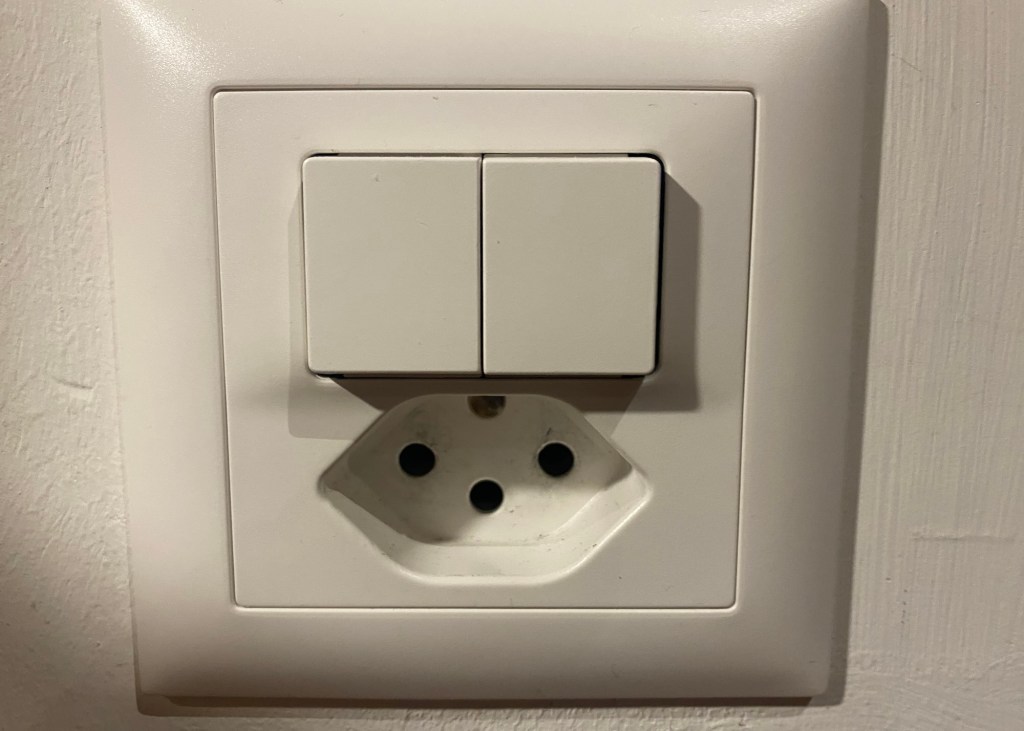
Deep, precise, safe, unique electric plug sockets

Finishing our coffee in Brunnen, we were surprised to join a long traffic jam full of vehicles travelling from Zurich and funnelled onto a single lane road to get up to the tunnel or to go over the pass.

It must have been incredibly frustrating for the motorists, we heard it was taking over 4 hours to get through.

Fortunately for us there was a nice cycle path so we glided past all the traffic trying not to look too smug.

Perhaps we hadn’t properly understood the way Switzerland works as we’d found ourselves being forcefully told off quite a bit since arriving in the country. Clare generally prides herself on being a stickler for rules but even she was told off three times in one day in Basel.

So we were a little nervous when a smiling policeman flagged us down just as the cycle path became a pavement. A pavement which was then blocked by a sign that forced us briefly onto the road in order to manoeuvre our big, heavy bikes around it.

Nein, nein, he said, ist verboten.

Andy smiled back and apologised for not speaking German.

No good, he said, not allowed.

Oh Entschuldigung (sorry), said Andy thinking we weren’t allowed to cycle on the pavement after all, we go on road.

The policeman pointed up the road. OK later, he said, here no good. Too dangerous.

Andy looked up and saw that the pavement was indeed outside the protective cover of the half tunnel that the traffic was crawling through. Ich verstehe (I understand), he said miming rocks falling down, bang on my head.

The policeman nodded sagely.

Danke schön, we waved and joined the traffic queue on the road.

The policeman now became quite animated. Nein, nein, nein, he shouted. Verboten! Verboten! You must go here … pointing at the pavement.

It felt as if the language barrier was just a tiny bit too big to explain that the only reason we’d moved off the pavement and onto the road (for just one moment) … was to get around his bloody sign.

As we set off again on the pavement, once again serenely passing the traffic queue, we were sure that we could hear him chuckling away to his colleagues almost as much as we were. Dummes Englisch Radfahrer!

Shortly after that another cycle path emerged to help us climb the mountain, which only served to increase our sense of superiority.

As usual on a climb, Clare shot ahead. Since we’ve acquired our e-bikes she’s become so much faster at going uphill than Andy, enjoying the significantly better power-to-weight ratio that the motor gives her, even in a lower power setting. Andy is now habitually huffing and puffing in her wake, trying in vain to stay close to her wheel.

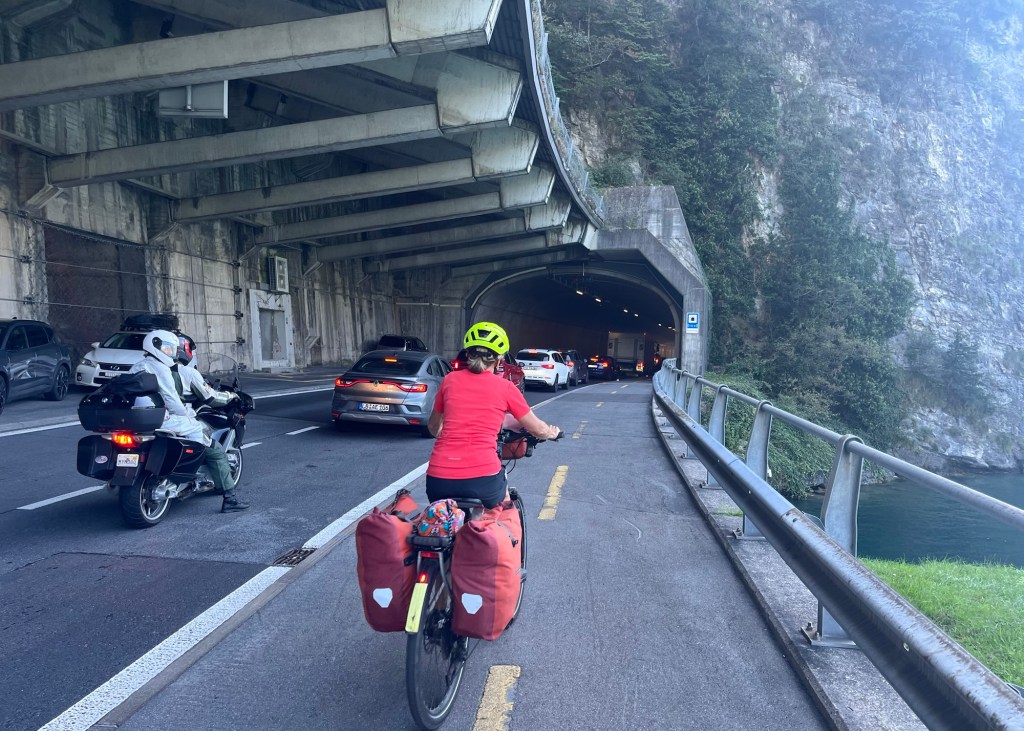
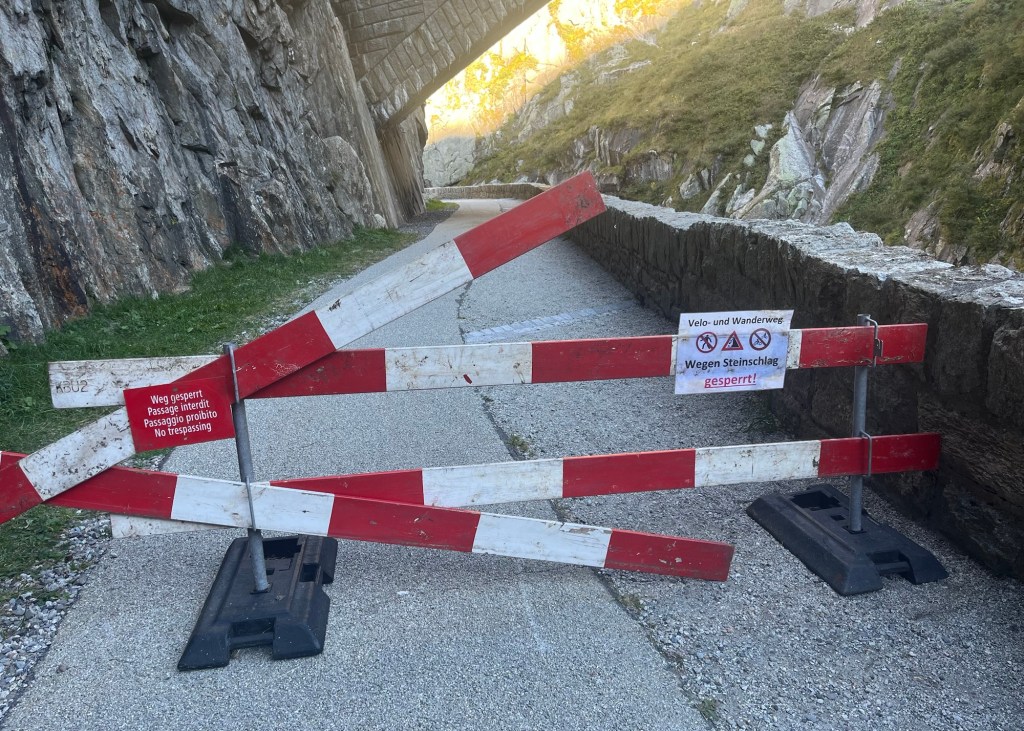
But near the top of the climb he found her forlornly contemplating a problem … the cycle path was closed, blocked by a rockfall. We had no choice but to join the busy road through a long tunnel.

The only thing that touring cyclists hate more than cobbles is a road tunnel. Quite rightly we’re normally banned from entering them, but even if we are allowed in, we’ll do anything to avoid one … especially if it’s going uphill, especially if there’s a lot of traffic.

Because Clare was so much faster than Andy, it was difficult to use our normal busy road formation, Clare in front, Andy behind and slightly outside her. So Andy went first setting a slow but steady pace. 

The road through the tunnel was very narrow, the drivers were clearly not expecting to find us in there and many of them must have been feeling exhausted by the long traffic jam they’d endured. Probably quite irritated too by the sight of smug cyclists cruising past them on the pavement all day.

Several sounded off their horns in frustration and we had a few close shaves as they squeezed past.

Then a car got too close and brushed against Clare’s pannier knocking her sideways.

Luckily she still doesn’t clip in on both sides on a climb … even after all the thousands of kilometres of bicycle touring she’s done. This meant she could quickly put her foot down and recover her balance, instead of sprawling into the road. Phew!!

Clare’s tunnel, you can just see the rockfall on the cycle path

We emerged to find another access point to the cycle path. It was still closed but this time we didn’t care.

This path took us through the Schöllenen Gorge, the greatest engineering challenge of the Gotthard Pass and the reason why it wasn’t used in Roman times, until they eventually managed to build a bridge across the gorge in the 13th Century.

So important was this bridge to complete the trading route that it marked the beginning of the long period of prosperity for the Swiss Confederacy. Prosperity that has ultimately led to it becoming such an expensive country to visit today.

Schöllenen Gorge

We recharged overnight in the spa and ski resort of Andermatt, ready for the final push up to the pass itself the next morning and then the joyful descent down the precisely laid cobbles of the Tremola.

It was another beautiful sunny day.

But the receptionist at the hotel gave us a wry smile. You must get down quickly, she said, snow is coming.

And she was not wrong. The unusually early season snow arrived the very next day and once it started, it didn’t stop for a week. We later met touring cyclists who were forced to take the high speed train through the big base tunnel to reach Italy, missing the Gotthard and Tremola experience all together.

A massive pothole avoided! How lucky were we!

Clare being careful to follow the rules on the final ascent to the pass
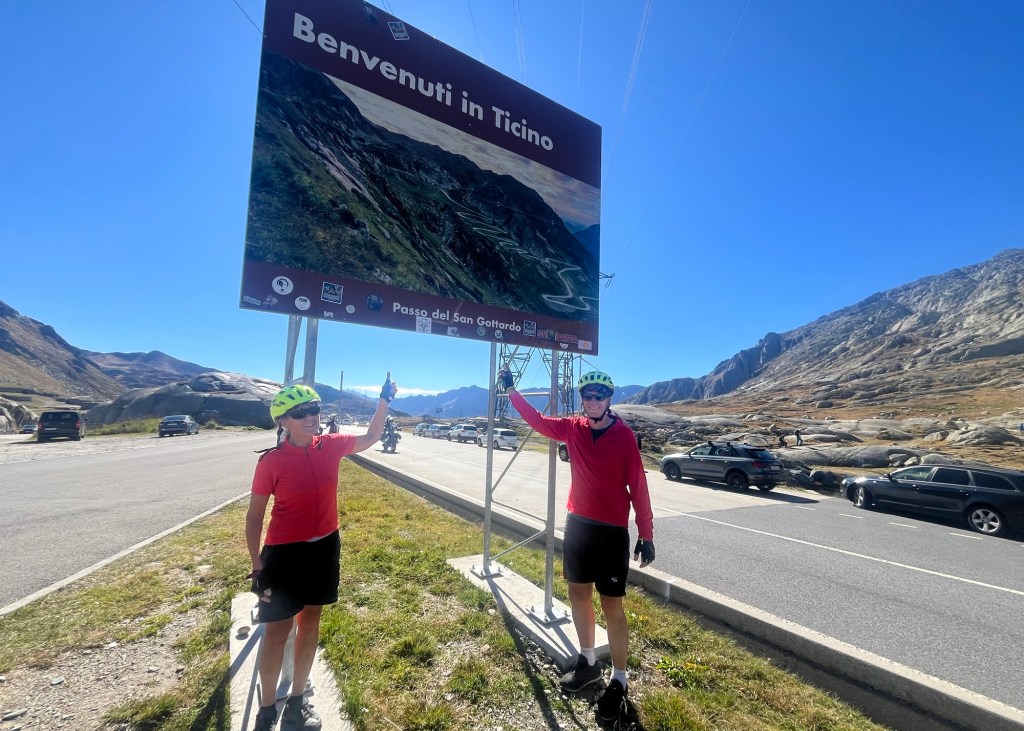
At the top … and into Italian speaking Ticino

The Gotthard Pass also marks the border between German speaking central Switzerland and the Italian speaking canton of Ticino.

Map showing the main languages spoken across Switzerland. Photo credit: Wikipedia

Despite not actually leaving Switzerland, it was amazing to see different road signs, advertising for Trattorias and Osterias and to hear people chatting away in Italian, rather than German. The food definitely improved, with delicious pastas and risottos replacing cheese fondue or wienerschnitzel. But it was still just as expensive and the road surfaces were still super smooth.

The following day we crossed the border from Swiss Italy to Real Italy halfway around Lake Maggiore.

Plenty of noise and life in Italy

The changes were immediate. Manhole covers were no longer precisely flush with the road … instead they were deep, hazardous pits. Houses looked like they needed a lick of paint. There was the occasional piece of rubbish on the street.

But … the pasta was now a reasonable price, so was the wine, so was the gelati. And there was a lot more vibrancy on the streets, a lot more life, a lot more noise.

What else would you do first when you cross the border into Real Italy?

It did feel a lot more real and we immediately loved it.

After all, we had just pedalled across half of Europe and over the Alps to experience Real Italy on a bicycle.

Andiamo! … Let’s go!

Clare & Andy

Bath to Verbania, on Lake Maggiore in Italy

1,480km pedalled (920 miles)

11,792m climbed

78 hours in the saddle

River Deep, Mountain High

If your dream is to slowly pedal a bicycle beside a winding river on a soft early autumnal afternoon, watching a grey heron in graceful flight ahead of you, waving to a passing riverboat and crossing from one side of the river to the other on a tiny bridge … then Eastern France is the right place for you.

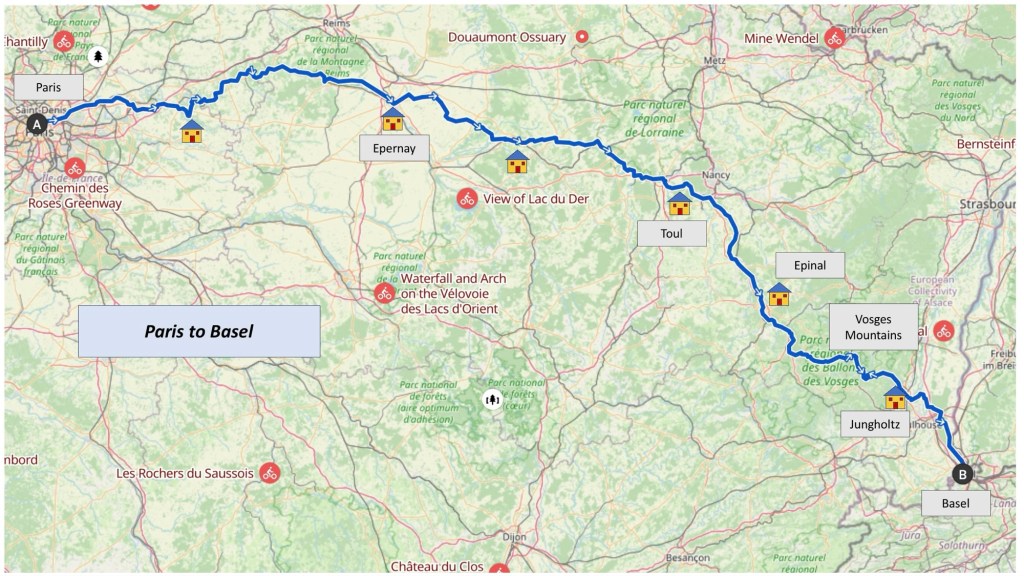
Since arriving in Honfleur at the mouth of the Seine, we have cycled besides twelve rivers or their accompanying canals, in order to reach Basel just inside the Swiss border.

As well as La Seine we’ve pedalled alongside L’Ourcq, La Marne, Le Petit Morin, La Vesle, L’Ornain, La Meuse, La Moselle, La Moselotte, La Lauch and L’Ill before reaching the grandaddy of them all, Le Rhin (known to us as the Rhine and an old friend from our ride through Germany a couple of years ago).

The French waterway network is the largest in Europe with over 8500km of navigable routes. Whenever a river is too shallow or too dangerous, they built a canal next door. Today, it’s still possible to travel across France by boat from the Mediterranean to the English Channel or out to the Atlantic.

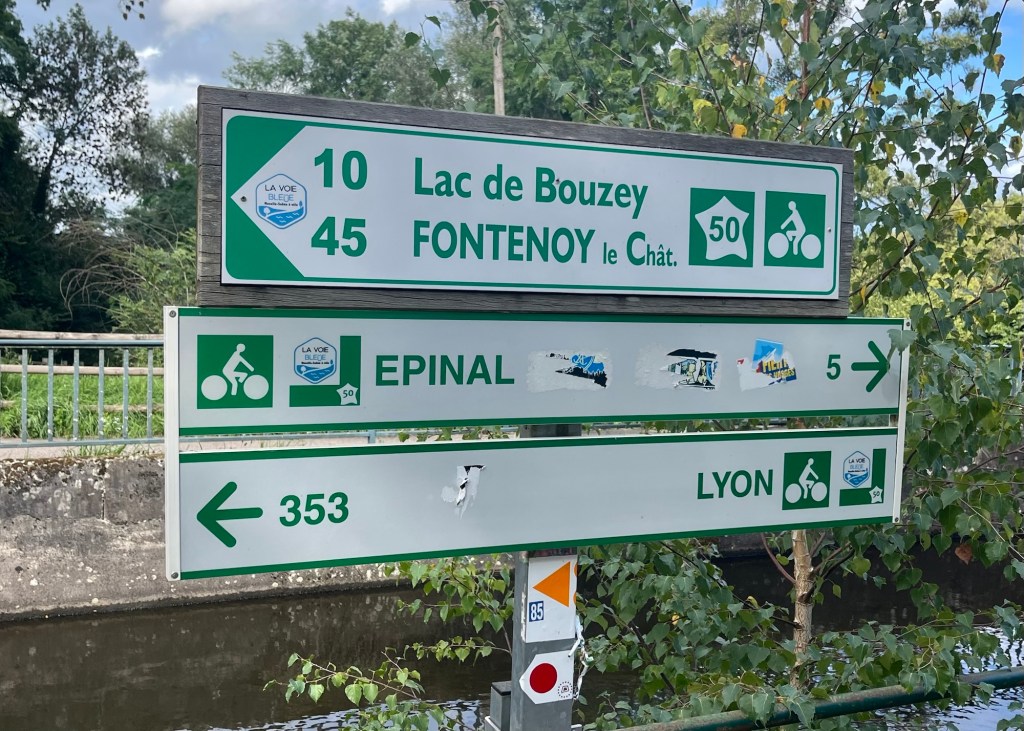
We were turning right to Epinal. Turn left and in 353kms you can be in Lyon, canal paths all the way!

The first waterway of our journey, the Canal d’Ourcq, made it incredibly easy to escape Paris, as we picked it up just 3km from our hotel.

This canal was commissioned by Napoleon, not this time for transport, but in order to keep the city clean. It still supplies about half of the 84 million gallons of water needed to flush out the city’s sewers, gutters and parks every single day.

Leaving the Ourcq, we then followed the gentle curves of the Marne for the next 150 kilometres, winding through Champagne country to Épernay and onto Châlons-en-Champagne.

It was fascinating to see just how many Récoltant-Manipulants are making the famous fizz … small grower producers creating their own single vintage, each with the coveted RM symbol. This is to distinguish them from the major Négociant-Manipulant (NM) houses who buy their grapes from multiple sources so lack the individual vineyard expression that makes a RM champagne so special.

As we pedalled past the rows and rows of vines, we couldn’t help noticing the rose bushes at the end of each one. Roses are particularly sensitive to the dreaded powdery mildew, so act as an early warning system for this greatest threat facing every RM, as it can destroy the whole precious crop if it’s not treated quickly.

On the Avenue de Champagne, Epernay

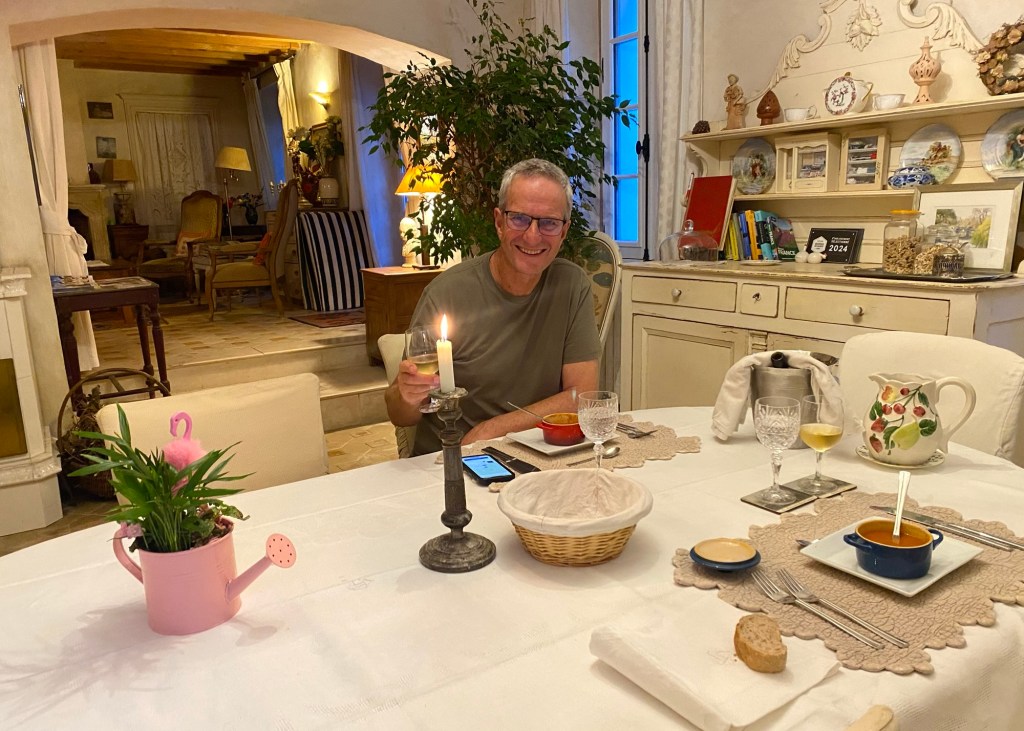
We’ve always found French food to be surprisingly lacking in vegetables, so we book apartments as often as we can to cook up a hearty veggie meal. But it was also a real treat to stay in two small family run guesthouses where the hostess provided an evening meal … a delicious tiny peak into French home life.

Powered by this home cooked food and starting to feel fitter now that we’re a couple of weeks into the journey, we’ve increased our rides to between 80 and 100km every day.

Which is a good thing as, to be brutally honest, the rivers, canals and empty French countryside can get a bit samey after a while.

Empty Diagonal, France

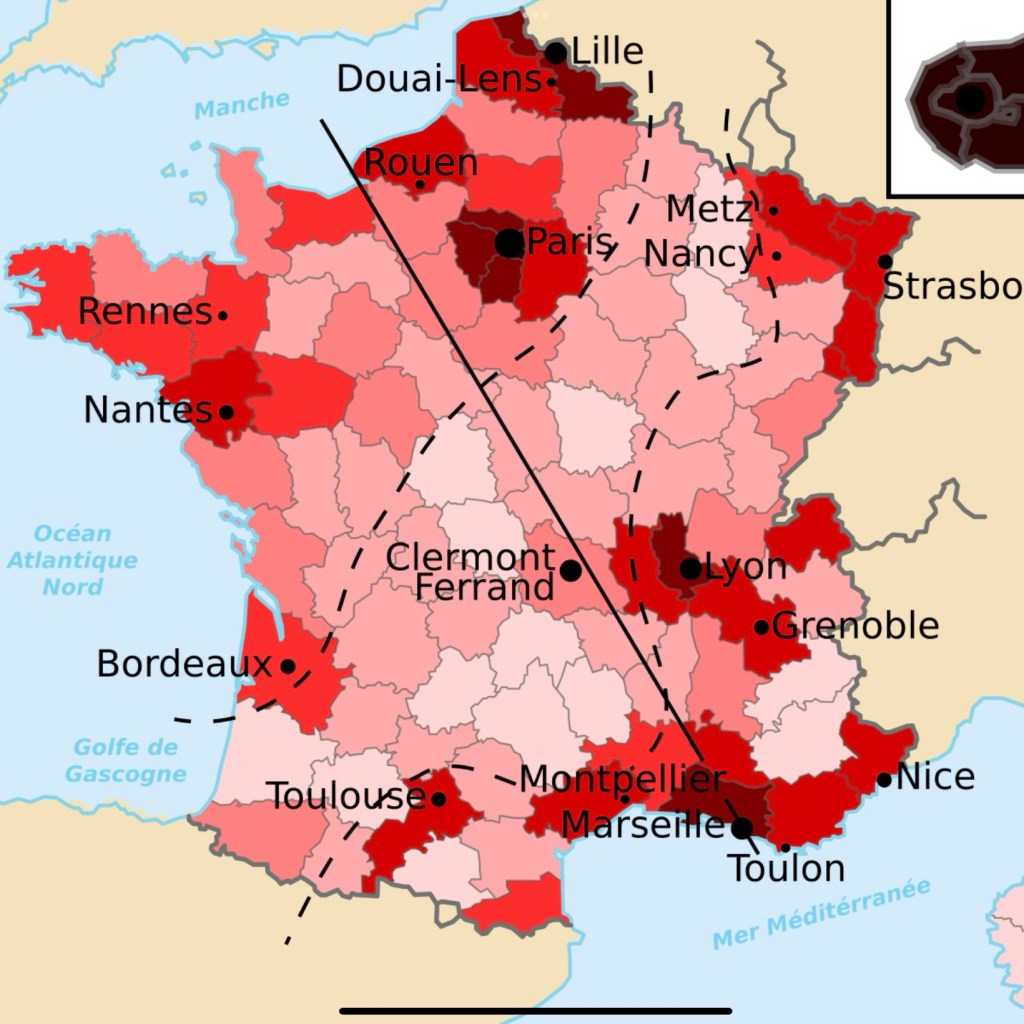
After leaving Champagne, we cycled through part of ‘Le Diagonale du Vide’ (the Empty Diagonal), a huge slice of France with a dramatically low population density, stretching from the Spanish border in the southwest to the Belgium border in the northeast,

Le Diagonale du Vide, between the dashed lines. Photo Credit: Wikipedia

There are many reasons why this empty space exists in such a rich, cultural country.

These include the mechanisation of agriculture which led to less rural jobs, the appeal of metropolitan cities and a worldwide human desire to live within driving distance of a coast.

But the biggest reason by far is the huge death toll these areas suffered from in both the Napoleonic Wars and the First World War, which permanently diminished the population.

For modern day touring cyclists there is one very serious consequence of this empty diagonal … nowhere to stop for a coffee!

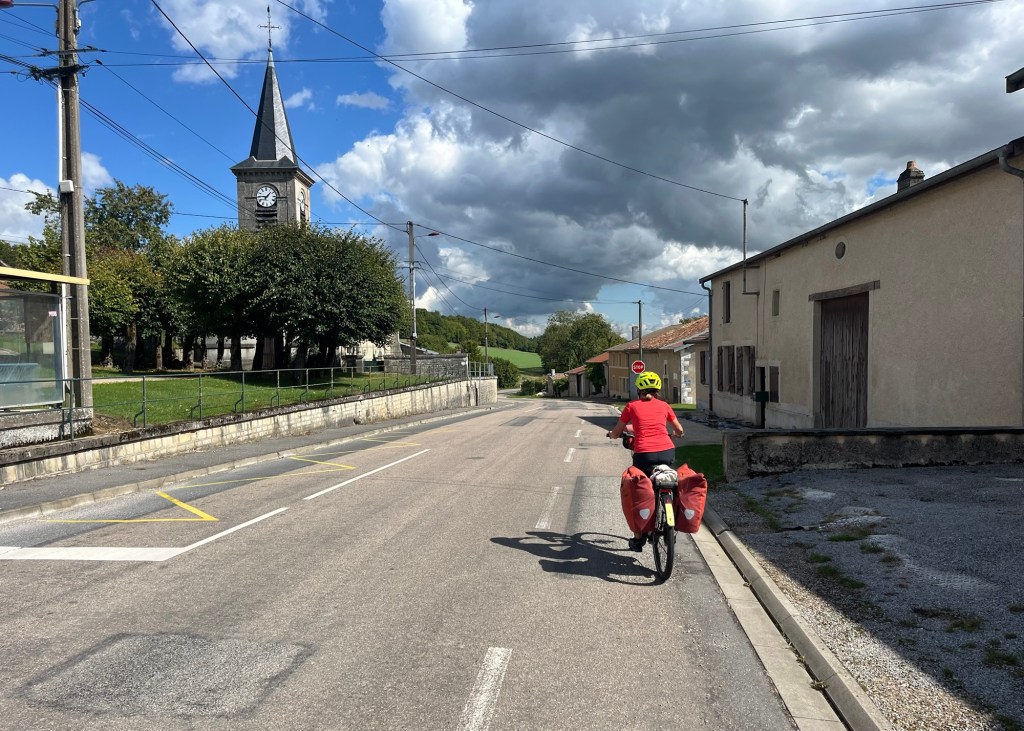
As we pedalled through village after village we couldn’t find a single shop, bar or a quaint riverside cafe. There’s simply not enough people to sustain them.

And as any cyclist will tell you … there’s nothing worse than no coffee stops.

Anyone see a cafe?
No cafes, so the locals have resorted to vending machines

Fortunately we knew what to expect.  We’d cycled through a different part of the empty diagonal before … on our way to Barcelona in 2016.

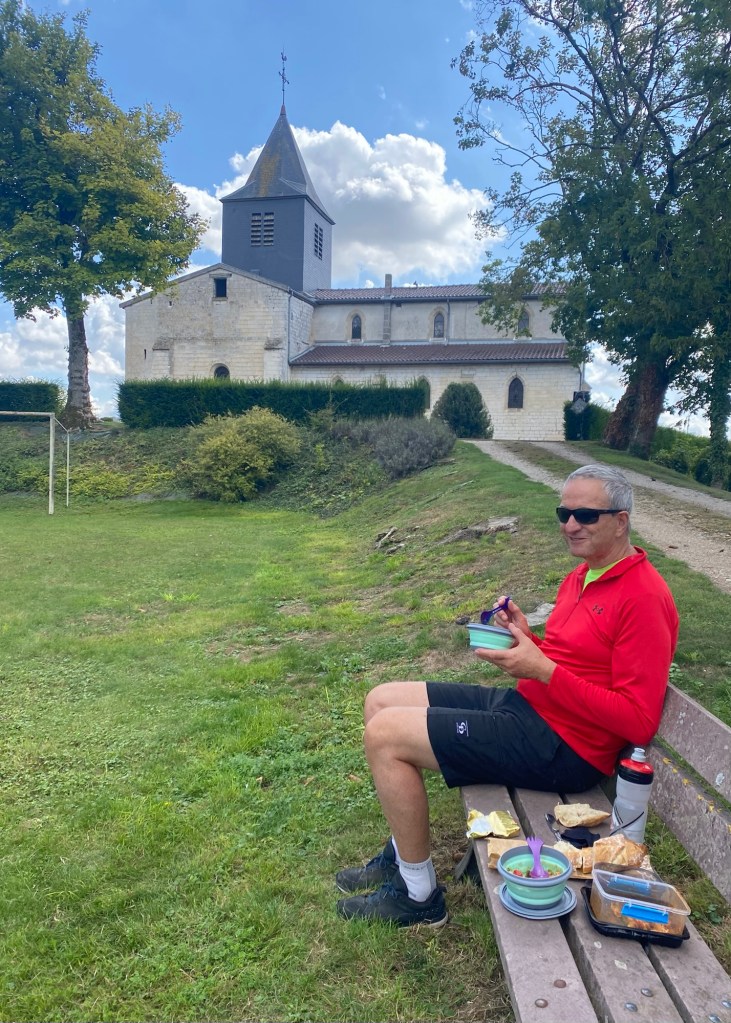
Clare knew how important it is to pick up a baguette before the Boulangerie closes at midday, she knew she should carry a bit of butter, a slice or two of ham, a piece of fruit. Then voilà, as if by magic she produces the perfect picnic lunch … a delicious Jambon Beurre sandwich to be enjoyed on a bench in a churchyard.

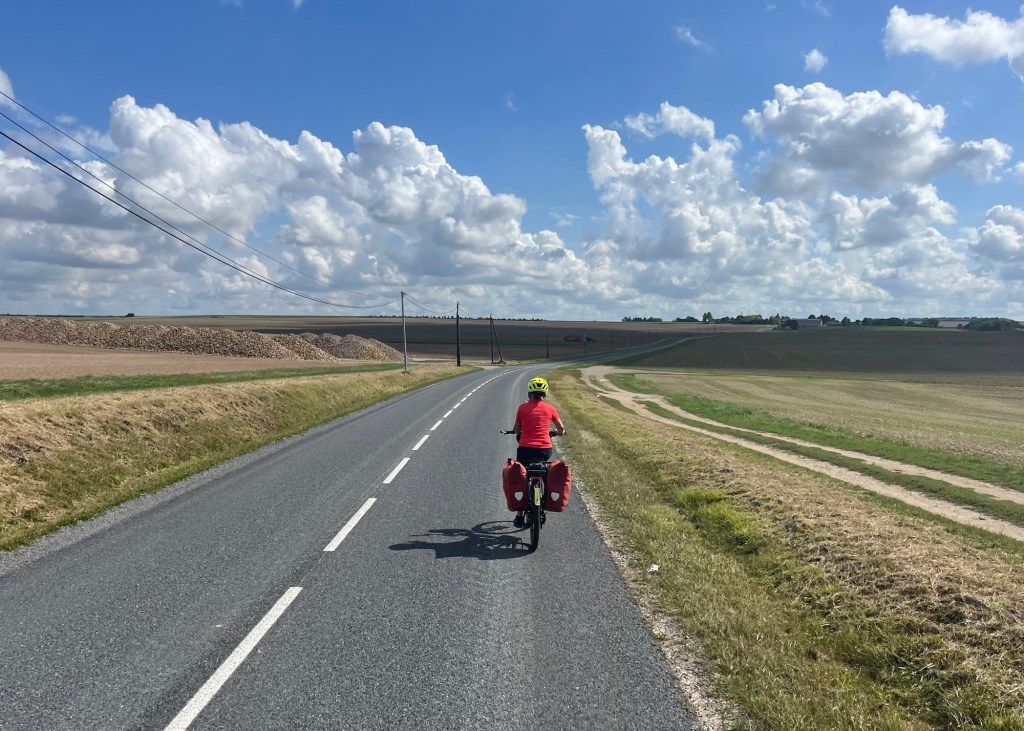
Despite the lack of coffee stops, there is one major compensation for the touring cyclist from the empty diagonal … the extraordinary quality of the country roads and cycle paths, even when there are so few people to use them.

They are simply amazing.

Perfectly smooth, not a pothole in sight, they’re just right for sticking on a podcast, putting you head down and belting along as fast as you can for 100km a day until you reach somewhere that’s a bit more interesting, somewhere with a few cafes.

Incredible road quality!

For us, that somewhere was the Vosges mountains. The range of mountains that lie between Lorraine and Alsace, a region of France that was disputed with Germany for centuries, changing hands many times. It is amazing to encounter so many German place names and traditions (such as bierkellers) in a French province.

We were both looking forward getting up into the forested hill sides, although we knew that our day in the Vosges would involve two substantial climbs with over 1500m of climbing. It would be a test for our legs … and more importantly a test for our batteries.

Vosges mountains

Initially we nursed the batteries carefully, turning the power off on flat sections and then tackling the first climb in a low power setting. But less battery power meant more leg power.

The hard work on the first hill allowed us to ramp the power up for the second steeper climb, safe in the knowledge that we had a lot of downhill to come towards the end of the day.

It was a Saturday so it was a popular riding day for cyclists. But not only for cyclists …  it was popular for motorbikes too, roaring around the switchbacks and over the tops. There were so many bikers that the local Gendarmes were out in force running speed checks and checking papers. It felt like being buzzed by a swarm of wasps.  
We reached the ski resort of Jungfrauenkopf (Virgin’s Head) looking forward to the long descent to Jungholtz where we were staying.

But we had only freewheeled for a few metres when Clare heard a nasty noise coming from her back wheel. Stop!! STOPPPPPP!!!, she yelled. 

Andy stopped.

My bike’s gone badly wrong!

Andy took a look. The brake disk pads were loose and the holding pin was missing. Then one of the brake pads fell out … not good news at the start of a 1000m descent.

With lots of motorbikes buzzing past there was nowhere safe to stop and Andy was simply feeling too exhausted to take the back wheel off and remove the rest of the mechanism by the side of the road.

Start going down the hill slowly using just the front brake, he suggested, and I’ll watch you carefully from behind.  But I’m afraid we still have at least 25km to go.

Clare started going slowly for about 500m. The noise was very loud but it felt a better when she sped up a bit. Soon she was up to her normal descending speed of 40-50km per hour.

That left Andy desperately trying to work out whether she was in any danger. Could the brake spring jam the disk mechanism? he wondered. Surely not, it’s too flimsy. And it’s the back wheel, not the front, so the worst that could happen is she’ll slide to a halt, not be thrown over the handlebars.

Clare made it safely, though noisily, to the bottom. She had 17% battery left, her lowest ever.

Why did you go so fast? asked Andy, feeling very relieved.

You told me I still had 25km to go … and I just wanted to get there!

Our lovely family run hotel in Jungholtz

There was no chance of finding an open bike shop the following Sunday morning so in the comfort of the hotel car park, we took the back wheel off and removed both the spring and the remaining brake pad. Clare would only have one brake for the flat ride to Basel that day but at least the noises had stopped.

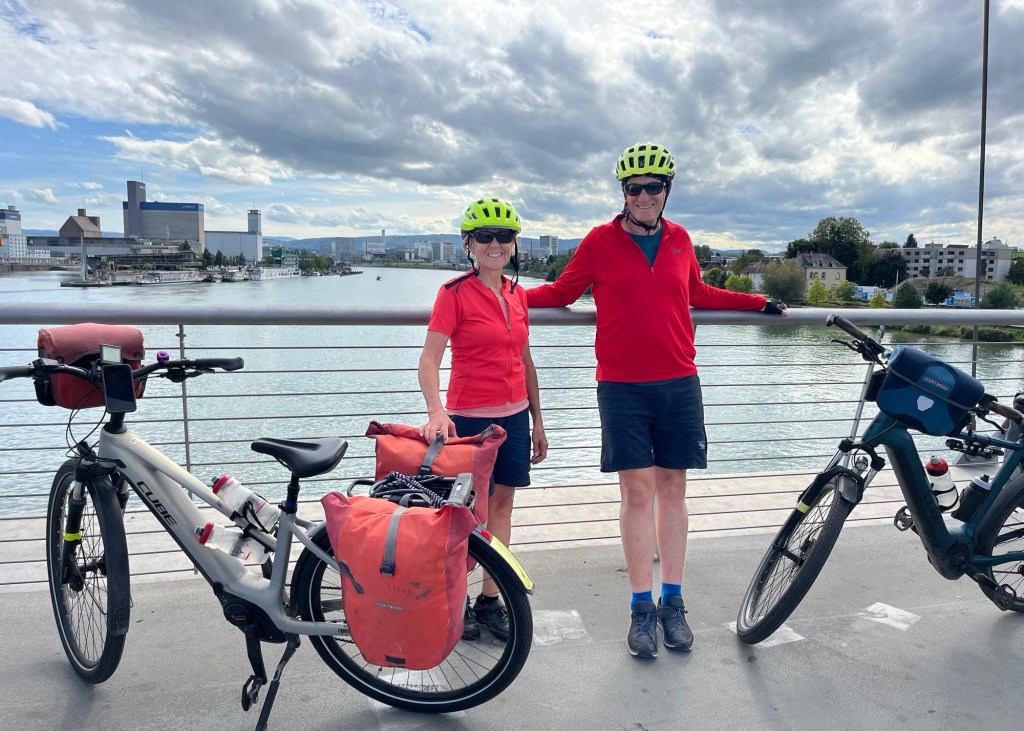
Arriving in Basel – this bridge looks out across 3 countries … France, Germany and Switzerland

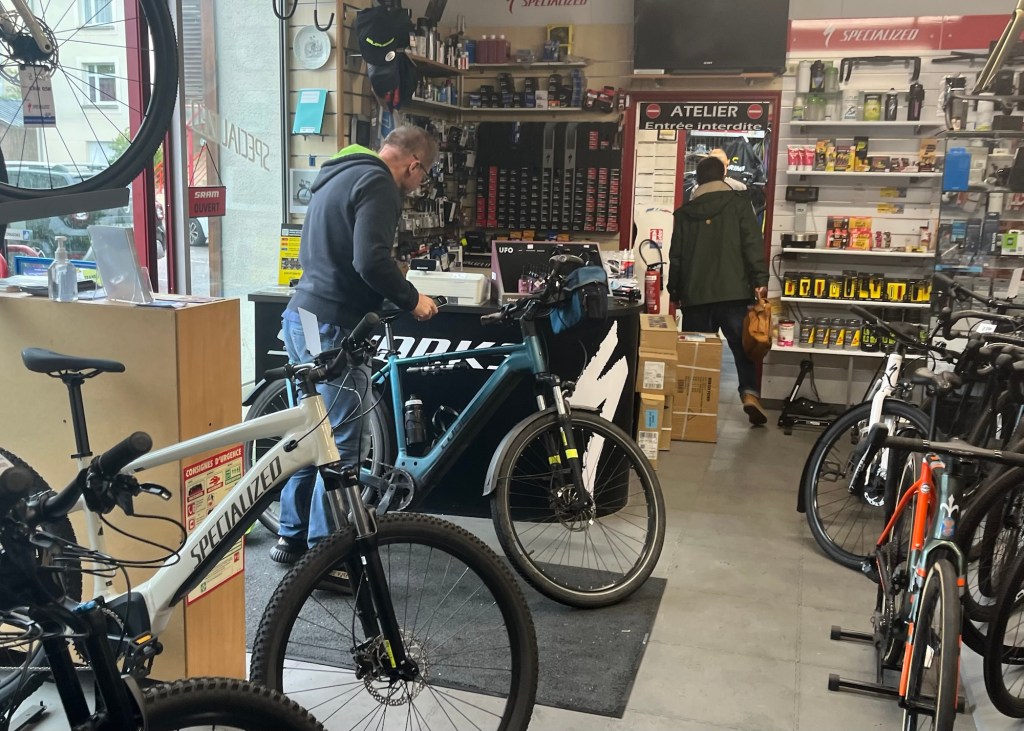
On Monday we found a bike shop in Basel. But not just any old bike shop. This was a proper Swiss bike shop with a massive range of parts, a huge workshop and prices to match. Clare’s rear brake was soon replaced, which was just as well with the Alps looming ahead.

Not just a bike shop … a Swiss bike shop

Basel itself was a lovely place for a mini city-break in the middle of a bike tour.

We enjoyed the free trams.

We enjoyed the free water fountains dotted throughout the city.

Many of these spout mountain fresh water from the mouths of mythical basilisks. Half cockerel, half serpent, they’re the guardian creatures of Basel. Filling your water bottle can be a dangerous exercise though … as the legend tells us a basilisk can kill you with just one look in your eye.

Clare is not risking catching the basilisk’s eye

We also enjoyed the work of a couple of quirky modern artists, thanks to some recommendations by our friend, David.

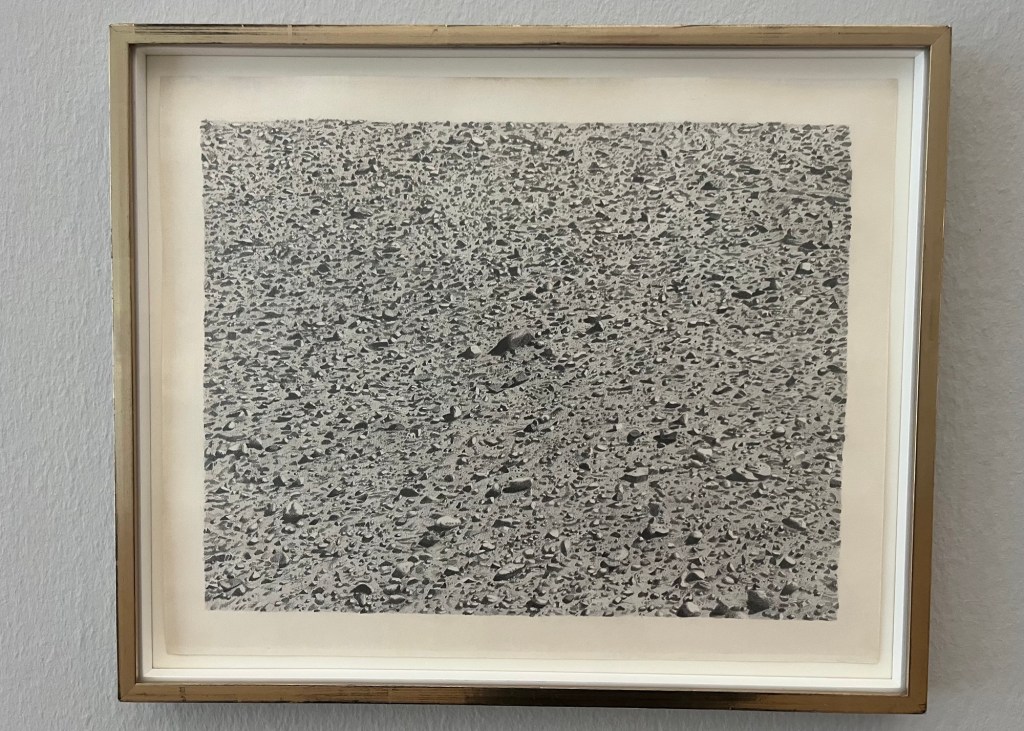
An exhibition by Vija Celmins, known for her meticulous paintings of natural phenomena such as the ocean, night skies and deserts. 

This Vija Celmins painting of a stony desert made Clare feel relieved she hadn’t chosen to cycle in Morocco after all

And a museum celebrating the work of Jean Tinguely, famous for his kinetic sculptures … machines built from bits of old junk that move and make a noise.

So how are we getting to the Alps from Basel?

Yes, you’ve guessed it … we’ll be following the rivers again. First the Ergolz, then the Aare, the Tych and finally the Reuss.

After all, they’re pretty good mountain guides!

Clare and Andy

Bath to Basel

1129km pedalled

7923m climbed

59 hours in the saddle

Ooh La La

What do you do when you’ve finally achieved your dream?

When we last posted in November 2024, we had just cycled across Europe from Bath to Istanbul, the bicycle journey we’d been dreaming of ever since we first clipped into our pedals back in 2016.

But, much to our surprise, we found ourselves wanting more. We weren’t done with bicycle touring yet, especially now that we’d discovered the extra joy of e-bikes.

Clare was dreaming of an African adventure to Morocco. Of ticking off another continent.

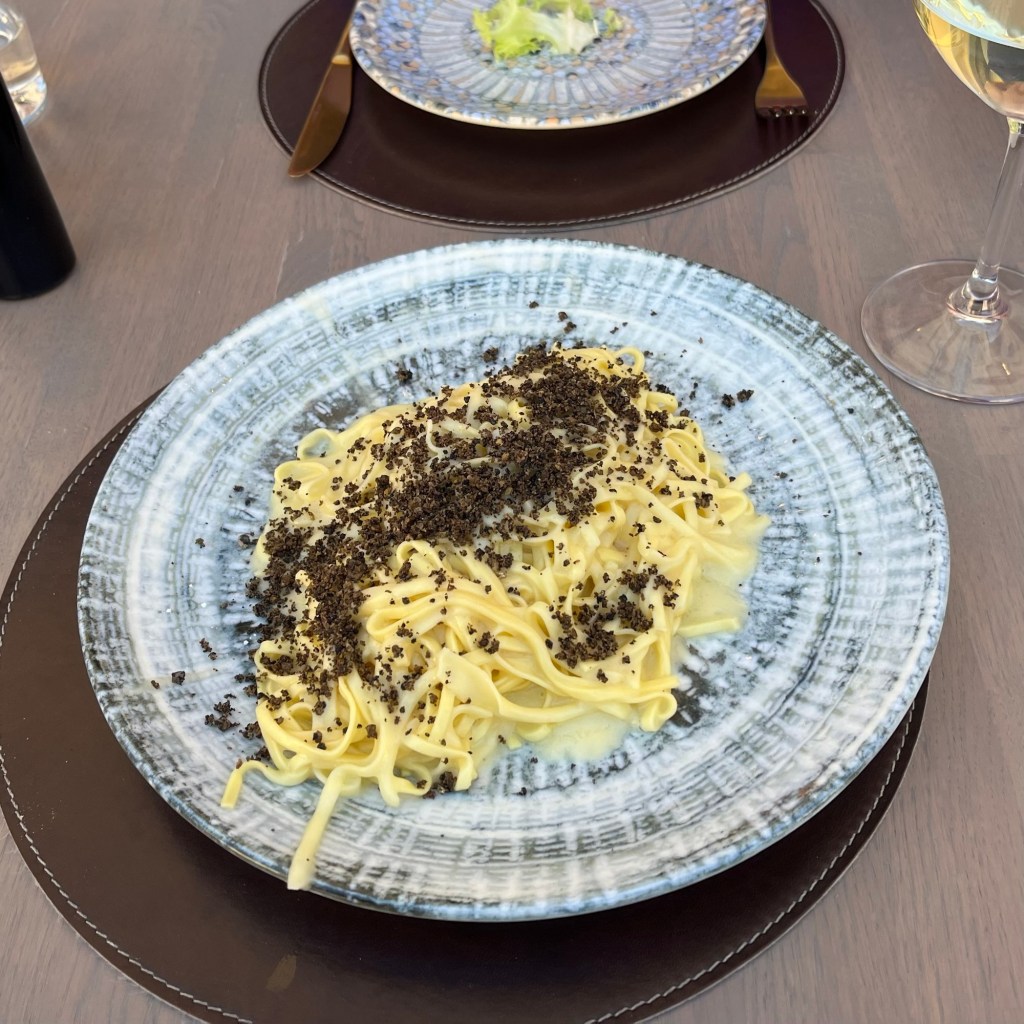
Having enjoyed a taste of Italy on the way back from Istanbul, Andy’s head was full of pasta lunches, cold Italian white wine and delicious gelato.

Memories of Tagliatelle with Black Truffles

So we checked out Morocco first. Yes, said Andy having researched possible routes, it’s do-able and the mountains will be fun. But honestly, the rest looks a bit boring … there’s an awful lot of stony desert. Please take a look and see what you think.

So Clare checked it out too. Great for a cycling holiday in the Atlas Mountains, she thought, but it doesn’t really look so appealing for a long distance e-bike tour. Too many hot dusty roads, too much busy traffic, some big gaps in accommodation. Plus some female touring cyclists do talk about getting a bit of hassle.

The pasta and wine lunches started to look a bit more tempting for her too.

So right now, we’re back on our e-bikes and are intending to pedal from Bath to Rome. 

It’s still quite an adventure … over 3000km through England, France, Switzerland and Italy. Over the Alps as well. 

And back through Spain. As we can’t fly home with e-bikes our return plan is to take a ferry from Rome to Barcelona, cycle across the foothills of the Pyrenees to Bilbao, then jump onto another ferry back to Portsmouth.

Before embarking on such a long trip, the bikes needed a full electrical check-up and a proper service. We took them to Tom at Green Park Bike Station who did an excellent job … he is highly recommended to our Bath based readers. And it was just as well we did, as Clare’s Bosch power control unit turned out to be faulty.

Imagine if that broke down while she was crossing the Alps?

After a very dry summer, the weather broke just as we were about to depart, with bands of rain coming in from the Atlantic fuelled by the remnants of Hurricane Erin.

We were lucky to dodge the showers from Bath to Winchester where we enjoyed an evening catching up with Ian and Nicola, old friends from when we lived there in the 1990’s.

Winchester Cathedral

Leaving Winchester Andy had forgotten that Komoot (our navigation App) has a deep mistrust of roads it thinks might be busy with traffic and will reroute us away from them at every opportunity. Often this means directing us down a narrow, rutted track when there’s a perfectly nice minor road nearby.

When we’re bicycle touring he checks this carefully every day. But we weren’t yet in the swing of things so Andy was out of practise.

We found ourselves pedalling up a steep, narrow, stony walking path with thick brambles on either side … just to avoid a roundabout. A roundabout we knew was totally safe for cyclists.

Just over half way up, Andy ducked under a leafy branch hanging across the path. But it wasn’t a leafy branch, it was a thick bough, which knocked him on the helmet and sent him tumbling violently sideways into the prickly brambles.

Oops!

He managed to clamber out with only a few scratches but his bike was less lucky. 

The twisting fall had snapped something inside his suspension seat post which was now moving alarmingly from side to side. No matter, said Andy, I’ll sort out a replacement in Portsmouth before we get the ferry. 

We arrived at the hotel just as the rain set in. Leaving Clare behind to enjoy the warmth, Andy set of to explore the bike shops of Portsmouth in search of a new seat post.

Unfortunately they did not cover themselves in seat post glory …

Number 1 said he’d had a recent run on seat posts and didn’t have the right size. Helpfully he gave Andy a note of the size (27.2) … so he could find it elsewhere.

Number 2 was also out of stock of 27.2’s (but he might have had some larger ones?)

Number 3 had a 27.2 (hurray) but then told Andy it was the wrong size when he tried to fit it. Andy actually needed a 30.9 … but he was out of stock of those.

Number 4 was closed for his holidays (fair enough).

Number 5 didn’t have a 30.9 but he did have a 30.8 which he reckoned would be alright. He then broke the existing tightening bolt but managed to find a replacement at the back of his drawer.

Job done … but it was a very wet and bedraggled Andy that limped back to the hotel 2 hours later.

Leaving Portsmouth

The next afternoon, after a pleasant ferry crossing, we were happily cycling along the Normandy coast from Ouistreham to Honfleur when Andy felt his saddle suddenly give way beneath him as it sank into the frame of the bike. He stopped to raise it, tightening the bolt as hard as he could. A few minutes later it happened again, then again and again.

The trouble was Andy’s bottom was acting like a pile driver with every bump he went over.

So he started riding as lightly as he could on his saddle, standing up over even the tiniest of bumps, avoiding every pothole as much as possible.

It was an obstacle course … and it was surprising to find out just how many bumps and cracks there are on an apparently smooth road.

Honfleur

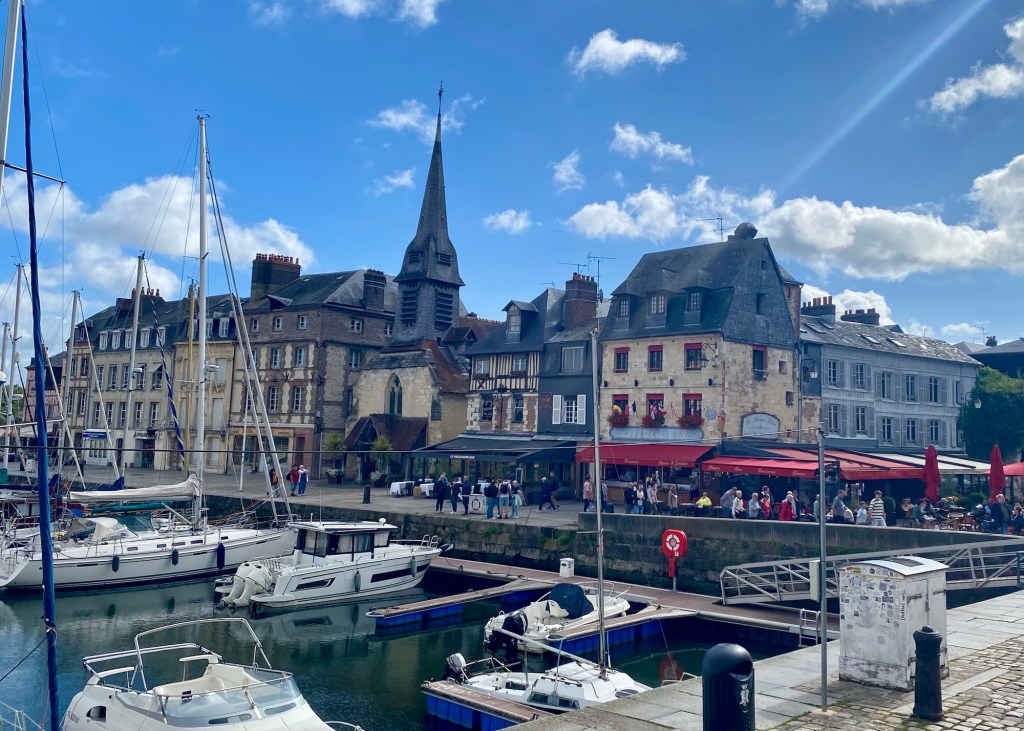
Honfleur, on the Seine estuary, is a gem. Ports don’t come any prettier. Colourful half-timbered houses jostle for position on the quays, alongside art galleries and restaurants.

Honfleur

That night Andy read about a hack for sinking seat post syndrome, a little piece of electrical tape to provide more traction plus some duck tape to create a ridge.

This was great news as tape is an important spare part for any touring cyclist so we had plenty of it with us.

But all it did was change a sudden saddle drop into a slow sinking feeling on what turned out to be a long and challenging ride from Honfleur to Rouen. It reminded Andy of riding his old Raleigh Chopper bike as a kid!

Memories of a Raleigh Chopper

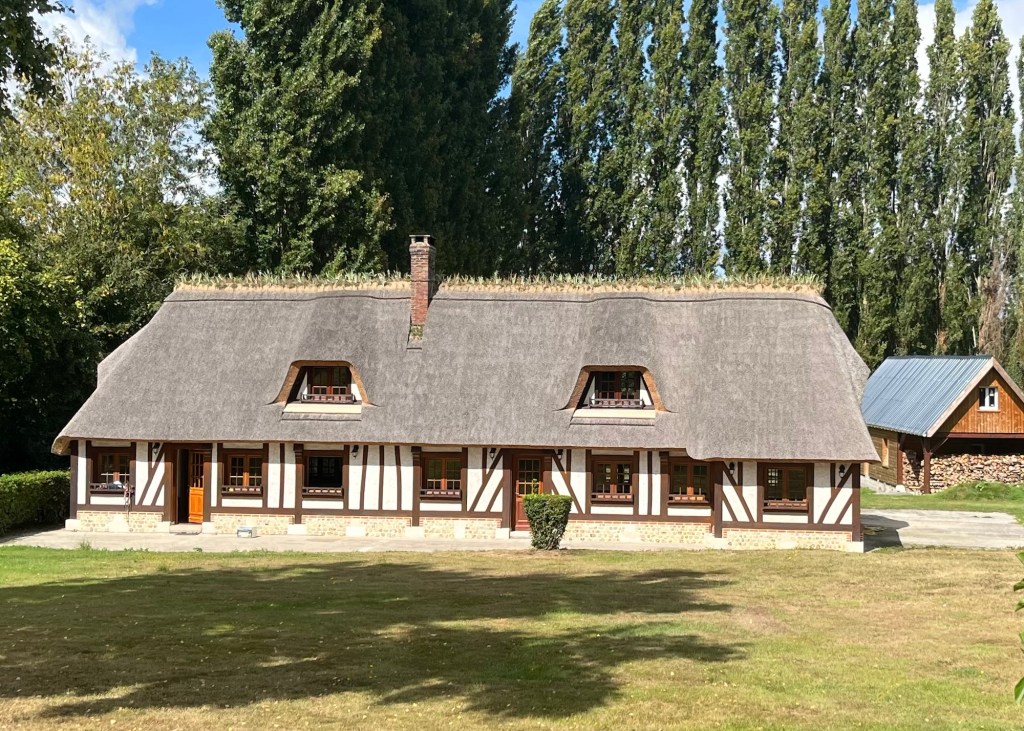
For much of the day we followed the Routes des Chaumières (the Thatched Cottage Route) through the delightful Normandy countryside, each cottage topped with that unique local tradition …. a line of irises to take up moisture and help bind the thatch together.

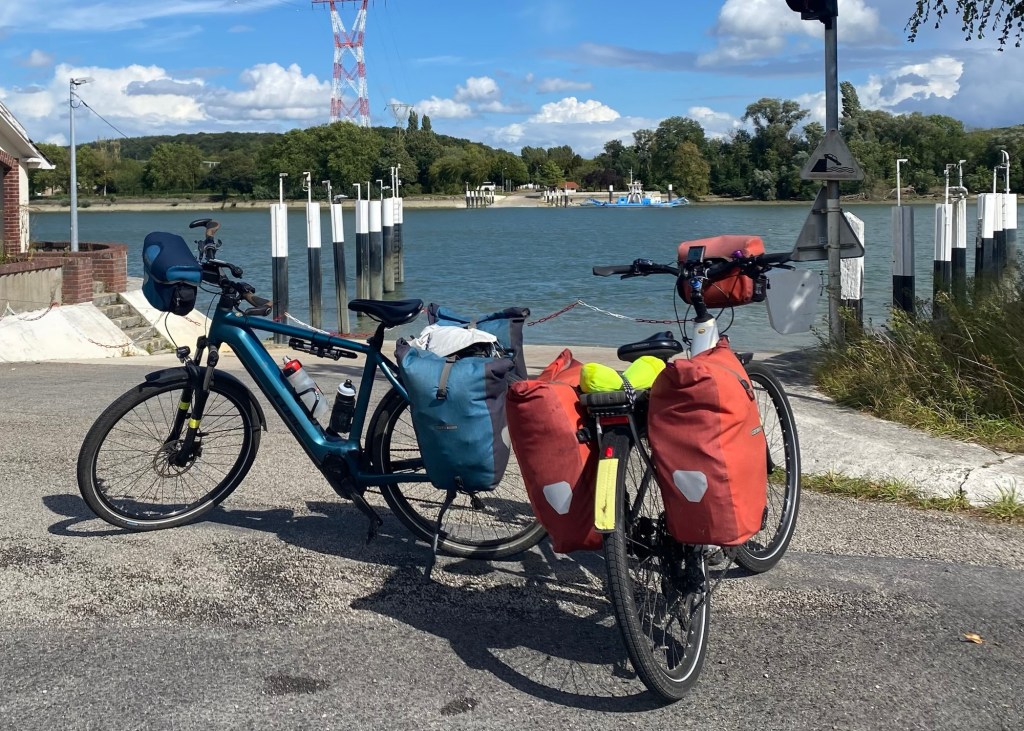
Then onto the Seine à Vélo, a cycle path that follows the river around it’s huge, sweeping bends, crossing over from time to time. Many cargo ships ply this part of the Seine so bridges are rare and in their place are several little free ferries called bacs.

Our route included three bacs and meant we could cut across some of the biggest bends. But when we arrived at the first bac it was closed because of an ‘operating incident’, back as normal tomorrow.

This bac ain’t going nowhere!

No matter … it was only a 10km deviation to get the next bac further upstream. That was closed too. Now it was 30km to get around the next bend. At least the sun was still shining.

Disconsolately we pedalled on and soon reached a point where we had a choice between a rough river path or a short but precipitously steep hill. There was a local man walking his dog. He pointed to the hill, shaking his head.

Vous n’y monter là-haut, n’est-ce pas? (You’re not going up there, are you?)

Même les cyclistes français ne font pas ça! (Even French cyclists don’t do that!)

Without admitting that she was riding an e-bike, Clare gave him a cheery wave and shot up the hill.

Ooh La La! he exclaimed, clearly impressed. He peered at Andy suspiciously … et vous?

As discretely as possible, Andy switched on turbo power and selected his lowest gear before staggering slowly up the 20% hill. Expecting to hear the man’s surprise at the extraordinary strength of British cyclists, all Andy got was …

Anglais, votre selle est trop basse! (Englishman, your saddle is too low!)

When Andy reached the top, feeling somewhat exhausted, Clare quietly admitted that she hadn’t even used turbo … Ooh La La! indeed.

Clare’s hill

To our great relief the 3rd bac was working but as we cycled to Rouen, the heavy rain eventually caught up with us. As Andy was sitting so low on his bike, a small, stagnant pond started to appear in his lap. He was sure he could see a couple of tadpoles frolicking around.

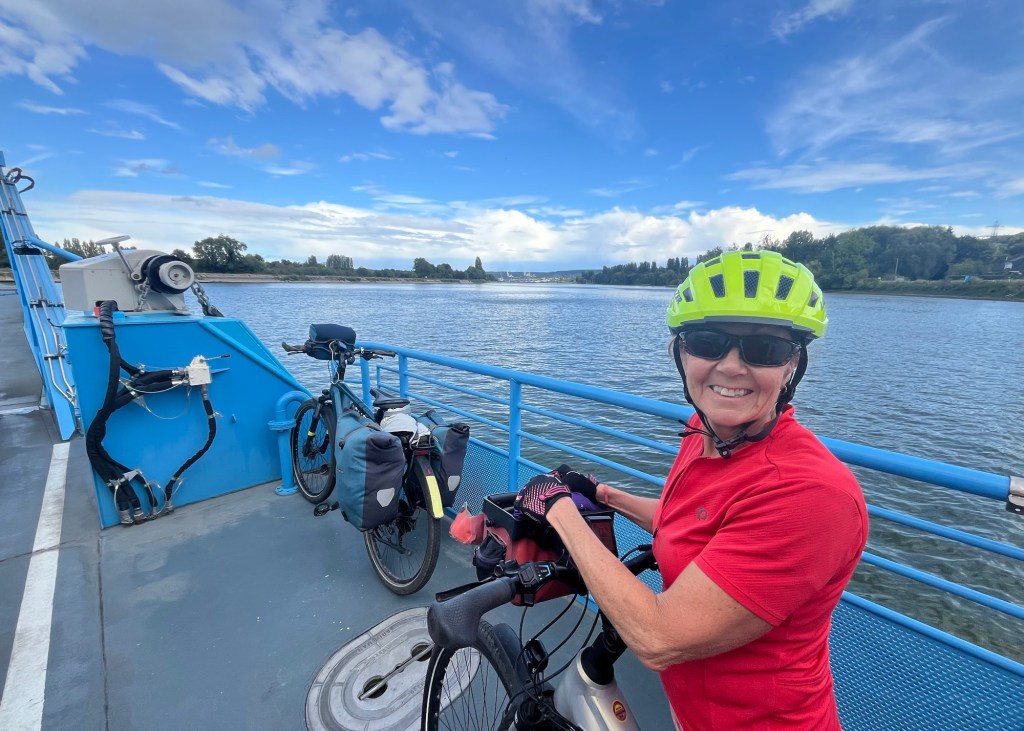
Pleased to be on a bac at last

The next morning, we took Andy’s bike to an excellent Rouen bike shop. They explained that Portsmouth Number 5 had done a botch job, not only was the seat post too small but the bolt he’d used was also the wrong size.

The French mechanics carefully replaced the seat post with exactly the right size, added a brand new bolt and coated it in friction paste for extra grip before testing it carefully to make sure it would hold. It might have been a lot more expensive but it was a much better experience.

Rouen bike fix

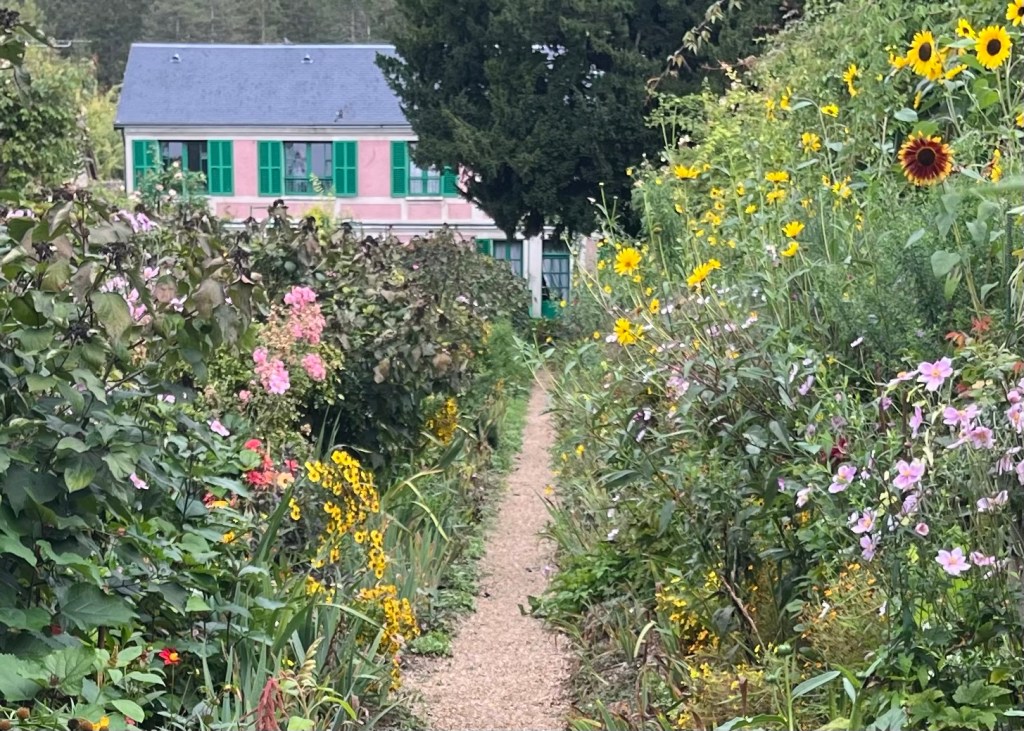
After Rouen, our next stop was Giverny, the small village where Claude Monet created his home of 43 years, together with a truly remarkable garden that includes the famous lily pond that he then proceeded to paint over 250 times. The garden was just as stunning as the paintings, even on a cloudy day.

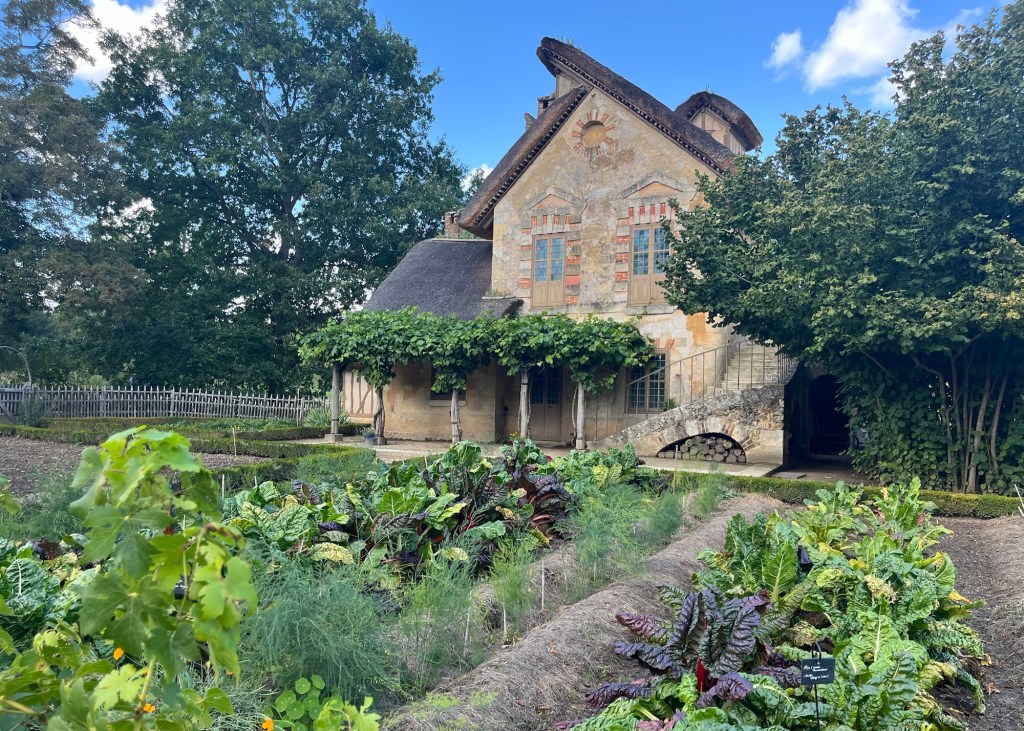
On previous visits to Paris, we’d always thought that Versailles was too far out of town to include on our itinerary. But this time we’d be cycling right by it so it would be rude not to stop and take a look.

In the Hall of Mirrors

As well as the staterooms and the famous hall of mirrors, we particularly enjoyed seeing Little Trianon, Marie Antoinette’s refuge from the stifling formality of court life. And the Queens Hamlet, a peculiar play-farm she had built to recreate the charms of rural life with a windmill and a dairy sitting right next to her salon and boudoir.

Petit Trianon
A cottage in the Queens Hamlet

Having read in the newspaper that Paris mayor Anne Hidalgo was working hard to clean up the city, improve air quality and make it cycling friendly, we decided to ride through the city centre, rather than give it a wide berth.

And the first signs were encouraging … well marked bicycle lanes, even on the busiest roads.

Clear bike lanes on a major road

Andy persuaded Clare to join him on a magical mystery tour of the famous sights on the way to our hotel.

She enjoyed cycling around the Eiffel Tower.

She didn’t object to the incredibly long queue to see the newly refurbished Nôtre Dame.

She even enjoyed cycling up the Champs Elyesees.

But when she started following Andy around the chaos of the Arc de Triomphe at rush hour, she decided enough was enough!

There are lots of people on bicycles in Paris, she thought, but only one of them is trying to ride around the biggest, busiest roundabout in the world. My crazy husband!

Too much!!

Paris did have one sting in the tail. For the first time in 10 years of bicycle touring and over 300 overnight stays, our Paris hotel charged us for bicycle storage. Quite a whack too … €17 per bike per night, adding up to €68 for a couple of nights.

Everyone we’ve mentioned this to gives a little Gallic shrug and says That’s Paris … but should they really get away with stuff like this, just because it’s Paris? We managed to negotiate the rate down by half … but even so!

Enjoying their luxury accommodation!

By far the best bit of our short stay in Paris was the late night show at the Moulin Rouge.

It was 90 minutes of magic, a whirlwind of feathers, sequins and legs from the incredibly professional dancers, interspersed with strength, virtuosity and humour from their guest artists. And the main highlight? The iconic, timeless Can-Can!

As they might say in Paris … Ooh La La!

Clare and Andy

Bath to Paris

507km pedalled (350 miles)

3,735m climbed

28 hours in the saddle

Striking out for Home

We’d made it to Istanbul! The dream had come true!

Now we had to get home.

We couldn’t fly with e-bikes and didn’t want to cycle all the way so we were looking at ferries, trains, buses and maybe a man-with-a-van.

You might think there’d be a ferry from Istanbul to, say, Athens? But no … because of the delicate history between the two countries the ferries that operate between Turkey and Greece only go as far as the nearby islands.

If we could get to a Greek island in the Aegean we could take a ferry to Athens, cycle across the Peloponnese to the other side of Greece and get yet another ferry to Italy.

In Italy there would be just one last challenge remaining. Other touring cyclists had warned us that it was almost impossible to take bicycles on international trains, say from a town in Italy to Nuremberg in Germany where we’d left our car in Frank’s care.

We decided the worst case scenario would mean we’d have to jump on a train without them, pick up the car, drive back across the Alps to Italy to collect the bikes and then drive home to Bath. A hell of a long way around … but just about possible.

Before then the first task was to get across Turkey to the coast. Everyone we asked in Istanbul just told us to take a bus.

But past experience has made us nervous of buses as it’s difficult to squeeze bulky bicycles into the luggage compartment especially if the bus is full.

Even if you buy a ticket, even if the staff at the bus station say it’s fine, even if it’s not completely full … getting on a bus with a bike entirely depends on what the driver has to say about it. And we’ve been thrown off lots of buses at the last minute.

Instead, we looked around to see if we could find a man-with-a-van in Istanbul or maybe a one way van rental. Sadly, these proved to be ruinously expensive.

So still feeling quite fit, we decided to cycle the 400 hilly kilometres instead.

Leaving Istanbul

Before climbing back onto our bikes, we could get well on the way by taking a ferry across the Sea of Marmaris. Arriving at the terminal on a blustery day, tickets in hand, we were soon approached by a flustered looking official.

“Where you go?” he asked.

“Bandirma,” Andy smiled back.

His face dropped. “Oh no. Sorry, no. Big problem. Bandirma boat cancelled. Much wind. Sorry, winter much wind problem, sorry.”

Using Google Translate, he explained that it wasn’t just blustery in the middle of the Marmaris, it was a very windy Force 7, far too much for the ferry. The wind wasn’t going to calm down for at least a couple of days.

Helpfully, he took us over to a map.

“Other way possible,” he said. “This one” (to Mudanya, quite near our planned cycling route), “3 o’clock … maybe go? … maybe not?”

“Or this one” (to Yalova, a long way away from our cycling route), “go in 20 minutes. Bigger boat. OK … this one OK.”

So we went on the bigger boat. After all, what was one extra day of cycling?

As it turned out, we both enjoyed the 80 kms enforced ride to Mudanya that day. We felt good after 4 days off the bike in Istanbul, cycling first on wide main roads and then on a lovely quiet coast road, watching the late afternoon sun sink down in the sky.

But keen to get to the Aegean as fast as possible, we convinced ourselves it might be easier to find a man-with-a-van in a small town like Mudanya.

Again, everyone we asked kept telling us to take the bus instead. It’s different in Turkey, they said. Many bus companies in Turkey, no problem with bicycle, all they want is your money. Anyway buses not busy now, not holiday season.

So we took a deep breath and decided to give it a try.

They were right about the huge choice of long distance bus companies; there was a dazzling array to choose from. We bought tickets to Kuşadasi and waited. No problem, the ticket ladies said. Of course you can take bike on bus, don’t worry.

Just a few bus companies

When the bus arrived, 20 minutes late, it was packed with both people and luggage. The driver was clearly not at all happy. But after a lengthy discussion with his colleagues, full of head shaking and pointing, he reluctantly moved some bags and helped us to jam the bikes in, front wheels removed.

The bus itself was fantastic. Lots of space, great leg room, a clean loo, plus free drinks and snacks served by two friendly hosts.

We settled gratefully back into our seats and day-dreamed … as long as the bikes survived, we’d have time for a mini Turkish holiday by the sea … we could explore the area on our e-bikes, potter around the old town, eat delicious Turkish food and visit Ephesus. We wouldn’t even be using any precious Schengen days.

Mmm … as long as the bikes survived …

Kuşadasi

And miraculously they did survive.

Despite bent mudguards, bells no longer working and loose fittings, there was no major damage. The mini Turkish holiday in Kuşadasi was everything we had dreamt of.

The theatre at Ephesus

Wandering around the ancient port of Ephesus, it was easy to imagine a bustling, cultural city first of the Greeks, then of the Romans; or to imagine early Christians making a pilgrimage in honour of St Paul, St John and Mary, mother of Jesus, who was said to have lived there for her final years.

We were particularly struck by the ‘Terraced Houses’, luxurious Roman family homes with plumbing, heating and lavish interior frescoes built within strolling distance of the many temples, theatres, libraries, public baths and shopping centres; the remains of which still line the marble streets.

Ephesus Terraced Houses

On the ferry across to Samos (the closest Greek island to Kuşadasi) we bumped into David, a lone touring cyclist from New Zealand who was nearing the end of a long trip from London to Istanbul and then around Turkey and Greece. He’s been doing it the hard way … no e-bike of course but also no apartments as he was wild camping most nights on beaches, behind mosques or on any patch of grass he could find. An amazing experience but very tough … full respect to him.

Chapeau David!

As well as being good company, David was brilliant at foraging for food. An endless supply of goodies emerged from his panniers … sweet figs, juicy persimmons, even some fresh fish he’d bought straight off the boat.

David, loaded up

Now we’d arrived in Greece, we’d have to put our skates on, as we only had 23 Schengen days left. But … we weren’t going anywhere quickly as the Greek ferry workers had called a sudden 48-hour strike which meant that our ferry to Athens was cancelled. Two days later they extended the strike by a further 48 hours.

When we got to the front of the queue at the local Blue Star Ferries ticket office, the lady told us how lucky we were to have grabbed the last cabin on the next ship out.

“I must book it quickly before it goes,” she said.

“Well lucky and unlucky,” mused Andy, thinking about the delay.

She didn’t miss a beat. “No, no, no …  you are very, very lucky,” she said. “You are forced to stay more days on the beautiful island of Samos. The sun is shining, the sea is still warm, what can possibly be nicer?”

Samos

And she was right, those few extra days on a beautiful Greek island turned out to be another wonderful mini break. As we slowly explored Samos on our e-bikes (the perfect way to get around this very hilly island) we forgot all about the strikes and our ticking Schengen time-bomb.

We stayed in an aptly named apartment called Heavens Door with a view to die for. We ate fish for lunch, drank cool white wine and even swam in the sea.

We sent grateful thanks to the ferry workers!

View from Heavens Door

However, the delay from the strike did create one onward travel headache … we now only had 2 days to cycle 240km across the Peloponnese from Athens to Patras. Too much for us … now that we’d lost fitness and gained a few pounds from all the mini breaks!

Arriving in Athens at 3 o’clock in the morning, we found a friendly hotel foyer to hang out in until dawn and then managed to book ourselves and our bikes onto a small suburban commuter train that ran out to a place called Kiato, cutting the ride down to just 120km.

It was a national holiday in Greece, celebrating the moment in 1940 when they said “Oxi” or “No” to Mussolini when he told them to allow Axis troops to enter the country or face war. It’s been celebrated ever since as a source of great national pride with parades, flag waving and marching bands.

Oxi Day made for an easy introduction to travelling with e-bikes by train as we practically had the 6:15am to ourselves.

Nice and easy

The ferry to Italy was almost a mini cruise, steaming for 24 hours through the Ionian islands, past Corfu and then up the Adriatic.

It had always been our plan to cycle for a few days in Italy as long as the weather was OK and we had enough spare Schengen. We wanted to get a taste of Italy as we hope to come back and explore more of the country by e-bike another time.

Taste is the right word … as Italy lived up to its culinary reputation, enticing us to stop for extended pasta lunches every day, always washed down by a glass or two of Italian wine.

Spaghetti with Mussels and Tomato

And we needed that pasta to power us, as Italy also lived up to its reputation for brutally steep hills. So steep that on the second day of cycling from Pergola to Carpegna we even had to recharge our batteries over lunch, something we’ve never contemplated before.

Folding Hills of Le Marche

Which was easier said than done.

Most of the electrical sockets were old fashioned Italian 3-pin plugs, which our 2-pin European adaptors didn’t fit into. And it was All Saints Day (a public holiday) so none of the shops were open.

Furthermore, we found ourselves at the epicentre of a famous truffle festival which meant that the restaurants were jam packed, full of contented gourmands enjoying this special delicacy.

But the Saints must have been smiling on us. We rounded a corner to find an open supermarket, stocking the adaptors we needed. Then on the edge of town, we cycled past a restaurant with just one free table available on the terrace.

So whilst the batteries recharged, we recharged ourselves with Tagliatelle smothered in Black Truffle shavings and a couple of glasses of delicious Verdicchio to wash it down. It was perfect!

Tagliatelle with Black Truffle

But … we still had 60km to ride and several hills to climb, including a 750m summit finish to Carpegna. Maybe it was the wine that made us forget the clocks had just moved back to winter time. We’d be lucky to get there before dark!

Fortunately, the e-bikes were also feeling nice and replete. They were happy to ramp up their power and speed up the hills in the glorious late Autumn sunshine, whilst we revelled in the stunning landscape of Le Marche region.

It will go down as one of our more epic cycling days (and the only epic cycling day with a good lunch!)

Appropriately, the Italian food bicycle tour ended in Bologna, famous as Italy’s food capital. Here, we indulged in even more pasta and gelato and enjoyed wandering through the porticoes to visit the sights … Europe’s oldest university, the famous two towers, the unfinished Basilica.

Strolling through the porticoes of Bologna
Bologna

There was one final treat in Bologna.  We were amazed to find a train with two bookable bike spaces that would take us all the way over the Brenner Pass, through Austria and then onto Munich. Bike spaces that were booked out for every single day, except for the one day we wanted to travel!

A glance at the amazing train travel website that is ‘The Man in Seat 61’ told us that we would be travelling on a brand new, shiny red, Austrian train with easy access, luxury accommodation for the bikes, comfortable seats for us and even a buffet car to help pass the 8 hour journey.

But when the train rolled in (only 25 minutes late), it wasn’t red, it wasn’t shiny, it certainly wasn’t new. It looked tired and old.

Another strike!

The previous day, the Italian railway union had called everyone out in protest at staff safety arrangements after a conductor was attacked near Genoa. Fair enough. But it meant that all the trains were in the wrong places. Which meant that the Austrians had to pull this one out of retirement from a dusty siding, as an emergency measure.

We were soon joined on the platform by two incredibly helpful female conductors, one Italian, the other German. Follow us, they said. We’ll take you to the carriage for the bicycles. We followed them to the far end of the train.

Oh dear, they said when we got there. It hasn’t been connected. Never mind, follow us, we have a guard van, you can put them there. We followed them to the other end of the train.

But the rolling door to the guard van was jammed shut. Oh no, this is no good, they said. Go to the next carriage and put one bicycle at each end.

Which we did, lifting the heavy bikes up precipitous steps, then jamming them uncomfortably between the loo and the train door.

Not good!

The train set off but we didn’t think our efforts would be up to Health and Safety rules.

When they came through the train to check the tickets, they agreed. No, no this doesn’t work. Go to the next carriage. There you will find hooks to hang them on.

We lugged the bikes through the train. Unfortunately, those hooks were designed for the sort of streamlined road bike beloved by Italians, not our heavy e-bikes with their thick tyres. They simply didn’t fit.

Oh dear … problem after problem, they said. But don’t worry, it’s not your fault. It’s because we changed the train. Phew, we thought … they’re not going to throw us off.

Suddenly Andy had a bright idea. Could we take the bikes off the train at the next station, go back to the guard van but lift the bikes up through the passenger door and into the guard van from the inside? Mmm, they said.  Yes, yes, maybe this could work.

Verona was the next station and half of Italy seemed to be getting onto our train. Not surprisingly the doors to the 1st class carriage were also jammed, so all those passengers now had to climb on through the guard van. The two lovely guards continued to be friendly and sympathetic, the other passengers a bit less so! 

After much gesturing and shrugging Italian style, we managed to get the bikes into the van, where they lived in luxury for the rest of the journey.

Luxury accommodation

The platform in Munich was on the opposite side of the train. On that side, the guard van door rolled up without a hitch so the bikes came off very easily. We celebrated, perhaps a little prematurely, as we still had to get onto the connection to Nuremberg.

This turned out to be a sleek German Inter City Express high speed train, travelling all the way to Hamburg. It didn’t look at all like the type of train you could take a bicycle on.

But we found one carriage with two huge bicycle images printed on the outside. With easy roll-on access, there was a lovely space for the bikes. The only problem was that the tyres were again too thick to fit onto the safety attachments. The more officious conductor took one look and started scrolling through his regulations.

Oh no! Were we going to fail at the final hurdle?

He lifted his head, smiled and asked “Can you lock the bicycle to this attachment?”

Yes. Yes! YES! … we can!!

On the train from Munich to Nuremberg … phew!

We had made it to Nuremberg, ready to enjoy a celebratory curry with Frank as a thank you for looking after our car. Lots of great German beer, lots of laughter.

From Nuremberg it was a two day drive back to Bath, arriving in Phileas Fogg style, exactly 80 days since we’d set out. We cruised through the French customs without incident … despite the strikes we’d only used 17 Schengen days to get home from Istanbul, so we still had a whopping 6 days left!

Back to the car in Nuremberg

All this public transport has taught us a few lessons for future e-bike tours:

  1. Ferries are the best – there’s plenty of room for bikes, no fuss, no extra charges.
  2. Bookable trains are easier than we thought (with an extra charge for the bikes) – as long as they come with a friendly conductor.
  3. Buses are a last resort – e-bikes are simply too big to go in their luggage compartments, it’s rude to try.
  4. Most of the staff on the ferries, trains and buses are incredibly helpful. They’re on your side and will get you on board if they possibly can.
  5. It’s more difficult than you’d think to find a man-with-a-van in Turkey.

When we first set out on this odyssey, both of us had secretly decided it was probably our last long bicycle tour. But after a few weeks on the road, we both realised that we’re not ready to hang up our cycling shorts just yet.

The e-bikes are simply too good and there are too many wonderful places to explore.

Clare suggests going to Morocco next … to experience an African adventure.

Andy suggests Italy … to eat more pasta.

Watch this space.

Clare and Andy

Nuremberg to Istanbul to Bologna (this year)

3,746km pedalled (2,328miles)

28,014m climbed

193 hours in the saddle

Bath to Istanbul to Bologna (the whole journey)

5,075km pedalled (3,153miles)

35,803m climbed

264 hours in the saddle

2024: A Cycling Odyssey

It’s impossible to over state our emotions as we pedalled that last kilometre towards the mouth of the Golden Horn, finally arriving in Istanbul on an overcast Sunday in the middle of October.

Gateway to the East, the junction between Europe and Asia. Through the centuries Istanbul has seen a huge number of mystics, merchants, nomads and conquerors pass through its walls … and now it was welcoming two emotional touring cyclists from Bath.

But why not feel the enormity of the moment?

Since leaving our car at Frank’s shop in Nuremberg in late August we’ve cycled 3003 kilometres (1866 miles). 39 days in the saddle.

And if we look at the whole trip since we left Bath last summer it’s 4332 kilometres (2692 miles). 56 days of cycling across 9 countries.

It was nine years since Clare first came up with the idea of cycling to Istanbul during a chat around our kitchen table.

And it was fourteen months since we were forced to stop our journey in Nuremberg because of Andy’s racing heartbeat from Atrial Fibrillation. Almost exactly a year since his catheter ablation gave us the chance to go back and try again.

During those nine years we’ve been on many bicycle tours to many amazing places. But Istanbul was always the dream destination, the big one, the journey of a lifetime … our personal cycling odyssey!

Yet the junction between Europe and Asia seemed so far away, much further than we’d ever cycled before. It just felt too big a challenge.

Those kitchen table chats went round and round in circles … can we really cycle that far? … can we be away for so long? … what’s the best way to go? … when’s the right time? … will we be limited by the post-Brexit Schengen visa restrictions?

The more we talked about it, the more we decided that no, we couldn’t do it. We weren’t getting any younger and various bits of our bodies were starting to complain in a way that they hadn’t before. Istanbul was just going to be too much!

But then we switched to e-bikes and realised we could travel much further each day for the same number of hours in the saddle. We discovered that whilst e-biking is still good exercise, we don’t suffer from the same level of exhaustion from hill climbing as we did on our old steel touring bikes.

Suddenly the cycling odyssey was back on!

Any bicycle tour of this length is not just about the pedalling …

It’s a lot of staring at maps and planning the best route for the next day.

It’s many hours spent researching the most appropriate places to stay.

It’s endless packing and unpacking of our panniers, trying to remember to put things back in the same place.

It’s taking the batteries off the e-bikes and recharging them every night.

It’s plastering on enough chamois cream or vaseline to keep the saddle sores at bay.

It’s washing out smelly cycling shorts in a hotel sink.

But best of all it’s about being in a bicycle touring bubble together, riding behind each other or side by side, sharing a lot of date nights, both equally consumed by the whole experience.

“A journey of a lifetime is measured by memories, not by time.” Debasish Mridha.

The final leg of this journey-of-a-lifetime got off to a rather bleak start.

Leaving Bucharest on a cold damp morning we cycled back towards the Danube across the featureless farmland of the Danubian Plain. Now widening out as it heads towards its delta, the river has always been a formidable barrier in this part of the world, protecting Romania from many an invading army.

And so it proved for us.

Amazingly until 2013, there was only one bridge over the Danube from Romania to Bulgaria, the ‘Friendship Bridge’ between Giurgiu and Ruse which opened in 1954. Even now there are still only two, the second being the ‘New Europe Bridge’ which is much further west near the Serbian border.

There are several ferries we could have aimed for but the best crossing point for our route was easily the Friendship Bridge. Now old and tired, it’s in need of substantial repairs which means lane closures and lengthy queues.

Bulgarian Border

That gave us plenty of time to gaze across at the forbidding industrial landscape that greeted us as our first view of Bulgaria.

And to pick our way through the questionable cycle path that led to the border controls.

Is it that way?

Oh! Maybe not?

Before arriving in Bulgaria we knew even less about the country than we did Romania. So we decided to pedal first to the historic city of Veliko Tarnovo in order to learn a bit more.

Veliko Tarnovo

Tucked into some dramatic bends of the Yantra river and surrounded by an amphitheatre of forested hills, Veliko Tarnovo is a gem. Capital of the second Bulgarian Empire (a two hundred year respite from Ottoman occupation between the 12th and 14th centuries) Tarnovo was also the site of the declaration of independence for the modern Bulgarian state in 1908.

To mark its status as the country’s historic and cultural capital, Veliko meaning ‘Great’ was added to the city’s name in 1965.

Tsarevets Fortress, citadel of the 2nd Bulgarian Empire

Clare scored us a great last-minute-midweek-hotel deal there, a 5-star boutique hotel with only four beautifully curated rooms, a significant upgrade on our normal digs which we have to admit added to our enjoyment of the city.

Best room

The worst room of the trip also came in Bulgaria, the bed so uncomfortable that Andy pulled the mattress onto the floor in the middle of the night. In the morning he realised the discomfort was caused by some spare wooden bed slats left under the mattress. What a delicate princess-with-a-pea he is!

Worst room

After leaving Veliko Tarnovo we pedalled onto Elena, gateway to the Balkan Mountains that split Bulgaria in two, north and south and give their name to the whole Balkan region.

Here we stayed in a small workman’s cottage with a charming owner who re-assured us that the quiet pass we’d planned for the next day was indeed the perfect way to cycle over the mountains.  

Then he went on to tell us that there are only three border crossings between Bulgaria and Turkey. Only three!

“Don’t go main road way to Edirne” he said, “Many big trucks from Istanbul. Many people coming in car from Holland or Germany.”

“Better you go Black Sea. Very beautiful. Especially Sozopol, much beautiful place.”

“Then you go through nature park to other border. Third border. Not many people go there. But oak trees, oak trees far as you see. Much better for bicycle. You go that way.” 

So we did. And he was not wrong.

Those two days of climbing, first over the Balkan Mountains and then up through Strandja Nature Park to the Turkish border, were one of the highlights of the whole trip. The Balkan Mountains are covered in a carpet of ancient beech, hornbeam and spruce forests, Strandja Nature Park in ancient oak trees many of them well over 500 hundred years old.

With barely any cars passing by, the sun shining in a clear blue sky overhead and with every ridge and fold of the hills covered in a thick carpet of trees, it felt as if we had been plunged into a sparkling pool filled with fresh forest air.

A carpet of trees

Ever keen to preserve her battery, Clare once again stayed in blue (level 2 support) for the whole of both climbs. Andy gambled on purple (level 3) simply to try and keep up with her. It was cutting it fine … on both days he rolled up to our accommodation with just 3% of his battery left!

Into the oak forest

Once we got over the top of the Balkan Mountains and into Southern Bulgaria the landscape changed considerably. Gone were the lush forests, replaced instead by an open, arid, Mediterranean outlook.

An arid feel to the south

The south also seemed poorer to us, more neglected. For example, we rode past several piles of fly tipping, something we hadn’t noticed before.

This got us to thinking about the pre-conceptions touring cyclists and other slow travellers bring to the countries they pass through.

We hadn’t expected to like Bulgaria very much and found ourselves noticing things that continually reinforced that view … the litter, the abandoned dilapidated buildings, our difficulty understanding the Slavic language and Cyrillic alphabet, the food always smothered in cheese (which Clare hates), the apparent brusqueness of the people.

We felt we were in a kind of negative reinforcement loop that was hard to get out of. 

Many of the same things were also present in Romania but that was a country we expected to like. There we only found positive reinforcement … the rustic charm, the smiles from friendly people, the easier Latin based language. 

This didn’t seem fair to Bulgaria somehow.  But you can’t help what you think as a traveller passing through.

We decided we’d need a spectacular experience to shock us out of the negative spiral and see the country afresh through more positive eyes. The two days of riding up through the forests almost did it … they were amazing, inspiring, incredibly beautiful, almost enough to change the spiral. But not quite.

Reaching the Black Sea

The Black Sea coast didn’t reverse the spiral either.

Much of the cycling was challenging, along busy roads or along some of the worst maintained cycle paths we’ve ever pedalled on.

Worst cycle path ever?

One Sunday we were bumping down such a cycle path when the heavens opened into an almighty thunderstorm that forced us to shelter under the trees for an hour. 

Eventually we took refuge in a pop-up fish restaurant full of people enjoying a family lunch.

Our host in Elena was right, Sozopol is a charming old town … full of meandering cobbled streets and pretty wooden houses, all huddled together on a narrow peninsula.

Wooden house in Sozopol

And Tsarevo, further down the coast, is a pleasant family resort.  Both are notable for being unusually clean, swept and scrubbed each morning by an army of street sweepers armed only with straw brooms.

Tsarevo

On the way up from Tsarevo to the Turkish border, we paused in the tiny village of Kondolovo, delighted to find a coffee vending machine with real Italian coffee!

A welcome sight!

These coffee machines are extremely popular in Bulgaria. They’re everywhere … on street corners, in bus stops, even in remote villages … and they offer a shot of surprisingly good coffee for a very low price.

A welcome break!

At the border we were surprised to come across a number of coaches which must have driven up the main road from Burgas, each one taking 20 minutes or so to process. No matter … Clare cleverly sliced her way through the queue of traffic like a knife through butter with Andy following sheepishly in her wake.

Within minutes we had left the EU and the Schengen zone behind.

Clare slicing her way through the border in record time

From the border it was a three day ride across Eastern Thrace (European Turkey) to reach Istanbul. Turkey already felt very different … mosque minarets signalling the next village in place of church towers, women dressed in burkas, groups of old men languishing outside every tea shop.

But they all gave us a notably more cheery welcome as we pedalled through, waving and calling out encouragement.

The ride into Istanbul itself is notorious in the bicycle touring community for being especially difficult, highways full of impatient mad drivers, narrow side roads completely blocked by traffic, roadworks everywhere.

We followed the advice of a couple of young bloggers and hugged the Sea of Marmaris as closely as we could. It turned out to be a mix of the serene and the scary.

Serene

Serene as we cruised gently along coastal cycle paths, weaving our way between families enjoying their weekend stroll. Scary when we were cast out into the traffic, winding through suburbs in a desperate attempt to avoid any main roads.

Scary … perhaps not the best time to try the pavement!

But it wasn’t as bad as the warnings suggested so after reaching the Golden Horn we decided to carry on cycling through this crazy city taking in its sights and sounds. We even caught a ferry across the Bosphorus to Anatolia (Asian Turkey) … just to make sure we’d properly completed our journey from West to East.

Enjoying the Bosphorus ferry

By the end of the day we were weaving through the traffic like a local Deliveroo rider!

We’ve been lucky enough to visit Istanbul a few times before and it’s one of our favourite cities. An enchanting blend of Eastern and Western culture, it’s a vibrant modern city but with many layers of history to peel away … from Byzantium to Constantinople to the Ottoman era to the Turkish War of Independence.

The famous Hagia Sophia

Jam packed with people, Istanbul is chaotic, colourful and confusing with extraordinary experiences lurking around every corner.

A fitting destination for our cycling odyssey.

Spice market

Now it’s time to turn around and travel west in order to get home. We have 23 Schengen days left to get back to Bath. Our rough plan uses 20 of them so there’s not much time for things to go wrong.

We can’t go on planes (as they won’t carry our e-bike batteries) but trains and automobiles are part of the plan. As are buses and ferries, lots of ferries … and a bit of cycling.

Not much cycling though, that part of the odyssey is done.

Clare and Andy

Bath to Istanbul

4,332km pedalled (2,692miles)

27,209m climbed

224 hours in the saddle

Drum Bun across the Carpathians

Pedalling out of every village in Romania we were sent on our way with a cheery Drum Bun … bon voyage, safe journey, happy trails, good road.

It became the drum beat of our journey through Transylvania … calling out Drum Bun to each other as soon as we saw the sign, backwards and forwards, loud and joyous.

We even wished startled Romanians Drum Bun, occasionally greeting people who were simply sitting outside their house. It’s easier to say than most Romanian phrases.

And sitting on a bench outside your house watching the world go by is something older Romanians do a lot.

It’s part of the rustic charm of Transylvania, together with the conical haystacks, the horse and carts, the honey trucks, the Saxon villages.

Photo Credit: True Romania Tours

At times it seemed we were pedalling through a living history museum.

Before coming to Romania, we have to admit that we thought Transylvania was a range of mountains. We were also a bit vague about the Carpathians … maybe they were further East?

We learnt that Transylvania is one of four historical regions, together with Wallachia to the south, Moldavia to the East and Dobruja by the Black Sea. The Carpathians are the mountain range, sweeping through Transylvania like a fish hook.

The Carpathians Photo Credit:Wikipedia

Our route took us north of the Southern Carpathians, then across the Transylvanian Plateau

Transylvanian Saxons were first invited to colonise this area in the 12th century. Initially they came from the Low Countries, especially Luxembourg, whose language is the most similar, then later from across modern Germany.

These people created the unique appeal of Transylvania but have now almost entirely disappeared, driven away by the deprivations of the communist era to Austria or Bavaria.

Having learnt about the ‘tragedy’ of the Trianon Treaty to Hungarians it was interesting to hear a different point of view. Transylvania voted to join Romania (not Hungary) on 1st December 1918 two full years before Trianon, with the date still commemorated as a national holiday, Great Union Day.

History is all about perspective.

Sighișoara streets

As well as plenty of rural rustic charm, we pedalled through some delightful Saxon towns, notably Sighișoara with its narrow, colourful winding streets and Făgăraș with its stunning renovated castle and Orthodox Church.

Făgăraş Orthodox Church

Any google search for independent travel in Romania throws up many a dire warning. Don’t rent a car, the roads are terrible, the drivers suicidal. 

We beg to differ.

Of course we went on quite a few rough roads, including our fair share of gravel tracks but surprisingly we found ourselves cycling on brand new tarmac a lot of the time. 

New tarmac on a mountain pass

Recognising that the legacy of a creaking infrastructure from the Ceausescu era is holding the country back, the government are half way through a €17bn investment  programme to build new roads and improve existing ones, much of the money coming from the EU.

It shows … and some of it is even being spent on small country roads.

But it wouldn’t be a Clare and Andy bike tour if we didn’t find ourselves in some scrapes when the tarmac runs out.

One day we pedalled down a series of small roads through a chain of villages. The road became gravel, then a farm track, before reaching a narrow suspended footbridge.

There were some serious warning signs …

Andy went to investigate … the wooden boards did seem a bit rotten in the middle. Probably not worth the risk.

But maybe, just maybe, could it be ok?

As he was pondering, Andy gradually became aware of some loud shrieking noises behind him. It was Clare explaining just what she thought of the whole situation …

“NO WAY am I going across that bridge!”

“You are TOTALLY CRAZY. I would rather go ONE HUNDRED kilometres to get round!!”

“It says PERIL OF ACCIDENT … STRICTLY ANT-TER-DEE!!!”

So we did go round … not 100km but about thirty, back to the main road we’d been trying to avoid, back to the white van drivers late for their last delivery and worst of all back to huge swarms of flying ants that had come out to enjoy the evening sunshine.

Another attempt to avoid the main roads

As well as the roads, the drivers in Romania have been better than advertised.

Romania might have its fair share of boy racers and impatient white van drivers but most people have been pretty good. In fact, we’d put Romania in a solid mid-table position in our Clare & Andy Driver Courtesy League (Holland at the top, Argentina at the bottom) which positions Romania above the UK … who are flirting with relegation!

The other thing we were warned about in Romania were packs of dogs.

It’s common for villagers in Transylvania to let their dogs roam free, especially late in the afternoon. They get together with their mates and there is nothing they like more than chasing unsuspecting touring cyclists … rushing out to bark and yap at us, maybe worse.

Our natural instinct is to speed up and try to outrun them … but we’d read this is exactly the wrong thing to do. It triggers their chase instinct and they can easily out-pace and out-last us.

We discovered this for real when this little dog peeled off from his pack and chased us for over six kilometres, sometimes overtaking just to show us that he could. 

He was completely harmless, only wanting to run alongside us for a bit of fun. It was only when we reached the rival dogs at the next village that he gave up and returned to his friends.

To be honest, most of the dogs we’ve seen on the street have been equally harmless, lazily raising an eyebrow as we passed by or politely crossing the road to let us through. Most of the barkers and yappers have been behind a fence with the real devil dogs properly chained up.

The one time we came across a more aggressive pack we did what the experts suggest (even though it’s completely counterintuitive). Slow down, stop, get off your bike, place it between you and the dogs, make a commanding noise and raise your arm as if you have a stone.

The only problem is it takes Andy a very, very … very long time to get off his bike. So long that Clare has likened him to a floundering elephant. Enough time for a snarling dog to take a piece out of him.

Andy’s normal method of getting off his bike

But adrenaline kicked in.

He leapt off, shouted “Oi! Oi!”, stood tall behind his bike and put his arm in the air. It worked … the snarls stopped and the dogs slunk away to a safe distance.

Andy had made himself Top Dog!

A guesthouse devil dog warning

Vlad Dracula is another a ubiquitous presence in Transylvania.

He was a real 15th century Wallachian prince, engaged in endless battles with the Ottomans, but is also said to have inspired Bram Stokers famous fictional character, Count Dracula.

His signature was not fang marks on a victim’s neck but to have his enemies, including many Transylvanian Saxons, impaled on stakes so they endured a slow, painful death. Much more bloody!

Thus he became known as Vlad the Impaler.

To some Vlad is a hero for standing up for Wallachia and keeping the Ottamans at bay. To others he is a villain for his extreme cruelty.

Fighting Vlad

He is certainly a hero to the Romanian tourist industry … he’s everywhere, either as his historical self or as a fictional vampire.

Keeping away of Count Dracula

Before we started Andy had tried to persuade Clare to include the famous Transfăgărășan pass on our ride through Romania, a highway that no less an authority than Jeremy Clarkson has described as “the best road in the world!”

She was not at all keen.

Maybe it was the 1600m of climbing that put her off? Maybe it was the stray dogs?

No … it was the bears!

29% of Romania is still forested, especially in the Carpathian Mountains, providing the perfect habitat for Eurasian brown bears. There are over 6000 roaming the woody slopes.

After a beautiful day of cycling through the rolling hills from Sighişoara to Făgăraş, Andy thought the Transfagarasan was worth one last try. 

Would she like to go to Brasov, visit the famous Blad Castle and enjoy/endure more Vlad Dracula memorabilia? Or would she like to ride over that pass he’d mentioned?

This time Clare was extremely enthusiastic. That’s a proper cycle touring experience, she said, of course we should go!

“But what about the bears?”

“No probs … now you’re Top Dog, you can easily fend off a bear!”

Andy wasn’t sure it was quite the same thing.

Transfagarasan Highway

The road is unquestionably beautiful but it also has a dark history. Built during Nicolae Ceausescu’s dictatorship in the 1970’s as a military escape route in case of a Czechoslovakia style invasion by the Soviet Union, it was dynamited out of the bedrock by untrained soldiers. There were many casualties, officially 40 deaths but unofficially it was in the hundreds.

Memorial to the victims

Staying overnight at the bottom of the climb we had the first bit of range anxiety we’d had for ages, as this was our first high mountain pass on our e-bikes. 

How much will a 1600m climb take out of our batteries? Even with a long descent, will we make it to or our hotel 110km away? Will we run out of juice just as we meet a large bear?

Andy’s bike feeling nervous about his battery life

Setting off bright and early, we wound our way up this extraordinary road enjoying the mountain air. Clare is now much faster than Andy at riding uphill on e-bikes as the power-to-weight ratio has moved in her favour.

Long time readers will be pleased to hear that Clare is now clipping in on both sides so that’s also increasing her uphill pace. She first tried the technique racing along the Danube, inevitably falling off the first time she stopped but she’s now adapted well and is enjoying the extra power.

Andy just has to watch her zoom up the climbs, disappearing from view.

To stay anywhere near her, he normally switches to purple (level 3 support) or even to red (level 4 turbo). But this time we made a pledge to stay in blue (level 2) to save our batteries, which made it quite hard work. Clare was kind, easing off to avoid wearing Andy out too much.

Phew!

Emerging from the tree line, we paused to take in the view and pulled over next to a man who was playing with his two young sons.

He broke away from the game and stared hard at our bikes. “Are you thinking to go over the top on those?” he asked.

“Yes”, said Andy “it’s not far to the top, we’re about half way.”

“No, no,” he looked worried, “I don’t mean the climb. There are bears the other side, many bears, many.”

“Where are they?” asked Clare “In the parking areas?”

“Yes, yes. The parking. Also in the street.”

This was NOT what Clare wanted to hear. Much as Andy reminded her that people cycle over the Transfagarasan all the time, she could not get the image of a bear attacking us out of her head. 

And we hadn’t seen anyone else on a bicycle that day. 

And she was no longer feeling quite so sure that Andy’s top dog tactics would work.

Andy explained to the man that it didn’t matter as we’d be going downhill, so we could make a fast getaway. He smiled weakly and got back into the safety of his car.

We carried on climbing, carefully monitoring our battery consumption, admiring the views, watching the cable car, even enjoying a lunch of roasted vegetables at the top.

Lunch service

When we reached the summit, we’d both used 52% of our batteries for 27km distance at an average gradient of 5.1%. A few quick calculations … it should be OK.

Before enjoying the twists and turns of the descent, we first had to pass through 884m of the Bâlea tunnel. Then we swept down the mountain, all the time keeping a watchful eye out for dark brown bear-like silhouettes. By the time we reached Lake Vidrarul we’d only seen two bears, both surrounded by tourists in cars taking photos.

Not a bad result at all we thought.

Clare descending

Lake Vidrarul, formed by a dam at the far end, is a big lake. The road around it runs for 27km up and down through thick forest, which meant using a lot more precious battery power than we’d bargained for.

It also meant our escape speed was limited, should we need it. 

And we did need it … we kept running into bears, one after another just as the man had said, usually with 2-3 cars in attendance. Despite the many warnings, some tourists continue to feed them … which of course is why they’re sitting by the side of the road in the first place.

We managed to slide by unnoticed.

But then we turned a corner to find a large male patrolling our side of the road. We stopped and decided to try the safety technique recommended by local cycling experts … wait for a car, ask them to drive slowly past the bear and keep the car between you and the bear.

We were lucky, the four young people in the next car to come along spoke perfect English, understood exactly why we wanted to do this strange manoeuvre and executed it perfectly.

In total we saw nine bears. In truth, none of them took any notice of us, even this mother protecting her two cubs.

From the dam at the end of the lake it was another 30km ride to Curtea de Arges and our hotel. We both pulled up with just 10% battery left.

Brilliant, thought Clare, that’s a good buffer.

Damn it, thought Andy, I could have used more power on the climb.

Our hotel in Curtea de Arges

After all that excitement we decided to skip Bucharest and get to Bulgaria as quickly as possible.

But when John and Anne told us they were going to be passing through at the same time, we jumped at the chance to see them. It was so lovely to catch up with good friends, talk about normal life, eat and laugh together, explore the city a little.

Anne and John are interailing to Turkey and back

It seems ironic that the most popular sites in Bucharest are based on the excesses of Ceausescu and his wife and the personality cult they were obsessed with developing.

We joined the tour groups, gawping at the outrageously large Palace of the Parliament, the heaviest, most expensive and most ornate administrative building in the world. It cost over €4 billion at a time when Ceausescu had imposed a crippling austerity programme on the people with food, fuel, energy all rationed and many starving.

Just a hallway

Then to their private villa with its famous gold bathroom fittings, swimming pool and nuclear bunker in the basement.

The bathroom

As Anne said, it was weirdly distasteful.

Romania has been truly delightful country for slow bicycle travel. An ever fascinating iMax view from our handlebars and none of the dangers we were warned about becoming real … not the roads, not the drivers, not the dogs, not even the bears!

In Bucharest Photo Credit: John Coghlan

So come to Romania if you’re looking for an interesting and unusual country to visit. John and Anne advise against the slow, unreliable trains … but take a tour, hire a car … especially rent an e-bike.

And when you come … we can only wish you one thing. Drum Bun!

Clare and Andy

Bath to Budapest

3,407km pedalled (2,117 miles)

17,678m climbed

176 hours in the saddle

Clare was excited to pass 2000km since we left Nuremberg

The Rough with the Smooth

Clare’s face was a picture!

Blocking her path was a man wearing only a pair of sandals and an all-over tan, proudly displaying his not inconsiderable manhood.

Behind him was another, and then another.

Leaving Vienna, we had just rejoined the Danube Cycle Path towards Bratislava. Eyes front, head down, she pedalled on.

Naked people were everywhere. Sunbathing, enjoying a coffee, sauntering down the path ahead of us.

This part of the Danube turned out to be an area for Freikörperkultur or FKK, literally translating as Free Body Culture, a ‘type of naturism that makes maximum use of sun, air and water to restore your physical and mental well being.’

But it was also a family-friendly bicycle path.

And it was certainly one of the more unusual views we’ve ever had from our handlebars!

Cooling off in Budapest after the shock

Since rolling off the ferry in Holland last August we’ve worked out that a remarkable 80% of our journey through Europe has been on dedicated cycle paths. Most of them have been extremely high quality … super-smooth and free of any bumpy tree roots pushing up through the tarmac.

And the prize for the smoothest of all goes to …  Slovakia. We spent very little time in the country but all of it was pedalled on raised, smooth, brand new bicycle-dedicated ribbons of asphalt.

The smoothest of all … Slovakia

So it was a bit of a shock to find ourselves back on the roads in Hungary! 

Not that Hungary is not doing its best to introduce a cycling network to rival its northern neighbours.

It is … there are plenty of bike paths.

Some of them are good bike paths, smooth with a fresh coating of asphalt.

But others are bad bike paths, rough, cracked, weed infested and with large tree roots pushing up through the surface, bumpy enough to send our panniers flying.

In the first few days in Hungary, we managed to avoid their roads by crossing the Danube back into Slovakia as often as we could. Being able to criss-cross the borders at will was a reminder of how much things have changed in Europe.

All this border crossing brought us to the beautiful town of Esztergom, the first capital city of Hungary and site of the crowning of St Stephen, their first king.

Esztergom Basilica

The magnificent baroque Basilica was built in the 19th century and is still Hungary’s largest church.

View from the Basilica

Esztergom lost most of its influence in 1920 after the Treaty of Trianon, imposed by the Allies (UK, USA, France, Russia) at the end of World War I, reduced it to a border town.

We heard quite a lot about this treaty as we passed through Hungary, surprised to find that several young people we met still felt resentful about it, given that it was signed over 100 years ago.

Hungary lost two thirds of its land, 60% of its population, 30% of ethnic Hungarians and many resources including almost all its gold & silver mines and over 80% of iron ore.

Victor Orbán, the Prime Minister, often keeps the issue alive as part of his nationalist message. In 2020 to mark the 100th anniversary, he unveiled a memorial right outside the Budapest parliament building depicting the names of all the lost towns and villages.

A bit shocked that we’d never heard of this treaty before, considering the impact it had on a major European country, we still don’t fully understand it. But it does feel like rough justice to Hungarians … though no doubt a relief to the many ethnic Romanians, Slovakians etc. who live in those areas.

Arriving in Budapest

We ended up staying in Budapest for four days, enjoying another city break. This was not to see the sights but to treat some saddle sores that Clare had developed probably from the extremely hot, dry weather.

Saddle sores are different to being sore from the saddle. They look like angry red spots and get so painful they become all you can think of as you ride along.

Clare has nicknamed them ‘pickels’, German for pimples, and for a while we thought these pickels might bring a premature end to our trip, such was her discomfort on and off the bike.

A four day break from cycling helped a lot. As did new cycling shorts, some Preparation H cream (normally used for haemorrhoids) and a last minute bike fit. Zoltan changed the tilt of her saddle a fraction and made a tiny adjustment to the position of the cleats on her shoes.

Small changes can make a big difference … apparently!

Bike Fit

Looks like he was right … since leaving Budapest her pickels are a lot less angry.

Perhaps the biggest benefit came not from the bike fit or the haemorrhoid cream but from the thermal baths for which Hungary is famous. We went to two in Budapest … the biggest and most popular at Szechenyi (jam packed with tourists) and a smaller more local one called Rudas (better but still very busy).

Szechenyi Baths – so busy, even on a Monday

Rudas Baths

But it was in the small village of Cserkeszőlő that we stumbled across our best thermal bath experience, completely by chance. It was just an overnight stop on the ride across the Great Hungarian Plain towards Romania.

Discovered in 1938 during a failed oil exploration, the water in these baths emerges at 93°C and comes from a depth of 2000m, containing some of the best mineral content of any spa in the country.

For Cserkeszőlő it’s liquid gold!

A well balanced life?

In total, there are more than 1300 thermal baths in Hungary, a country where soaking in warm mineral waters for hours on end is not seen as a decadent indulgence, just a natural part of a well balanced life.

Decadent indulgence

The moment she saw our bikes, the lady at our Panzio (B&B) in Cserkeszőlő rushed out in alarm . “Danger, big danger!” she shrieked as she grabbed a small weed from the centre of the drive and thrust it towards us.  

It looked harmless. 

“Very bad, very bad …. my bicycle … six, SIX! Big danger!”

She was trying to tell us that she’d suffered six punctures in as many weeks. It was only when we looked more closely at a longer stem that we saw the seed pods and understood … each one was protected by sharp, nasty barbs.

Small but lethal

This plant is Tribulus Terrestris, known to cyclists as Puncture Vine but with many other names including Goathead, Devil’s Thorn and Devil’s Eyelashes.

It thrives in loose, dry arid soil which few other plants can survive so is perfectly adapted to the cracks that form on cycle paths. The seed pods are barbed so that they can attach themselves to animals hooves for greater dispersal and are strong enough to penetrate a bicycle tyre, especially as they dry out.

Hence the name!

Instinctively we looked down at our tyres. Sure enough there was a seed pod clinging to the side of Clare’s front tyre … and it was now a very squidgy tyre!

“I told you, big danger!” she said, “Everywhere in Hungary. EVERYWHERE! Very bad.”

The Panzio (B&B) in Cserkeszőlő

This was our first puncture for three years and the first on our new electric bikes with their big fat tyres.

We thought we had become reasonably good at replacing inner tubes but this one was a major struggle. We were rubbish, completely out of practise, just relieved to be doing it in our room rather than by the side of a dusty road.

The next morning we relaxed for a long time in the thermal baths safe in the knowledge that we’d only planned a short, leisurely ride that day. It was pure decadent indulgence.

When we’d planned the best way to pedal across the Great Hungarian Plain from Budapest to Békéscsaba, there had been two choices …

One … follow Hungary’s bicycle route 5 as it meanders beside the Körös river. This meant taking an extra day but with shorter rides each day.

Or two … follow the main road and the cycle path that goes alongside it. Fast, but boring. And who knows whether it will be a good or bad Hungarian bike path?

We chose the leisurely river route.

We’ve never noticed puncture vine before. But it’s one of those things that once you know about it, you start seeing it everywhere. EVERYWHERE! … just as the lady said.

Sure enough the cycle path out of Békéscsaba was riddled with it. We gave up and pedalled on the road instead.

Dodging the puncture vine

Hungarian drivers have generally been very courteous, leaving plenty of room when overtaking and giving way whenever a cycle path crossed the road.

As long as we used the cycle path that is!

If we ever had the audacity to cycle on the road when a (good or bad) bike path was available, a driver would wind down their window and deliver a surprisingly long explanation of what we were doing wrong.

Of course, we didn’t understand a word … but we imagined they were saying something like …

Even though you shafted us so badly at Trianon, we have saved money to build you beautiful bicycle paths all over our great country … so the least you can do is show a little respect and use the bloody thing!”

We retreated back to the bike path, puncture vine and all.

But the start of the Route 5 river path in the small village of Öcsöd was too much. The path was so stony and so covered in puncture vine that it was difficult to pick a way through … it was not the leisurely ride we’d imagined at all.

No way through

Retreating to a kids play area and surrounded by graffiti, we were amazed to find we had 5G.

In just a few minutes, we’d cancelled that night’s Panzio, replanned the route back to the road, checked on Google Earth that it was a good Hungarian bike path and booked a new hotel in Békéscsaba. 

Try doing that in a tiny village the middle of Yorkshire!

It was a long, straight ride but it was a surprisingly good Hungarian bike path without a hint of puncture vine. Adopting our heads-down-crack-on-new-ebike-cruising-speed we easily made it before dark.

Almost Danubesque

Which was just as well as Storm Boris was now ravaging Central Europe, causing chaos to the areas we’d just pedalled through … Vienna, Bratislava, Budapest etc. We hunkered down for two days watching the rain fall and then finally braved the conditions for a cold, damp ride crossing the next border into Romania.

A statue in Békéscsaba … they don’t seem worried about the cold

A week ago we’d left Vienna in 35-40°C (around 100°F) under sunny skies. Now it was just 9°C (48°F) with a biting headwind and light rain.

Quite a change! Even the naked enthusiasts by the Danube might have had to put some clothes on!

Clare and Andy

Bath to Békéscsaba:

2,534km pedalled (1,574 miles)

11,350m climbed

132 hours in the saddle