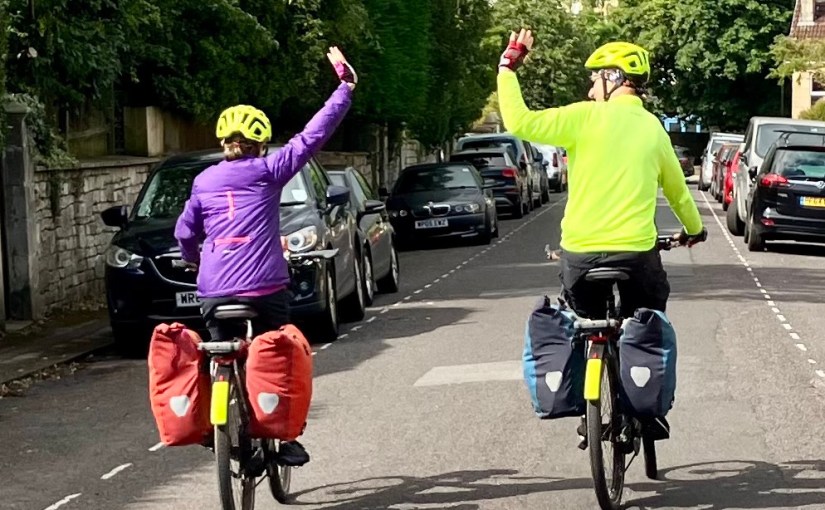
Ooh La La

What do you do when you’ve finally achieved your dream?

When we last posted in November 2024, we had just cycled across Europe from Bath to Istanbul, the bicycle journey we’d been dreaming of ever since we first clipped into our pedals back in 2016.

But, much to our surprise, we found ourselves wanting more. We weren’t done with bicycle touring yet, especially now that we’d discovered the extra joy of e-bikes.

Clare was dreaming of an African adventure to Morocco. Of ticking off another continent.

Having enjoyed a taste of Italy on the way back from Istanbul, Andy’s head was full of pasta lunches, cold Italian white wine and delicious gelato.

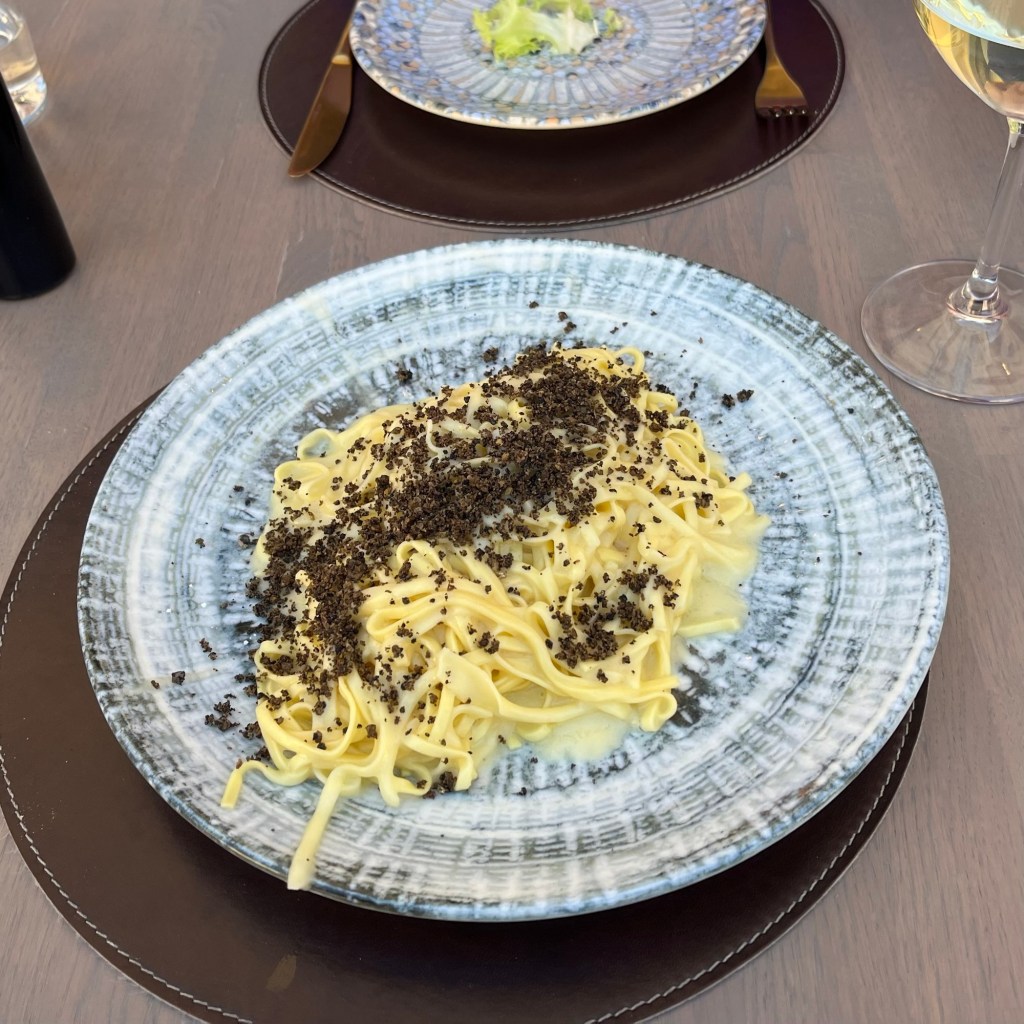
Memories of Tagliatelle with Black Truffles

So we checked out Morocco first. Yes, said Andy having researched possible routes, it’s do-able and the mountains will be fun. But honestly, the rest looks a bit boring … there’s an awful lot of stony desert. Please take a look and see what you think.

So Clare checked it out too. Great for a cycling holiday in the Atlas Mountains, she thought, but it doesn’t really look so appealing for a long distance e-bike tour. Too many hot dusty roads, too much busy traffic, some big gaps in accommodation. Plus some female touring cyclists do talk about getting a bit of hassle.

The pasta and wine lunches started to look a bit more tempting for her too.
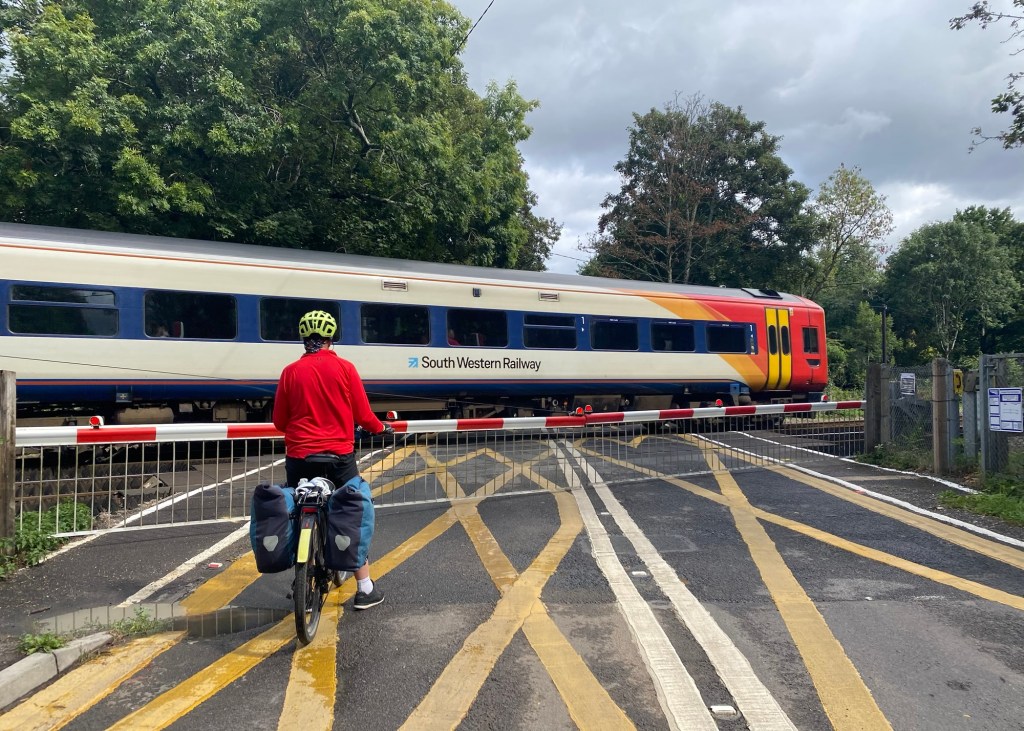
So right now, we’re back on our e-bikes and are intending to pedal from Bath to Rome. 

It’s still quite an adventure … over 3000km through England, France, Switzerland and Italy. Over the Alps as well. 

And back through Spain. As we can’t fly home with e-bikes our return plan is to take a ferry from Rome to Barcelona, cycle across the foothills of the Pyrenees to Bilbao, then jump onto another ferry back to Portsmouth.

Before embarking on such a long trip, the bikes needed a full electrical check-up and a proper service. We took them to Tom at Green Park Bike Station who did an excellent job … he is highly recommended to our Bath based readers. And it was just as well we did, as Clare’s Bosch power control unit turned out to be faulty.

Imagine if that broke down while she was crossing the Alps?
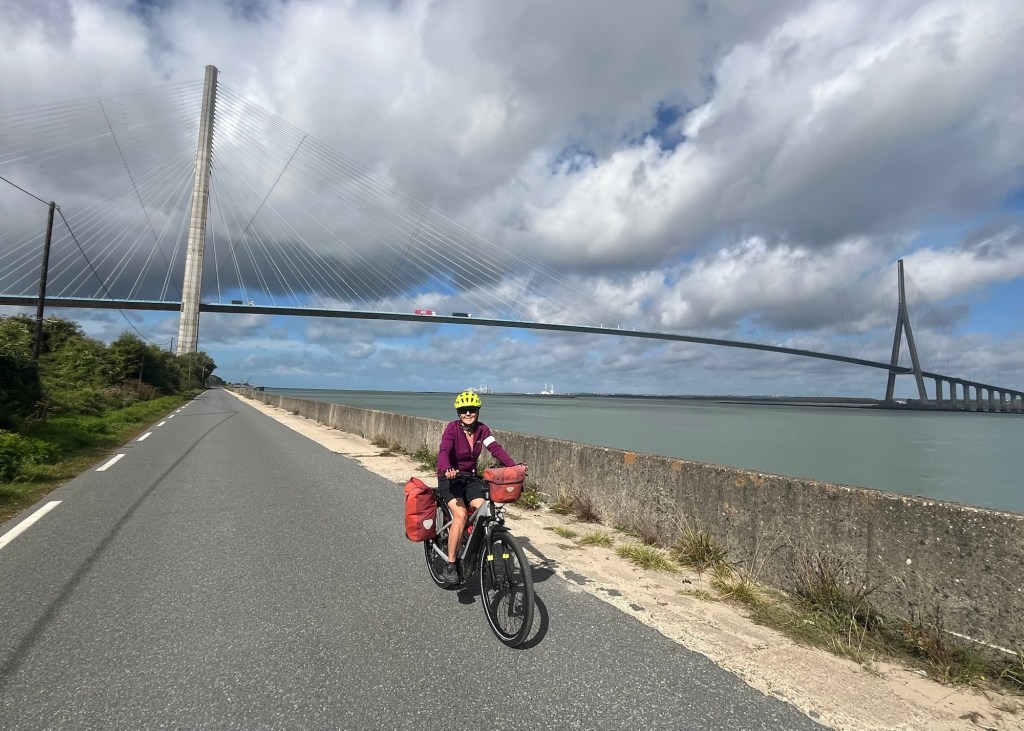
After a very dry summer, the weather broke just as we were about to depart, with bands of rain coming in from the Atlantic fuelled by the remnants of Hurricane Erin.

We were lucky to dodge the showers from Bath to Winchester where we enjoyed an evening catching up with Ian and Nicola, old friends from when we lived there in the 1990’s.

Winchester Cathedral

Leaving Winchester Andy had forgotten that Komoot (our navigation App) has a deep mistrust of roads it thinks might be busy with traffic and will reroute us away from them at every opportunity. Often this means directing us down a narrow, rutted track when there’s a perfectly nice minor road nearby.

When we’re bicycle touring he checks this carefully every day. But we weren’t yet in the swing of things so Andy was out of practise.

We found ourselves pedalling up a steep, narrow, stony walking path with thick brambles on either side … just to avoid a roundabout. A roundabout we knew was totally safe for cyclists.

Just over half way up, Andy ducked under a leafy branch hanging across the path. But it wasn’t a leafy branch, it was a thick bough, which knocked him on the helmet and sent him tumbling violently sideways into the prickly brambles.

Oops!

He managed to clamber out with only a few scratches but his bike was less lucky. 

The twisting fall had snapped something inside his suspension seat post which was now moving alarmingly from side to side. No matter, said Andy, I’ll sort out a replacement in Portsmouth before we get the ferry. 

We arrived at the hotel just as the rain set in. Leaving Clare behind to enjoy the warmth, Andy set of to explore the bike shops of Portsmouth in search of a new seat post.

Unfortunately they did not cover themselves in seat post glory …

Number 1 said he’d had a recent run on seat posts and didn’t have the right size. Helpfully he gave Andy a note of the size (27.2) … so he could find it elsewhere.

Number 2 was also out of stock of 27.2’s (but he might have had some larger ones?)

Number 3 had a 27.2 (hurray) but then told Andy it was the wrong size when he tried to fit it. Andy actually needed a 30.9 … but he was out of stock of those.

Number 4 was closed for his holidays (fair enough).

Number 5 didn’t have a 30.9 but he did have a 30.8 which he reckoned would be alright. He then broke the existing tightening bolt but managed to find a replacement at the back of his drawer.

Job done … but it was a very wet and bedraggled Andy that limped back to the hotel 2 hours later.

Leaving Portsmouth

The next afternoon, after a pleasant ferry crossing, we were happily cycling along the Normandy coast from Ouistreham to Honfleur when Andy felt his saddle suddenly give way beneath him as it sank into the frame of the bike. He stopped to raise it, tightening the bolt as hard as he could. A few minutes later it happened again, then again and again.

The trouble was Andy’s bottom was acting like a pile driver with every bump he went over.

So he started riding as lightly as he could on his saddle, standing up over even the tiniest of bumps, avoiding every pothole as much as possible.

It was an obstacle course … and it was surprising to find out just how many bumps and cracks there are on an apparently smooth road.
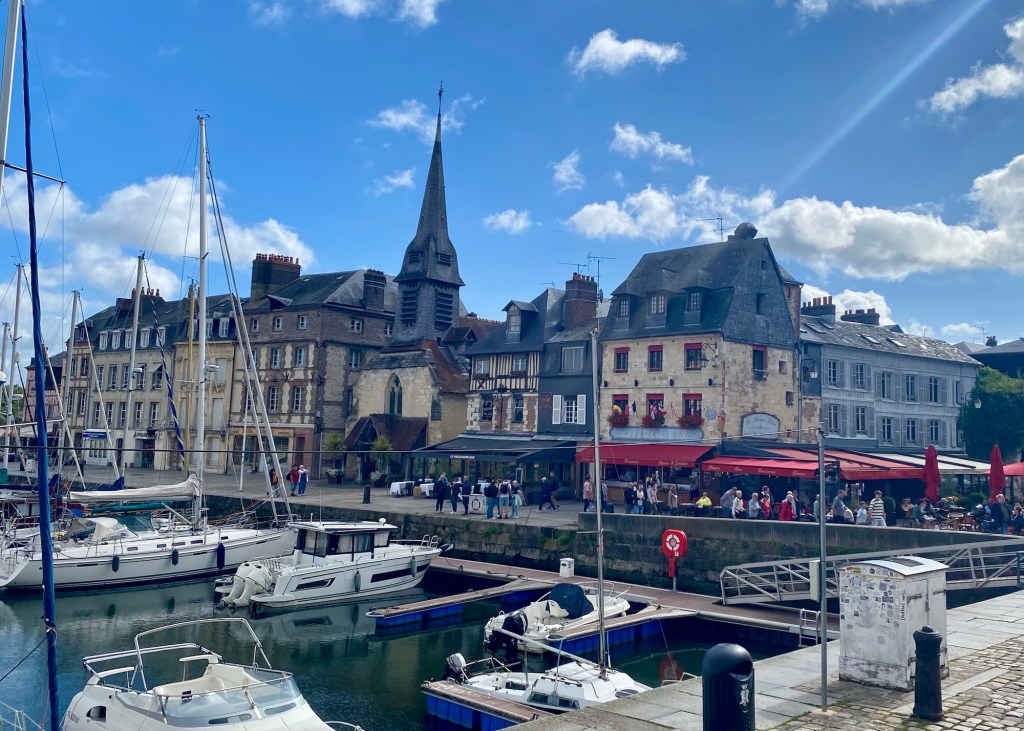
Honfleur

Honfleur, on the Seine estuary, is a gem. Ports don’t come any prettier. Colourful half-timbered houses jostle for position on the quays, alongside art galleries and restaurants.

Honfleur

That night Andy read about a hack for sinking seat post syndrome, a little piece of electrical tape to provide more traction plus some duck tape to create a ridge.

This was great news as tape is an important spare part for any touring cyclist so we had plenty of it with us.

But all it did was change a sudden saddle drop into a slow sinking feeling on what turned out to be a long and challenging ride from Honfleur to Rouen. It reminded Andy of riding his old Raleigh Chopper bike as a kid!
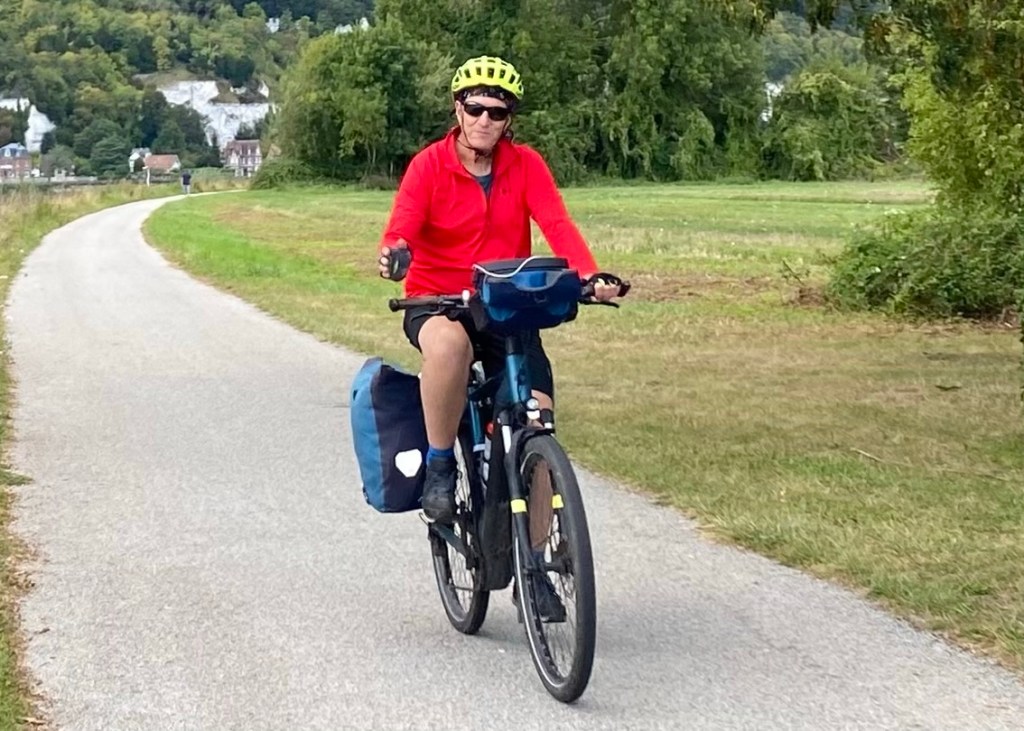
Memories of a Raleigh Chopper

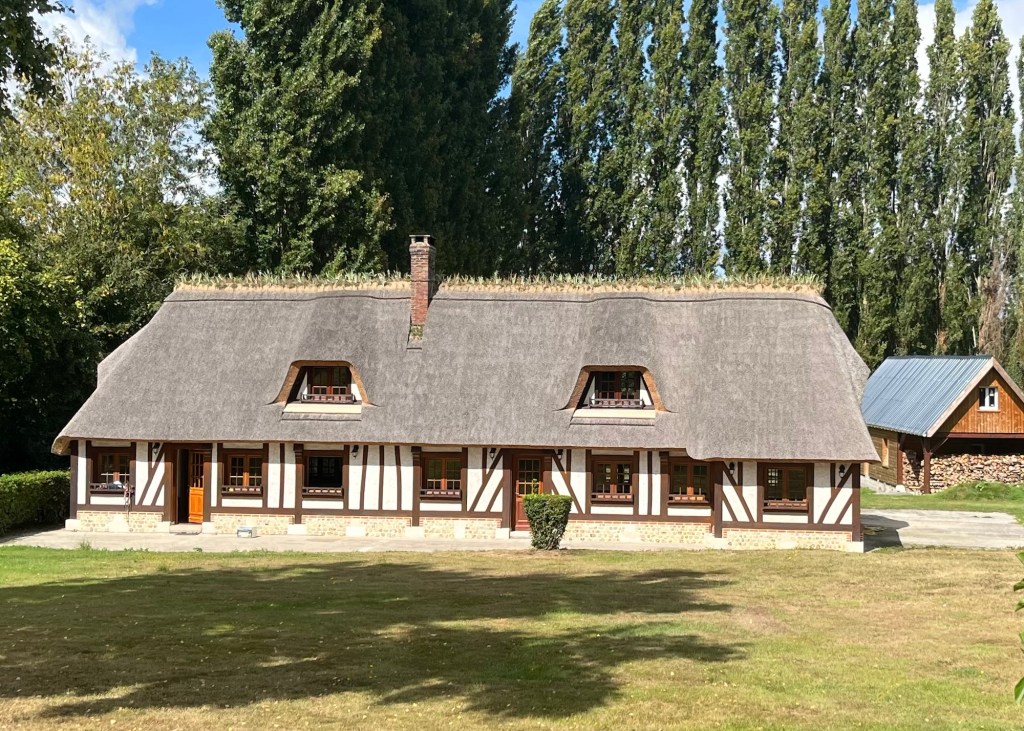
For much of the day we followed the Routes des Chaumières (the Thatched Cottage Route) through the delightful Normandy countryside, each cottage topped with that unique local tradition …. a line of irises to take up moisture and help bind the thatch together.
Then onto the Seine à Vélo, a cycle path that follows the river around it’s huge, sweeping bends, crossing over from time to time. Many cargo ships ply this part of the Seine so bridges are rare and in their place are several little free ferries called bacs.

Our route included three bacs and meant we could cut across some of the biggest bends. But when we arrived at the first bac it was closed because of an ‘operating incident’, back as normal tomorrow.
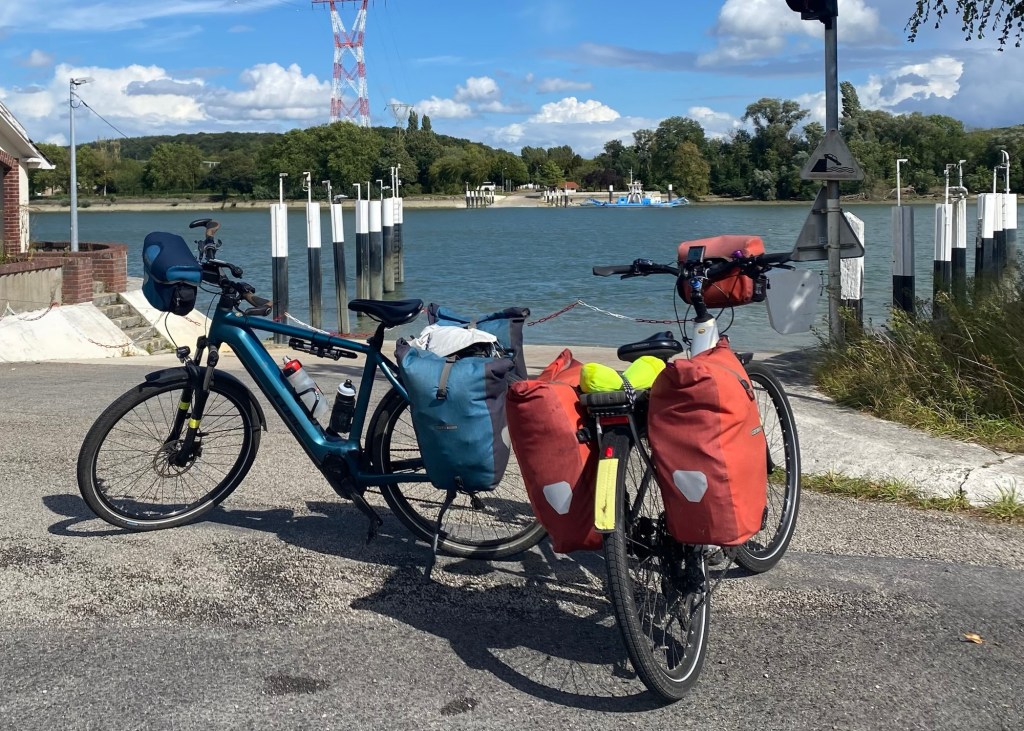
This bac ain’t going nowhere!

No matter … it was only a 10km deviation to get the next bac further upstream. That was closed too. Now it was 30km to get around the next bend. At least the sun was still shining.

Disconsolately we pedalled on and soon reached a point where we had a choice between a rough river path or a short but precipitously steep hill. There was a local man walking his dog. He pointed to the hill, shaking his head.

Vous n’y monter là-haut, n’est-ce pas? (You’re not going up there, are you?)

Même les cyclistes français ne font pas ça! (Even French cyclists don’t do that!)

Without admitting that she was riding an e-bike, Clare gave him a cheery wave and shot up the hill.

Ooh La La! he exclaimed, clearly impressed. He peered at Andy suspiciously … et vous?

As discretely as possible, Andy switched on turbo power and selected his lowest gear before staggering slowly up the 20% hill. Expecting to hear the man’s surprise at the extraordinary strength of British cyclists, all Andy got was …

Anglais, votre selle est trop basse! (Englishman, your saddle is too low!)

When Andy reached the top, feeling somewhat exhausted, Clare quietly admitted that she hadn’t even used turbo … Ooh La La! indeed.

Clare’s hill

To our great relief the 3rd bac was working but as we cycled to Rouen, the heavy rain eventually caught up with us. As Andy was sitting so low on his bike, a small, stagnant pond started to appear in his lap. He was sure he could see a couple of tadpoles frolicking around.
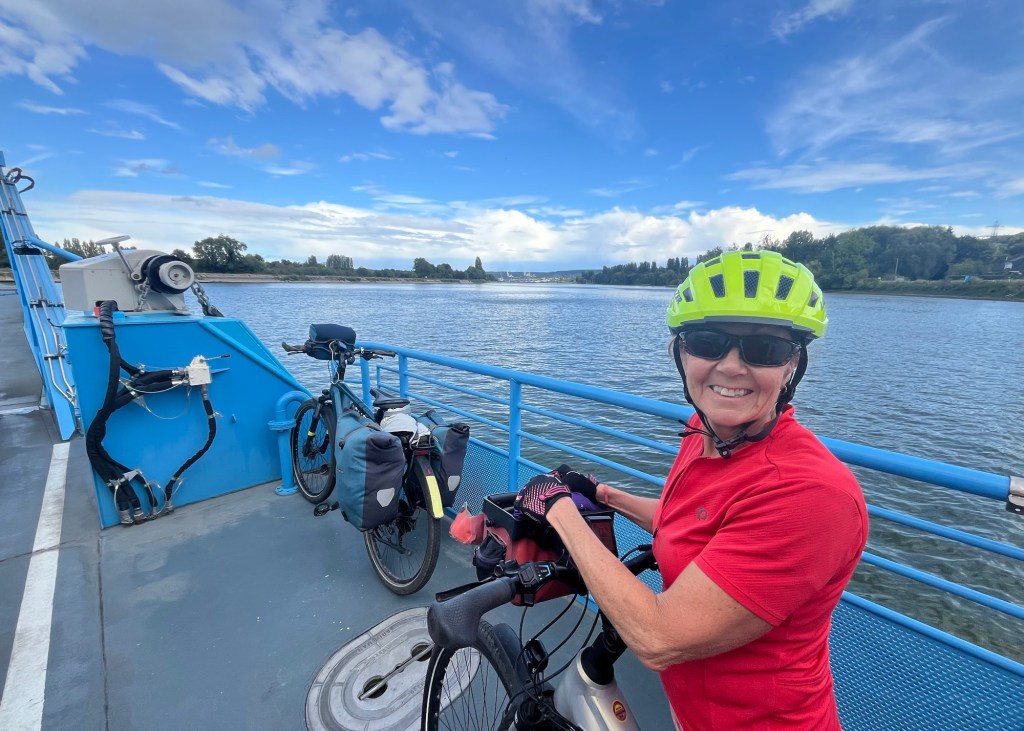
Pleased to be on a bac at last

The next morning, we took Andy’s bike to an excellent Rouen bike shop. They explained that Portsmouth Number 5 had done a botch job, not only was the seat post too small but the bolt he’d used was also the wrong size.

The French mechanics carefully replaced the seat post with exactly the right size, added a brand new bolt and coated it in friction paste for extra grip before testing it carefully to make sure it would hold. It might have been a lot more expensive but it was a much better experience.
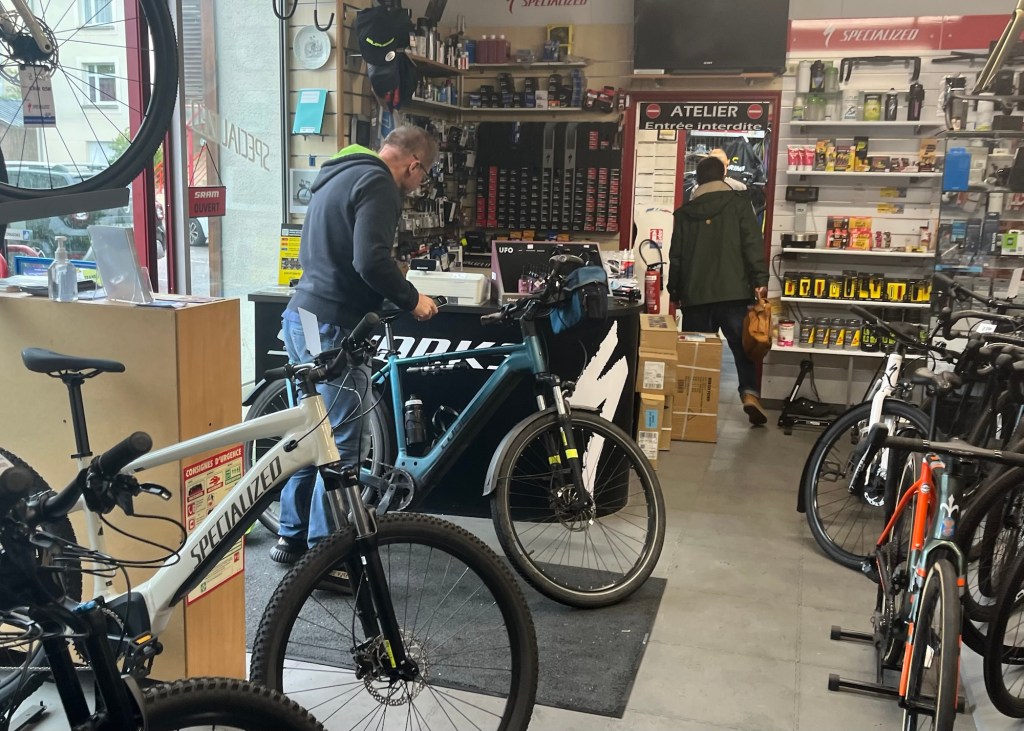
Rouen bike fix

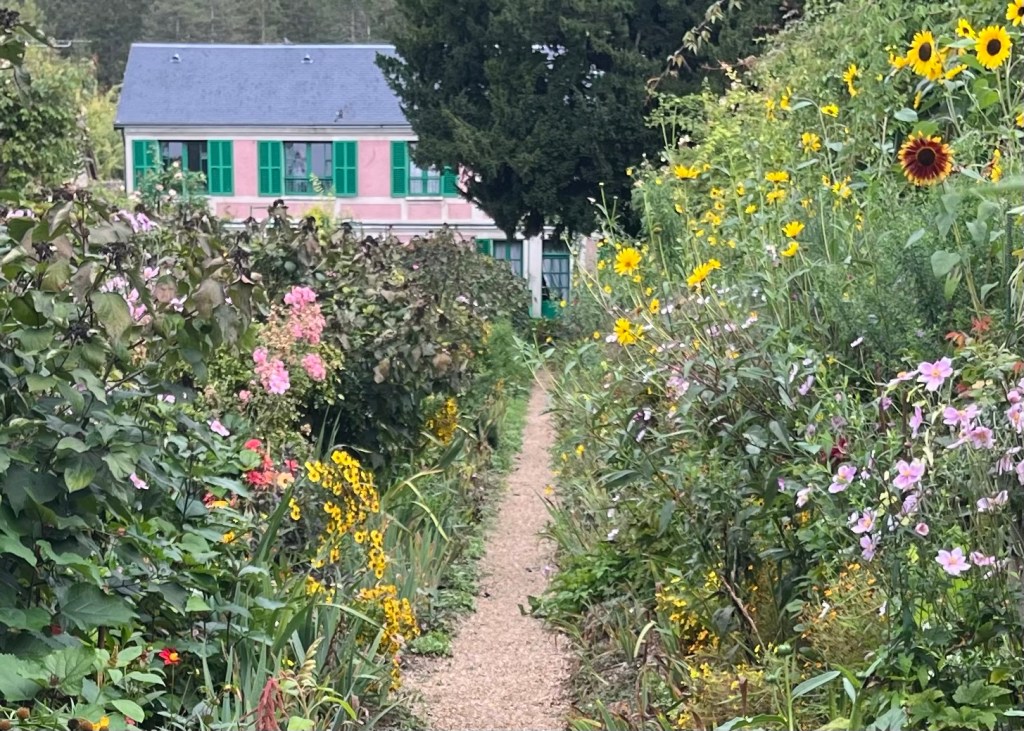
After Rouen, our next stop was Giverny, the small village where Claude Monet created his home of 43 years, together with a truly remarkable garden that includes the famous lily pond that he then proceeded to paint over 250 times. The garden was just as stunning as the paintings, even on a cloudy day.
On previous visits to Paris, we’d always thought that Versailles was too far out of town to include on our itinerary. But this time we’d be cycling right by it so it would be rude not to stop and take a look.

In the Hall of Mirrors

As well as the staterooms and the famous hall of mirrors, we particularly enjoyed seeing Little Trianon, Marie Antoinette’s refuge from the stifling formality of court life. And the Queens Hamlet, a peculiar play-farm she had built to recreate the charms of rural life with a windmill and a dairy sitting right next to her salon and boudoir.

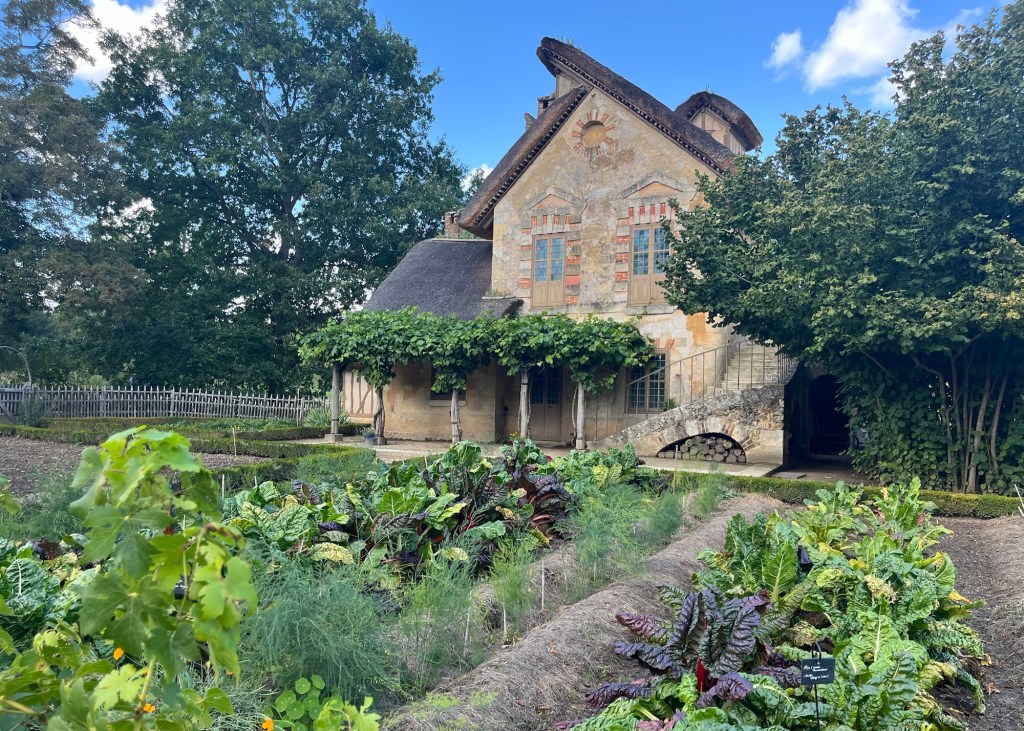
Petit Trianon
A cottage in the Queens Hamlet

Having read in the newspaper that Paris mayor Anne Hidalgo was working hard to clean up the city, improve air quality and make it cycling friendly, we decided to ride through the city centre, rather than give it a wide berth.

And the first signs were encouraging … well marked bicycle lanes, even on the busiest roads.

Clear bike lanes on a major road

Andy persuaded Clare to join him on a magical mystery tour of the famous sights on the way to our hotel.

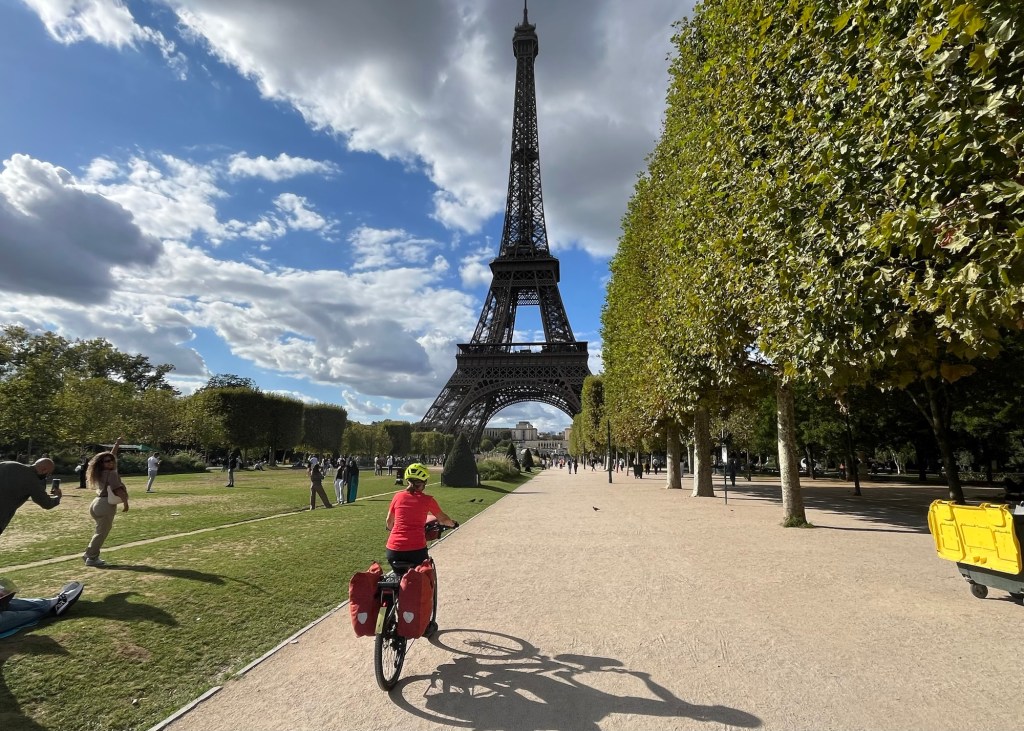
She enjoyed cycling around the Eiffel Tower.
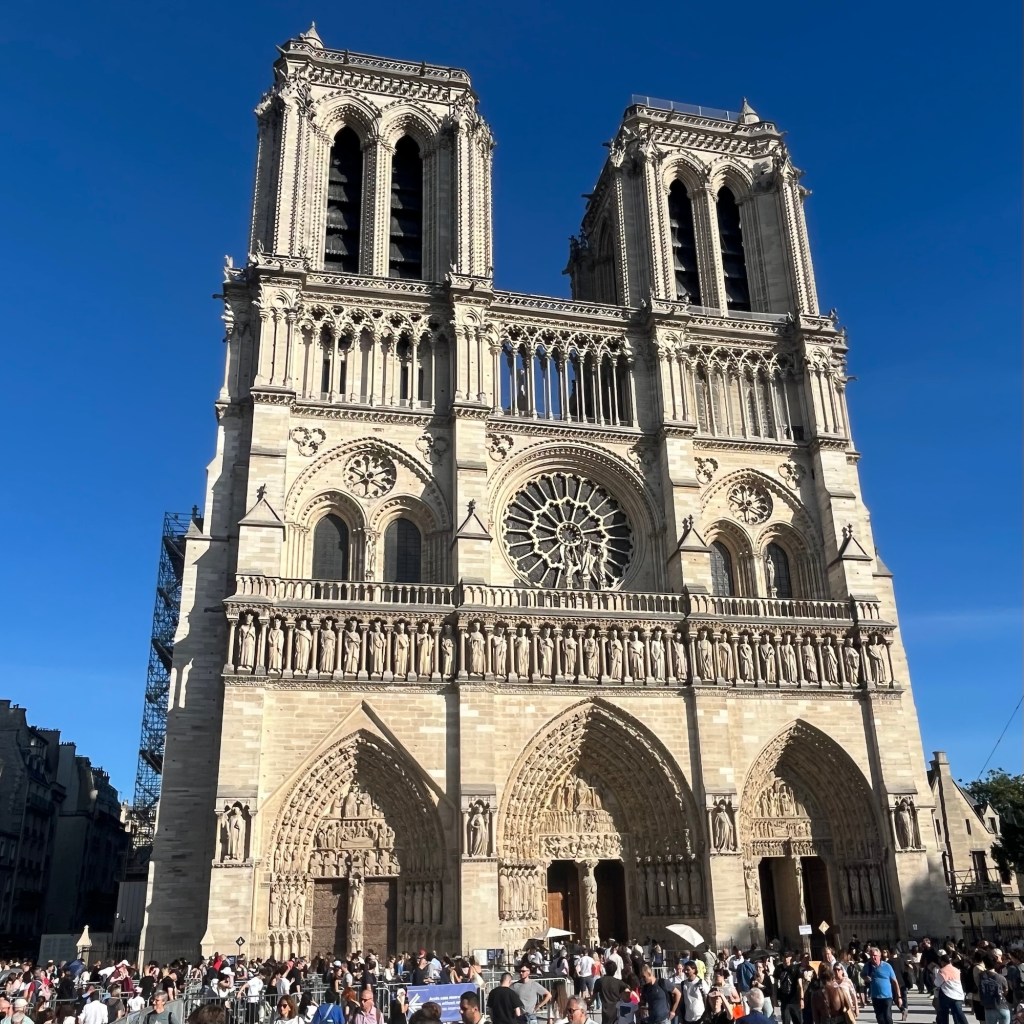
She didn’t object to the incredibly long queue to see the newly refurbished Nôtre Dame.
She even enjoyed cycling up the Champs Elyesees.

But when she started following Andy around the chaos of the Arc de Triomphe at rush hour, she decided enough was enough!

There are lots of people on bicycles in Paris, she thought, but only one of them is trying to ride around the biggest, busiest roundabout in the world. My crazy husband!

Too much!!

Paris did have one sting in the tail. For the first time in 10 years of bicycle touring and over 300 overnight stays, our Paris hotel charged us for bicycle storage. Quite a whack too … €17 per bike per night, adding up to €68 for a couple of nights.

Everyone we’ve mentioned this to gives a little Gallic shrug and says That’s Paris … but should they really get away with stuff like this, just because it’s Paris? We managed to negotiate the rate down by half … but even so!
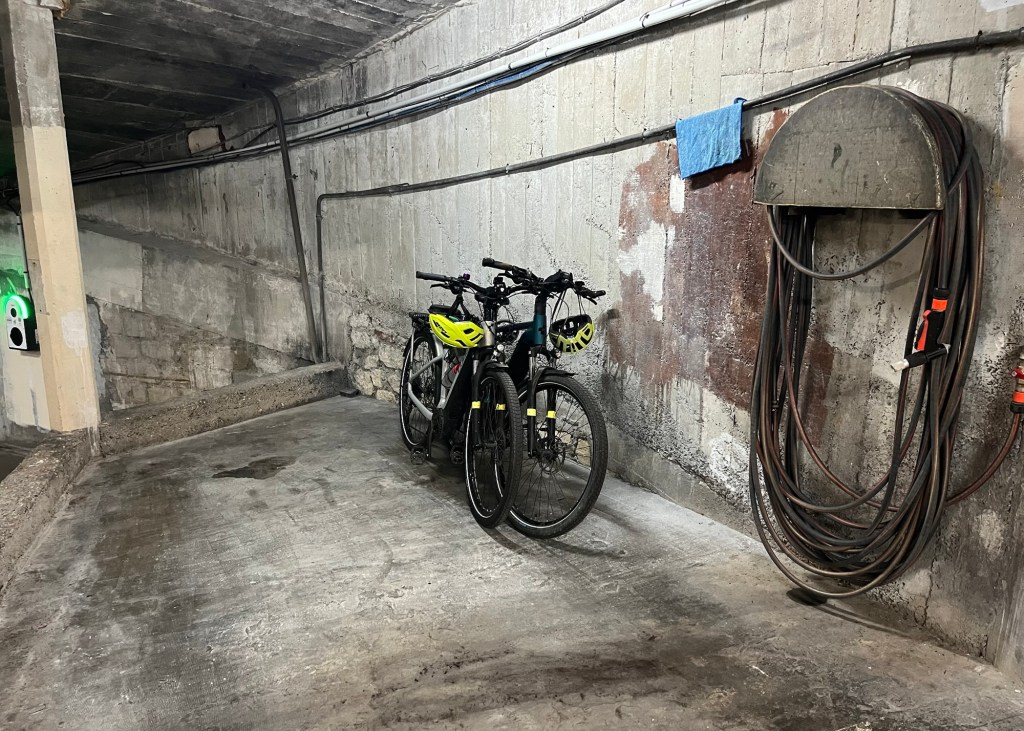
Enjoying their luxury accommodation!

By far the best bit of our short stay in Paris was the late night show at the Moulin Rouge.
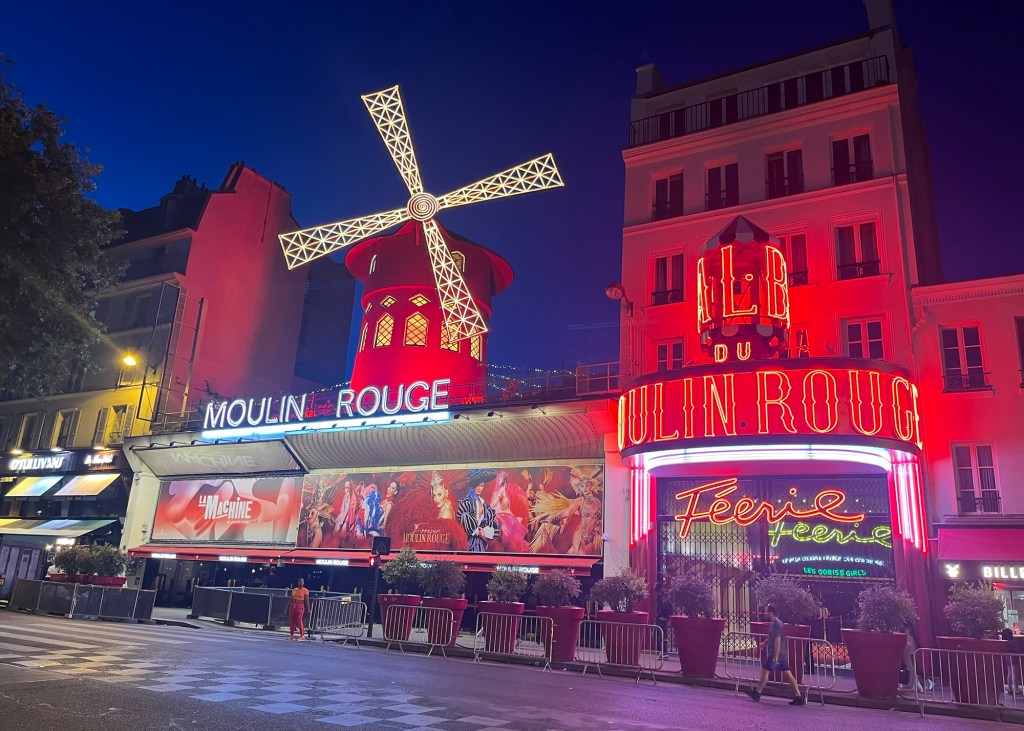
It was 90 minutes of magic, a whirlwind of feathers, sequins and legs from the incredibly professional dancers, interspersed with strength, virtuosity and humour from their guest artists. And the main highlight? The iconic, timeless Can-Can!

As they might say in Paris … Ooh La La!

Clare and Andy

Bath to Paris

507km pedalled (350 miles)

3,735m climbed

28 hours in the saddle

River Deep, Mountain High

If your dream is to slowly pedal a bicycle beside a winding river on a soft early autumnal afternoon, watching a grey heron in graceful flight ahead of you, waving to a passing riverboat and crossing from one side of the river to the other on a tiny bridge … then Eastern France is the right place for you.

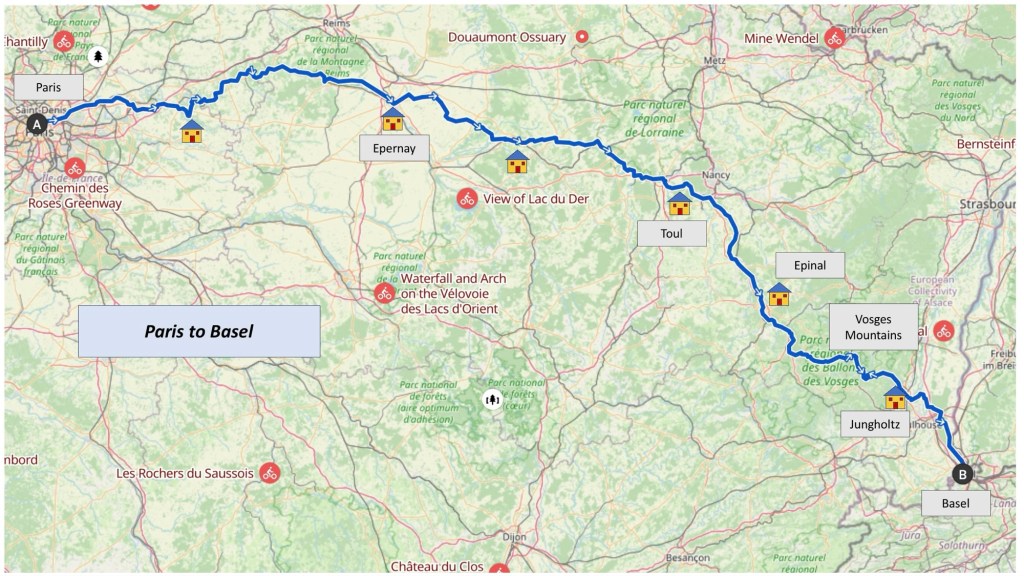
Since arriving in Honfleur at the mouth of the Seine, we have cycled besides twelve rivers or their accompanying canals, in order to reach Basel just inside the Swiss border.

As well as La Seine we’ve pedalled alongside L’Ourcq, La Marne, Le Petit Morin, La Vesle, L’Ornain, La Meuse, La Moselle, La Moselotte, La Lauch and L’Ill before reaching the grandaddy of them all, Le Rhin (known to us as the Rhine and an old friend from our ride through Germany a couple of years ago).

The French waterway network is the largest in Europe with over 8500km of navigable routes. Whenever a river is too shallow or too dangerous, they built a canal next door. Today, it’s still possible to travel across France by boat from the Mediterranean to the English Channel or out to the Atlantic.

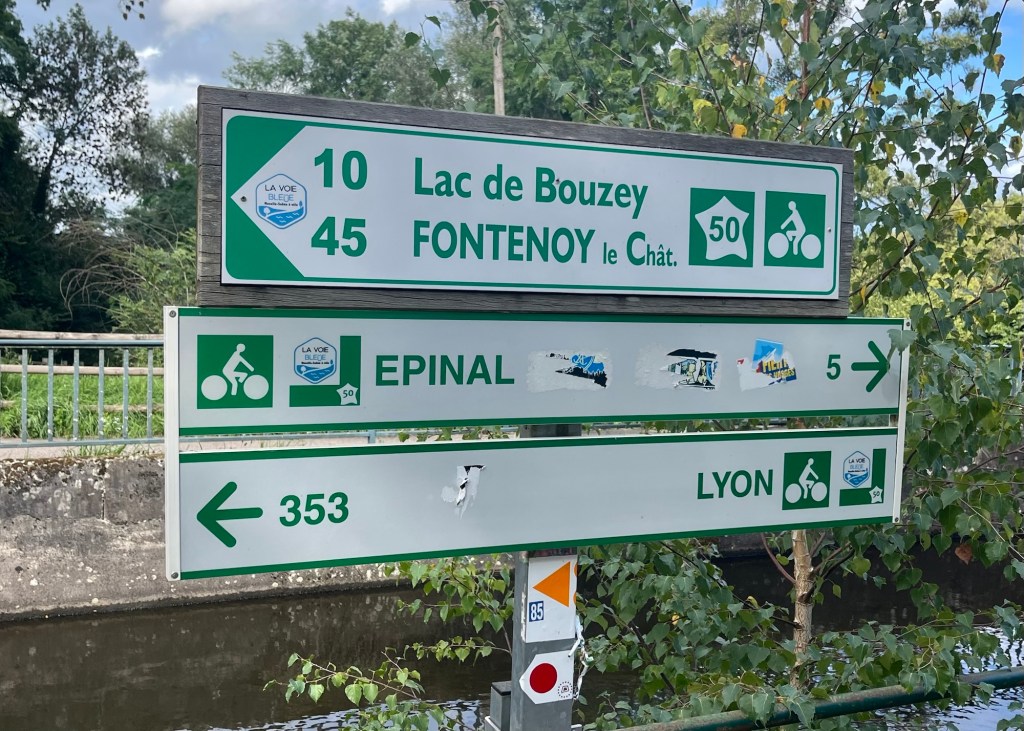
We were turning right to Epinal. Turn left and in 353kms you can be in Lyon, canal paths all the way!

The first waterway of our journey, the Canal d’Ourcq, made it incredibly easy to escape Paris, as we picked it up just 3km from our hotel.

This canal was commissioned by Napoleon, not this time for transport, but in order to keep the city clean. It still supplies about half of the 84 million gallons of water needed to flush out the city’s sewers, gutters and parks every single day.

Leaving the Ourcq, we then followed the gentle curves of the Marne for the next 150 kilometres, winding through Champagne country to Épernay and onto Châlons-en-Champagne.

It was fascinating to see just how many Récoltant-Manipulants are making the famous fizz … small grower producers creating their own single vintage, each with the coveted RM symbol. This is to distinguish them from the major Négociant-Manipulant (NM) houses who buy their grapes from multiple sources so lack the individual vineyard expression that makes a RM champagne so special.

As we pedalled past the rows and rows of vines, we couldn’t help noticing the rose bushes at the end of each one. Roses are particularly sensitive to the dreaded powdery mildew, so act as an early warning system for this greatest threat facing every RM, as it can destroy the whole precious crop if it’s not treated quickly.

On the Avenue de Champagne, Epernay

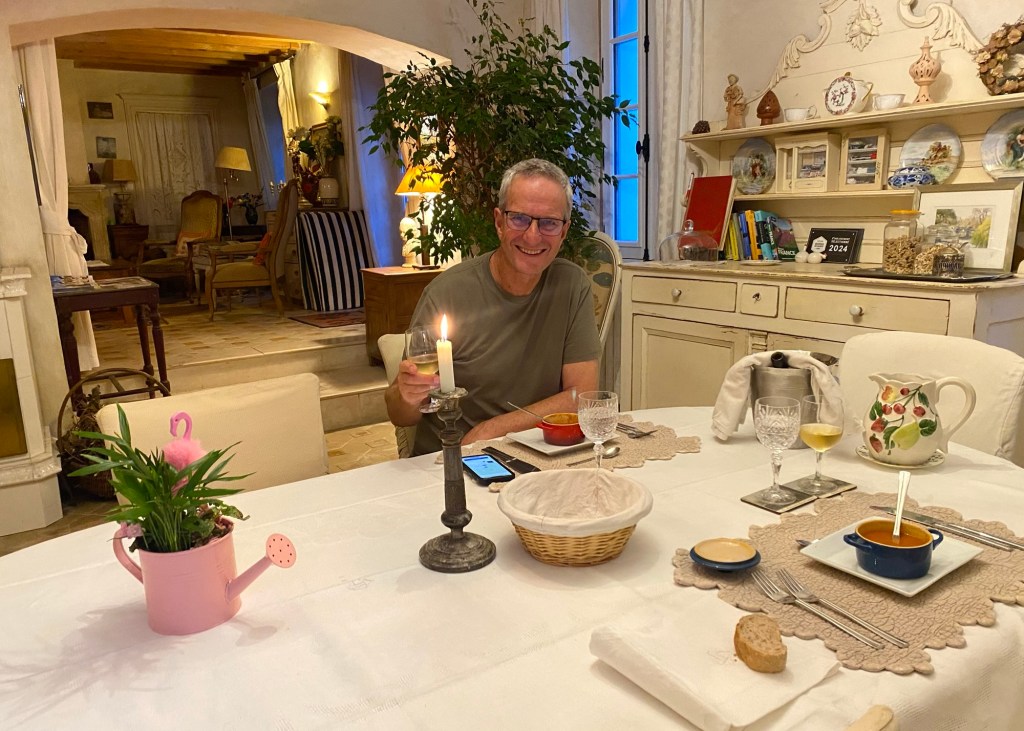
We’ve always found French food to be surprisingly lacking in vegetables, so we book apartments as often as we can to cook up a hearty veggie meal. But it was also a real treat to stay in two small family run guesthouses where the hostess provided an evening meal … a delicious tiny peak into French home life.

Powered by this home cooked food and starting to feel fitter now that we’re a couple of weeks into the journey, we’ve increased our rides to between 80 and 100km every day.

Which is a good thing as, to be brutally honest, the rivers, canals and empty French countryside can get a bit samey after a while.

Empty Diagonal, France

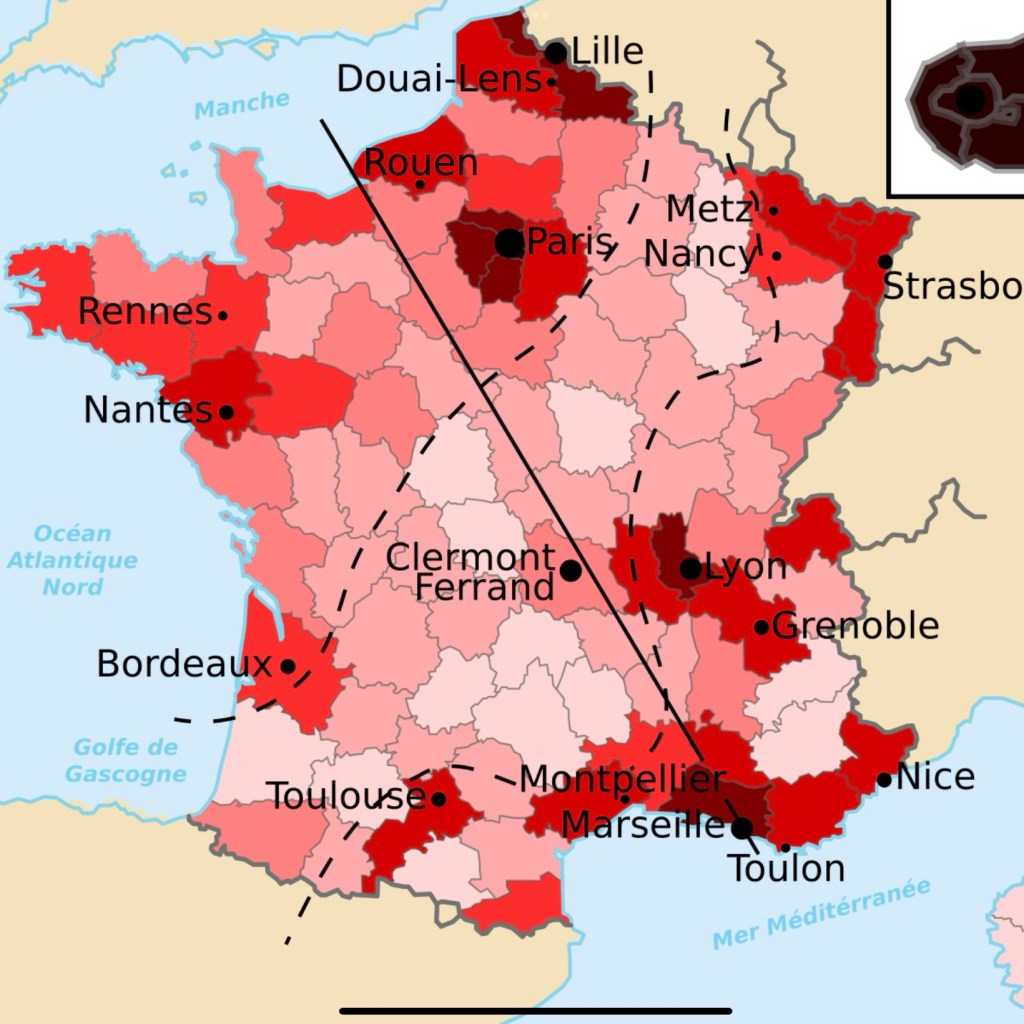
After leaving Champagne, we cycled through part of ‘Le Diagonale du Vide’ (the Empty Diagonal), a huge slice of France with a dramatically low population density, stretching from the Spanish border in the southwest to the Belgium border in the northeast,

Le Diagonale du Vide, between the dashed lines. Photo Credit: Wikipedia

There are many reasons why this empty space exists in such a rich, cultural country.

These include the mechanisation of agriculture which led to less rural jobs, the appeal of metropolitan cities and a worldwide human desire to live within driving distance of a coast.

But the biggest reason by far is the huge death toll these areas suffered from in both the Napoleonic Wars and the First World War, which permanently diminished the population.

For modern day touring cyclists there is one very serious consequence of this empty diagonal … nowhere to stop for a coffee!

As we pedalled through village after village we couldn’t find a single shop, bar or a quaint riverside cafe. There’s simply not enough people to sustain them.

And as any cyclist will tell you … there’s nothing worse than no coffee stops.

Anyone see a cafe?
No cafes, so the locals have resorted to vending machines

Fortunately we knew what to expect.  We’d cycled through a different part of the empty diagonal before … on our way to Barcelona in 2016.

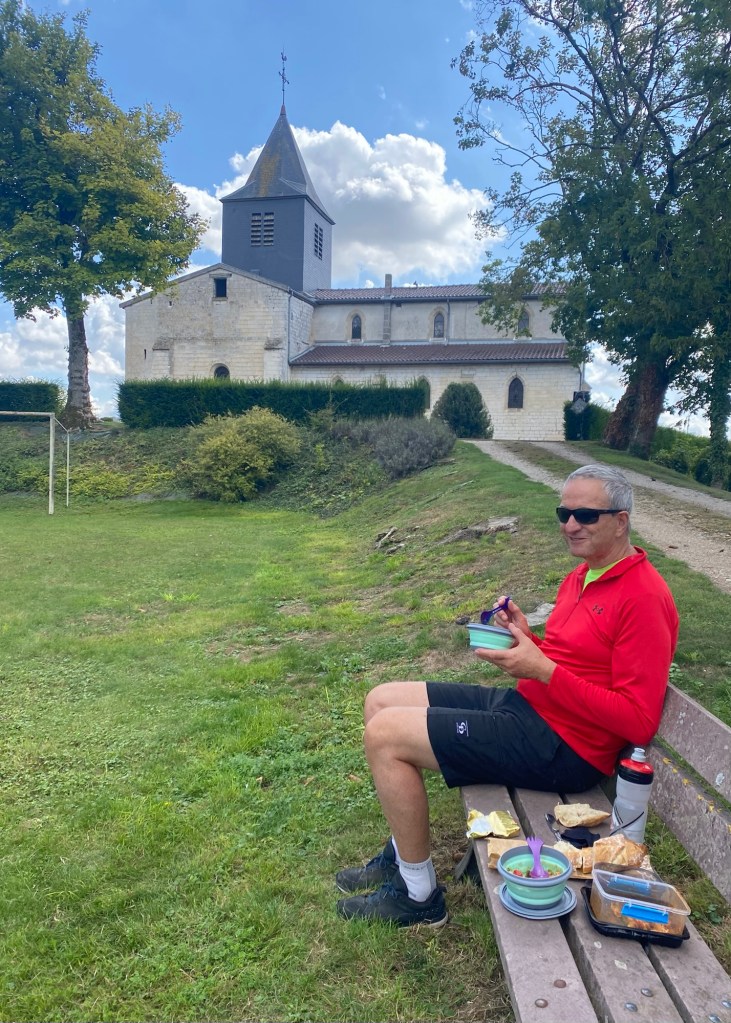
Clare knew how important it is to pick up a baguette before the Boulangerie closes at midday, she knew she should carry a bit of butter, a slice or two of ham, a piece of fruit. Then voilà, as if by magic she produces the perfect picnic lunch … a delicious Jambon Beurre sandwich to be enjoyed on a bench in a churchyard.

Despite the lack of coffee stops, there is one major compensation for the touring cyclist from the empty diagonal … the extraordinary quality of the country roads and cycle paths, even when there are so few people to use them.

They are simply amazing.

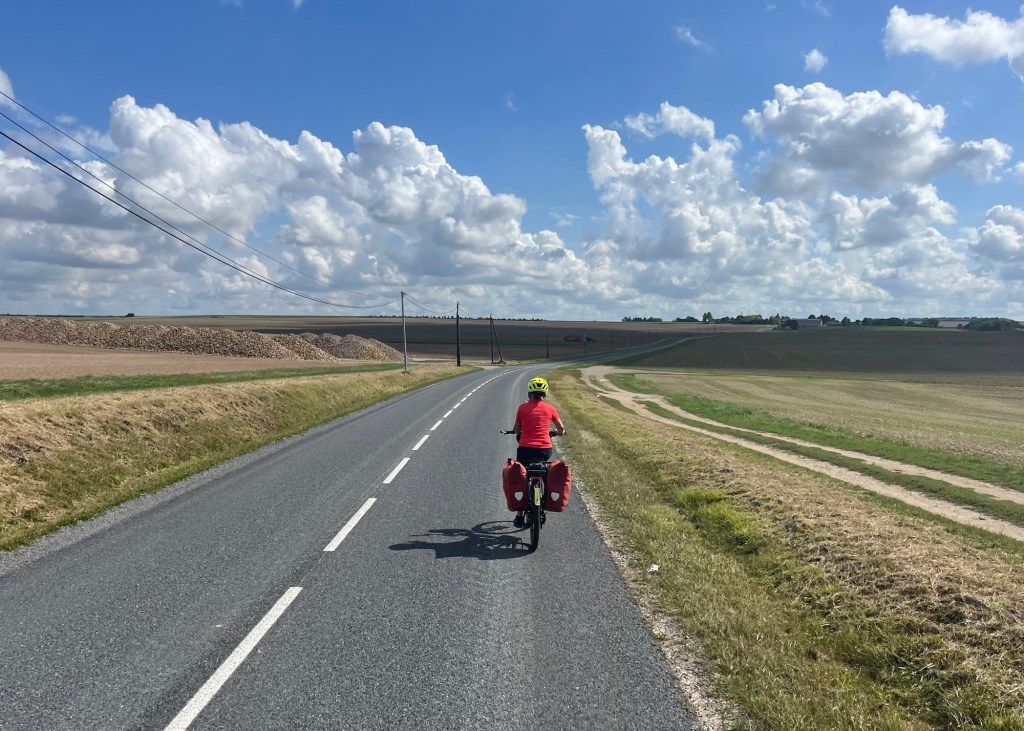
Perfectly smooth, not a pothole in sight, they’re just right for sticking on a podcast, putting you head down and belting along as fast as you can for 100km a day until you reach somewhere that’s a bit more interesting, somewhere with a few cafes.

Incredible road quality!

For us, that somewhere was the Vosges mountains. The range of mountains that lie between Lorraine and Alsace, a region of France that was disputed with Germany for centuries, changing hands many times. It is amazing to encounter so many German place names and traditions (such as bierkellers) in a French province.

We were both looking forward getting up into the forested hill sides, although we knew that our day in the Vosges would involve two substantial climbs with over 1500m of climbing. It would be a test for our legs … and more importantly a test for our batteries.

Vosges mountains

Initially we nursed the batteries carefully, turning the power off on flat sections and then tackling the first climb in a low power setting. But less battery power meant more leg power.

The hard work on the first hill allowed us to ramp the power up for the second steeper climb, safe in the knowledge that we had a lot of downhill to come towards the end of the day.

It was a Saturday so it was a popular riding day for cyclists. But not only for cyclists …  it was popular for motorbikes too, roaring around the switchbacks and over the tops. There were so many bikers that the local Gendarmes were out in force running speed checks and checking papers. It felt like being buzzed by a swarm of wasps.  

We reached the ski resort of Jungfrauenkopf (Virgin’s Head) looking forward to the long descent to Jungholtz where we were staying.

But we had only freewheeled for a few metres when Clare heard a nasty noise coming from her back wheel. Stop!! STOPPPPPP!!!, she yelled. 

Andy stopped.

My bike’s gone badly wrong!

Andy took a look. The brake disk pads were loose and the holding pin was missing. Then one of the brake pads fell out … not good news at the start of a 1000m descent.

With lots of motorbikes buzzing past there was nowhere safe to stop and Andy was simply feeling too exhausted to take the back wheel off and remove the rest of the mechanism by the side of the road.

Start going down the hill slowly using just the front brake, he suggested, and I’ll watch you carefully from behind.  But I’m afraid we still have at least 25km to go.

Clare started going slowly for about 500m. The noise was very loud but it felt a better when she sped up a bit. Soon she was up to her normal descending speed of 40-50km per hour.

That left Andy desperately trying to work out whether she was in any danger. Could the brake spring jam the disk mechanism? he wondered. Surely not, it’s too flimsy. And it’s the back wheel, not the front, so the worst that could happen is she’ll slide to a halt, not be thrown over the handlebars.

Clare made it safely, though noisily, to the bottom. She had 17% battery left, her lowest ever.

Why did you go so fast? asked Andy, feeling very relieved.

You told me I still had 25km to go … and I just wanted to get there!

Our lovely family run hotel in Jungholtz

There was no chance of finding an open bike shop the following Sunday morning so in the comfort of the hotel car park, we took the back wheel off and removed both the spring and the remaining brake pad. Clare would only have one brake for the flat ride to Basel that day but at least the noises had stopped.

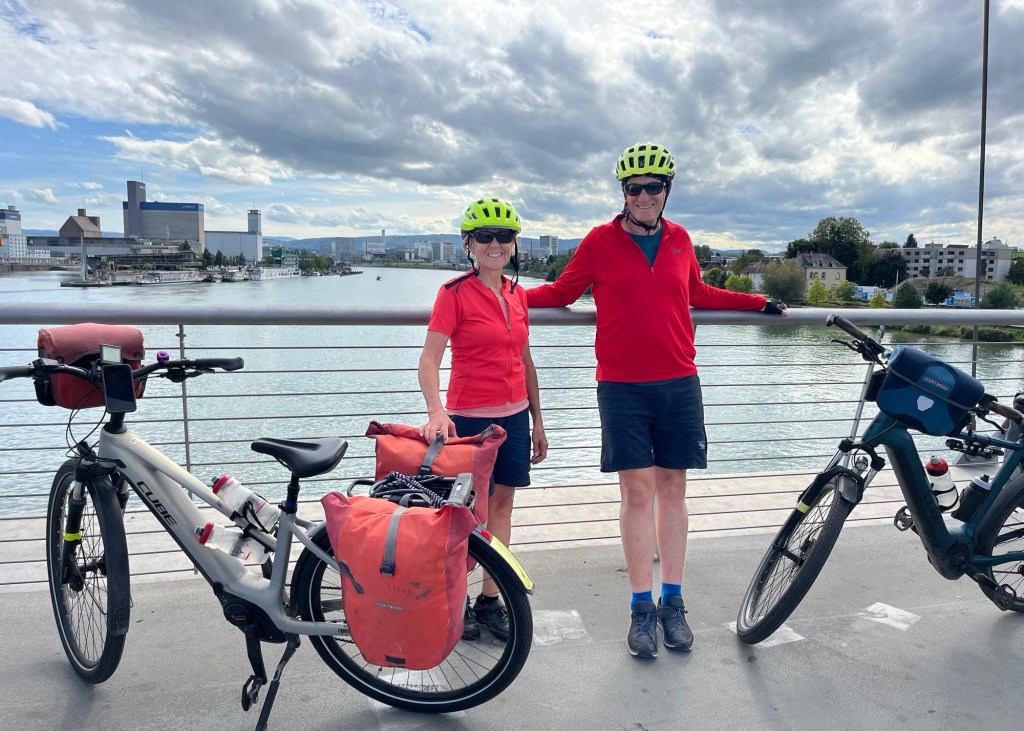
Arriving in Basel – this bridge looks out across 3 countries … France, Germany and Switzerland

On Monday we found a bike shop in Basel. But not just any old bike shop. This was a proper Swiss bike shop with a massive range of parts, a huge workshop and prices to match. Clare’s rear brake was soon replaced, which was just as well with the Alps looming ahead.

Not just a bike shop … a Swiss bike shop

Basel itself was a lovely place for a mini city-break in the middle of a bike tour.

We enjoyed the free trams.

We enjoyed the free water fountains dotted throughout the city.

Many of these spout mountain fresh water from the mouths of mythical basilisks. Half cockerel, half serpent, they’re the guardian creatures of Basel. Filling your water bottle can be a dangerous exercise though … as the legend tells us a basilisk can kill you with just one look in your eye.

Clare is not risking catching the basilisk’s eye

We also enjoyed the work of a couple of quirky modern artists, thanks to some recommendations by our friend, David.

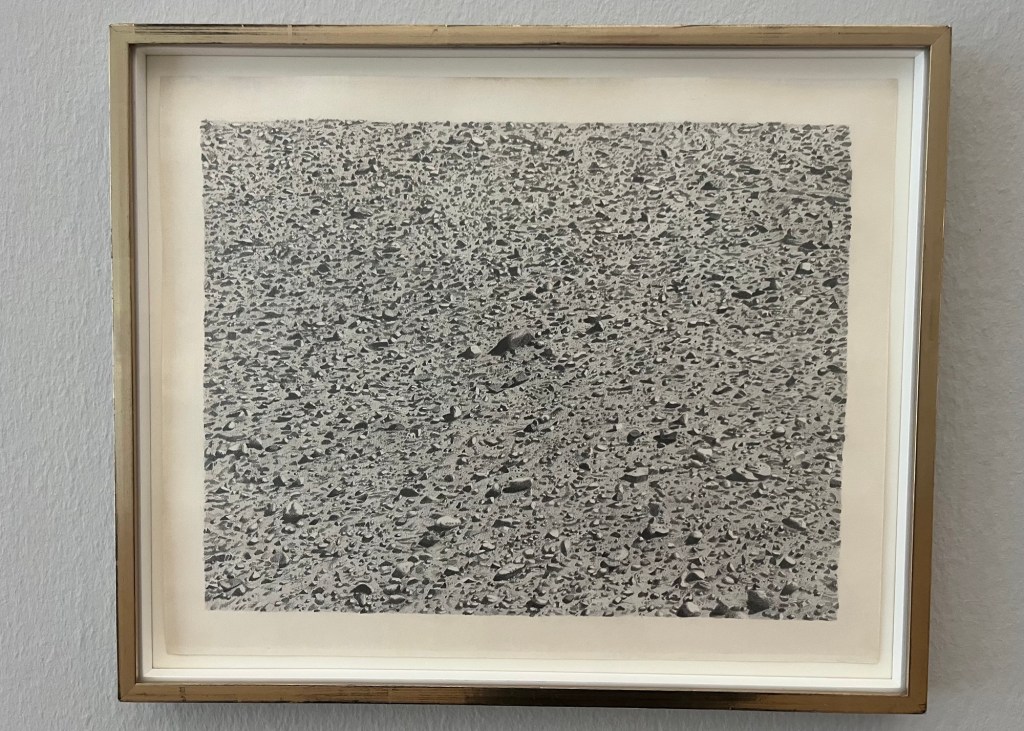
An exhibition by Vija Celmins, known for her meticulous paintings of natural phenomena such as the ocean, night skies and deserts. 

This Vija Celmins painting of a stony desert made Clare feel relieved she hadn’t chosen to cycle in Morocco after all

And a museum celebrating the work of Jean Tinguely, famous for his kinetic sculptures … machines built from bits of old junk that move and make a noise.

So how are we getting to the Alps from Basel?

Yes, you’ve guessed it … we’ll be following the rivers again. First the Ergolz, then the Aare, the Tych and finally the Reuss.

After all, they’re pretty good mountain guides!

Clare and Andy

Bath to Basel

1129km pedalled

7923m climbed

59 hours in the saddle

The Joy of Swiss Precision

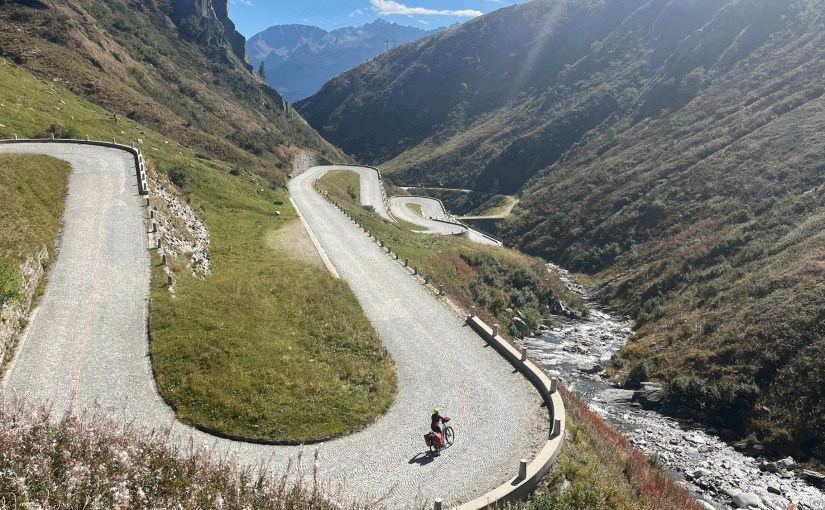
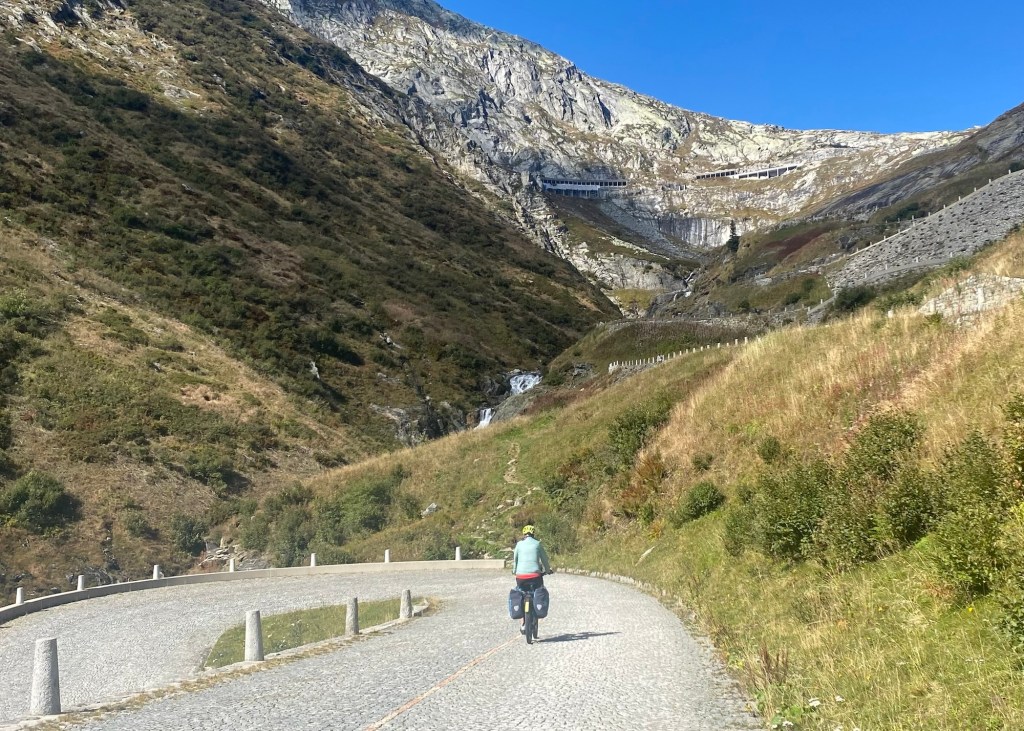
It’s not every day that a touring cyclist gets the chance to descend a 19th century cobbled road from the top of a famous Alpine pass, dropping 1000m over 15km and swooping around 37 hairpin bends.

Almost alone in the wild, rocky, mountain landscape.

Under a deep blue, cloudless sky.

This is the Tremola … the historic old road that runs down the southern side of the Gotthard Pass in Switzerland. Opened in 1830 it quickly became a vital trading route for horse drawn wagons and carriages travelling between Northern and Southern Europe.

Today the Gotthard Pass is still a major transport axis but most of the goods and people are carried through three huge tunnels, each one the world’s longest at the time of their construction. 

The 15km Gotthard Rail Tunnel (1882) still carries regular trains.

The 16.9km Gotthard Road Tunnel (1980) for freight and fast traffic. 

And the 57km Gotthard Base Tunnel (2016) for fast trains.

Most importantly for touring cyclists there’s also the Gotthard Pass Road (1977), which opens for tourist traffic in the summer and is preferred by road cyclists going down the hill, as their tyres are too narrow to bump down the cobbles.

So we practically had the Tremola to ourselves. With only red-faced road cyclists coming up the hill plus the occasional curious car or motorcycle for company.

Normally, touring cyclists hate cobbles! Rattling over them at the end of a long day, they shake your weary bones to the core as you search an historic town centre for your night’s resting place.

But these are Swiss cobbles!

Even in the early 19th century, the Swiss builders had placed the neat square stones so carefully and precisely together, they still made for an incredibly smooth ride down on our strong, thick tyres nearly 200 years later.

Perfectly precise cobbles

The ride up the north side of the Gotthard Pass hadn’t been quite so much fun, and that was nothing to do with the elevation!

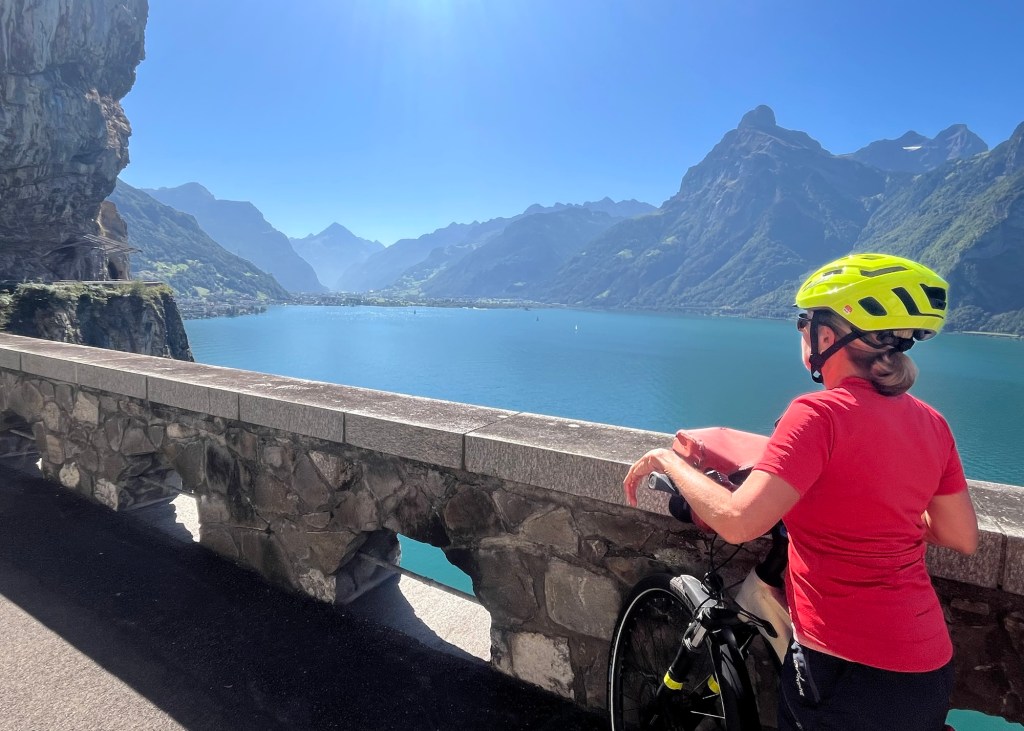
We had left Basel just three days earlier on another glorious late summer day, cycling across picture perfect countryside on picture perfect back roads and cycle paths to the picture perfect city of Lucerne and then onwards around the picture perfect lake.

It was stunningly beautiful. Breathtakingly beautiful.

Lucerne

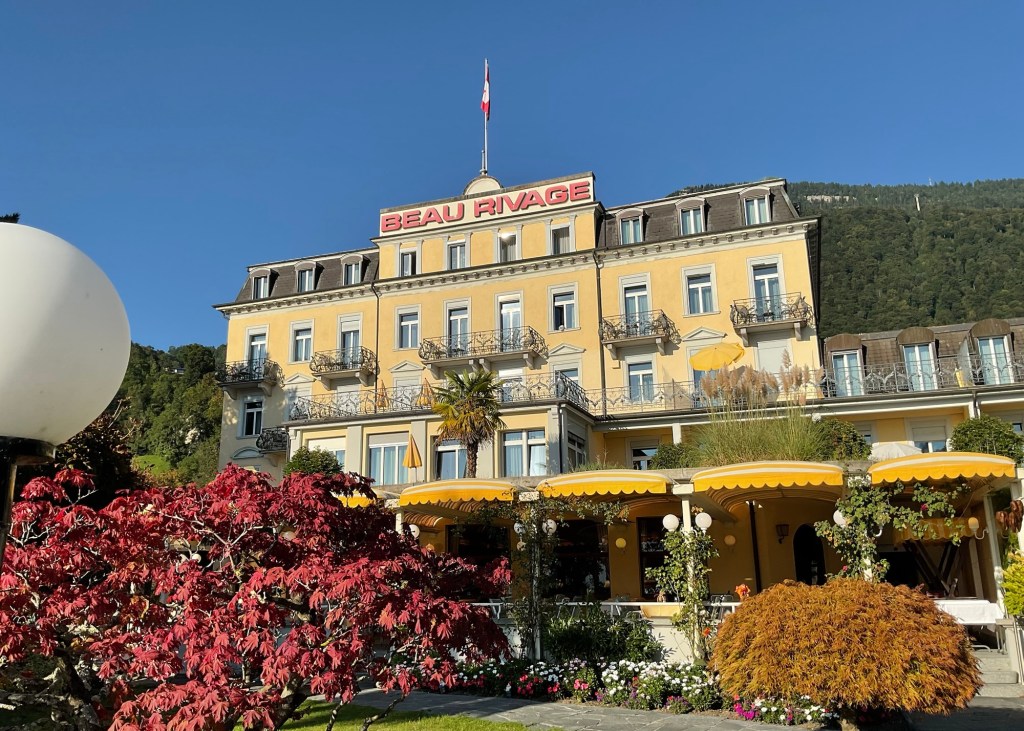
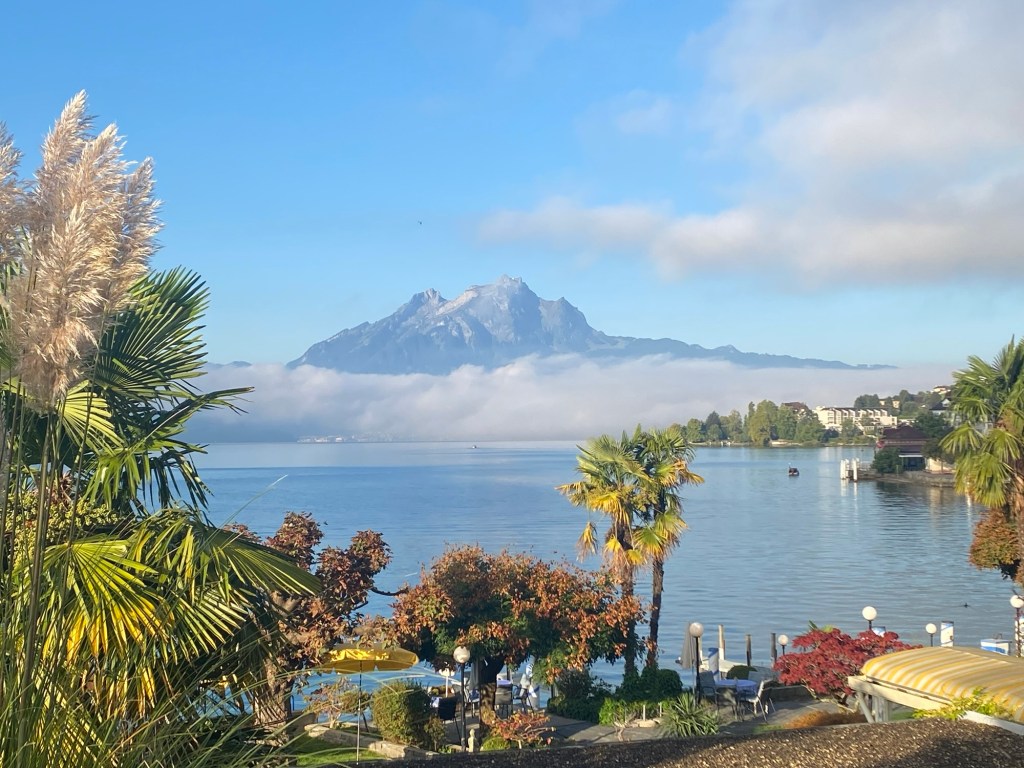
We stayed overnight at the Beau Rivage, a slightly faded small hotel on Lake Lucerne where Queen Victoria had once rested her weary head.

Hotel Beau Rivage
View from Hotel Beau Rivage

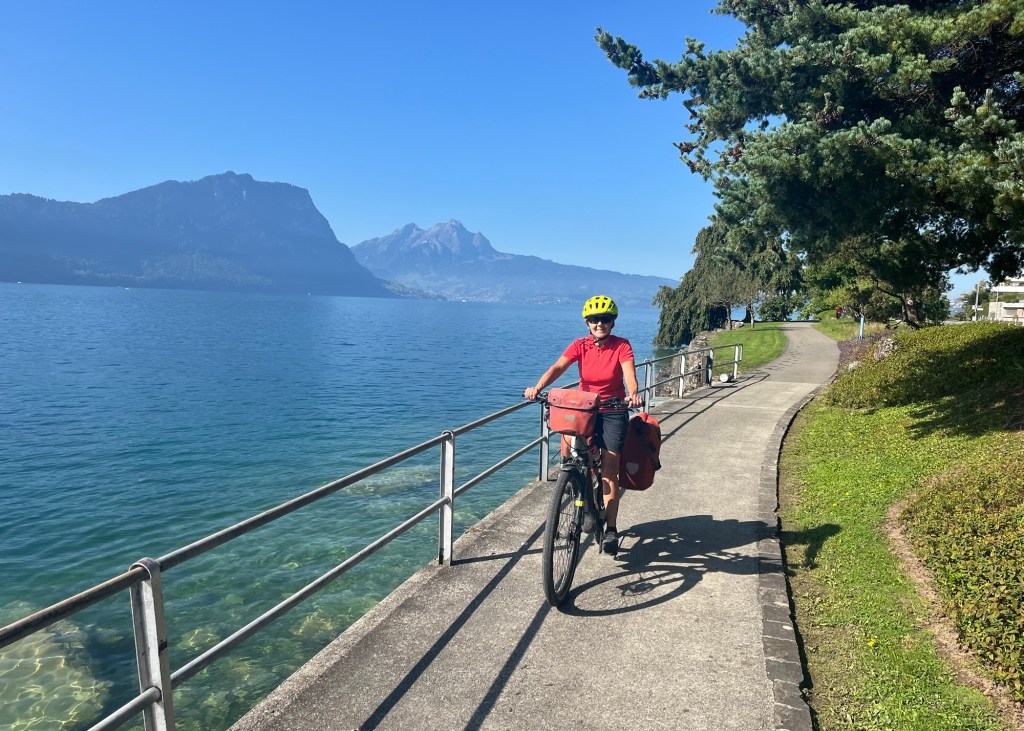
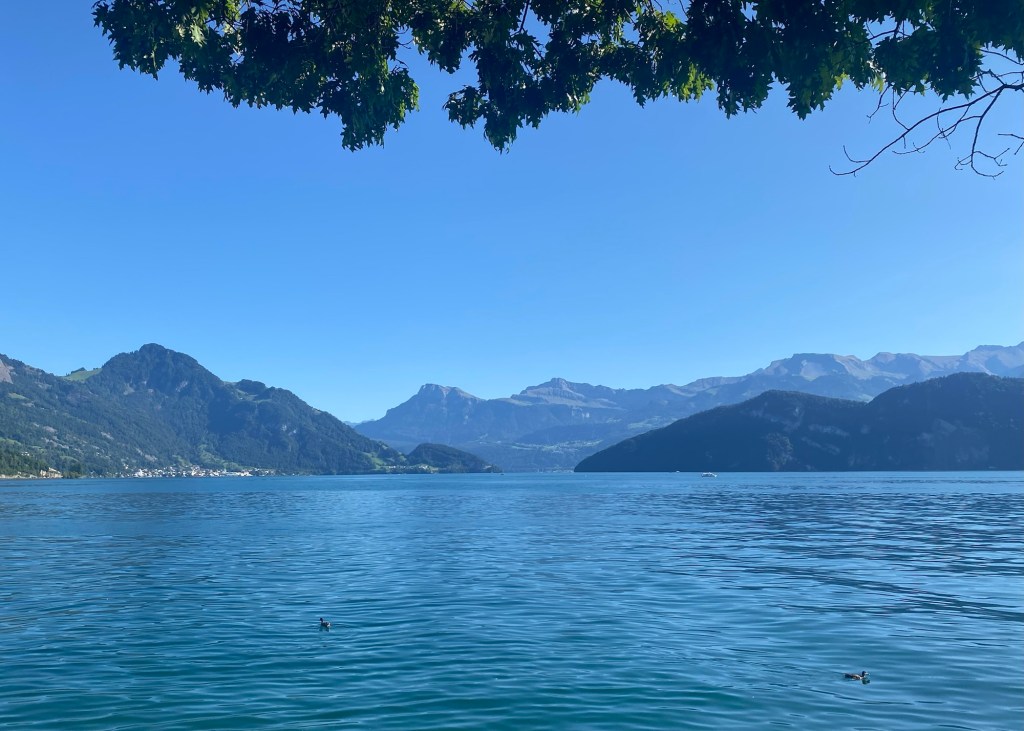
Leaving the hotel the following morning, the box of Swiss delights became even more sumptuous as we slowly pedalled around the contours of Lake Lucerne before stopping for a coffee in the small lakeside town of Brunnen.

Switzerland is a fascinating country. A small, landlocked oasis of peace, prosperity and neutrality in the heart of Europe, still with four official languages (German, French, Italian and Romansh) and as many distinct cultures.

It really is as clean, efficient and precise as its reputation.

No wonder the cycle paths are so clean
Which means lots of people regularly cycle in Switzerland

A strong economy and consistent current account surplus, plus a growing reputation as a safe haven currency in uncertain times have dramatically strengthened the Swiss Franc in recent years.  Before the 2008 financial crisis £1 would buy a British traveller 2.4 Swiss Francs, now the two currencies are nearing parity.

That has made Switzerland draw-droppingly expensive for that British traveller. Fortunately the country is quite small so it didn’t take us too long to cycle across it!

Clare likened Switzerland to a super-premium IKEA … it’s good quality, it all fits precisely together, it works efficiently and it looks nice … if a tiny bit lacking in character. 

But you have to understand how it works.

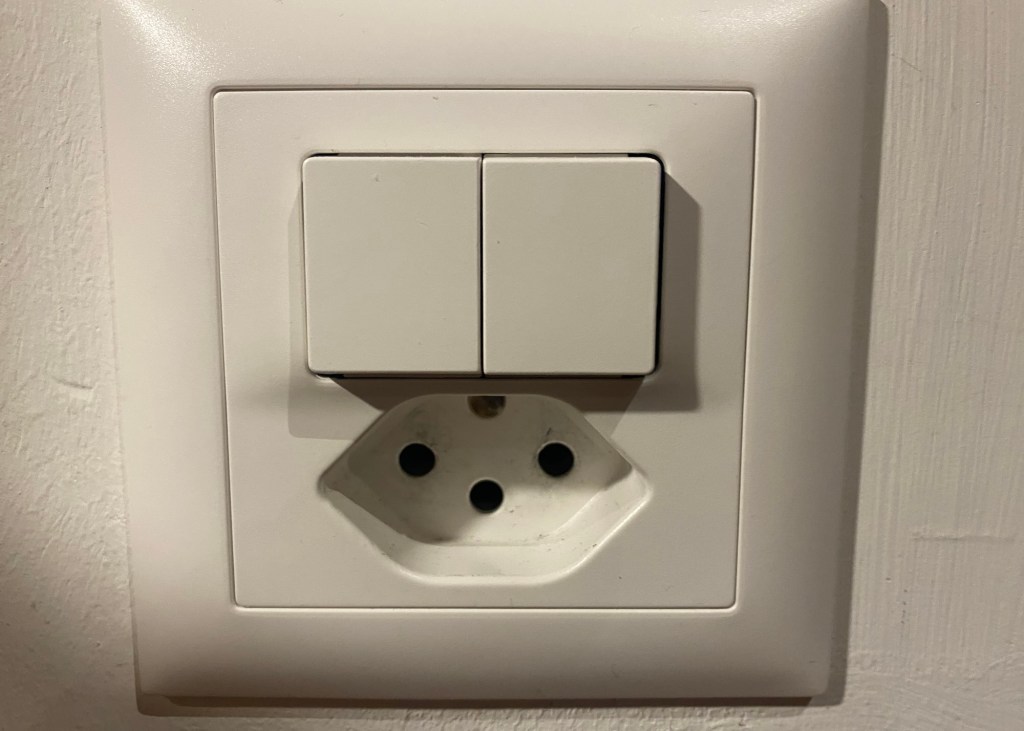
Deep, precise, safe, unique electric plug sockets

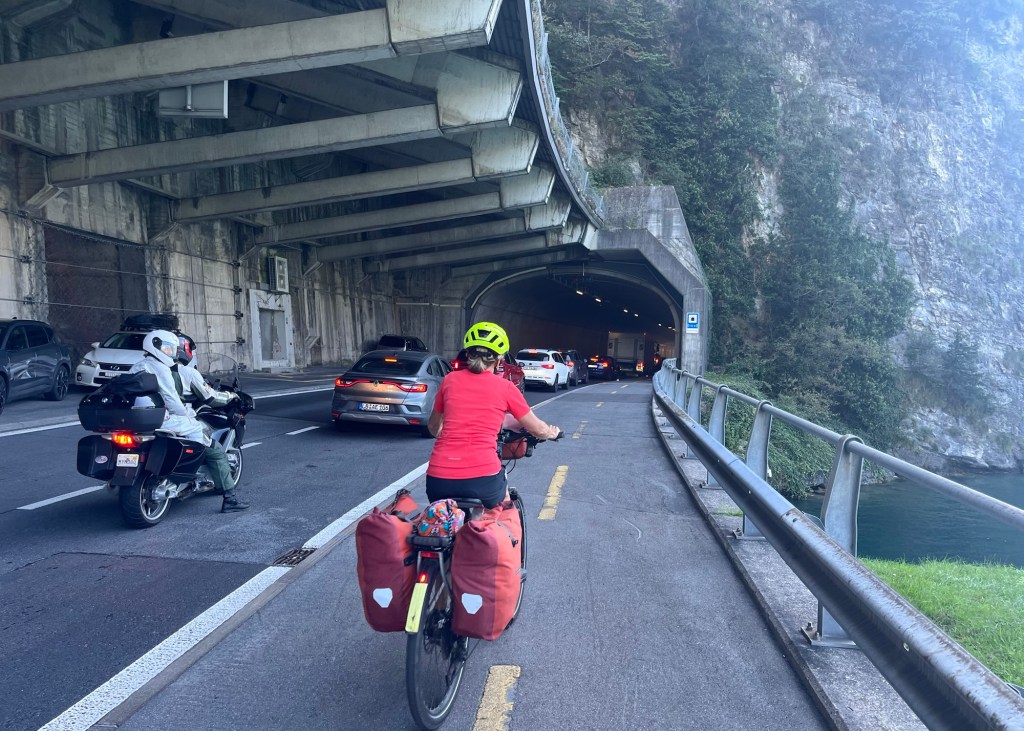
Finishing our coffee in Brunnen, we were surprised to join a long traffic jam full of vehicles travelling from Zurich and funnelled onto a single lane road to get up to the tunnel or to go over the pass.

It must have been incredibly frustrating for the motorists, we heard it was taking over 4 hours to get through.

Fortunately for us there was a nice cycle path so we glided past all the traffic trying not to look too smug.

Perhaps we hadn’t properly understood the way Switzerland works as we’d found ourselves being forcefully told off quite a bit since arriving in the country. Clare generally prides herself on being a stickler for rules but even she was told off three times in one day in Basel.

So we were a little nervous when a smiling policeman flagged us down just as the cycle path became a pavement. A pavement which was then blocked by a sign that forced us briefly onto the road in order to manoeuvre our big, heavy bikes around it.

Nein, nein, he said, ist verboten.

Andy smiled back and apologised for not speaking German.

No good, he said, not allowed.

Oh Entschuldigung (sorry), said Andy thinking we weren’t allowed to cycle on the pavement after all, we go on road.

The policeman pointed up the road. OK later, he said, here no good. Too dangerous.

Andy looked up and saw that the pavement was indeed outside the protective cover of the half tunnel that the traffic was crawling through. Ich verstehe (I understand), he said miming rocks falling down, bang on my head.

The policeman nodded sagely.

Danke schön, we waved and joined the traffic queue on the road.

The policeman now became quite animated. Nein, nein, nein, he shouted. Verboten! Verboten! You must go here … pointing at the pavement.

It felt as if the language barrier was just a tiny bit too big to explain that the only reason we’d moved off the pavement and onto the road (for just one moment) … was to get around his bloody sign.

As we set off again on the pavement, once again serenely passing the traffic queue, we were sure that we could hear him chuckling away to his colleagues almost as much as we were. Dummes Englisch Radfahrer!

Shortly after that another cycle path emerged to help us climb the mountain, which only served to increase our sense of superiority.

As usual on a climb, Clare shot ahead. Since we’ve acquired our e-bikes she’s become so much faster at going uphill than Andy, enjoying the significantly better power-to-weight ratio that the motor gives her, even in a lower power setting. Andy is now habitually huffing and puffing in her wake, trying in vain to stay close to her wheel.

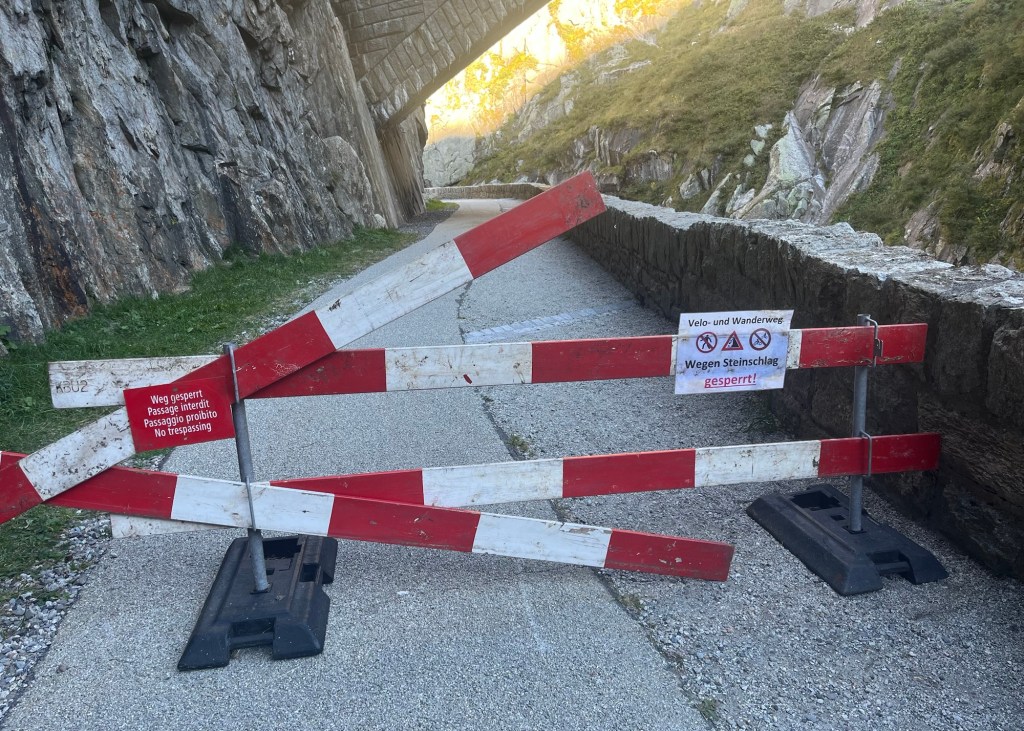
But near the top of the climb he found her forlornly contemplating a problem … the cycle path was closed, blocked by a rockfall. We had no choice but to join the busy road through a long tunnel.

The only thing that touring cyclists hate more than cobbles is a road tunnel. Quite rightly we’re normally banned from entering them, but even if we are allowed in, we’ll do anything to avoid one … especially if it’s going uphill, especially if there’s a lot of traffic.

Because Clare was so much faster than Andy, it was difficult to use our normal busy road formation, Clare in front, Andy behind and slightly outside her. So Andy went first setting a slow but steady pace. 

The road through the tunnel was very narrow, the drivers were clearly not expecting to find us in there and many of them must have been feeling exhausted by the long traffic jam they’d endured. Probably quite irritated too by the sight of smug cyclists cruising past them on the pavement all day.

Several sounded off their horns in frustration and we had a few close shaves as they squeezed past.

Then a car got too close and brushed against Clare’s pannier knocking her sideways.

Luckily she still doesn’t clip in on both sides on a climb … even after all the thousands of kilometres of bicycle touring she’s done. This meant she could quickly put her foot down and recover her balance, instead of sprawling into the road. Phew!!

Clare’s tunnel, you can just see the rockfall on the cycle path

We emerged to find another access point to the cycle path. It was still closed but this time we didn’t care.

This path took us through the Schöllenen Gorge, the greatest engineering challenge of the Gotthard Pass and the reason why it wasn’t used in Roman times, until they eventually managed to build a bridge across the gorge in the 13th Century.

So important was this bridge to complete the trading route that it marked the beginning of the long period of prosperity for the Swiss Confederacy. Prosperity that has ultimately led to it becoming such an expensive country to visit today.

Schöllenen Gorge

We recharged overnight in the spa and ski resort of Andermatt, ready for the final push up to the pass itself the next morning and then the joyful descent down the precisely laid cobbles of the Tremola.

It was another beautiful sunny day.

But the receptionist at the hotel gave us a wry smile. You must get down quickly, she said, snow is coming.

And she was not wrong. The unusually early season snow arrived the very next day and once it started, it didn’t stop for a week. We later met touring cyclists who were forced to take the high speed train through the big base tunnel to reach Italy, missing the Gotthard and Tremola experience all together.

A massive pothole avoided! How lucky were we!

Clare being careful to follow the rules on the final ascent to the pass
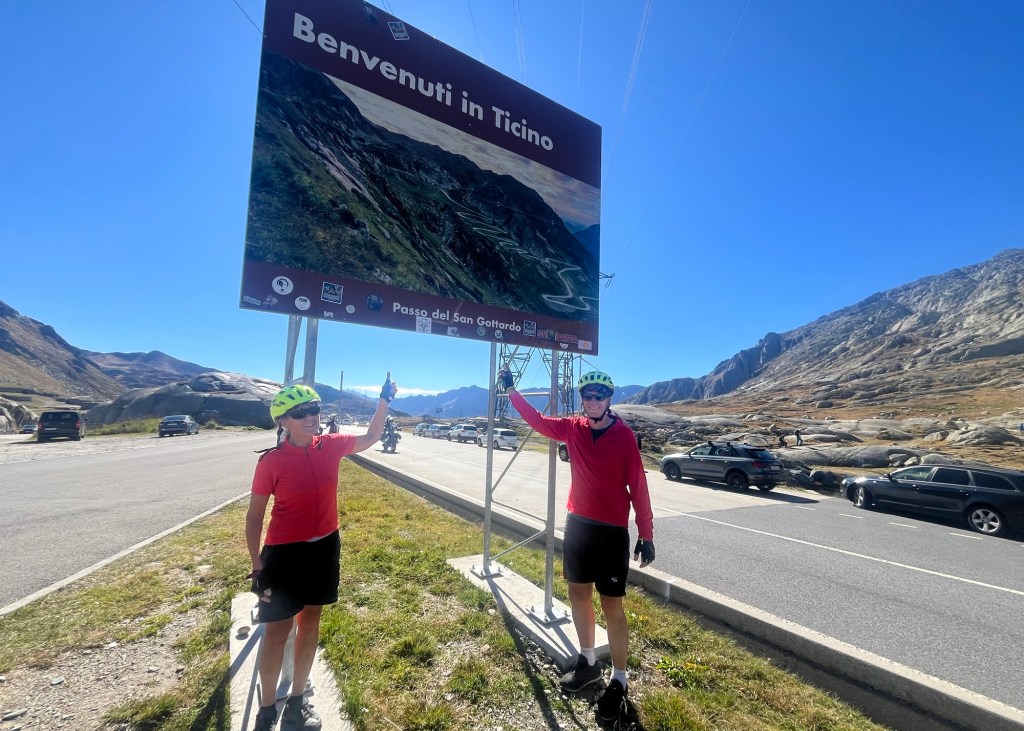
At the top … and into Italian speaking Ticino

The Gotthard Pass also marks the border between German speaking central Switzerland and the Italian speaking canton of Ticino.

Map showing the main languages spoken across Switzerland. Photo credit: Wikipedia

Despite not actually leaving Switzerland, it was amazing to see different road signs, advertising for Trattorias and Osterias and to hear people chatting away in Italian, rather than German. The food definitely improved, with delicious pastas and risottos replacing cheese fondue or wienerschnitzel. But it was still just as expensive and the road surfaces were still super smooth.

The following day we crossed the border from Swiss Italy to Real Italy halfway around Lake Maggiore.

Plenty of noise and life in Italy

The changes were immediate. Manhole covers were no longer precisely flush with the road … instead they were deep, hazardous pits. Houses looked like they needed a lick of paint. There was the occasional piece of rubbish on the street.

But … the pasta was now a reasonable price, so was the wine, so was the gelati. And there was a lot more vibrancy on the streets, a lot more life, a lot more noise.

What else would you do first when you cross the border into Real Italy?

It did feel a lot more real and we immediately loved it.

After all, we had just pedalled across half of Europe and over the Alps to experience Real Italy on a bicycle.

Andiamo! … Let’s go!

Clare & Andy

Bath to Verbania, on Lake Maggiore in Italy

1,480km pedalled (920 miles)

11,792m climbed

78 hours in the saddle
A Path less Travelled

If it’s snowing at the top of the Alps it’s likely to be raining in the Italian lakes.

Sure enough, the heavens opened and the rain poured immediately after we’d crossed the Gotthard Pass on that idyllic sunny day. A blizzard closed the pass for a week.

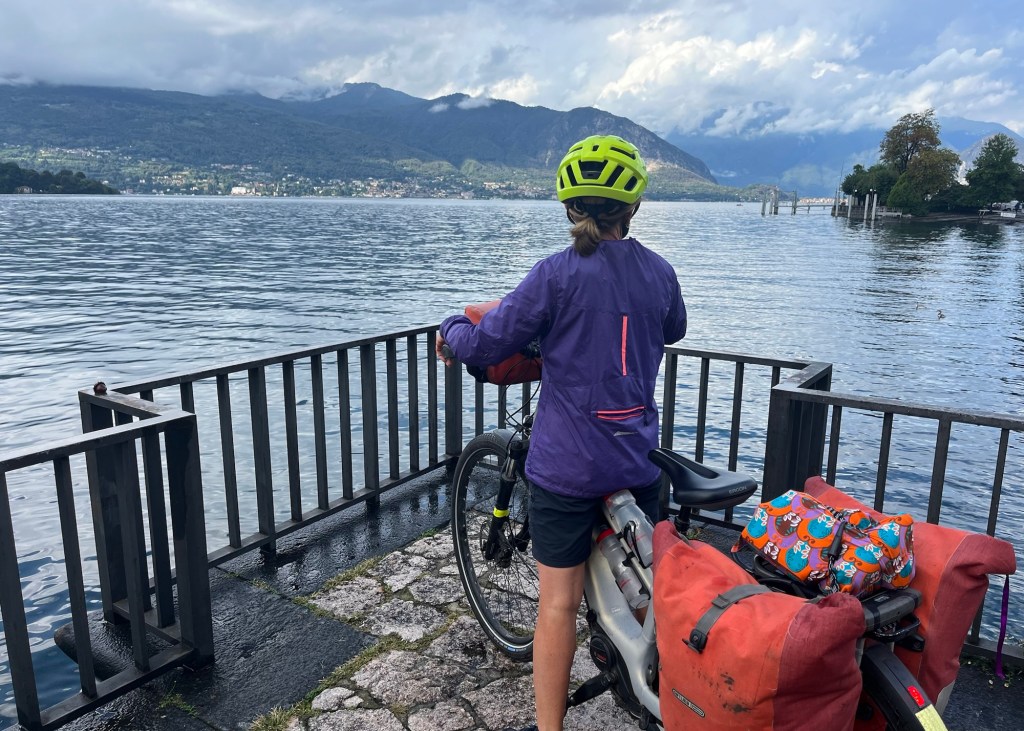
Feeling very lucky, we holed up in Verbania on Lake Maggiore watching the rain bounce off the cobblestones. It was a perfect opportunity to catch up on laundry, write a blog post and, of course, to start eating pasta and drinking wine.

Lake Maggiore

Then we moved the short distance to Lake Orta for another couple of days, a much smaller lake, less visited and a great tip from our friends Neil and Claire. They were right, it’s a beautiful and peaceful place made all the more mysterious and atmospheric by the rain clouds rolling down the mountains.

Lake Orta

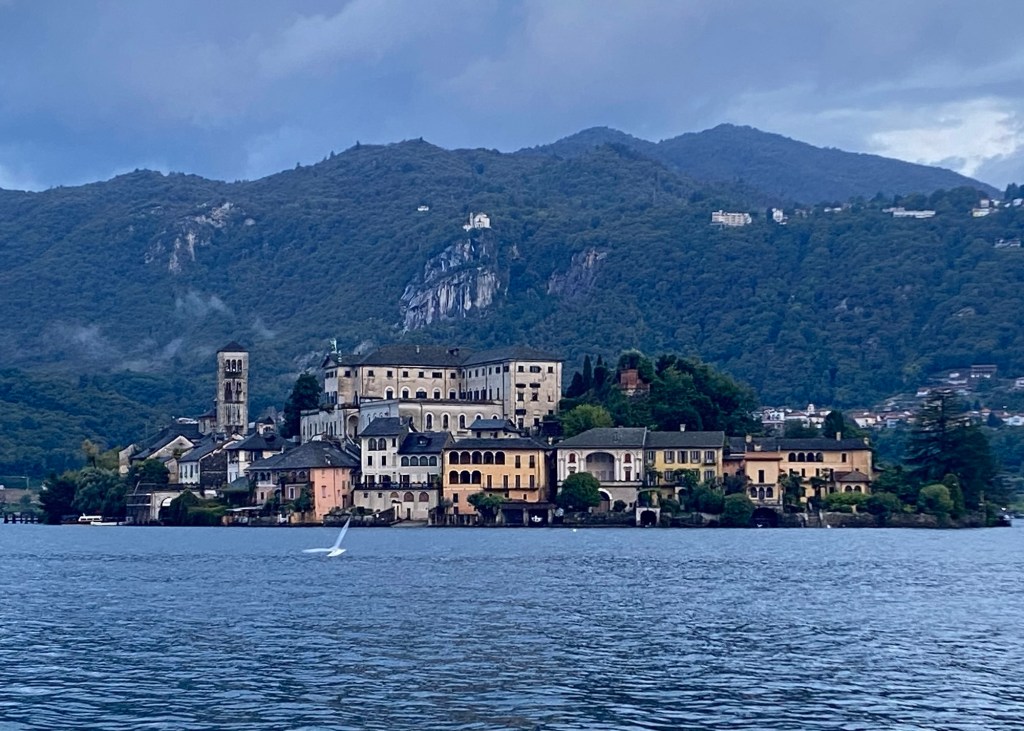
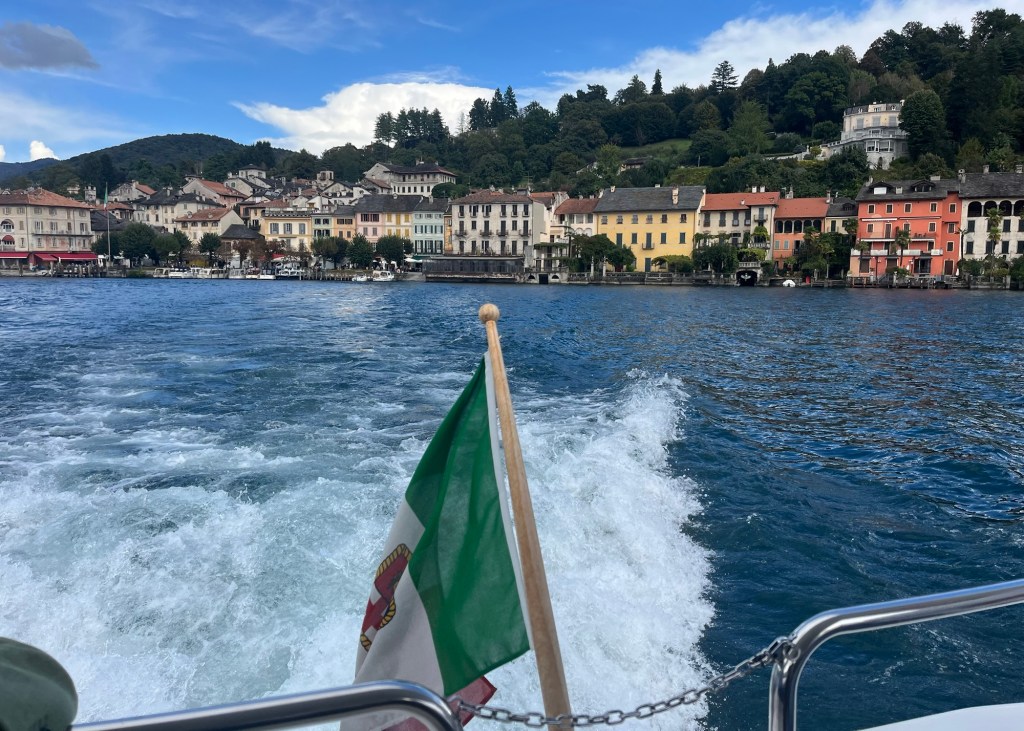
If Lake Orta is a hidden gem amongst the Italian lakes, then Orta San Guilio is its crown jewel. Built on a small promontory jutting out into the lake it’s considered to be one of Italy’s prettiest villages. Sitting in the main square whilst gazing across to the tiny island of Isola San Guilo felt like being part of a classic Italian movie set.

Isola San Guilo

But we didn’t just sit in the square, watching the world go by.

We took the five minute boat ride across to the island.

We had a pleasant evening stroll around the promontory until it was interrupted by a thunderstorm of almost biblical proportions.

A bit wet

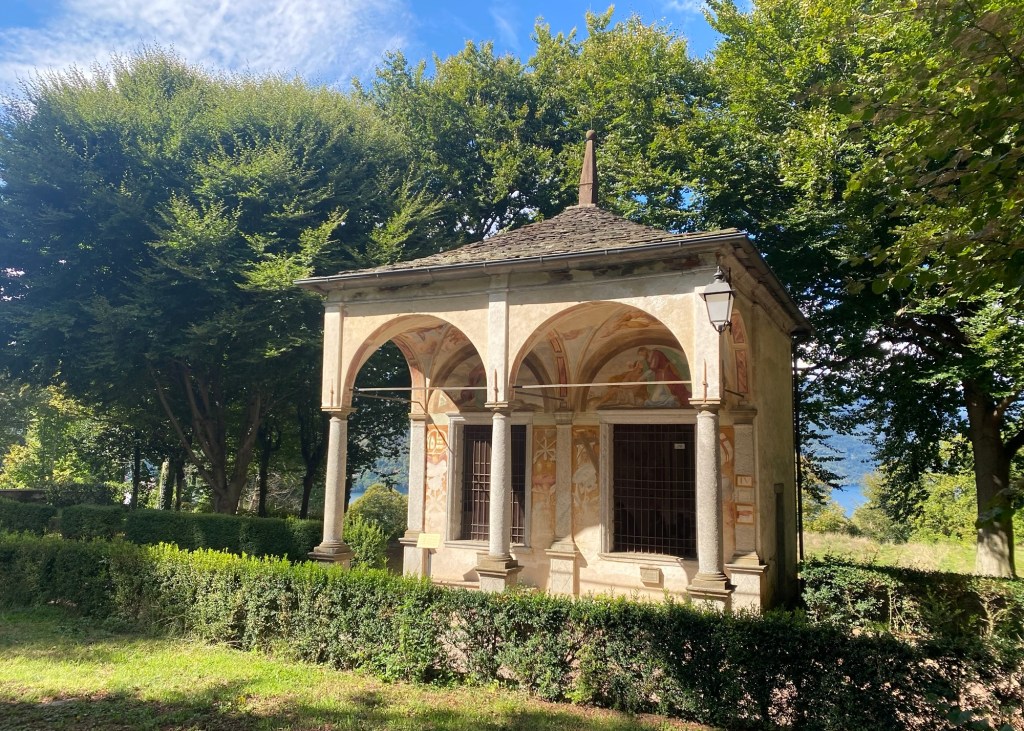
And we walked up the hill to wander around the Sacro Monte di Orta, a series of 20 (twenty!) chapels that tell the life story of St. Francis of Assisi. The first chapel was built in the late 1500’s but the complex was not completed for another 300 years, each one becoming bigger and more flamboyant over time, as if the benefactors were trying to outdo their predecessors in the eyes of God.

One of 20 Chapels at Sacro Monte di Orta

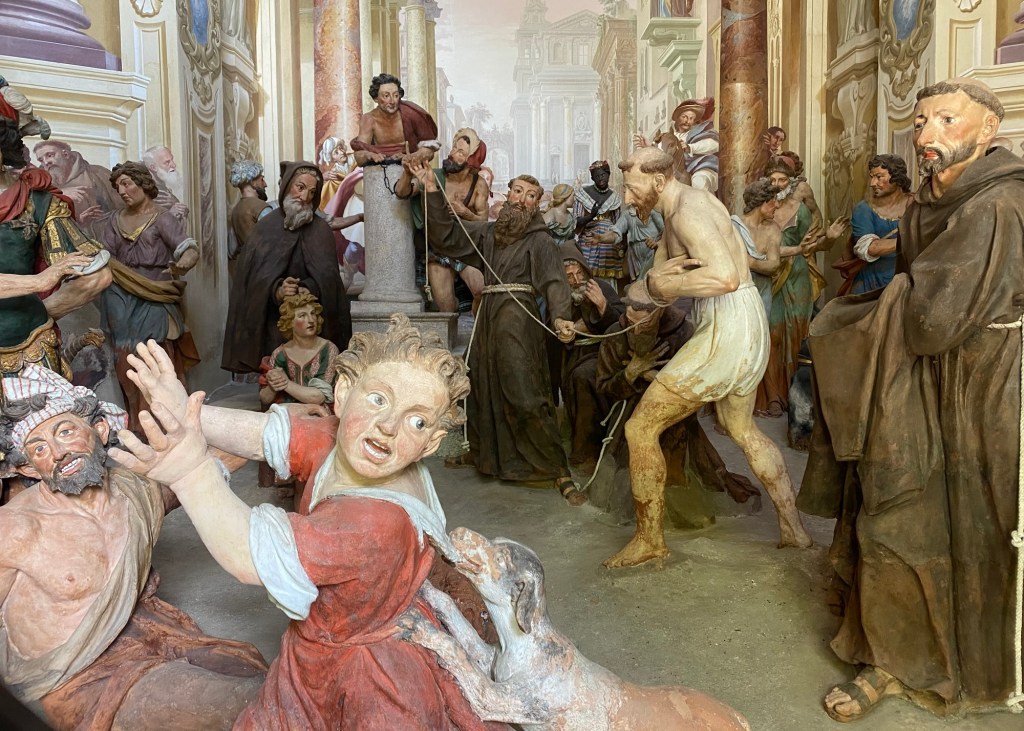
A guide in one of the many churches we’ve since visited in Italy explained the importance of art for religious propaganda in the Middle Ages. Sermons were preached in Latin (effectively a foreign language) and as most people couldn’t read, they learnt about the bible and the Holy Catholic message through art instead.

It was very easy to see how that happened at Sacro Monte di Orta. Frescoes on every wall surface set the background for life size figures acting out the story, each tableau created by an artistic master. It held our attention, so it must have been incredibly compelling in a world before magazines, cinema, television and the internet.

A break in the weather presented the opportunity to ride the 100 kilometres from the lakes down to Milan, following the Naviglio Grande (the Big Canal) for much of the way. You might think we were a bit fed up of canals but this was a particularly impressive one, some of the locks designed by no less an architect than Leonardo de Vinci.

Initially dug by hand as far back as the 12th century, it was enlarged from the 14th century in order to carry huge blocks of pinkish white marble needed to build the massive new Duomo di Milan (Cathedral). The marble travelled roughly the same route as us, all the way from a quarry near Lake Maggiore.

Naviglio Grande

Nobody would describe Milan as being on a path less travelled, especially during Milan fashion week. The city was jam packed with fashionistas as well as tourists.

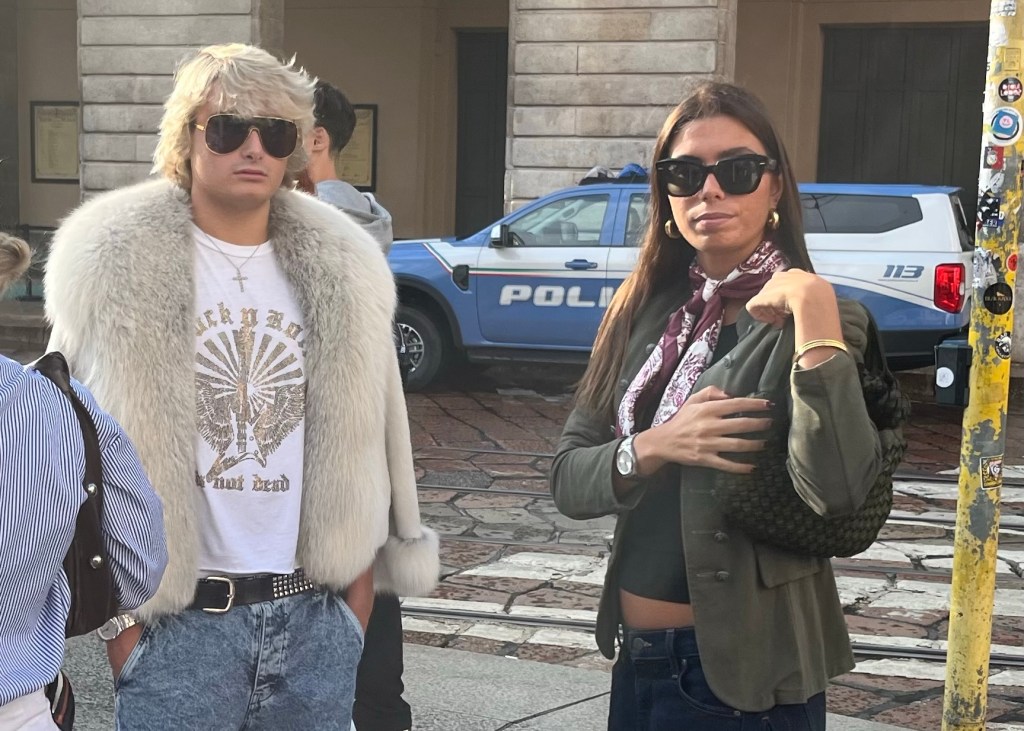
Fashion week made for some interesting people watching

We were even treated to an impromptu fashion show right outside the Duomo.

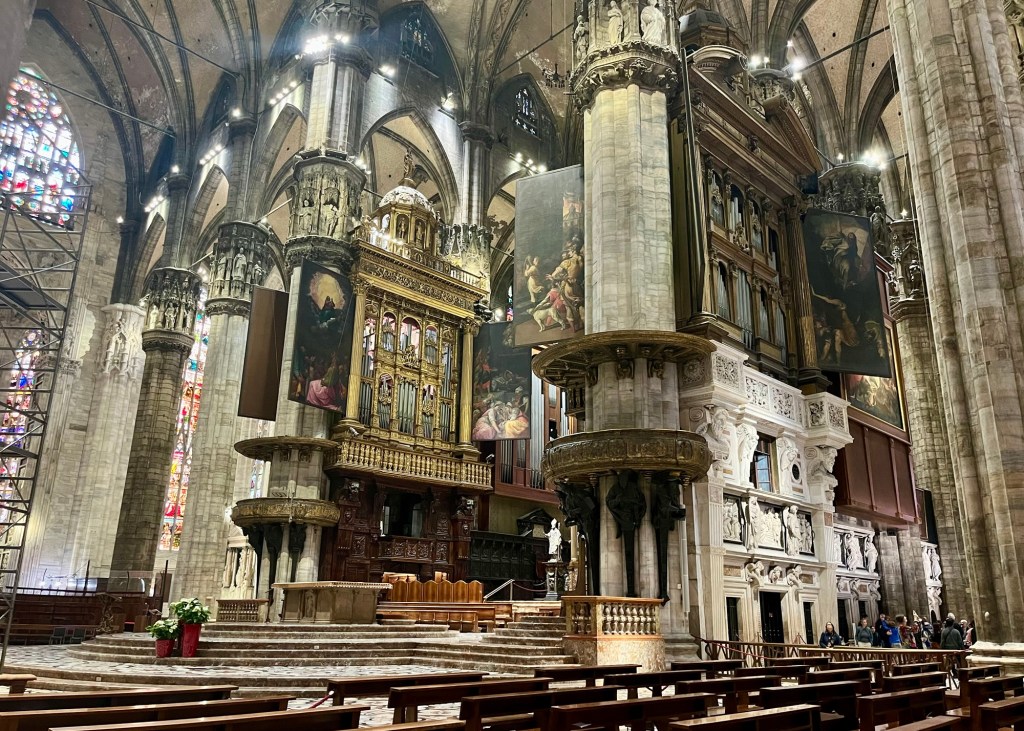
There’s no doubt that the Duomo is immensely impressive. Built over five centuries and not officially completed until 1965, it’s the 5th largest cathedral in the world with a capacity for 40,000 people and a world record number of statues … a staggering 3400 of them gaze down at all the visitors.

Inside the Duomo

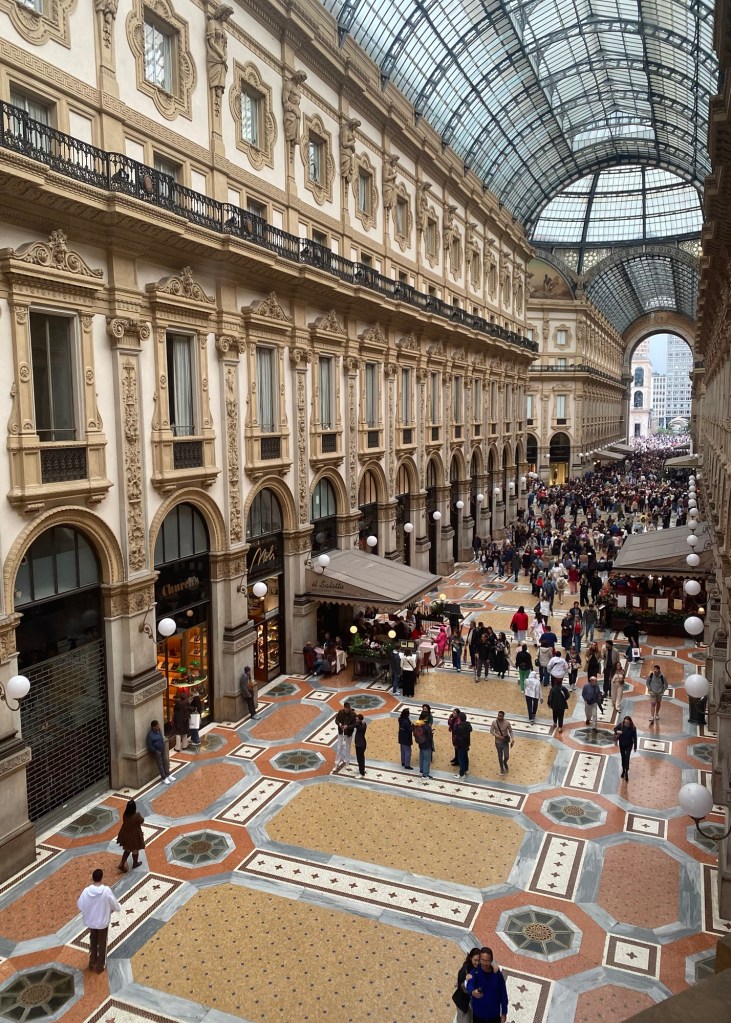
The Duomo is flanked by the other great cathedral in Milan … the Galleria Vittorio Emanuele II, a cathedral of fashion packed with luxury brand boutiques.

Inside the Galleria Vittorio Emanuele II

Sadly, we couldn’t squeeze any luxury items into our panniers, so we had to keep our credit cards in our pockets.

As we left Milan, the sun briefly came out again. Turning to look back, there was a thick ribbon of white snow covering the Alps, yet another reminder of our good fortune.

For a couple of days we pedalled gently across the Po Valley, a huge fertile plain that runs across Italy from the Western Alps to the Adriatic Sea and is home to a third of the Italian population.

Lunch stop in the Po valley

We paused in the delightful town of Piacenza where we spent a lovely evening with Erica from Nuremberg, a fellow touring cyclist who is also heading to Rome. It was great fun to talk bicycle touring for a bit, comparing notes on the most useful bits of kit and laughing about squeezing everything into two panniers.

Clare and Erica

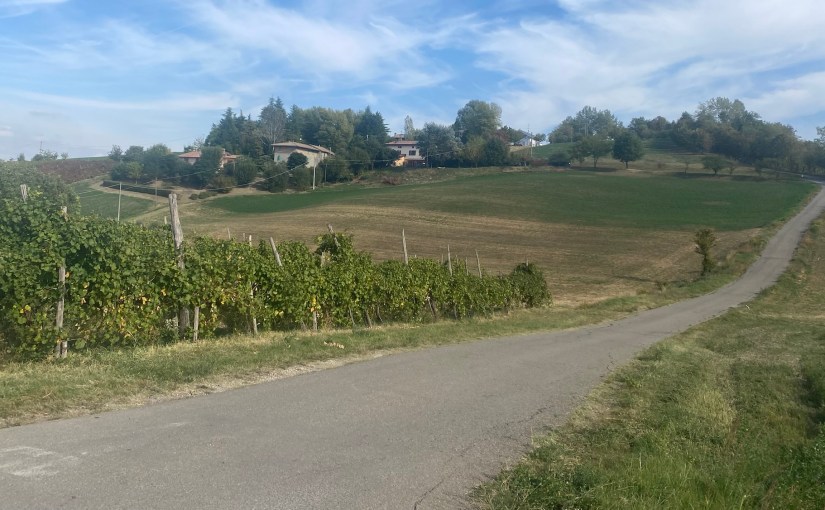
The following night we stayed at a small family vineyard just outside the town of Reggio Emilia where they proudly grow Lambrusco. Now we are of a British generation that is forever biased against this wine, considering it a cheap, sickly-sweet drink from a 1970’s party, alongside Babycham or some fizzy beer from a Watney’s Party Seven.

But it seems Lambrusco is much better than that. It’s delicate. It’s dry. It can have a delightful aroma of orange blossom, violets or watermelon.  It pairs particularly well with beef and lamb or with spicy Thai and Indian cuisine. And it’s recovering from the tarnished 1970’s legacy … as the Milan fashionistas would say “it’s having a moment”.

Over the next few days there was little else available so we threw ourselves into Lambrusco country with gusto, whatever we were eating.

Were we convinced?

Honestly … it’s pleasant enough but, nah … it’s still a fizzy red … which somehow just seems wrong!

Fine Lambrusco

Back in our formative years, when we were both just starting to dream about exploring the world, an inspiration for both of us was the travel writer Eric Newby … A Short Walk in the Hindu Kush (1958), Slowly Down the Ganges (1966), The Big Red Train Ride (1978) amongst others.

Our favourite was Love and War in the Apennines (1971) in which he described escaping from a prisoner-of-war camp near Parma during WWII, then hiding from the Germans in the very same hills we were now cycling through. There he was helped, at huge risk to themselves, by the local mountain people and in particular by Wanda, a young Slovenian lady and her father. Predictably Wanda and Eric fell in love. Less predictably they found each other after the war and remained happily married, travelling together on all their other adventures.

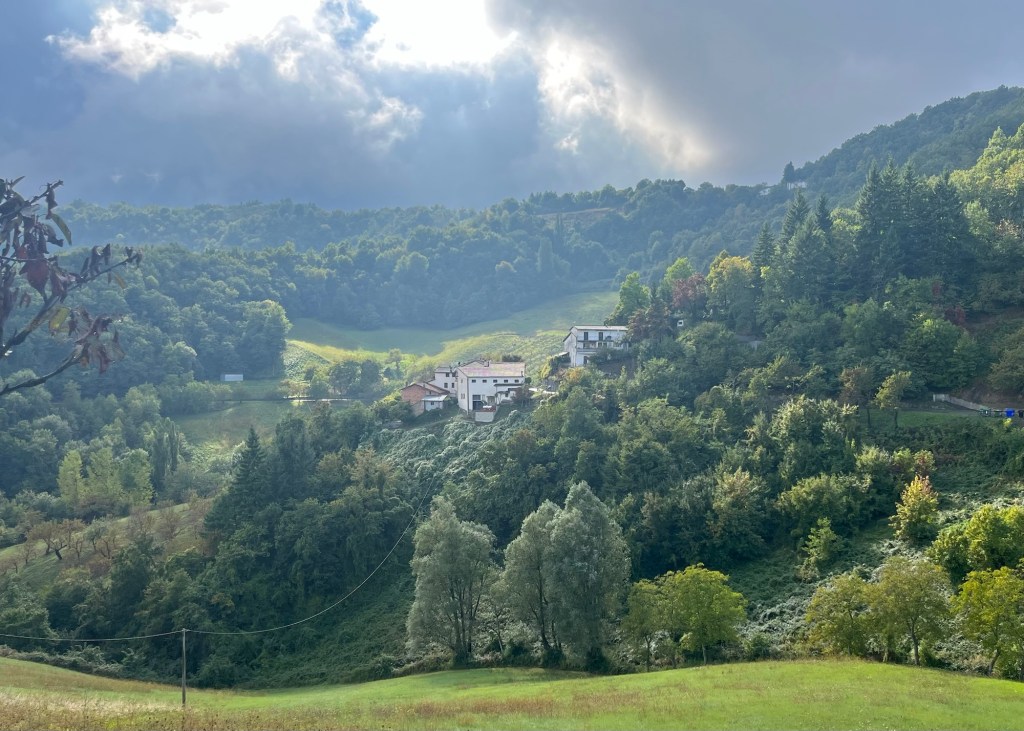
We thought a lot about Eric and Wanda as we pushed our way up through the hills,  moody with mist, coated in sweet chestnut trees, remote farmhouses illuminated by a shaft of light from the heavens.

Sweet Chestnuts

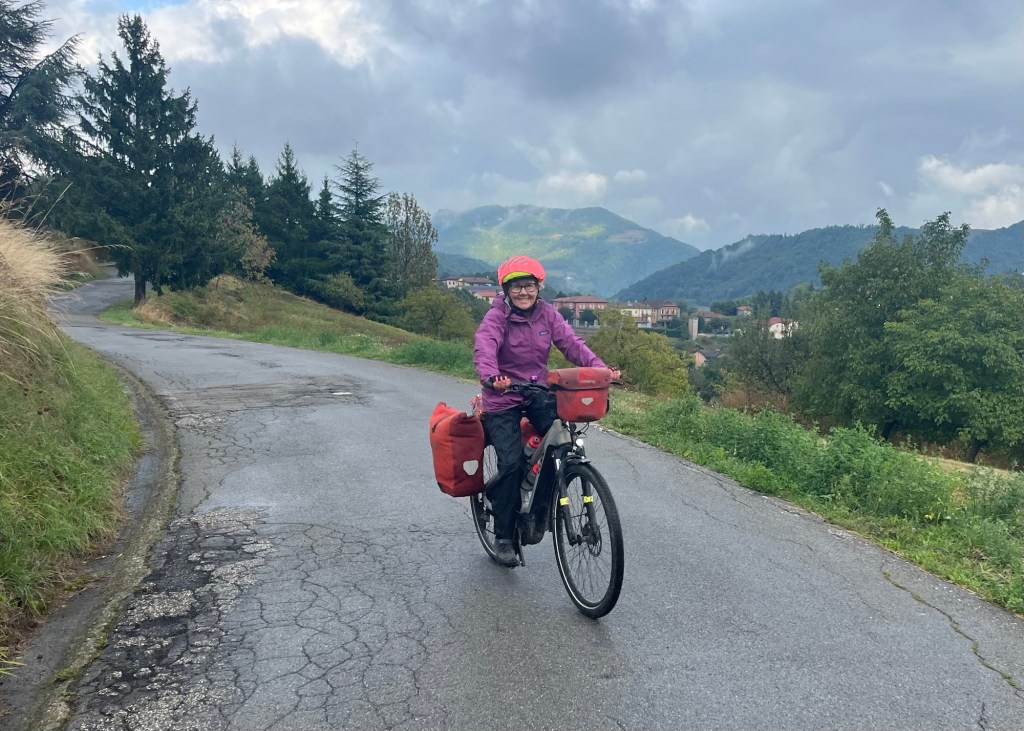
Of all the mountain ranges we’ve now cycled through, the Apennines are the steepest. They’re brutal, steeper than the Alps, steeper than the Pyrenees, steeper than the Andes.

Now we know you’re thinking we have nothing to complain about … we have motors and batteries to help get us up steep hills.

But as you watch your remaining battery percentage collapse before your eyes, there is NO WAY you can accept that riding a heavy e-bike up 15% inclines on rough roads is an easy option.

It’s still brutal!

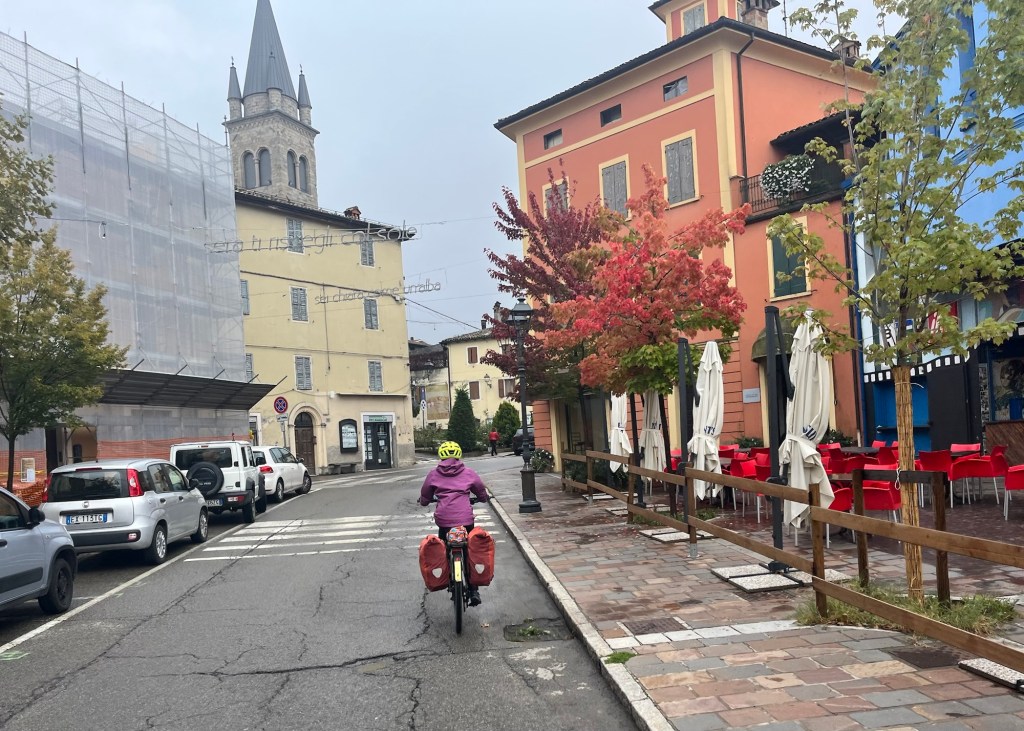
We may not have needed the same life saving protection that was given to Eric Newby, but feeling as exhausted as our batteries, we were very relieved to be welcomed into the warm hospitality of a family run mountain B&B near Zocca. It’s since become firmly established as one of our favourite lodges from this trip, a simple but comfortable room and a cavernous restaurant warmed by a pizza oven and an open barbecue, dripping with large joints of meat.

The family invited in two bedraggled cyclists without a murmur and then encouraged us to stay on in our room until the following afternoon to wait out the last of the rain.

Hearing we were travelling to Zocca, the lady in the Lambrusco vineyard had become very excited. You go on Zocca? she said, it’s the home of my favourite singer. He’s Vasco Rossi. People go to Zocca from all over Italy. They hope to see him. Perhaps you will the be lucky ones!

Vasco Rossi is indeed a big cheese in Italy, with 30 albums to his name and regularly selling out stadium tours. But not everyone is going on a pilgrimage to Zocca, it turns out Italian fans either love him or hate him. As one critic put it …

According to his fans, he’s Bruce Springsteen, Freddie Mercury and Michael Jackson rolled up into one musical genius. According to his detractors, he’s just a sleazy package of average Italian mediocrity.

Zocca … not a Vasco in sight

As we’ve been lucky enough to visit Florence several times over the years we decided to take the path less travelled on emerging from the Apennines, and go to Pistoia instead … Florence’s little sister.

Screenshot

There might be a reason why it wasn’t visited very often in the past. For much of its history, Pistoia has been reviled as a dangerous, aggressive place.

The city’s metalsmiths were as famous for their daggers as the Pistoiesi were for stabbing each other.

The city reputedly lent its name to the Pistol.

Michelangelo even called the Pistoiesi the “enemies of heaven.”

Pistoia

The most notorious incident of the Middle Ages happened when a massive feud that turned Florence into a war zone for centuries allegedly started in Pistoia.

Two boys were playing with wooden swords when one of them was inevitably hurt. The father of the perpetrator told his son to visit the family of the injured boy to apologise. But the victims father became so incensed that he took out his dagger and promptly cut off the boy’s hand, shouting that “Iron, not words, is the only remedy for sword wounds!” 

Tough judgement.

One thing led to another and before long it had snowballed into a much bigger battle between the Guelphs who supported the Pope in Rome, and the Ghibellines who wanted an independent Florence city-state.

Thousands died … no wonder Pistoia became so notorious.

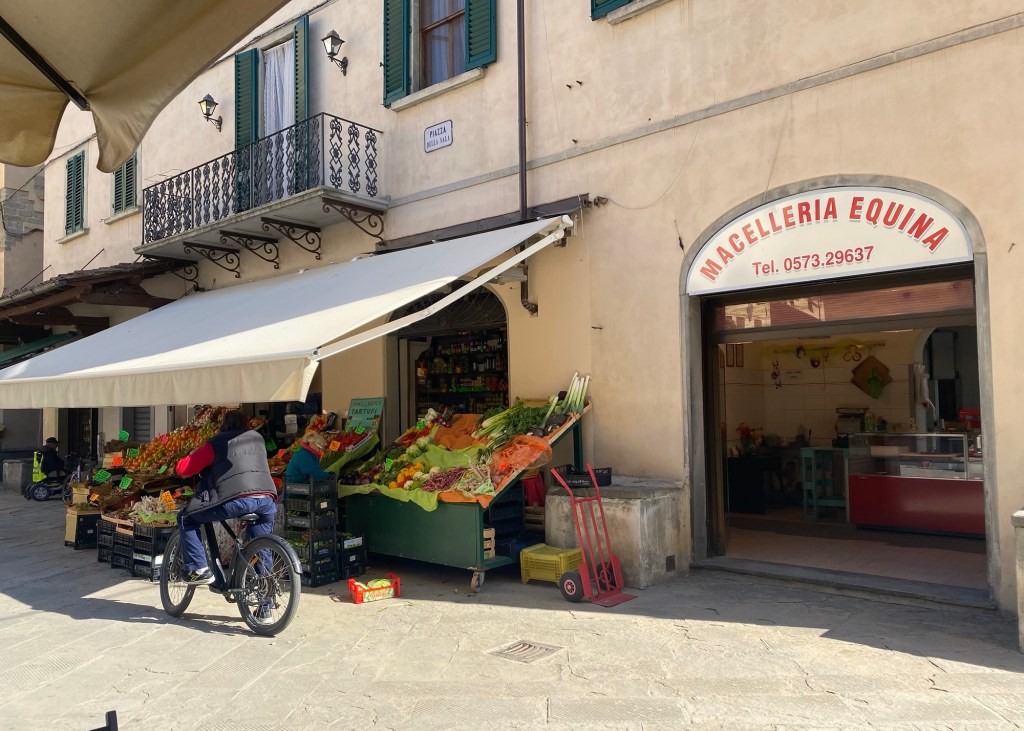
This butcher only sells horse meat!

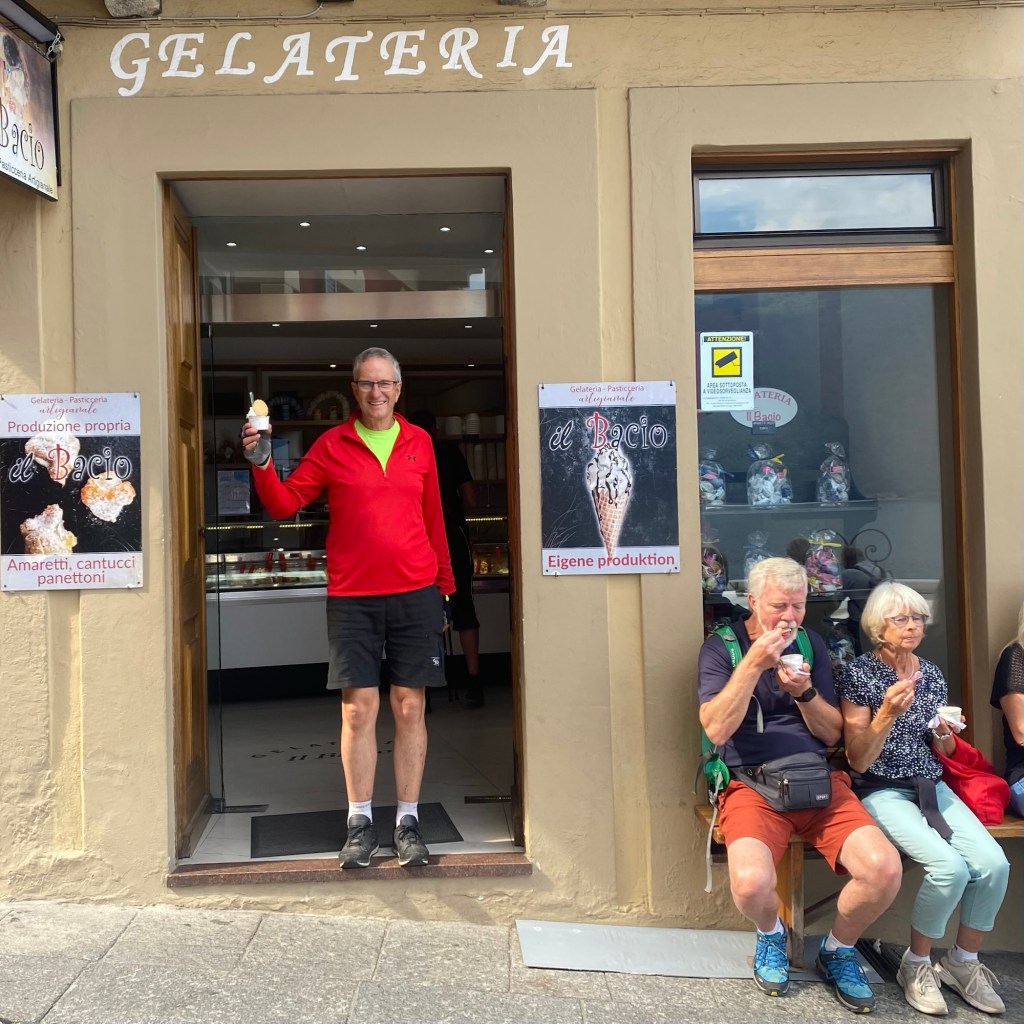
That dangerous history might be responsible for keeping people away as today there are very few tourists in Pistoia and barely any hotels. Which is a shame as it’s a charming typical Tuscan town, full of interesting renaissance buildings, lots of art and the best Gelateria!

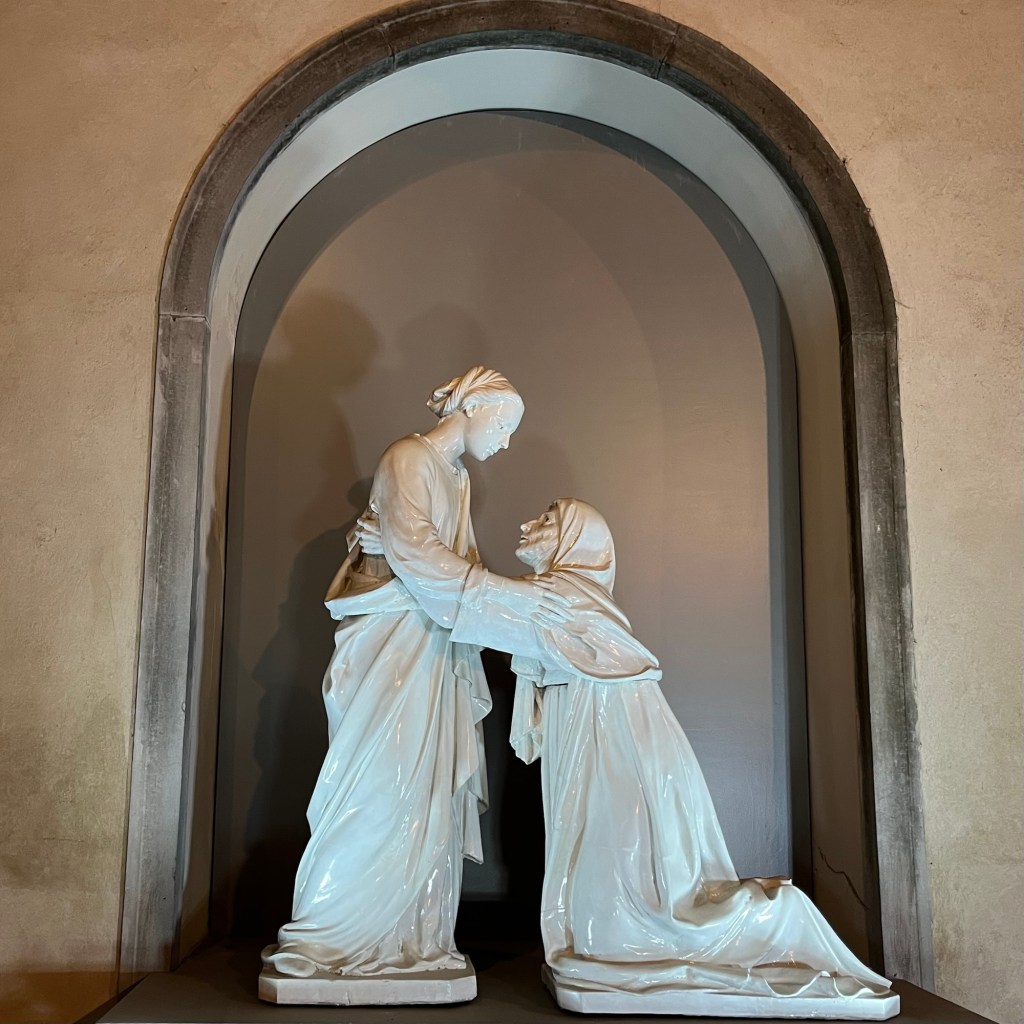
‘The Visitation’, Mary visiting Elizabeth, in glazed terracotta by 15th century artist Luca della Robbia

For bicycle tourists seeking the path less travelled, Pistoia was a perfect stopover and introduction to Tuscany.

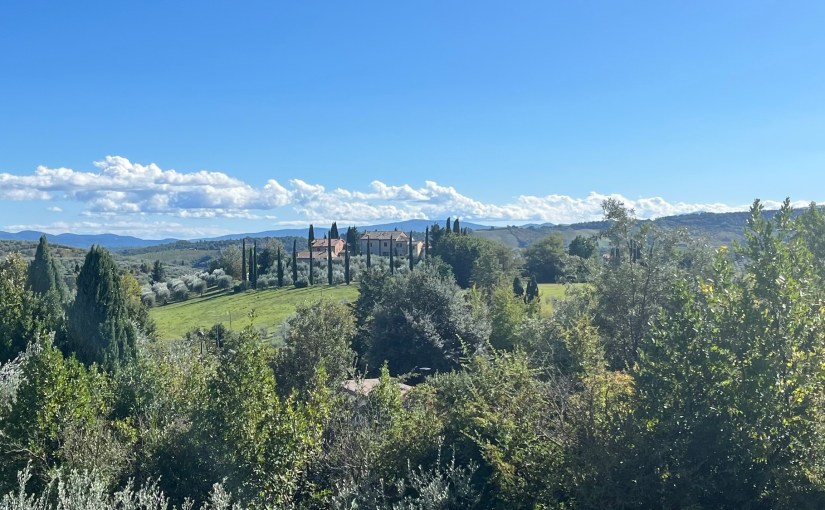
So, as we enjoyed our gelati in the square, we could start to dream about the path ahead … rolling Tuscan hills punctuated by poplar trees and topped by medieval hilltop villages.

After all that’s the Italy we’d pedalled across half of Europe to explore.

Clare & Andy

Bath to Pistoia

1,991km pedalled

15,471m climbed

105 hours in the saddle

La Dolce Vita on Two Wheels (almost!)

Is there anywhere more perfect for a bicycle tour than Tuscany?

Riding through the famous rolling green hills, dotted with vineyards, olive groves and cypress trees makes it difficult to imagine that there is.

It’s difficult to imagine when pedalling slowly through yet another atmospheric village.

Or when marvelling at the renaissance art and buildings in a city like Siena.

Siena Duomo

Yes, Tuscany is the sweet bicycle touring life … the dolce vita on two wheels.

Well … almost … there’s always a but!

Rather than take the direct route to Siena, we decided to swing eastwards to San Gimignano and into the Chianti hills. It proved to be an inspired decision as the next two days were amongst our favourites. 

Sunny but unseasonably cool we had the ferociously steep hills to keep us warm.

Approaching San Gimignano

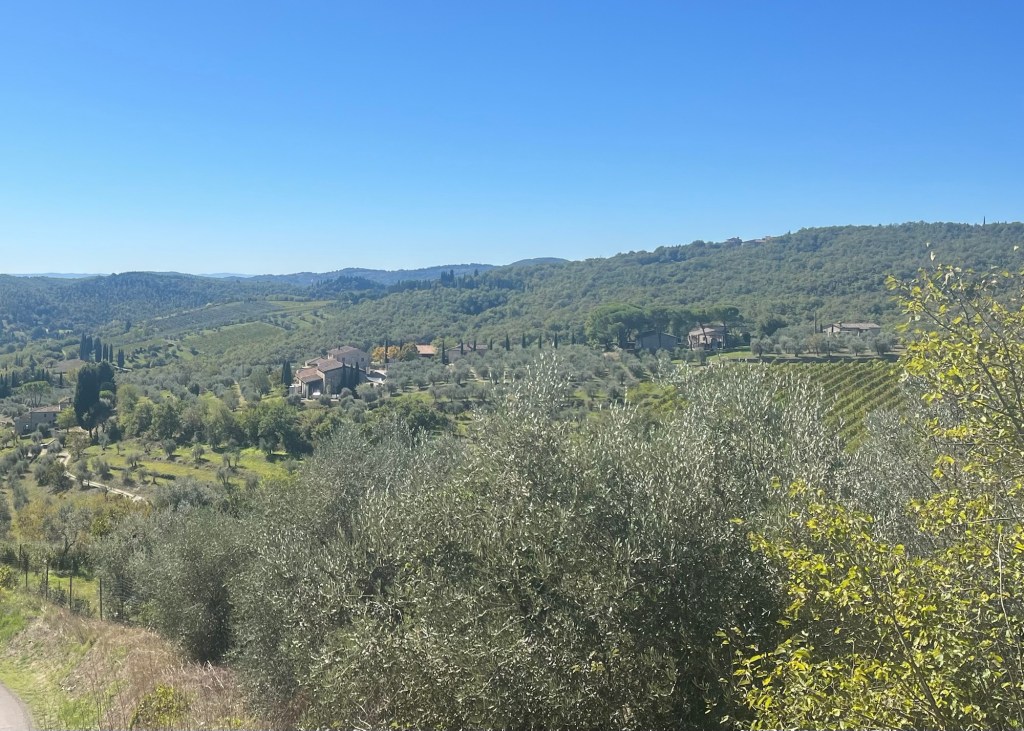
Chianti had a surprise in store … it’s covered in trees, lots of trees. The canopy of oak and chestnuts are punctuated by olive grove polka dots, stripes of vines and blocks of farmhouses guarded by rectangles of tall poplars … a tapestry in every shade of green.

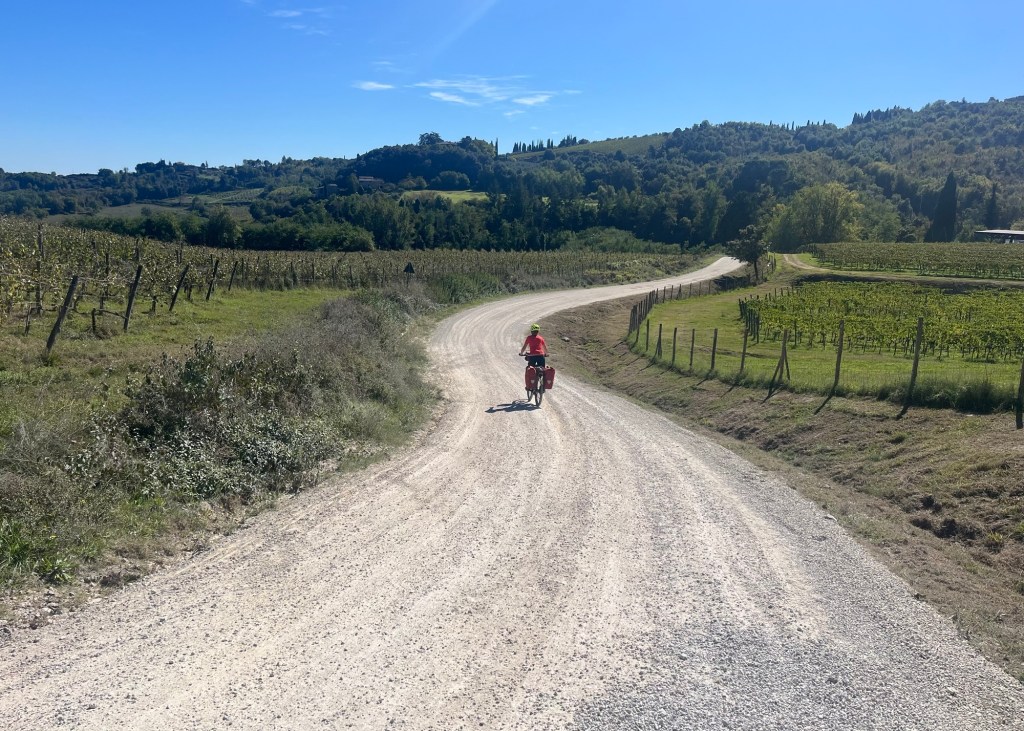
White ribbons of the famous Strade Bianchi (white roads) are then woven through this tapestry. Made from fine crushed limestone and beautifully groomed in this part of Tuscany, they led us from one hilltop village to the next. 

Groomed Strade Bianchi in Chianti

Our favourite stopover was Castellina-in-Chianti, a village with a single narrow street clinging to the ridge of a hill, full of ancient houses, restaurants, gelaterias, delicatessens and wine shops.

Trying to select a vintage in Castellina-in-Chianti

Whilst in Chianti it would have been rude not to stop at a vineyard to learn a little about the history of the wine … and, of course, to taste it.

As far back as 1716, Cosimo III de’ Medici, Grand Duke of Tuscany, decreed that only wine produced in a tiny area around Castellina could use the Chianti label, a state of affairs that happily continued until the 1930’s.

Then the Italian government of Mussolini decided to expand the Chianti region in order to export more wine around the world. Chianti became ubiquitous … cheap, poor quality plonk sold in those squat waxy bottles that were covered in a wicker flask and used as candle holders in every Italian restaurant. Ironically, the straw flask is called a fiasco in Italian.

As far as the winemakers around Castellina were concerned it was indeed a fiasco!

They fought back, launching Chianti Classico with very strict regulations on the grapes, the location of the vineyards, the type of soil and the winemaking techniques. The result was a wine of much higher quality that could be sold at a premium price, labelled with the coveted black rooster to separate it from the rough stuff.

Tasting the difference between Chianti and Chianti Classico

It was easy to tell them apart!

Sadly we could only try a couple of vintages as we still had to pedal to Siena that afternoon.

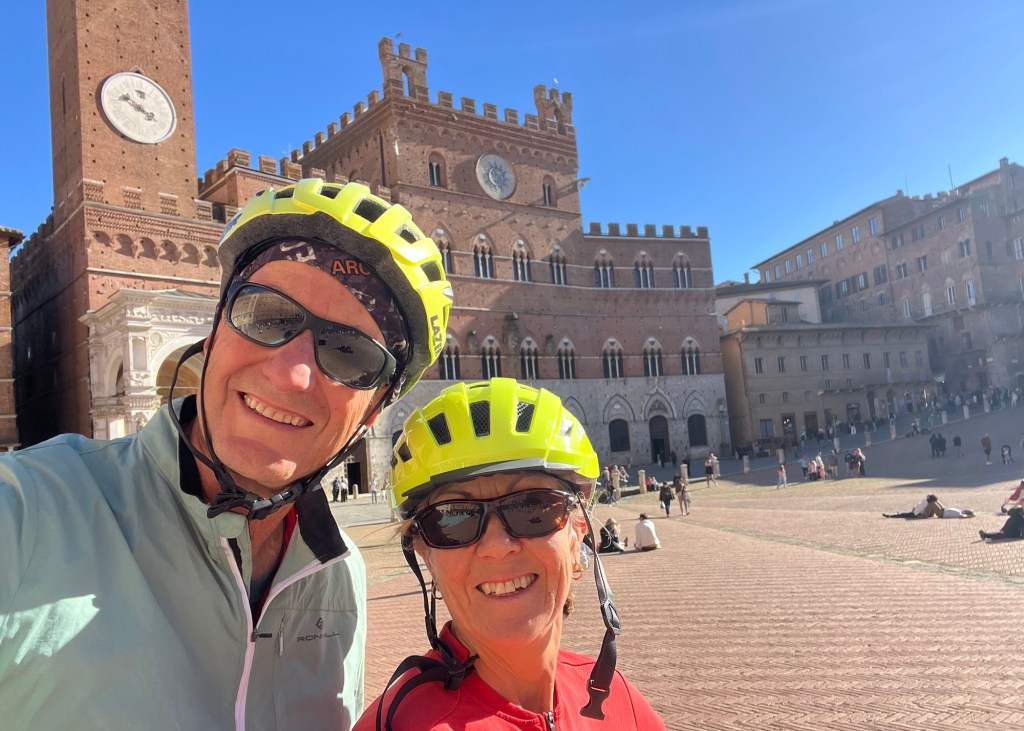
Arriving in Siena, post Chianti tasting

Siena would be a highlight of any visit to Tuscany.

To make it even more special we happened to be there during one of the short periods each year when the floor of Siena Duomo (Cathedral) is uncovered.

No other building has a floor which matches the scale and artistry of this one. Taking five centuries to complete, fifty six panels of marble mosaic inlay illustrate scenes from the bible but also from Greek and Roman mythology.

Siena Duomo Floor Photo Credit: Siena Duomo

It covers the whole floor of the cathedral. The effect is breathtaking!

Detail of one of the panels

The crypt of Siena Cathedral is also remarkable. This underground chamber was covered in religious paintings in the second half of 13th century before being abruptly sealed and filled with sand and earth.

Only re-discovered in 1999, those centuries buried underground have preserved the paint perfectly. This means that visitors today still get to experience the bright, vivid colours that the artists originally intended.

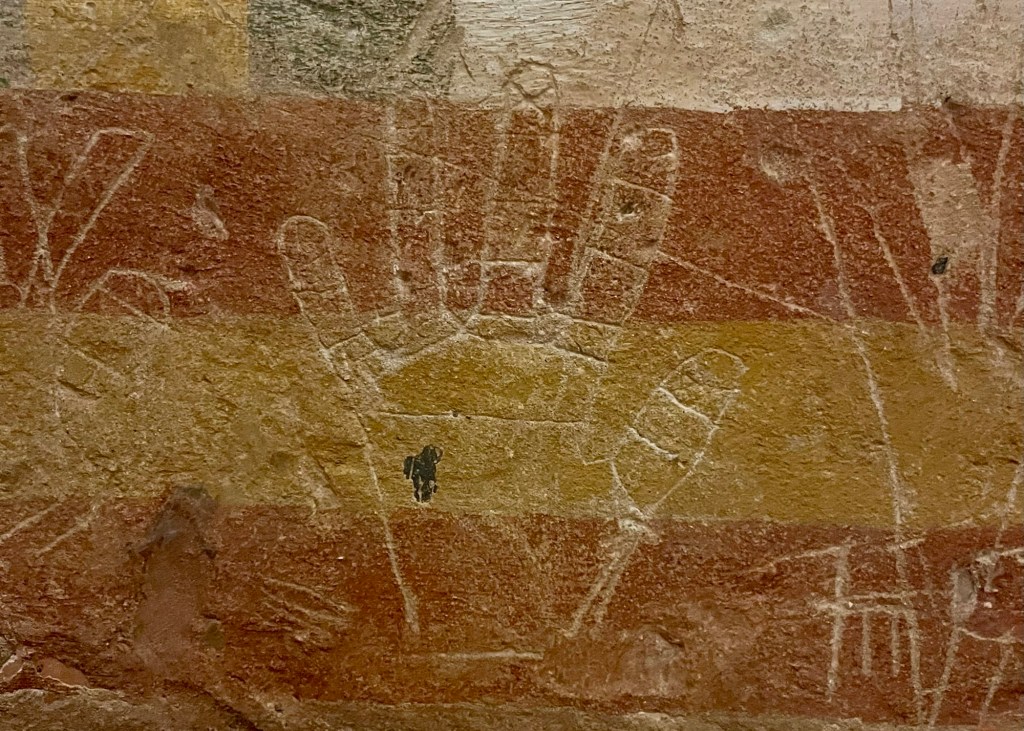
The lower part of the paintings are covered in graffiti, scratched into the limestone plaster.  This can only be graffiti from people living between the 1280’s when the painting were made and the 1350’s when the crypt was sealed and filled with sand.

It feels as if those people are calling out to us across the centuries … I’m alive. I’m here. I made this mark … look, this is my hand!

As usual with a museum or cathedral, the exit is through a gift shop. But only in an Italian cathedral does a gift shop look quite like this!

So why is Tuscany the dolce vita on two wheels (almost)? What’s the almost? What’s the but?

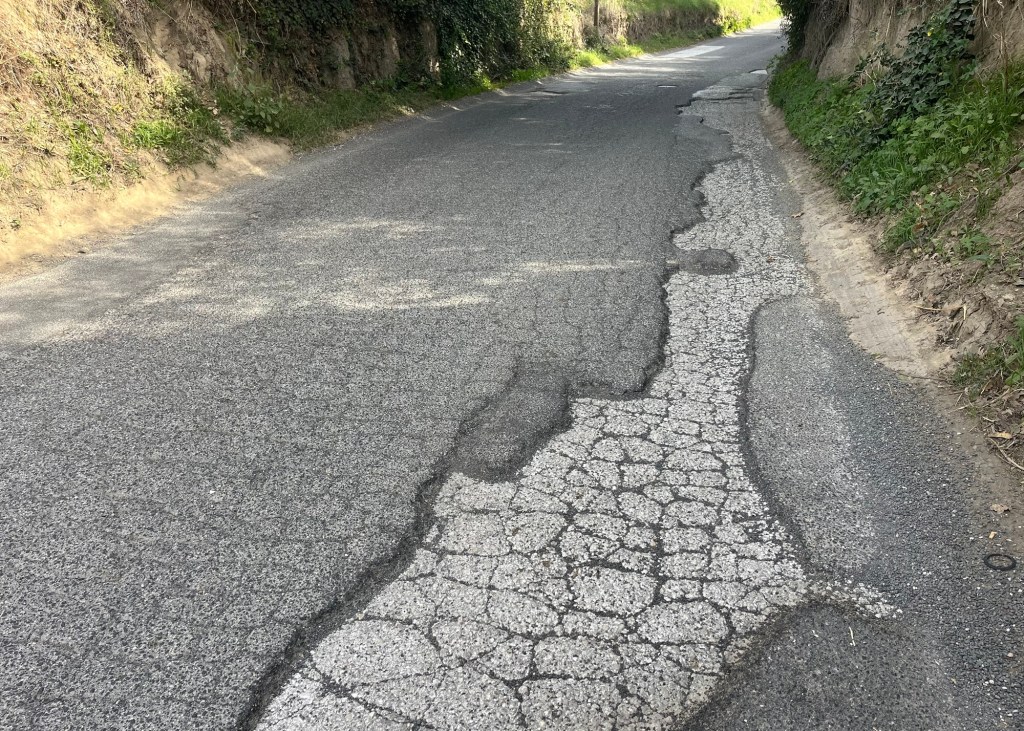
Well … it’s the roads … they really are as bad as their reputation.

And it’s the drivers. Italians are normally the warmest, friendliest people but put them behind the wheel of a car and they turn into crazy, impatient monsters.

The roads feel like a bumpy obstacle course. As a cyclist, you can’t afford to drop your guard for a second.

Typical Italian country road

At any moment you might have to weave between the cracks. Or swerve to avoid a sudden pothole, or a tree root, or a deep manhole cover, or all manor of debris.

Which is a dangerous game as the roads are also very narrow and you probably have an impatient monster revving up behind you.

To be fair the bigger the vehicle, the more courteous the drivers are. Trucks and vans are fine. What you really have to watch out for are the crazy monsters nipping around in their Fiat 500s!

This means that for a bicycle tourist, Tuscany charms and terrifies in equal measure. We’d love to come back and explore more of the area but perhaps we’ll stick to four wheels next time … maybe hire a Fiat 500 and become crazy monsters too?!

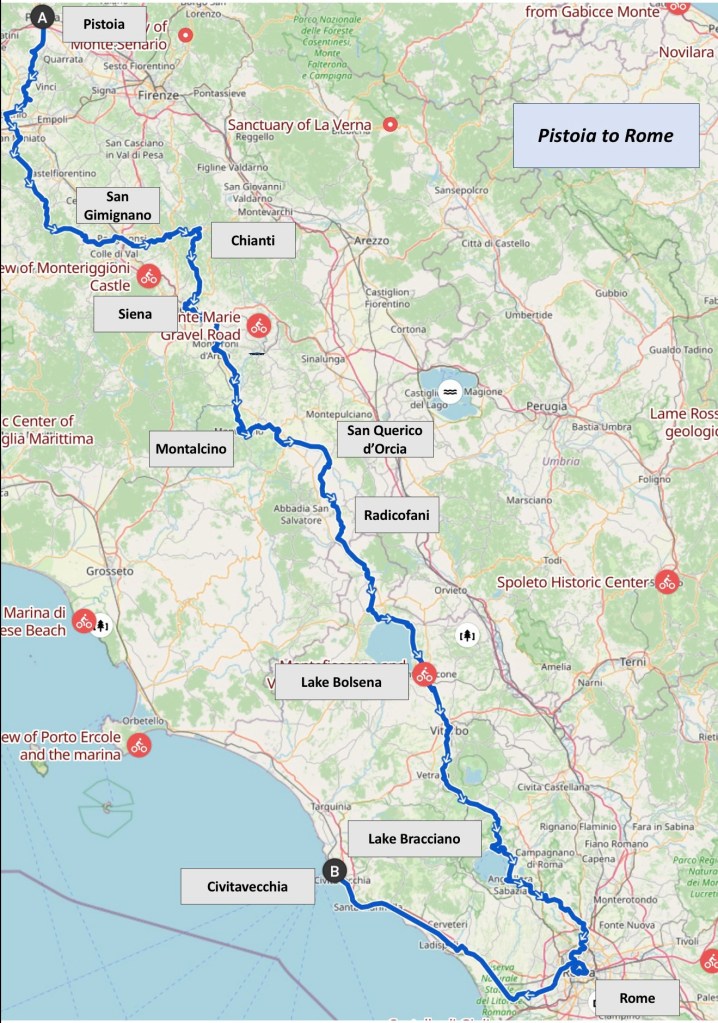
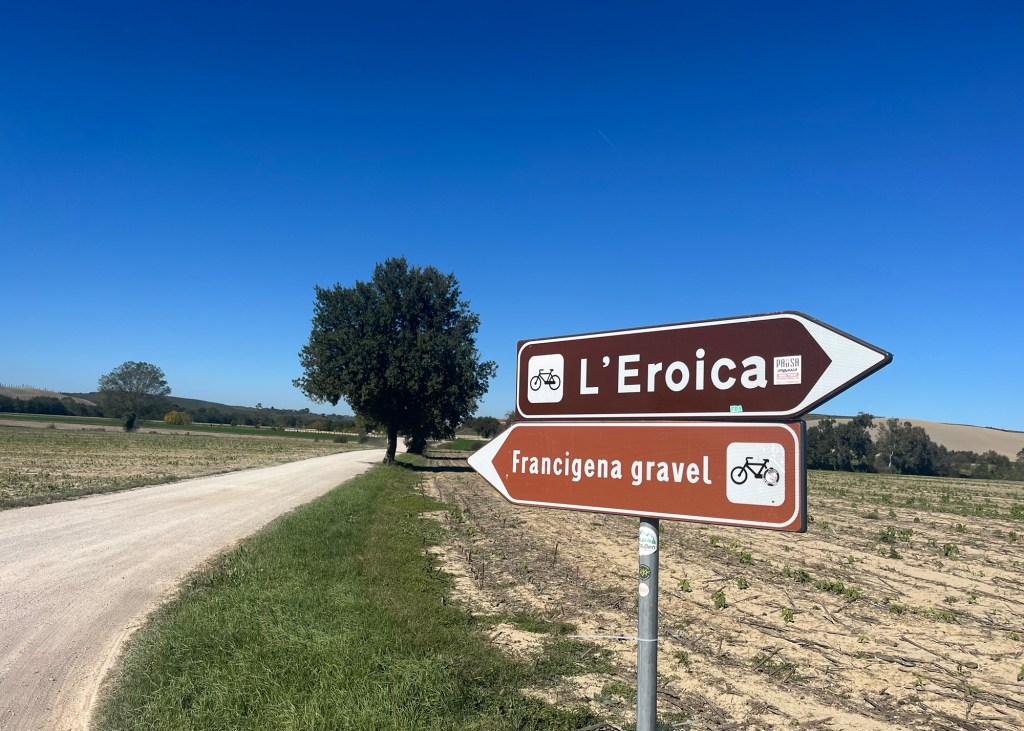
Since leaving Pistoia we’ve often been guided by an ancient pilgrimage route called the Via Francigena. It was an important medieval road for pilgrims travelling to Rome from as far away as Canterbury. Today, it’s still popular as a long distance walking and cycling trail, especially the section that runs through Tuscany.

We saw lots of people walking the Via Francigena

In turn, the Via Francigena often follows an even older Roman road, the Via Cassia, built to connect Rome to Florence. And the Via Cassia has since been used to plan the route of a major regional road.

For a touring cyclist this means the choice often comes down to a gravel track on the Via Francigena or the busy main road.

Clare hates gravel. Andy hates main roads.

Something had to give!.

Lunch stop in Radicofani

After a long climb up to a hilltop village called Radicofani for lunch, it was perhaps not Andy’s best idea to avoid the main road by choosing a long gravel descent down the other side.

This was not the same smooth gravel that Clare had enjoyed in Chianti. Much steeper. A lot bumpier. Very deep in places. Great for mountain bikers, not so great for touring cyclists. Lots of opportunities to skid and slide. 

And it lasted 20 kilometres!

Clare was not impressed. I didn’t spend hours struggling up that hill just to come down this ridiculous gravel. It’s so dangerous!

Predictably, about halfway way down there was one skid and slide too many.

“Stupid bloody gravel!”

Andy promised to take the road next time.

But the next day he pushed his luck even more by trying out a section of the original Via Cassia, still with the paving exactly as it was in Roman times.

It was even slower going but fortunately we both enjoyed the privilege of riding across the same stones that had carried the sandled feet of so many Roman legionaries marching off to yet another war.

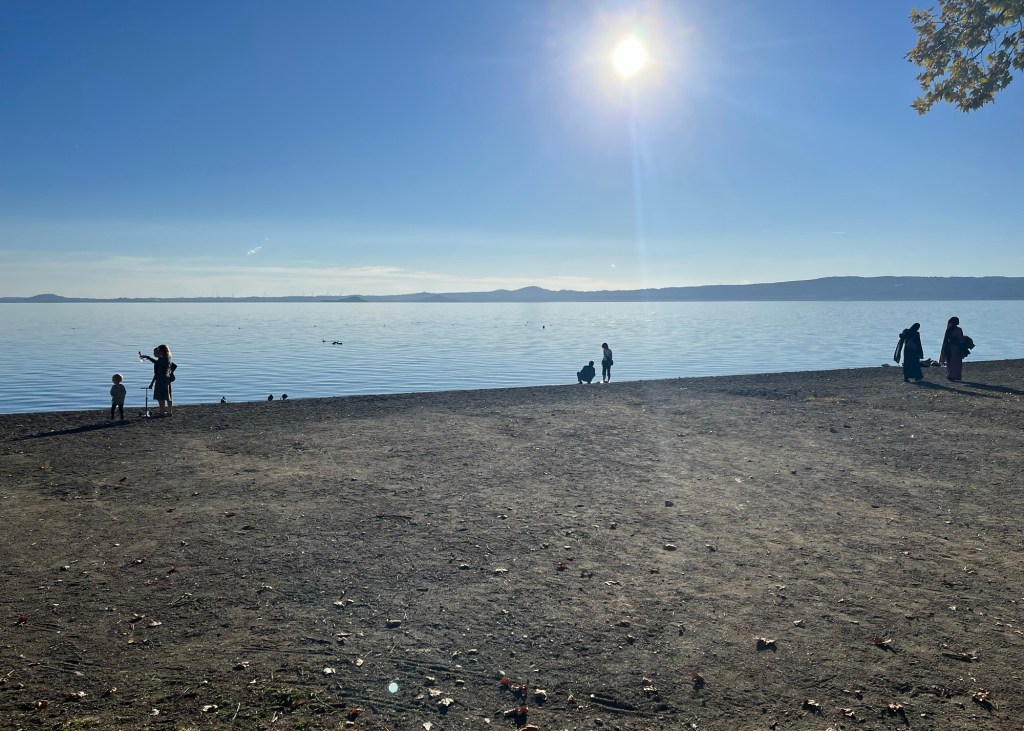
There was one last treat in store before reaching Rome … the Bolsena and Bracciano volcanic lakes, both very pleasant escapes from the rough and tumble of the city.

Lake Bolsena

We even enjoyed Lake Bolsena so much that we stayed an extra night.

Beer o’clock at Lake Bolsena

This meant that despite Rome being our destination, despite pedalling over 2500 kilometres to get there, we ended up spending just one day in the eternal city.

As well as the lake we had simply enjoyed Italy and especially Tuscany too much, slowing down, eating up the days we’d planned for Rome.

It proves yet again what Clare is always telling Andy … that a bicycle tour is about the journey, not the destination. Plus this was our third visit to the eternal city.

Getting into Rome gave us one final challenge, and it wasn’t only to dodge the crowds at the Colosseum.

Knowing that the Roman drivers are at yet another level of craziness to the rest of Italy, we decided the best way to enter the city would be along the River Tiber cycle path.

To get to it we had to cross the Veio Regional Park first, famous for its Etruscan ruins and slightly infamous for controversially reintroducing three packs of wolves into a park that is so close to a major city.

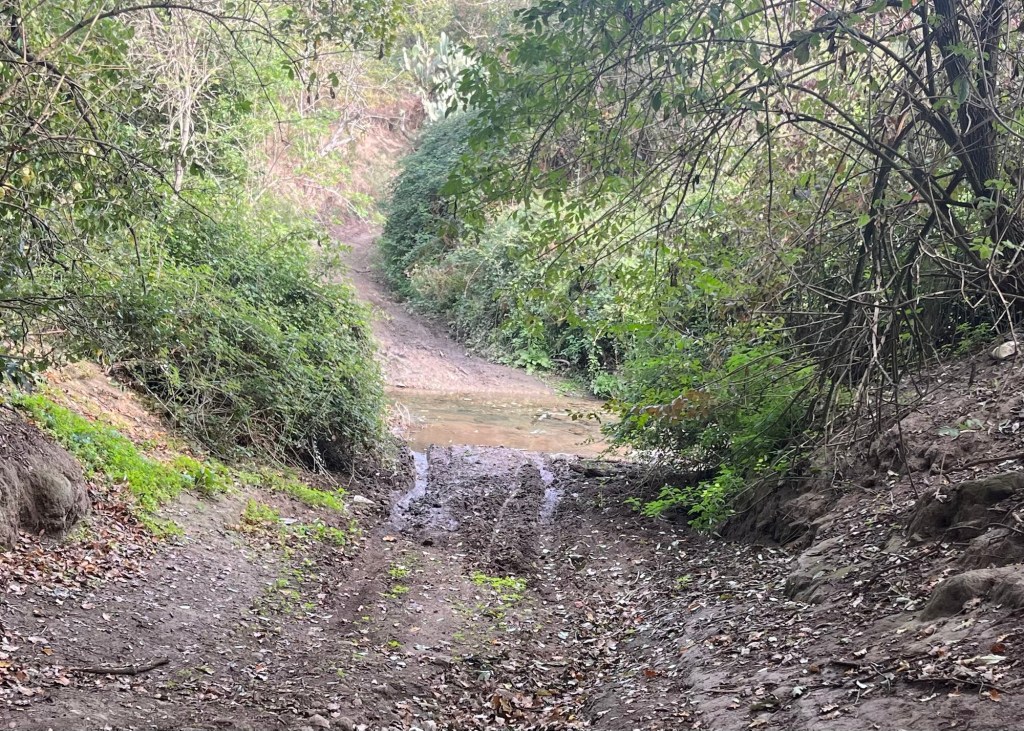
Komoot (our mapping app) guided us into the park on a nice road to start with. But that road became a track and then the track turned into this …

Whilst Andy was wondering how Clare might react, he came face to face with a wild boar just by the water. They stared at each other for a minute before the boar snuffled and quietly went about its business.

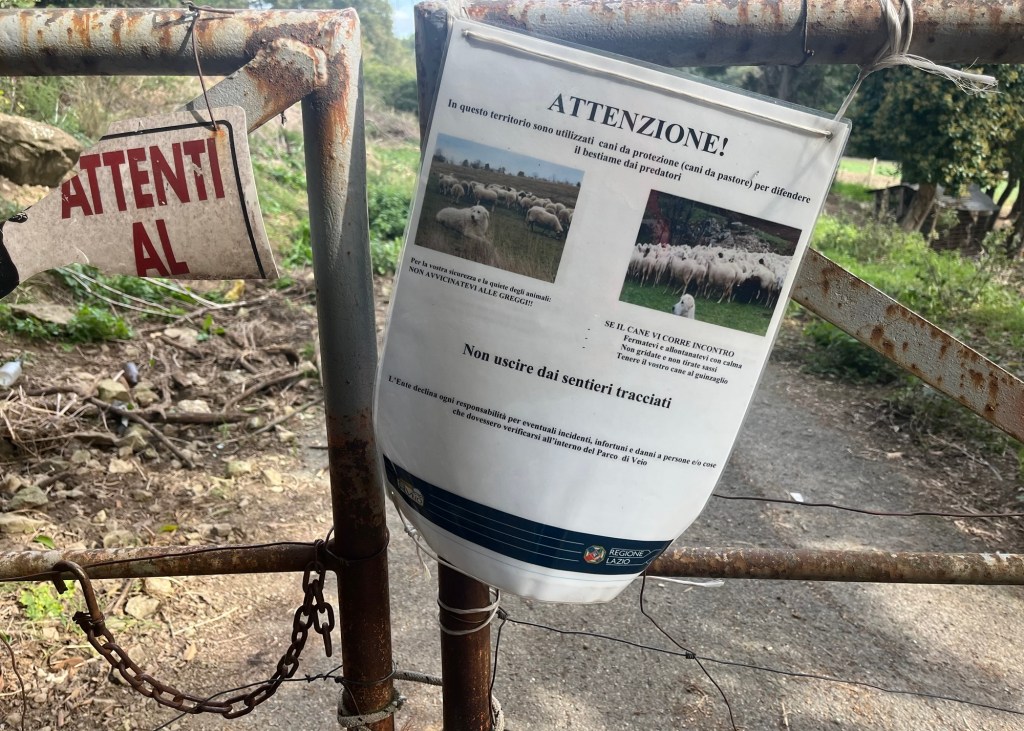
That was enough to convince Andy that crossing the muddy stream was a bad idea. The only alternative was a farm track blocked by a roped up gate that displayed this warning sign …

The sign explains to potential visitors that dogs are used to protect the sheep from the wolves. If a dog was to charge at us, we should not throw stones but walk away calmly.

Clare voted with her pedals and quickly headed back to the busy main road.

But Andy convinced her that if he could be Top Dog in Romania last year, he could still be Top Dog here. But even he had to admit … pedalling slowly across the field and up the hill was pretty nerve wracking. Fortunately the sheep and the dogs were in another field that day.

From the top of the hill it was a lovely cycle down to the river on some nice country roads and an even better ride along the best cycle path we’ve come across in Italy, all the way along the river and right into the heart of the city.

River Tiber Cycle Path

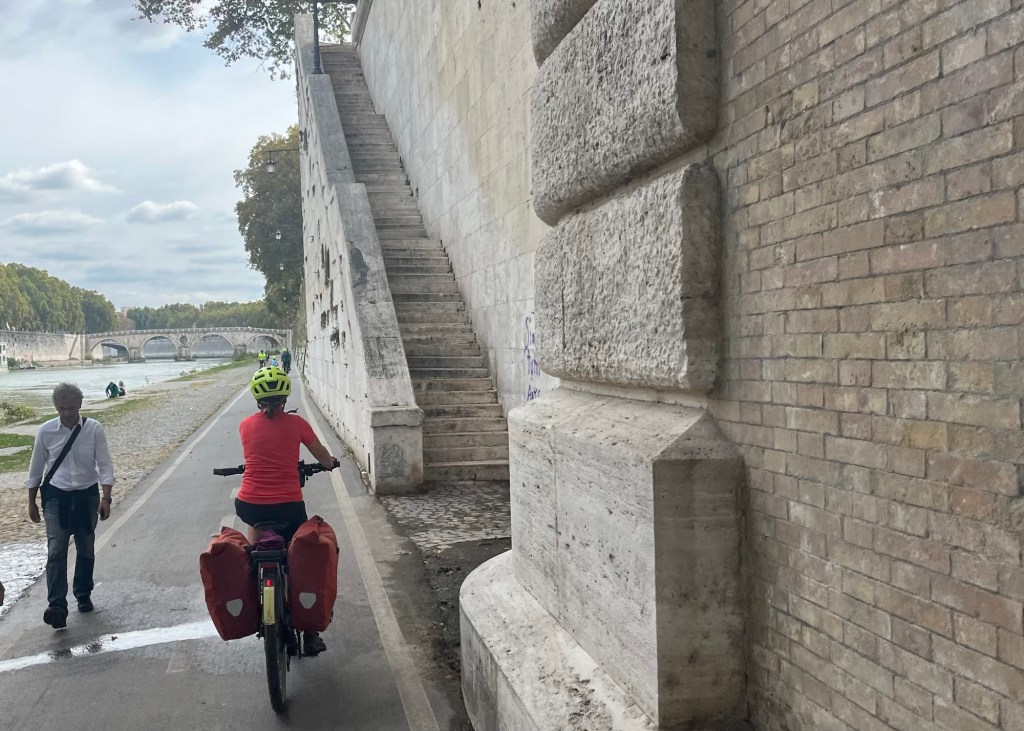
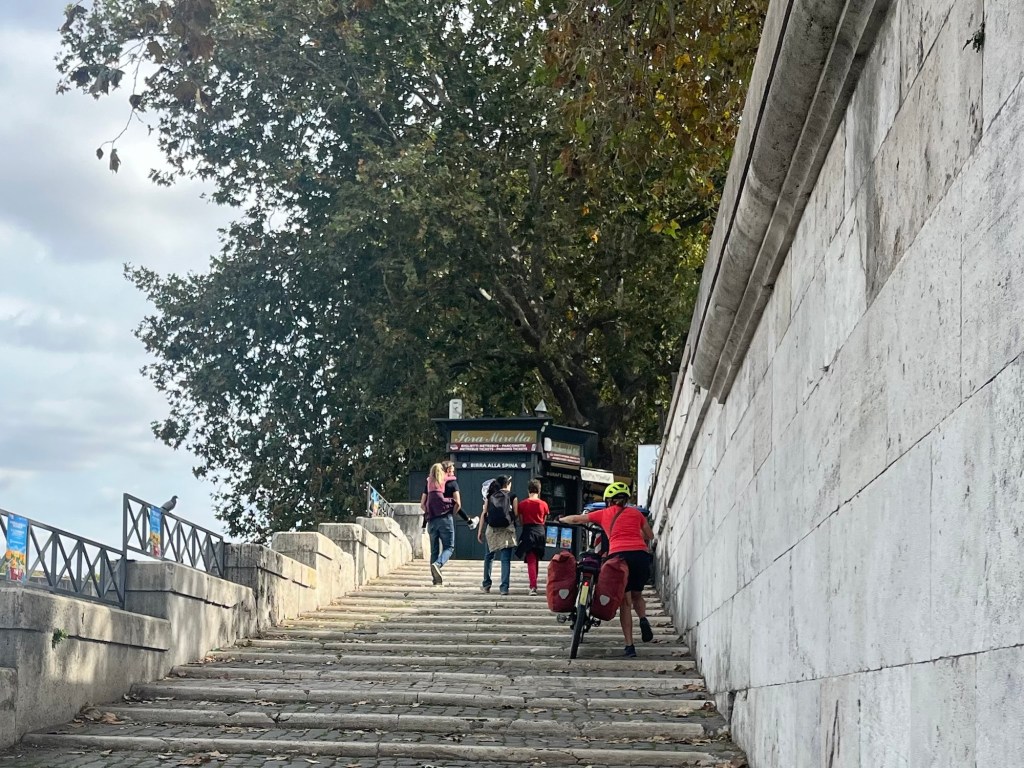
But once we reached the centre of Rome, we couldn’t escape. We were trapped on the Tiber by some very steep steps.

Trapped on the Tiber
Too steep for us

So we just kept going and going and going … until eventually we found some shallower steps.

So how to enjoy just one day in Rome?

First to celebrate completing the 2,541km journey with our bicycles outside the Colosseum!

Then to revisit some old favourites … the Pantheon, Piazza Navona, Campo del Fiore.

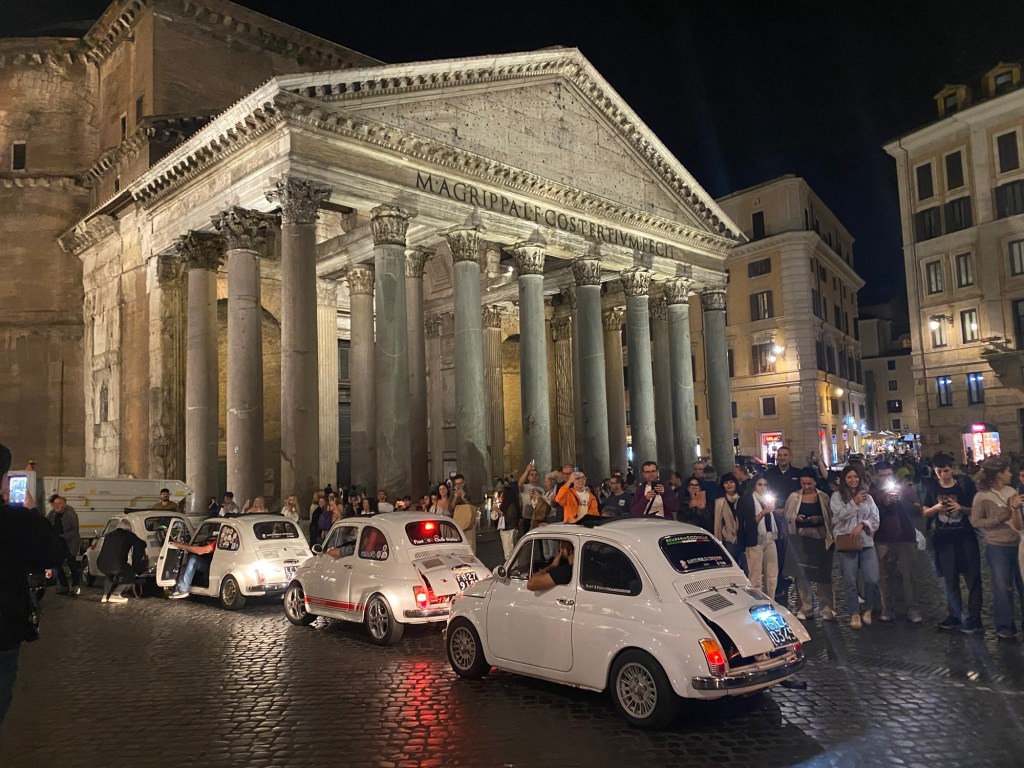
A Fiat rally in front of the Pantheon

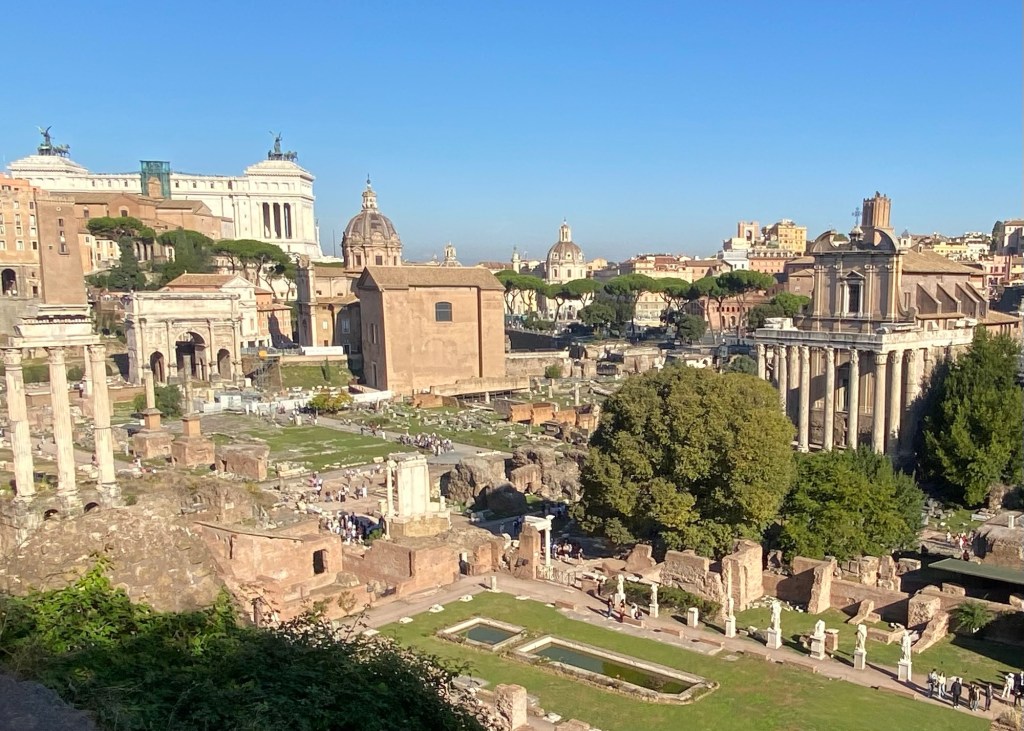
Then to enjoy one of the main attractions that we’ve somehow managed to miss in the past and take the senators walk down from the Palatine Hill to the Forum, following in the footsteps of Julius Caesar, Cicero and Augustus.

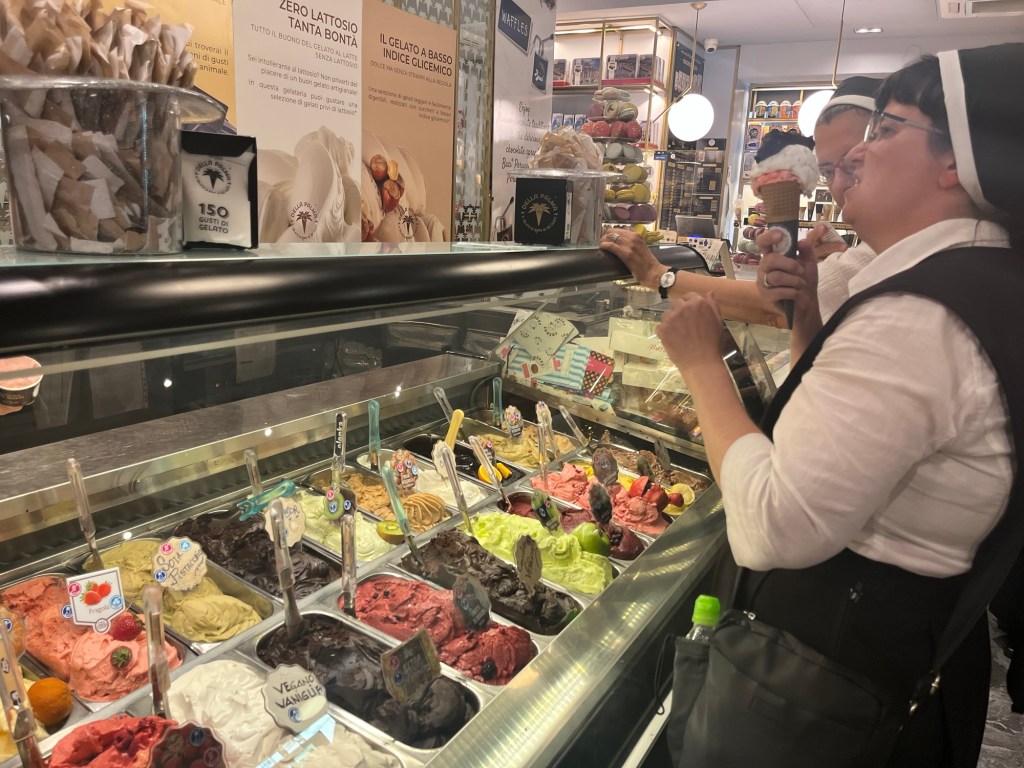
Then to revisit another old favourite and enjoy a gelato from Gelateria Della Palma, where they bamboozle you with over 150 flavours. No visit to Rome is complete without it.

Sharing the experience with some gelati loving nuns

And finally to do something new by paying our respects to Pope Francis, who died earlier this year, at his final resting place in Santa Maria Maggiore.

A beautifully simple tomb 

Rome has been a pilgrimage destination for centuries, many journeying to the eternal city on the Via Francigena. If all roads lead to Rome, perhaps all bike paths eventually do too.

So it’s a fitting end to this e-bicycle tour through England, France, Switzerland and Italy.

Accept it’s not the end. We still have to get home!

Now, where does the ferry to Barcelona leave from?

Clare and Andy

Bath to Rome

2,541 kilometres pedalled

22,656 metres climbed

135 hours in the saddle
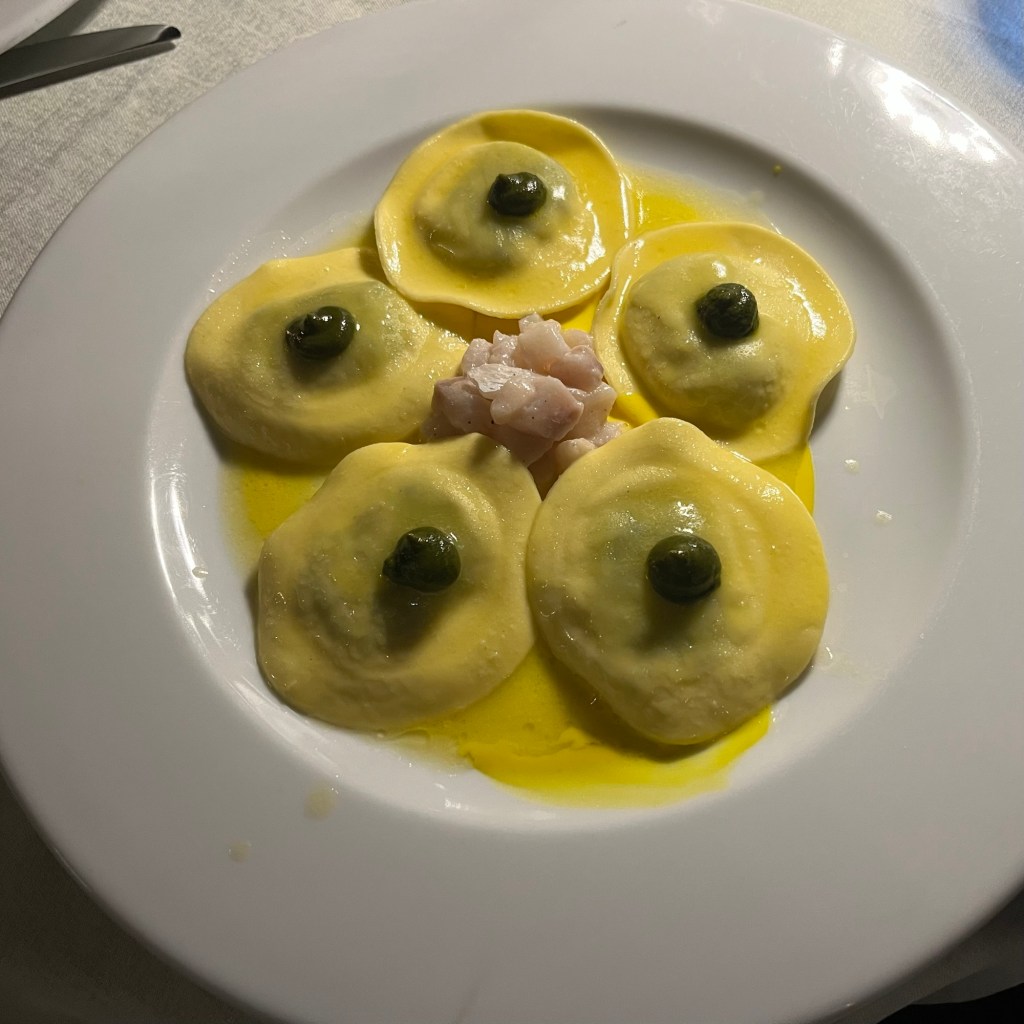
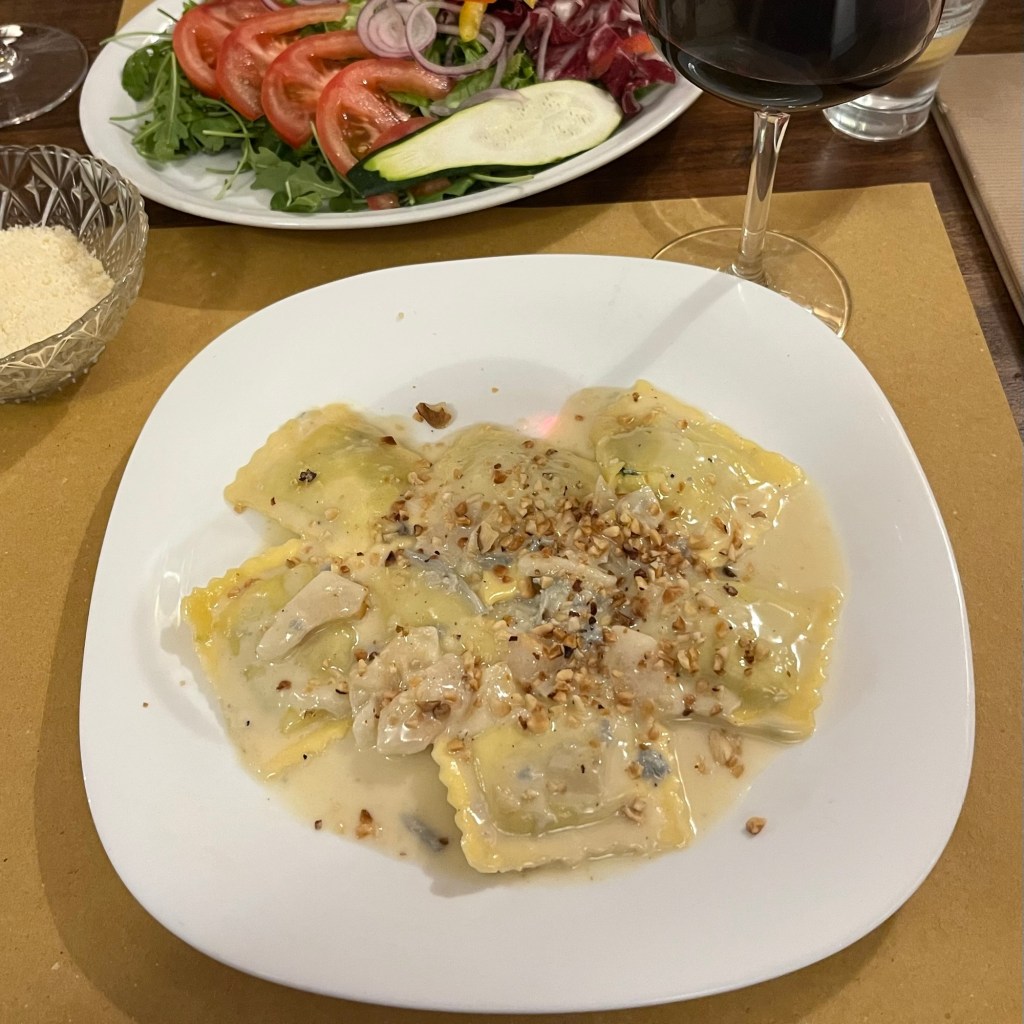
Those of you who love pasta may have been wondering where the pasta porn pictures are? After all, the opportunity to enjoy a mid-bikeride pasta lunch is one of the reasons we rode to Italy in the first place. So don’t worry … we’ve saved the best till last …

It’s Electrifying


We clearly remember the moment the idea first flashed through our minds … Mallorca, November 2017, on our way back from a ride out to Cap Formentor. 

Struggling up a steep slope, legs burning, sweat dripping into our eyes, lungs gasping for air, we were surprised by an older lady serenely cruising past us, shortly followed by her husband.  She was riding a sit-up bicycle with a wicker basket on the front and looked as if she was pottering down to the local market.

At first we couldn’t believe it and pushed harder, standing up on our pedals. But the older couple simply glided away from us.

Then we realised … they were riding electric bikes!

The idea started to grow. Should we go electric too? Would it make bicycle touring even more enjoyable?

With the passing of the years the physicality of climbing hills on fully loaded bikes gradually became less enjoyable and more challenging. On the toughest days, the thought that we could be doing this on e-bikes got louder  – the Seven Lakes Road in Argentina, the Wilderness Road in Tasmania, through the Badlands of southern Spain. By the time we rode the Blue Ridge Mountains of Virginia last October, it was screaming at us.

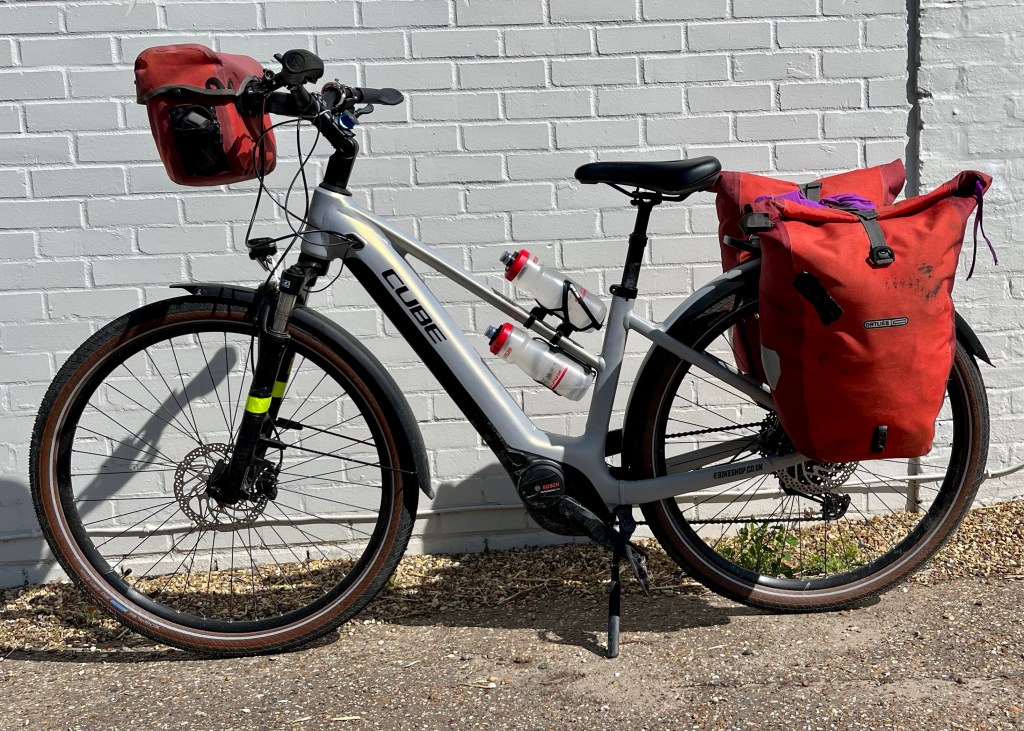
Now we’ve taken the plunge and have just set off for our latest adventure on two Cube e-bikes with Bosch batteries and motors. Our trusty old Ridgebacks are left behind in the garage, trying to console themselves with happy memories from the journeys they’ve taken us on over the last few years, but probably realising their time is up.

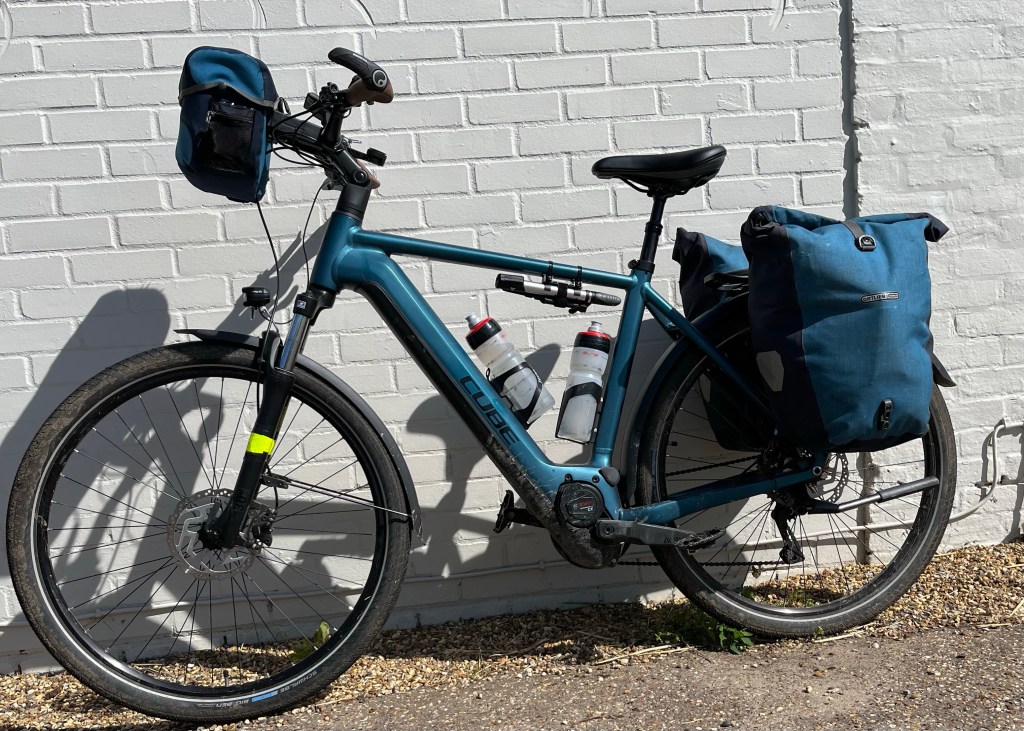
Clare’s Cube Touring Pro

Andy’s Cube Kathmandu One


As many of you know, our dream has always been to cycle across Europe from Bath to Istanbul so we’re heading in that direction and waiting to see how far we get. Our rough route takes us 3800km through Holland, Germany, Austria, Slovakia, Hungary, Romania, Bulgaria and Turkey but we know we might have to turn around at any time.

We’ve always enjoyed keeping our plans flexible but it’s a bit more complicated this year.

Not only is Istanbul much further than we’ve ever pedalled before but Andy was diagnosed with a heart arrhythmia (atrial fibrillation) shortly after we got back from America last year. His AF is not too serious and it’s well controlled with meds but it could get in the way if the episodes become too frequent. The good news is that Andy’s cardiologist has given his blessing to the trip, especially when he realised we would be on e-bikes.

Our route across England

Stage 1 meant four days of cycling through seven counties of undulating English countryside from Bath to Harwich and then boarding a ferry to Holland.

Friends had joked that we would need to be extra vigilant at ‘avoiding potholes’ in the UK, but we found the road surfaces to be pretty good overall, getting better the further East we went.

There were some familiar bike-touring experiences … diving down a muddy track on a dreadful detour, a stand up lunch outside a village convenience store, sheltering from a sharp shower under a tree.

Emerging from a Dreadful Detour

Despite the mixed weather it was lovely to pedal in familiar countryside past fields of golden wheat and barley, through quaint picture postcard villages, up tree-lined lanes to the top of gentle hills.

But we nearly didn’t make it out of England alive!

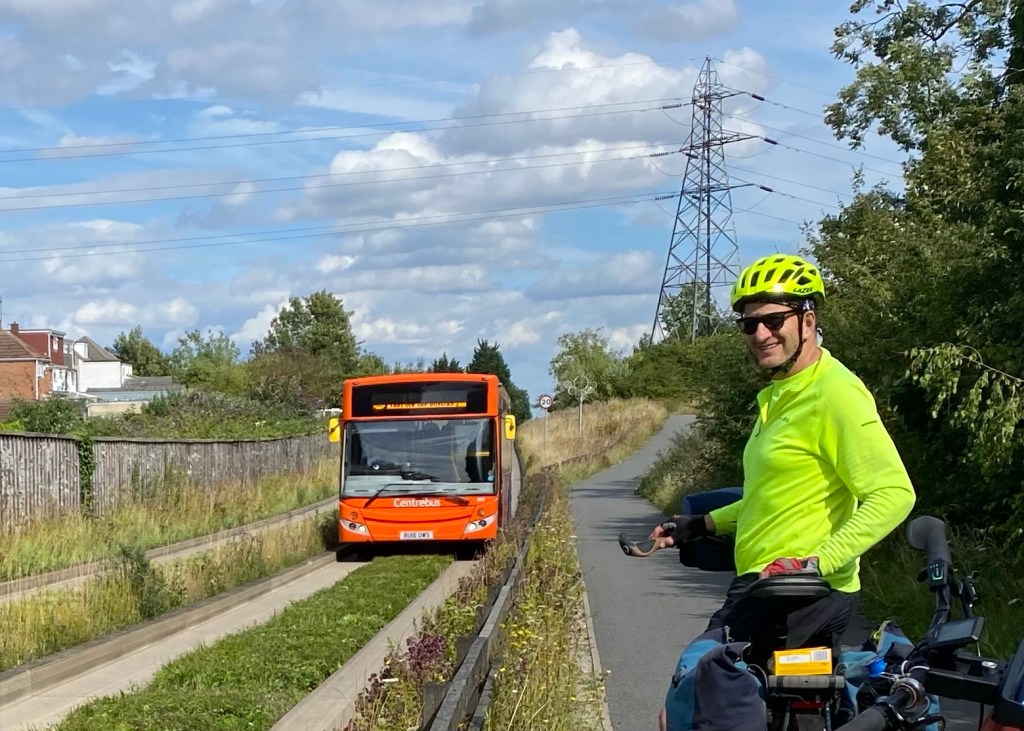
In Luton there is a ‘Busway’ that crosses the town on dedicated concrete tracks, a bit like a railway for buses. A cycle path runs alongside it. Having never seen this ingenious public transport system before, we mistook the Busway for the cycle path.

Once on there was no way off. Concrete sides blocked our escape and our heavy bikes would take too long to turn around. All we could do was to put our heads down and race to the next station, much to the surprise of the local commuters. Our luck was in, we made it out … just ahead of the number 23!

A lucky escape from the Busway in Luton

So how have we found the e-bike bicycle touring experience so far?

It’s early days but the two big differences seem to be speed and effort.

We go faster which means we can go further each day.  Travelling across England we managed three consecutive days of 100km or more, something we would have thought was completely barmy on our old bikes.

And whilst we have to pedal, giving  plenty of exercise, we don’t get the exhaustion that used to come from tackling long or steep hills. We simply flick on a higher power setting and serenely pedal up them … just like that lady in Mallorca!

A perfect surface in Essex

Bosch offers 4 power settings:

  • Eco (Green) – low level support for the longest range
  • Tour (Blue) – consistent, smooth support for long rides
  • eMTB (Purple) – dynamic acceleration for rough tracks and hill starts
  • Turbo (Red) – maximum power for steep ascents

More power means less battery range … and we definitely don’t want to run out of battery, not once, not ever.

But any range anxiety we might have felt has now completely disappeared.

After the first day, Andy’s knee was sore, sore enough to hobble down the stairs. Not a good sign with well over 3000km still ahead! To ease it, he made some micro adjustments to his saddle position and increased his cadence (speed of pedal strokes) to cut down the force he had to press onto the pedals.

But the best medicine came from riding at a much higher power level using blue or purple with gay abandon and even throwing in some extended blasts of red. On that second day we rode for 108km … and at the end of it Andy still had a quarter of his battery left and a knee that was beginning to feel much better.

E-bikes also come with several features that are useful for bicycle tourers such as built in lights and a stand … but there are a few downsides.

They are really, really heavy, weighing in at 28kg or around 46kg fully loaded. This makes them difficult to manoeuvre in tight spaces. Lifting them up stairs is a no-no and even turning them around is hard work … we’re getting used to 3-point turns and wide circles.

They’re more attractive to thieves so we’ve invested in strong locks and insurance. Bosch also offers a phone app that immobilises the motor and sets off an alarm if they’re moved.

They’re banned from aeroplanes because of the size of the batteries. That raises the question of how we’re going to get back from Istanbul if we get that far. A question we don’t have an answer to yet!

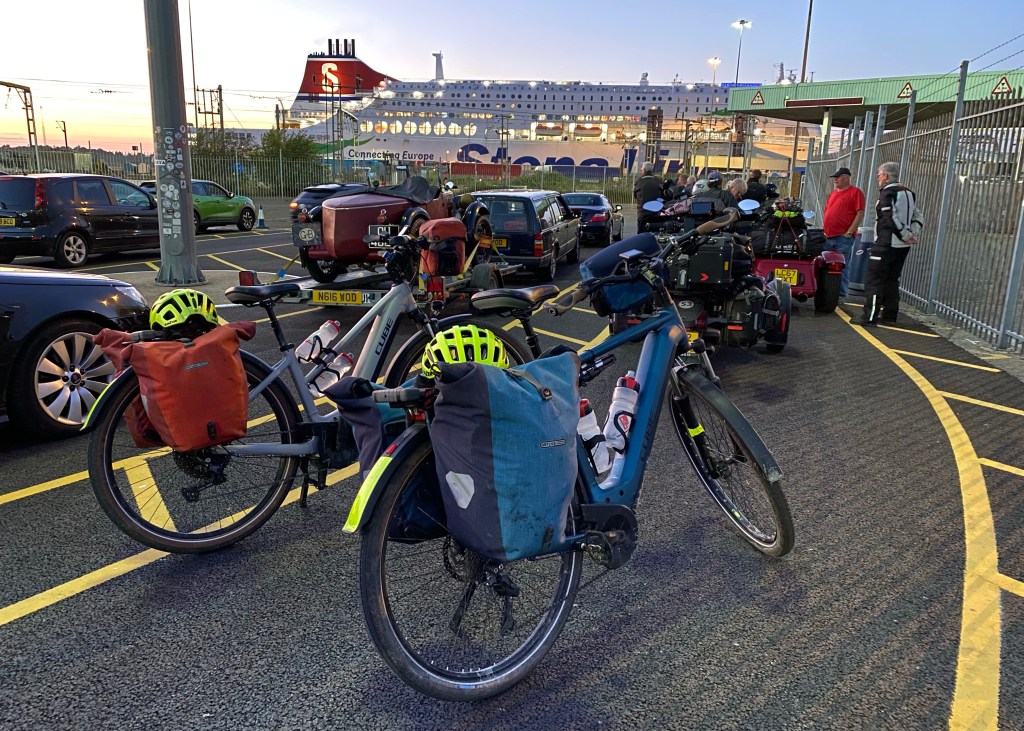
Waiting for then ferry to Holland

It did take us several days to get used to the day-to-day mechanics of an e-bike tour … the way the panniers fit, recharging the batteries, the different pieces of equipment etc. On the second morning Clare rode off without her plastic battery cover which is important to stop rain and mud ruining the electronics.

Fortunately, we had enjoyed a lovely stay near Oxford the night before with our good friends, Neil and Gill. Realising the cover would be difficult to replace, Neil drove out of his way to to reunite her with it before any dampness got inside.

We’re now settling into the rhythm of both our new machines and of being back on the road. The panniers are going on smoothly, the 3-point turns are working well and recharging has become easier. 

Andy’s knee is now fully recovered. However after more long days on our saddles in a row than we’re used to, we can’t say the same about our bums! 

So with apologies to the makers of Grease …

“We’ve got pains, they’re multiplying

And we’re losing control

‘Cause the power Bosch are supplying

It’s electrifying!”

We’d better shape up!

Clare and Andy

A Two Wheeled Wonderland

It’s easy to see why Holland is known as a two-wheeled paradise.

It’s flat, of course. Dutch Pancake flat in fact. The first place we’ve ever been where flat properly means flat.

And cycling tracks are everywhere. 

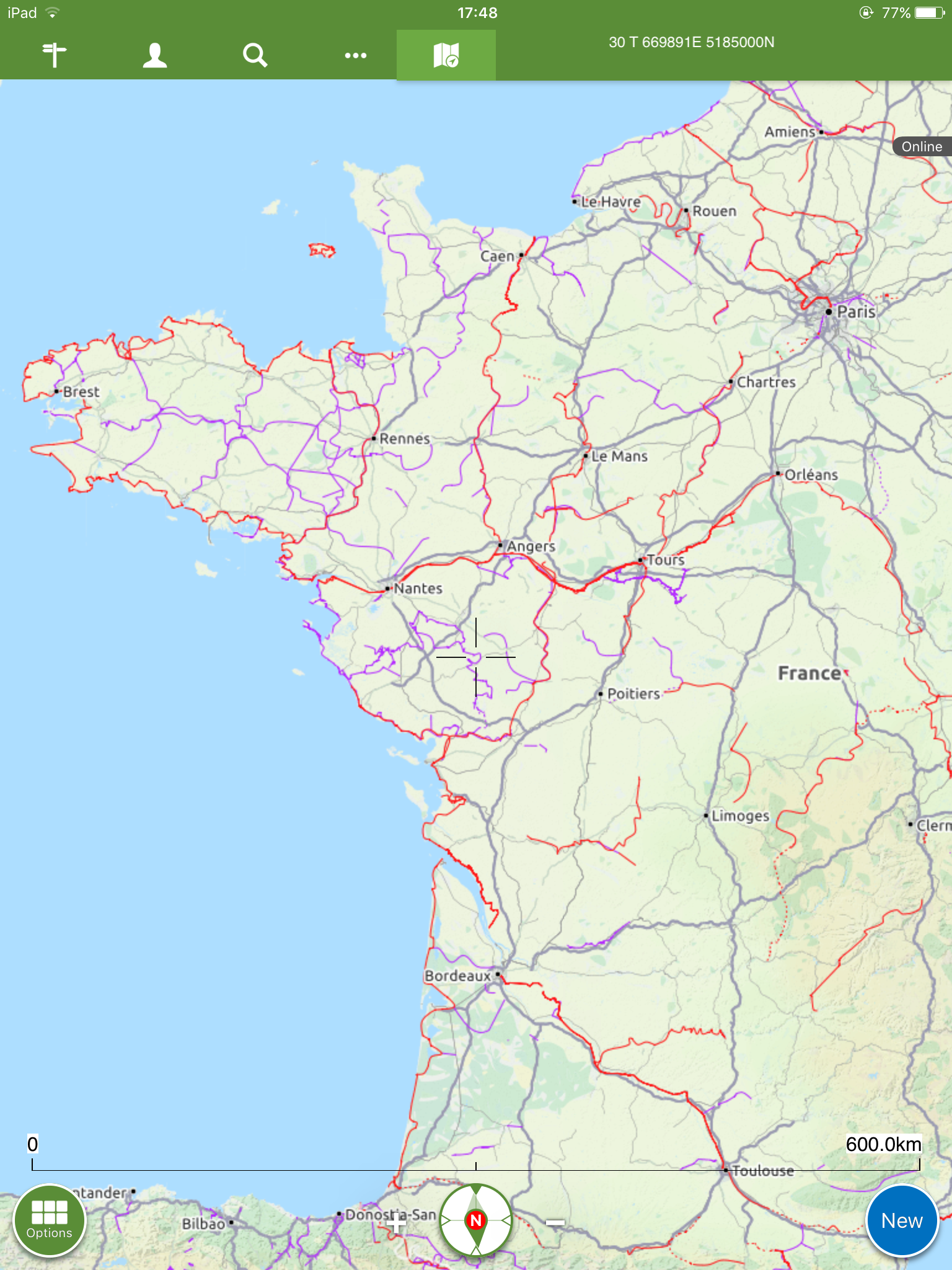
Everywhere? Really? Yes! … take a look at these maps …

Here’s a map of the national and regional cycling routes in England and Wales …


Not bad! And the same for France …


But this is what it looks like for Holland!


Everywhere!

Many of these cycling routes are on smooth, dedicated bicycle paths with no motorised traffic allowed. They’re cleverly designed too, often offering the most direct way to travel between two villages, making a bike journey much quicker and easier than the same trip by car.

This might explain why there are more bicycles than people in Holland! 13 bikes for every 10 people, the highest ratio for any country in the world.

Or why more than a quarter (28%) of all trips are made by bicycle … especially commuting, shopping or visiting friends. Again, the most in the world!

It follows that most car drivers also ride bicycles, which is probably why they’re so polite to cyclists. Giving way every time a cycle path crosses a road, patiently waiting to let us on to a roundabout.

In fact they’re so polite, they go straight to the top of the Clare & Andy Driver Courtesy League, pushing the Irish down into second place.

Just for bicycles


Holland is so well set up for cycling, it sometimes doesn’t feel quite real. It’s almost too easy, too nice. It can feel a bit like a cycling theme park or a bicycle-touring version of The Truman Show!

Adding to the theme park impression, we found Dutch people to have similar characteristics to the staff of a well known company, famous for its mouse and princesses.

Extremely friendly but also a little formidable. 

The Dutch pride themselves for telling it straight, no beating about the bush, and not minding at all when others do the same to them.

This can come as a surprise to those of us who live in a country where people will skirt apologetically around any difficult request with “I’m sorry but would you mind…” or “Excuse me but I’m going to have to ask you to…”

Take this exchange.

Having checked out of our hotel, we’re sitting in the hotel cafe for a few minutes waiting for the rain to clear before we set off. Suddenly we hear a rather severe voice behind us … 

“People, you have to leave!”

“Oh, OK”

“No, you have to leave now.”

We gather up our things. “Thats no problem, we’re going”

“We need to clean up. We have to close. You can’t stay here. You have to go.”

We scuttle out and shelter in the hotel reception instead.

Fifteen minutes later, after the rain has stopped, the same lady comes up to us in the street all smiles and chattiness. She wants to know where we’re going, tells us about her years living in Turkey and is genuinely interested in how we are finding the trip.

She’s so friendly, we might have been best buddies!

A Full Crossing

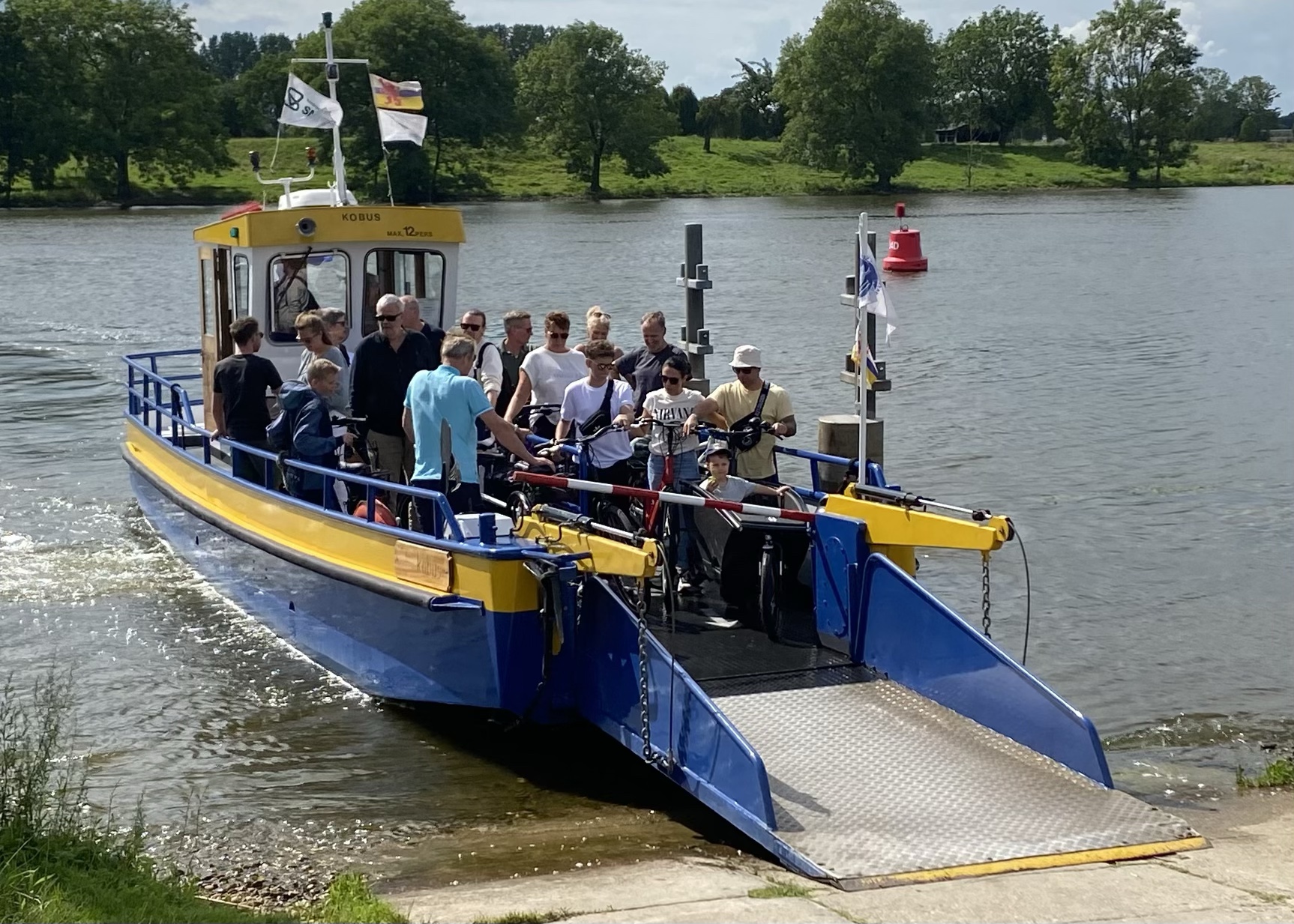
Another part of the fun of cycling in Holland is jumping on and off the water buses that ferry you across the many waterways.

Join the queue

Over the five days we spent cycling through the country, we roughly followed the route of the River Meuse so must have enjoyed at least a dozen of these boat rides.

But they’re not always busy

Another interesting thing about cycling through different countries is discovering their individual quirks. In Holland for example, many cafes don’t open until 10am in the morning which might work well for sleepy locals but is not so good when you’ve arrived early on an overnight ferry and really need a coffee to get your legs going.

The announcements on the ferry had told us many times that we had to use the cycle paths in Holland and should never ride on roads unless there was absolutely no alternative. We tried our best to stick to these rules on the long caffeine-free ride through the centre of Rotterdam but became so confused by the sheer number of cycle tracks that we often went wrong, collecting several straight-talking telling offs along the way.

Leaving the ferry with no coffee

When we eventually did sit down for breakfast, we were so hungry we added a traditional Dutch snack … deep fried bitterballen. It’s a type of croquette that became popular in the 1800’s as the perfect way to transform yesterday’s leftovers into today’s lunch. Yum … but not necessarily for breakfast!

After escaping Rotterdam, our first day became a lot more scenic. We pedalled through the famous windmills of Kinderdijk, the island town of Dordrecht and the Biesbosch nature reserve before pausing for a couple of days in Gorinchem, described officially as ‘the most beautiful fortified town in the Netherlands!‘

Gorinchem

It was strange to think we were sometimes cycling across reclaimed fields that are below the level of sea water. Fields that are incredibly verdant and vivid green from all the rich fertile soil and water, protected by strong dykes on all sides. It’s a unique agricultural landscape.

Biesbosch Nature Reserve

Much of this land was reclaimed in the 16th and 17th centuries using a state-of-the-art technology for the time, the windmill. Having literally created much of the country, windmills are rightly celebrated across The Netherlands, many beautifully restored and still operational. Using a range of intricate mechanisms, they cleared the land of water, milled grain into flour, cut timbers and made gin.

Kinderdijk

Visiting the mill in Gorinchem, we enjoyed a lovely experience thanks to the miller who demonstrated the sails and showed us its inner workings. It didn’t matter that he was the only Dutch person not to speak a word of English as we communicated happily using gestures, grunts and laughter.

Inner Workings

Somehow he must have sensed our interest as he stopped the sails by pulling hard on a thick rope like a human break and beckoned us through a locked hatch to visit the very top of the mill. We climbed a precipitously steep ladder with the help of a supporting rope and clambered around the rafters to watch him grease the mechanism with some animal fat that hung like vines from nearby hooks.

He then invited Clare to climb onto the sails for a quick spin. Only joking, it was just for a picture.

From Gorinchem, we followed the river south, stopping overnight in Oss, Grubbenvorst and Heerlen before coming across some surprising hills in the far south of the country, just before we crossed into Germany. 

As always it was fascinating to cross a border and see the immediate differences between the two countries.

Suddenly there were a lot more Mercedes cars around, the typical Dutch gable roofs had been replaced by a more functional triangle and for bicycle tourists there were less cycle paths, more potholes to avoid and the drivers had become much more impatient.

Coming from England, it felt normal!

But we missed the two-wheeled-wonderland we’d been cocooned in for the previous five days. Unlike Truman Burbank (Jim Carey’s character) … we didn’t really want to escape.

But our time in this bicycle touring paradise was up, so as he would say … “Good afternoon, good evening and good night!”

Clare and Andy

685km pedalled (426 miles)

3235m climbed (mainly in England!)

37 hours in the saddle
By the Rivers of Germany

It’s a calm, sunny afternoon and we have just reached the river Rhine. We’re cruising along on a beautifully smooth radweg (cycle path), slowly overtaking an aak (river barge) and gazing up at a schloss (castle) on the hillside above.

Two touring cyclists are coming towards us. Slowing down, we beam at them, wondering if they fancy a chat. “Schöne morgen!” (lovely morning) we call out … but only receive a cursory nod in return.

No bother … another couple of well-panniered cyclists are just behind them. “Hallo!” (hello) we smile. Again, just a nod.

Then another couple and another and another. All enjoying this gorgeous curve of the Rhine on this gorgeous day. All just nodding or staring silently ahead.

Everywhere else we’ve travelled, it’s been an event to come across another touring cyclist, a cause for celebration, a chance to stop and swap tales of the road or at the very, very least to smile, wave and call out “Bonne Route” or “Happy Travels” or some such.

Except for here.

And before you think it, it’s not because they’re German.

Lots of touring bikes

It’s simply because there are so many people pedalling down the Rhine that it’s impossible to greet everyone. For us too … by the time the fifteenth couple had cruised past us we had become nodding dogs. By the end of the day we wondered if our heads would still be attached to our shoulders.

We were the odd ones out. Cycling from north to south. Upstream. Very, very slightly uphill.

Most people prefer to ride downstream so we had a lot more touring cyclists to greet … sorry, nod to … sorry, stare silently ahead.

Practising the stare

This part of the river from Koblenz to Mainz is known as the ‘Romantic Rhine’. So picturesque, it inspired many an early 19th century romantic, most notably the painter William Turner who used it as the subject for many of his greatest landscapes.

We’ve both fallen in love with e-bike touring and are now fully embracing the ‘E’ in e-bike!

No more do we say that we “only ever use Eco”. In fact, we haven’t seen the Green Eco (level 1) light for weeks!

Instead we cruise along in Blue (level 2) and help ourselves to generous dollops of Purple (level 3). There are many good reasons for a Purple Boost … the incline increasing … the merest hint of gravel … feeling slightly tired at the end of the day. It’s a wonderful feeling … like being given a little push.

And a more serious hill? Bang it straight into Red (level 4)!

Enjoying the Red Zone

A good trick on flat river paths is to cruise along at 25km/hour, just below the speed at which the power cuts out. It’s easy to maintain momentum without working too hard.

So far we’ve averaged 82km a day, which means we’re riding for between 4 and 5 hours. Both of us love the amount of exercise this gives us. It’s a moderate but sustained effort but we’re never out of breath.

To compare it to normal bikes, let’s say regular bike touring exercise is on a scale of 1 to 5 where 1=pottering through a village looking at the sights, 3=riding at a good speed on the flat and 5=climbing a steep hill in the hot sun.

E-bike touring is always between 1 and 3, whatever the conditions. Clare does not miss the 4’s and 5’s!

Before reaching the Rhine we cycled through the old forests of the Eifel National Park … a very different experience. As an 87km day with 1340m of climbing it was a good test, both for us and for our batteries.

The Eifel

The bikes give you lots of information including a remaining range indicator but we prefer to keep an eye on how much of the battery we’ve used v how far we’ve travelled.

On flat days we get over 2km for every 1% of battery. On that hilly day through the Eifel, Andy got just under 1km for every 1%, which still gave him a range of over 90km.

So he wasn’t worried when his battery almost ran out near the end of the ride. As we pulled up outside our guest house in Bad Munstereifel, he had just 4% left!

Well judged, thought Andy, a good test.

Just as well there wasn’t a dreadful detour, thought Clare.

An orange light is bad news

As long as the e-bikes keep working!

Clare’s motor suddenly stopped as we were leaving Mainz, displaying an alarming error code.

The UK shop we bought the bikes from told us it was a software issue and that we couldn’t fix it ourselves. We did all the normal computer things … turning it on and off again, pulling the lead out and pushing it in again.

No luck!

Spirits sinking, we slowly rode back towards an e-bike shop we’d seen in town when Clare decided to try one last thing. She turned it on and off whilst the bike was actually moving.

Miraculously it worked and it’s been working ever since!

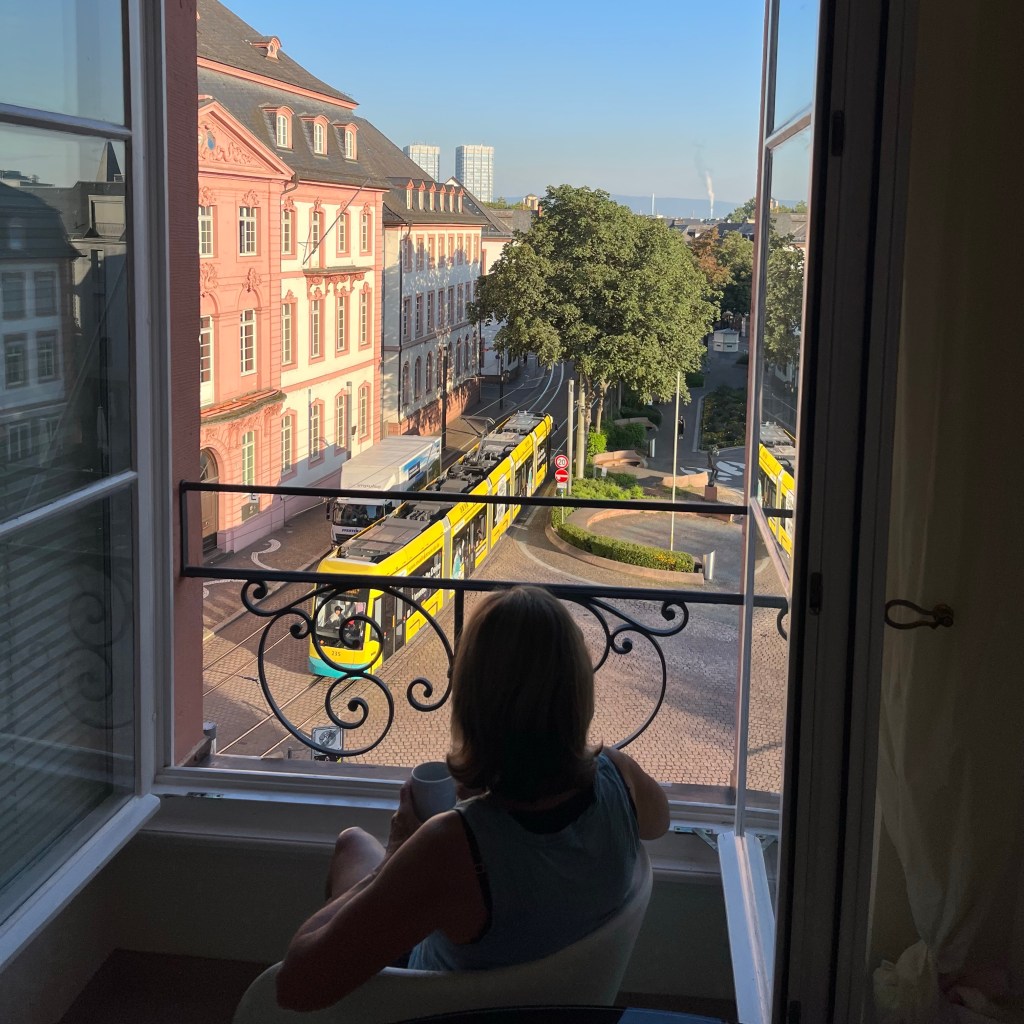
Early morning coffee in our Mainz apartment

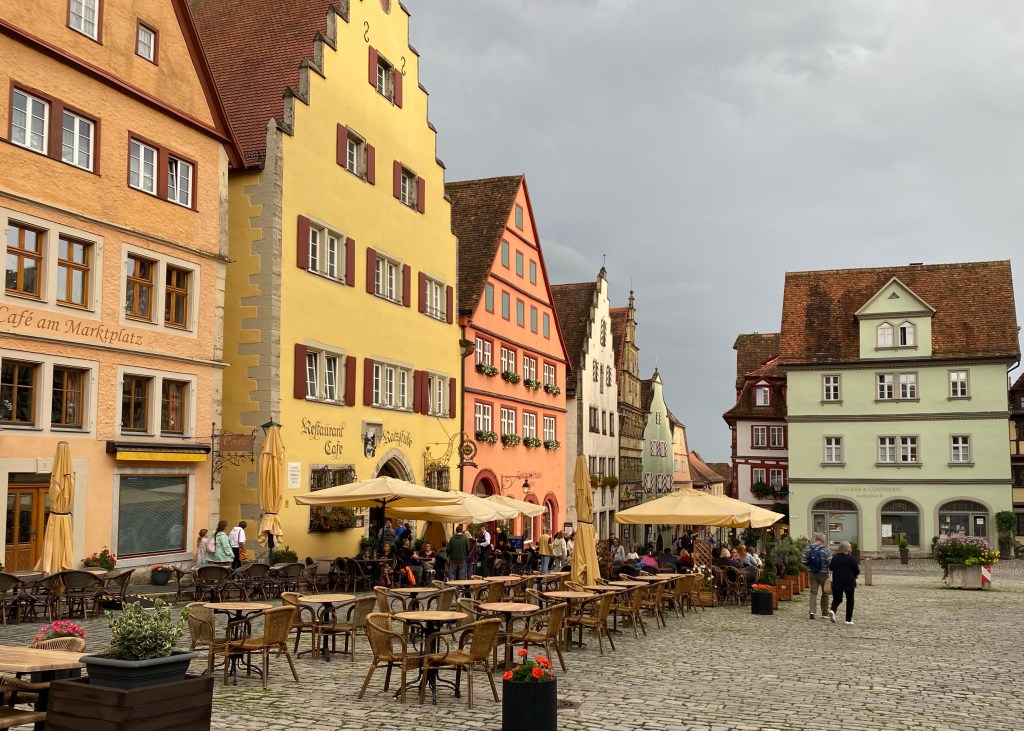
From Mainz we headed cross country, first to Heidelberg and then through Franconian Bavaria to Rothenburg ob der Tauber and on to Nuremburg.

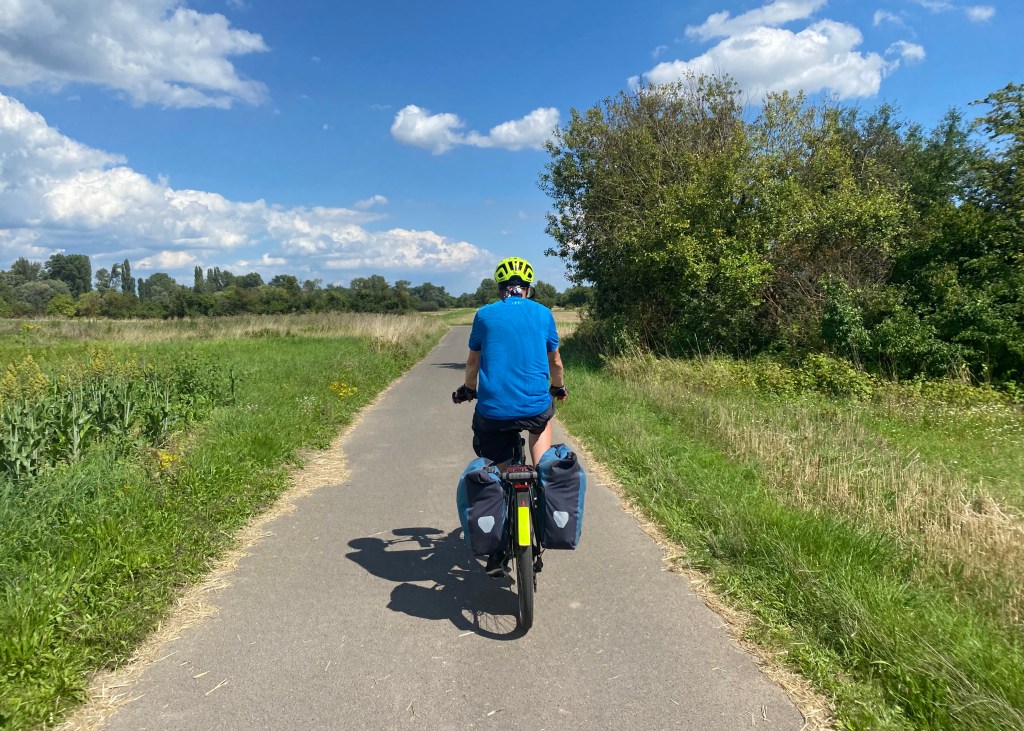
It was joyful. Proper bicycle touring in rolling hills, through lush meadows, along forests trails and down winding country backroads that led us from one chocolate box village to another. Secretly we were both delighted to get away from the river for a while.

We began to properly appreciate what a superb country Germany is for Radwandern (literally bicycle wandering) with more than 70,000km of well-signposted long-distance cycle trails criss-crossing the country.

One of many Radwegs

On the rare occasions we found ourselves on the road it was usually because we hadn’t spotted the radweg!

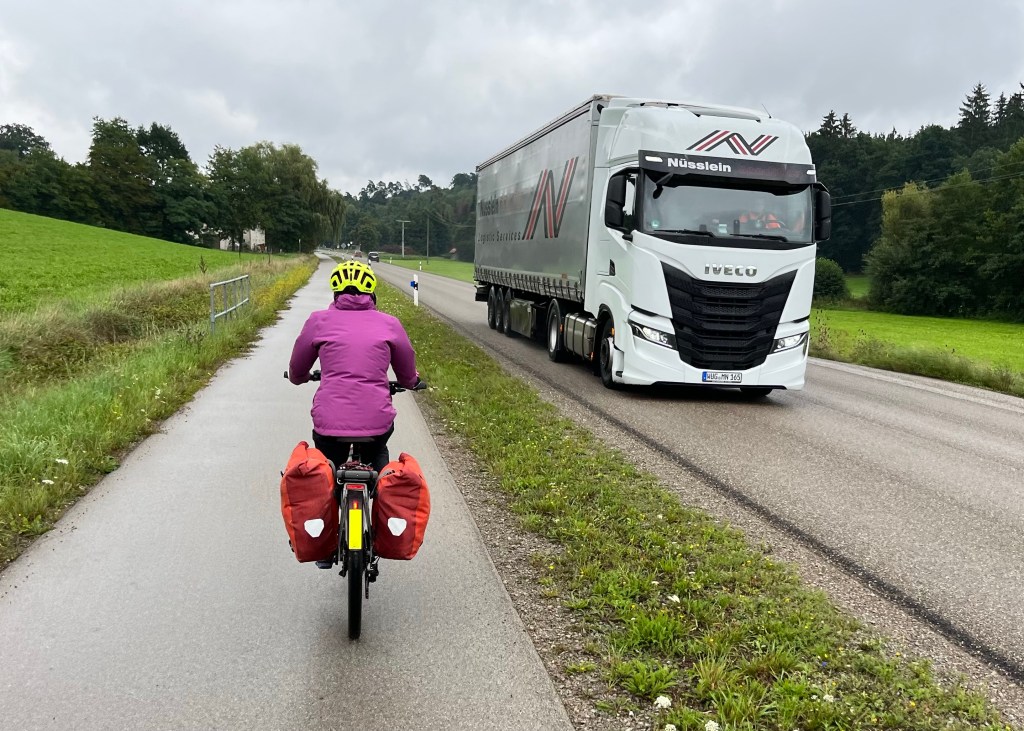
Even country roads have a dedicated cycle track alongside

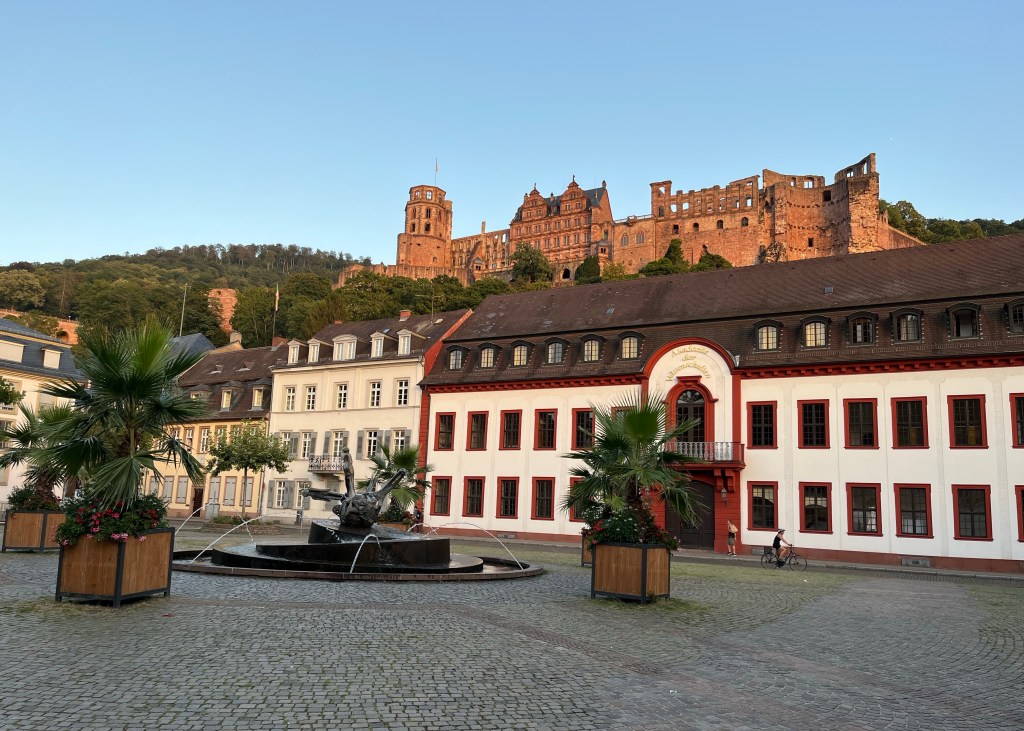
Heidelberg is as beautiful as it’s reputation, a real highlight.

Surrounded by forest and on a beautiful riverside setting beside the Neckar, it’s Germany’s oldest and most famous university town, renowned for its baroque Altstadt and evocative half-ruined hilltop castle.

Heidelberg Castle

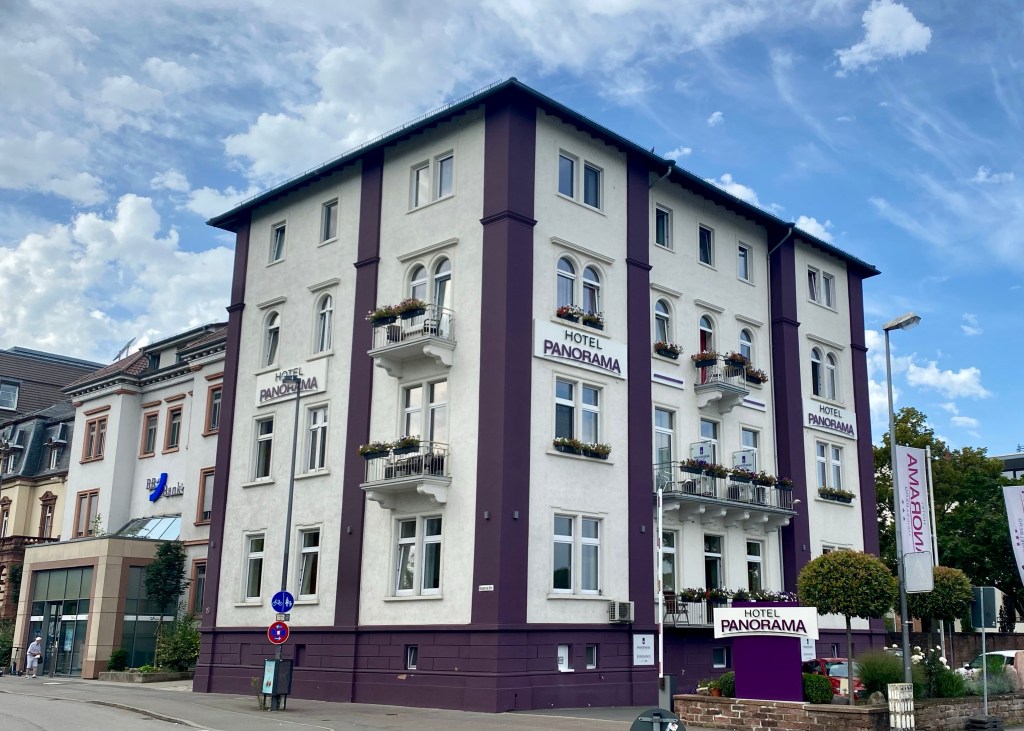
We stayed in one of our favourite ever hotels, the 3-star Panorama. Not much to look at from the outside, it’s a friendly family run place with comfortable rooms, a superb breakfast and a safe, comfortable cellar for our bikes.

Hotel Panorama

In general, the accommodation has been very good in Holland and Germany. We’ve alternated between pensions/small hotels and apartments which allow us to cook for ourselves. Wherever we’ve stayed, the bikes have been reassuringly well looked after and it’s been easy to recharge the batteries.

Mind you, we weren’t so impressed by our stay in the little village of Sindringen, the night after leaving Heidelberg, as the church bells kept us awake all night, chiming every 15 minutes right outside our window. We must remember to check out how close we are to churches in the future.

Rothenburg ob der Tauber

To reach Rothenburg ob der Tauber, we cruised downhill for miles on quiet country roads before Clare led us up a steep cobbled backstreet to enter the walled town. Suddenly, we were surrounded by brightly coloured half timbered houses and lots of tourists. It felt as if we’d been teleported into the middle of Chitty Chitty Bang Bang.

Which we had!

This was indeed the location for the Vulgarian village scenes in the 1960’s classic. We glanced around nervously, half expecting to see the Child Catcher disappearing down an alley.

A surprising arrival into Chitty Chitty Bang Bang land

That thought became more sinister when we learnt that Rothenburg odT held a special significance for Nazi ideologists. It was hailed as the ‘most German of German towns’ and was being developed by Nazi nationalists as an ‘ideal’ Nazi community full of ‘ideal’ Nazi families.

Made the place feel a bit uneasy.

Nuremberg

As always there are plenty of idiosyncrasies to enjoy in any country. A few that struck us in Germany are:

There are still cigarette machines everywhere (very surprising).

Gardens fill the the edges of every town. Called Schrebergarten these are family spaces as well as allotments. Many have lawns, swings and slides, animals.

Schrebergarten

It’s still a cash society. Many restaurants and shops don’t take credit cards as they don’t like the charges.

And we came across our fair share of unusual food and drink …

Some we really enjoyed … Apfelstrudel with cream, Schnitzel and of course a German Bier at the end of the day. Andy hasn’t drunk any alcohol since February but the choice and quality of Alkoholfrei Bier is so good it didn’t matter.

Nothing like a beer garden after a ride, even Alkoholfrei

Some we weren’t sure about … Spätzle (a type of noodle), Kartoffelknödel (potato dumplings) and the Mainz speciality Handkäse mit Musik (Hand Cheese with Music). This is a hand moulded cheese soaked in vinegar and onions. As the locals say, the musik comes later, a few hours after you’ve eaten it!

Handkäse mit Musik

From Nuremberg we planned to spend a week or so cruising beside the Danube, another great river that starts in the Black Forest. The section between Passau and Vienna is the most popular bike ride in Europe attracting over 38,000 cyclists a year, 300 each day in the summer.

That’s a lot of nodding if you go against the flow.

But we’ve learnt our lesson. We’re going downstream with everyone else!

Clare and Andy

… but that’s not how things turned out …

The Danube will have to wait for another year as we have now decided to abandon the trip and go home.

It took 5 days of cycling for Andy’s Atrial Fibrillation (AF) to kick in, with episodes starting the first night we stayed in Holland. Since then it’s become a lot more pervasive, coming every 3 nights, then every other night, then every night, then several times day and night.

Feeling like a group of gremlins are throwing a wild party in his chest, AF triples his pulse, saps his energy and voraciously eats up his sleep time. Not the best ingredients for a bike tour.

Andy cut out everything he thought might be triggering it, even foregoing the alkoholfrei bier (as it still has trace elements of alcohol in Germany).

In the end we could only conclude that the moderate but sustained exercise of e-bike touring was the problem. Exercise induced AF is not uncommon amongst elite athletes … but e-bike touring is a long way short of that.

Two retired doctor friends kindly gave us the same helpful advice. “It’s only a bike ride,” they said, “the roads will still be there next year after your ablation.”

Which is true. There are AF suffering professional cyclists who have resumed their careers after a successful catheter ablation, a treatment which prevents the electric pulse in the heart from getting out of sync.

We can’t deny it … we’re very, very disappointed … but stopping is the right thing to do. It’s the only thing to do.

Time to stop!

After wondering for a long time how we’d get two heavy e-bikes (that are not allowed on an aeroplanes) home from wherever we finished, we simply called the best bike shop in Nuremberg and asked them to do it.

We were lucky to find Frank, one of the nicest men in the whole of the e-bike world. Sure … he’d pack them up and ship them for us and for a very reasonable price.

So with some emotion we said goodbye to the bikes, leaving them in Frank’s tender care.

It couldn’t have been easier … or so we thought.

Two days later a worried Frank called back. “Big problems,” he said, “the carriers can’t ship to the UK. I can send them anywhere you want in Europe but not to the UK.”

All because of Bloody Brexit!

So we asked SendBike, a specialist UK based agent to organise it instead. Apparently we have to declare them as personal goods, already purchased in the UK and ship them to ourselves. We can’t use a third party like Frank’s bike shop to send them.

Not a happy selfie, outside Frank’s shop

Before returning home, we decided to hire a car for a few days to explore the Bavarian Alps. This took us to Passau where we sat by the Danube, watching the many touring cyclists head east to Vienna and promising each other that we’ll do everything possible to come back next year and complete our journey.

On the Danube in Passau (surprisingly smiley)

The roads will still be there. So will the many bike paths. The Danube will be flowing the same way.

We’ll continue to embrace the ‘E’ in e-bikes.

We’ll swoop through rolling hills.

We’ll visit amazing towns and cities.

We’ll eat strange food.

We’ll drink great beer at the end of each day.

And we’ll still go downstream with everyone else!

Clare and Andy

1325km pedalled (823 miles)

7585m climbed

70 hours in the saddle

The Bavarian Alps – always a silver lining

Ticker Test Ticked

It’s now twelve months since we abandoned our pan-European e-bike tour due to the havoc that e-biking was playing with Andy’s heart. Fortunately he had a successful catheter ablation for his Atrial Fibrillation (AF) in October and has been healthy ever since.

Now the smooth, silky surface of the Danube cycle path is calling us back. Our e-bikes are desperate to get back onto the most popular bike ride in Europe and to once again point their handlebars in the direction of Istanbul.

And who are we to deny them that pleasure?

Our plan is to drive the bikes back to Nuremberg to exactly the same car park that we stopped in last year, just outside Frank’s bike shop. As the nicest man in the e-bike world, he’s promised to keep an eye our car while we’re away. Having a car in the centre of Europe will certainly make getting home a lot easier at the end of the trip.

We will enjoy the Danube for a couple of weeks as it winds its way through Germany, Austria, Slovakia and northern Hungary before saying goodbye to the river in Budapest. We’ll then head south east to see how far we can get … hopefully all the way across Hungary, Romania, Bulgaria and onto Istanbul!

There’s one thing that’s a little trickier this year though.

In March, both Romania and Bulgaria joined the Schengen Zone for free movement across the EU which only leaves Turkey (of the countries on our route) that’s still outside the bloc. After Bloody Brexit, Brits are only allowed to stay in Schengen countries for a rolling 90 days in every 180 and we’ve already used up some of our allowance with a holiday to Greece in June. This means we’d better not outstay our welcome … or we’ll be facing a difficult discussion with a French customs official on the way home!

To find out whether the gentle exercise of bicycle touring might re-start Andy’s AF, we went on a ‘Ticker Test’ ride in April, cycling north through the Cotswolds, around the top of Birmingham and back south down the Wye Valley. To make for a proper test we pushed it a bit by riding over 80km a day for eight days straight.

Andy passed with flying colours … not a murmur!

Despite the chilly April weather, it was a lot more enjoyable to be cycling in the UK than we’d expected. Once we left behind Somerset and Wiltshire, both notorious for deep potholes, we found the roads to be smooth and the countryside delightful. From the pretty Cotswold villages of Bibury and Lower Slaughter to the border towns of Shrewsbury and Ludlow in the Welsh Marches it was a green and pleasant land that stretched out ahead of us in the view from our handlebars.

Lower Slaughter

We kept telling each other that we really must go on a long bicycle tour across our own country sometime instead of always heading off to foreign climes. An idea for next year, perhaps?

Cycling through a green and pleasant land

Staying with good friends Jane and David near Rugby, we joined them for a detour into Coventry to visit the ‘new’ Cathedral, completed in 1962 as a symbol of peace and reconciliation after the second world war. It’s a building we’ve wanted to see for a very long time.

The tapestry dominating Coventry Cathedral

The modernist design of the interior is both striking and peaceful, dominated by Graham Sutherland’s vast tapestry of Christ and by John Piper’s colourful Bapistry Window.

Bapistry Window

When asked whether the window symbolised anything in particular, Piper is reported to have replied “No not really … other than a burst of glory!”

Just a day later, we were sitting outside another remarkable cathedral in Lichfield, famous for the carved figures of kings, queens and saints that adorn the exterior. We arrived just in time for Sunday evensong, made even more special as the choristers were accompanied by an organ that Clare’s grandfather used to regularly play.

Remembering her Grandfather at Lichfield Cathedral

In Ludlow we were surprised when our guest house hosts urged us to be sure to book a restaurant for the evening, even though it was only a Wednesday. Undeterred we took our chances and were lucky to get the last two seats in an Indian restaurant where the chef and the staff travel out from Birmingham every evening to serve up their famous Birmingham ‘Balti’ curries to the people of Shropshire.

It was only when some friends messaged to say how fortunate we were to stay in Ludlow and enjoy its famous fine dining scene that we understood the need to book ahead. We could only reply that “it was a very fine Balti” … and indeed it was!

Ludlow, famous for fine dining

Keen to make up for it, Andy suggested a detour the following afternoon when we reached Ross-on-Wye, turning right and riding for 25km out of our way just over the border into Wales. We’d be surprised if many people go so far out of their way for the simple pleasure of a meal in Wales but this one was well worth the extra kilometres. Both the meal and the overnight stay at the Bell in Skenfrith ended up being a highlight of the whole trip!

Crossing the border … just for dinner

From there we had the fun experience of crossing the old Severn Bridge back into England, but were surprised to find speed cameras on the cycle path and a leisurely speed limit of just 10mph. Fortunately, after all that food, it wasn’t too difficult for us to pedal so slowly!

Can anyone sound a horn on a bike?

So the Ticker Test was well ticked back in April. The e-bikes are now chomping at the bit to get going and we’re now all set to head back to the Danube in a few days time.

But to prepare properly, Andy has been taking every precaution with another vital part of his bicycling anatomy … his bottom.

As well as the AF, Andy suffered from some painful saddle sores for the first time last year, probably because his new e-bike had a slightly different set-up to his trusty old Ridgeback, on whose saddle he’d ridden for over 14,500 km without the merest hint of an annoying pimple.

Firstly, he’s invested in a big tub of Sudocrem, a UK brand of nappy rash cream beloved by babies and new parents alike.

Secondly, he’s been for a specialist bike fit to make sure his position on the bike is as comfortable as possible … something he now wishes he’d done years ago. If any of our Bath based friends fancy giving it a try, we would thoroughly recommend Jasper at Physio Impulse. As an Osteopath he’s unusual amongst bike fitters at being more focused on comfort than on power and performance.

It’s amazing how much difference some small adjustments can make

And thirdly, Andy’s found some new touring cycling shorts and undershorts. After much research he’s bought them from Corinne Dennis, a small company based in Cornwall. Their clothing may not be the most fashionable but it’s specifically aimed at touring cyclists seeking maximum comfort over long distances, on and off the bike. No lycra, no tight leg grips and padding made from soft, supple fleece.

New cycling shorts mean that Andy’s last piece of clothing from our first bicycle tour to Barcelona in 2016 has eventually bitten the dust … his favourite old shorts once held up by safety pins, frequently repaired but still missing a working fly zipper for several years.

This means that Clare has empathically won the make-your-kit-last-a-long-time competition. She might have ditched the hairdryer a long while ago but she’s still wearing the same cycling tops, shorts and sunglasses that she wore to Barcelona.

One of these photos is from 2016, the other is from 2022. Can you tell which is which? Answers on a postcard please … or in the comments below.

Clare and Andy

Cycle Touring Super Highway

It was just 50km outside Vienna that the young couple overtook us … cruising serenely past with their matching e-bikes and small, lightly packed panniers. “Grüß Gott” they beamed in greeting “Guten Morgen!”

And why not? It was a beautiful day and they were nearing the end of a wonderful holiday, enjoying this most popular of adventures … the Danube Cycle Path from Passau to Vienna.

Setting off from Passau

Over 30,000 cyclists enjoy riding this section of the Donau Trail every summer, making it the busiest bicycle path in Europe. It’s a true Cycle Touring Super Highway.

Most cyclists with panniers had read the same instructions as us and were cycling downstream from west to east.

They were a mixed bunch. 

Older couples on e-bikes were in the majority.  But there were also plenty of young families, often towing the family dog along for the ride. We also saw several large organised tours, all with matching bikes, matching panniers and sometimes even matching t-shirts.  

Mum had the luggage, Dad the younger child, Daughter the dog

Once or twice we came across a bare chested e-bike warrior gamely pulling a mountain of camping gear on his trailer and racing ahead of the rest of his group.

E-bike warrior

On the super smooth surface we were able to ride happily along at our new e-bike cruising speed of 24-25 km/hour, just below the point at which the motor cuts out. At this speed we reeled them all in … the oldies, the families, the groups, even the e-bike warriors … effortlessly passing by with a cheery “Guten Morgen” or some such annoying greeting.

Until now!

Humph, we muttered to each other … nobody overtakes us on on e-bikes!

We put in a tiny bit of extra effort and managed to overtake the young couple back, pretending of course that we weren’t trying.

They came past us again.

An e-bike race almost happens in slow motion. All our motors are limited to the same speed and it’s a huge effort to cycle consistently above that cut out point.

The path veered inland so we tucked in behind them, swooping as a pack around hairpin bends, just missing a wiry old gentleman on a rusty black bike.

Then it opened up onto another long straight. Carefully holding the pace we eventually inched past them and held our position for another exhausting four or five kilometres. They were on our back wheels the whole time, like sinister shadows.

As this race was only really happening in our heads … we could decide where the finishing line would be. Feeling pretty knackered, we quickly decided it was the footbridge just ahead.

We pulled over breathing deeply.

They rode on with a grin and a cheery wave. They probably thought it was just the end of the first lap.

Riding at this e-bike touring speed means that we can cover longer distances for our preferred 4-5 hours of pedalling each day. From Nuremberg to Straubing to Passau to Linz to Melk we leapt down the Danube in 90-100km stages.

The prize for all this effort was a proper tourist cycling day of just 45km, cruising through the beautiful Wachau valley between Melk and Krems.

We started at the stunningly beautiful Melk Abbey, rebuilt in the Baroque style in the early 1700’s and surviving the dissolution of the monasteries that destroyed many of its peers later in the same century.

Melk Abbey

This makes it one of the best preserved Baroque buildings in the world. So well preserved that photography is not allowed inside the abbey itself which was great news for us as it meant we could enjoy the building without looking through a sea of camera phones.

But it also means we can’t show you what it looked like. 

So here’s a picture of the cafe instead …

No doubt you can tell from the cafe that the abbey itself was not understated!

Just 6km downstream was another fairytale gem, the 12th century Schloss Schönbühel. No need for camera phones here either as the castle was temporarily closed.

Schloss Schönbühel

The guy at the ticket office was very pleased with his joke, which he must have said a thousand times already … “Das Schloss ist geschlossen!” Ho, ho, ho!

No matter, there was still plenty more fun to be had in the rest of the Wachau. But we had barely pedalled a few kilometres before we discovered the next surprise … the Danube Bike Path was blocked by a landslide.

No way through

That meant for an unexpected treat … a free Danube River Cruise. We’d seen plenty of pleasure boats cruising up and down the river, so imagined we’d be transported in something that looked like this …

What we got was this …

It was still good fun to get out onto the river, if a little bumpy! There was so much wash from the proper river cruisers that our young skipper excitedly declared that these were the biggest waves he’d ever seen on the Danube. EVER!

He seemed to be loving it a lot more than we were.

We were back on the river again as soon as we reached Spitz, this time on a calmer, more familiar vessel. Ancient cable ferries have been taking people and their stuff backwards and forwards across the Danube since the 13th century.

Cable Ferry

They’re simple but very clever. Secured to a cable fixed high above the river a few metres upstream, they just need to angle their twin bows into the current to glide silently across. Perfect eco-friendly transport!

The cable

After spending so much time on the river we fancied a view so we cycled up to the ruins of Hinterhaus Castle. It was the second time we’d gone off piste to get some height and both occasions have required some serious mountain-bike skills to navigate the steep, rocky bike paths.

Feeling like Tom Pidcock

The first occasion was an even more rugged climb to enjoy the iconic view of the Schlögener loop between Passau and Linz where the river is forced make a series of 180 degree bends. Tough … but we’re sure you’ll agree the view was worth the effort!

Schlögener Loop

From Hinterhaus castle, we not only had a great view of the Danube, but also of the vine terraces that make the Wachau valley famous. The abundant grapes turn into some of Austria’s finest wines, notably Grüne Veltliner and Riesling. 

Wachau Valley vineyards

As the late afternoon sun mellowed, a ride down through the vineyards and apricot orchards made for a glorious end to a perfect cycling day.

As did sampling both a delicious home made apricot ice-cream and, of course, a glass or two of Wachau’s finest. It would be rude not to!

A week earlier it hadn’t looked so rosy.

We’d arrived at Frank’s bike shop in Nuremberg after an incident free journey and left our car in the capable hands of his team. It was exactly a year since we’d abandoned the ride to Istanbul and it felt quite emotional to be back on exactly the same spot.

We rode off to our hotel literally shrieking with pleasure and relief, much to the alarm of the people who happened to be passing by.

Leaving Frank’s shop

Once again we were on the road. Once again we were heading towards Istanbul.

Once again it didn’t quite turn out like that.

Andy woke up at 5am the next morning with a nasty dose of sickness and diarrhoea. We’ll spare you the details but suffice to say a stomach bug is not a good fit with a bicycle tour! Andy was beginning to feel he had the Nuremberg curse. 

Fortunately it only lasted three days and was gone by the time we reached Passau.

Passau

Our friend, Judith, once made a very insightful comment on this blog about the dubious pleasure of riding down canal paths, something we’ve endured many times. 

“Canal paths are like fish and chips, nice to start with but then too much and rather boring.”

By comparison the Danube River is a royal banquet, a smorgasbord of delights. 

As you cruise down the super smooth cycle path the river swirls gently by, milky jade mixed with cinnamon and ochre undertones … never still, always changing. The trees lining the banks seem to lean forward slightly as if lazily dipping their toes in the water. 

Then to break things up, the path will meander away from the river, up through a wood or around a village. Sometimes it accompanies a railway line, sometimes a road. Sometimes it climbs a little for a broader perspective.

If you wander off the main path it’s not too difficult to find your way back to the river. There are plenty of signs. The Danube is your constant and reliable companion.

Easy to find your way

And the Austrian authorities do love a sign!

One particular sign that kept popping up every few kilometres was to warn us of the danger of a Treppelweg. What could it be? These nasty Treppelwegs were everywhere.

A dangerous current in the river to watch out for? Some kind of vicious animal? The Danube River Monster?

Sometimes the signs were crossed out, helpfully telling us the Treppelweg danger was over. Phew! Then around the corner there lurked another one.

In the end we had to look it up … a Treppelweg is a slope.

Now this is the very, very, VERY flat Danube Cycle Path, not the Alps, so if there was a slope it was barely perceptible. A gentle dip at most. But thanks for alerting us to the danger Austria!

The warnings became catastrophic the only time there was a proper slope …

The Danube Cycle Path is not perfect though. Sometimes the path turns to gravel … although it’s very smooth gravel. Once (shock horror) we found ourselves on a road. A proper road with trucks and fast cars zooming past. On this occasion the signs were sadly lacking, making our presence quite a surprise for both cyclists and motorists.

That’s probably because it was flat, if only there had been a Treppelweg there would have been loads of signs!

Hofburg Palace, Sisi’s apartments

The destination for most people holidaying on the Danube Cycle Path is Vienna and it’s a real treat, a fantastic city break.

Two people dominated our weekend there … the Empress Elizabeth of Austria and Wolfgang Amadeus Mozart.

Both of them are everywhere. 

Elisabeth, better known as Sisi, is easily Austria’s favourite Empress. She did have an unusual and interesting life. Some of the  highlights that stood out to us include:

She enticed the emperor away from her older sister at the tender age of 15.

She played a pivotal role in negotiating the creation of the Austro-Hungarian empire.

She did gymnastics every morning in her bedroom (you can still see the equipment).

She slept with cloths soaked in cider vinegar to preserve her slim waist and bathed in olive oil to preserve her skin tone.

She fell into a deep depression after her son killed his 17 year old mistress and then shot himself. 

Mozart is Austria’s favourite composer having lived in the city for many of his most productive years, achieving fame but sadly, not fortune.

We listened to an excellent string quartet at the Sala Terrana, the very room in which the maestro himself (allegedly) played.

They were very good

We then ate at the city’s oldest restaurant, the Greichenbeisl (Greek Inn) the very place where maestro (allegedly) enjoyed many a convivial evening. 

His signature is on the ceiling, together with those of Beethoven, Strauss, Schubert, Pavarotti and Phil Collins … so it must be true!

Dinner beneath Mozart’s signature

Empress Sisi once said … “Destination’s are only desirable because a journey lies in-between.”

She could have been summing up the joy of bicycle touring … on the Danube Super Highway or anywhere else. 

Our journey to Budapest is back on that Super Highway.

But we promise not to use it as a race track anymore. After all, we’re not e-bike warriors … well not yet!

Clare and Andy

As we’re continuing the journey from last year, we’ve decided to combine the stats starting from Bath.

Bath to Vienna:

1,938km pedalled (1,204 miles)

10,514m climbed

102 hours in the saddle

This means we’re now about half way from Bath to Istanbul.