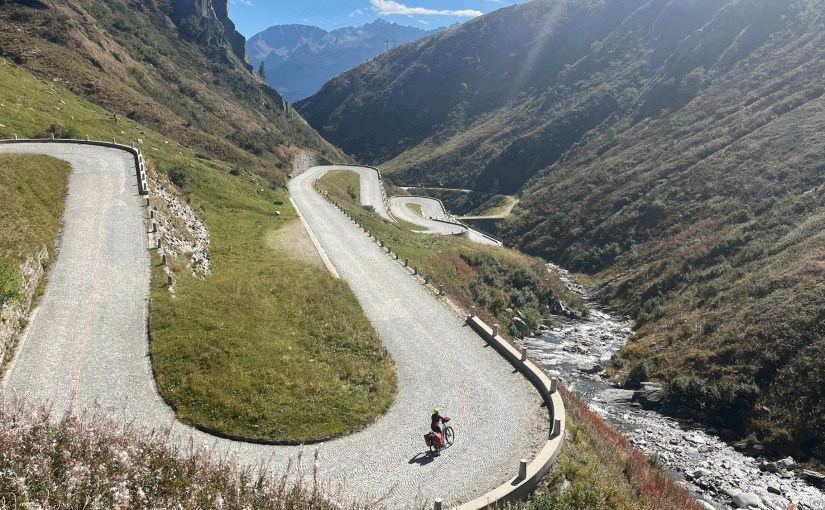
It’s not every day that a touring cyclist gets the chance to descend a 19th century cobbled road from the top of a famous Alpine pass, dropping 1000m over 15km and swooping around 37 hairpin bends.
Almost alone in the wild, rocky, mountain landscape.
Under a deep blue, cloudless sky.
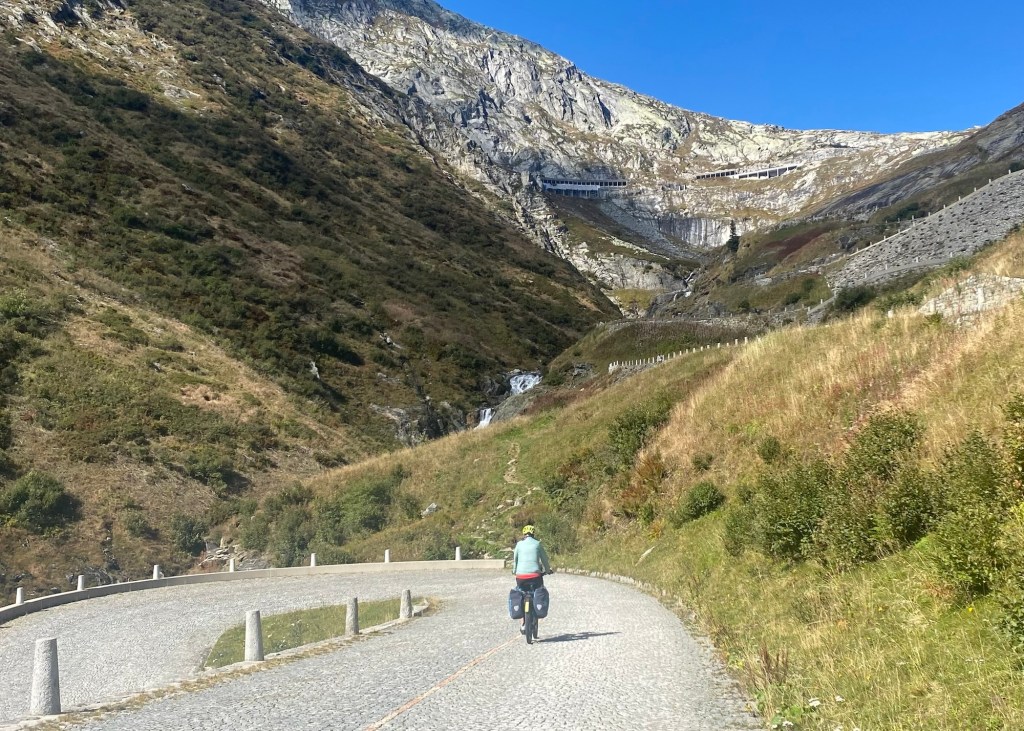
This is the Tremola … the historic old road that runs down the southern side of the Gotthard Pass in Switzerland. Opened in 1830 it quickly became a vital trading route for horse drawn wagons and carriages travelling between Northern and Southern Europe.
Today the Gotthard Pass is still a major transport axis but most of the goods and people are carried through three huge tunnels, each one the world’s longest at the time of their construction.
The 15km Gotthard Rail Tunnel (1882) still carries regular trains.
The 16.9km Gotthard Road Tunnel (1980) for freight and fast traffic.
And the 57km Gotthard Base Tunnel (2016) for fast trains.
Most importantly for touring cyclists there’s also the Gotthard Pass Road (1977), which opens for tourist traffic in the summer and is preferred by road cyclists going down the hill, as their tyres are too narrow to bump down the cobbles.
So we practically had the Tremola to ourselves. With only red-faced road cyclists coming up the hill plus the occasional curious car or motorcycle for company.

Normally, touring cyclists hate cobbles! Rattling over them at the end of a long day, they shake your weary bones to the core as you search an historic town centre for your night’s resting place.
But these are Swiss cobbles!
Even in the early 19th century, the Swiss builders had placed the neat square stones so carefully and precisely together, they still made for an incredibly smooth ride down on our strong, thick tyres nearly 200 years later.

The ride up the north side of the Gotthard Pass hadn’t been quite so much fun, and that was nothing to do with the elevation!

We had left Basel just three days earlier on another glorious late summer day, cycling across picture perfect countryside on picture perfect back roads and cycle paths to the picture perfect city of Lucerne and then onwards around the picture perfect lake.

It was stunningly beautiful. Breathtakingly beautiful.

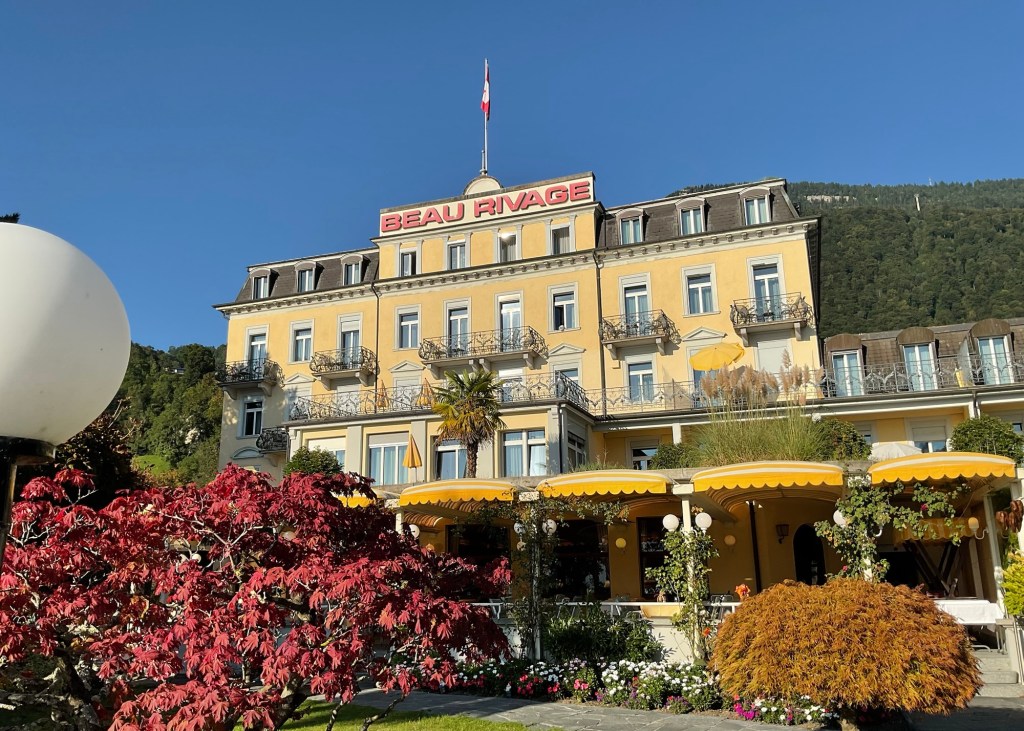
We stayed overnight at the Beau Rivage, a slightly faded small hotel on Lake Lucerne where Queen Victoria had once rested her weary head.
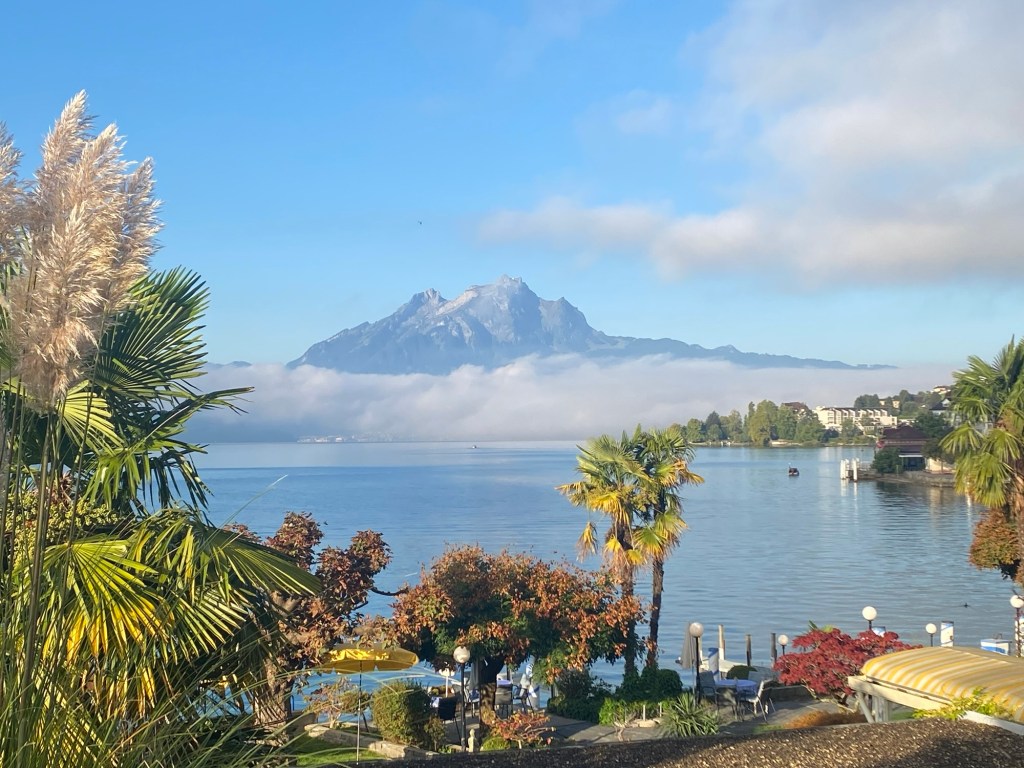
Leaving the hotel the following morning, the box of Swiss delights became even more sumptuous as we slowly pedalled around the contours of Lake Lucerne before stopping for a coffee in the small lakeside town of Brunnen.
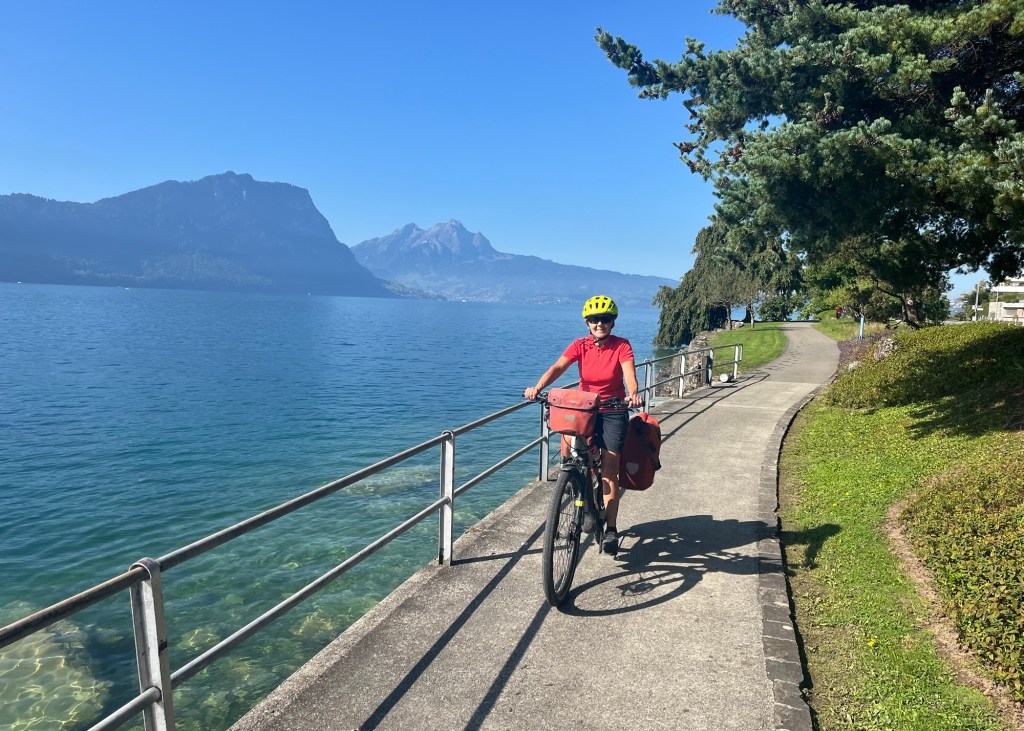
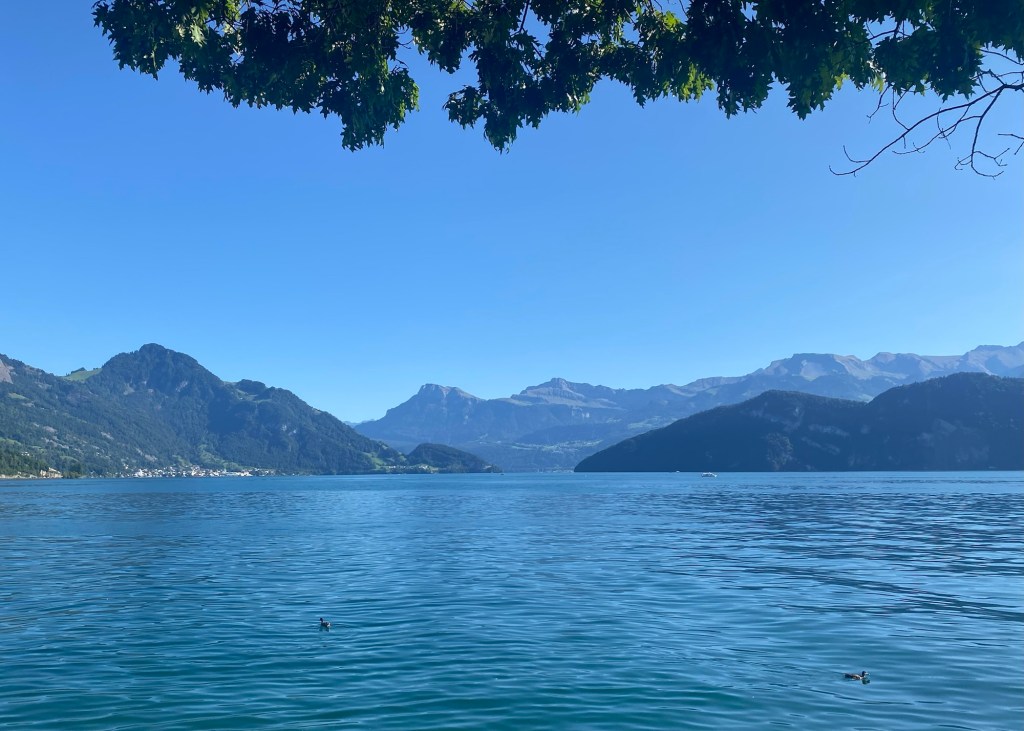
Switzerland is a fascinating country. A small, landlocked oasis of peace, prosperity and neutrality in the heart of Europe, still with four official languages (German, French, Italian and Romansh) and as many distinct cultures.
It really is as clean, efficient and precise as its reputation.


A strong economy and consistent current account surplus, plus a growing reputation as a safe haven currency in uncertain times have dramatically strengthened the Swiss Franc in recent years. Before the 2008 financial crisis £1 would buy a British traveller 2.4 Swiss Francs, now the two currencies are nearing parity.
That has made Switzerland draw-droppingly expensive for that British traveller. Fortunately the country is quite small so it didn’t take us too long to cycle across it!
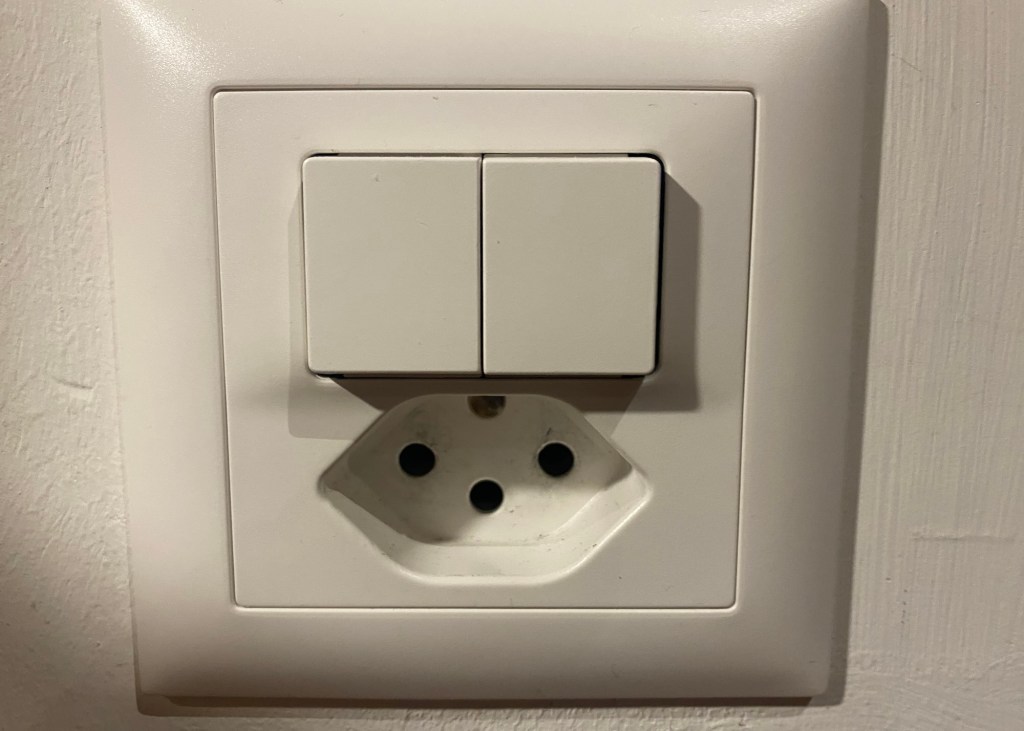
Clare likened Switzerland to a super-premium IKEA … it’s good quality, it all fits precisely together, it works efficiently and it looks nice … if a tiny bit lacking in character.
But you have to understand how it works.
Finishing our coffee in Brunnen, we were surprised to join a long traffic jam full of vehicles travelling from Zurich and funnelled onto a single lane road to get up to the tunnel or to go over the pass.
It must have been incredibly frustrating for the motorists, we heard it was taking over 4 hours to get through.

Fortunately for us there was a nice cycle path so we glided past all the traffic trying not to look too smug.
Perhaps we hadn’t properly understood the way Switzerland works as we’d found ourselves being forcefully told off quite a bit since arriving in the country. Clare generally prides herself on being a stickler for rules but even she was told off three times in one day in Basel.
So we were a little nervous when a smiling policeman flagged us down just as the cycle path became a pavement. A pavement which was then blocked by a sign that forced us briefly onto the road in order to manoeuvre our big, heavy bikes around it.
Nein, nein, he said, ist verboten.
Andy smiled back and apologised for not speaking German.
No good, he said, not allowed.
Oh Entschuldigung (sorry), said Andy thinking we weren’t allowed to cycle on the pavement after all, we go on road.
The policeman pointed up the road. OK later, he said, here no good. Too dangerous.
Andy looked up and saw that the pavement was indeed outside the protective cover of the half tunnel that the traffic was crawling through. Ich verstehe (I understand), he said miming rocks falling down, bang on my head.
The policeman nodded sagely.
Danke schön, we waved and joined the traffic queue on the road.
The policeman now became quite animated. Nein, nein, nein, he shouted. Verboten! Verboten! You must go here … pointing at the pavement.
It felt as if the language barrier was just a tiny bit too big to explain that the only reason we’d moved off the pavement and onto the road (for just one moment) … was to get around his bloody sign.
As we set off again on the pavement, once again serenely passing the traffic queue, we were sure that we could hear him chuckling away to his colleagues almost as much as we were. Dummes Englisch Radfahrer!
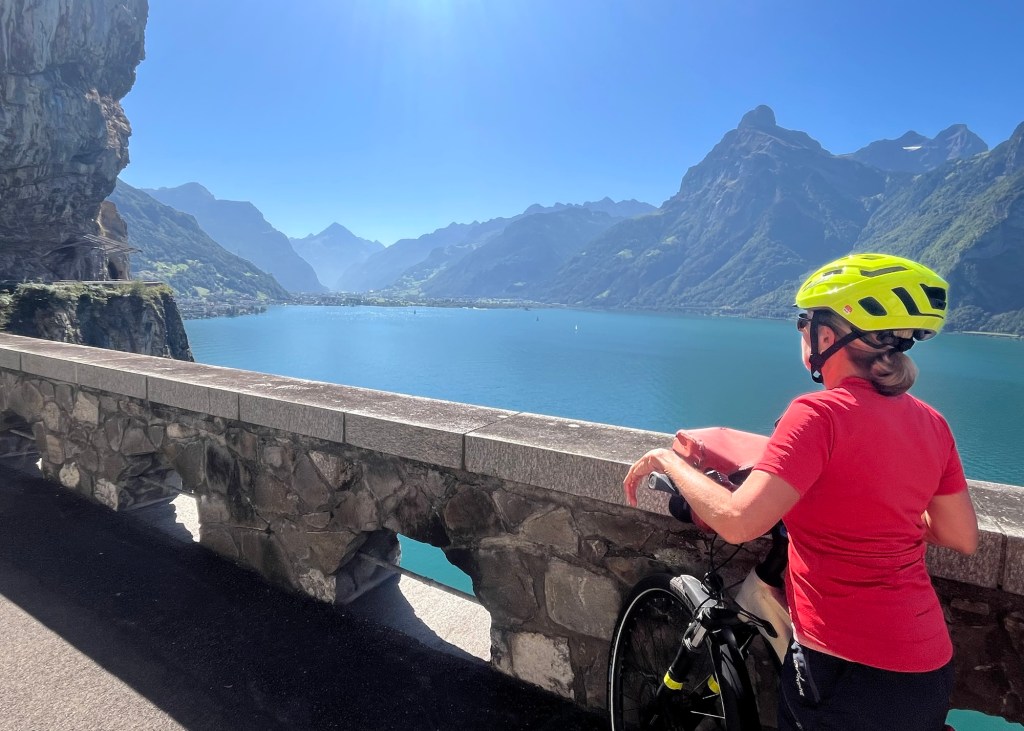
Shortly after that another cycle path emerged to help us climb the mountain, which only served to increase our sense of superiority.
As usual on a climb, Clare shot ahead. Since we’ve acquired our e-bikes she’s become so much faster at going uphill than Andy, enjoying the significantly better power-to-weight ratio that the motor gives her, even in a lower power setting. Andy is now habitually huffing and puffing in her wake, trying in vain to stay close to her wheel.
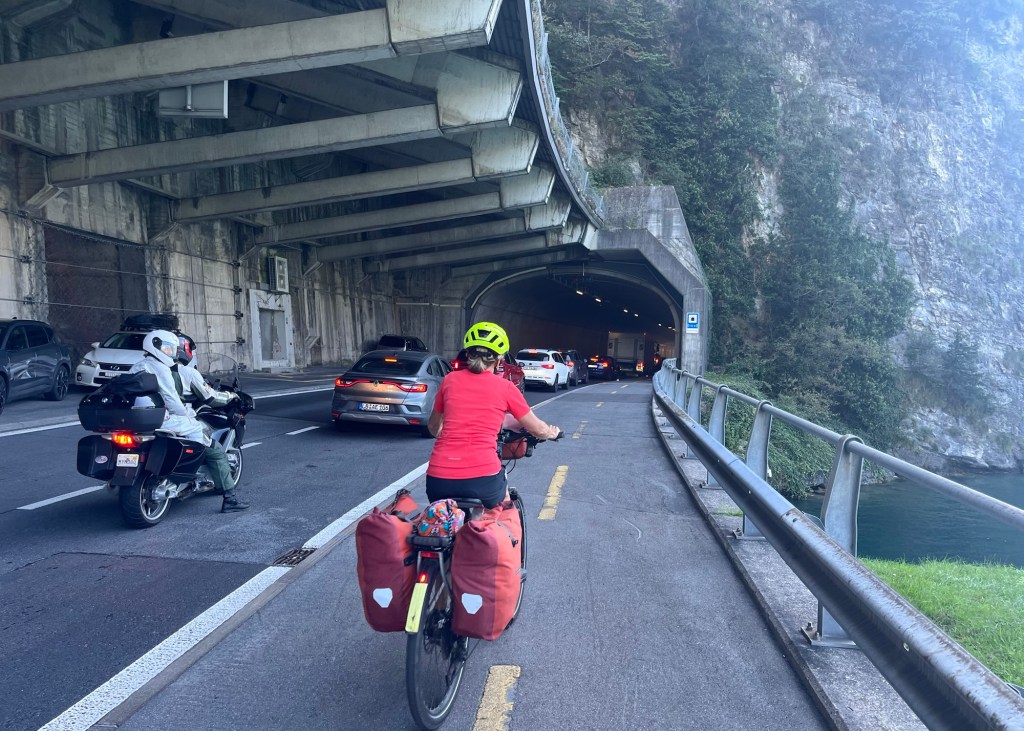
But near the top of the climb he found her forlornly contemplating a problem … the cycle path was closed, blocked by a rockfall. We had no choice but to join the busy road through a long tunnel.
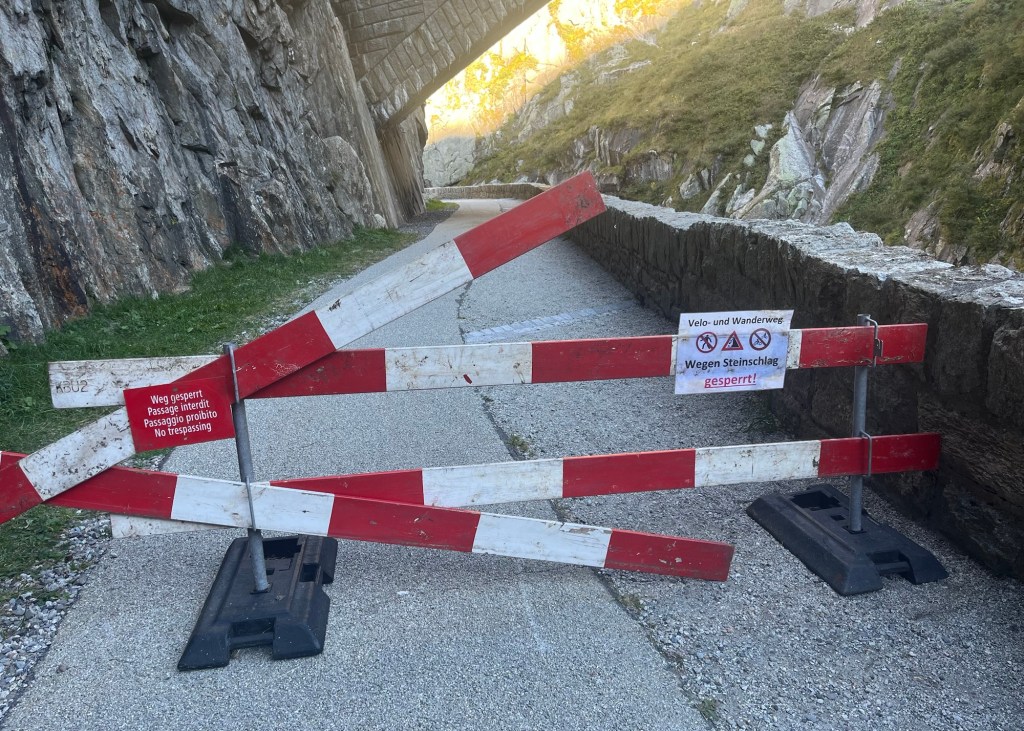
The only thing that touring cyclists hate more than cobbles is a road tunnel. Quite rightly we’re normally banned from entering them, but even if we are allowed in, we’ll do anything to avoid one … especially if it’s going uphill, especially if there’s a lot of traffic.
Because Clare was so much faster than Andy, it was difficult to use our normal busy road formation, Clare in front, Andy behind and slightly outside her. So Andy went first setting a slow but steady pace.
The road through the tunnel was very narrow, the drivers were clearly not expecting to find us in there and many of them must have been feeling exhausted by the long traffic jam they’d endured. Probably quite irritated too by the sight of smug cyclists cruising past them on the pavement all day.
Several sounded off their horns in frustration and we had a few close shaves as they squeezed past.
Then a car got too close and brushed against Clare’s pannier knocking her sideways.
Luckily she still doesn’t clip in on both sides on a climb … even after all the thousands of kilometres of bicycle touring she’s done. This meant she could quickly put her foot down and recover her balance, instead of sprawling into the road. Phew!!

We emerged to find another access point to the cycle path. It was still closed but this time we didn’t care.
This path took us through the Schöllenen Gorge, the greatest engineering challenge of the Gotthard Pass and the reason why it wasn’t used in Roman times, until they eventually managed to build a bridge across the gorge in the 13th Century.
So important was this bridge to complete the trading route that it marked the beginning of the long period of prosperity for the Swiss Confederacy. Prosperity that has ultimately led to it becoming such an expensive country to visit today.

We recharged overnight in the spa and ski resort of Andermatt, ready for the final push up to the pass itself the next morning and then the joyful descent down the precisely laid cobbles of the Tremola.
It was another beautiful sunny day.
But the receptionist at the hotel gave us a wry smile. You must get down quickly, she said, snow is coming.
And she was not wrong. The unusually early season snow arrived the very next day and once it started, it didn’t stop for a week. We later met touring cyclists who were forced to take the high speed train through the big base tunnel to reach Italy, missing the Gotthard and Tremola experience all together.
A massive pothole avoided! How lucky were we!

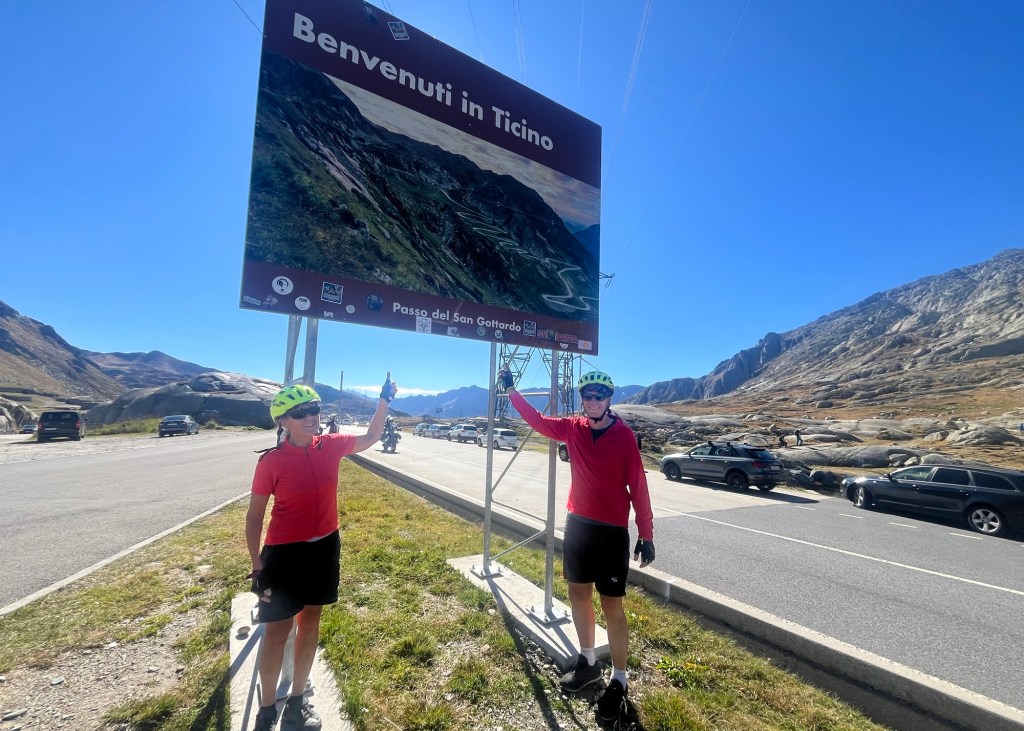
The Gotthard Pass also marks the border between German speaking central Switzerland and the Italian speaking canton of Ticino.

Despite not actually leaving Switzerland, it was amazing to see different road signs, advertising for Trattorias and Osterias and to hear people chatting away in Italian, rather than German. The food definitely improved, with delicious pastas and risottos replacing cheese fondue or wienerschnitzel. But it was still just as expensive and the road surfaces were still super smooth.
The following day we crossed the border from Swiss Italy to Real Italy halfway around Lake Maggiore.

The changes were immediate. Manhole covers were no longer precisely flush with the road … instead they were deep, hazardous pits. Houses looked like they needed a lick of paint. There was the occasional piece of rubbish on the street.
But … the pasta was now a reasonable price, so was the wine, so was the gelati. And there was a lot more vibrancy on the streets, a lot more life, a lot more noise.
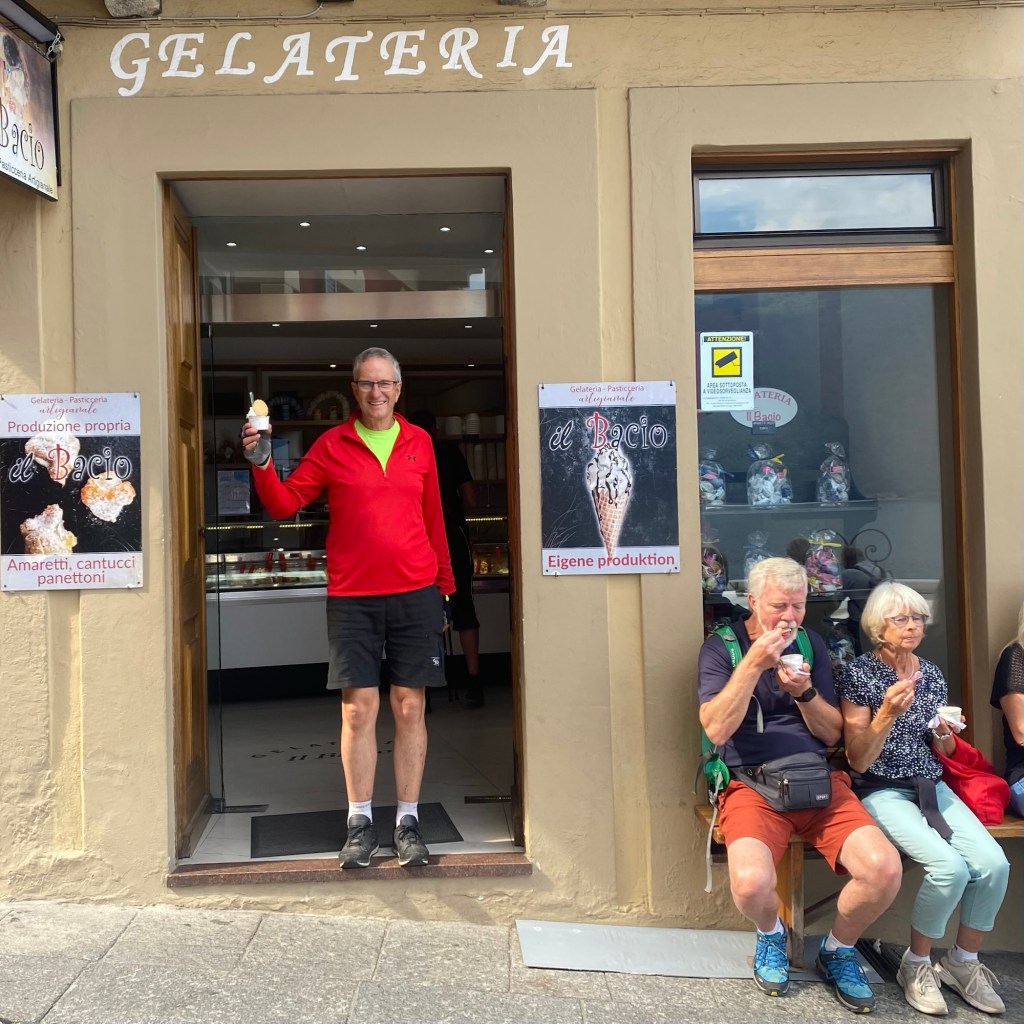
It did feel a lot more real and we immediately loved it.
After all, we had just pedalled across half of Europe and over the Alps to experience Real Italy on a bicycle.
Andiamo! … Let’s go!
Clare & Andy
Bath to Verbania, on Lake Maggiore in Italy
1,480km pedalled (920 miles)
11,792m climbed
78 hours in the saddle

 Avoiding Potholes
Tremola looks fabulous, what a marvel of engineering and precision cobbling. Very lucky to catch the pass before the snow. However the tunnel in traffic is going to be horrible and dangerous. When I meet closed sections of trail I tend to ignore the barriers, this results in either a clear run or we turn back. Love the scenery and the weather.
LikeLiked by 1 person
👏🏻👏🏻👋
Regards
Stuart
LikeLiked by 1 person
That was an intrepid episode. Super scary tunnels. I guess you could not get off and push (not the done thing). Such blue skies! And you both look even fitter!! Well, now for the Italian countryside. Can’t wait to see a picture with those skinny tall Cyprus trees in it – I love them 😍
LikeLiked by 1 person
As usual I am really enjoying your blog. Another epic journey. Good luck in Italy – possibly my favourite country.
LikeLiked by 1 person
As fascinating as ever you two. Reading it I’m almost tempted to give it a go myself, although on reflection maybe I’ll just continue to read the Blog 😁. Those cobbles and their precision were extraordinary!
Sent from my iPhone
LikeLiked by 1 person
Hi Clare and Andy Another great update. Glad to hear that Clare is ok after the near miss. We love all the small details that make your blogs so interesting. Keep pedalling!Ian xx Sent from the all-new AOL app for iOS
LikeLiked by 1 person
When I was a kid we went over the Gotthard Pass on our way from Germany to Italy – I still remember it. Another great blog and super photos!
LikeLiked by 1 person
Weather looks great throughout. Yikes on the tunnel experience. Stay safe, both of you.
LikeLiked by 1 person