
If your dream is to slowly pedal a bicycle beside a winding river on a soft early autumnal afternoon, watching a grey heron in graceful flight ahead of you, waving to a passing riverboat and crossing from one side of the river to the other on a tiny bridge … then Eastern France is the right place for you.
Since arriving in Honfleur at the mouth of the Seine, we have cycled besides twelve rivers or their accompanying canals, in order to reach Basel just inside the Swiss border.
As well as La Seine we’ve pedalled alongside L’Ourcq, La Marne, Le Petit Morin, La Vesle, L’Ornain, La Meuse, La Moselle, La Moselotte, La Lauch and L’Ill before reaching the grandaddy of them all, Le Rhin (known to us as the Rhine and an old friend from our ride through Germany a couple of years ago).

The French waterway network is the largest in Europe with over 8500km of navigable routes. Whenever a river is too shallow or too dangerous, they built a canal next door. Today, it’s still possible to travel across France by boat from the Mediterranean to the English Channel or out to the Atlantic.
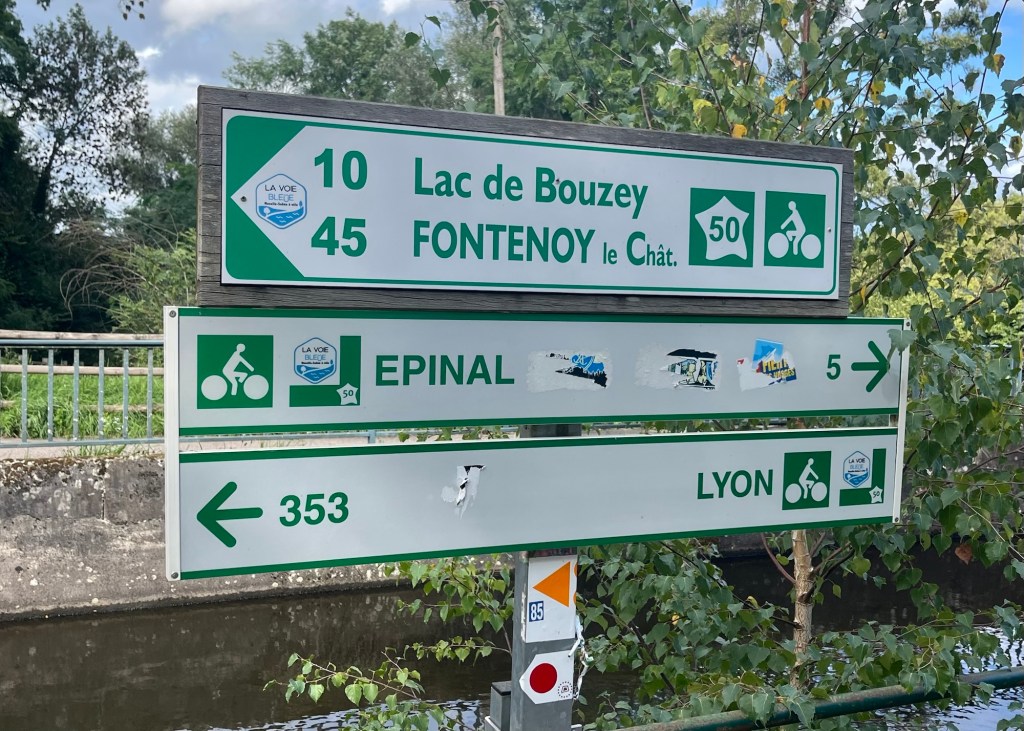
The first waterway of our journey, the Canal d’Ourcq, made it incredibly easy to escape Paris, as we picked it up just 3km from our hotel.
This canal was commissioned by Napoleon, not this time for transport, but in order to keep the city clean. It still supplies about half of the 84 million gallons of water needed to flush out the city’s sewers, gutters and parks every single day.
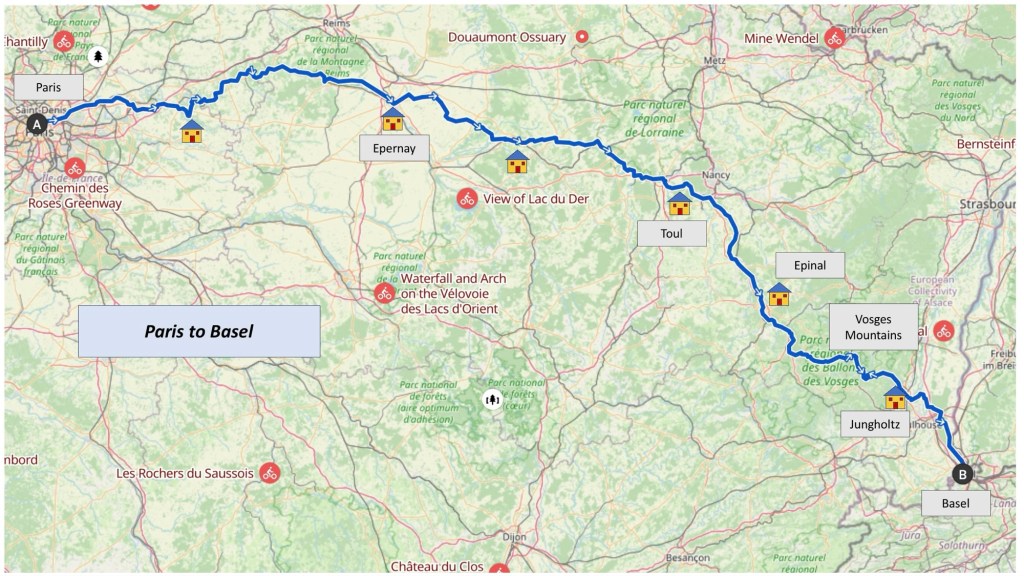
Leaving the Ourcq, we then followed the gentle curves of the Marne for the next 150 kilometres, winding through Champagne country to Épernay and onto Châlons-en-Champagne.
It was fascinating to see just how many Récoltant-Manipulants are making the famous fizz … small grower producers creating their own single vintage, each with the coveted RM symbol. This is to distinguish them from the major Négociant-Manipulant (NM) houses who buy their grapes from multiple sources so lack the individual vineyard expression that makes a RM champagne so special.
As we pedalled past the rows and rows of vines, we couldn’t help noticing the rose bushes at the end of each one. Roses are particularly sensitive to the dreaded powdery mildew, so act as an early warning system for this greatest threat facing every RM, as it can destroy the whole precious crop if it’s not treated quickly.

We’ve always found French food to be surprisingly lacking in vegetables, so we book apartments as often as we can to cook up a hearty veggie meal. But it was also a real treat to stay in two small family run guesthouses where the hostess provided an evening meal … a delicious tiny peak into French home life.
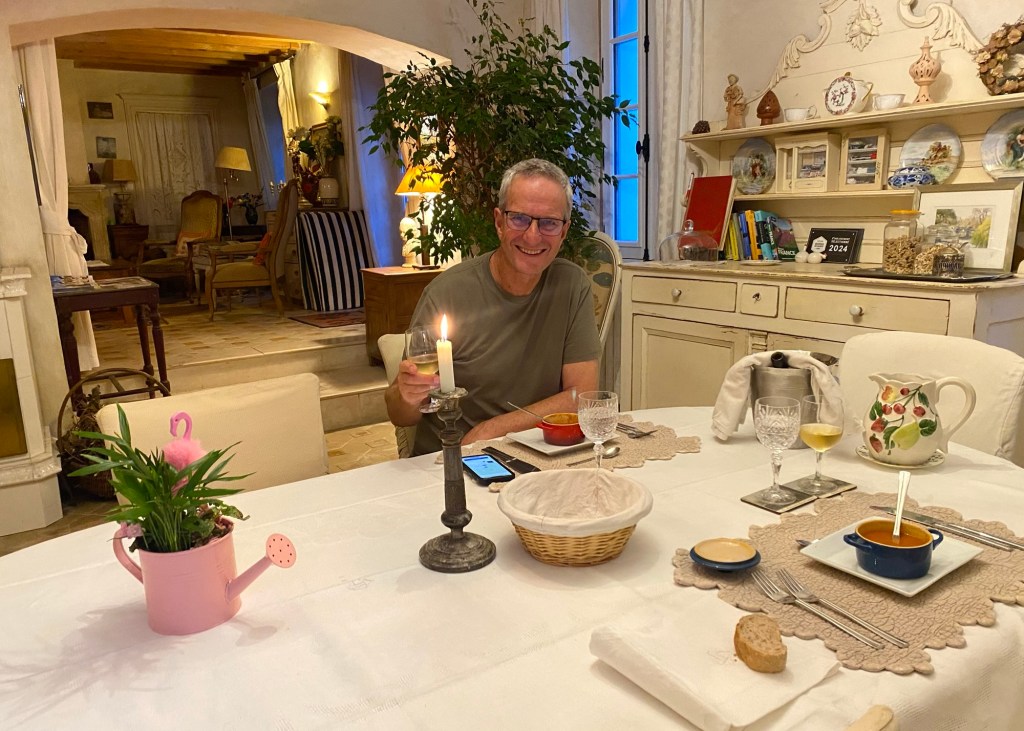
Powered by this home cooked food and starting to feel fitter now that we’re a couple of weeks into the journey, we’ve increased our rides to between 80 and 100km every day.
Which is a good thing as, to be brutally honest, the rivers, canals and empty French countryside can get a bit samey after a while.

After leaving Champagne, we cycled through part of ‘Le Diagonale du Vide’ (the Empty Diagonal), a huge slice of France with a dramatically low population density, stretching from the Spanish border in the southwest to the Belgium border in the northeast,
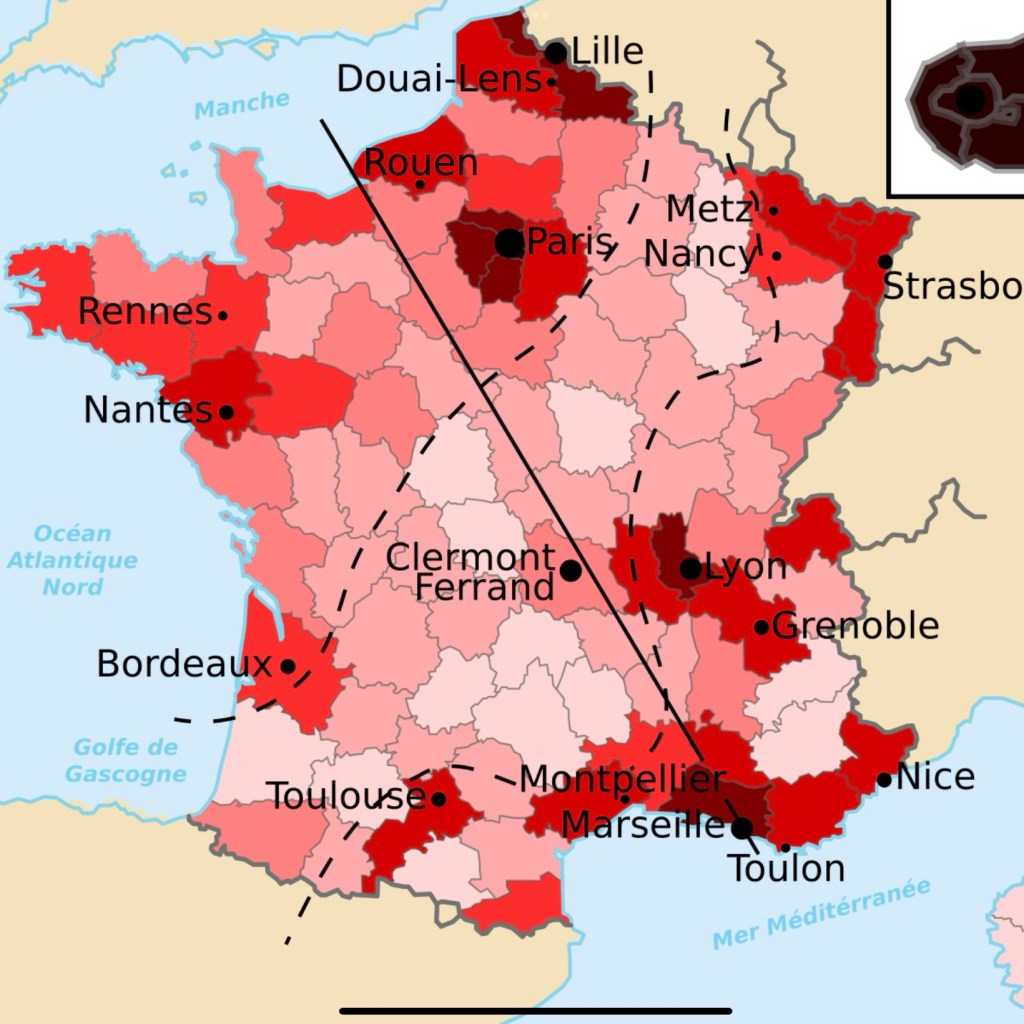
There are many reasons why this empty space exists in such a rich, cultural country.
These include the mechanisation of agriculture which led to less rural jobs, the appeal of metropolitan cities and a worldwide human desire to live within driving distance of a coast.
But the biggest reason by far is the huge death toll these areas suffered from in both the Napoleonic Wars and the First World War, which permanently diminished the population.
For modern day touring cyclists there is one very serious consequence of this empty diagonal … nowhere to stop for a coffee!
As we pedalled through village after village we couldn’t find a single shop, bar or a quaint riverside cafe. There’s simply not enough people to sustain them.
And as any cyclist will tell you … there’s nothing worse than no coffee stops.
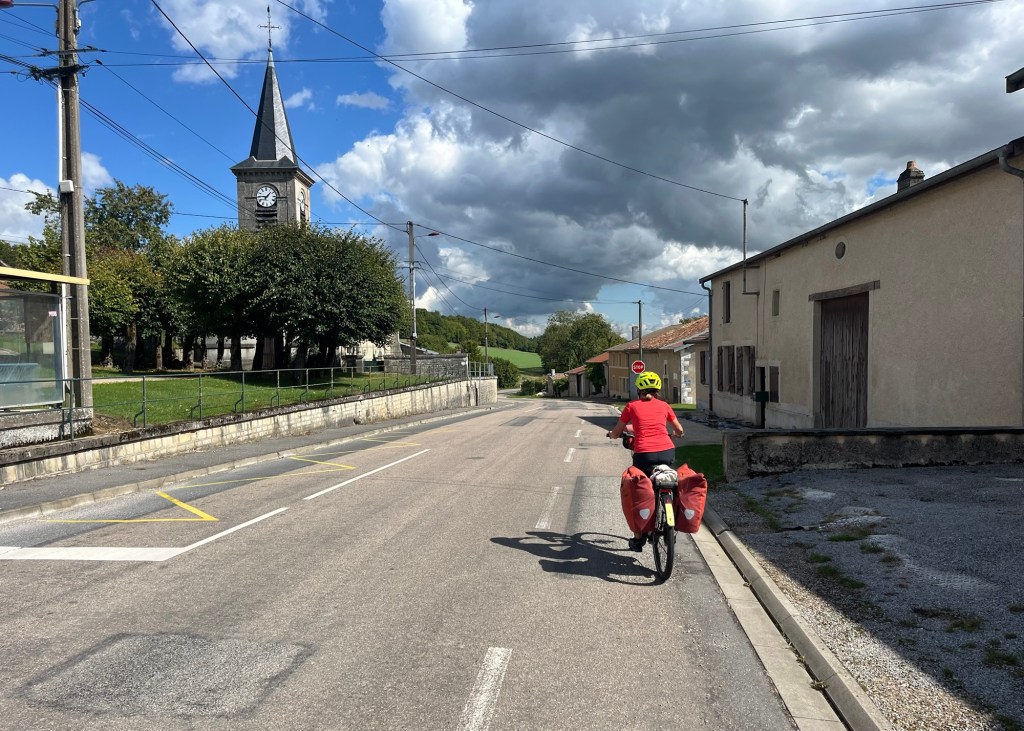

Fortunately we knew what to expect. We’d cycled through a different part of the empty diagonal before … on our way to Barcelona in 2016.
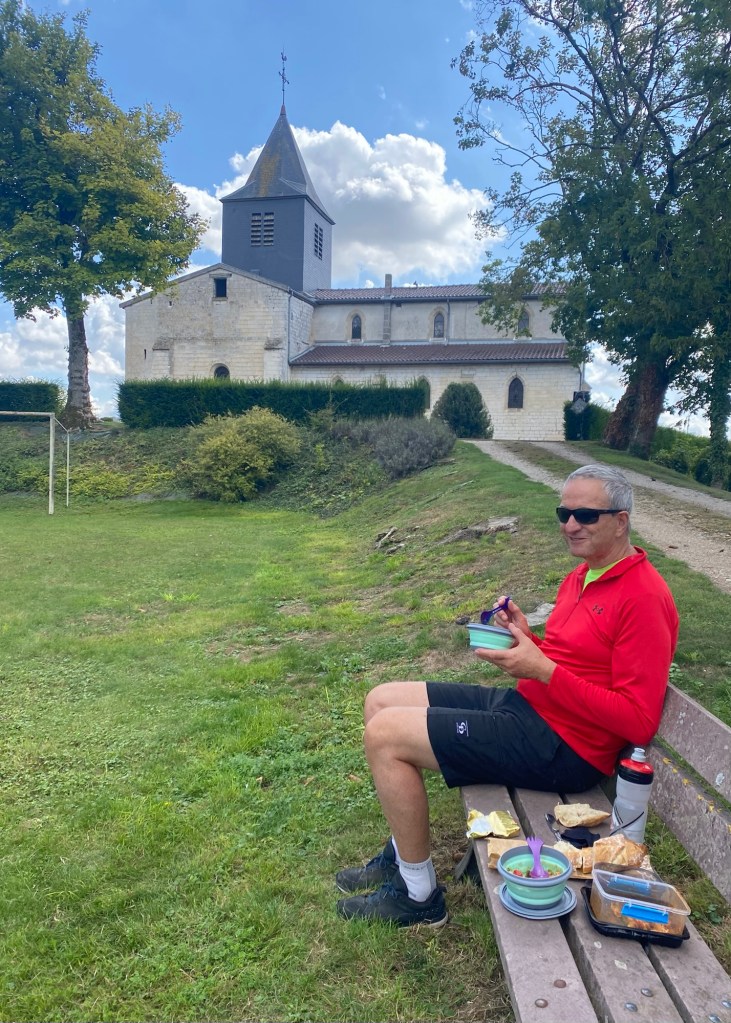
Clare knew how important it is to pick up a baguette before the Boulangerie closes at midday, she knew she should carry a bit of butter, a slice or two of ham, a piece of fruit. Then voilà, as if by magic she produces the perfect picnic lunch … a delicious Jambon Beurre sandwich to be enjoyed on a bench in a churchyard.
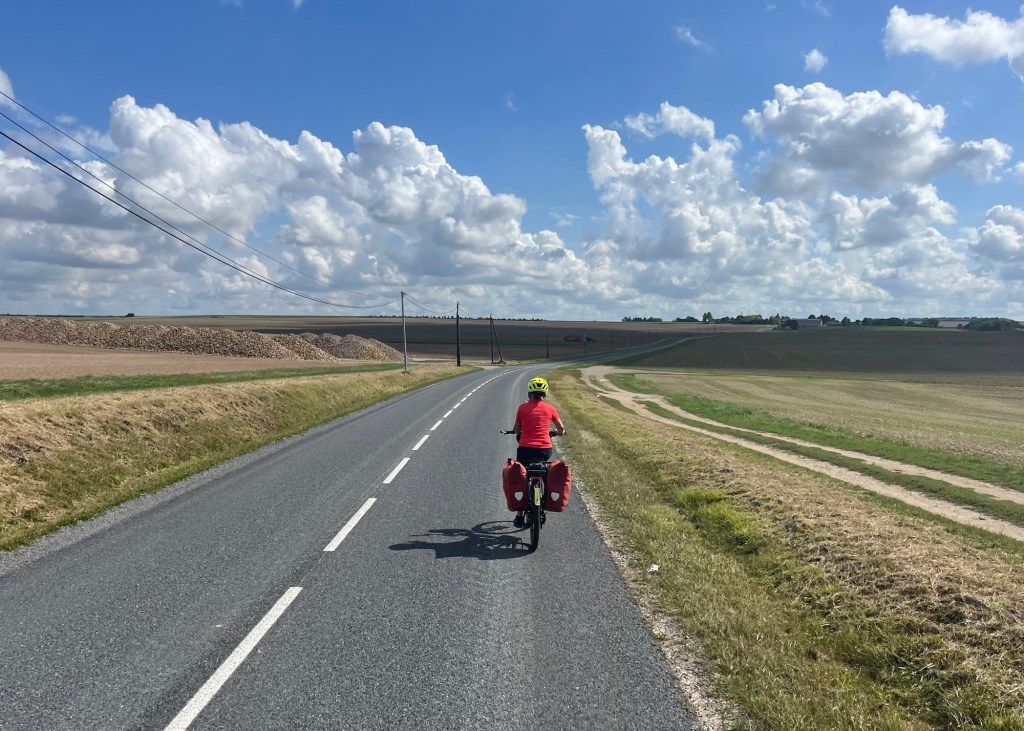
Despite the lack of coffee stops, there is one major compensation for the touring cyclist from the empty diagonal … the extraordinary quality of the country roads and cycle paths, even when there are so few people to use them.
They are simply amazing.
Perfectly smooth, not a pothole in sight, they’re just right for sticking on a podcast, putting you head down and belting along as fast as you can for 100km a day until you reach somewhere that’s a bit more interesting, somewhere with a few cafes.
For us, that somewhere was the Vosges mountains. The range of mountains that lie between Lorraine and Alsace, a region of France that was disputed with Germany for centuries, changing hands many times. It is amazing to encounter so many German place names and traditions (such as bierkellers) in a French province.
We were both looking forward getting up into the forested hill sides, although we knew that our day in the Vosges would involve two substantial climbs with over 1500m of climbing. It would be a test for our legs … and more importantly a test for our batteries.

Initially we nursed the batteries carefully, turning the power off on flat sections and then tackling the first climb in a low power setting. But less battery power meant more leg power.
The hard work on the first hill allowed us to ramp the power up for the second steeper climb, safe in the knowledge that we had a lot of downhill to come towards the end of the day.
It was a Saturday so it was a popular riding day for cyclists. But not only for cyclists … it was popular for motorbikes too, roaring around the switchbacks and over the tops. There were so many bikers that the local Gendarmes were out in force running speed checks and checking papers. It felt like being buzzed by a swarm of wasps.
We reached the ski resort of Jungfrauenkopf (Virgin’s Head) looking forward to the long descent to Jungholtz where we were staying.
But we had only freewheeled for a few metres when Clare heard a nasty noise coming from her back wheel. Stop!! STOPPPPPP!!!, she yelled.
Andy stopped.
My bike’s gone badly wrong!
Andy took a look. The brake disk pads were loose and the holding pin was missing. Then one of the brake pads fell out … not good news at the start of a 1000m descent.
With lots of motorbikes buzzing past there was nowhere safe to stop and Andy was simply feeling too exhausted to take the back wheel off and remove the rest of the mechanism by the side of the road.
Start going down the hill slowly using just the front brake, he suggested, and I’ll watch you carefully from behind. But I’m afraid we still have at least 25km to go.
Clare started going slowly for about 500m. The noise was very loud but it felt a better when she sped up a bit. Soon she was up to her normal descending speed of 40-50km per hour.
That left Andy desperately trying to work out whether she was in any danger. Could the brake spring jam the disk mechanism? he wondered. Surely not, it’s too flimsy. And it’s the back wheel, not the front, so the worst that could happen is she’ll slide to a halt, not be thrown over the handlebars.
Clare made it safely, though noisily, to the bottom. She had 17% battery left, her lowest ever.
Why did you go so fast? asked Andy, feeling very relieved.
You told me I still had 25km to go … and I just wanted to get there!

There was no chance of finding an open bike shop the following Sunday morning so in the comfort of the hotel car park, we took the back wheel off and removed both the spring and the remaining brake pad. Clare would only have one brake for the flat ride to Basel that day but at least the noises had stopped.
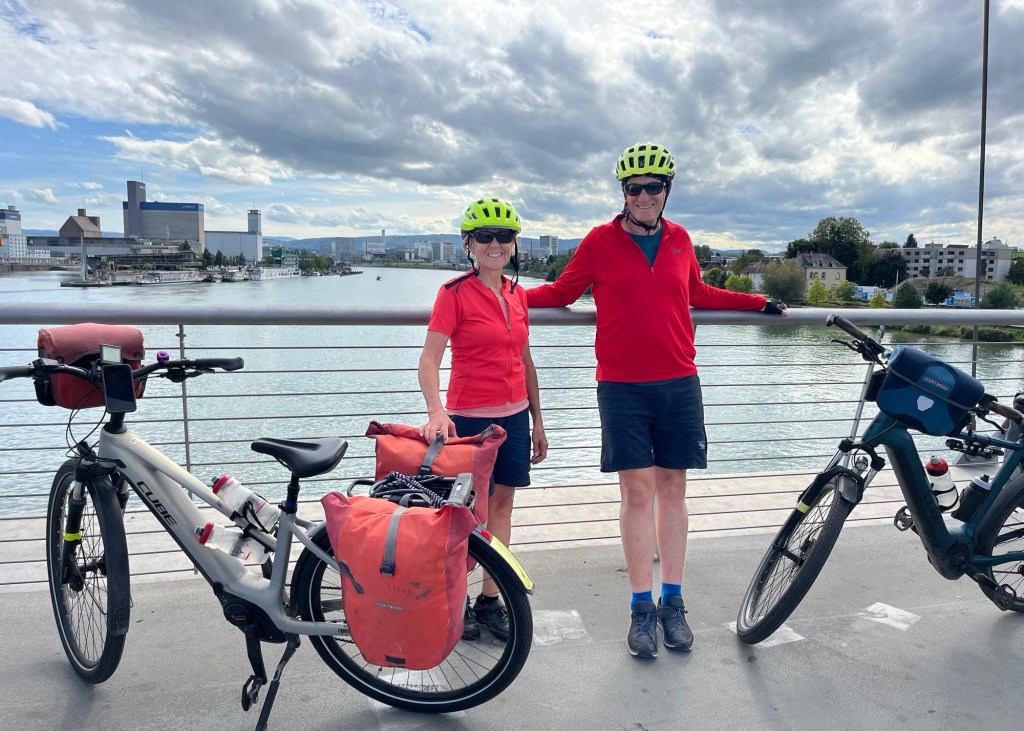
On Monday we found a bike shop in Basel. But not just any old bike shop. This was a proper Swiss bike shop with a massive range of parts, a huge workshop and prices to match. Clare’s rear brake was soon replaced, which was just as well with the Alps looming ahead.

Basel itself was a lovely place for a mini city-break in the middle of a bike tour.
We enjoyed the free trams.

We enjoyed the free water fountains dotted throughout the city.
Many of these spout mountain fresh water from the mouths of mythical basilisks. Half cockerel, half serpent, they’re the guardian creatures of Basel. Filling your water bottle can be a dangerous exercise though … as the legend tells us a basilisk can kill you with just one look in your eye.

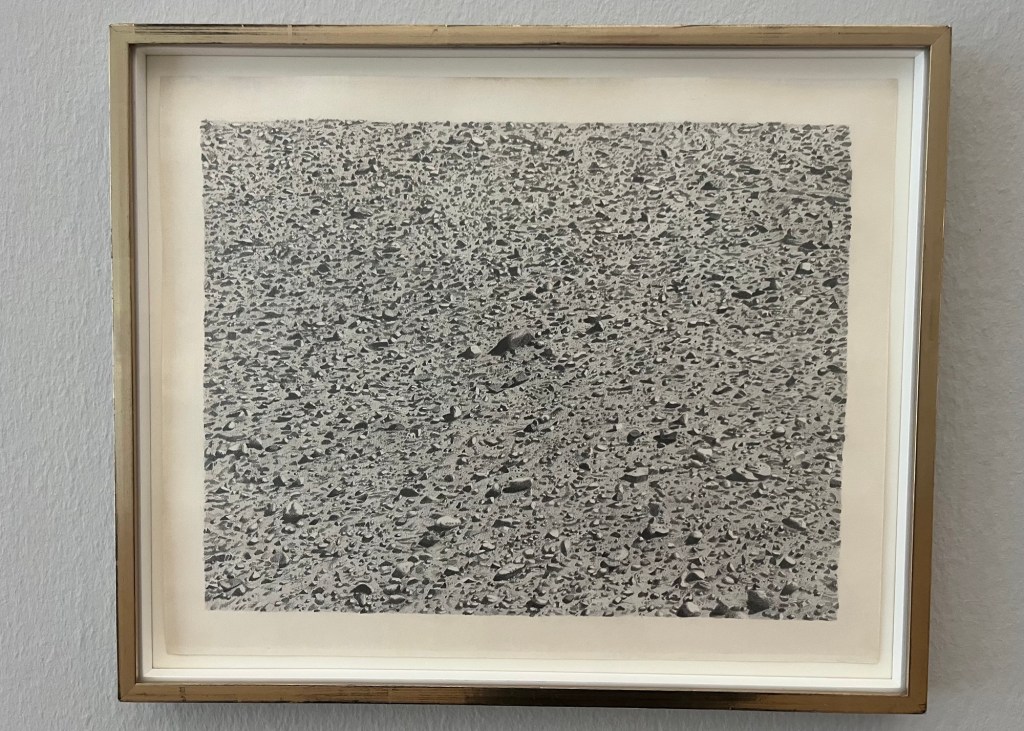
We also enjoyed the work of a couple of quirky modern artists, thanks to some recommendations by our friend, David.
An exhibition by Vija Celmins, known for her meticulous paintings of natural phenomena such as the ocean, night skies and deserts.
And a museum celebrating the work of Jean Tinguely, famous for his kinetic sculptures … machines built from bits of old junk that move and make a noise.

So how are we getting to the Alps from Basel?
Yes, you’ve guessed it … we’ll be following the rivers again. First the Ergolz, then the Aare, the Tych and finally the Reuss.
After all, they’re pretty good mountain guides!
Clare and Andy
Bath to Basel
1129km pedalled
7923m climbed
59 hours in the saddle

 Avoiding Potholes
You’ll be able to go on Mastermind, specialist subject ‘rivers of Europe’. Front brake only is fine with care and dry roads. Clare was pushing on at 50kph!
LikeLiked by 1 person
She’s remarkably fast uphill too! Leaves me standing. Andy
LikeLike
Hi Andy and Clare, I’ve been trying to leave this comment on the Blog page, maybe I’ve got too many WordPress accounts and passwords it’s not letting me login. Anyways here’s the comment and look forward to the next post !
A great read you two, thanks so much. As always a really interesting travelogue interspersed with your personal reflections and reports of incidents both good and unlucky. The coffee shop desert sounded like a test of endurance and the brake pad incident didn’t sound like fun. Look forward to the next instalment and take care going up (and maybe especially down) the Alps.
Sent from my iPhone
LikeLiked by 1 person
Thanks Bob, that must be the right account.
We’ve made it over the Alps, really good fun and very lucky with the weather. Now in Italy where we’re delighted to say there’s plenty of coffee! And wine. And pasta.
All the best.
LikeLike
Wonderful! …As always, a fascinating read, (and an escape into your world of avoiding potholes – although sounds like there’s very few to worry about on this trip!)
Have a safe onward ride to the Alps and let’s hope you find the odd cafe along the route…perhaps there’ll be some for you if you’re heading towards the touristy areas!
Good luck!
PS. So glad Clare’s brake issues didn’t cause disaster!
Finola
LikeLiked by 1 person
Thank you Finola, lovely to hear from you.
Hope all is going well for you and your work.
All the best
Clare & Andy
LikeLike
Great to hear your adventures as always! Thanks for sharing!! Lorna
LikeLiked by 1 person