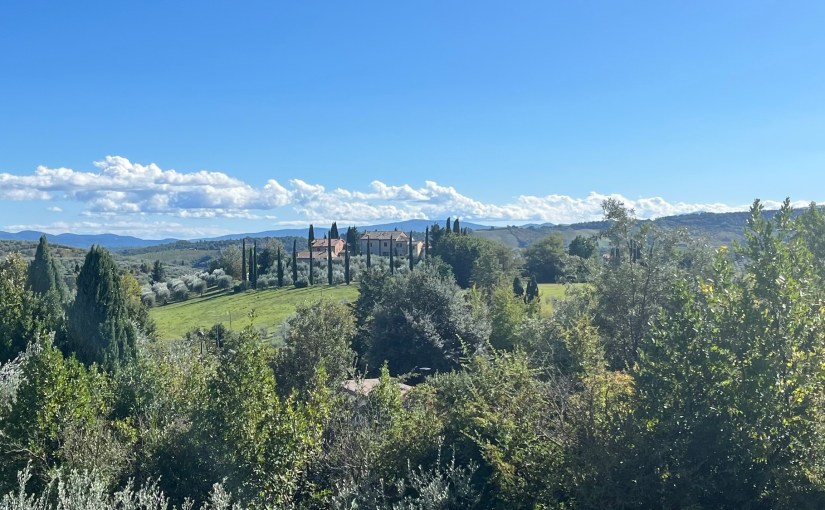
La Dolce Vita on Two Wheels (almost!)

Is there anywhere more perfect for a bicycle tour than Tuscany?

Riding through the famous rolling green hills, dotted with vineyards, olive groves and cypress trees makes it difficult to imagine that there is.

It’s difficult to imagine when pedalling slowly through yet another atmospheric village.

Or when marvelling at the renaissance art and buildings in a city like Siena.

Siena Duomo

Yes, Tuscany is the sweet bicycle touring life … the dolce vita on two wheels.

Well … almost … there’s always a but!
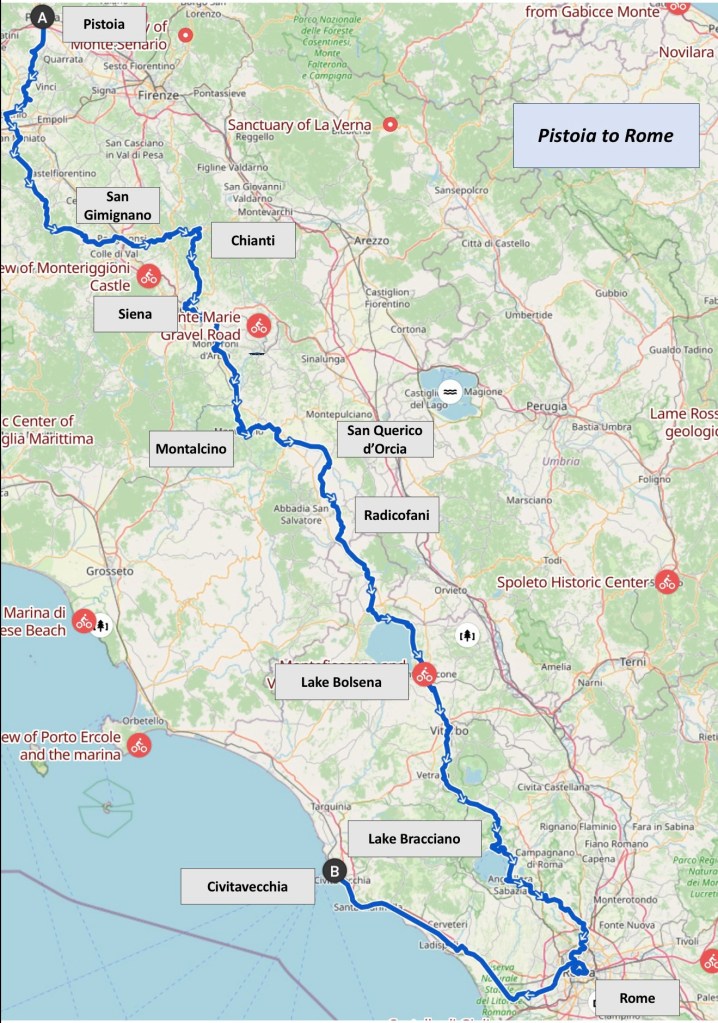
Rather than take the direct route to Siena, we decided to swing eastwards to San Gimignano and into the Chianti hills. It proved to be an inspired decision as the next two days were amongst our favourites. 

Sunny but unseasonably cool we had the ferociously steep hills to keep us warm.

Approaching San Gimignano

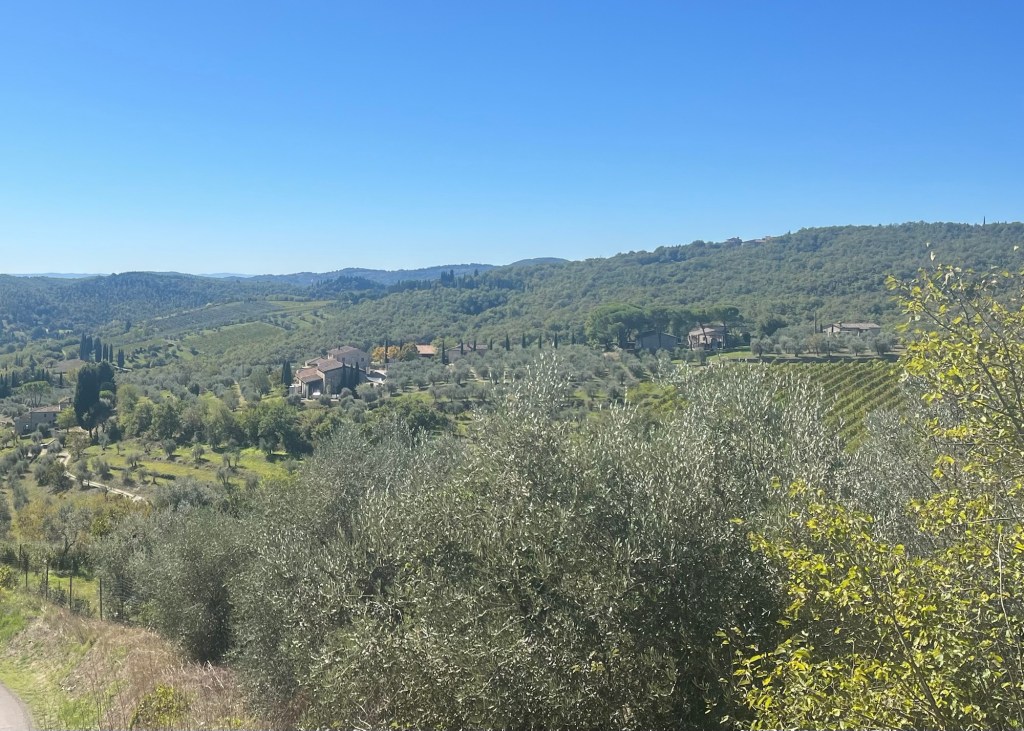
Chianti had a surprise in store … it’s covered in trees, lots of trees. The canopy of oak and chestnuts are punctuated by olive grove polka dots, stripes of vines and blocks of farmhouses guarded by rectangles of tall poplars … a tapestry in every shade of green.
White ribbons of the famous Strade Bianchi (white roads) are then woven through this tapestry. Made from fine crushed limestone and beautifully groomed in this part of Tuscany, they led us from one hilltop village to the next. 
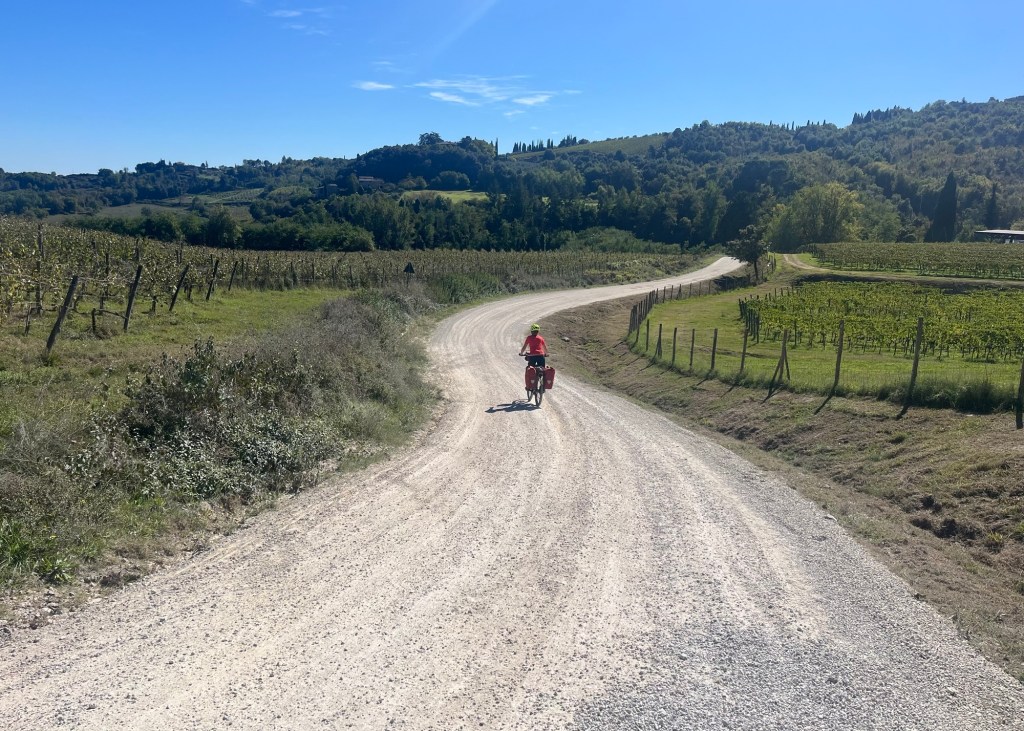
Groomed Strade Bianchi in Chianti

Our favourite stopover was Castellina-in-Chianti, a village with a single narrow street clinging to the ridge of a hill, full of ancient houses, restaurants, gelaterias, delicatessens and wine shops.

Trying to select a vintage in Castellina-in-Chianti

Whilst in Chianti it would have been rude not to stop at a vineyard to learn a little about the history of the wine … and, of course, to taste it.

As far back as 1716, Cosimo III de’ Medici, Grand Duke of Tuscany, decreed that only wine produced in a tiny area around Castellina could use the Chianti label, a state of affairs that happily continued until the 1930’s.

Then the Italian government of Mussolini decided to expand the Chianti region in order to export more wine around the world. Chianti became ubiquitous … cheap, poor quality plonk sold in those squat waxy bottles that were covered in a wicker flask and used as candle holders in every Italian restaurant. Ironically, the straw flask is called a fiasco in Italian.

As far as the winemakers around Castellina were concerned it was indeed a fiasco!

They fought back, launching Chianti Classico with very strict regulations on the grapes, the location of the vineyards, the type of soil and the winemaking techniques. The result was a wine of much higher quality that could be sold at a premium price, labelled with the coveted black rooster to separate it from the rough stuff.

Tasting the difference between Chianti and Chianti Classico

It was easy to tell them apart!

Sadly we could only try a couple of vintages as we still had to pedal to Siena that afternoon.
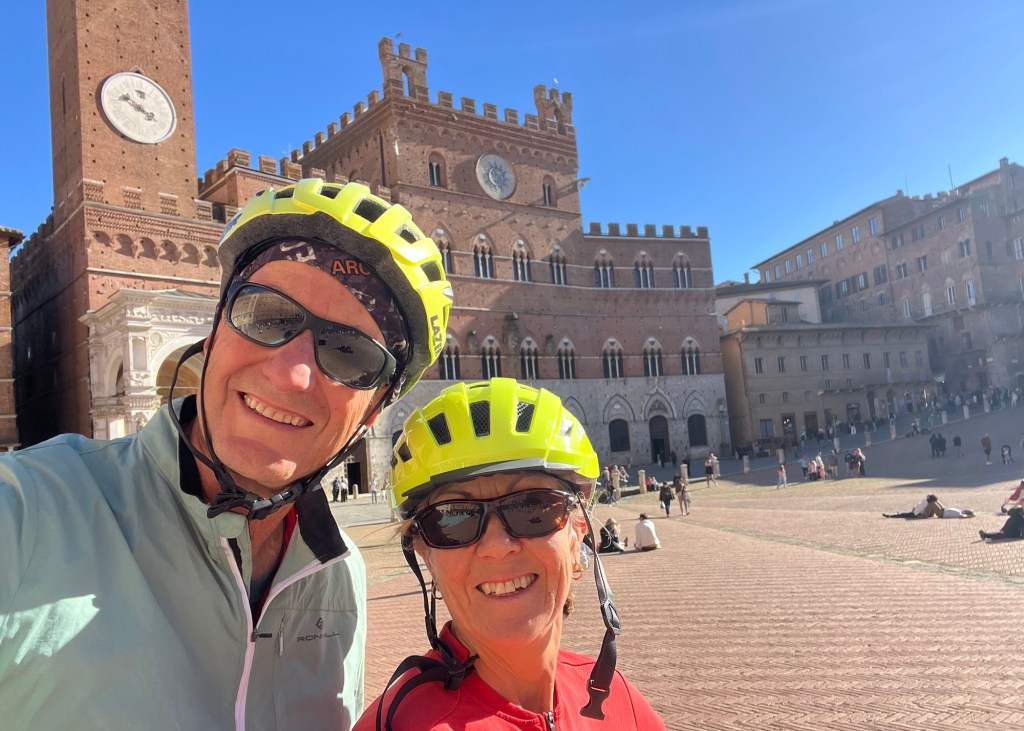
Arriving in Siena, post Chianti tasting

Siena would be a highlight of any visit to Tuscany.

To make it even more special we happened to be there during one of the short periods each year when the floor of Siena Duomo (Cathedral) is uncovered.

No other building has a floor which matches the scale and artistry of this one. Taking five centuries to complete, fifty six panels of marble mosaic inlay illustrate scenes from the bible but also from Greek and Roman mythology.

Siena Duomo Floor Photo Credit: Siena Duomo

It covers the whole floor of the cathedral. The effect is breathtaking!

Detail of one of the panels

The crypt of Siena Cathedral is also remarkable. This underground chamber was covered in religious paintings in the second half of 13th century before being abruptly sealed and filled with sand and earth.

Only re-discovered in 1999, those centuries buried underground have preserved the paint perfectly. This means that visitors today still get to experience the bright, vivid colours that the artists originally intended.

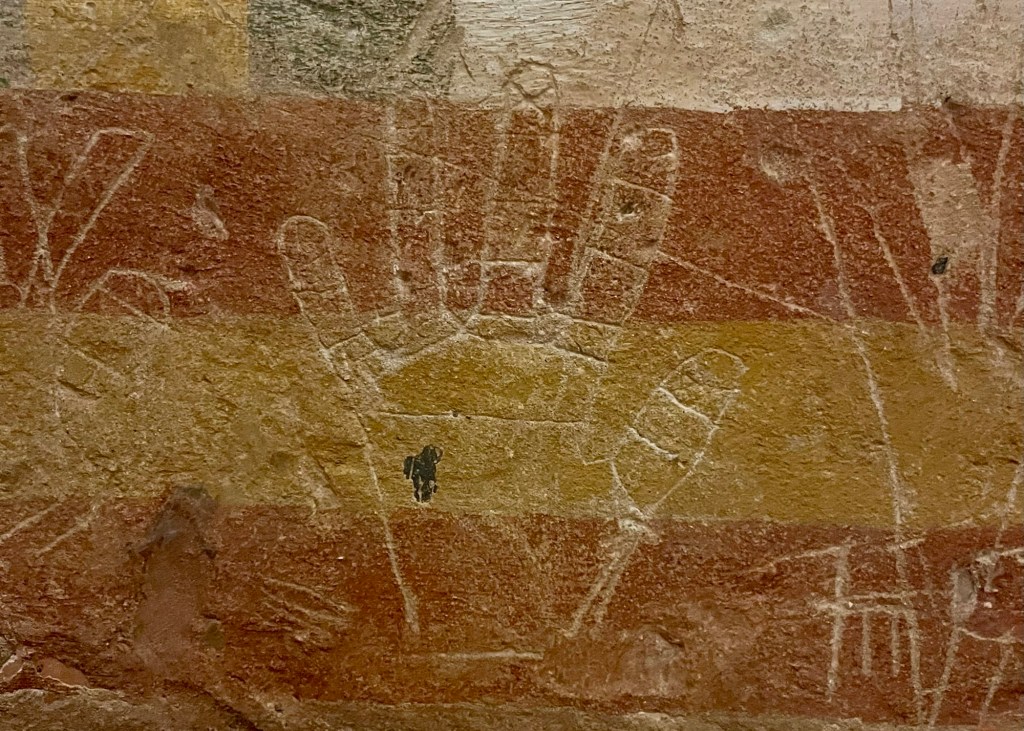
The lower part of the paintings are covered in graffiti, scratched into the limestone plaster.  This can only be graffiti from people living between the 1280’s when the painting were made and the 1350’s when the crypt was sealed and filled with sand.

It feels as if those people are calling out to us across the centuries … I’m alive. I’m here. I made this mark … look, this is my hand!
As usual with a museum or cathedral, the exit is through a gift shop. But only in an Italian cathedral does a gift shop look quite like this!

So why is Tuscany the dolce vita on two wheels (almost)? What’s the almost? What’s the but?

Well … it’s the roads … they really are as bad as their reputation.

And it’s the drivers. Italians are normally the warmest, friendliest people but put them behind the wheel of a car and they turn into crazy, impatient monsters.

The roads feel like a bumpy obstacle course. As a cyclist, you can’t afford to drop your guard for a second.
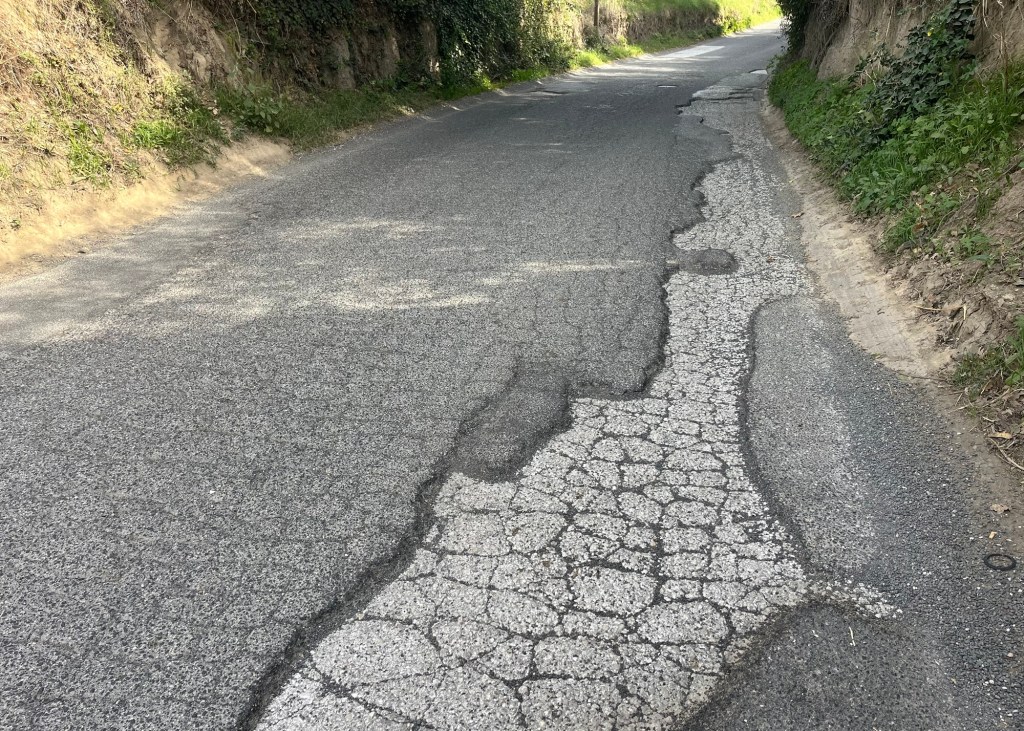
Typical Italian country road

At any moment you might have to weave between the cracks. Or swerve to avoid a sudden pothole, or a tree root, or a deep manhole cover, or all manor of debris.

Which is a dangerous game as the roads are also very narrow and you probably have an impatient monster revving up behind you.

To be fair the bigger the vehicle, the more courteous the drivers are. Trucks and vans are fine. What you really have to watch out for are the crazy monsters nipping around in their Fiat 500s!

This means that for a bicycle tourist, Tuscany charms and terrifies in equal measure. We’d love to come back and explore more of the area but perhaps we’ll stick to four wheels next time … maybe hire a Fiat 500 and become crazy monsters too?!
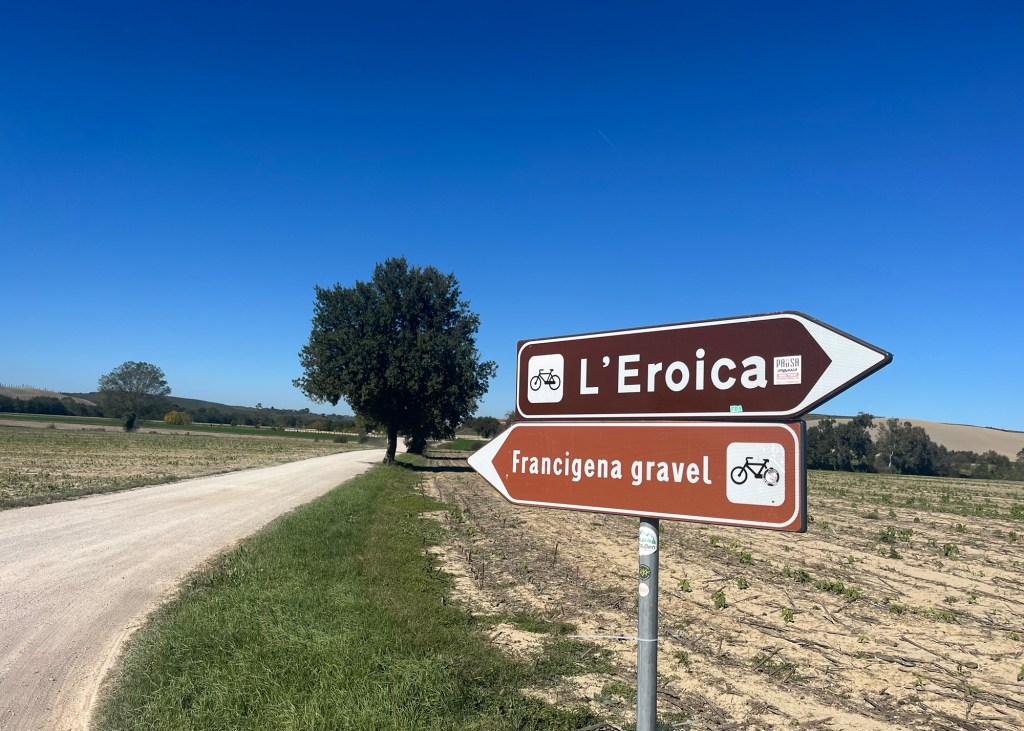
Since leaving Pistoia we’ve often been guided by an ancient pilgrimage route called the Via Francigena. It was an important medieval road for pilgrims travelling to Rome from as far away as Canterbury. Today, it’s still popular as a long distance walking and cycling trail, especially the section that runs through Tuscany.

We saw lots of people walking the Via Francigena

In turn, the Via Francigena often follows an even older Roman road, the Via Cassia, built to connect Rome to Florence. And the Via Cassia has since been used to plan the route of a major regional road.

For a touring cyclist this means the choice often comes down to a gravel track on the Via Francigena or the busy main road.

Clare hates gravel. Andy hates main roads.

Something had to give!.
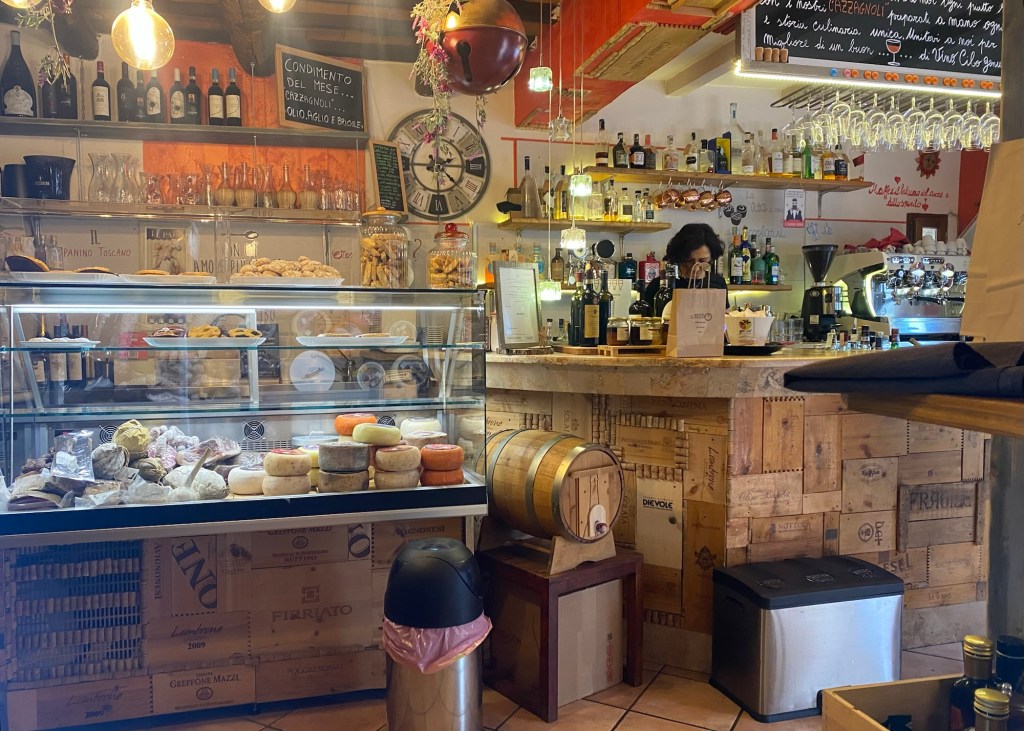
Lunch stop in Radicofani

After a long climb up to a hilltop village called Radicofani for lunch, it was perhaps not Andy’s best idea to avoid the main road by choosing a long gravel descent down the other side.

This was not the same smooth gravel that Clare had enjoyed in Chianti. Much steeper. A lot bumpier. Very deep in places. Great for mountain bikers, not so great for touring cyclists. Lots of opportunities to skid and slide. 

And it lasted 20 kilometres!

Clare was not impressed. I didn’t spend hours struggling up that hill just to come down this ridiculous gravel. It’s so dangerous!

Predictably, about halfway way down there was one skid and slide too many.

“Stupid bloody gravel!”

Andy promised to take the road next time.

But the next day he pushed his luck even more by trying out a section of the original Via Cassia, still with the paving exactly as it was in Roman times.

It was even slower going but fortunately we both enjoyed the privilege of riding across the same stones that had carried the sandled feet of so many Roman legionaries marching off to yet another war.

There was one last treat in store before reaching Rome … the Bolsena and Bracciano volcanic lakes, both very pleasant escapes from the rough and tumble of the city.
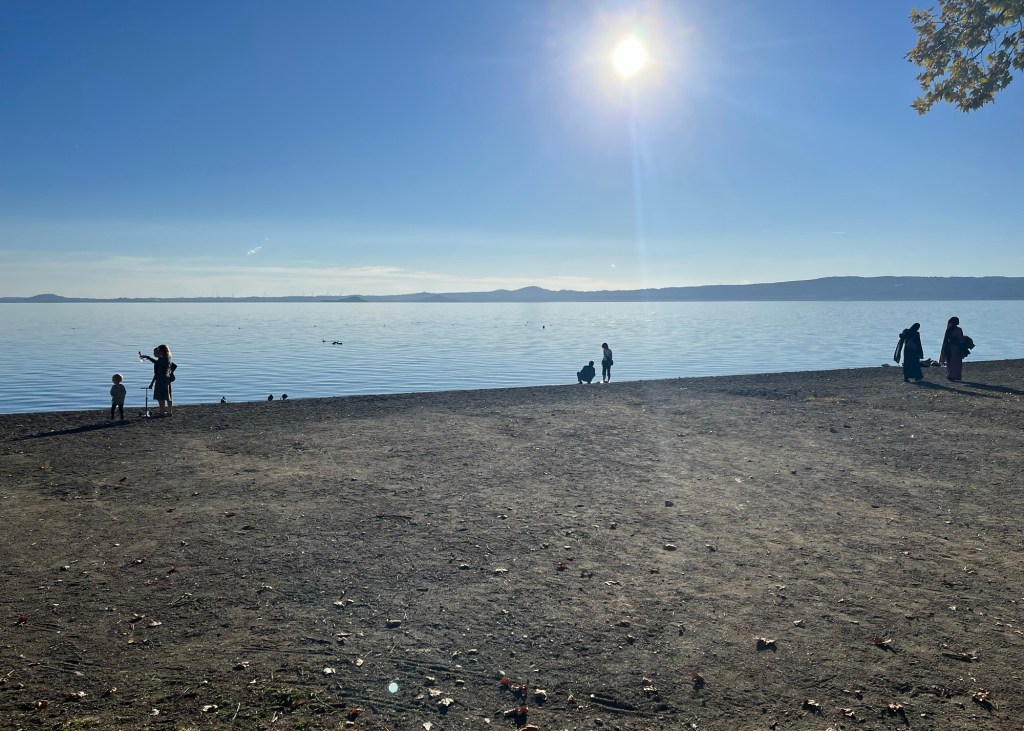
Lake Bolsena

We even enjoyed Lake Bolsena so much that we stayed an extra night.

Beer o’clock at Lake Bolsena

This meant that despite Rome being our destination, despite pedalling over 2500 kilometres to get there, we ended up spending just one day in the eternal city.

As well as the lake we had simply enjoyed Italy and especially Tuscany too much, slowing down, eating up the days we’d planned for Rome.

It proves yet again what Clare is always telling Andy … that a bicycle tour is about the journey, not the destination. Plus this was our third visit to the eternal city.

Getting into Rome gave us one final challenge, and it wasn’t only to dodge the crowds at the Colosseum.

Knowing that the Roman drivers are at yet another level of craziness to the rest of Italy, we decided the best way to enter the city would be along the River Tiber cycle path.

To get to it we had to cross the Veio Regional Park first, famous for its Etruscan ruins and slightly infamous for controversially reintroducing three packs of wolves into a park that is so close to a major city.

Komoot (our mapping app) guided us into the park on a nice road to start with. But that road became a track and then the track turned into this …
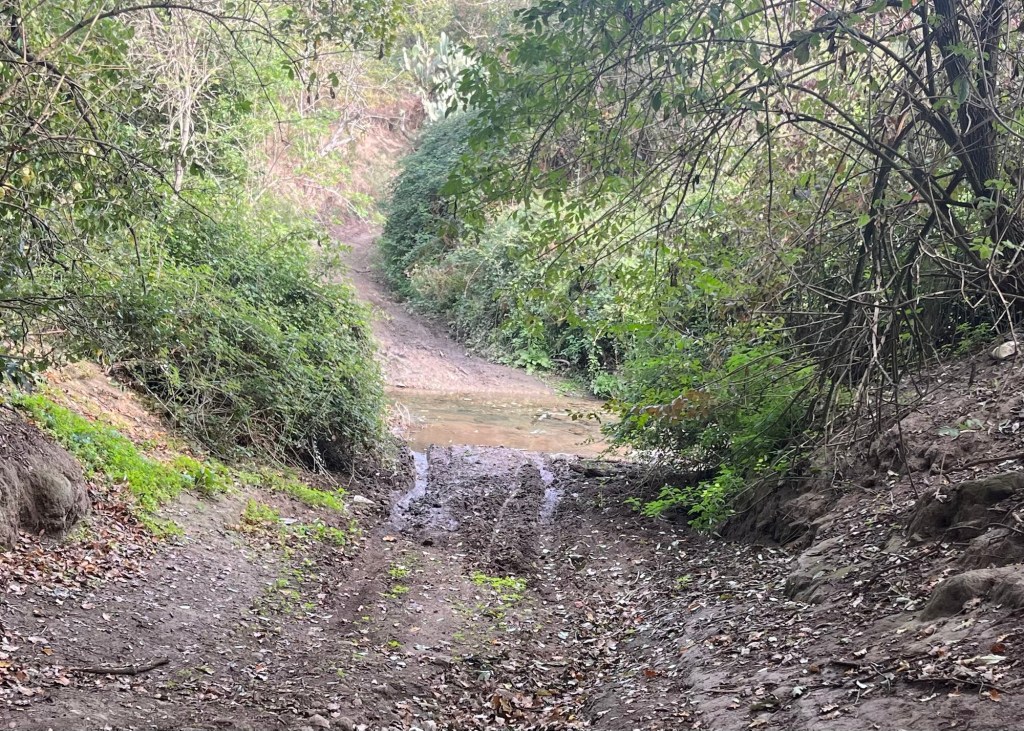
Whilst Andy was wondering how Clare might react, he came face to face with a wild boar just by the water. They stared at each other for a minute before the boar snuffled and quietly went about its business.

That was enough to convince Andy that crossing the muddy stream was a bad idea. The only alternative was a farm track blocked by a roped up gate that displayed this warning sign …
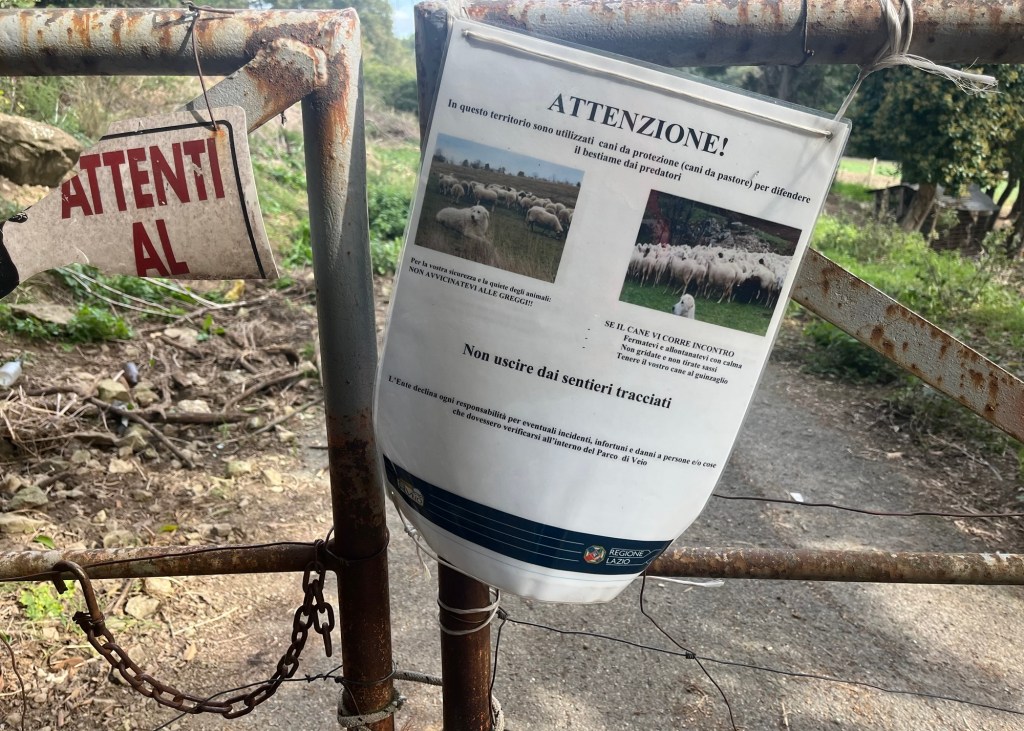
The sign explains to potential visitors that dogs are used to protect the sheep from the wolves. If a dog was to charge at us, we should not throw stones but walk away calmly.

Clare voted with her pedals and quickly headed back to the busy main road.

But Andy convinced her that if he could be Top Dog in Romania last year, he could still be Top Dog here. But even he had to admit … pedalling slowly across the field and up the hill was pretty nerve wracking. Fortunately the sheep and the dogs were in another field that day.

From the top of the hill it was a lovely cycle down to the river on some nice country roads and an even better ride along the best cycle path we’ve come across in Italy, all the way along the river and right into the heart of the city.

River Tiber Cycle Path

But once we reached the centre of Rome, we couldn’t escape. We were trapped on the Tiber by some very steep steps.

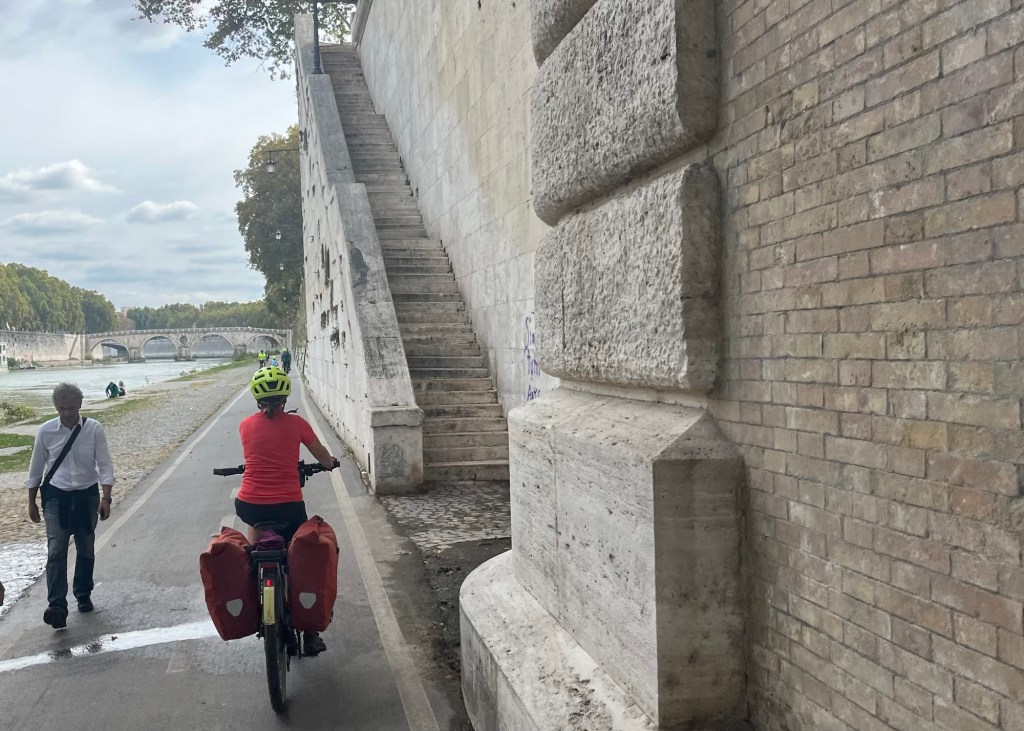
Trapped on the Tiber
Too steep for us

So we just kept going and going and going … until eventually we found some shallower steps.
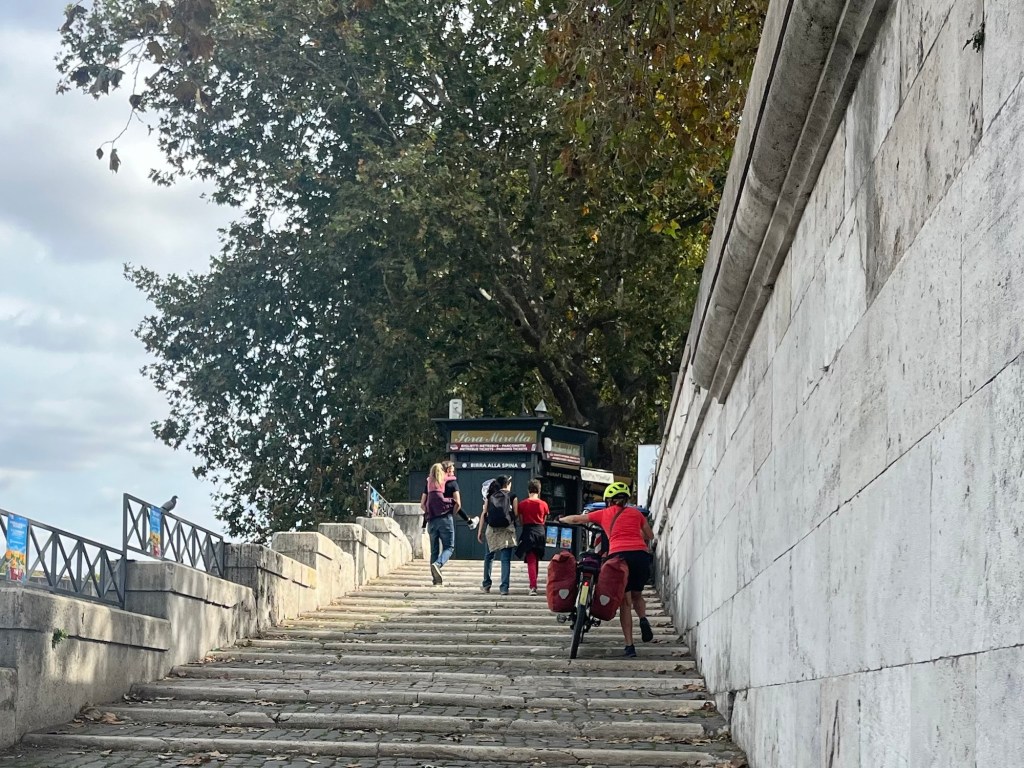
So how to enjoy just one day in Rome?

First to celebrate completing the 2,541km journey with our bicycles outside the Colosseum!

Then to revisit some old favourites … the Pantheon, Piazza Navona, Campo del Fiore.
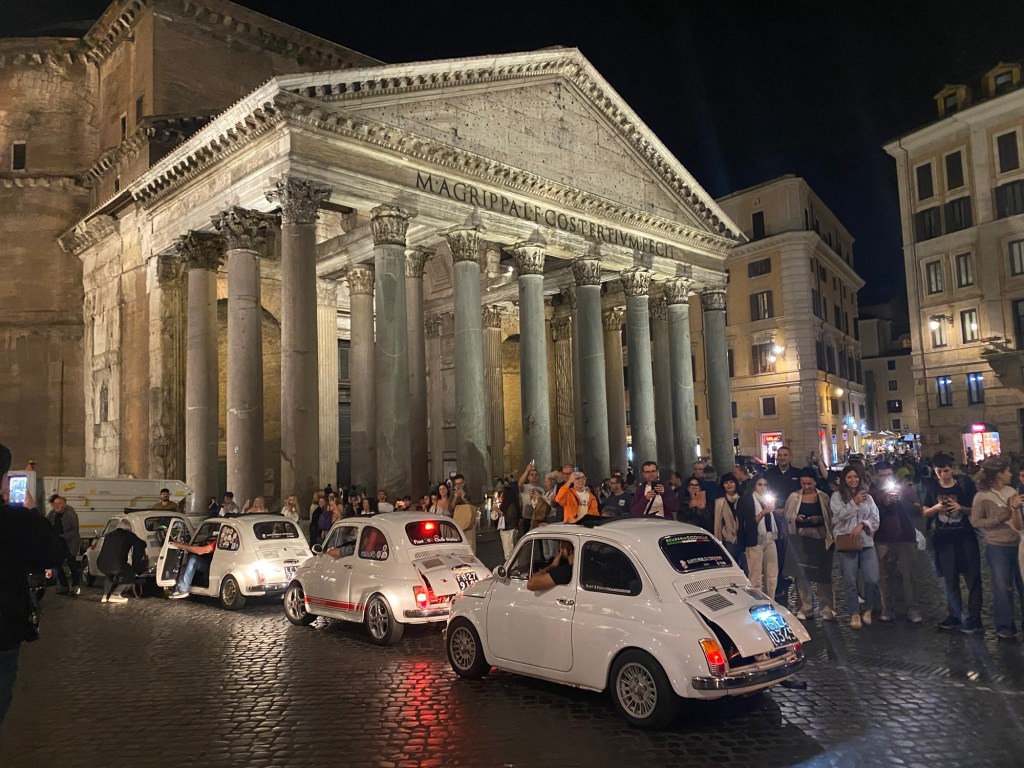
A Fiat rally in front of the Pantheon

Then to enjoy one of the main attractions that we’ve somehow managed to miss in the past and take the senators walk down from the Palatine Hill to the Forum, following in the footsteps of Julius Caesar, Cicero and Augustus.
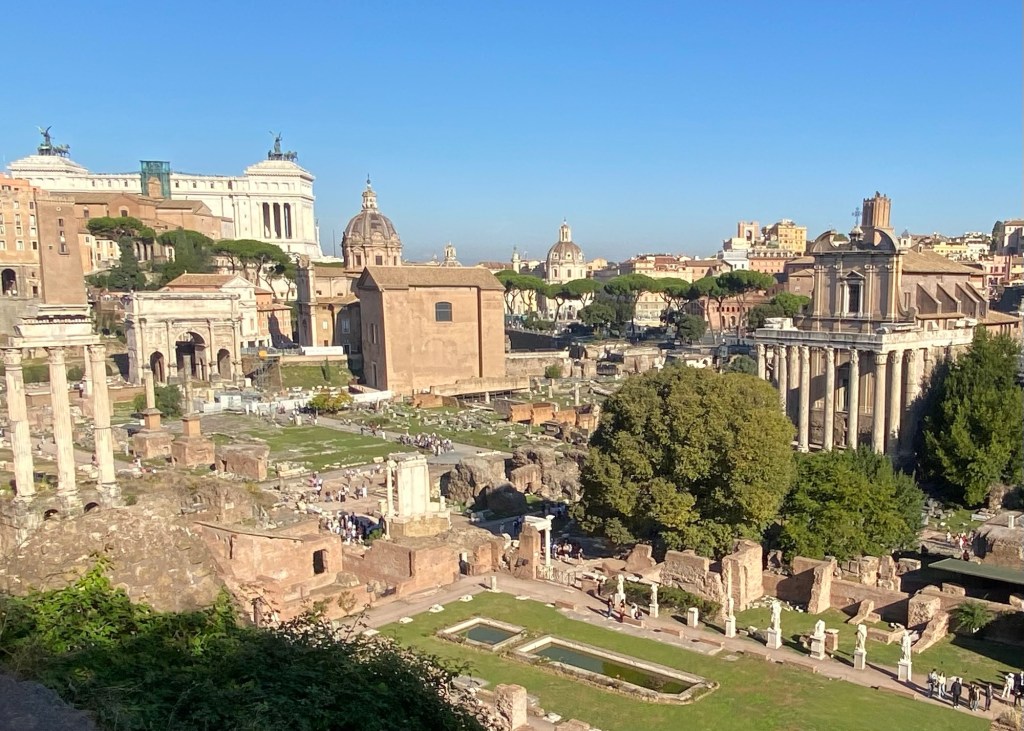
Then to revisit another old favourite and enjoy a gelato from Gelateria Della Palma, where they bamboozle you with over 150 flavours. No visit to Rome is complete without it.
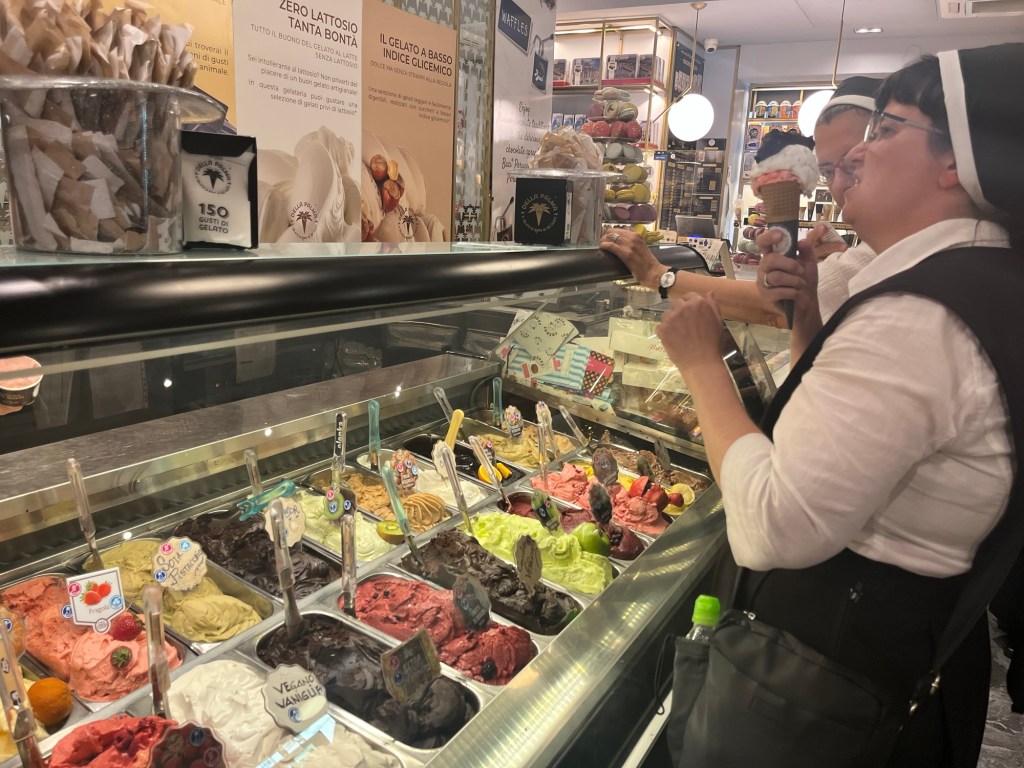
Sharing the experience with some gelati loving nuns

And finally to do something new by paying our respects to Pope Francis, who died earlier this year, at his final resting place in Santa Maria Maggiore.

A beautifully simple tomb 

Rome has been a pilgrimage destination for centuries, many journeying to the eternal city on the Via Francigena. If all roads lead to Rome, perhaps all bike paths eventually do too.

So it’s a fitting end to this e-bicycle tour through England, France, Switzerland and Italy.

Accept it’s not the end. We still have to get home!

Now, where does the ferry to Barcelona leave from?

Clare and Andy

Bath to Rome

2,541 kilometres pedalled

22,656 metres climbed

135 hours in the saddle

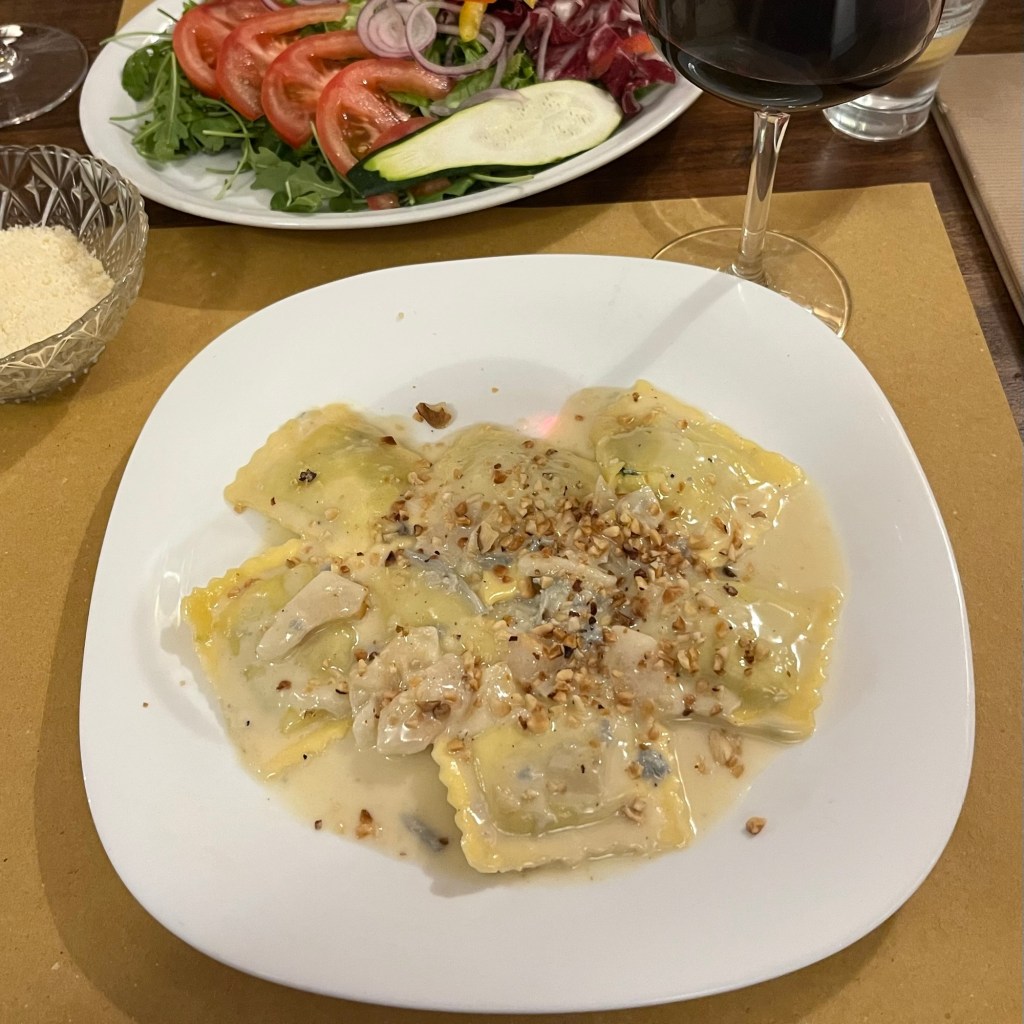
Those of you who love pasta may have been wondering where the pasta porn pictures are? After all, the opportunity to enjoy a mid-bikeride pasta lunch is one of the reasons we rode to Italy in the first place. So don’t worry … we’ve saved the best till last …
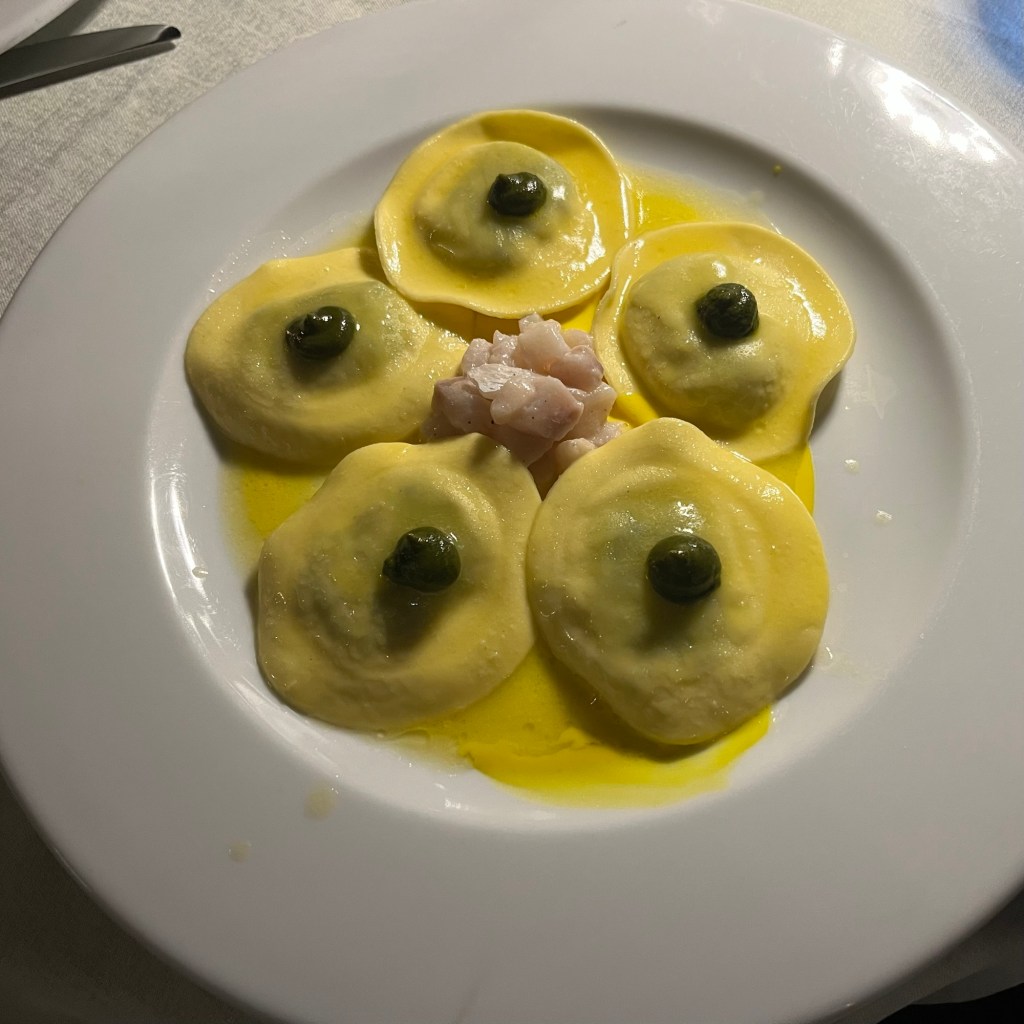
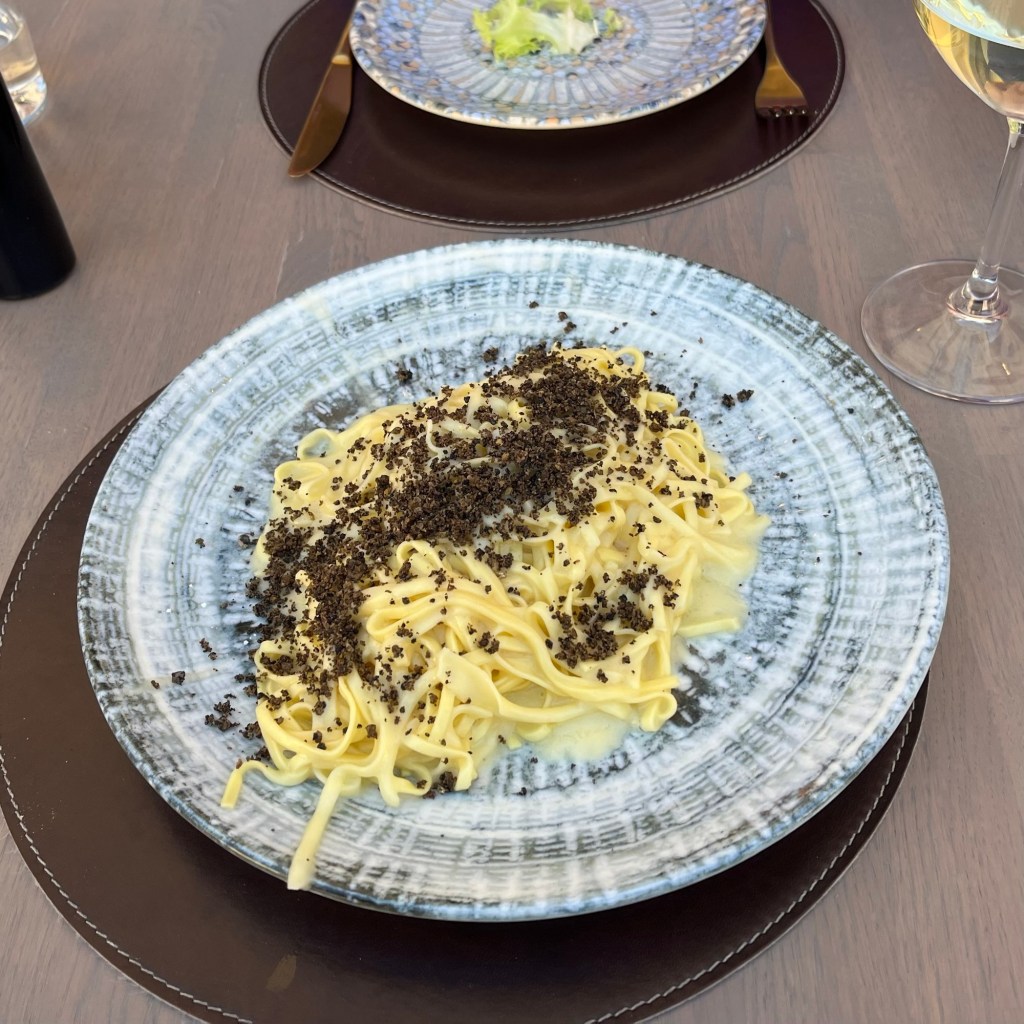
2024: A Cycling Odyssey

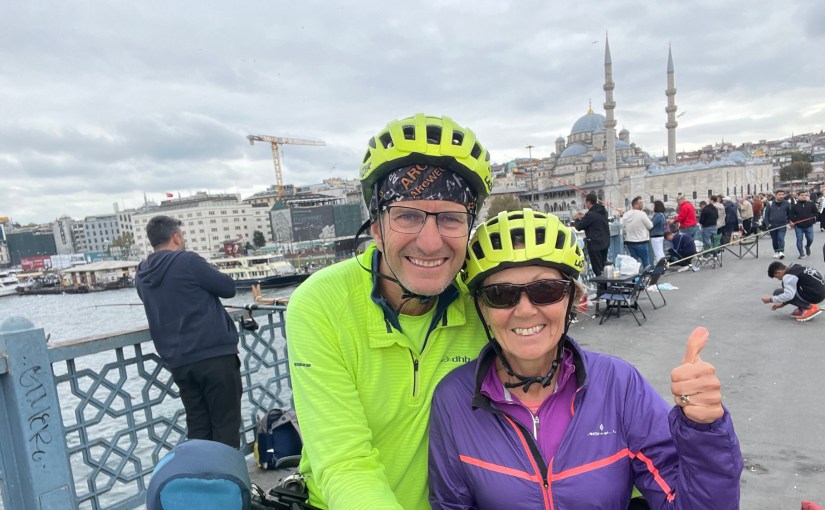
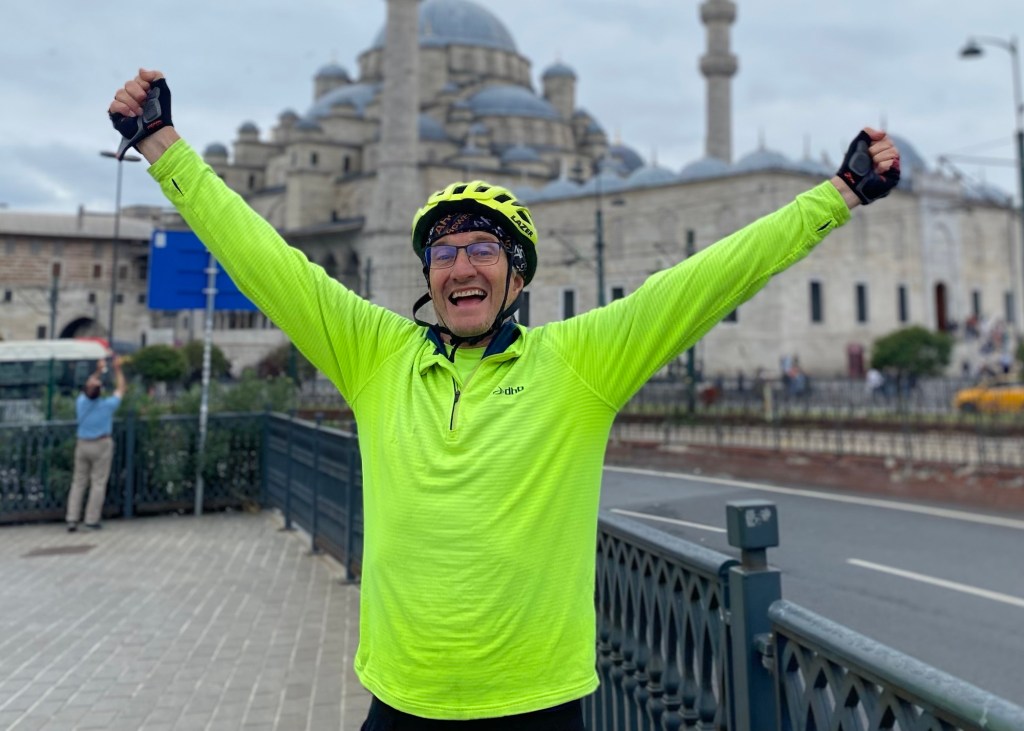
It’s impossible to over state our emotions as we pedalled that last kilometre towards the mouth of the Golden Horn, finally arriving in Istanbul on an overcast Sunday in the middle of October.

Gateway to the East, the junction between Europe and Asia. Through the centuries Istanbul has seen a huge number of mystics, merchants, nomads and conquerors pass through its walls … and now it was welcoming two emotional touring cyclists from Bath.

But why not feel the enormity of the moment?

Since leaving our car at Frank’s shop in Nuremberg in late August we’ve cycled 3003 kilometres (1866 miles). 39 days in the saddle.

And if we look at the whole trip since we left Bath last summer it’s 4332 kilometres (2692 miles). 56 days of cycling across 9 countries.

It was nine years since Clare first came up with the idea of cycling to Istanbul during a chat around our kitchen table.

And it was fourteen months since we were forced to stop our journey in Nuremberg because of Andy’s racing heartbeat from Atrial Fibrillation. Almost exactly a year since his catheter ablation gave us the chance to go back and try again.

During those nine years we’ve been on many bicycle tours to many amazing places. But Istanbul was always the dream destination, the big one, the journey of a lifetime … our personal cycling odyssey!

Yet the junction between Europe and Asia seemed so far away, much further than we’d ever cycled before. It just felt too big a challenge.

Those kitchen table chats went round and round in circles … can we really cycle that far? … can we be away for so long? … what’s the best way to go? … when’s the right time? … will we be limited by the post-Brexit Schengen visa restrictions?

The more we talked about it, the more we decided that no, we couldn’t do it. We weren’t getting any younger and various bits of our bodies were starting to complain in a way that they hadn’t before. Istanbul was just going to be too much!

But then we switched to e-bikes and realised we could travel much further each day for the same number of hours in the saddle. We discovered that whilst e-biking is still good exercise, we don’t suffer from the same level of exhaustion from hill climbing as we did on our old steel touring bikes.

Suddenly the cycling odyssey was back on!

Any bicycle tour of this length is not just about the pedalling …

It’s a lot of staring at maps and planning the best route for the next day.

It’s many hours spent researching the most appropriate places to stay.

It’s endless packing and unpacking of our panniers, trying to remember to put things back in the same place.

It’s taking the batteries off the e-bikes and recharging them every night.

It’s plastering on enough chamois cream or vaseline to keep the saddle sores at bay.

It’s washing out smelly cycling shorts in a hotel sink.

But best of all it’s about being in a bicycle touring bubble together, riding behind each other or side by side, sharing a lot of date nights, both equally consumed by the whole experience.

“A journey of a lifetime is measured by memories, not by time.” Debasish Mridha.

The final leg of this journey-of-a-lifetime got off to a rather bleak start.

Leaving Bucharest on a cold damp morning we cycled back towards the Danube across the featureless farmland of the Danubian Plain. Now widening out as it heads towards its delta, the river has always been a formidable barrier in this part of the world, protecting Romania from many an invading army.

And so it proved for us.

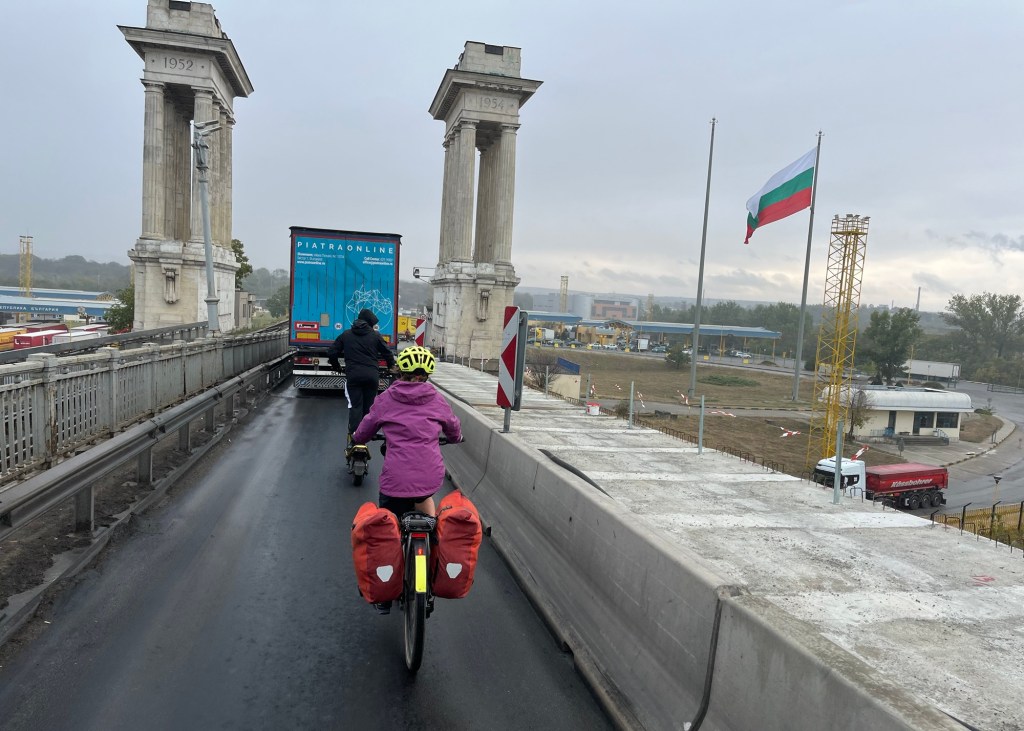
Amazingly until 2013, there was only one bridge over the Danube from Romania to Bulgaria, the ‘Friendship Bridge’ between Giurgiu and Ruse which opened in 1954. Even now there are still only two, the second being the ‘New Europe Bridge’ which is much further west near the Serbian border.

There are several ferries we could have aimed for but the best crossing point for our route was easily the Friendship Bridge. Now old and tired, it’s in need of substantial repairs which means lane closures and lengthy queues.

Bulgarian Border

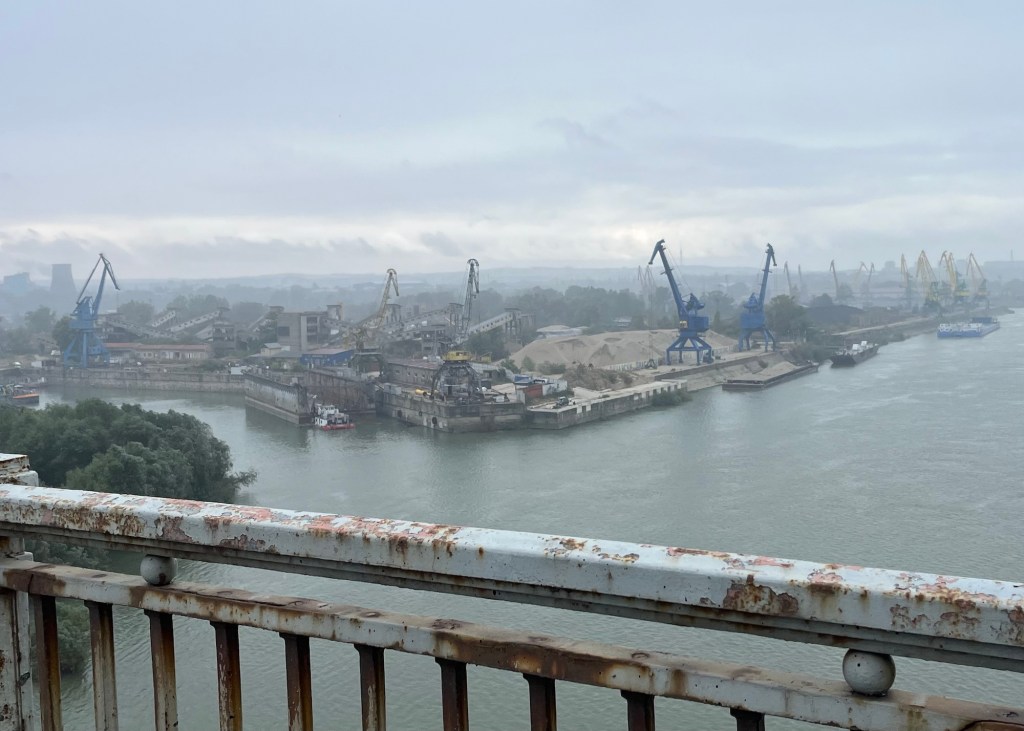
That gave us plenty of time to gaze across at the forbidding industrial landscape that greeted us as our first view of Bulgaria.

And to pick our way through the questionable cycle path that led to the border controls.

Is it that way?

Oh! Maybe not?

Before arriving in Bulgaria we knew even less about the country than we did Romania. So we decided to pedal first to the historic city of Veliko Tarnovo in order to learn a bit more.

Veliko Tarnovo

Tucked into some dramatic bends of the Yantra river and surrounded by an amphitheatre of forested hills, Veliko Tarnovo is a gem. Capital of the second Bulgarian Empire (a two hundred year respite from Ottoman occupation between the 12th and 14th centuries) Tarnovo was also the site of the declaration of independence for the modern Bulgarian state in 1908.

To mark its status as the country’s historic and cultural capital, Veliko meaning ‘Great’ was added to the city’s name in 1965.

Tsarevets Fortress, citadel of the 2nd Bulgarian Empire

Clare scored us a great last-minute-midweek-hotel deal there, a 5-star boutique hotel with only four beautifully curated rooms, a significant upgrade on our normal digs which we have to admit added to our enjoyment of the city.

Best room

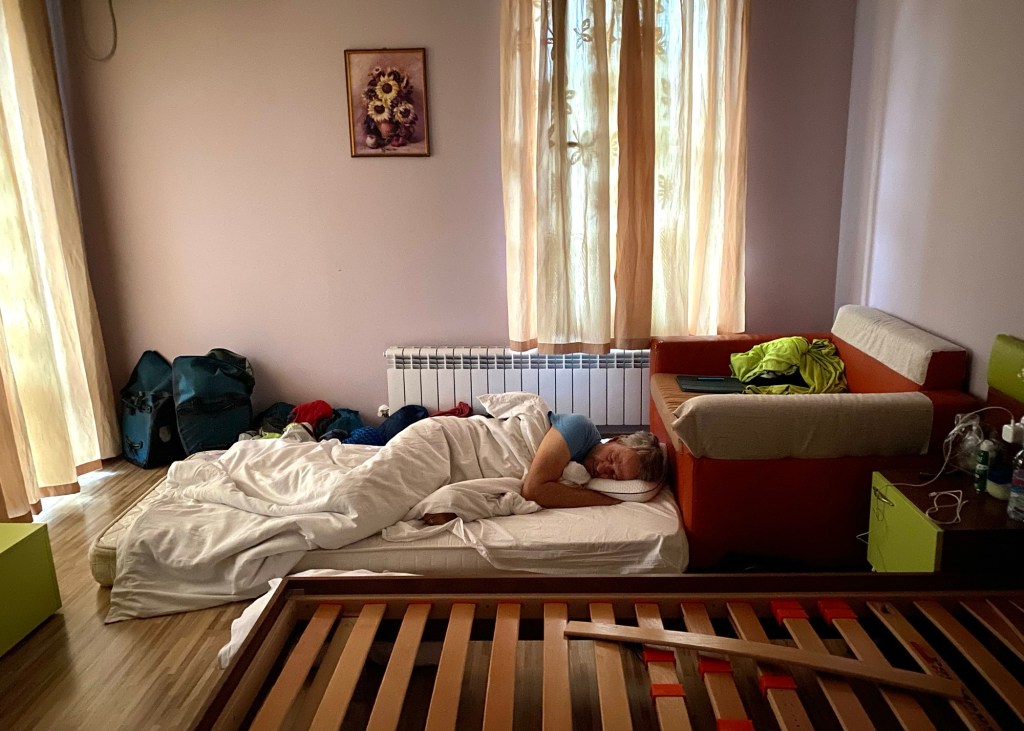
The worst room of the trip also came in Bulgaria, the bed so uncomfortable that Andy pulled the mattress onto the floor in the middle of the night. In the morning he realised the discomfort was caused by some spare wooden bed slats left under the mattress. What a delicate princess-with-a-pea he is!

Worst room

After leaving Veliko Tarnovo we pedalled onto Elena, gateway to the Balkan Mountains that split Bulgaria in two, north and south and give their name to the whole Balkan region.

Here we stayed in a small workman’s cottage with a charming owner who re-assured us that the quiet pass we’d planned for the next day was indeed the perfect way to cycle over the mountains.  

Then he went on to tell us that there are only three border crossings between Bulgaria and Turkey. Only three!

“Don’t go main road way to Edirne” he said, “Many big trucks from Istanbul. Many people coming in car from Holland or Germany.”

“Better you go Black Sea. Very beautiful. Especially Sozopol, much beautiful place.”

“Then you go through nature park to other border. Third border. Not many people go there. But oak trees, oak trees far as you see. Much better for bicycle. You go that way.” 

So we did. And he was not wrong.

Those two days of climbing, first over the Balkan Mountains and then up through Strandja Nature Park to the Turkish border, were one of the highlights of the whole trip. The Balkan Mountains are covered in a carpet of ancient beech, hornbeam and spruce forests, Strandja Nature Park in ancient oak trees many of them well over 500 hundred years old.

With barely any cars passing by, the sun shining in a clear blue sky overhead and with every ridge and fold of the hills covered in a thick carpet of trees, it felt as if we had been plunged into a sparkling pool filled with fresh forest air.

A carpet of trees

Ever keen to preserve her battery, Clare once again stayed in blue (level 2 support) for the whole of both climbs. Andy gambled on purple (level 3) simply to try and keep up with her. It was cutting it fine … on both days he rolled up to our accommodation with just 3% of his battery left!

Into the oak forest

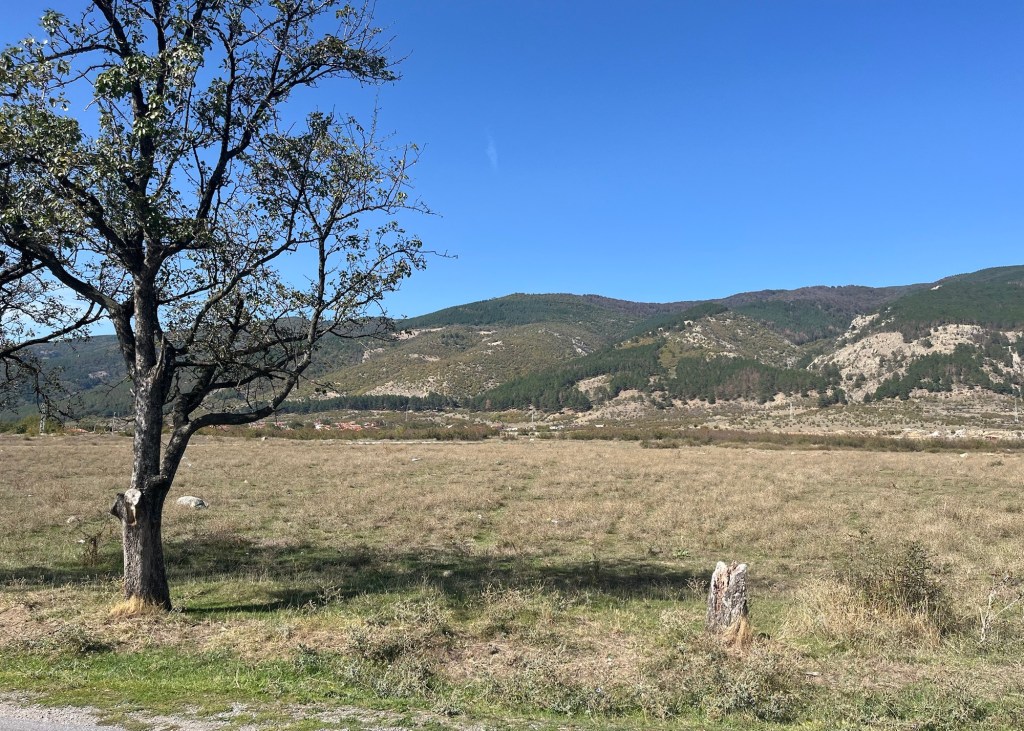
Once we got over the top of the Balkan Mountains and into Southern Bulgaria the landscape changed considerably. Gone were the lush forests, replaced instead by an open, arid, Mediterranean outlook.

An arid feel to the south

The south also seemed poorer to us, more neglected. For example, we rode past several piles of fly tipping, something we hadn’t noticed before.

This got us to thinking about the pre-conceptions touring cyclists and other slow travellers bring to the countries they pass through.

We hadn’t expected to like Bulgaria very much and found ourselves noticing things that continually reinforced that view … the litter, the abandoned dilapidated buildings, our difficulty understanding the Slavic language and Cyrillic alphabet, the food always smothered in cheese (which Clare hates), the apparent brusqueness of the people.

We felt we were in a kind of negative reinforcement loop that was hard to get out of. 

Many of the same things were also present in Romania but that was a country we expected to like. There we only found positive reinforcement … the rustic charm, the smiles from friendly people, the easier Latin based language. 

This didn’t seem fair to Bulgaria somehow.  But you can’t help what you think as a traveller passing through.

We decided we’d need a spectacular experience to shock us out of the negative spiral and see the country afresh through more positive eyes. The two days of riding up through the forests almost did it … they were amazing, inspiring, incredibly beautiful, almost enough to change the spiral. But not quite.
Reaching the Black Sea

The Black Sea coast didn’t reverse the spiral either.

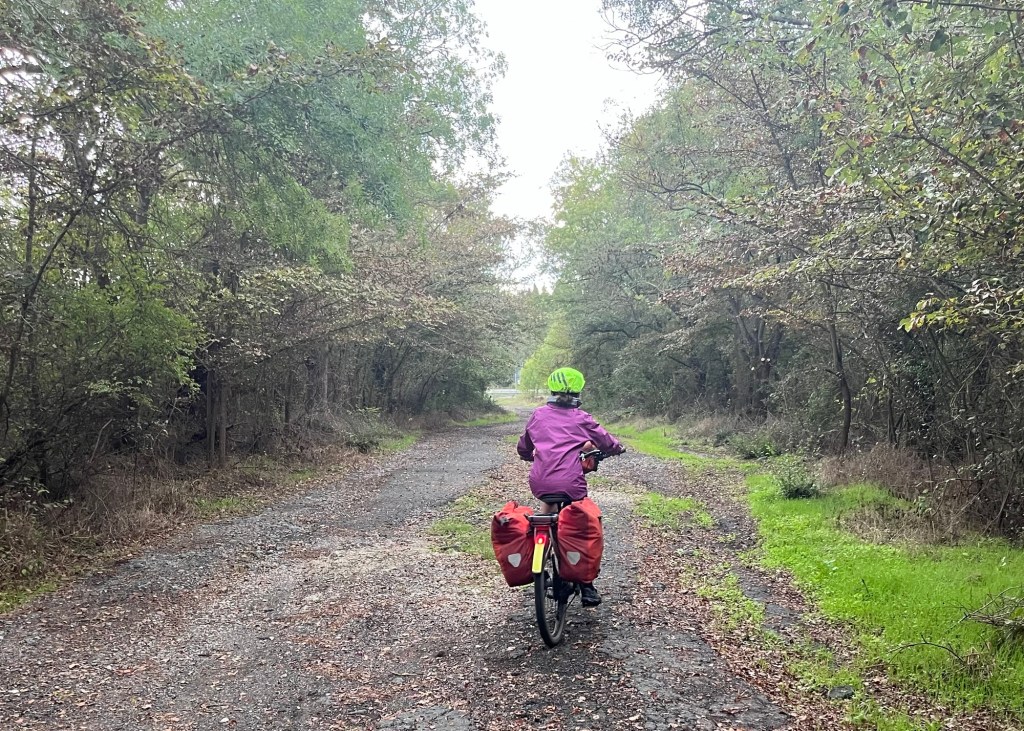
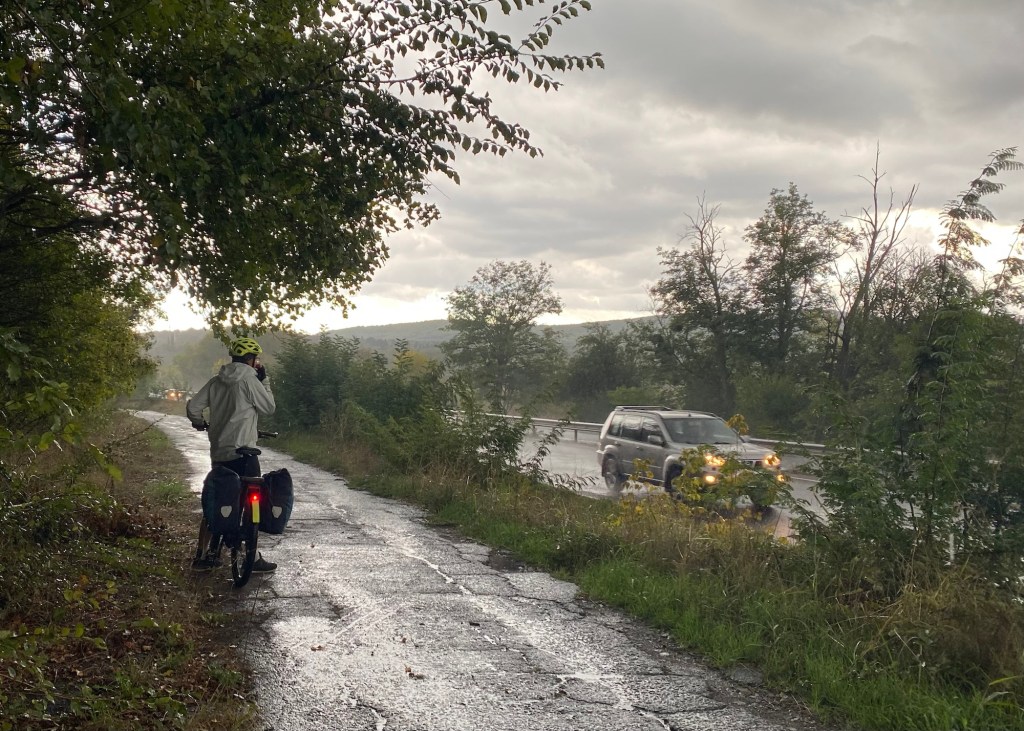
Much of the cycling was challenging, along busy roads or along some of the worst maintained cycle paths we’ve ever pedalled on.

Worst cycle path ever?

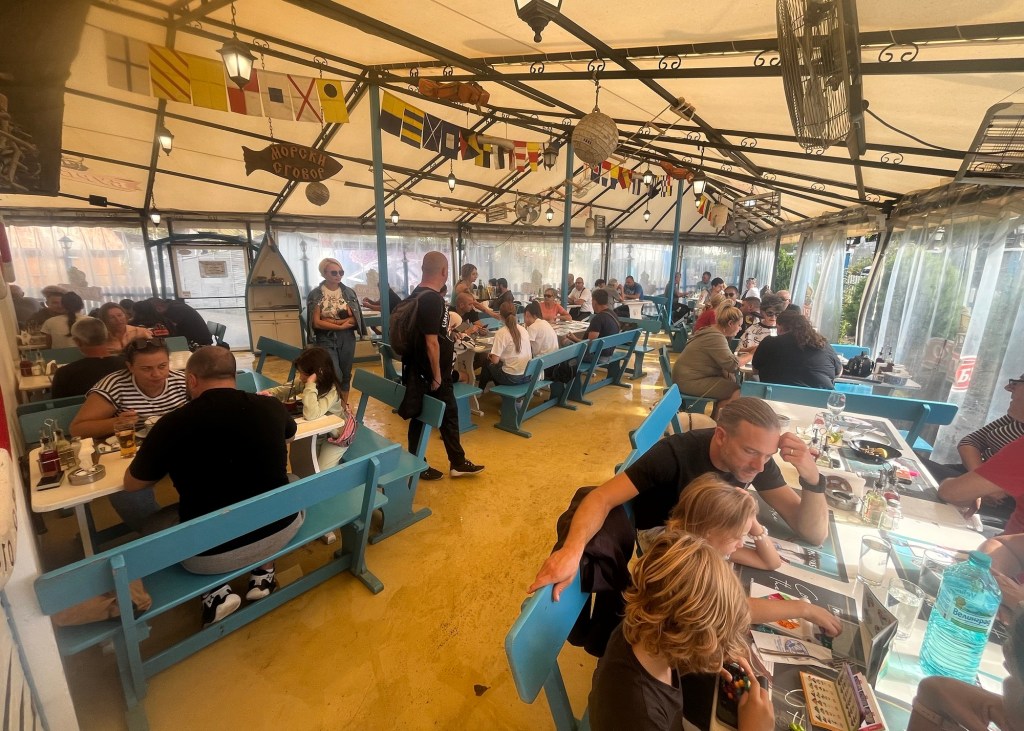
One Sunday we were bumping down such a cycle path when the heavens opened into an almighty thunderstorm that forced us to shelter under the trees for an hour. 

Eventually we took refuge in a pop-up fish restaurant full of people enjoying a family lunch.

Our host in Elena was right, Sozopol is a charming old town … full of meandering cobbled streets and pretty wooden houses, all huddled together on a narrow peninsula.

Wooden house in Sozopol

And Tsarevo, further down the coast, is a pleasant family resort.  Both are notable for being unusually clean, swept and scrubbed each morning by an army of street sweepers armed only with straw brooms.

Tsarevo

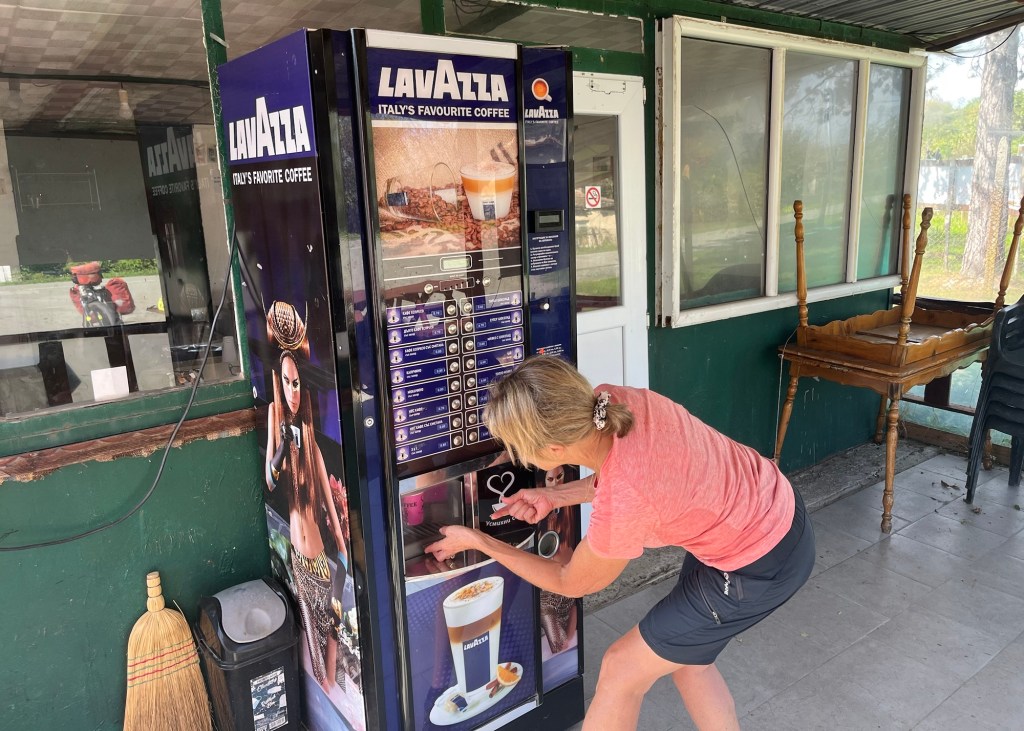
On the way up from Tsarevo to the Turkish border, we paused in the tiny village of Kondolovo, delighted to find a coffee vending machine with real Italian coffee!

A welcome sight!

These coffee machines are extremely popular in Bulgaria. They’re everywhere … on street corners, in bus stops, even in remote villages … and they offer a shot of surprisingly good coffee for a very low price.

A welcome break!

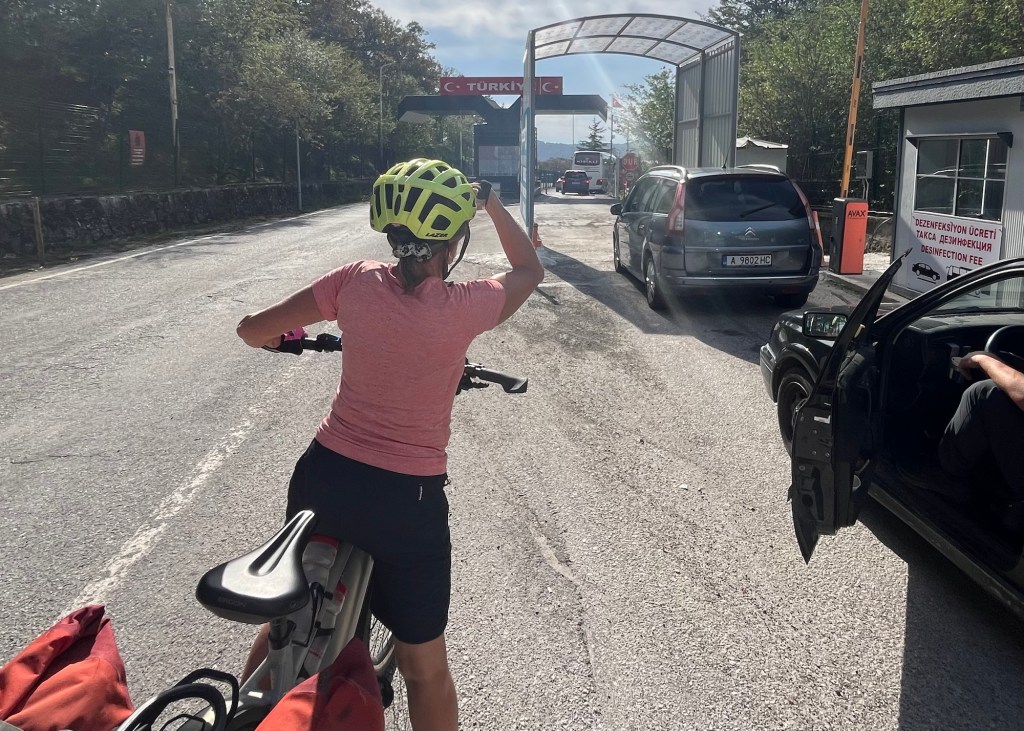
At the border we were surprised to come across a number of coaches which must have driven up the main road from Burgas, each one taking 20 minutes or so to process. No matter … Clare cleverly sliced her way through the queue of traffic like a knife through butter with Andy following sheepishly in her wake.

Within minutes we had left the EU and the Schengen zone behind.

Clare slicing her way through the border in record time

From the border it was a three day ride across Eastern Thrace (European Turkey) to reach Istanbul. Turkey already felt very different … mosque minarets signalling the next village in place of church towers, women dressed in burkas, groups of old men languishing outside every tea shop.

But they all gave us a notably more cheery welcome as we pedalled through, waving and calling out encouragement.

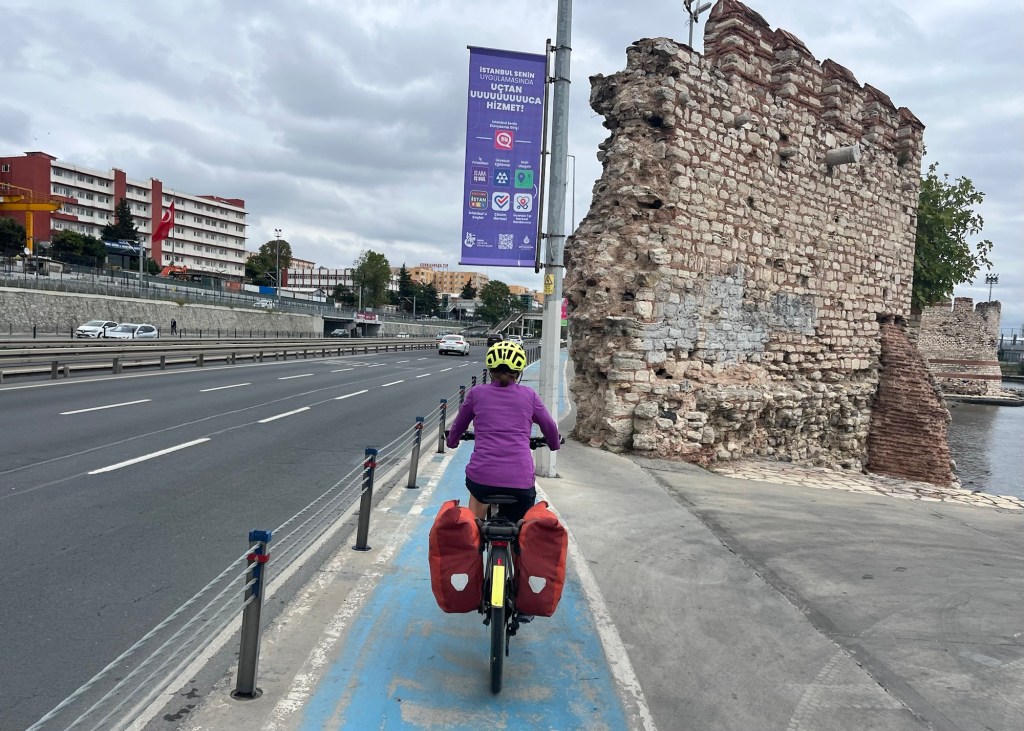
The ride into Istanbul itself is notorious in the bicycle touring community for being especially difficult, highways full of impatient mad drivers, narrow side roads completely blocked by traffic, roadworks everywhere.

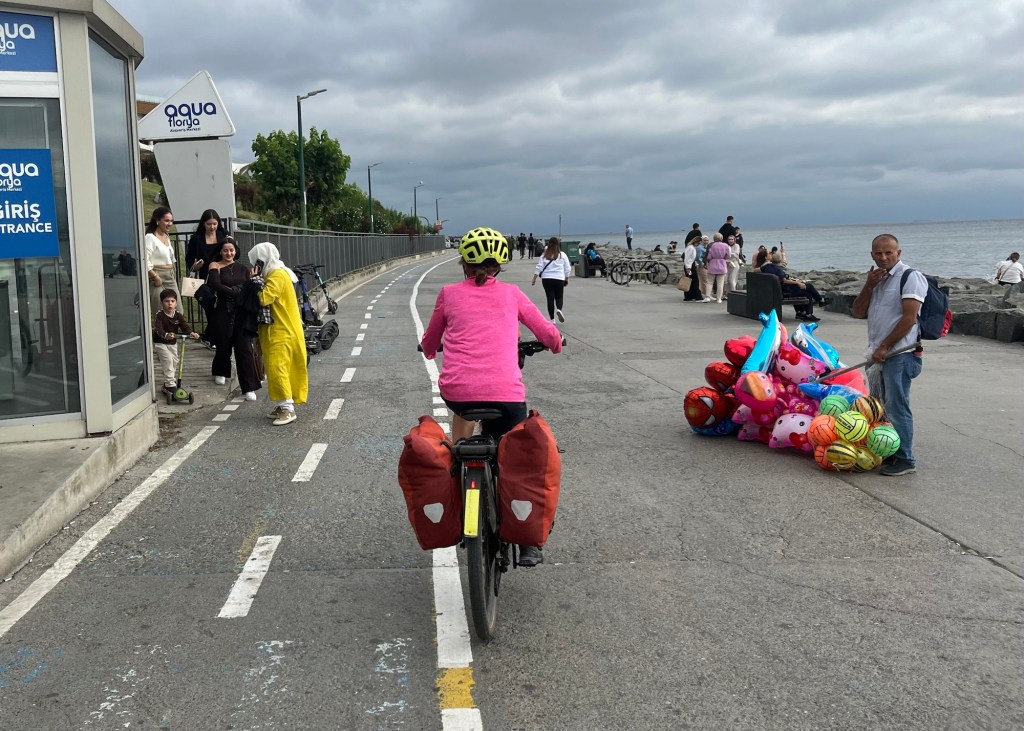
We followed the advice of a couple of young bloggers and hugged the Sea of Marmaris as closely as we could. It turned out to be a mix of the serene and the scary.

Serene

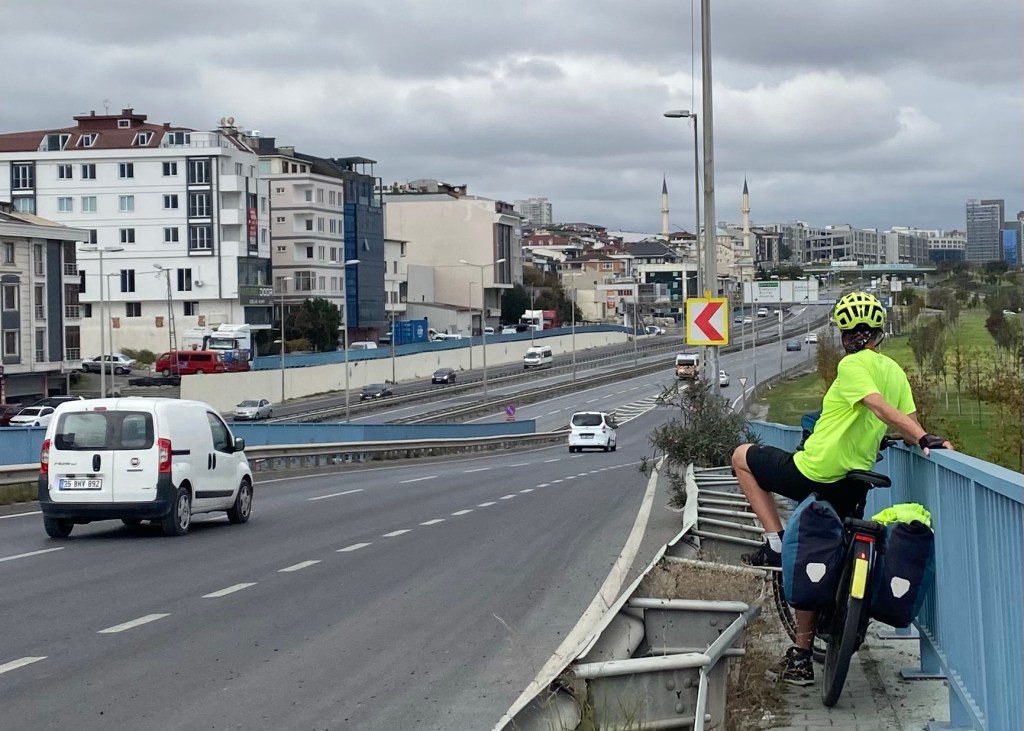
Serene as we cruised gently along coastal cycle paths, weaving our way between families enjoying their weekend stroll. Scary when we were cast out into the traffic, winding through suburbs in a desperate attempt to avoid any main roads.

Scary … perhaps not the best time to try the pavement!

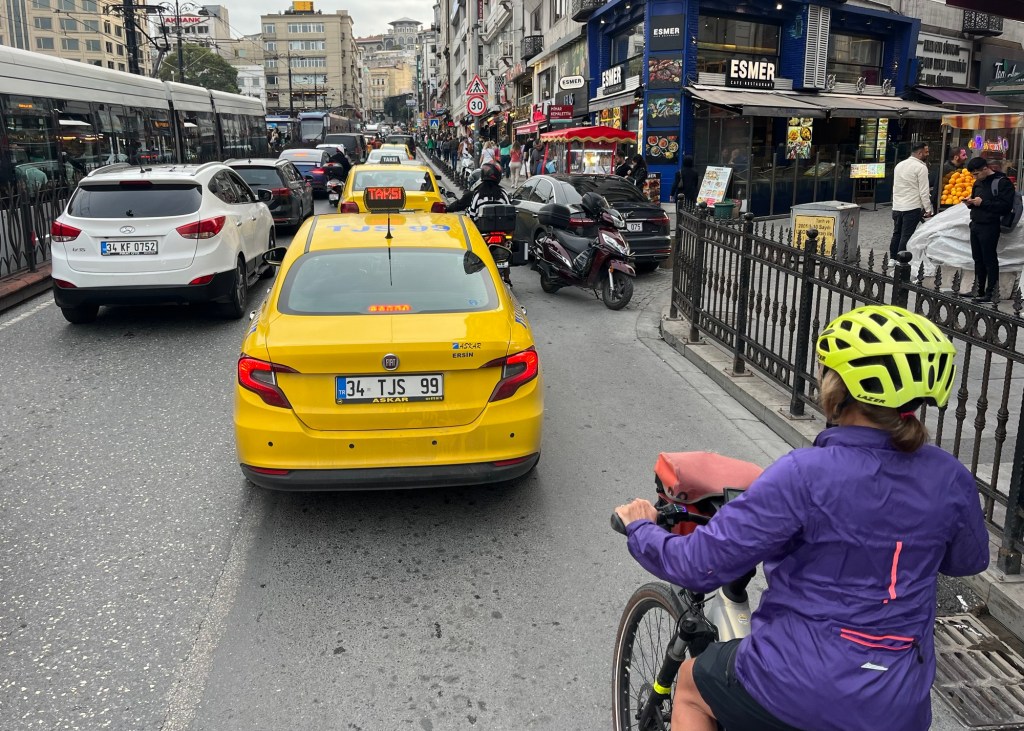
But it wasn’t as bad as the warnings suggested so after reaching the Golden Horn we decided to carry on cycling through this crazy city taking in its sights and sounds. We even caught a ferry across the Bosphorus to Anatolia (Asian Turkey) … just to make sure we’d properly completed our journey from West to East.

Enjoying the Bosphorus ferry

By the end of the day we were weaving through the traffic like a local Deliveroo rider!

We’ve been lucky enough to visit Istanbul a few times before and it’s one of our favourite cities. An enchanting blend of Eastern and Western culture, it’s a vibrant modern city but with many layers of history to peel away … from Byzantium to Constantinople to the Ottoman era to the Turkish War of Independence.

The famous Hagia Sophia

Jam packed with people, Istanbul is chaotic, colourful and confusing with extraordinary experiences lurking around every corner.

A fitting destination for our cycling odyssey.

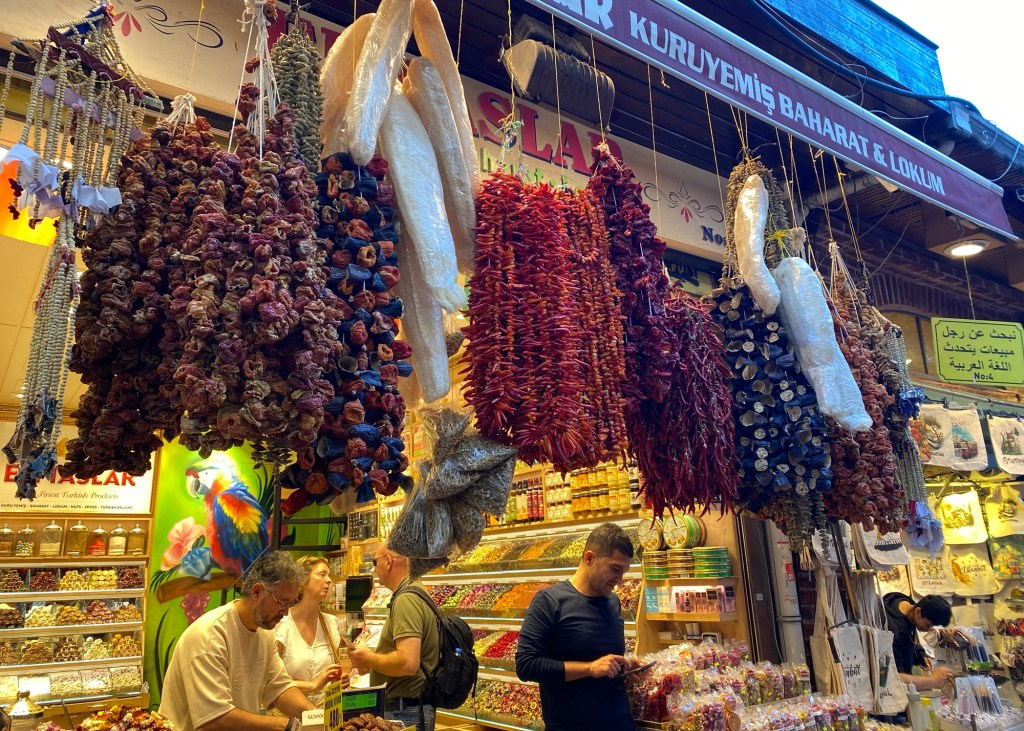
Spice market

Now it’s time to turn around and travel west in order to get home. We have 23 Schengen days left to get back to Bath. Our rough plan uses 20 of them so there’s not much time for things to go wrong.

We can’t go on planes (as they won’t carry our e-bike batteries) but trains and automobiles are part of the plan. As are buses and ferries, lots of ferries … and a bit of cycling.

Not much cycling though, that part of the odyssey is done.

Clare and Andy

Bath to Istanbul

4,332km pedalled (2,692miles)

27,209m climbed

224 hours in the saddle