The Rough with the Smooth

Clare’s face was a picture!

Blocking her path was a man wearing only a pair of sandals and an all-over tan, proudly displaying his not inconsiderable manhood.

Behind him was another, and then another.

Leaving Vienna, we had just rejoined the Danube Cycle Path towards Bratislava. Eyes front, head down, she pedalled on.

Naked people were everywhere. Sunbathing, enjoying a coffee, sauntering down the path ahead of us.
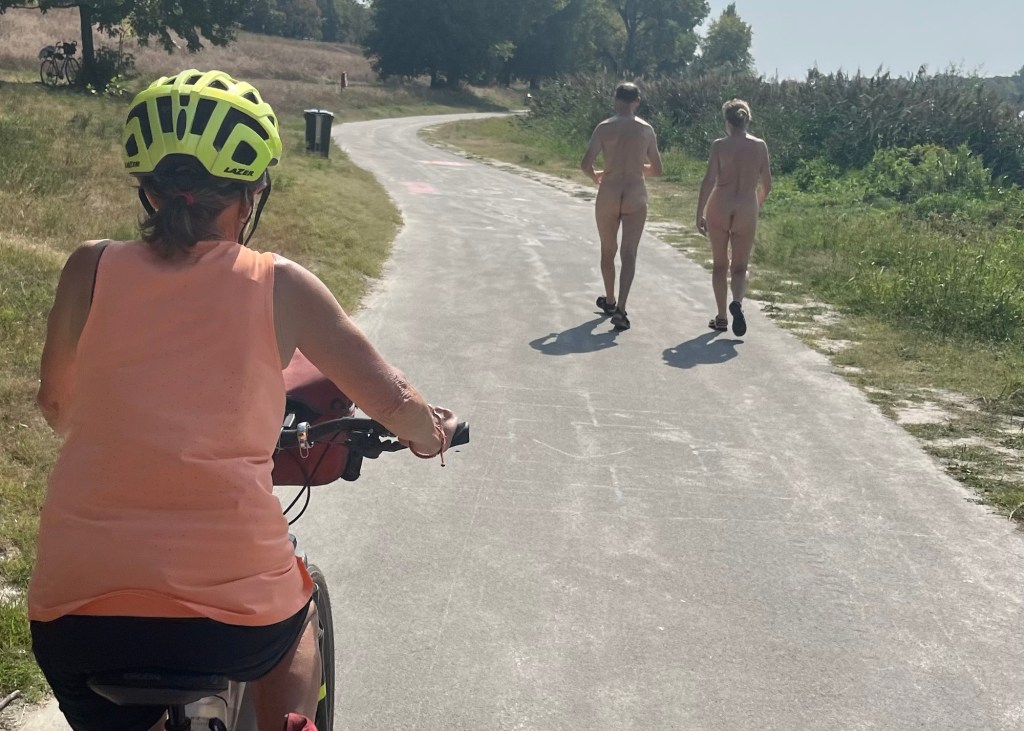
This part of the Danube turned out to be an area for Freikörperkultur or FKK, literally translating as Free Body Culture, a ‘type of naturism that makes maximum use of sun, air and water to restore your physical and mental well being.’

But it was also a family-friendly bicycle path.

And it was certainly one of the more unusual views we’ve ever had from our handlebars!
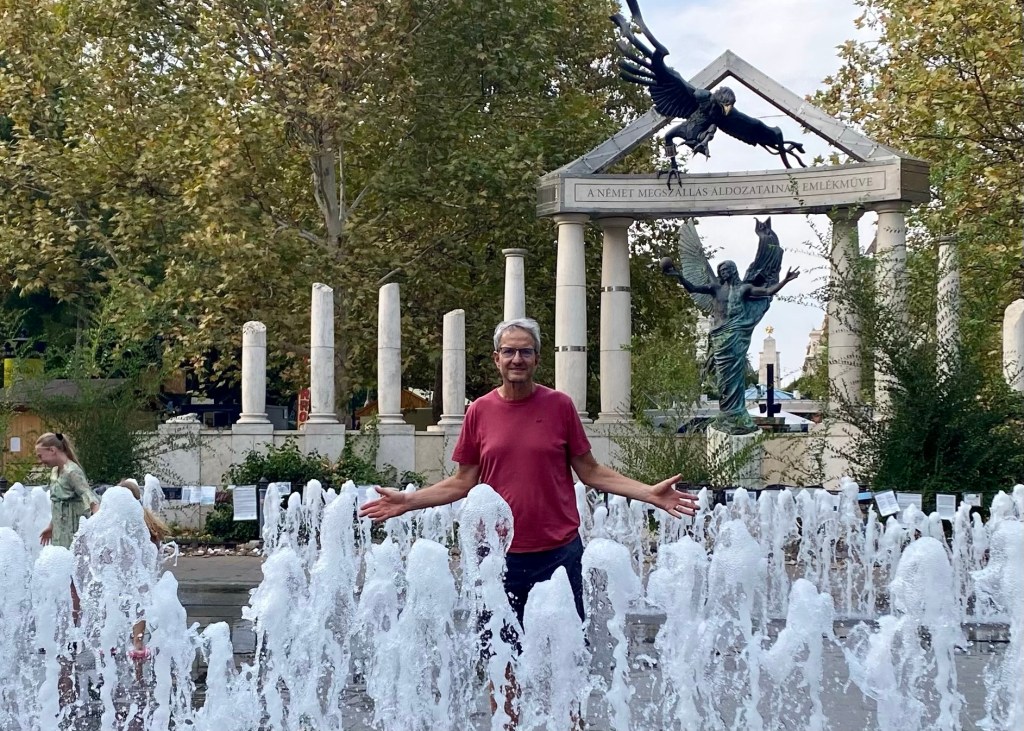
Cooling off in Budapest after the shock

Since rolling off the ferry in Holland last August we’ve worked out that a remarkable 80% of our journey through Europe has been on dedicated cycle paths. Most of them have been extremely high quality … super-smooth and free of any bumpy tree roots pushing up through the tarmac.

And the prize for the smoothest of all goes to …  Slovakia. We spent very little time in the country but all of it was pedalled on raised, smooth, brand new bicycle-dedicated ribbons of asphalt.

The smoothest of all … Slovakia

So it was a bit of a shock to find ourselves back on the roads in Hungary! 

Not that Hungary is not doing its best to introduce a cycling network to rival its northern neighbours.

It is … there are plenty of bike paths.

Some of them are good bike paths, smooth with a fresh coating of asphalt.

But others are bad bike paths, rough, cracked, weed infested and with large tree roots pushing up through the surface, bumpy enough to send our panniers flying.

In the first few days in Hungary, we managed to avoid their roads by crossing the Danube back into Slovakia as often as we could. Being able to criss-cross the borders at will was a reminder of how much things have changed in Europe.
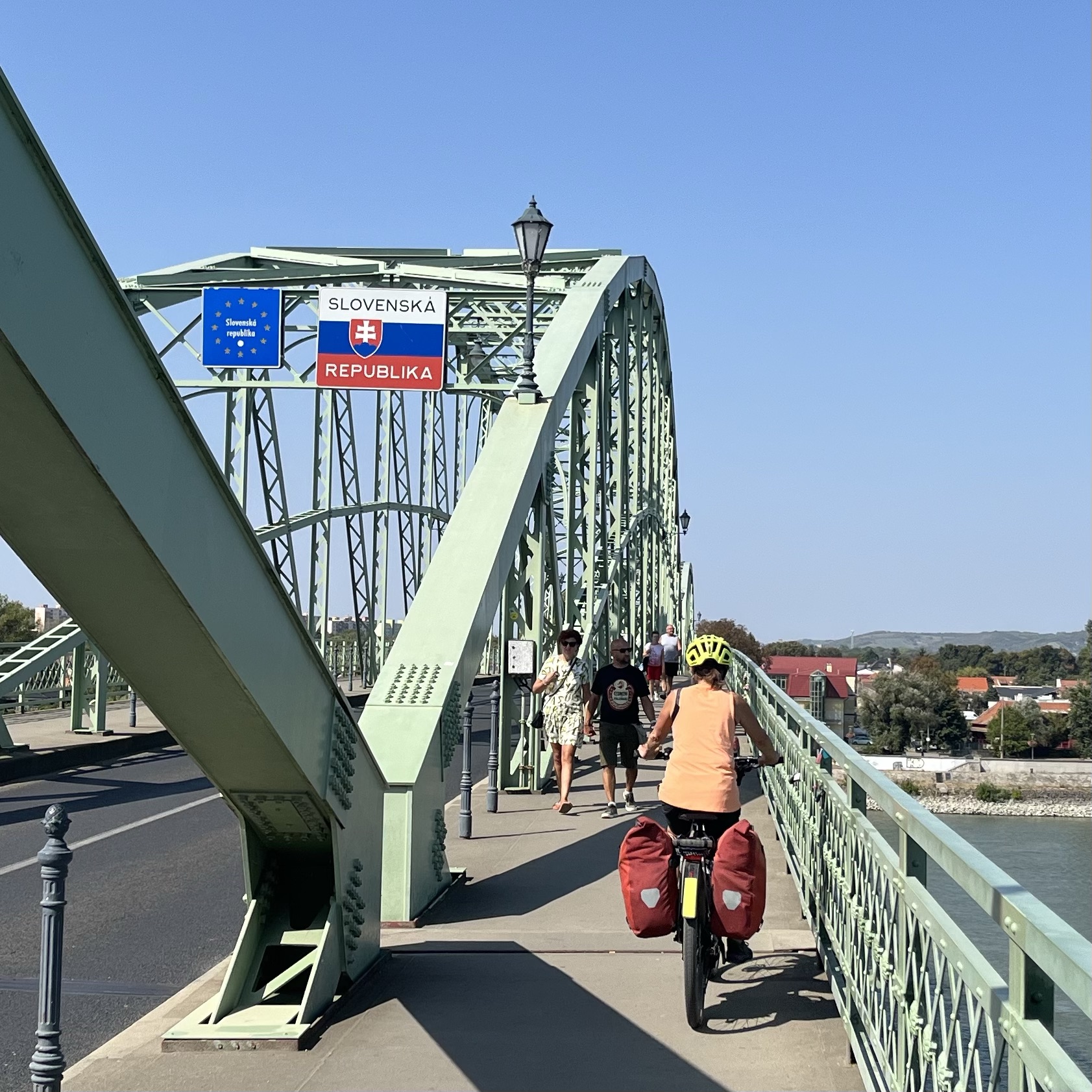
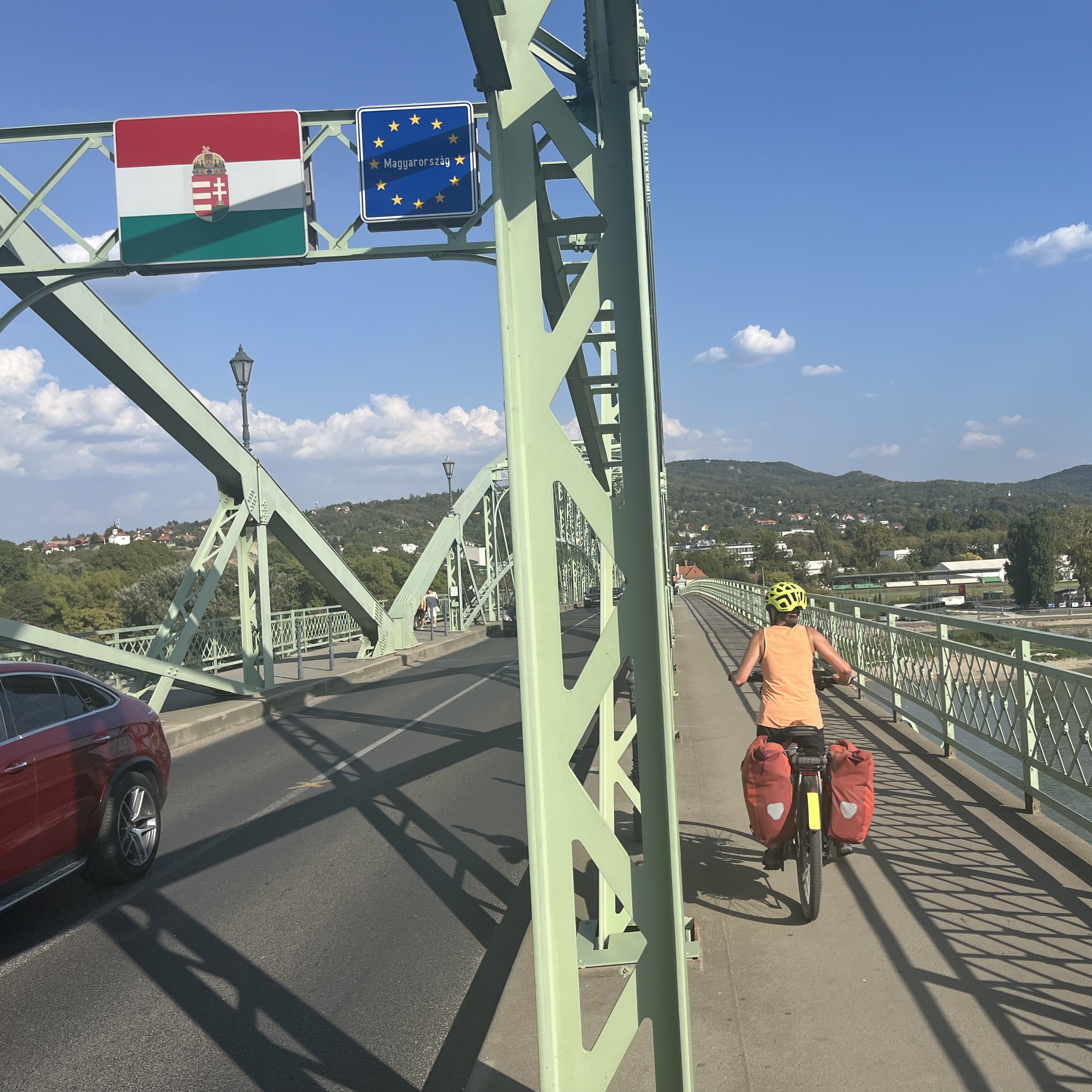
All this border crossing brought us to the beautiful town of Esztergom, the first capital city of Hungary and site of the crowning of St Stephen, their first king.

Esztergom Basilica

The magnificent baroque Basilica was built in the 19th century and is still Hungary’s largest church.
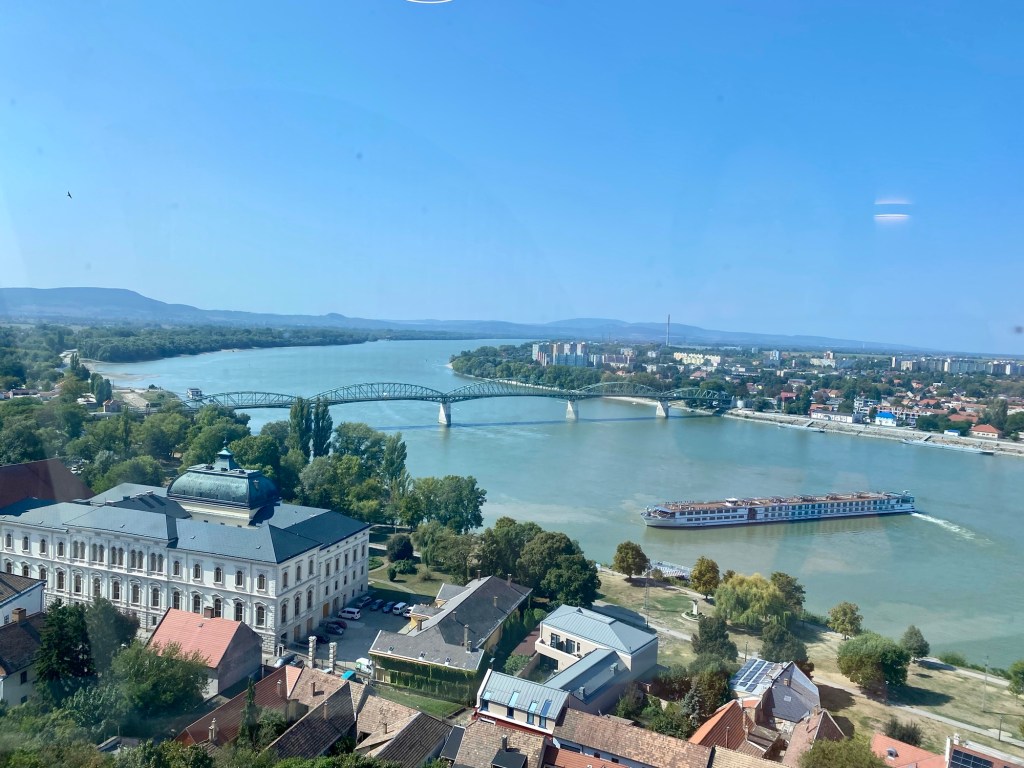
View from the Basilica

Esztergom lost most of its influence in 1920 after the Treaty of Trianon, imposed by the Allies (UK, USA, France, Russia) at the end of World War I, reduced it to a border town.

We heard quite a lot about this treaty as we passed through Hungary, surprised to find that several young people we met still felt resentful about it, given that it was signed over 100 years ago.

Hungary lost two thirds of its land, 60% of its population, 30% of ethnic Hungarians and many resources including almost all its gold & silver mines and over 80% of iron ore.

Victor Orbán, the Prime Minister, often keeps the issue alive as part of his nationalist message. In 2020 to mark the 100th anniversary, he unveiled a memorial right outside the Budapest parliament building depicting the names of all the lost towns and villages.

A bit shocked that we’d never heard of this treaty before, considering the impact it had on a major European country, we still don’t fully understand it. But it does feel like rough justice to Hungarians … though no doubt a relief to the many ethnic Romanians, Slovakians etc. who live in those areas.

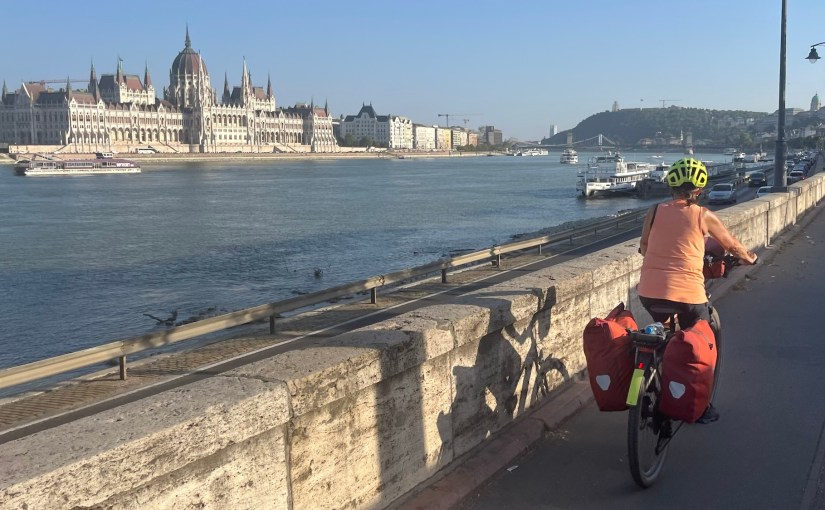
Arriving in Budapest

We ended up staying in Budapest for four days, enjoying another city break. This was not to see the sights but to treat some saddle sores that Clare had developed probably from the extremely hot, dry weather.

Saddle sores are different to being sore from the saddle. They look like angry red spots and get so painful they become all you can think of as you ride along.

Clare has nicknamed them ‘pickels’, German for pimples, and for a while we thought these pickels might bring a premature end to our trip, such was her discomfort on and off the bike.

A four day break from cycling helped a lot. As did new cycling shorts, some Preparation H cream (normally used for haemorrhoids) and a last minute bike fit. Zoltan changed the tilt of her saddle a fraction and made a tiny adjustment to the position of the cleats on her shoes.

Small changes can make a big difference … apparently!
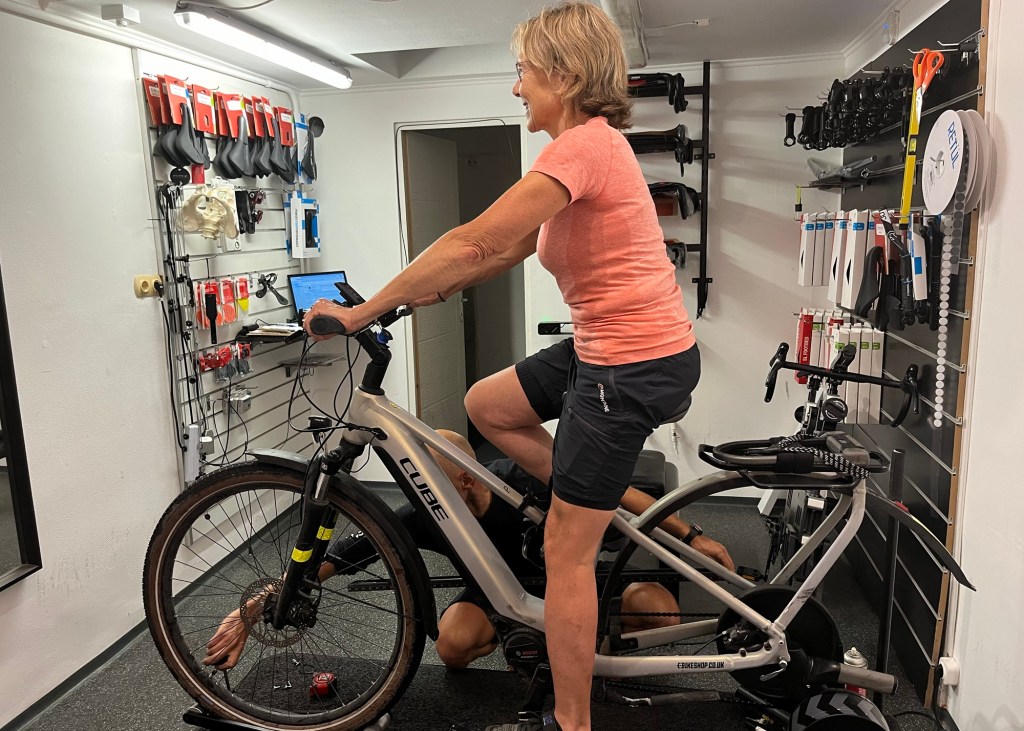
Bike Fit

Looks like he was right … since leaving Budapest her pickels are a lot less angry.

Perhaps the biggest benefit came not from the bike fit or the haemorrhoid cream but from the thermal baths for which Hungary is famous. We went to two in Budapest … the biggest and most popular at Szechenyi (jam packed with tourists) and a smaller more local one called Rudas (better but still very busy).

Szechenyi Baths – so busy, even on a Monday

Rudas Baths

But it was in the small village of Cserkeszőlő that we stumbled across our best thermal bath experience, completely by chance. It was just an overnight stop on the ride across the Great Hungarian Plain towards Romania.

Discovered in 1938 during a failed oil exploration, the water in these baths emerges at 93°C and comes from a depth of 2000m, containing some of the best mineral content of any spa in the country.

For Cserkeszőlő it’s liquid gold!
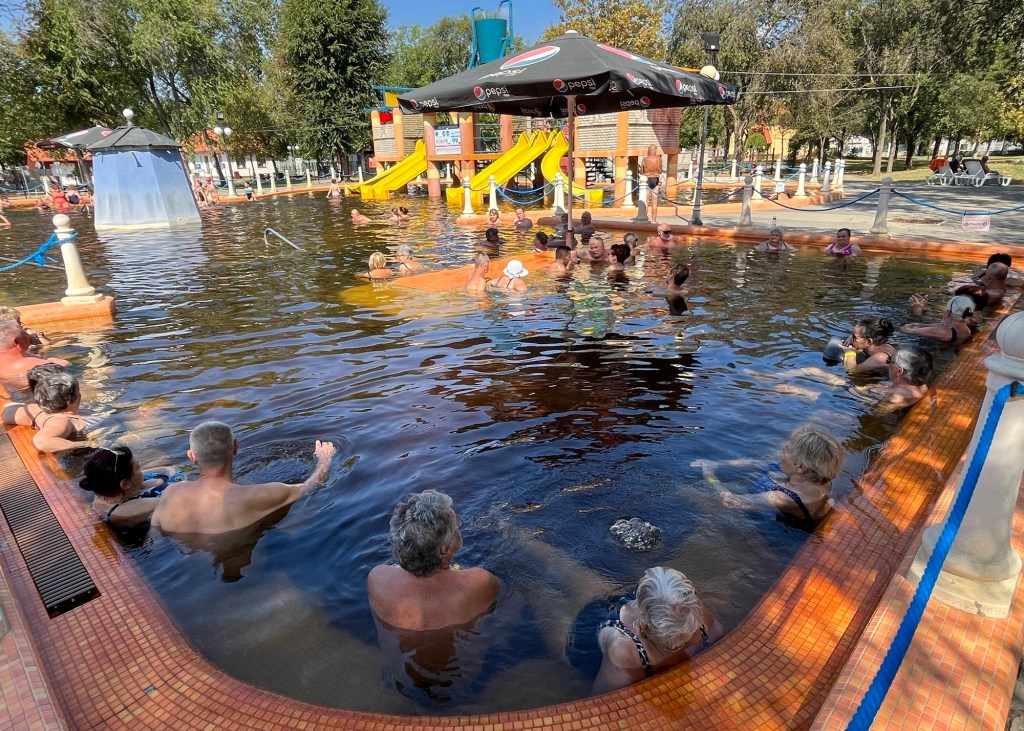
A well balanced life?

In total, there are more than 1300 thermal baths in Hungary, a country where soaking in warm mineral waters for hours on end is not seen as a decadent indulgence, just a natural part of a well balanced life.
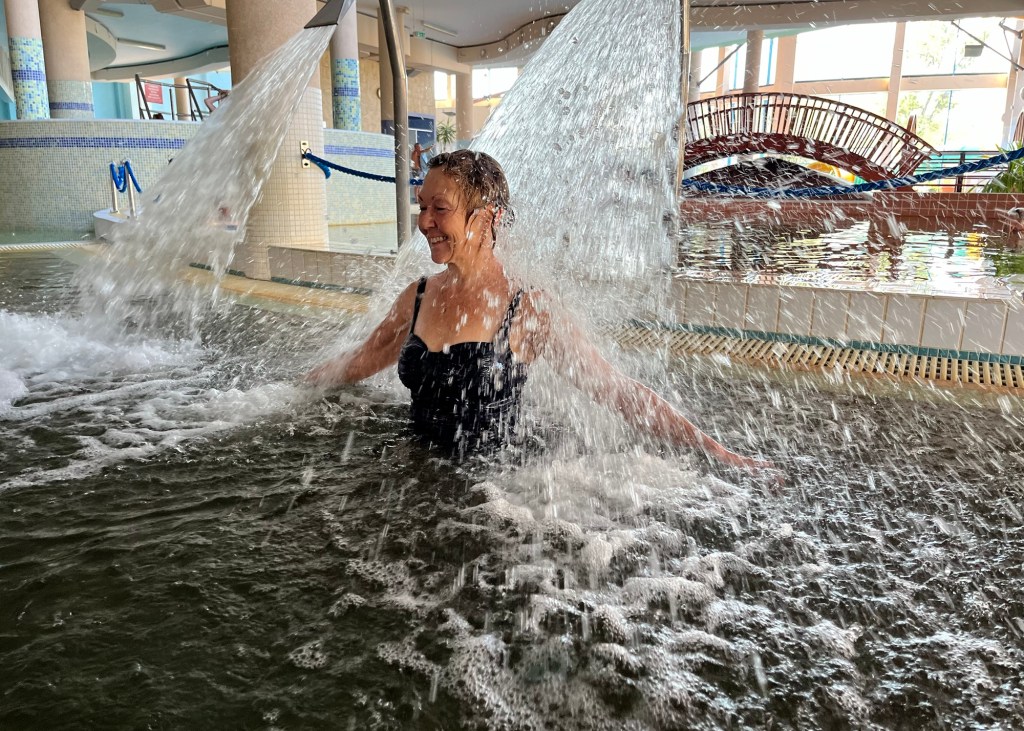
Decadent indulgence

The moment she saw our bikes, the lady at our Panzio (B&B) in Cserkeszőlő rushed out in alarm . “Danger, big danger!” she shrieked as she grabbed a small weed from the centre of the drive and thrust it towards us.  

It looked harmless. 

“Very bad, very bad …. my bicycle … six, SIX! Big danger!”

She was trying to tell us that she’d suffered six punctures in as many weeks. It was only when we looked more closely at a longer stem that we saw the seed pods and understood … each one was protected by sharp, nasty barbs.
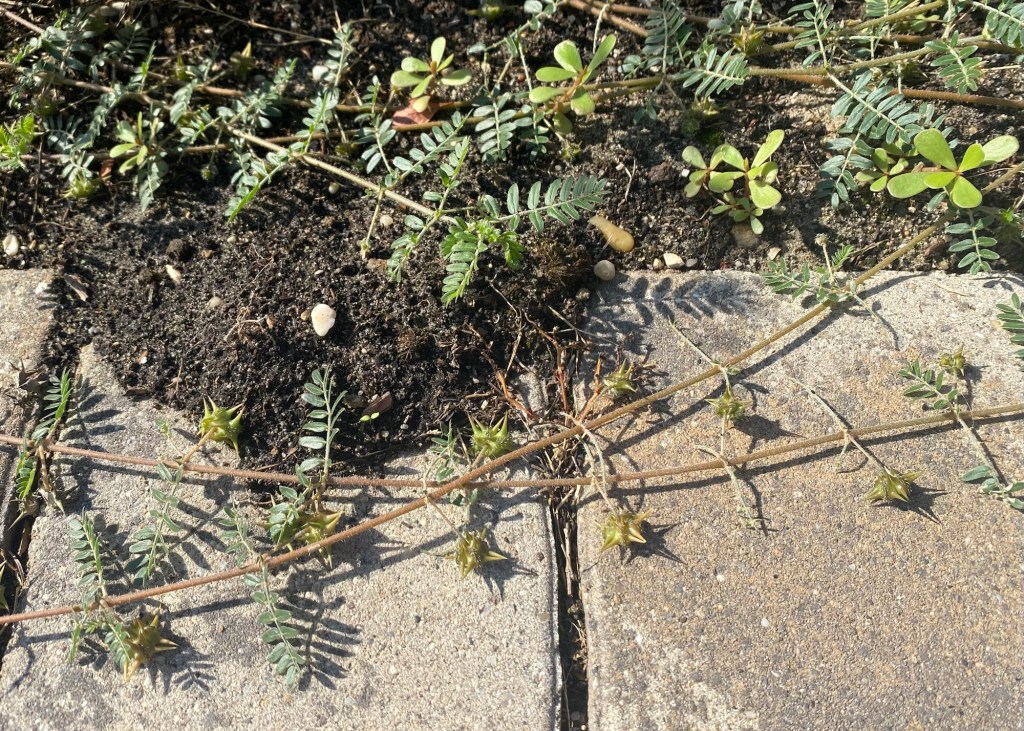
Small but lethal

This plant is Tribulus Terrestris, known to cyclists as Puncture Vine but with many other names including Goathead, Devil’s Thorn and Devil’s Eyelashes.

It thrives in loose, dry arid soil which few other plants can survive so is perfectly adapted to the cracks that form on cycle paths. The seed pods are barbed so that they can attach themselves to animals hooves for greater dispersal and are strong enough to penetrate a bicycle tyre, especially as they dry out.

Hence the name!

Instinctively we looked down at our tyres. Sure enough there was a seed pod clinging to the side of Clare’s front tyre … and it was now a very squidgy tyre!

“I told you, big danger!” she said, “Everywhere in Hungary. EVERYWHERE! Very bad.”

The Panzio (B&B) in Cserkeszőlő

This was our first puncture for three years and the first on our new electric bikes with their big fat tyres.

We thought we had become reasonably good at replacing inner tubes but this one was a major struggle. We were rubbish, completely out of practise, just relieved to be doing it in our room rather than by the side of a dusty road.
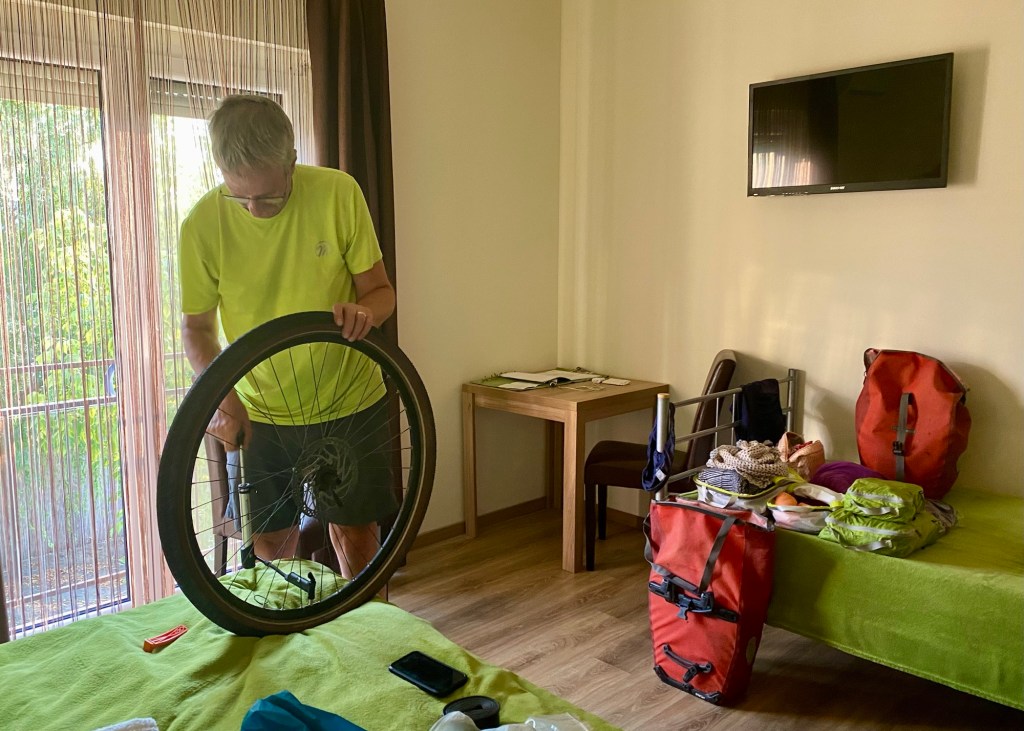
The next morning we relaxed for a long time in the thermal baths safe in the knowledge that we’d only planned a short, leisurely ride that day. It was pure decadent indulgence.

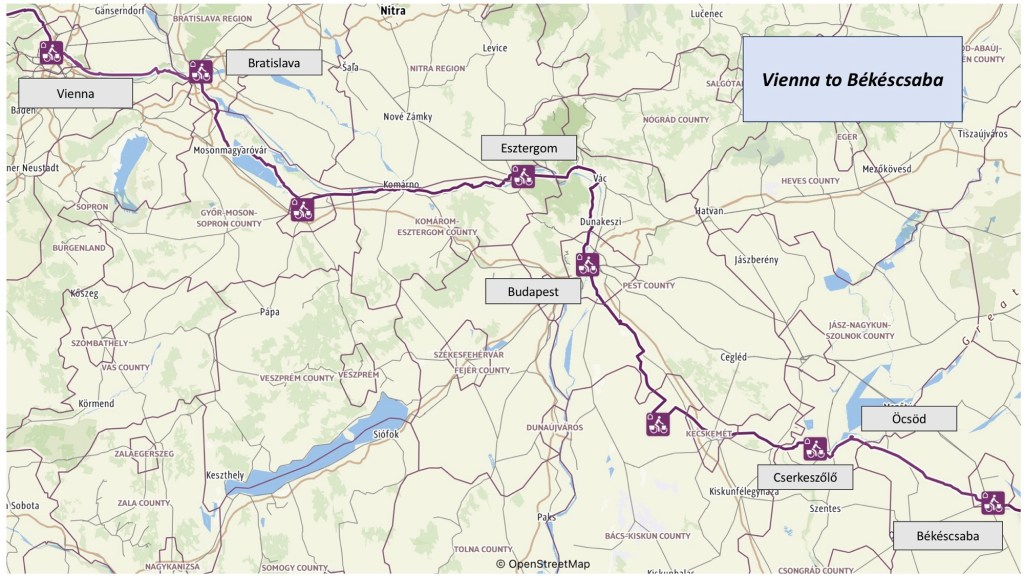
When we’d planned the best way to pedal across the Great Hungarian Plain from Budapest to Békéscsaba, there had been two choices …

One … follow Hungary’s bicycle route 5 as it meanders beside the Körös river. This meant taking an extra day but with shorter rides each day.

Or two … follow the main road and the cycle path that goes alongside it. Fast, but boring. And who knows whether it will be a good or bad Hungarian bike path?

We chose the leisurely river route.
We’ve never noticed puncture vine before. But it’s one of those things that once you know about it, you start seeing it everywhere. EVERYWHERE! … just as the lady said.

Sure enough the cycle path out of Békéscsaba was riddled with it. We gave up and pedalled on the road instead.

Dodging the puncture vine

Hungarian drivers have generally been very courteous, leaving plenty of room when overtaking and giving way whenever a cycle path crossed the road.

As long as we used the cycle path that is!

If we ever had the audacity to cycle on the road when a (good or bad) bike path was available, a driver would wind down their window and deliver a surprisingly long explanation of what we were doing wrong.

Of course, we didn’t understand a word … but we imagined they were saying something like …

Even though you shafted us so badly at Trianon, we have saved money to build you beautiful bicycle paths all over our great country … so the least you can do is show a little respect and use the bloody thing!”

We retreated back to the bike path, puncture vine and all.

But the start of the Route 5 river path in the small village of Öcsöd was too much. The path was so stony and so covered in puncture vine that it was difficult to pick a way through … it was not the leisurely ride we’d imagined at all.
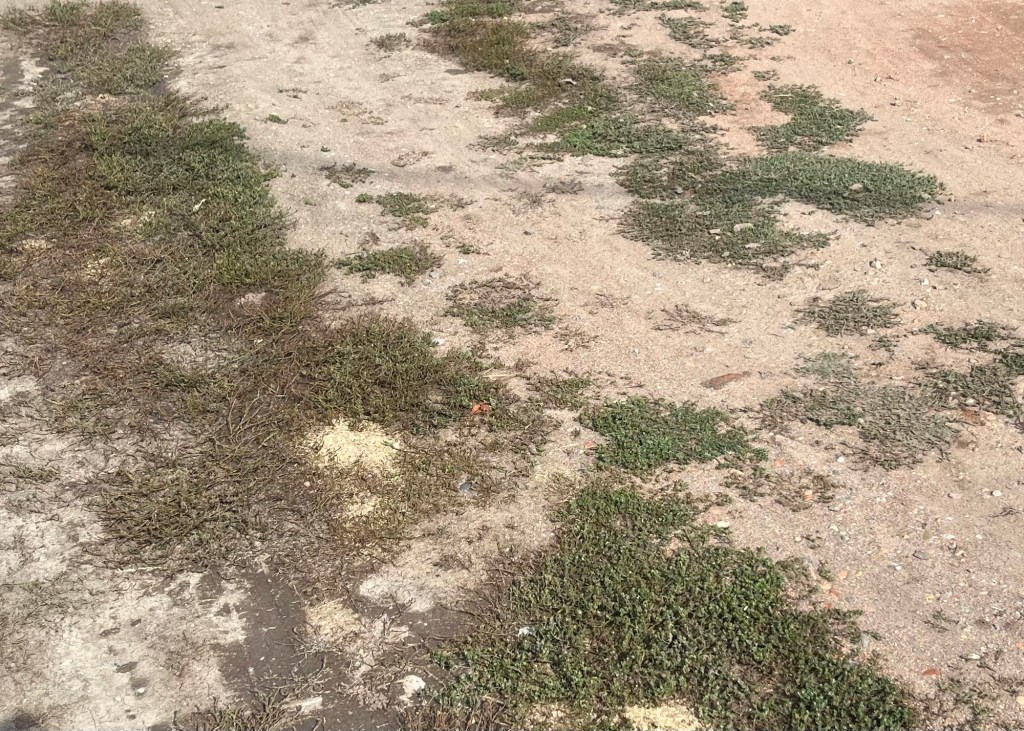
No way through

Retreating to a kids play area and surrounded by graffiti, we were amazed to find we had 5G.

In just a few minutes, we’d cancelled that night’s Panzio, replanned the route back to the road, checked on Google Earth that it was a good Hungarian bike path and booked a new hotel in Békéscsaba. 

Try doing that in a tiny village the middle of Yorkshire!

It was a long, straight ride but it was a surprisingly good Hungarian bike path without a hint of puncture vine. Adopting our heads-down-crack-on-new-ebike-cruising-speed we easily made it before dark.

Almost Danubesque

Which was just as well as Storm Boris was now ravaging Central Europe, causing chaos to the areas we’d just pedalled through … Vienna, Bratislava, Budapest etc. We hunkered down for two days watching the rain fall and then finally braved the conditions for a cold, damp ride crossing the next border into Romania.
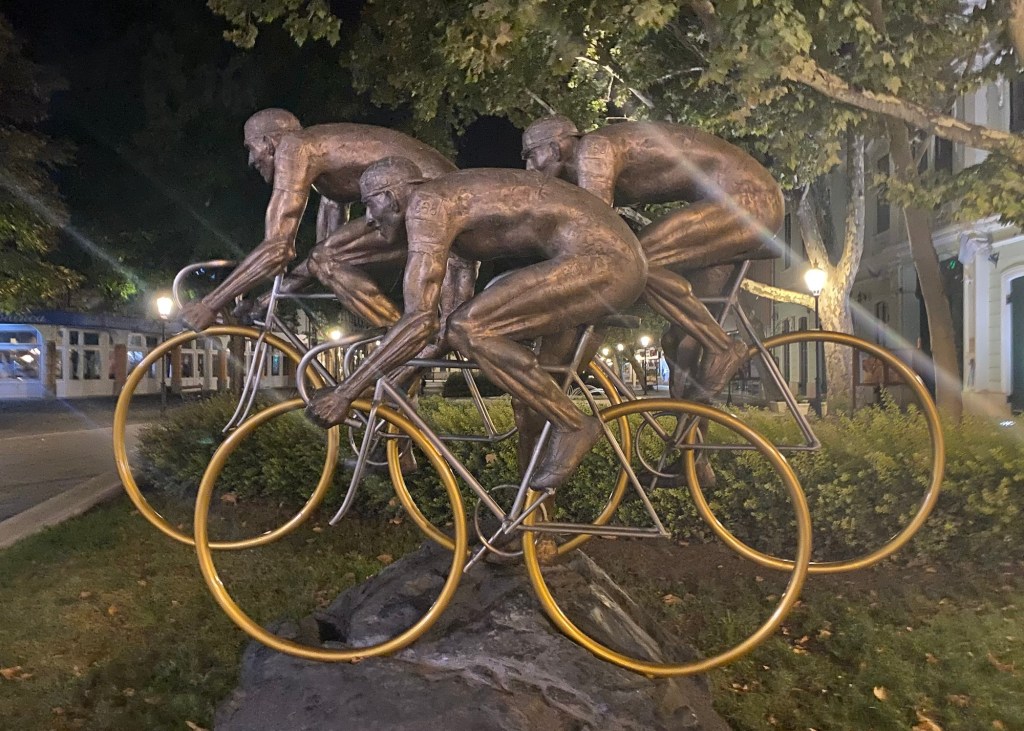
A statue in Békéscsaba … they don’t seem worried about the cold

A week ago we’d left Vienna in 35-40°C (around 100°F) under sunny skies. Now it was just 9°C (48°F) with a biting headwind and light rain.

Quite a change! Even the naked enthusiasts by the Danube might have had to put some clothes on!

Clare and Andy

Bath to Békéscsaba:

2,534km pedalled (1,574 miles)

11,350m climbed

132 hours in the saddle

Cycle Touring Super Highway

It was just 50km outside Vienna that the young couple overtook us … cruising serenely past with their matching e-bikes and small, lightly packed panniers. “Grüß Gott” they beamed in greeting “Guten Morgen!”

And why not? It was a beautiful day and they were nearing the end of a wonderful holiday, enjoying this most popular of adventures … the Danube Cycle Path from Passau to Vienna.

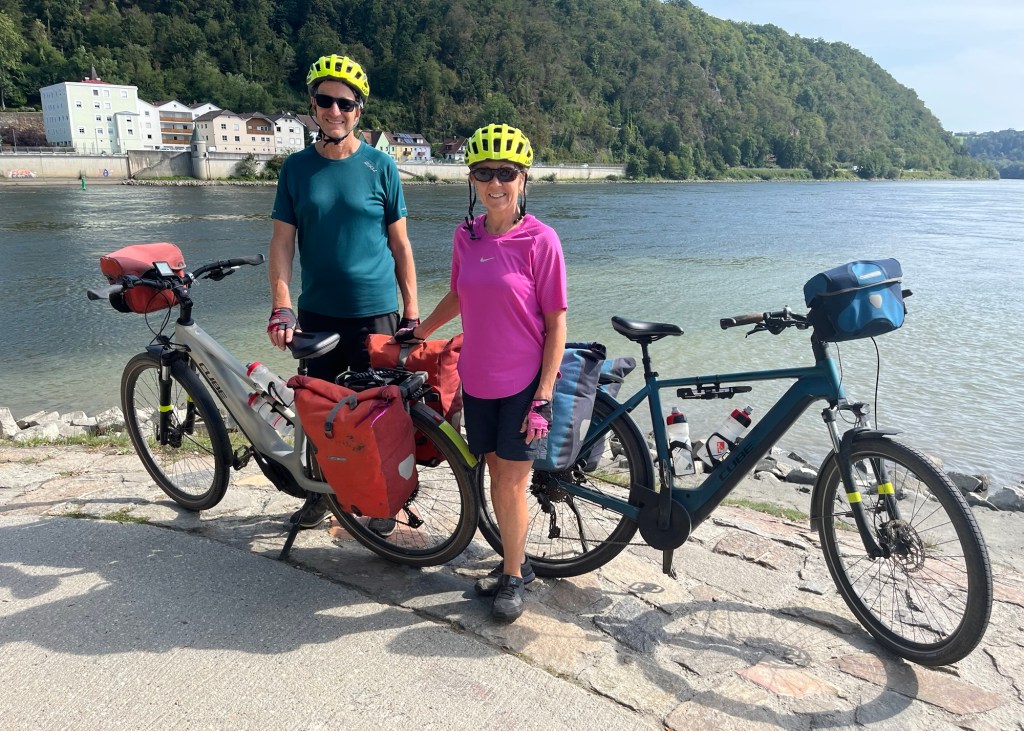
Setting off from Passau

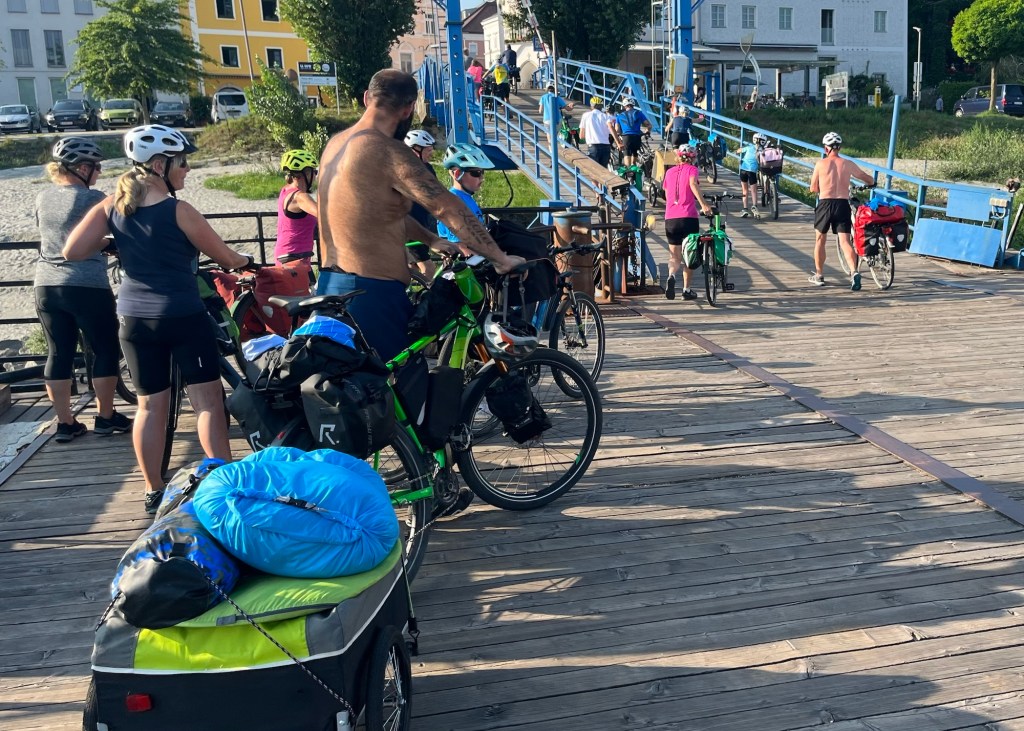
Over 30,000 cyclists enjoy riding this section of the Donau Trail every summer, making it the busiest bicycle path in Europe. It’s a true Cycle Touring Super Highway.

Most cyclists with panniers had read the same instructions as us and were cycling downstream from west to east.

They were a mixed bunch. 

Older couples on e-bikes were in the majority.  But there were also plenty of young families, often towing the family dog along for the ride. We also saw several large organised tours, all with matching bikes, matching panniers and sometimes even matching t-shirts.  

Mum had the luggage, Dad the younger child, Daughter the dog

Once or twice we came across a bare chested e-bike warrior gamely pulling a mountain of camping gear on his trailer and racing ahead of the rest of his group.

E-bike warrior

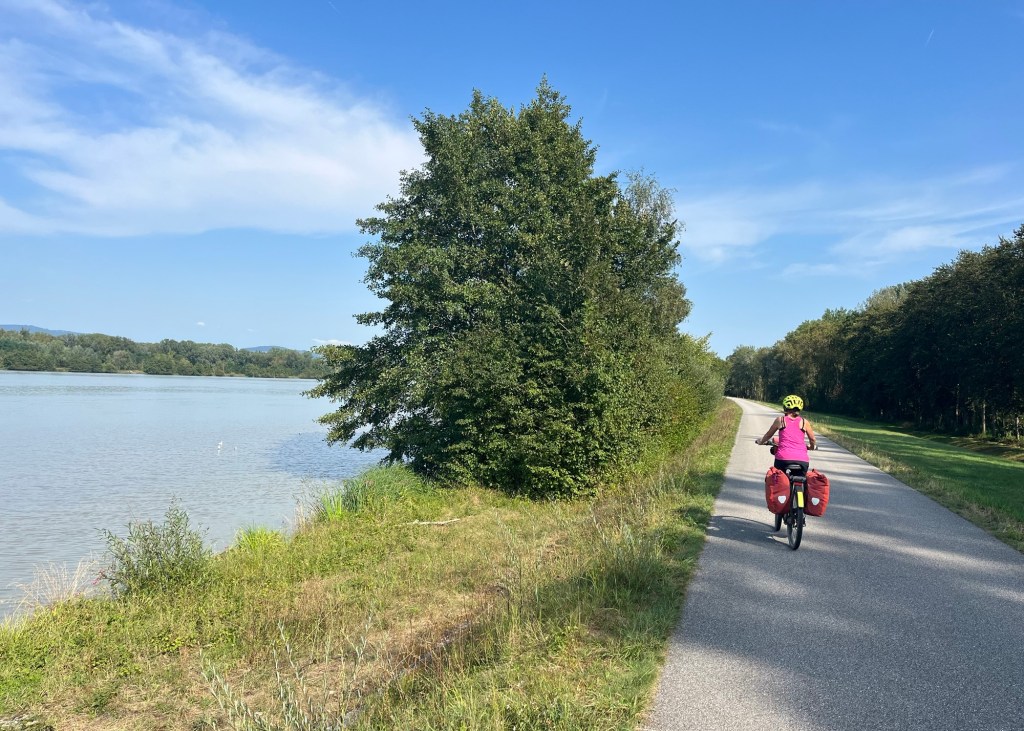
On the super smooth surface we were able to ride happily along at our new e-bike cruising speed of 24-25 km/hour, just below the point at which the motor cuts out. At this speed we reeled them all in … the oldies, the families, the groups, even the e-bike warriors … effortlessly passing by with a cheery “Guten Morgen” or some such annoying greeting.

Until now!

Humph, we muttered to each other … nobody overtakes us on on e-bikes!

We put in a tiny bit of extra effort and managed to overtake the young couple back, pretending of course that we weren’t trying.

They came past us again.

An e-bike race almost happens in slow motion. All our motors are limited to the same speed and it’s a huge effort to cycle consistently above that cut out point.

The path veered inland so we tucked in behind them, swooping as a pack around hairpin bends, just missing a wiry old gentleman on a rusty black bike.

Then it opened up onto another long straight. Carefully holding the pace we eventually inched past them and held our position for another exhausting four or five kilometres. They were on our back wheels the whole time, like sinister shadows.

As this race was only really happening in our heads … we could decide where the finishing line would be. Feeling pretty knackered, we quickly decided it was the footbridge just ahead.

We pulled over breathing deeply.

They rode on with a grin and a cheery wave. They probably thought it was just the end of the first lap.

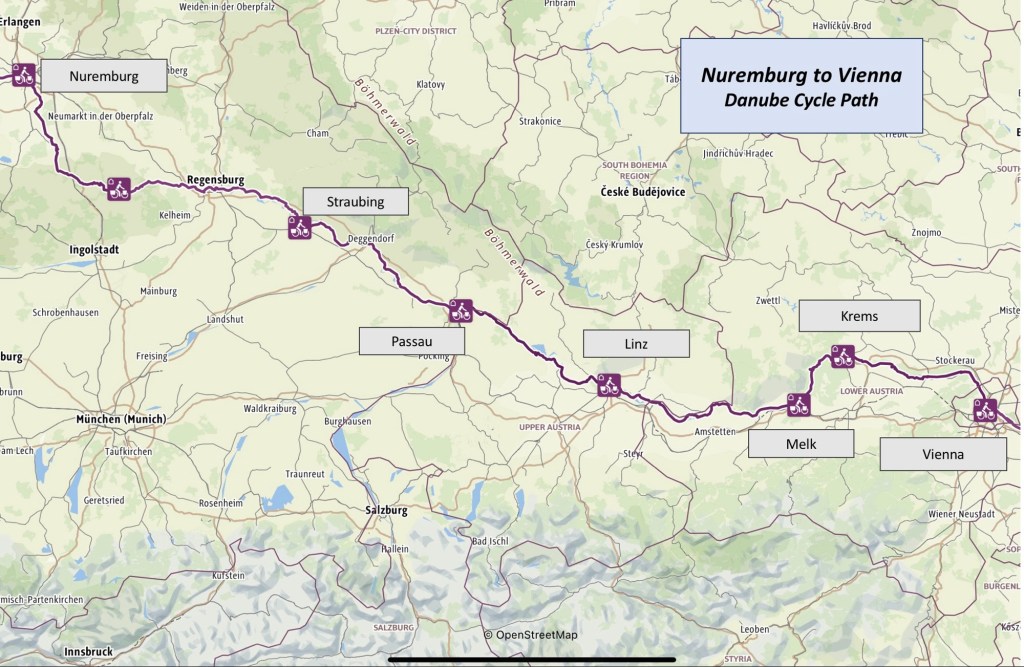
Riding at this e-bike touring speed means that we can cover longer distances for our preferred 4-5 hours of pedalling each day. From Nuremberg to Straubing to Passau to Linz to Melk we leapt down the Danube in 90-100km stages.

The prize for all this effort was a proper tourist cycling day of just 45km, cruising through the beautiful Wachau valley between Melk and Krems.

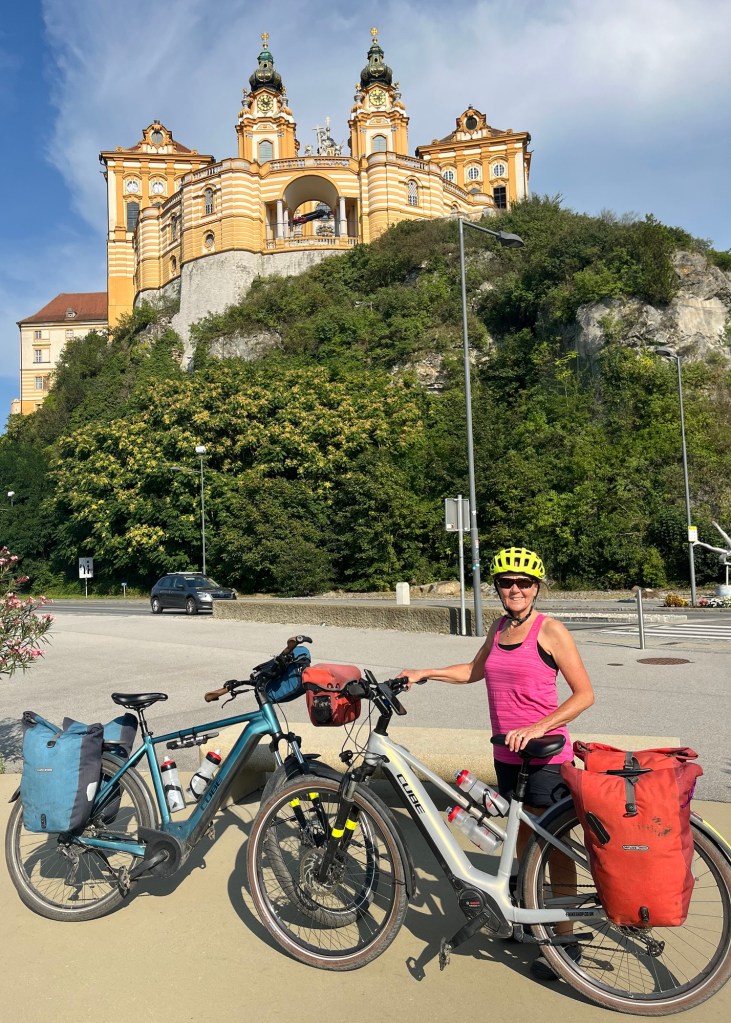
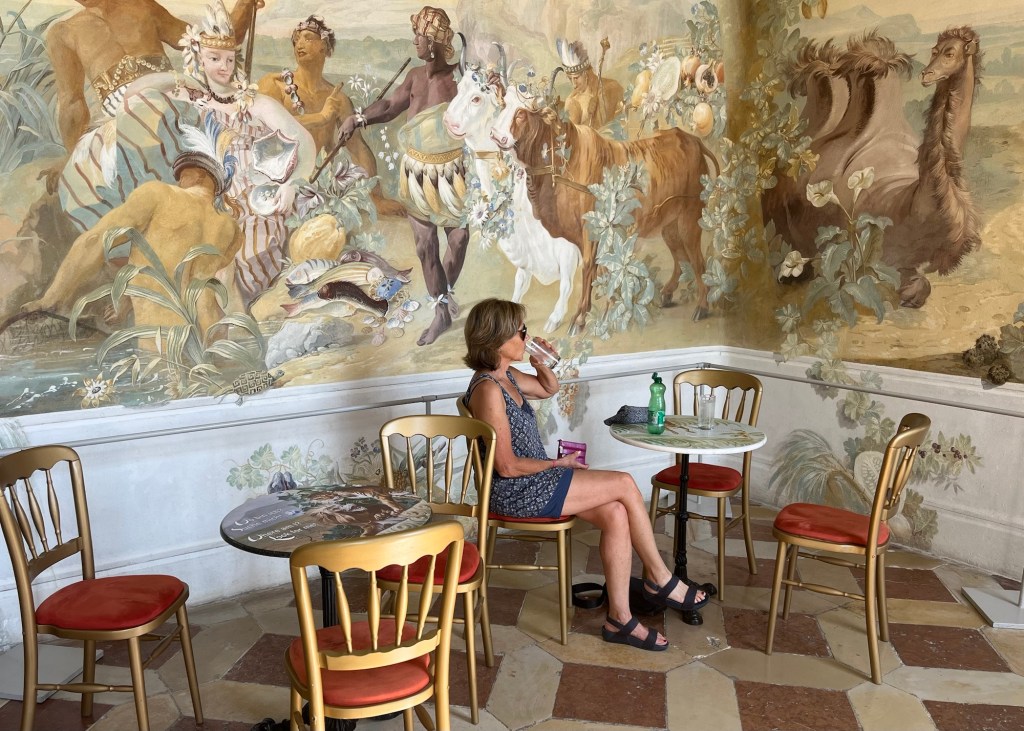
We started at the stunningly beautiful Melk Abbey, rebuilt in the Baroque style in the early 1700’s and surviving the dissolution of the monasteries that destroyed many of its peers later in the same century.

Melk Abbey

This makes it one of the best preserved Baroque buildings in the world. So well preserved that photography is not allowed inside the abbey itself which was great news for us as it meant we could enjoy the building without looking through a sea of camera phones.

But it also means we can’t show you what it looked like. 

So here’s a picture of the cafe instead …

No doubt you can tell from the cafe that the abbey itself was not understated!

Just 6km downstream was another fairytale gem, the 12th century Schloss Schönbühel. No need for camera phones here either as the castle was temporarily closed.

Schloss Schönbühel

The guy at the ticket office was very pleased with his joke, which he must have said a thousand times already … “Das Schloss ist geschlossen!” Ho, ho, ho!

No matter, there was still plenty more fun to be had in the rest of the Wachau. But we had barely pedalled a few kilometres before we discovered the next surprise … the Danube Bike Path was blocked by a landslide.

No way through

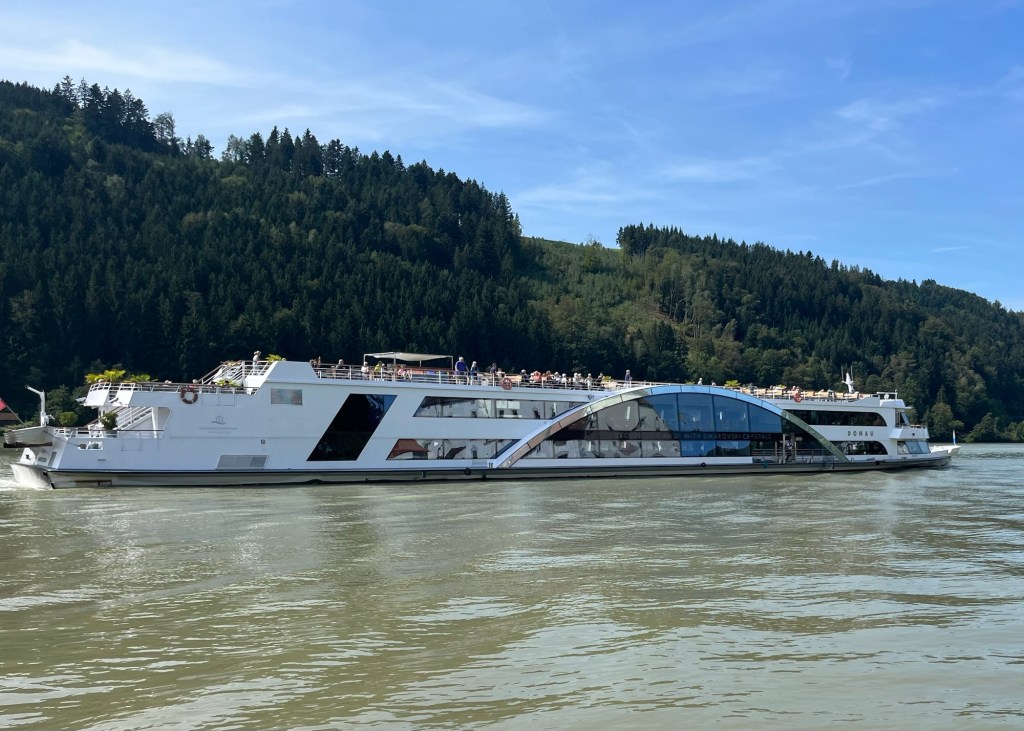
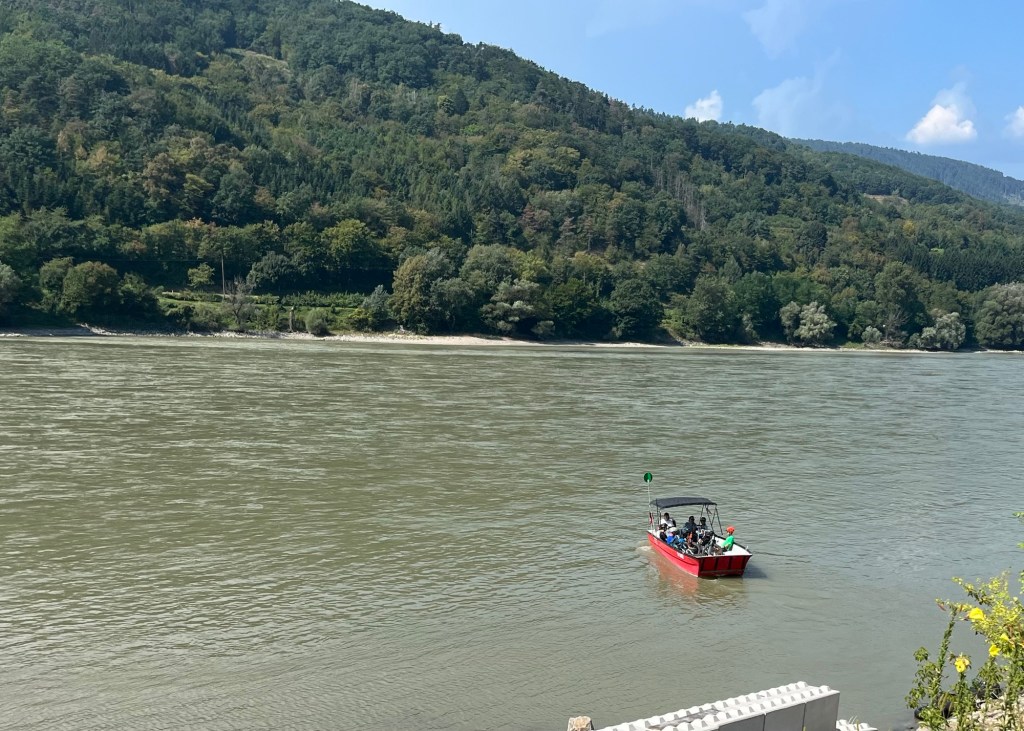
That meant for an unexpected treat … a free Danube River Cruise. We’d seen plenty of pleasure boats cruising up and down the river, so imagined we’d be transported in something that looked like this …

What we got was this …

It was still good fun to get out onto the river, if a little bumpy! There was so much wash from the proper river cruisers that our young skipper excitedly declared that these were the biggest waves he’d ever seen on the Danube. EVER!

He seemed to be loving it a lot more than we were.

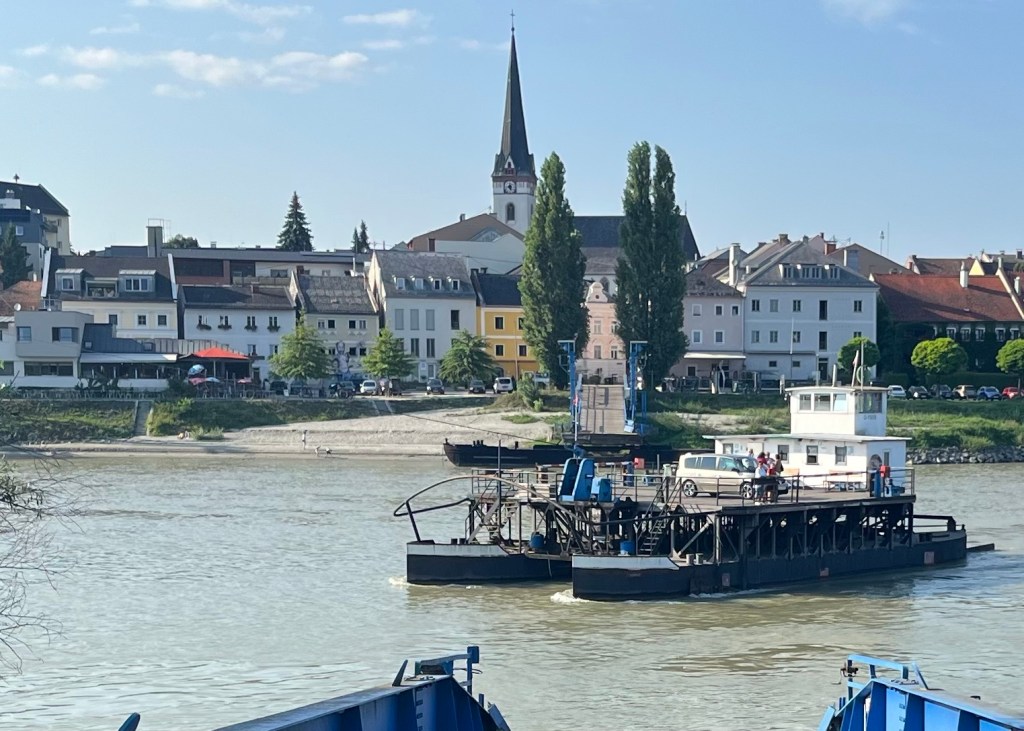
We were back on the river again as soon as we reached Spitz, this time on a calmer, more familiar vessel. Ancient cable ferries have been taking people and their stuff backwards and forwards across the Danube since the 13th century.

Cable Ferry

They’re simple but very clever. Secured to a cable fixed high above the river a few metres upstream, they just need to angle their twin bows into the current to glide silently across. Perfect eco-friendly transport!

The cable

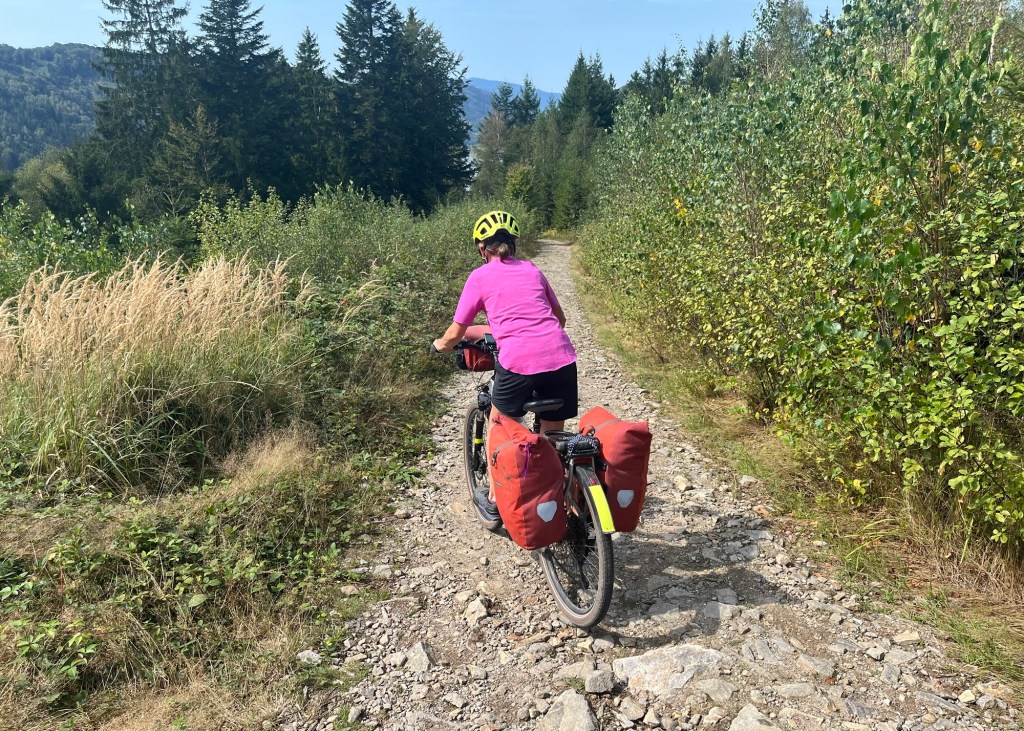
After spending so much time on the river we fancied a view so we cycled up to the ruins of Hinterhaus Castle. It was the second time we’d gone off piste to get some height and both occasions have required some serious mountain-bike skills to navigate the steep, rocky bike paths.

Feeling like Tom Pidcock

The first occasion was an even more rugged climb to enjoy the iconic view of the Schlögener loop between Passau and Linz where the river is forced make a series of 180 degree bends. Tough … but we’re sure you’ll agree the view was worth the effort!

Schlögener Loop

From Hinterhaus castle, we not only had a great view of the Danube, but also of the vine terraces that make the Wachau valley famous. The abundant grapes turn into some of Austria’s finest wines, notably Grüne Veltliner and Riesling. 

Wachau Valley vineyards

As the late afternoon sun mellowed, a ride down through the vineyards and apricot orchards made for a glorious end to a perfect cycling day.

As did sampling both a delicious home made apricot ice-cream and, of course, a glass or two of Wachau’s finest. It would be rude not to!

A week earlier it hadn’t looked so rosy.

We’d arrived at Frank’s bike shop in Nuremberg after an incident free journey and left our car in the capable hands of his team. It was exactly a year since we’d abandoned the ride to Istanbul and it felt quite emotional to be back on exactly the same spot.

We rode off to our hotel literally shrieking with pleasure and relief, much to the alarm of the people who happened to be passing by.

Leaving Frank’s shop

Once again we were on the road. Once again we were heading towards Istanbul.

Once again it didn’t quite turn out like that.

Andy woke up at 5am the next morning with a nasty dose of sickness and diarrhoea. We’ll spare you the details but suffice to say a stomach bug is not a good fit with a bicycle tour! Andy was beginning to feel he had the Nuremberg curse. 

Fortunately it only lasted three days and was gone by the time we reached Passau.

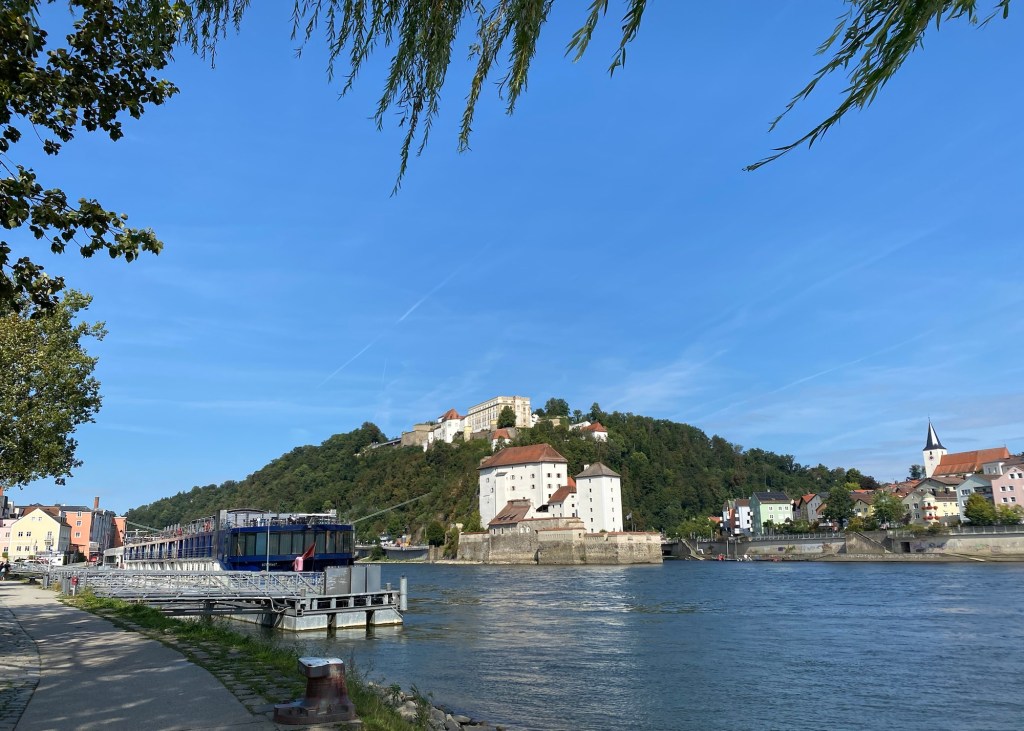
Passau

Our friend, Judith, once made a very insightful comment on this blog about the dubious pleasure of riding down canal paths, something we’ve endured many times. 

“Canal paths are like fish and chips, nice to start with but then too much and rather boring.”

By comparison the Danube River is a royal banquet, a smorgasbord of delights. 

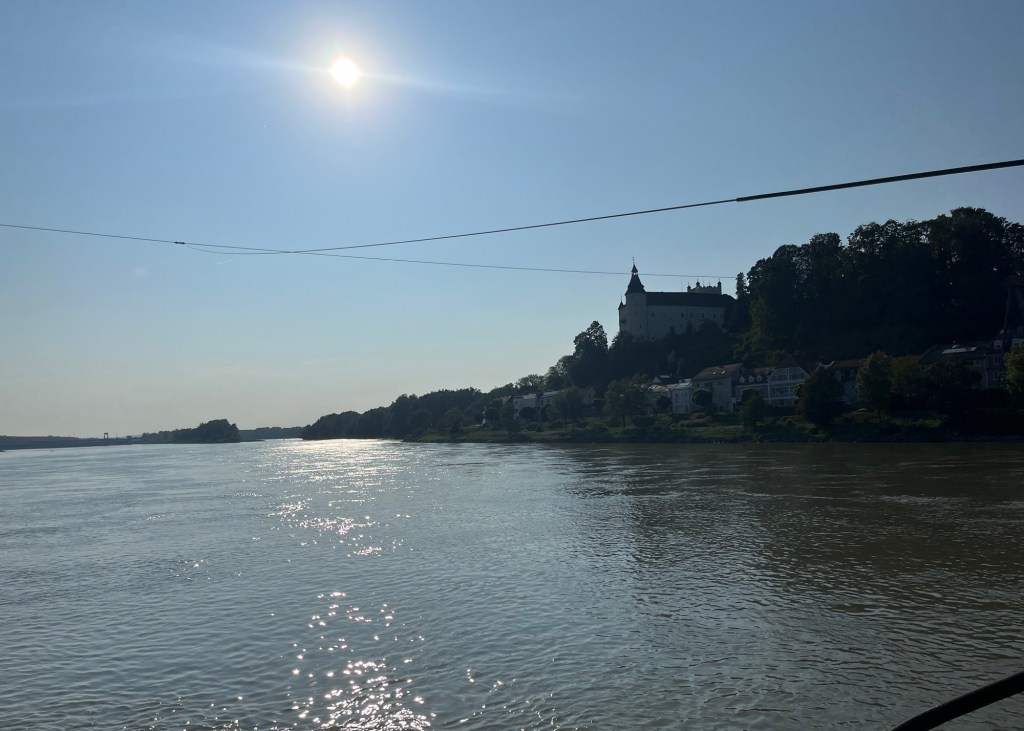
As you cruise down the super smooth cycle path the river swirls gently by, milky jade mixed with cinnamon and ochre undertones … never still, always changing. The trees lining the banks seem to lean forward slightly as if lazily dipping their toes in the water. 

Then to break things up, the path will meander away from the river, up through a wood or around a village. Sometimes it accompanies a railway line, sometimes a road. Sometimes it climbs a little for a broader perspective.

If you wander off the main path it’s not too difficult to find your way back to the river. There are plenty of signs. The Danube is your constant and reliable companion.

Easy to find your way

And the Austrian authorities do love a sign!

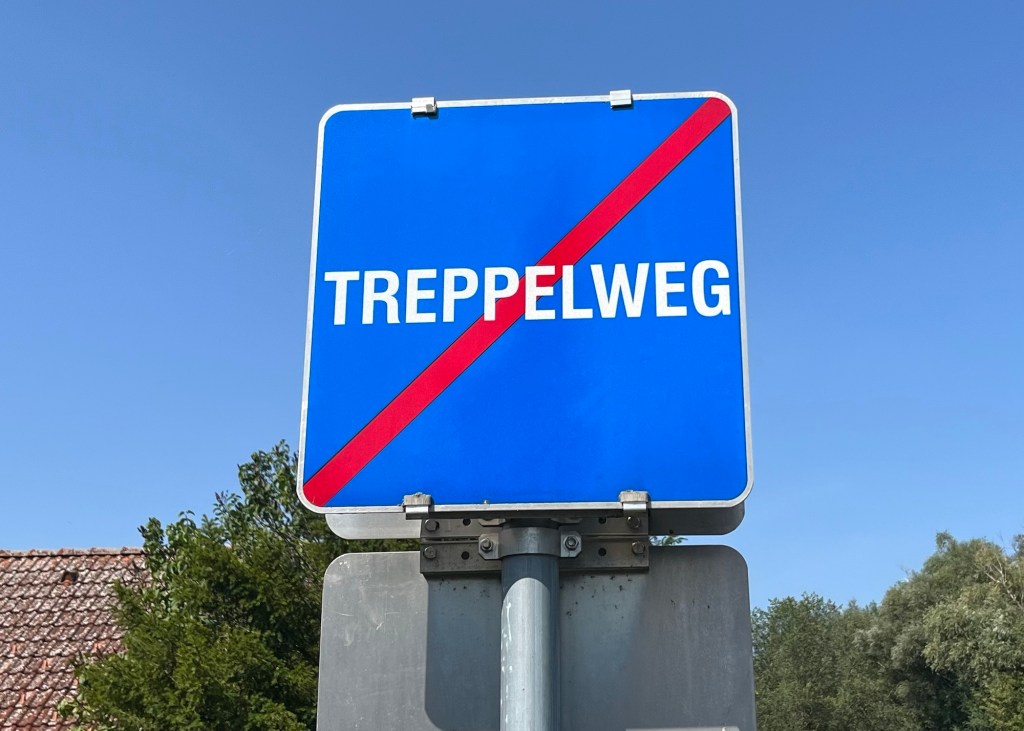
One particular sign that kept popping up every few kilometres was to warn us of the danger of a Treppelweg. What could it be? These nasty Treppelwegs were everywhere.

A dangerous current in the river to watch out for? Some kind of vicious animal? The Danube River Monster?

Sometimes the signs were crossed out, helpfully telling us the Treppelweg danger was over. Phew! Then around the corner there lurked another one.

In the end we had to look it up … a Treppelweg is a slope.

Now this is the very, very, VERY flat Danube Cycle Path, not the Alps, so if there was a slope it was barely perceptible. A gentle dip at most. But thanks for alerting us to the danger Austria!

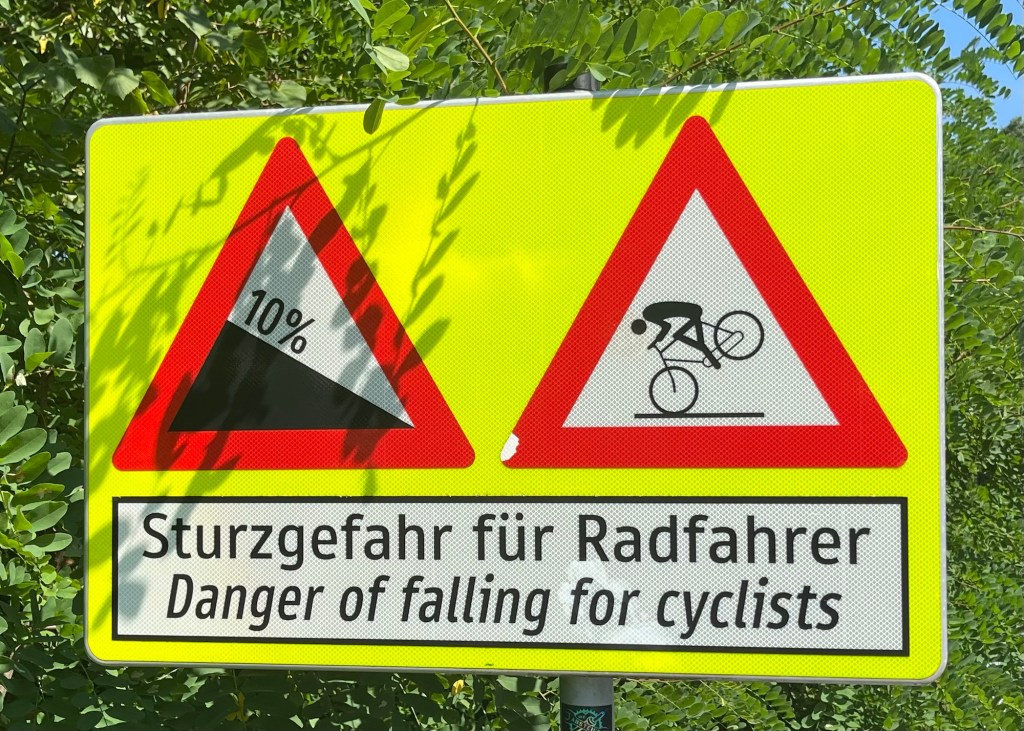
The warnings became catastrophic the only time there was a proper slope …

The Danube Cycle Path is not perfect though. Sometimes the path turns to gravel … although it’s very smooth gravel. Once (shock horror) we found ourselves on a road. A proper road with trucks and fast cars zooming past. On this occasion the signs were sadly lacking, making our presence quite a surprise for both cyclists and motorists.

That’s probably because it was flat, if only there had been a Treppelweg there would have been loads of signs!

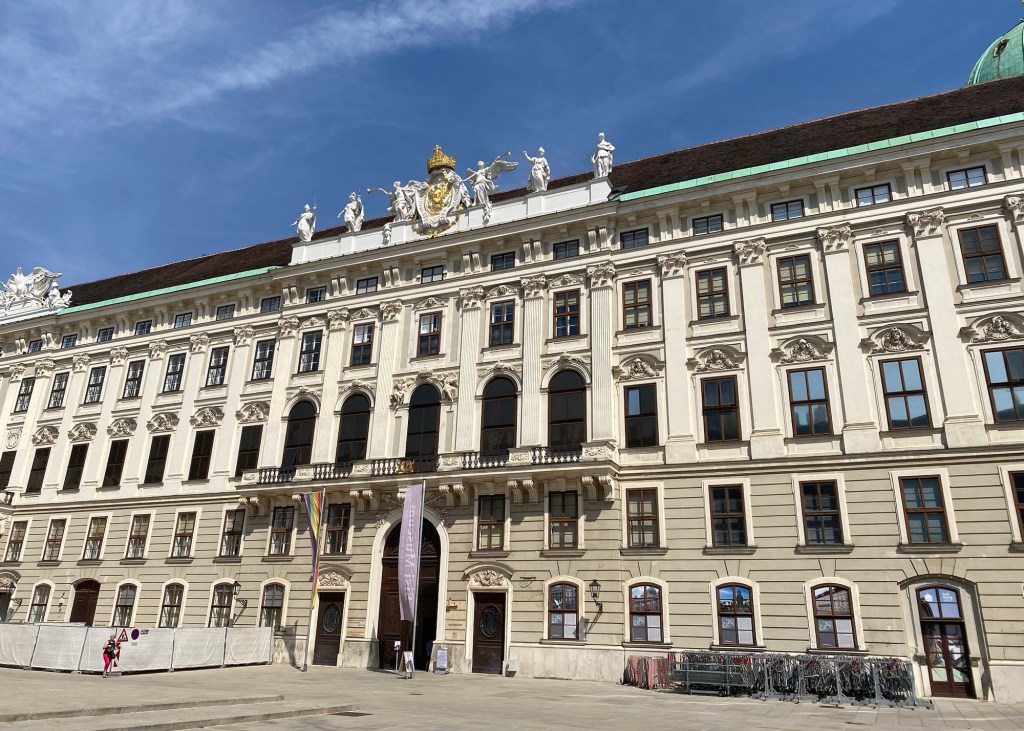
Hofburg Palace, Sisi’s apartments

The destination for most people holidaying on the Danube Cycle Path is Vienna and it’s a real treat, a fantastic city break.

Two people dominated our weekend there … the Empress Elizabeth of Austria and Wolfgang Amadeus Mozart.

Both of them are everywhere. 

Elisabeth, better known as Sisi, is easily Austria’s favourite Empress. She did have an unusual and interesting life. Some of the  highlights that stood out to us include:

She enticed the emperor away from her older sister at the tender age of 15.

She played a pivotal role in negotiating the creation of the Austro-Hungarian empire.

She did gymnastics every morning in her bedroom (you can still see the equipment).

She slept with cloths soaked in cider vinegar to preserve her slim waist and bathed in olive oil to preserve her skin tone.

She fell into a deep depression after her son killed his 17 year old mistress and then shot himself. 

Mozart is Austria’s favourite composer having lived in the city for many of his most productive years, achieving fame but sadly, not fortune.

We listened to an excellent string quartet at the Sala Terrana, the very room in which the maestro himself (allegedly) played.

They were very good

We then ate at the city’s oldest restaurant, the Greichenbeisl (Greek Inn) the very place where maestro (allegedly) enjoyed many a convivial evening. 

His signature is on the ceiling, together with those of Beethoven, Strauss, Schubert, Pavarotti and Phil Collins … so it must be true!

Dinner beneath Mozart’s signature

Empress Sisi once said … “Destination’s are only desirable because a journey lies in-between.”

She could have been summing up the joy of bicycle touring … on the Danube Super Highway or anywhere else. 

Our journey to Budapest is back on that Super Highway.

But we promise not to use it as a race track anymore. After all, we’re not e-bike warriors … well not yet!

Clare and Andy

As we’re continuing the journey from last year, we’ve decided to combine the stats starting from Bath.

Bath to Vienna:

1,938km pedalled (1,204 miles)

10,514m climbed

102 hours in the saddle

This means we’re now about half way from Bath to Istanbul.