In the footsteps of El Cid

It felt like the last glowing embers of summer.

We were sitting by the waterfront at a small beachside cafe in San Pedro del Pinatar sipping a Cortado coffee and munching on a toasted croissant. It was 9am on a warm Thursday morning. In front of us the waters of Mar Menor, Europe’s great coastal lake, were gently rippling in the November sunshine.

When we eventually dragged ourselves away to climb on our bikes, we were so intoxicated that we decided to ride out into the lagoon past salt flats and mud baths. Blown along by a gentle breeze we kept going and going, only stopping after 7km or so.
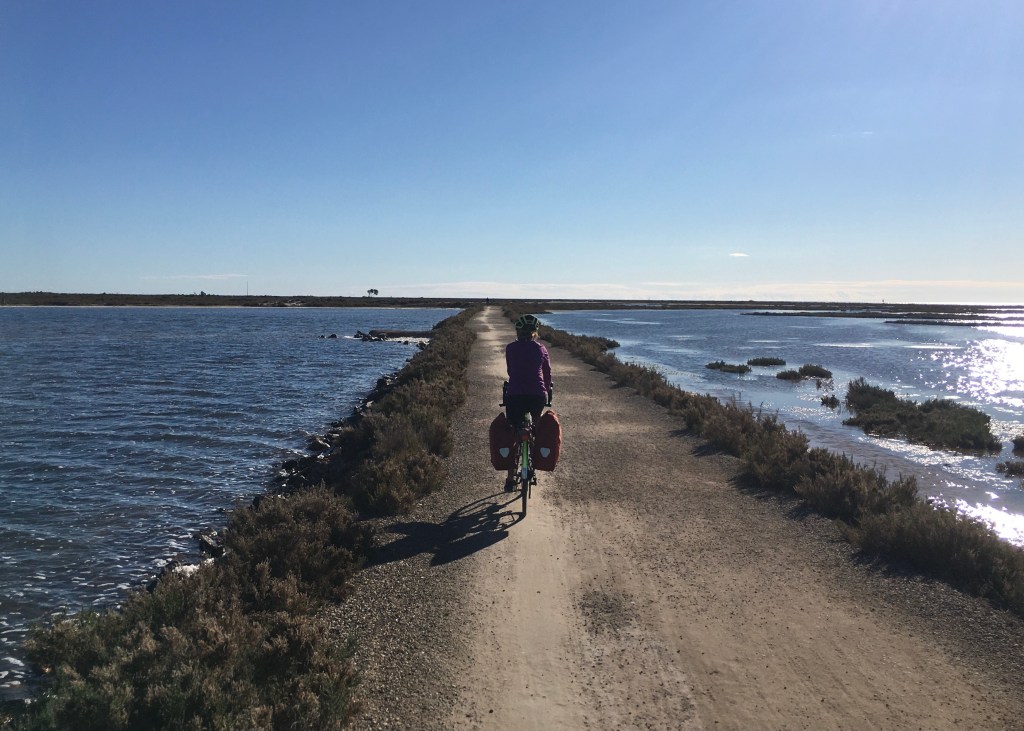
Just one problem … it was the wrong direction!

As we turned around, the gentle breeze immediately transformed itself into a strong northerly headwind. Heads down, we battled our way back to our breakfast cafe and then onward up the coast, the wind becoming stronger and stronger as the day warmed up.

Andy admitted that he was secretly pleased to have to pedal a bit harder as he hadn’t yet lost all the weight he was hoping to shed.

“That’s OK” said Clare, quick as a flash … “You lose it and I’ll cruise it!”

She tucked herself into Andy’s not insubstantial slipstream and resolutely cruised it for the next few days. Whenever he started to flag, she joyfully repeated her words of encouragement until they become something of a catchphrase.

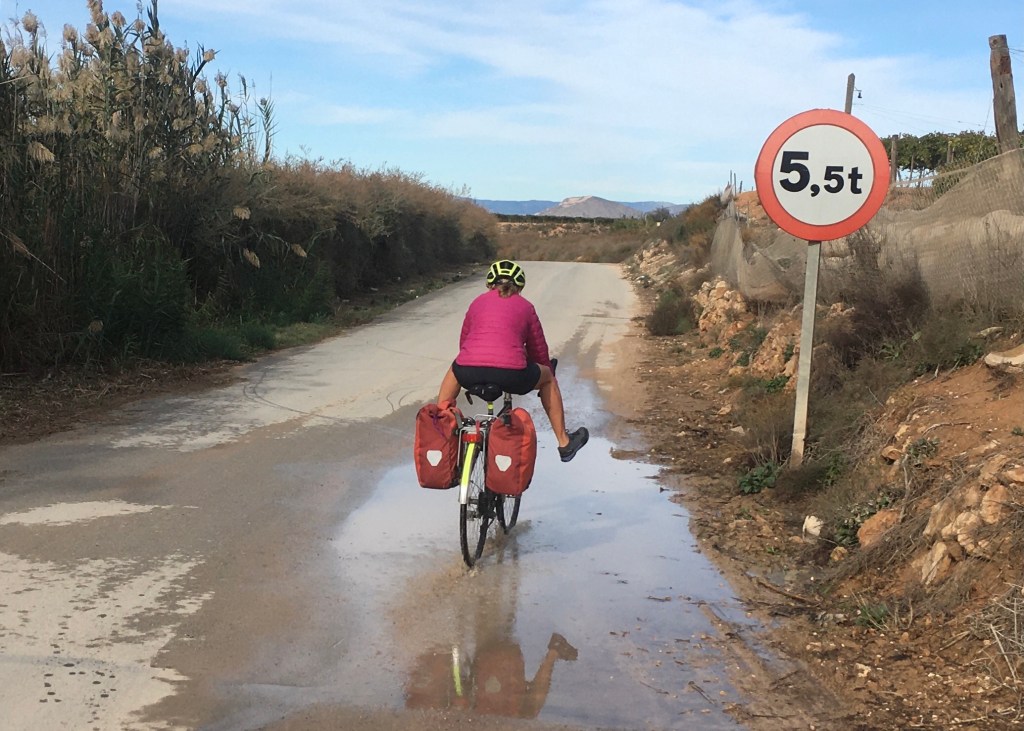
Losing it
Cruisin’ it

Our route briefly took us through part of the Spanish coast known as the Costa Blanca, much loved by Brits seeking winter sun. There were so many English voices and English signs that it sometimes felt as if we’d left Spain and arrived in a new part of Essex or Birmingham.

You know you’re in the Costa Blanca when you see signs like these …

But as soon as we turned inland past huge cacti farms towards Elche/Elx, we were immediately back in Spain. Elche/Elx is famous for being home to over 1000 shoes factories and over 200,000 palm trees which give it the flavour of a tropical oasis.

It has two names because Elx is the Valencian spelling, the official language of the region and very similar to Catalan. Elche is the Spanish spelling, sometimes referred to as ‘Castilian’ in this part of Spain, perhaps as a hangover from the country’s feudal past.

El Cid, a legendary hero from those feudal times, rested up in Elche over the winter of 1088 during his campaign against the Almorávids from Morocco, who ruled over most of southern Spain at the time.

In the epic poem ‘El Cantar del mio Cid’ (the song of my lord) the exploits of this much celebrated medieval knight take all of 3730 verses to describe. More interestingly to us, they’re also commemorated in the ‘Way of El Cid’, a cycling route that runs from Burgos in the north (where he was born) to Alicante in the south.

We picked up his trail in Elche and followed El Cid for over 200km all the way to Valencia, the city he dreamt of wrestling away from the Almorávids and ruling as a private kingdom.

After a year long siege, he eventually succeeded in forcing them out in 1094 only to die just 5 years later when they returned and besieged him back. Valencia then remained under Muslim control for the next 139 years.

With El Cid as our guide we climbed steadily through wide, fertile valley corridors flanked by forbidding mountain ranges on either side. He took us from one fortified hilltop town to the next … Montforte del Cid, Sax, Biar, Villena.

As the biting headwind accelerated towards us, Andy called back to Clare … “I bet El Cid didn’t like this!”

“He didn’t care” she replied, “he was on a horse, not a bike!”

Sax
Biar

Eventually the wind dropped as we rode out of Villena the following morning and slowly climbed up to 800m at the head of the valley. It felt very peaceful in the stillness of the autumn sunshine, a freshness to the air and a greater intensity of colour.

Somewhat surprisingly, this 76km day with 800m of climbing turned into one of our best ever.

Partly it was the long slow descent we enjoyed once we’d reach the top of the pass.

Partly it was the beautiful old towns we passed through … from ramshackle, medieval Bocairente to bold Xàtiva with its imposing castle.
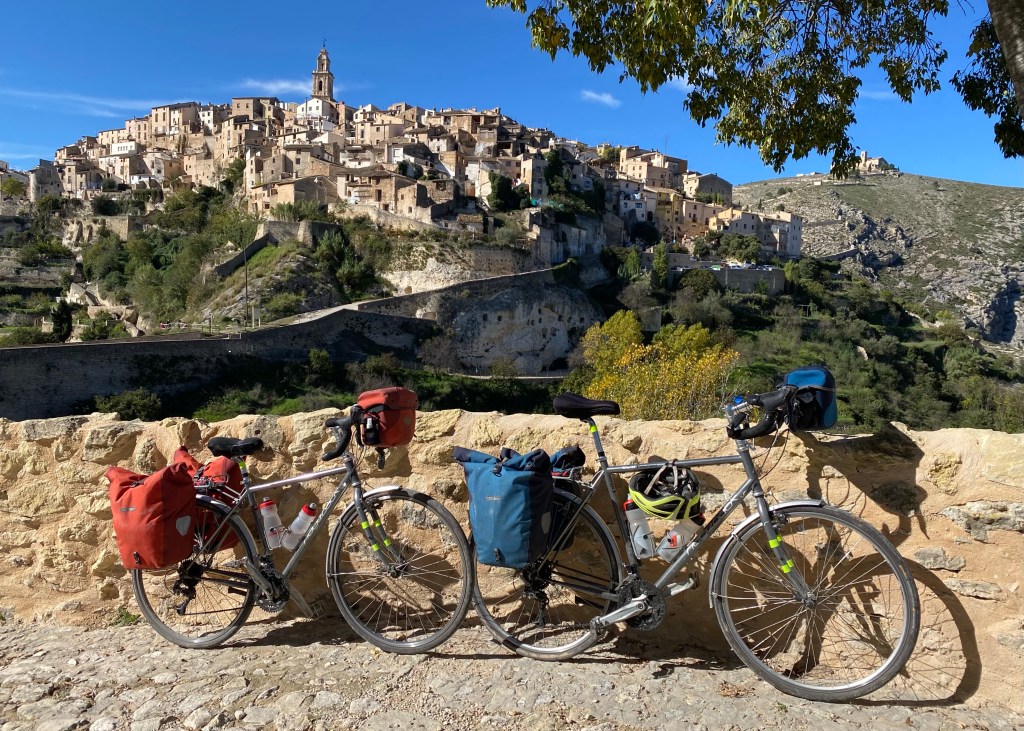
Bocairente

Partly it was the delicious Sunday lunch, eaten in a simple restaurant full of Spanish families and so good that it easily powered us through the three short, sharp climbs we faced to reach Xàtiva and our overnight stop.

But mainly it was the orange trees!

Now we thought we’d seen plenty of orange groves near Seville. But ohhh no …. those are poor relations when compared to the oranges of Valencia. Valencian oranges are much bigger and much juicier. They’re just … more orange.
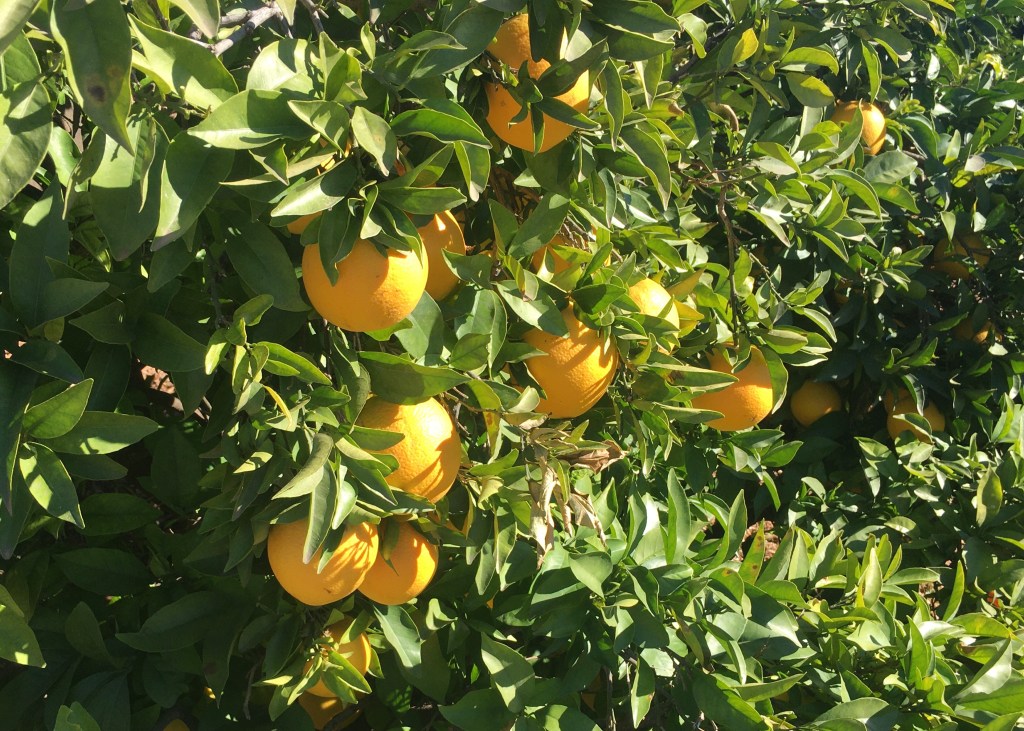
As well as oranges there were tangerines, mandarins, clementines and smooth skinned persimmons … an ocean of ripe fruit stretching out in every direction.

The trees were literally dripping with fruit, begging to be picked. It seemed rude not try one … or maybe two … or three. Fresh from the tree they were zingy and delicious.

Valencia itself is an old city in a modern wrapping.

The old walled city is a maze of tightly packed streets that open out onto squares buzzing with cafes and end-of-summer life. There are countless churches and a large imposing cathedral built over a mosque. In a corner chapel is a chalice that many people believe to be the holy grail, the cup that Jesus sipped wine from at the last supper.
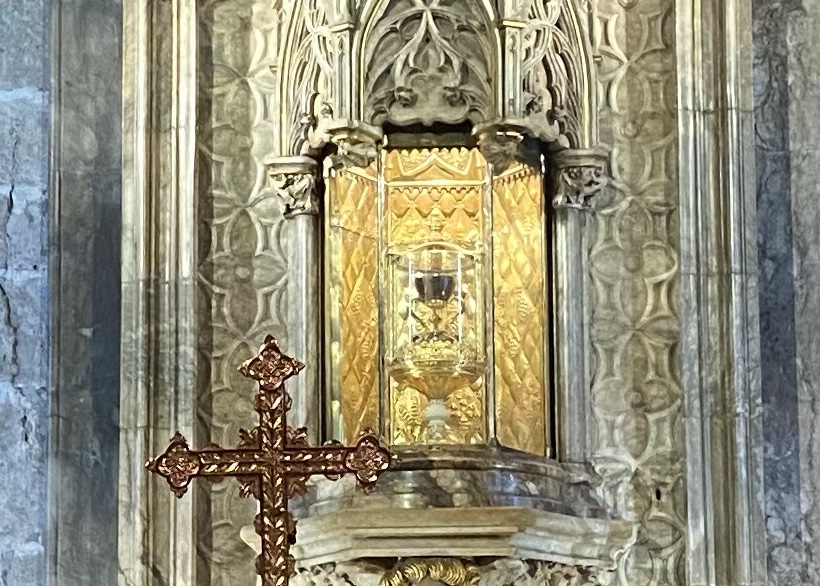
The Holy Grail … allegedly

We wandered into the cathedral late in the day. It was almost empty apart from an organist practising a dramatic and somewhat haunting piece of choral music. As we stood behind the chancel letting it wash over us, we glanced down and were surprised to find ourselves gazing at a display case containing a wisened human arm!

It turned out to be the left arm of Saint Vincent, a 3rd century martyr who was rather unpleasantly tortured to death by the Romans. This saint has been following us around the Iberian peninsula … perhaps working with El Cid to help guide us on our way.

He’s the patron saint of both Lisbon and Valencia. But of more significance to us, the most south-westerly point of Europe, the ‘End of the World’ is also named after him. After his death, his body was thrown in the sea at Cape St Vincent where it was guarded carefully by ravens until it could be recovered.

So thank you Saint Vincent for the helping hand. For putting your arm around us.

It’s been finger-lickin’ good!

A white knuckle ride!
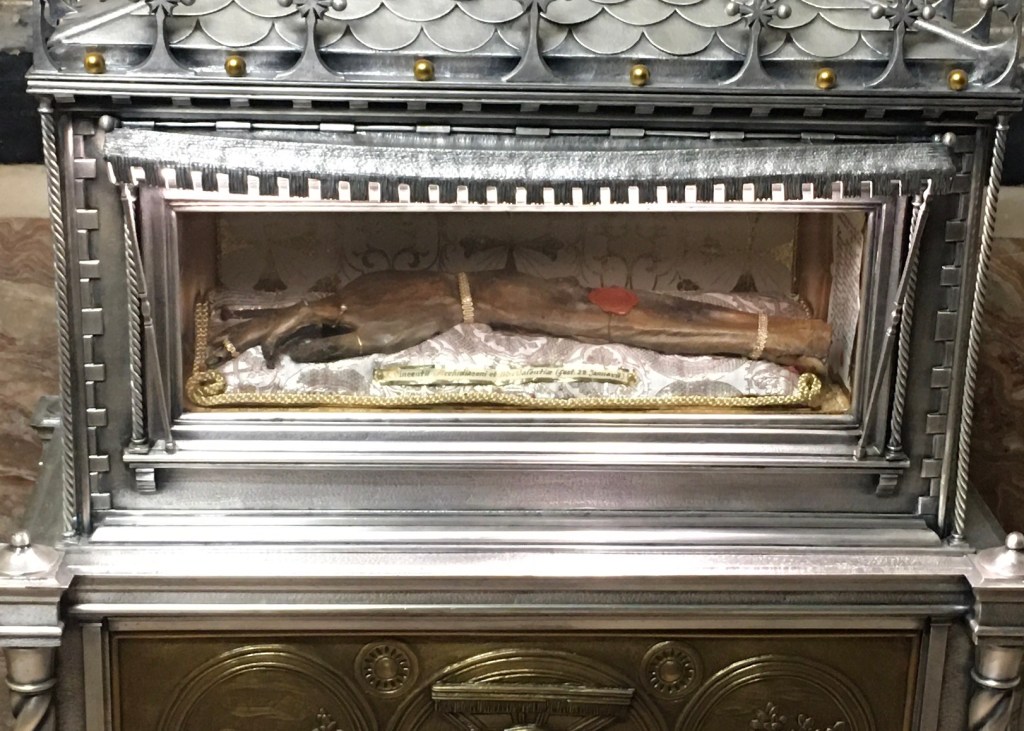
St Vincent’s arm

The modern wrapping of Valencia is the old riverbed of the Rio Turia. After several bad floods in the 1950’s, the river was diverted away from the city centre leaving a huge green strip full of playing fields, cycle tracks, jogging trails and gardens.

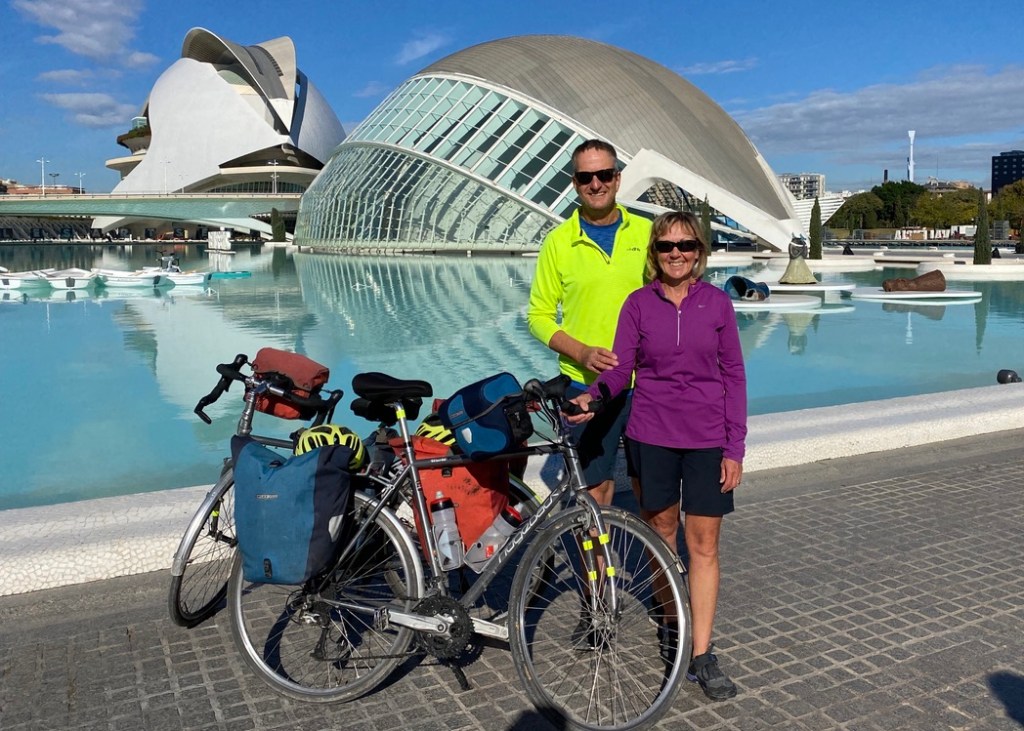
This new space also created room for the futuristic Ciudad de las Artes y las Ciencias (the City of Arts and Sciences). Opened in 1998 it’s a series of spectacular buildings that include an opera house, a science museum, an iMax cinema and a huge aquarium.
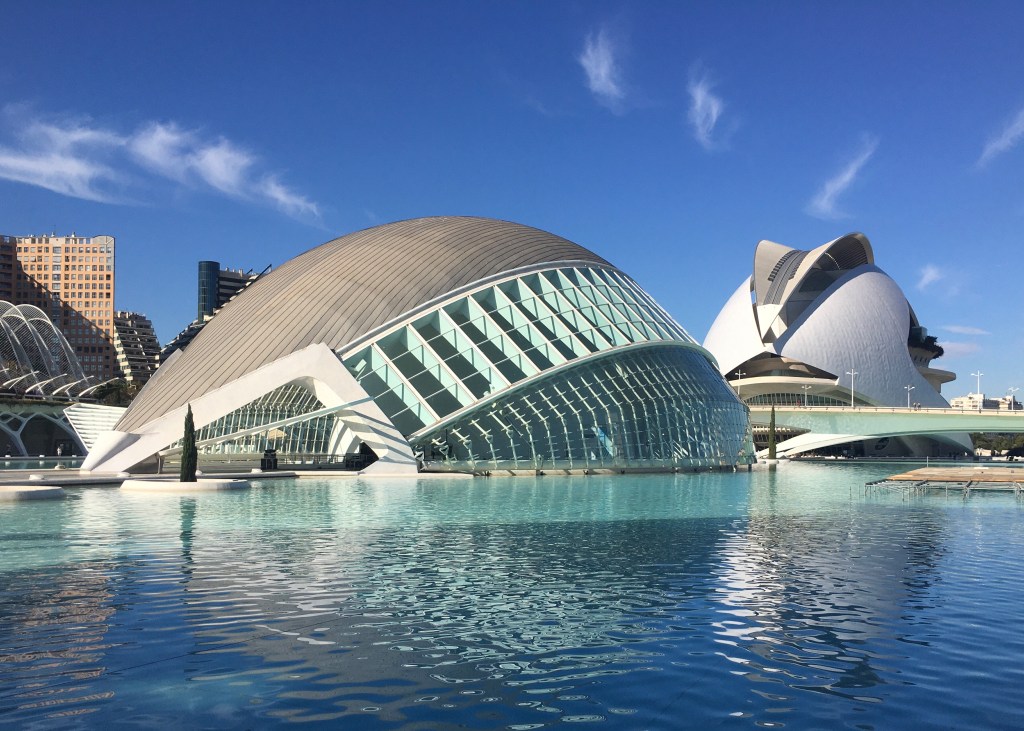
L’Hemisfèric iMax cinema (shaped like an eye) with the opera house behind
The science museum, inspired by the skeleton of a whale

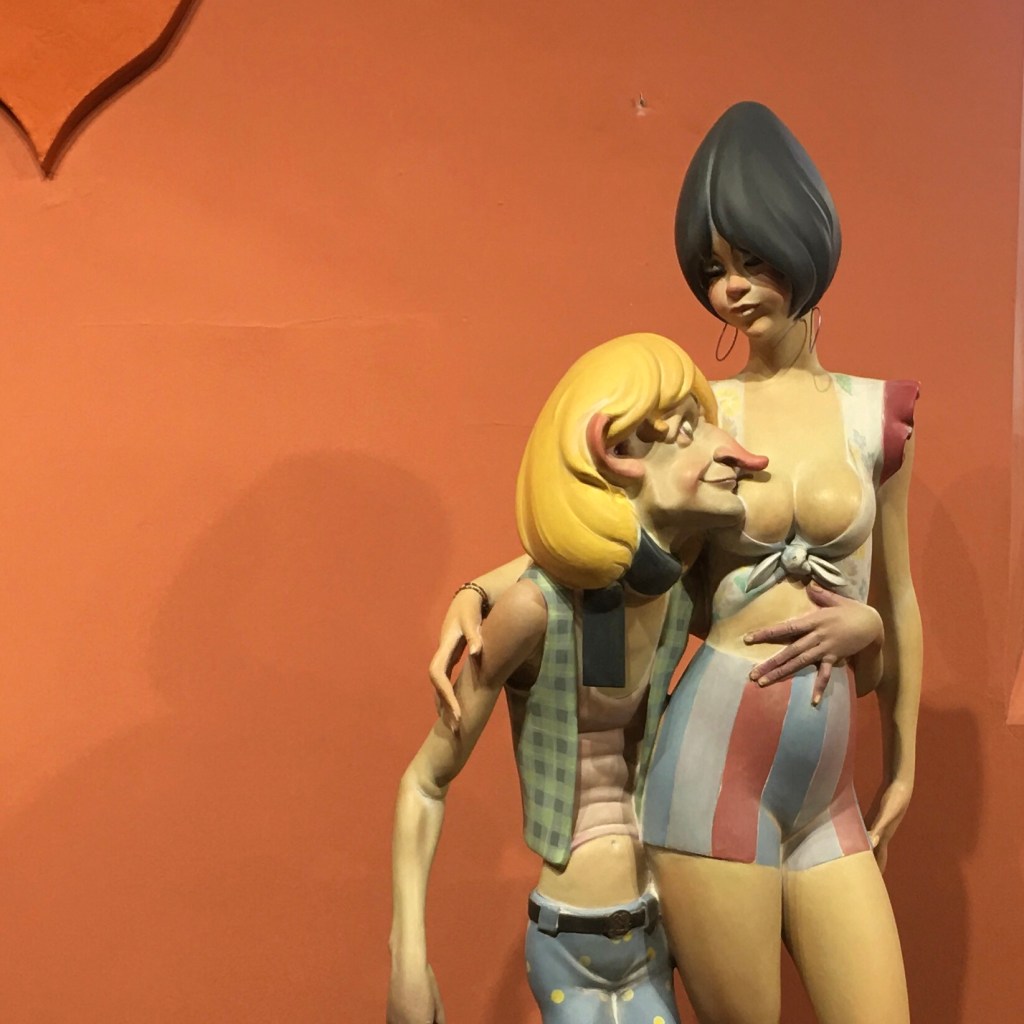
Next door is the type of quirky museum we love to visit. This one celebrates Valencia’s famous festival which takes place each March. Las Fallas is a huge pyrotechnic party with parades, concerts, bullfights … and lots and lots of fireworks.

Overnight on March 16th, over 350 ornate structures (fallas) spring up across the city ready for the parades. Made from papier-mâché and wood, they usually consist of a central figure up to 20m high surrounded by lots of smaller life-size ninots.

Five days later every falla and ninot goes up in flames in a final blast of pyrotechnic glory. Except for one. A single ninot, pardoned by public vote, is preserved in the Faller Museum for posterity.

It’s fun to see how they’ve changed through the years. Right now, an old fashioned sentimentality is popular … children and grandparents sharing simple pleasures.
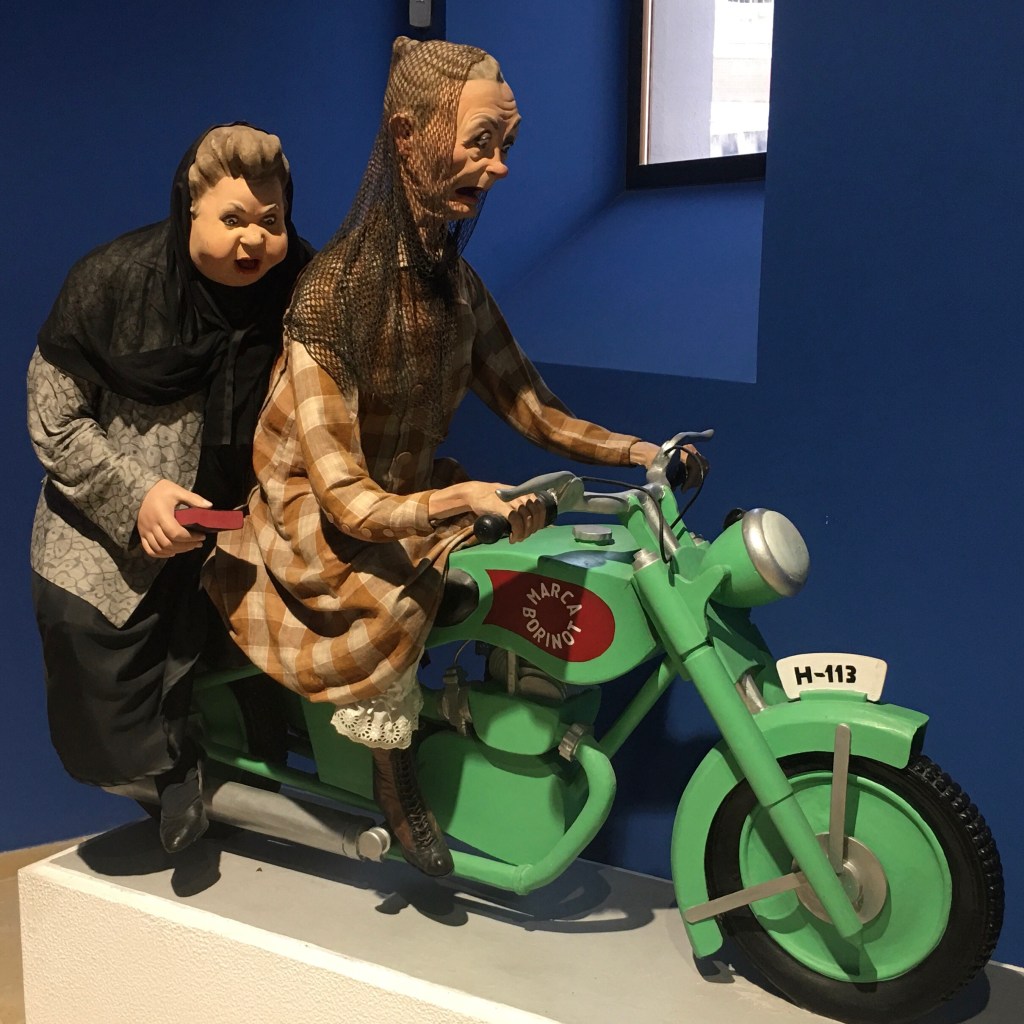
Sausage Vespa, taking grannies to mass (1958)
Hippie couple (1971)
Who is a shoemaker, who makes shoes (1989)
Don’t tell Grandma (2021)

As we leave Valencia, summer is eventually turning to Autumn in this part of Spain.

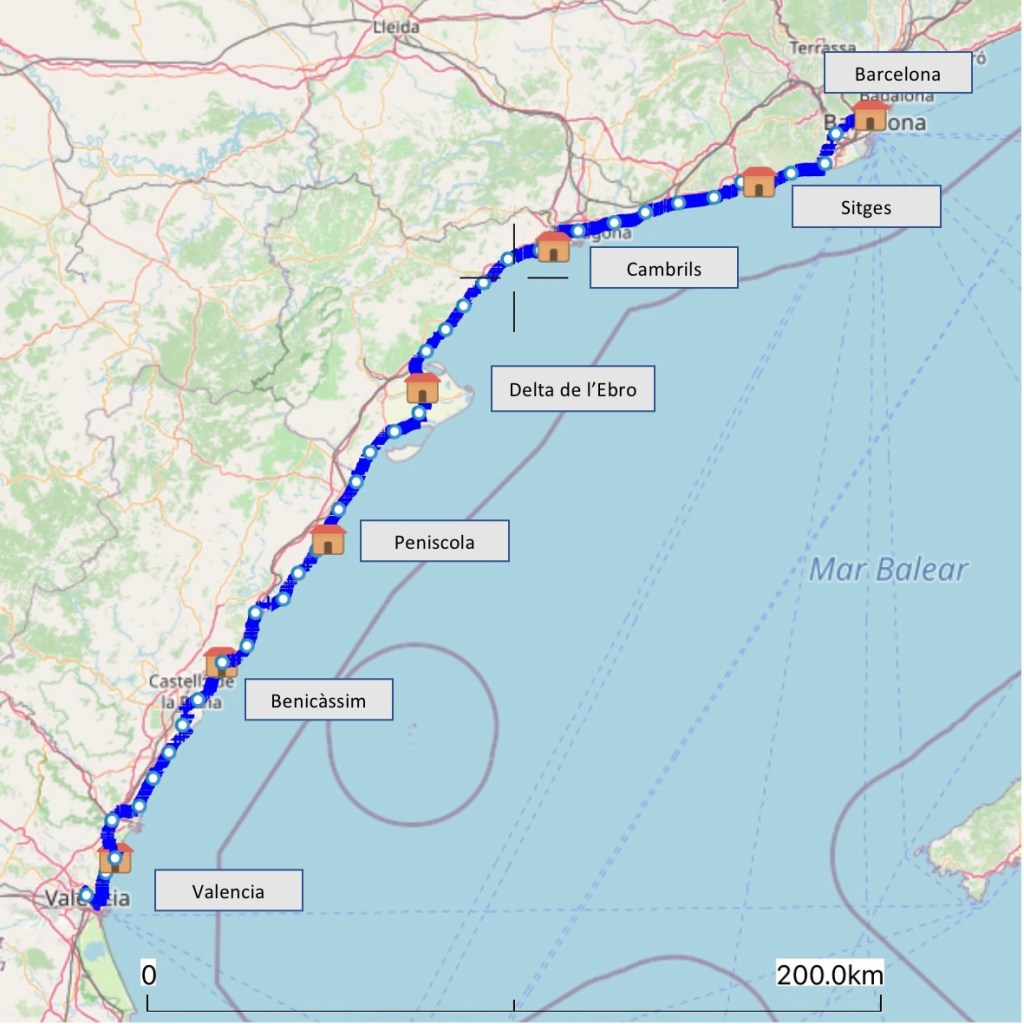
Waving a fond goodbye to El Cid we’re now looking forward to exploring 400km of the Costa Dorada (the Golden Coast) heading north towards Barcelona. Let’s hope the wind changes and it can live up to its name with some golden southerlies to warm our backs.

Clare and Andy

.

Stats to Valencia:

2,465km pedalled

22,633m climbed

163 hours in the saddle

Happy Endings

A bike ride of 436 kilometres is a long way to go for a dinner date!

Weeks ago, our daughter Sarah told us she was coming to Barcelona for a short break with some friends. If we could somehow get there by Saturday 20th November, she could meet us for dinner and we could spend Sunday together.

At the time we were vaguely thinking of flying home from Valencia. But this was quite an incentive … it would make for a very happy ending!

So we studied the map, worked out the distance, checked the kilometres per day, looked at the terrain and found that it fitted together perfectly … as long as our legs held up. If we kept pedalling up the Costa Dorada (Golden Coast), we could make it to Barcelona in time.

We did make it … and it was worth it! A lovely weekend together.

The journey itself was was very pleasant. The Costa Dorada is known for its flat golden beaches and calm shallow waters, punctuated by craggy hills that fall down to the sea in a series of steep turquoise bays.

For the cyclist this means being gently lulled into long periods of cruising … only to be rudely awoken by some short, sharp exercise.

Huge numbers of Spanish people have an apartment by the sea. For most of the year they live in busy cities but they all decamp to the beach as soon as the kids break up for their summer holidays, only going back when it’s time to shop for new school shoes.

From June to September the beaches, bars and playgrounds must be alive with the happy laughter of both children and adults. But by November they are ghost towns, in hibernation, all wrapped up for the coming winter.

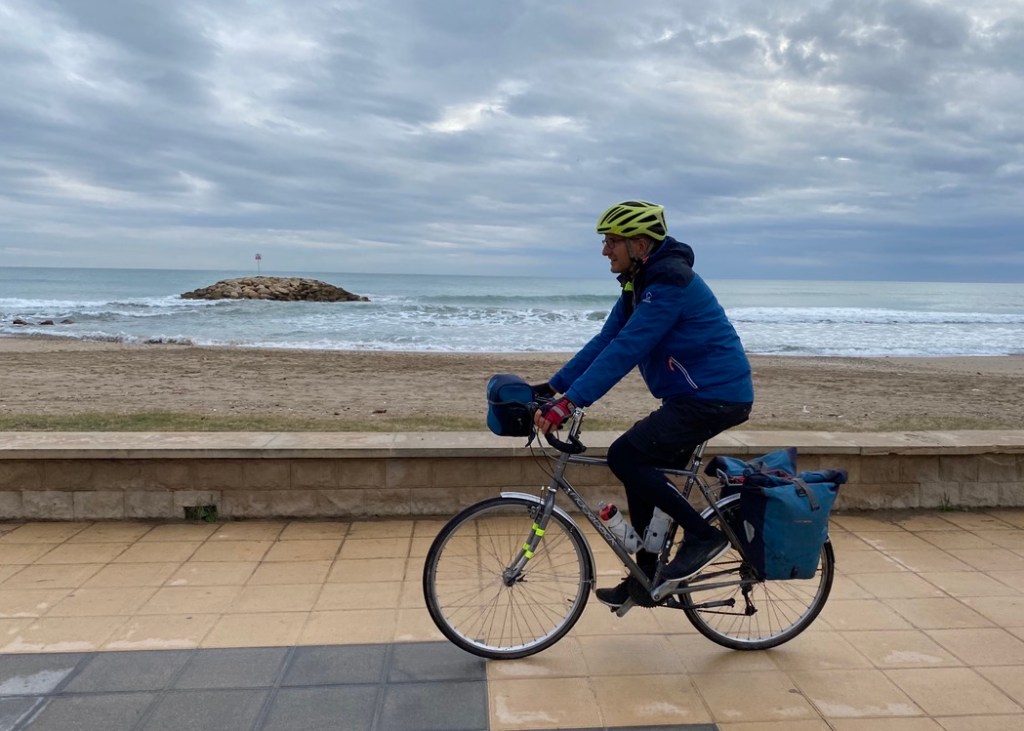
For mile after mile we were able to ride on the paved promenades that line each beach, the gentle waves of the Mediterranean lapping the shore to our right, the sun on our backs. We could ignore the ‘no cycling’ signs as there were so few pedestrians to disturb.

A few of the more popular towns still had some life about them … Benicàssim, Cambrils, Sitges … all very pleasant for an overnight stay.

We especially enjoyed the tiny peninsula of Peniscola where we celebrated the end of a particularly brutal 15km section of ripio (gravel track) … gazing out to sea in a bar that served relaxing tunes along with the beer and the snacks.

Last bit of ripio on the way to Peniscola
Peniscola

It wasn’t sunny every day … winter was coming and sometimes we had to wrap up warm in almost all the clothes we had. The darker evenings rushed towards us as we rode north, only arriving at our destination as the sun was setting.

All wrapped up

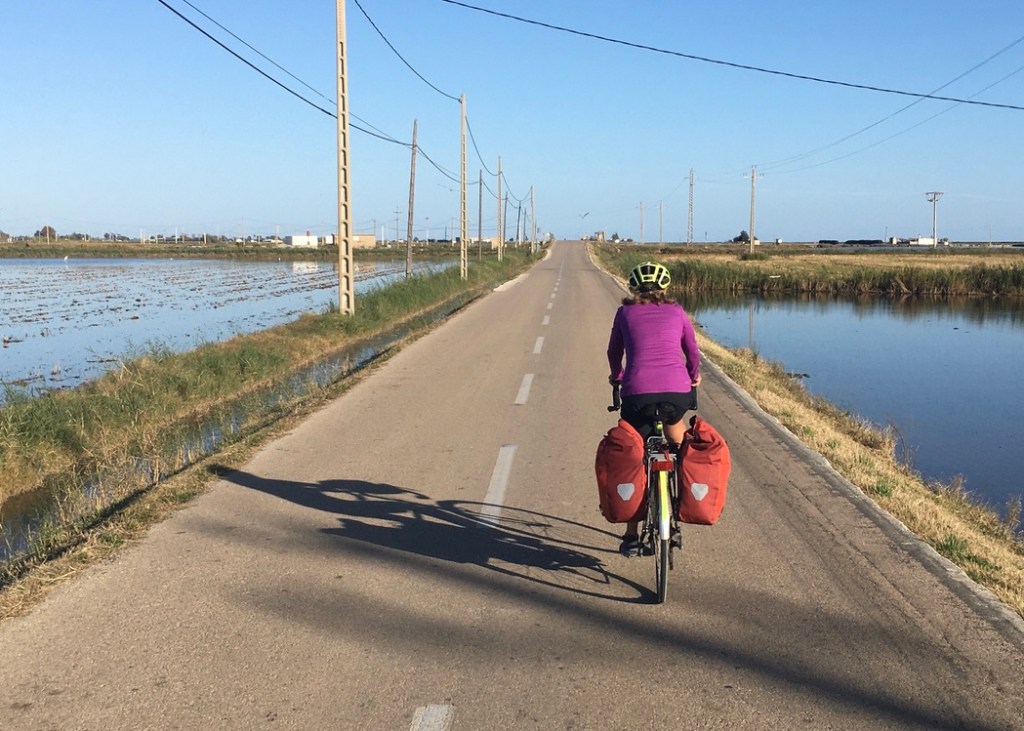
The big highlight of the week came late one afternoon about half way between Valencia and Barcelona, when we peddled slowly across the Delta de l’Ebro (the Ebro river delta).

For centuries the silt flowing down the longest river in Spain has created a wetland that bulges out into the Mediterranean, perfect for growing paella rice and a haven for migrating birds. Over 300 species live or pass through there each year – including grey herons, great egrets and thousands of starlings that were calling out to each other to get ready for the evening murmation.

It was a Sunday which meant that most restaurants were closed for dinner. So we stopped for a Menu del Dia (menu of the day) fish lunch and a complementary bottle of crisp white wine.

When we climbed unsteadily back onto our bikes to ride across the delta, Clare idly mentioned that we were lucky not to have lost anything or had any accidents on this trip. Unfortunately she spoke too soon!

Andy was so taken by the birds, by the open blue sky, by the watery light reflected in the sodden fields, that he unclipped his phone to take a few shots of Clare from his moving bicycle. Something he has managed to do many times before.

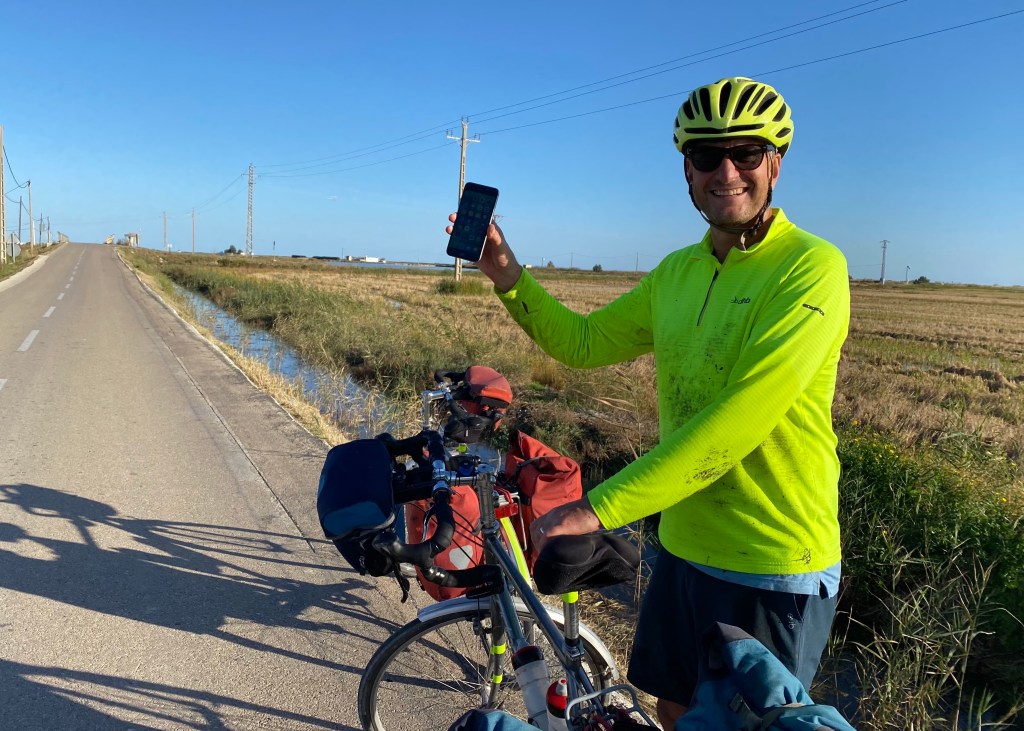
However, this time the phone slipped out of his fingers and with just one bounce it plopped into a ditch at the side of the road and sank into the water, leaving a few bubbles to mark the spot.

The last photo before the phone plopped in the ditch (to the left)

Without thinking, he immediately jumped off his bike and lay down on the verge to try and fish it out, his hands stretching further and further out into the muddy silt until his whole arm disappeared. Just as he was about to give up, his fingers wrapped themselves around a familiar smooth and solid shape.

Triumphantly he pulled out his phone, shouting with joy … only to find himself staring into the dark eyes of a very worried Spanish man.

“Mierda … pensé que estabas muerto!”

(Expletive … I thought you were dead!)

Hearing a commotion behind her, Clare had turned around and was amazed to find herself gazing at her husband lying face down in a ditch, the wheel of his abandoned bike slowly spinning beside him. She flagged down the first passing car and seeing her obvious alarm, they immediately leapt out to help.

Several more cars rolled up … it quickly turned into a small rescue party.

Which was just as well as it wasn’t at all easy to get out of that ditch. It was very slippery. Many hands were needed to pull Andy out.

Many apologies were needed to restore what was left of his dignity.

Predictably it was the phone that died. A black screen was soon staring forlornly back at us.

But this is a story with a happy ending.

After several days of tender loving care to dry it out, the phone came back to life … just for a few minutes. The next day it worked for about an hour. But the day after that it pronounced itself fully recovered and has been working perfectly ever since.

So the visit to the waters of the Ebro river delta was worth it after all! Together with Clare’s cycling tops and Andy’s cycling shorts, this phone is an old friend … they have all been on every one of our bicycle tours.

But we have made a few changes to our bikes this trip:

1. Bike stands: Incredibly useful for quick stops, picnic lunches and in crowded garages, they are well worth the extra half kilo in weight. We wish we’d attached them years ago.

2. New tyres: Continental Grand Prix 4 Season have replaced our trusty Schwable Marathon Plus. They’re more comfortable on smooth surfaces, not quite as grippy on gravel.

3. Mirrors: Kept on from Vietnam, they’re great for keeping track of each other and for spotting big trucks rumbling up behind.

As for mechanicals, we’ve only had two punctures … both to Andy’s back wheel, which is not surprising as it takes the heaviest weight (him, not the panniers!)

More seriously the shifter for Clare’s front derailleur broke back in Lisbon. When she shifted into a lower (easier) gear, the chain leapt over the middle chainring and landed on the smallest ‘granny gear’ … a dramatic change in power. Fortunately, she could get it back into the middle ring by shifting up again.

We checked it out with two bike shops in Portugal. Both rubbed their chins, declared it broken, told us the parts were impossible to get in these strange times and shrugged apologetically.

This means she’s been ‘double de-clutching’ (as she calls it) for over 2000 kilometres.

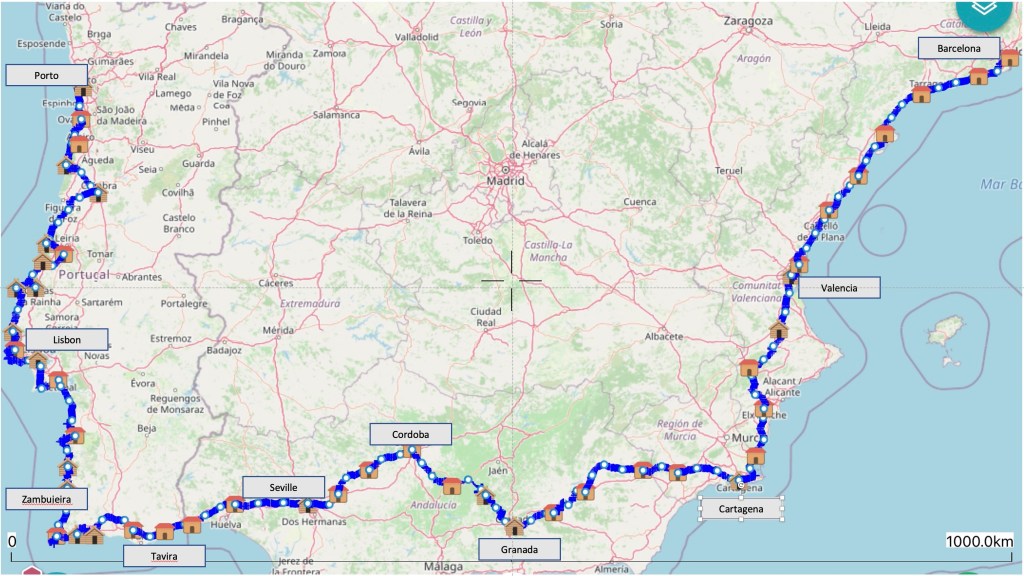
This journey around Portugal and Spain has easily been our longest bicycle tour so far:

2915 km pedalled

22,880m climbed (2.6 Everests)

193 hours in the saddle
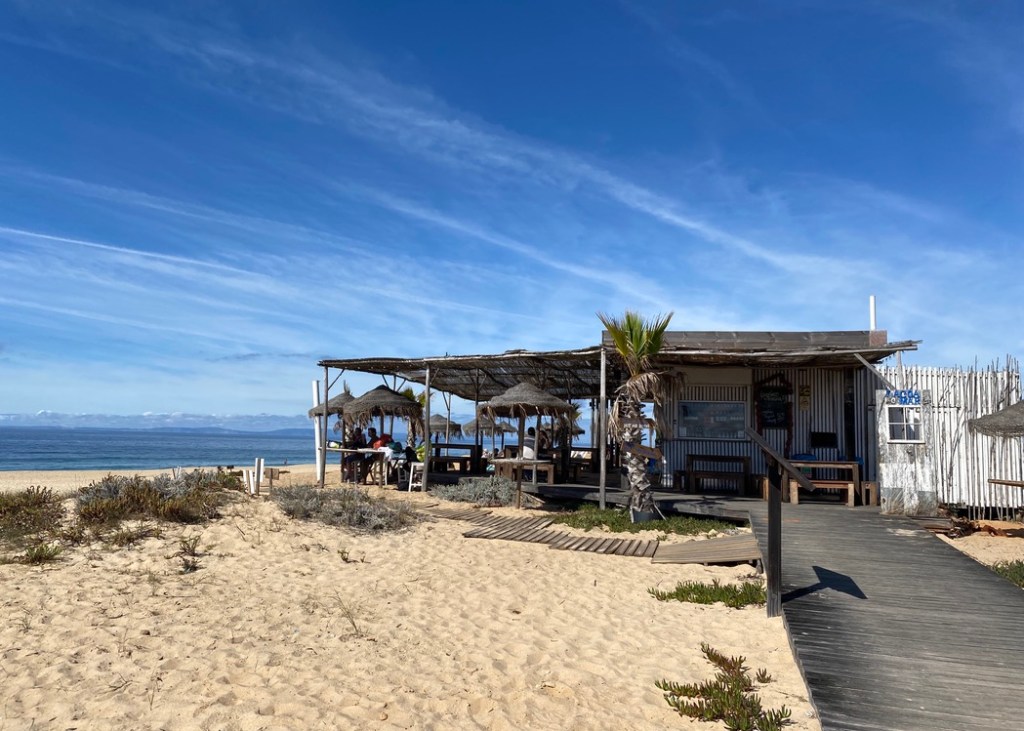
It’s also been our favourite.

Which has been something of a surprise … as it was only a late substitute for the ride we’d originally planned down America’s east coast.

A tough life in Sitges

Delightful late summer and autumn weather have certainly helped …. we’ve enjoyed endless blue skies, warmth and no rain since the 4th day of cycling! When the wind did blow, it was even-handed, dividing itself equally into headwinds and tailwinds.

Apart from a couple of small ferry river crossings, we’ve completed the whole journey on our bikes, pedalling for miles on well-maintained cycle paths and quiet backroads, with relatively small sections of busy main road or the dreaded ripio. Passing cars and trucks have been very courteous, especially in Spain.

Valencia

We visited eight magnificent cities … Porto, Coimbra, Lisbon, Seville, Cordoba, Granada, Valencia, Barcelona … all rich in history and culture.

Between those cities, the iMax view from our handlebars has created a new story at every corner … from the sand dunes of the Alentejo beside the wild Atlantic … to the orange plantations of Valencia beside the gentle Mediterranean.

Lunch stop in the Alentejo

The covid pandemic hasn’t affected us as much as we expected it to. A bicycle journey keeps you outdoors and away from other people most of the time. Both Portugal and Spain have both felt very safe, with relatively low case numbers and some of the highest vaccination rates in Europe. Everyone automatically pops on a mask when they go anywhere indoors.

Time will tell if we were lucky … as we write, travel bans are making a fresh comeback as the world becomes worried about the new Omicron variant.

Plenty of space

Staying in apartments was also safer during a pandemic. It meant we could cook for ourselves more often (especially vegetables!) and indulge in the washing machines. But we’ve also enjoyed learning about the food of both Portugal and Spain … a bit rich and meaty at first, we found that it gets better the more you understand it, helped greatly by Clare’s ever improving Spanish.

Valencian Paella

Lots of people have been asking us which parts of the journey we enjoyed most?

The answer is … all of it! But for those of you that love a list, here’s our league table:

  1. The Golden Triangle … from Tavira to Seville, Cordoba and Granada (589km)
  2. The Silver Coast … from Porto to Lisbon (639km)
  3. The Way of El Cid … from Cartagena to Valencia (342km)
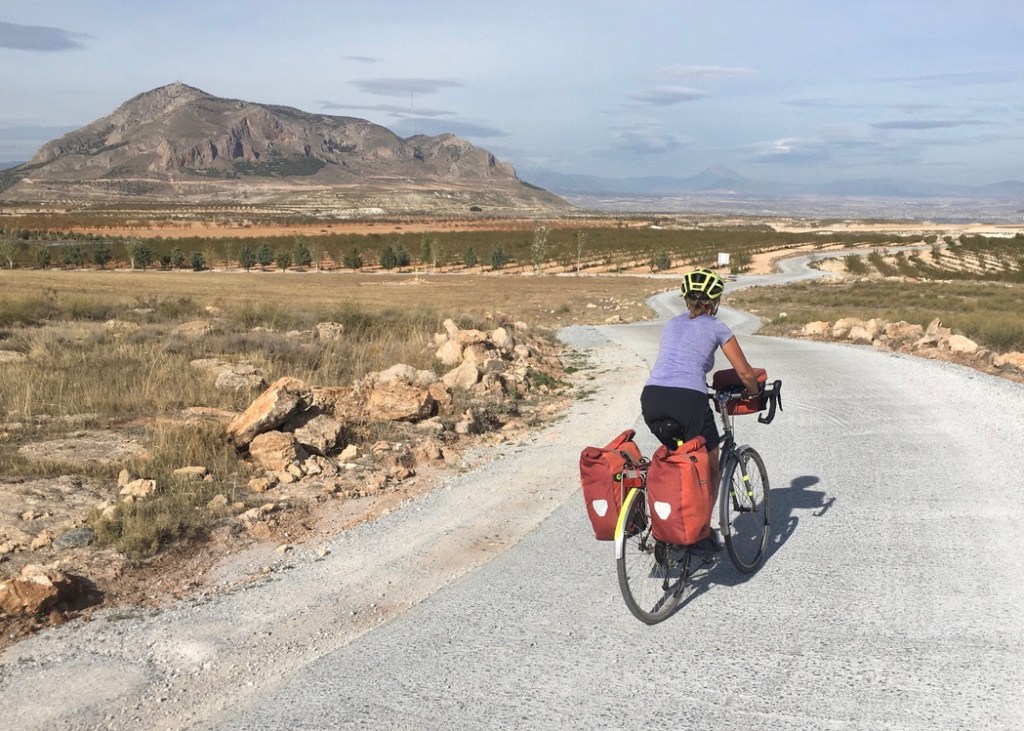
  4. Crossing the Badlands … from Granada to Cartagena (346km)
  5. The Golden Coast … from Valencia to Barcelona (450km)
  6. The Alentejo and Algarve … from Lisbon to Tavira (549km)
La Mezquita mosque cathedral in Cordoba, our favourite building

There were plenty of mixed feelings as we eventually rolled down Avenue Diagonal into Barcelona, the same road we’d used to enter the city five years ago on our first cycling tour.

Excitement at seeing Sarah. Looking forward to going home. Sadness that this surprisingly good bike tour was ending. Relief that our legs could have a rest.

Cruising down Avenue Diagonal (again!)

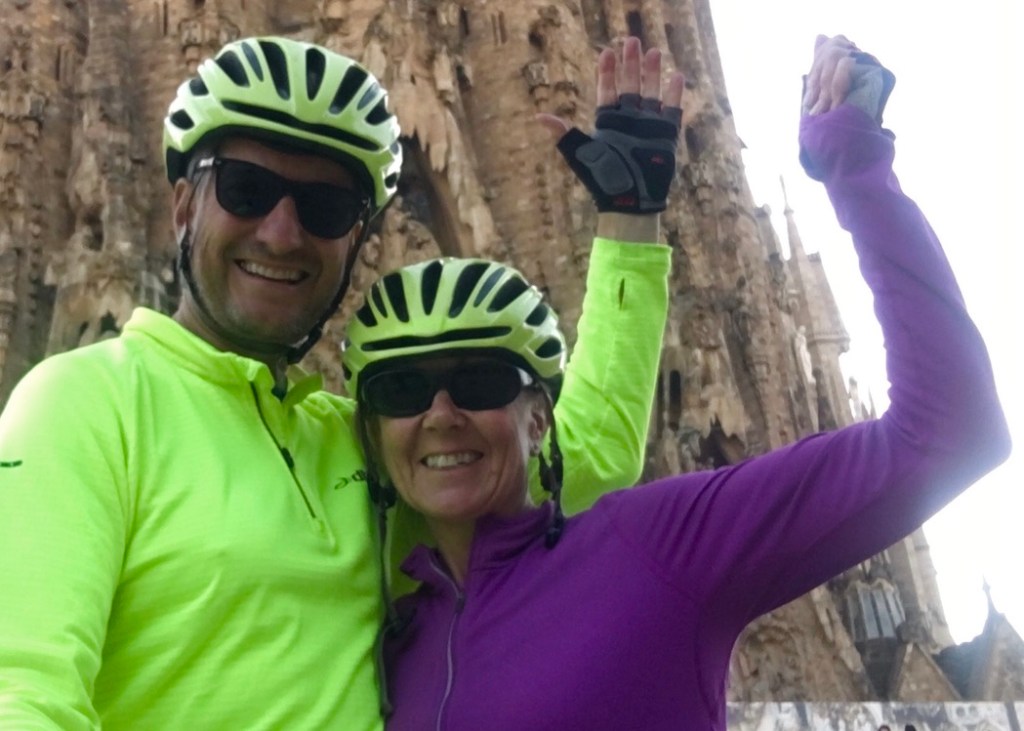
Once again we posed for pictures at the Sagrada Familia (Gaudi’s unfinished masterpiece) and by the sea at Barceloneta.

See if you can spot the difference …

2016
2021

Next Autumn we still hope to pedal down the east coast of America … world events permitting. It will need to be very, very good to match the supersub that was Portugal and Spain.

Thanks for following us on this journey. Until next year … muchas graciasmuito obrigado!

Clare and Andy

.

Strangers from another world

“Heyoooo … Heyoooo mister … Heyoooo mummy … Heyoooooo!!!”

Little people running out to us, waving, jumping up and down, huge smiles lighting up the dusty, parched landscape.

“Byeeeeeeee!!”

img_1529

Followed by noisy, excited laughter, gossip of what they’d said and how they’d waved to these two strangers from another world.

This was our soundtrack from thousands of children as we slowly pedalled by.

img_1533

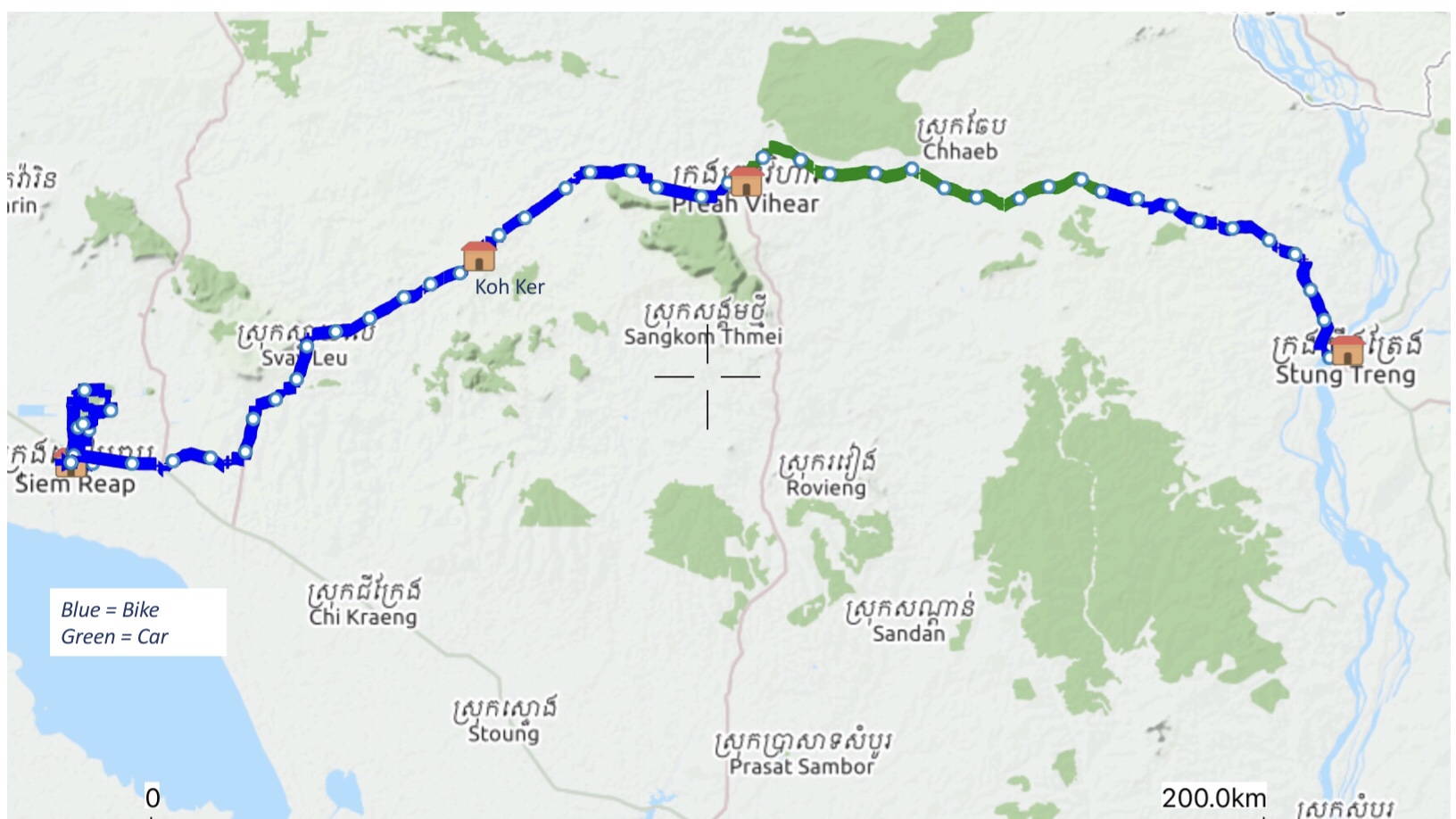
We were cycling along Route 64, a recently paved road that winds it’s way 300km across the remote north east of Cambodia from Siem Reap (home of the famous Angkor temples) to Stung Treng … our gateway to Laos.

It’s a rough, rural landscape that mixes open scrubland with smallholdings growing crops – cassava, peppers, bananas, sugar cane, mangoes, coconuts.

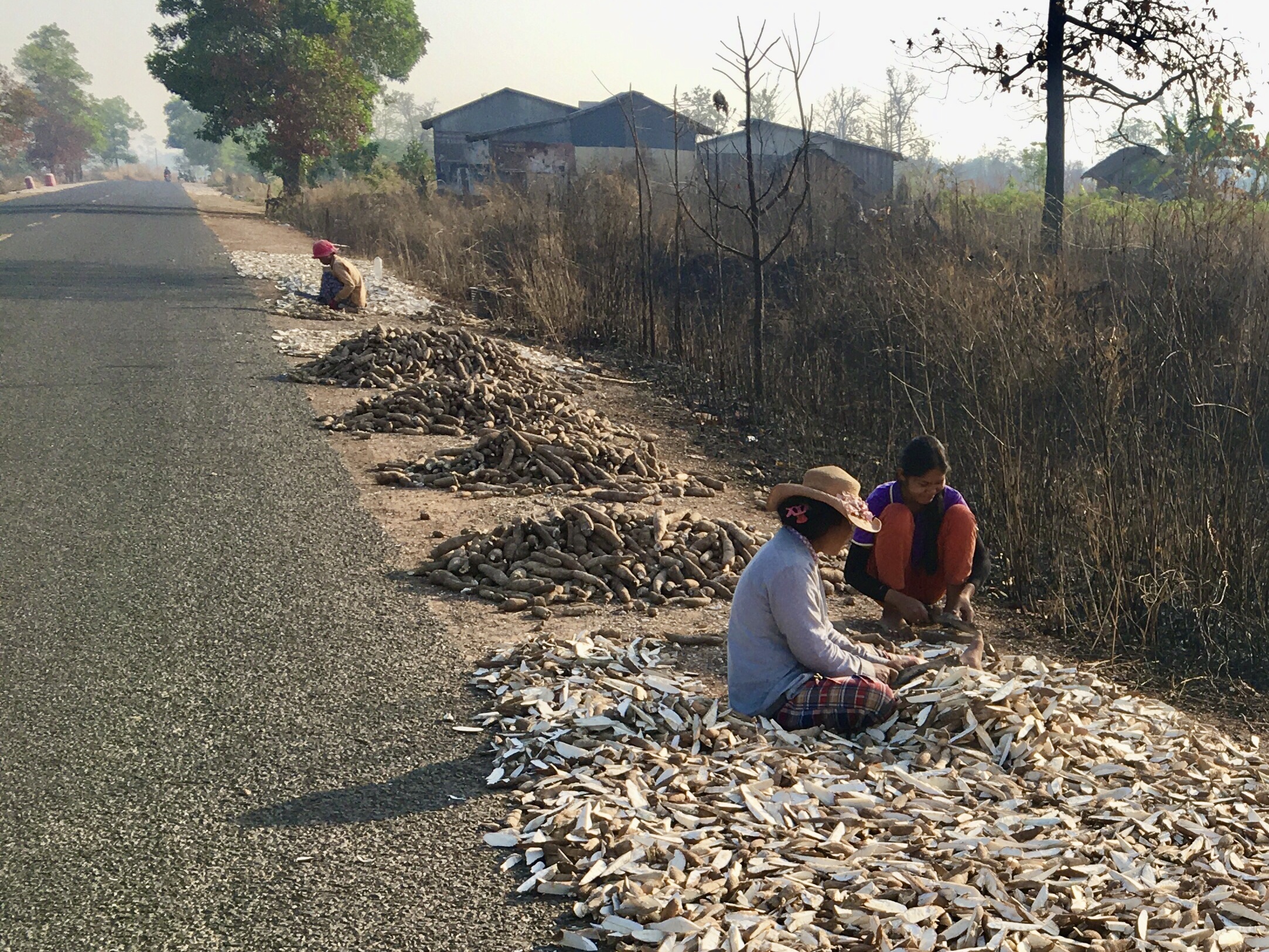
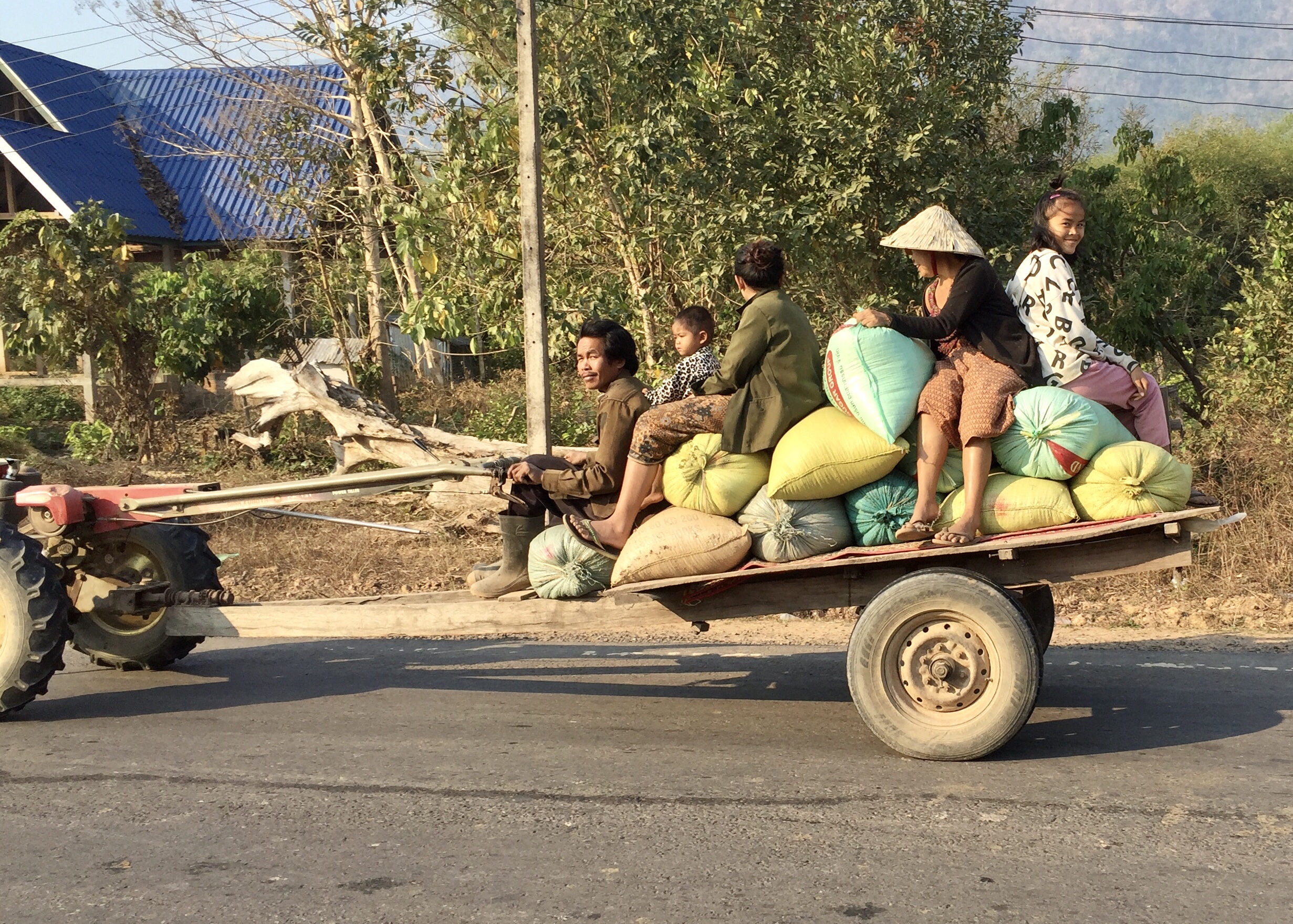
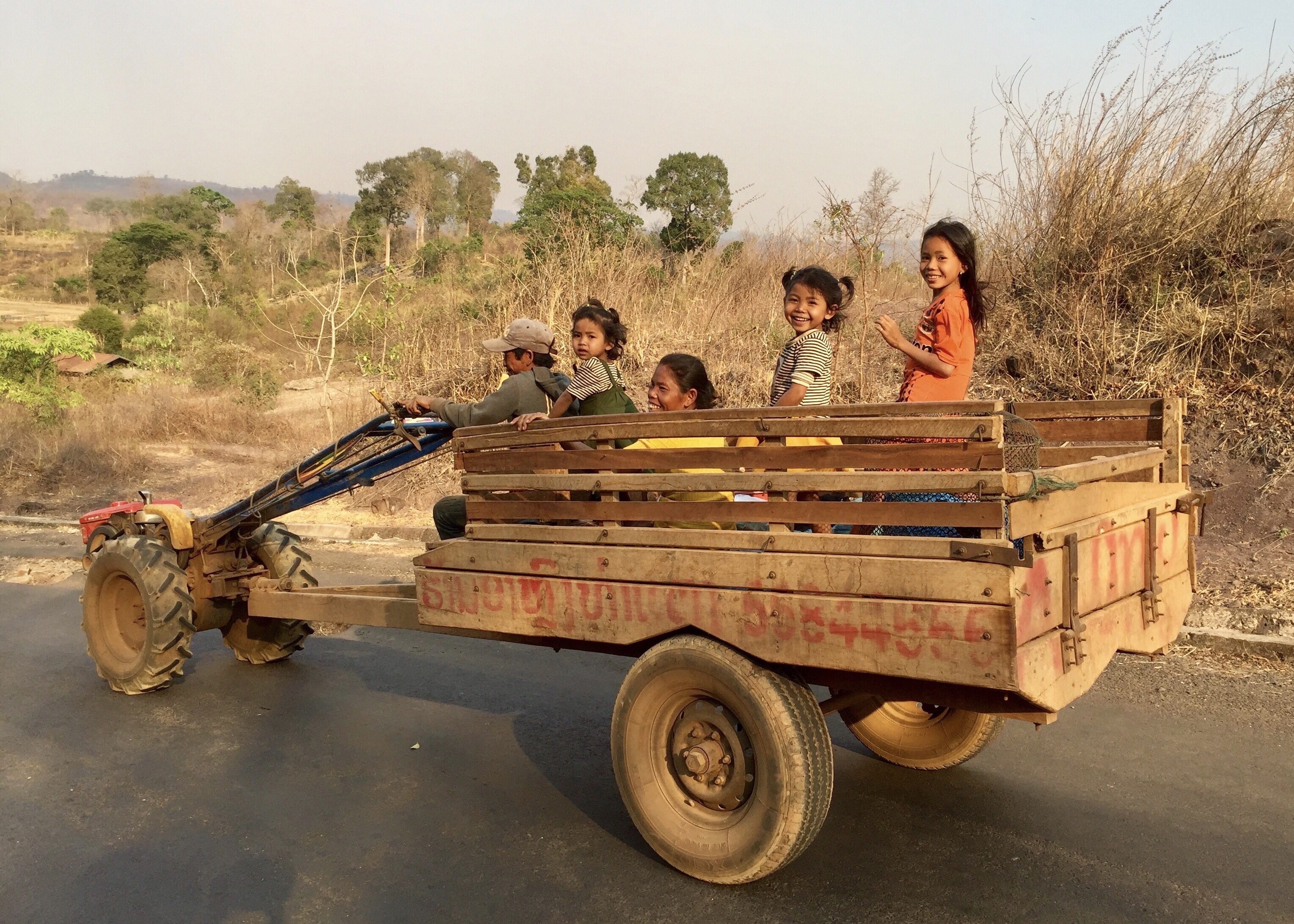
We were rarely alone. Houses are strung out on both sides of this dusty road. As well as the children, we were greeted by women chopping cassava to dry on the roadside or by young men passing by in two-wheeled tractors.

img_1592
Cassava is an important cash crop

img_1044
Two-wheeled tractor

Best of all was a father bringing a tiny child out to wave back at us and join in the fun. Or four children passing by on a motor scooter (the oldest driving but not yet a teenager) giggling “heyoooooo” in unison.

Cycling is the only way to have this kind of experience … walking is too slow, a motorbike is too fast, a car too enclosed and a bus is too busy.

img_1543

There is relatively little fast moving traffic on Route 64, especially east of the Mayan looking 10th century temples at Koh Ker. Most common are hawkers on scooters pedalling vegetables, eggs, salted fish, household items, ice-cream or huge blocks of ice … each with their distinctive call sign.

img_1458
Vegetable seller

Sounds like cycling heaven? Nearly, but not quite. It’s hot and dusty at this time of year and small towns that might have places to stay are spaced further apart than we would ideally like.

img_1512

This meant we needed to cycle just over 100km from Siem Reap to reach Koh Ker, our first destination. Most of it was slightly uphill, which would have been fine had we not been surprised by a persistent headwind.

This wasn’t an Irish gale. It wasn’t even a stiff breeze. But it was the kind of wind that makes smoke lean sideways. Enough to make you feel that you’re pushing the air aside as you ride through it. And it never stopped!

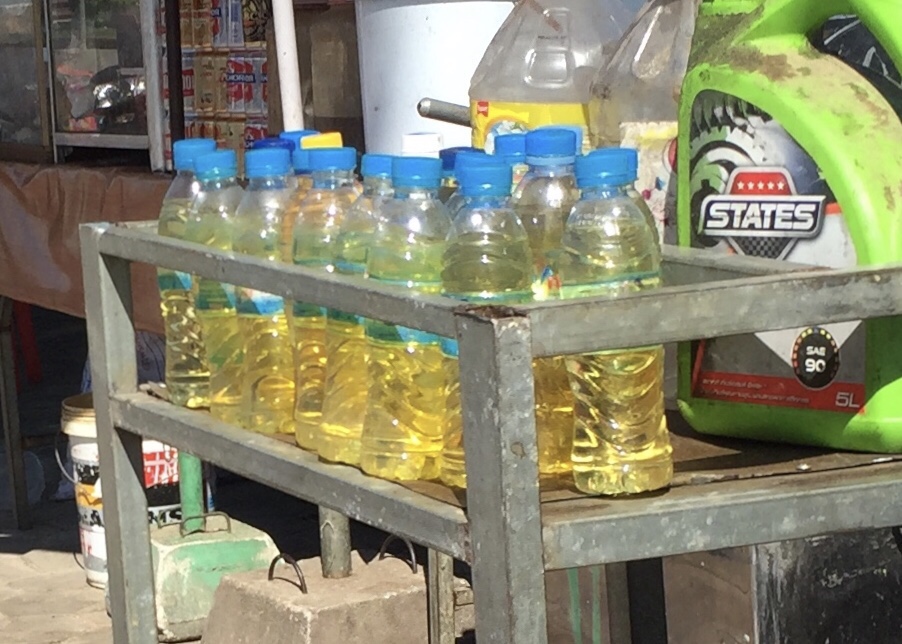
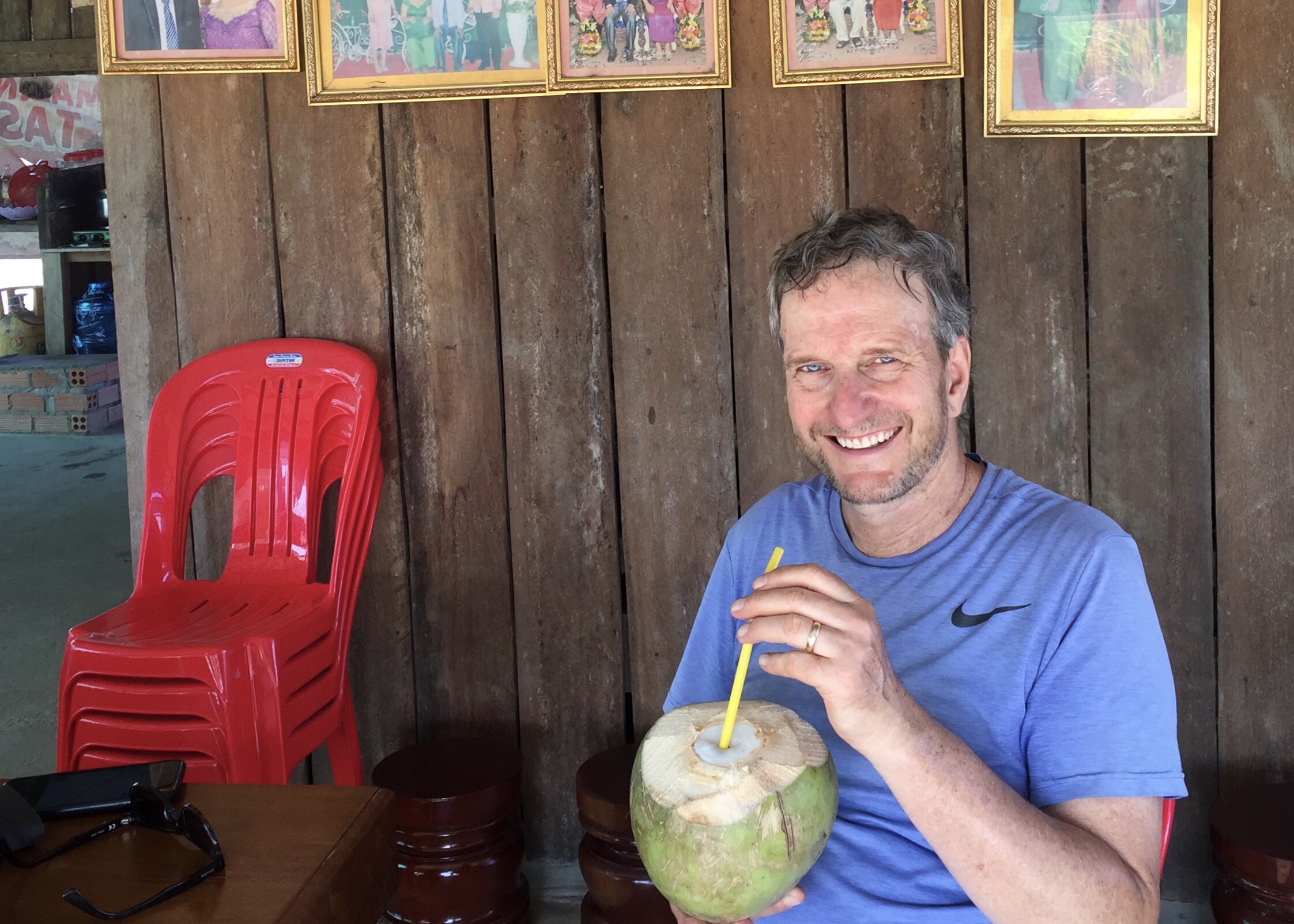
Luckily, there were lots of places to pause and rest. Nearly every house is a shop of sorts, selling petrol in old water bottles, strange snacks and best of all … fresh coconut water. Delicious and cool, it slipped down like a reviving nectar.

img_1039
Petrol station

Much to the locals surprise, we drank a whole coconut each, about half a litre. They had no idea how dehydrating it is to cycle into a warm wind all day. As the day wore on, our stops became more frequent … every 25km, then 15km, then struggling to make 10km.

img_1006

The following day was a manageable 65km from Koh Ker to the county town of Preah Vihear. Then we faced a choice … cycle 140km to Stung Treng in one day, stay overnight at the only guesthouse in a small town called Chhaeb (Google review – “only stay there if you have to”) … or find alternative transport.

The minivans that serve as buses couldn’t squeeze us in. So without any expectations, we wandered down to the local taxi rank to see what we could find.

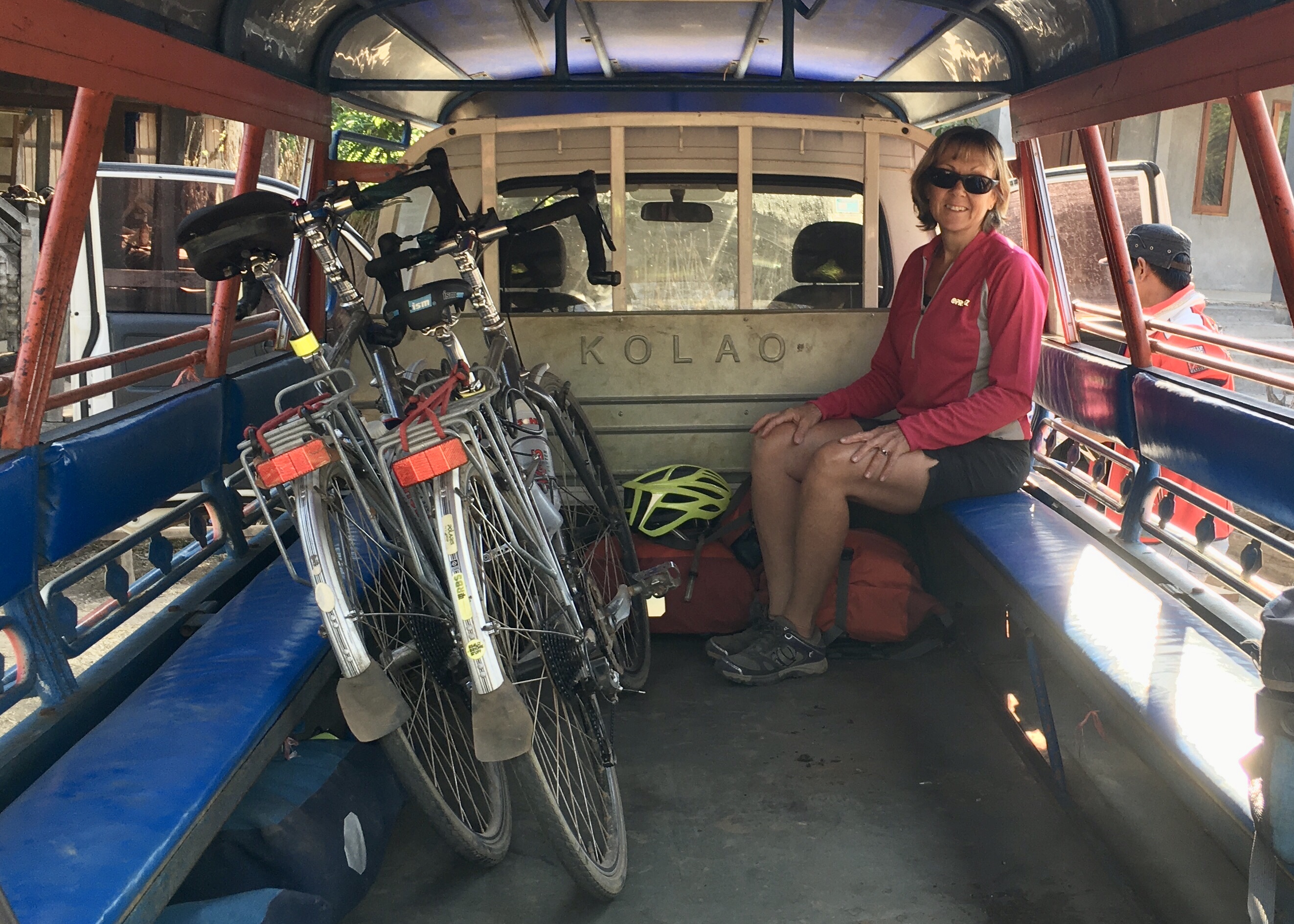
Leaving the next morning at sunrise in Atith’s taxi was possibly the best $30 we’d ever spent. He dropped us off a few kilometres beyond Chhaeb with a pleasant 70km still to cycle. As we put the front wheels back on our bikes in the middle of nowhere, Atith could not hide his amusement at these strangers from another world. He found the whole thing hilarious!
But it turned a tough day into a really enjoyable day.

img_1626
Thanks Atith

It also shows how much we’ve changed over the years, especially Andy. We’re now more interested in the experience than the journey. And as longtime readers will know, we’ve never claimed to be real touring cyclists!

img_0459
What’s in a letter?

Angkor with an ‘o’ means ‘city’ and is the name of the great civilization of the Khmer kings who ruled Cambodia from the 802 to 1432.

Angkar with an ‘a’ means ‘the organisation’ and is the name the Khmer Rouge used for its own leadership.

Angkor is the country’s national pride and celebrated everywhere, on the national flag, on money, as the leading brand of beer.

Angkar is Cambodia’s deep trauma.

Back in Phnom Penh, Cambodia’s capital city and in Siem Reap, it’s major tourist attraction we were able to learn a little of both Angkar and Angkor.

img_1515

Of course, we’re not qualified to comment on the terrible atrocities the Khmer Rouge regime inflicted on the Cambodian people from 1975-79, except to say that it still feels recent and raw.

The two sites we visited in Phnom Penh were simply and sympathetically presented. Much is left as it was found and visitors are guided by an excellent audio system that tells the story and creates an atmosphere of quiet reflection.

No-one was taking lots of photographs on the days we were there.

First to the notorious S-21 security prison. Housed in an old school in a quiet suburb, an estimated 20,000 victims were incarcerated and brutally tortured there until they made false confessions. There were only 12 known survivors, each because they had a skill that was useful to their captors.

img_1190
The rules at S-21

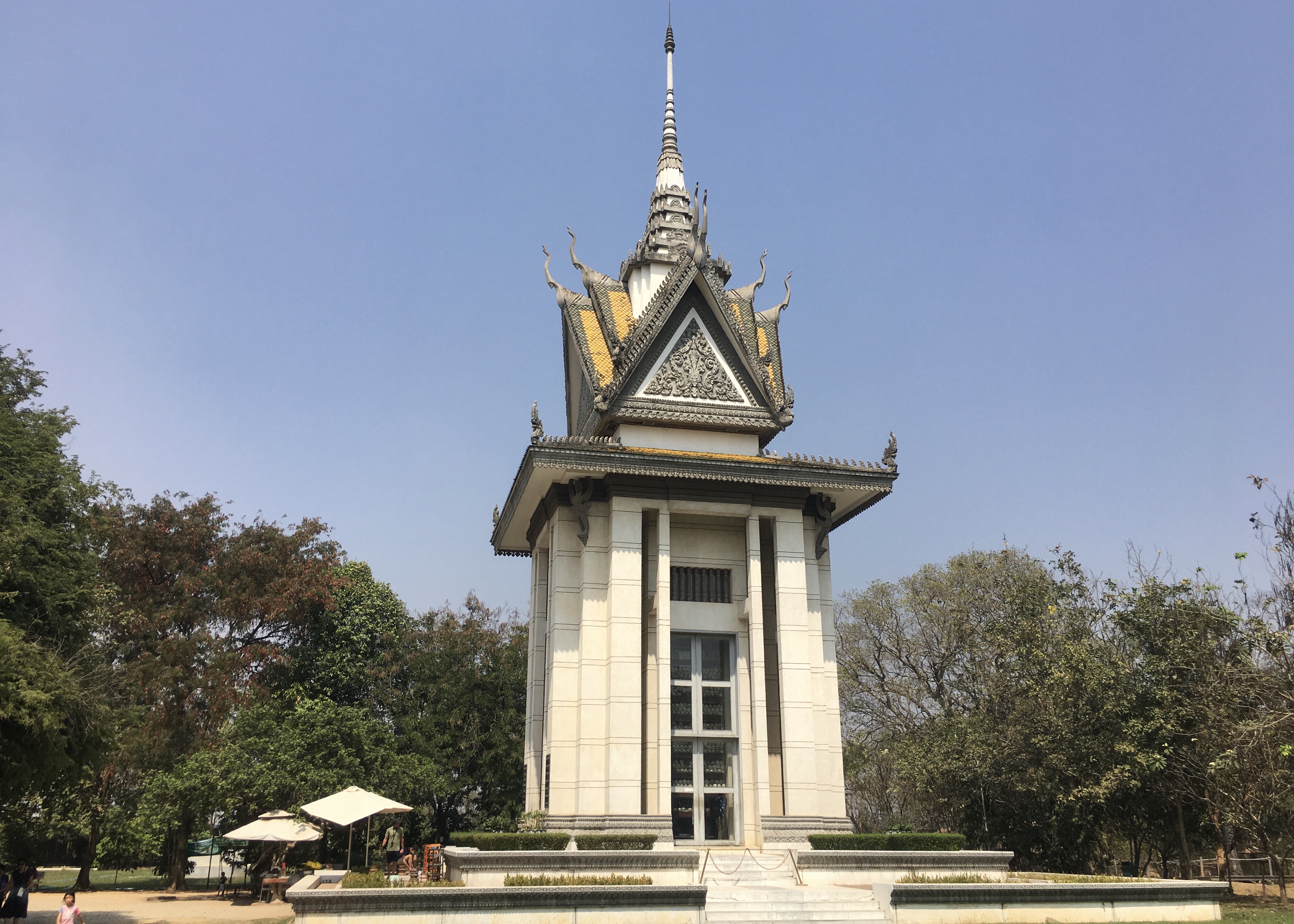
Then to Choeung Ek, one of 300 ‘Killing Fields’ spread across the country. The people in S-21 were taken here in the middle of the night for execution, made to kneel down beside an open grave and killed with a rough agricultural tool as bullets were too noisy and too precious.

Estimates vary but roughly 2 million people died, a quarter of the population.
img_1215
The Memorial Stupa at Choeung Ek, with more than 8000 skulls inside

We had travelled the 320km from Phnom Penh to Siem Reap by bus to avoid several days of cycling on a busy, featureless main road. This was by far the most hassle free bus journey we’ve ever made with our bikes, which were safely stowed in the hold without the need for packaging or removal of wheels.

Cycling around the Angkor complex of temples was pure delight.

img_1317
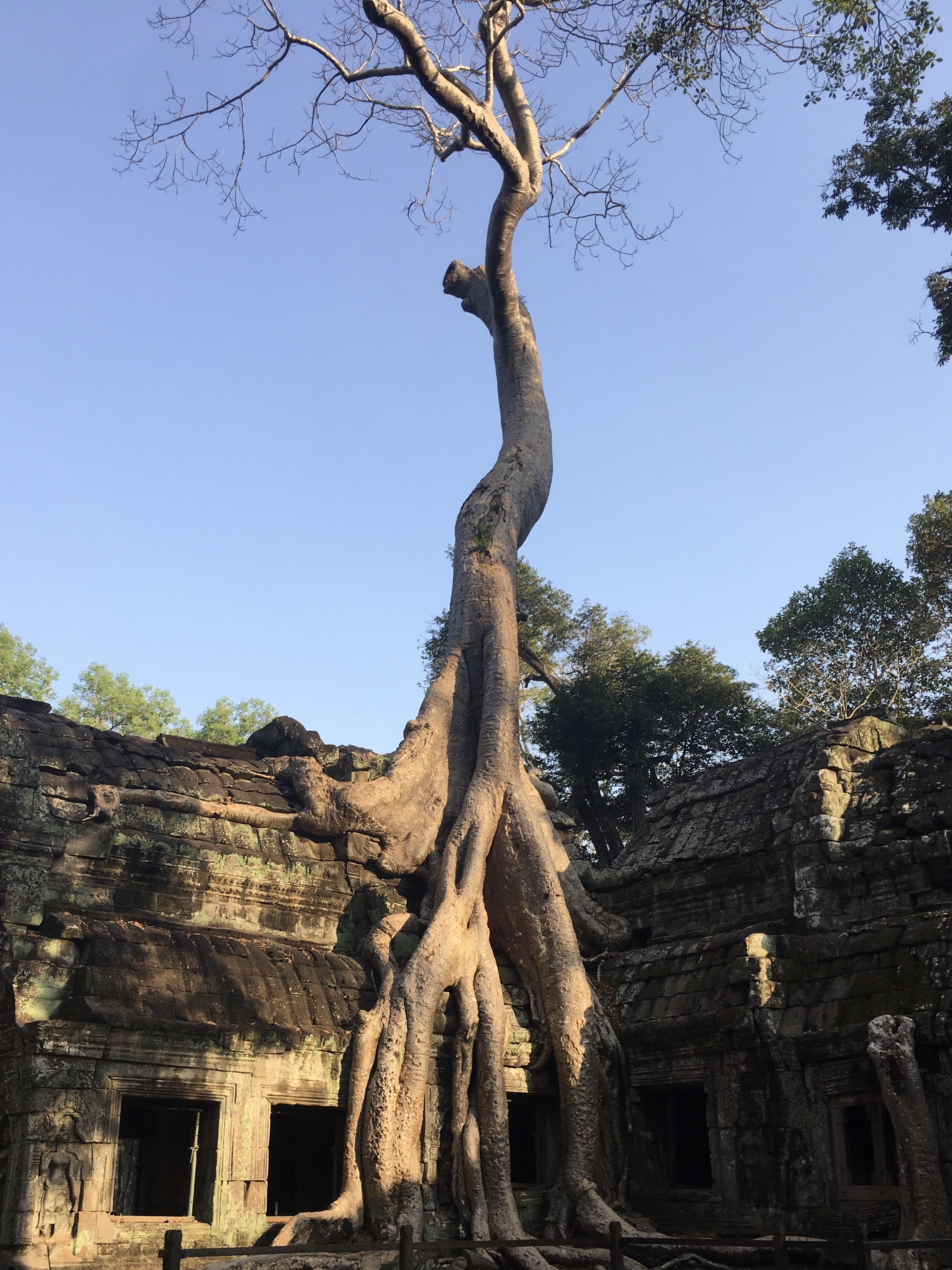
Ta Prohm, the Tomb Raider temple

It’s a vast area, a city that boasted a population of around 1 million people at a time when London was a small town of 50,000. Most of them were engaged in building ever grander temples for each successive Khmer God King as they switched from Hinduism to Buddhism and back again.

img_1411
Apsaras, female dancing spirits

The gateway to Angkor is 8km outside Siem Reap so a tour of a few temples adds up to a proper bike ride of around 50km each day.

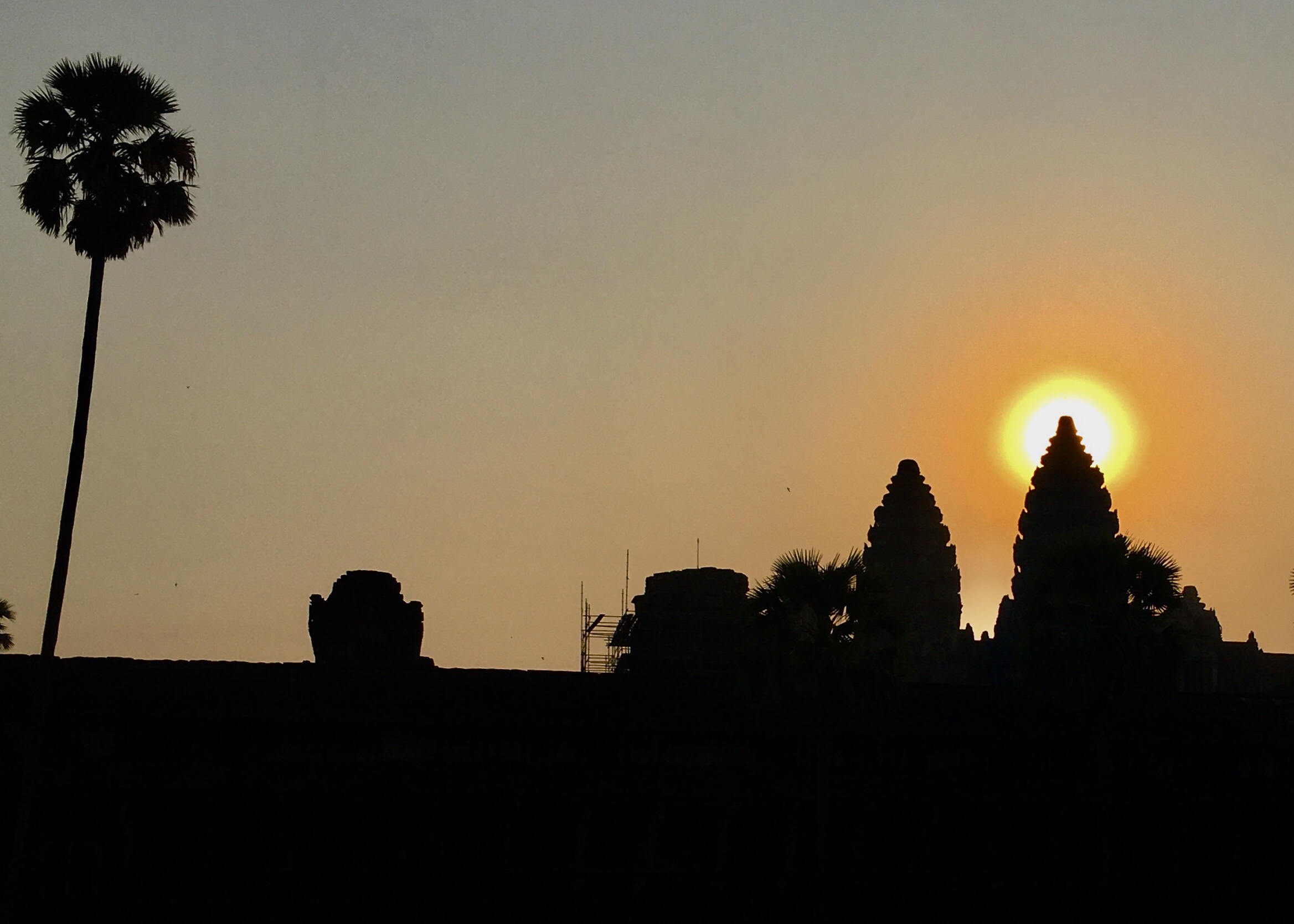
We saved the best until last. Angkor Wat at dawn. It was genuinely a spine-tingling moment to emerge through the outer gates and see the lotus-bud towers lit from behind by the sun of a new day.

As was ascending the precipitous steps to reach the kingdom of the gods.

img_1375

After 600 years, the empire of Angkor fell into decline partly as a result of over-population and deforestation. A lesson for us all today perhaps?

img_1402

As we cycled away from Angkor Wat towards Stung Treng, there were many quirky things we enjoyed about rural Cambodia … such as the hawkers on motor scooters and the petrol in plastic bottles,

Here are a few more:

Every house is a shop but it’s not a shop as you know it. Customers pull up outside on their motor scooters and shout their demands to the shopkeeper. There’s no browsing and you get a very odd look if you try to go inside!

Bright coloured pyjamas are all day wear for many rural Cambodian women.

Wooden houses are built on stilts, not so much for risk of flooding but to provide a nice shady area to swing in a hammock in the heat of the day.

img_1605

Baguettes are everywhere … a legacy from the French colonialists.

Instant coffee is only available as pre-mixed ‘3 in 1’ with milk powder and sugar. Yuk!

It’s another world … isn’t it!

Clare and Andy

Cycling with your husband

A few people have asked me for some tips on how to stay safe, healthy and happy while cycling with your husband in a place like South East Asia.

I’ve had plenty of time to think about this whilst peddling across rural NE Cambodia and, in the last few days, pushing my bike up a seemingly endless 1200m climb in Laos (we’ll tell this story in our next blog post).

So here are my tips:

Tips to say safe

Follow Andy’s rules of the roads. This has surprised me as my natural instinct is to stop whenever I sense danger. Here, I’ve become a road warrior, maintaining speed and direction … and never ever stopping.

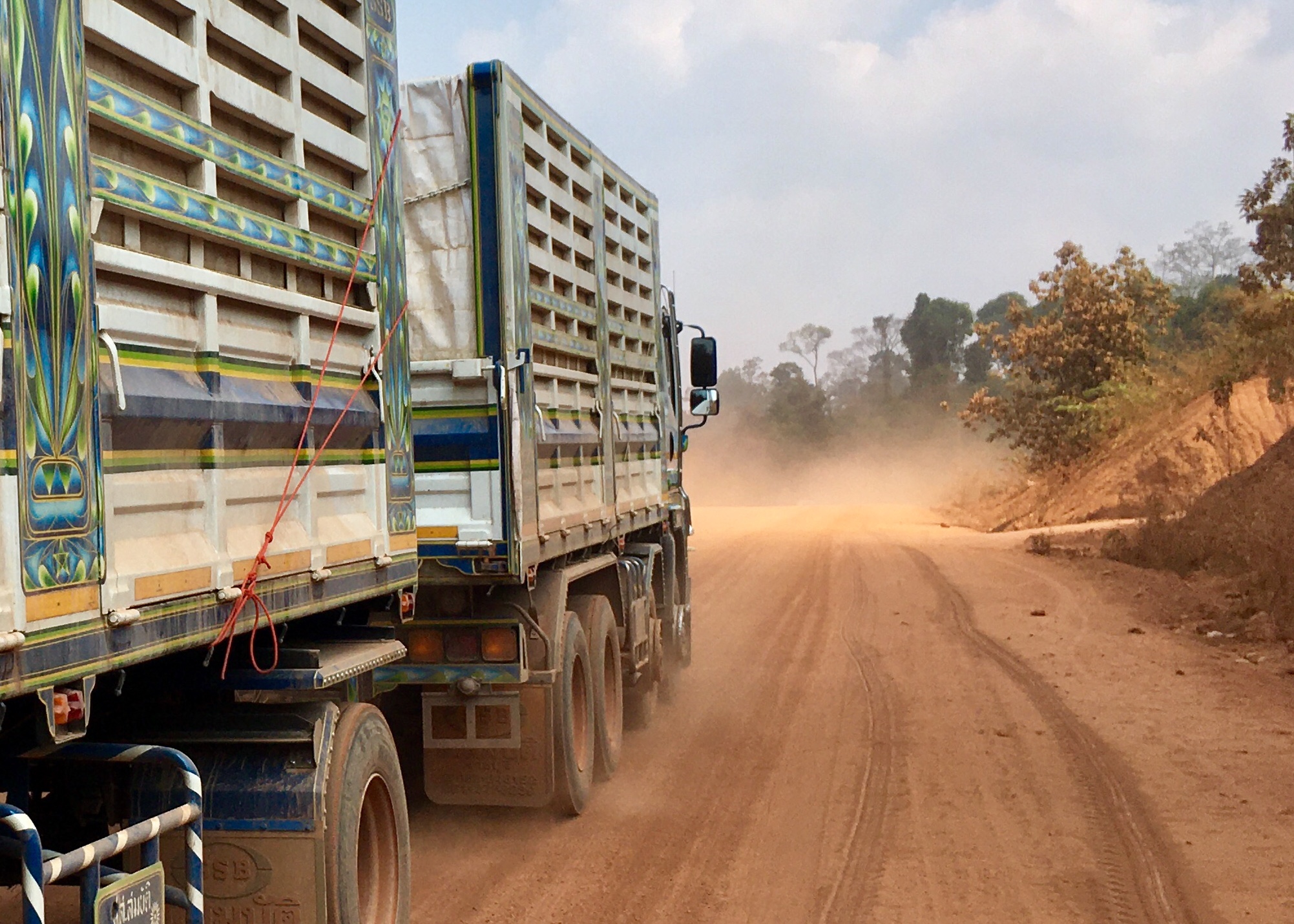
Don’t let him take side roads unless you can see tarmac. They’ll either be rocky and bottom-pummelling or sandy and dusty. A passing truck will inevitably cover you in a gritty cloud of red dust.

img_1890

Start cycling at sunrise to avoid the midday sun. So far, the intense heat has curdled my shampoo and heated my water bottle enough to brew a decent cup of tea. It’s also a beautiful time of day and there’s usually far less traffic on the road.

Use suntan lotion sparingly. It was impossible to buy more in rural Cambodia as the locals don’t use it. I’m not even sure they know what it is as people found it very funny when we put some on.

Respect local customs. Covering up your shoulders and knees in rural areas and at temples is polite, even when it’s 33 degrees.

Make him ride in-between you and any dogs. I was chased 3 times before he realised it was his manly duty to protect me.

img_1576
Or just get some new wheels …

Tips to stay healthy

Persuade him to take a rest. A few days pottering around the 4000 Islands in southern Laos on the mighty Mekong was restful, replenishing and reflective.

Don’t expect to always get a perfect coffee. Sometimes it comes with condensed milk that sits at the bottom of the cup. Just be grateful you’re having a coffee break at all.

Drink lots of water. Tap water is not safe and whilst refillable water stations are becoming more popular, they’re not yet freely available. Sadly, plastic waste is a real and obvious problem. It feels weird buying a big bottle of water and immediately pouring it into our cycling bidons.

Drink fresh coconut water whenever it’s available … it’s delicious and refreshing! Bottled fruit drinks are usually sticky and very sweet but Japanese green tea flavoured with honey & lemon has become another favourite.

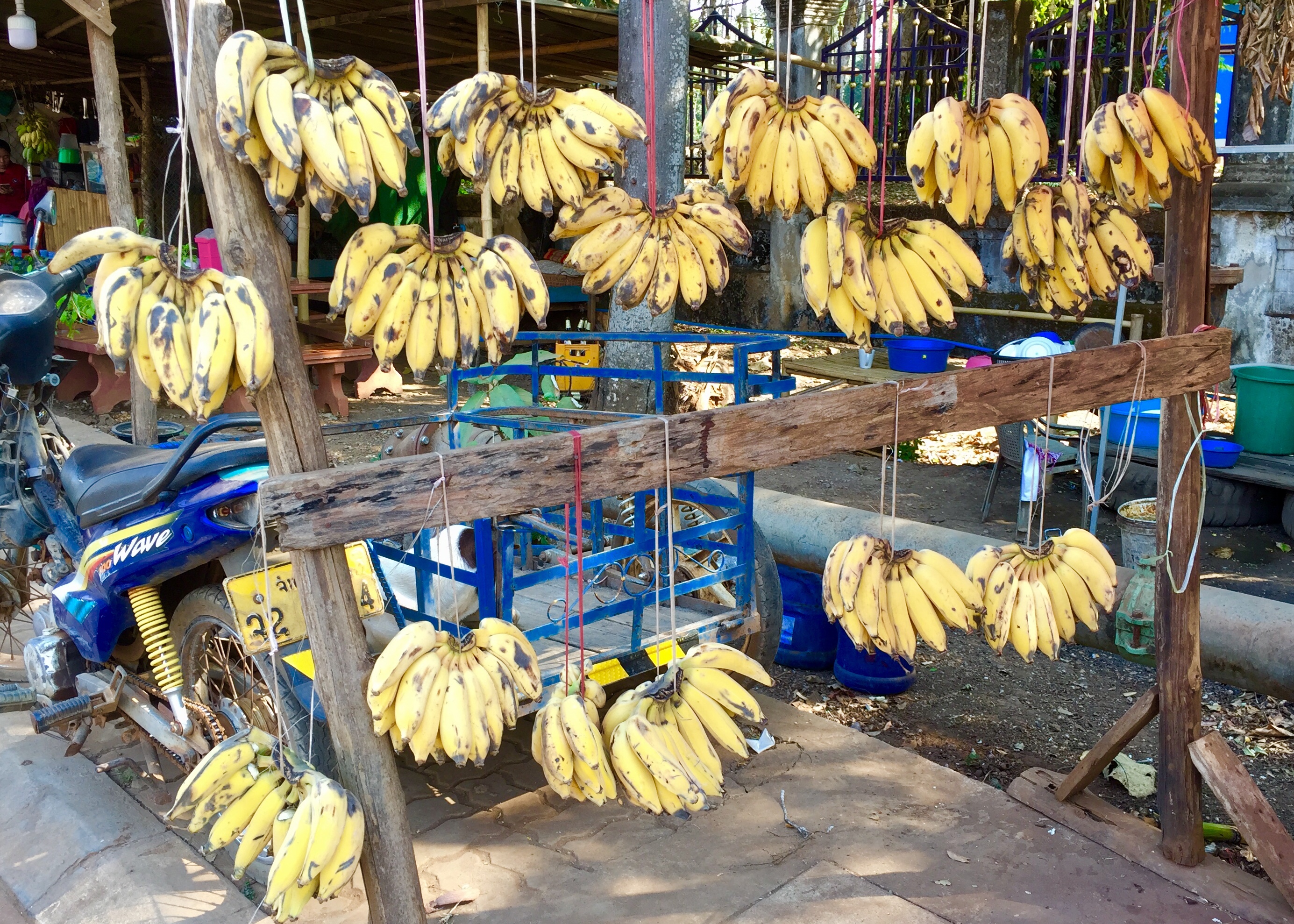
Eat bananas. They’ve become our staple cycling snack. You can only buy them in big bunches … but he can manage the extra weight in his panniers.

Eat well … today’s food is tomorrow’s fuel. We’ve found the food in all three countries to be really good. Local family-run places offering home cooked meals are often better than bigger (more expensive) restaurants.

img_1581
50 cents a bunch

Tips to stay happy

Mentally add at least 20% extra to the distance and elevation he’s suggesting for the days ride. That way you won’t have a meltdown when there’s still 10km uphill or off-road to go.

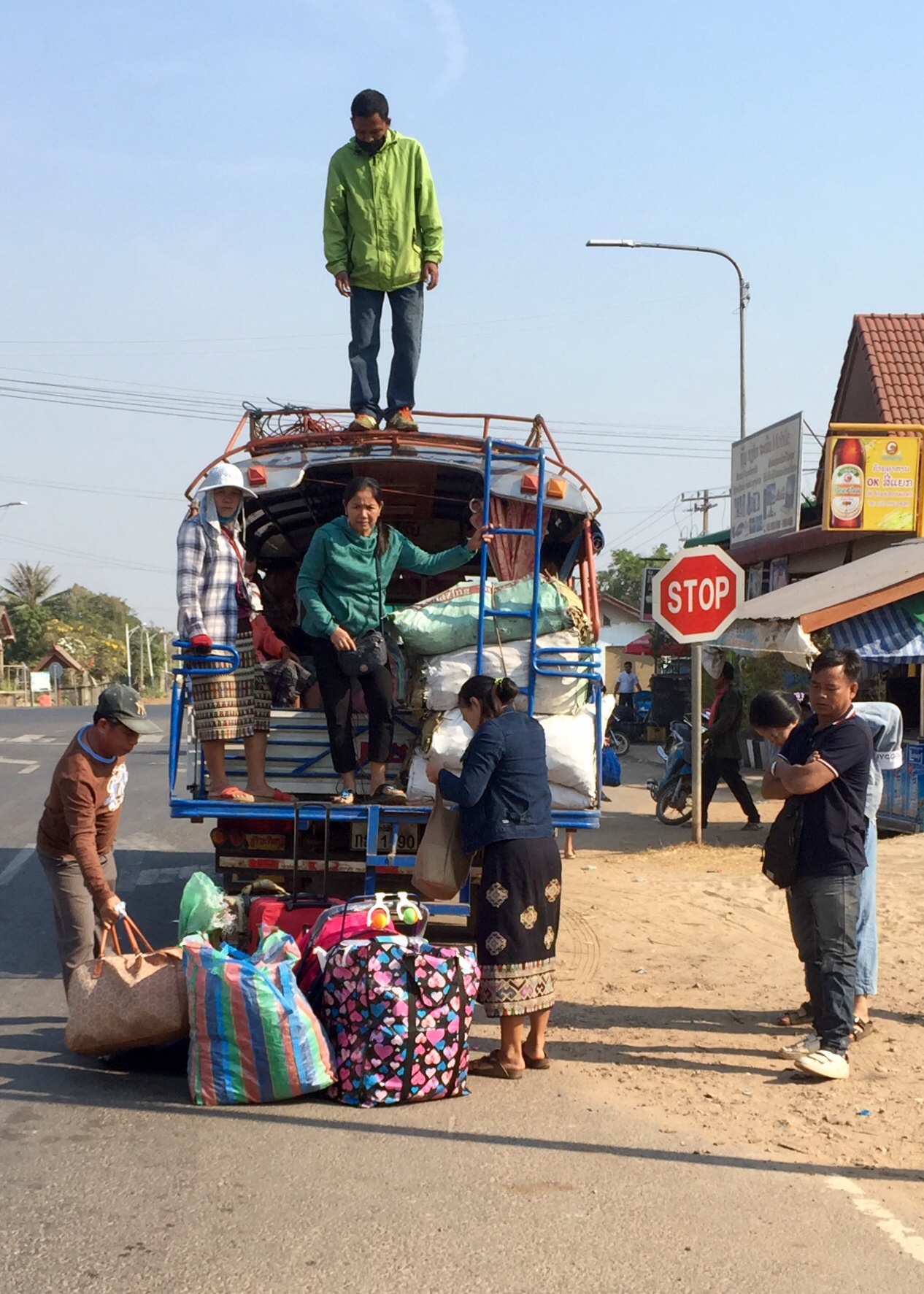
Take public transport if the distance and elevation he’s suggesting is too much.

img_1560
Sadly there was no room on this one

Get to know the currency. There are no coins in Vietnam, Cambodia or Laos and the notes look very similar especially when they’re well worn. The 50,000 Laos Kip note (about £4.50) looks almost the same as the 5000 Kip note (45p). Andy has got it embarrassingly wrong a few times!

Stick on your headphones when the going gets tough. Gazing out at beautiful scenery is wonderful, but it’s not beautiful all the time. When it becomes less interesting or your backside starts aching, you need a distraction. A podcast or talking book works for me.

Make sure there’s a decent shower to get rid of the dust wherever you stay. We’ve slept in a wide variety of places from homestays to luxurious hotels (very good value at the moment because of the coronavirus). Often the cheapest is the best … right now we’re in a typical Laos room on stilts in a lovely guesthouse for £7/night.

img_1633
Our room at Palamei Guesthouse, Tad Lo

Travel light. A good thing about travelling in warm climates is that your clothes dry really quickly. I’m getting used to wearing the same things again and again so next time I’ll try to bring even less. A hotel hairdryer remains a nice surprise but is no longer a necessity – my pink hair roller still does the job well!

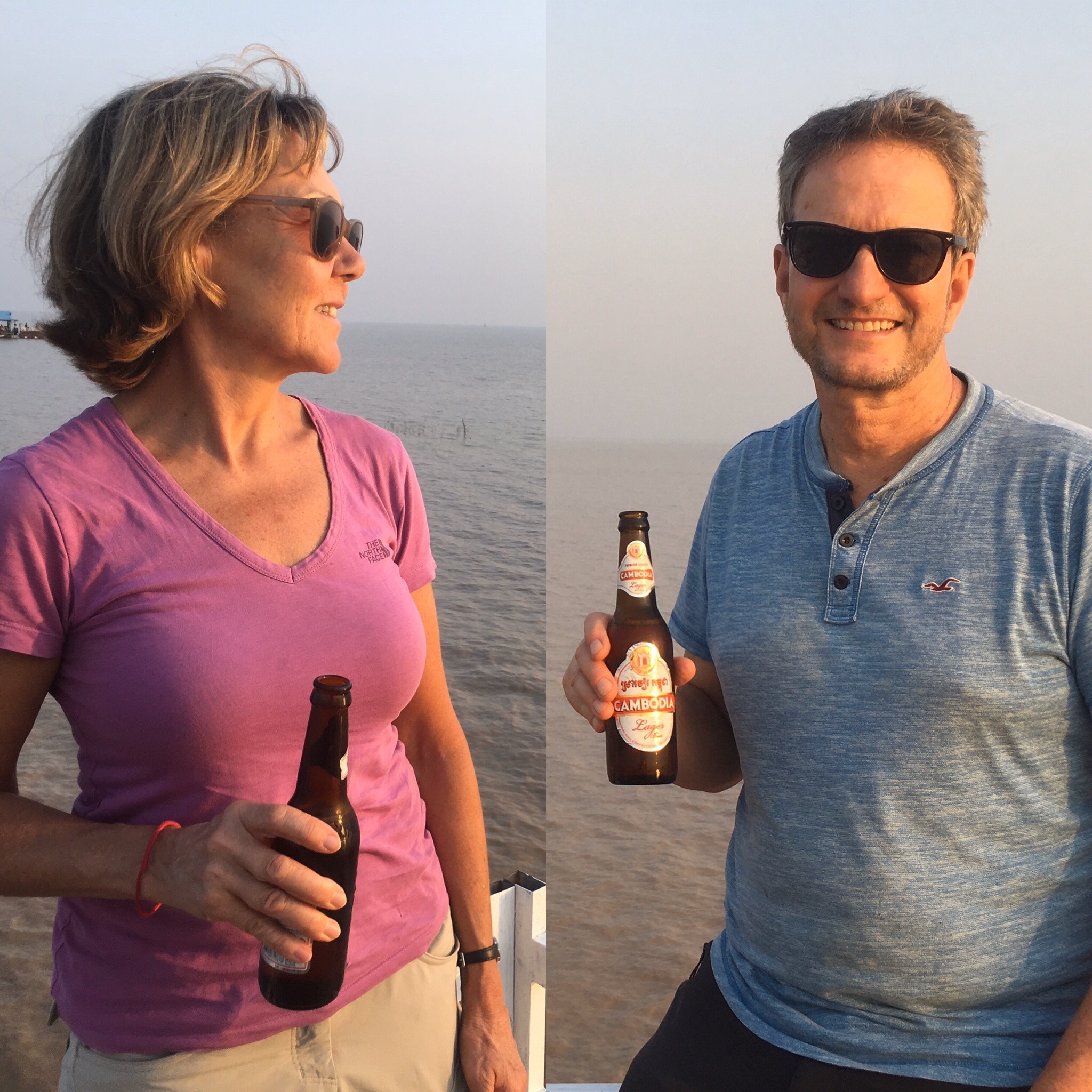
And finally … join your husband for a cold beer at the end of the day. It’s tastes great here and is usually the cheapest drink on the menu!

After all … there’s no gain without pain. And he’s still the best cycling buddy a wife could want!

Clare

96585559-432b-458b-a209-835d4c6b60f3

Laid back in Laos

We only started to get worried when the border guards summoned the bossman to examine our passports for a third time, all stern and officious in his crisp green Vietnamese army uniform.

Quite reasonably, they were on high alert for the coronavirus.

Our temperatures had already been checked and two masked officers had carefully scrutinised our passports, checking and double checking each stamp to make 100% sure we hadn’t recently been to China.

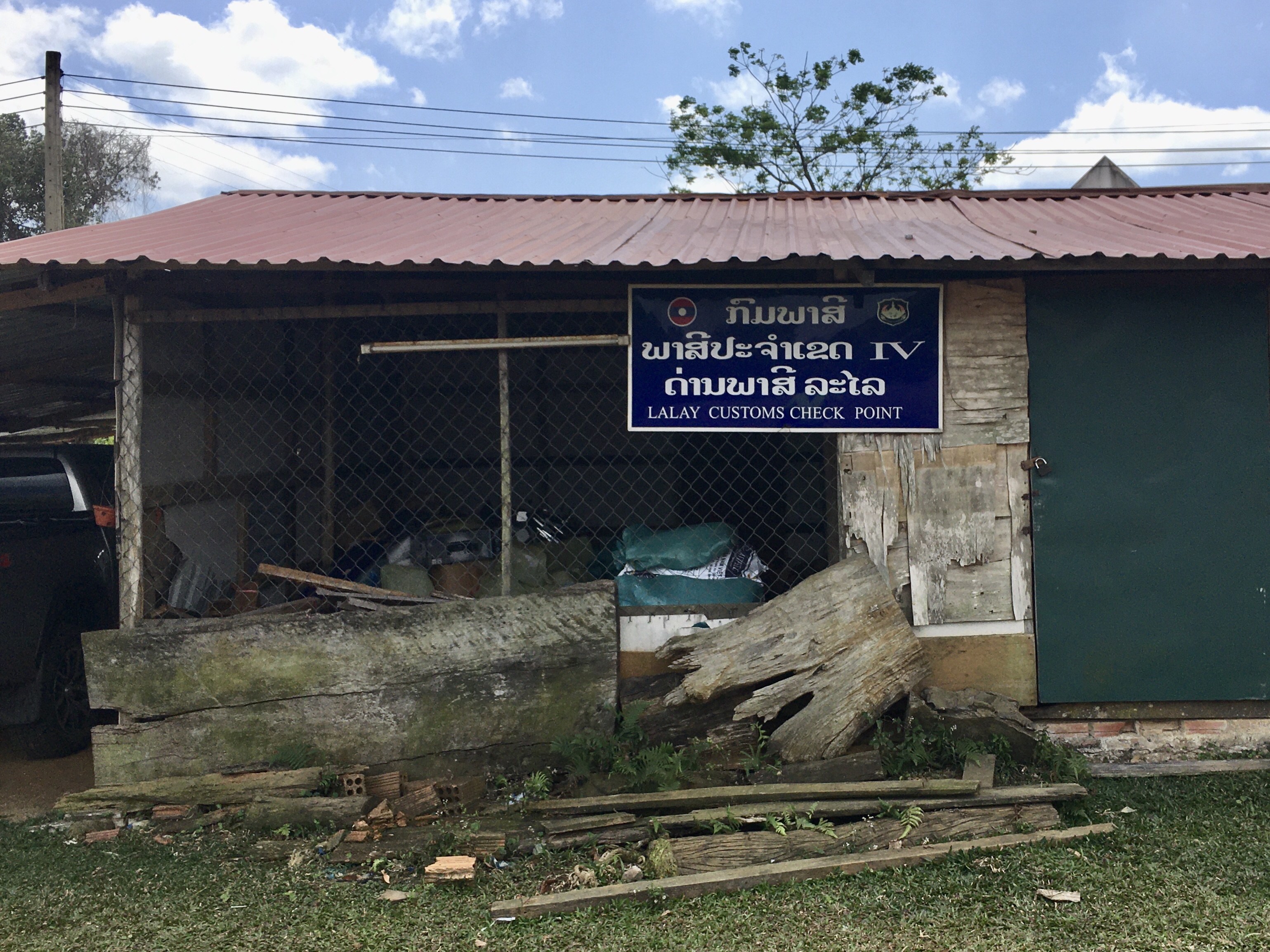
A few days before, we’d read that some travellers had been turned away from remote borders (such as this one at Lalay) if they had a Chinese visa in their passport, no matter how out of date it was. Andy has three Chinese visas (a legacy from his old job), the most recent of which expired in 2015.

img_2110
Part of the Lalay Border Post

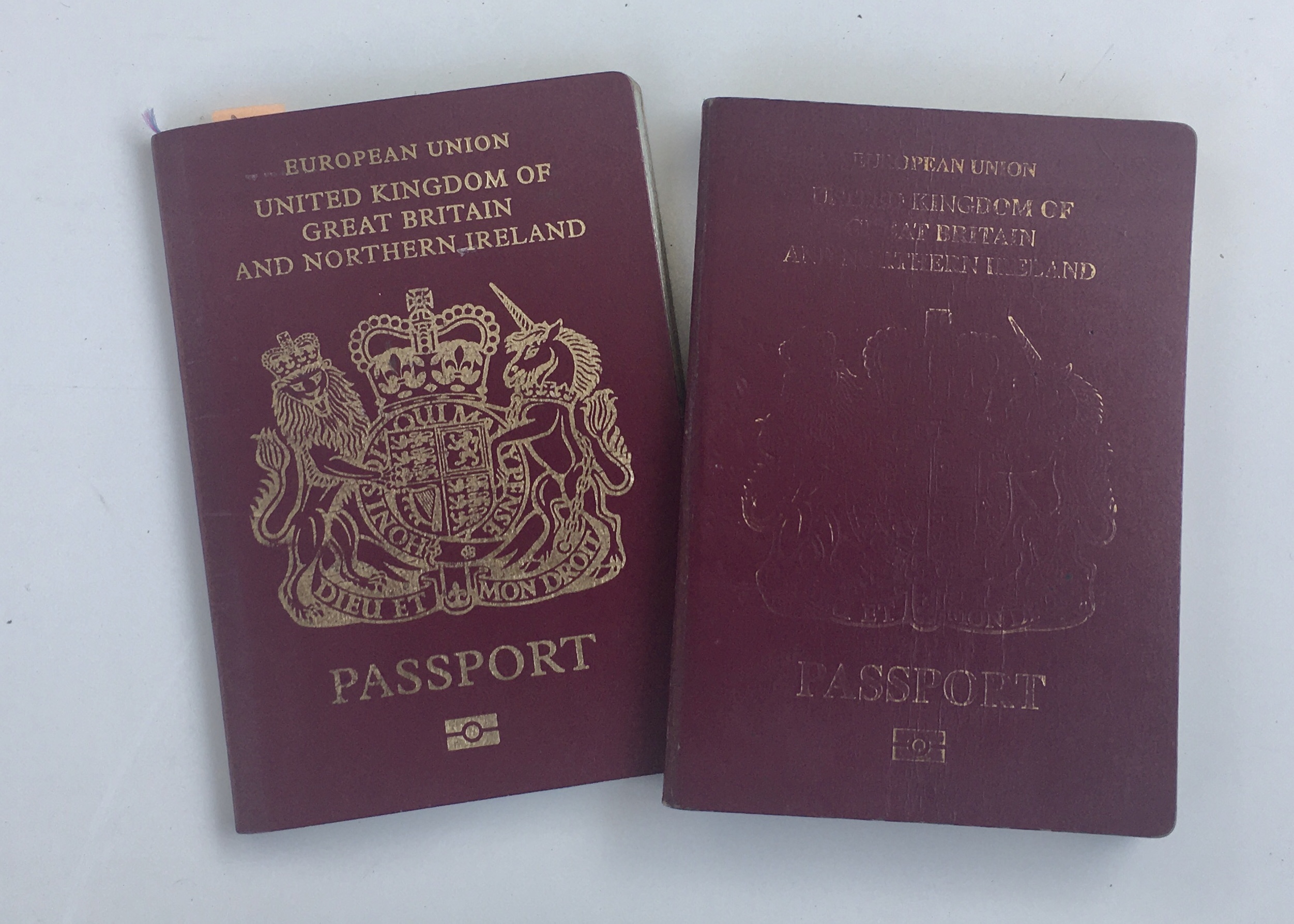
First the bossman studied the front of Andy’s passport to make sure of his nationality. This was quite amusing as most of the lettering had worn away and become impossible to read. He was only satisfied when we persuaded him that, honestly, it was the same type of passport as Clare’s and therefore came from the same country.

img_2409
You can see his problem

Then he painstakingly examined every single entry and exit stamp whilst his junior colleagues gathered around pointing and shaking their heads. Andy has 94 stamps in his passport, so this took quite a while.

Eventually and with enormous relief, as much for him as for us, he looked up and smiled … “Welcome to Vietnam!”

It’s not that we wanted to leave Laos. It’s that we’d like to head home in a few weeks time and crossing back into Vietnam makes that a whole lot easier. Plus … we really felt like we were in the middle of nowhere!

img_1667
On the way up to the border

The people of southern Laos are amongst the most laid back individuals we have ever met.  Guided by Theravada Buddhism which emphasises ‘the cooling of human passions’, they don’t get too worked up about the future, considering it to be determined by karma rather than by devotion or hard work. They also believe that ‘too much work is bad for your brain’ and feel sorry for people who ‘think too much’.

img_1554

The people we’ve met in Vietnam and Cambodia appear to be quite driven by comparison. It’s neatly summed up by a French saying:

‘The Vietnamese plant the rice, the Cambodians tend the rice and the Lao listen to it grow.’

But they also come across as a happy bunch. Unless any activity, work or leisure, contains an element of fun, it’s not worth pursuing.

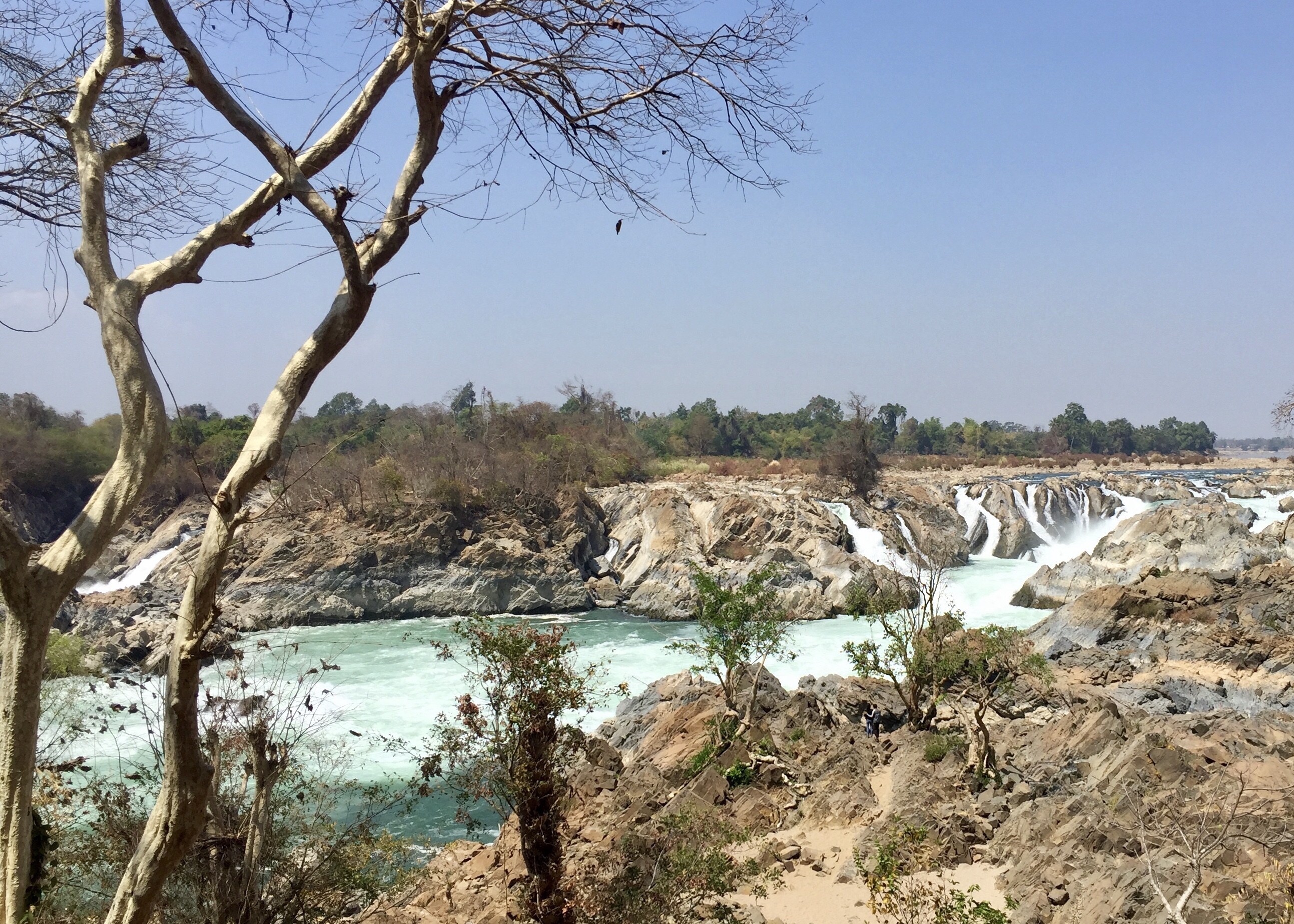
img_1133It was very easy to be seduced into the laid back life of Si Phan Don, literally meaning ‘Four Thousand Islands’. Here the Mekong bulges to a breadth of 14km, slowly easing it’s way past a few large inhabited islands and many islets and sandbars, then rushing down a series of rapids and waterfalls.

img_1350

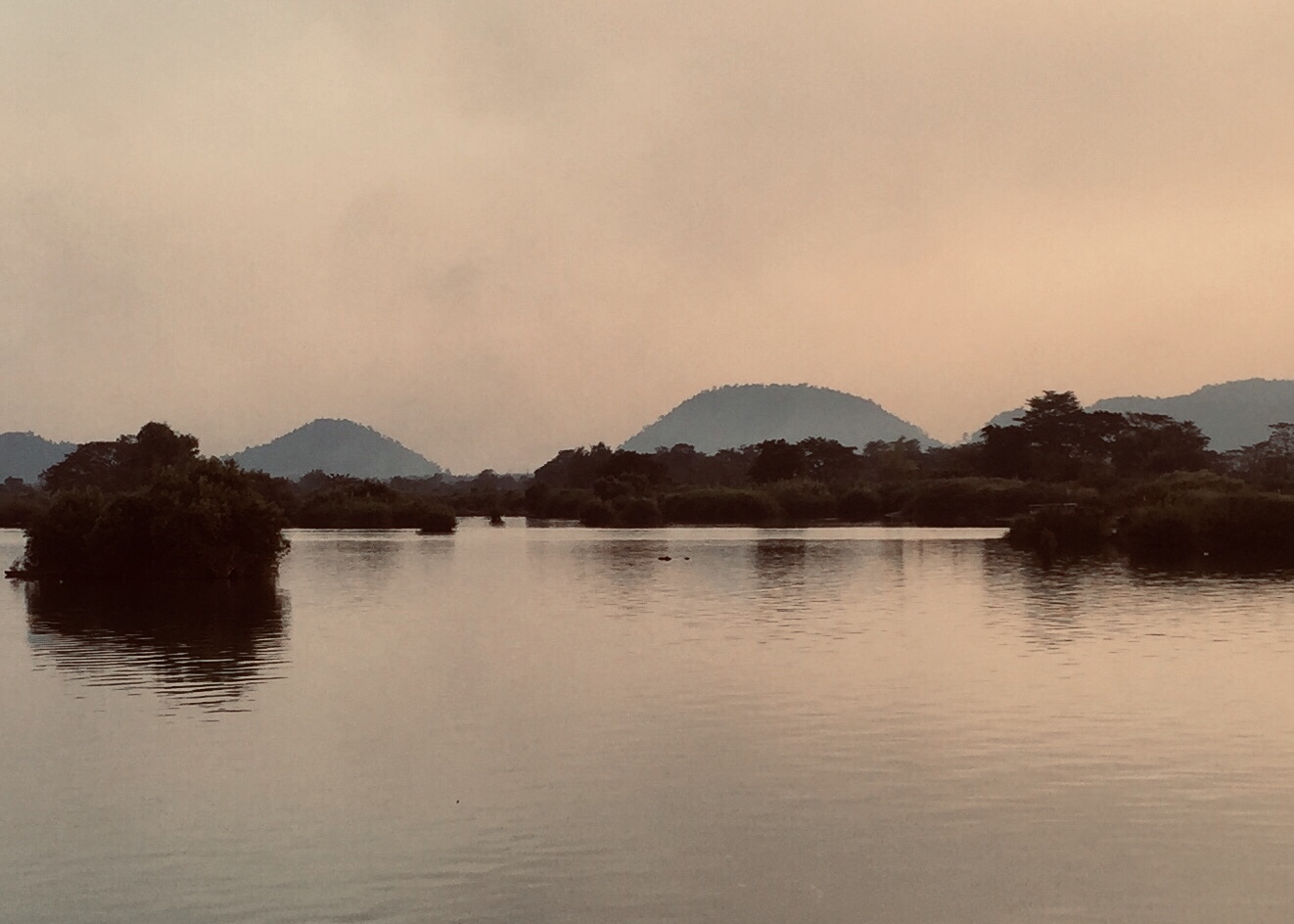
This natural barrier gives the Mekong it’s special charm – it’s one of the world’s great rivers meandering 4350km from the Tibetan Plateau to the South China Sea, but it can never become a shipping super-highway.

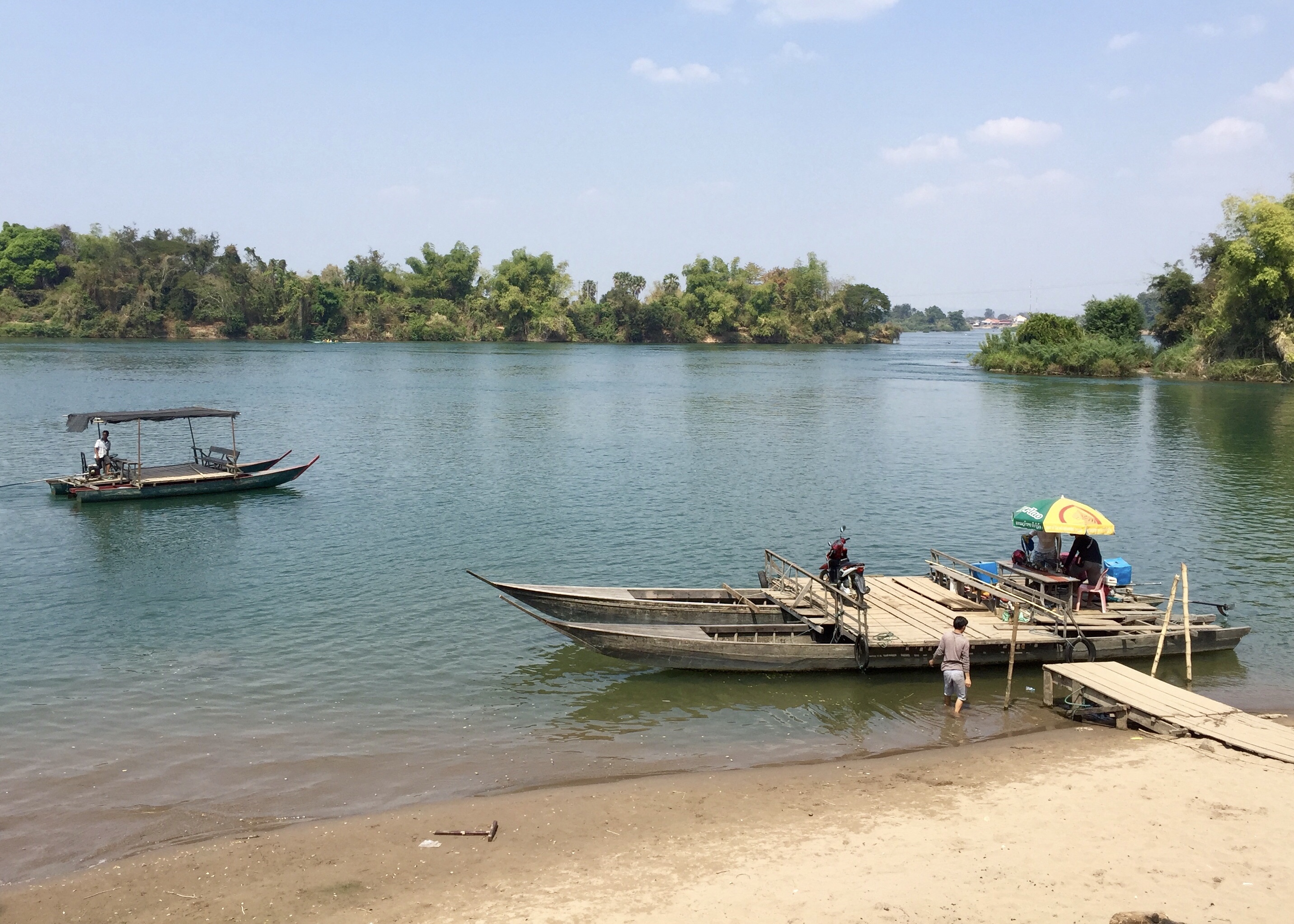
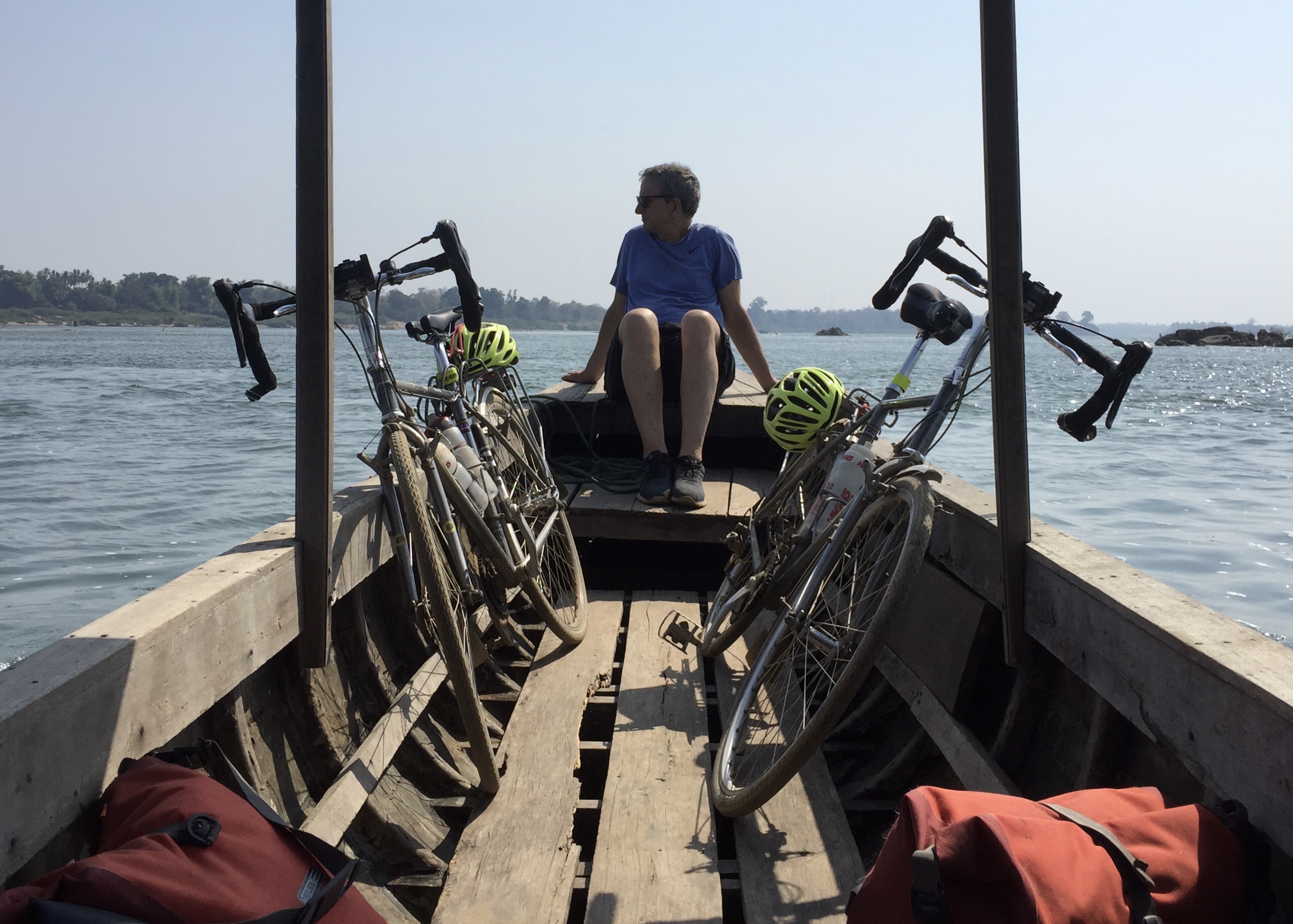
img_1149We enjoyed some gentle days pottering around the three main islands of Si Phan Don (Don Det, Don Khon and Don Khong), gradually becoming more proficient at manoeuvring our bikes on and off the small longtail boats and more chilled about doing so.

img_1343

We came to love the Mekong so much we even made our own tribute to it. Late one afternoon, Andy dived into the refreshing cool water without realising he had some cash tucked in the pocket of his swimming shorts, never to be seen again.

img_1204

From Don Khong it was a sweaty and dusty ride 110km up river to Champasak where we enjoyed two lovely surprises.

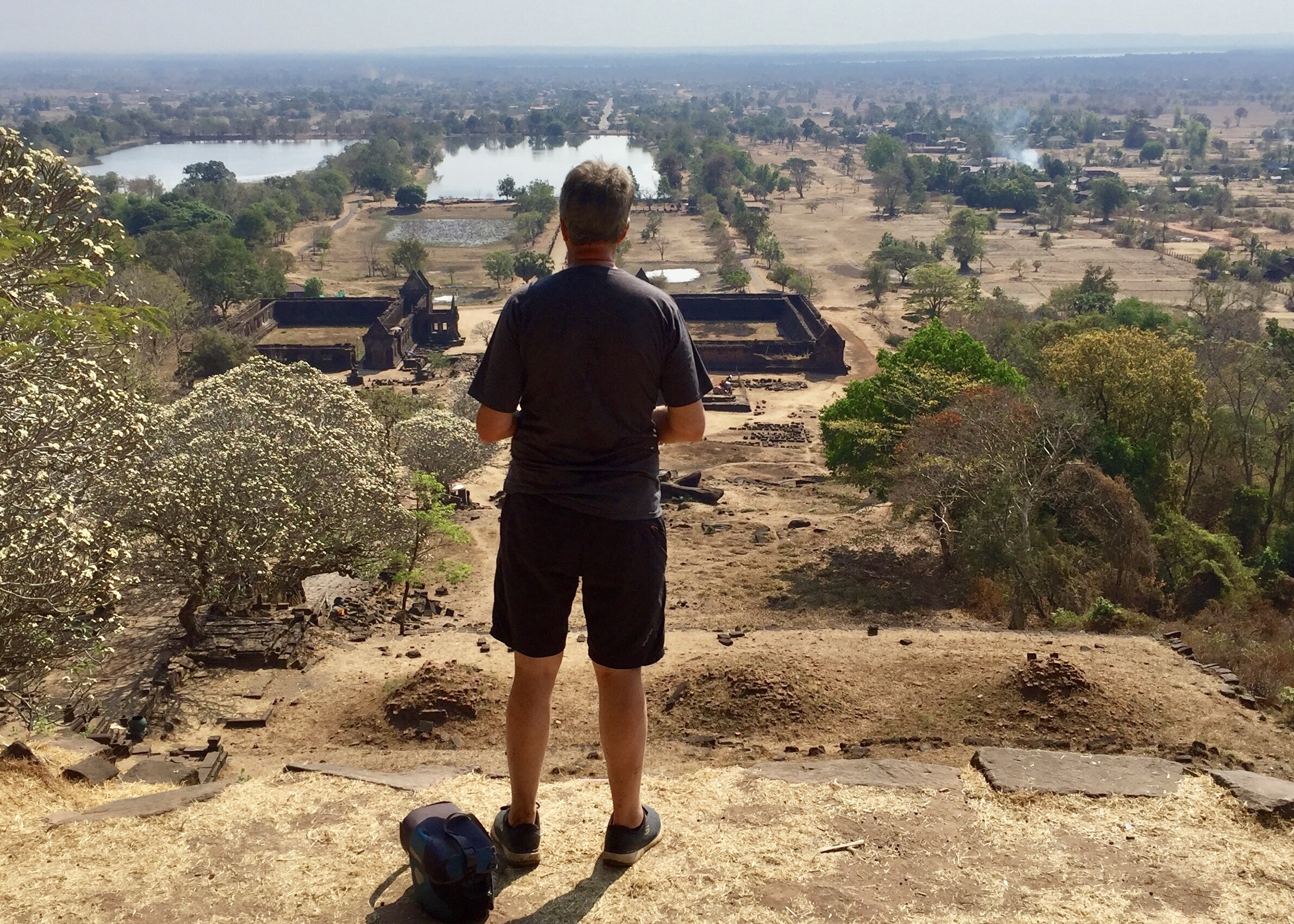
The first surprise was Wat Pho (meaning Mountain Temple), a contemporary of Angkor which stretches up the slopes of Phu Pasak, a sacred mountain known locally as Mount Penis. It’s a quirky, tumbledown place with attractions that include a crocodile stone carving allegedly used for human sacrifice and a sacred spring that cows now clamber up to for a holy drink.

img_1520
Looking down on Wat Pho

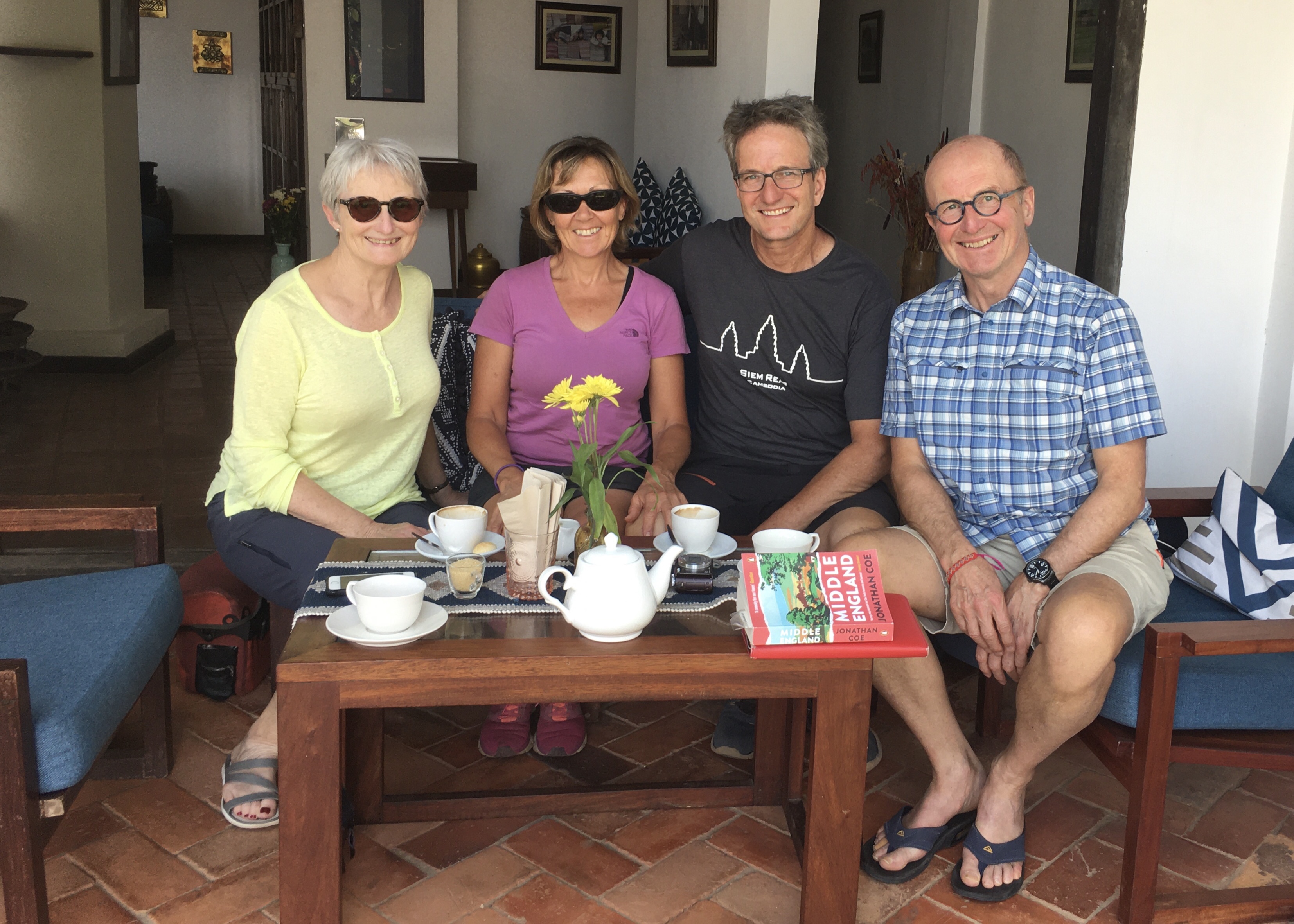
The second surprise was to hear our names being bellowed out as we cycled back to Champasak. Unbelievably it was Richard and Sue, good friends from home. We’d planned to meet up in Vietnam in a few weeks time but neither of us had any idea that we’d both be in this part of Laos at the same time. It was really good to see them and to spend an evening of easy conversation over beer and pizza.

img_1935

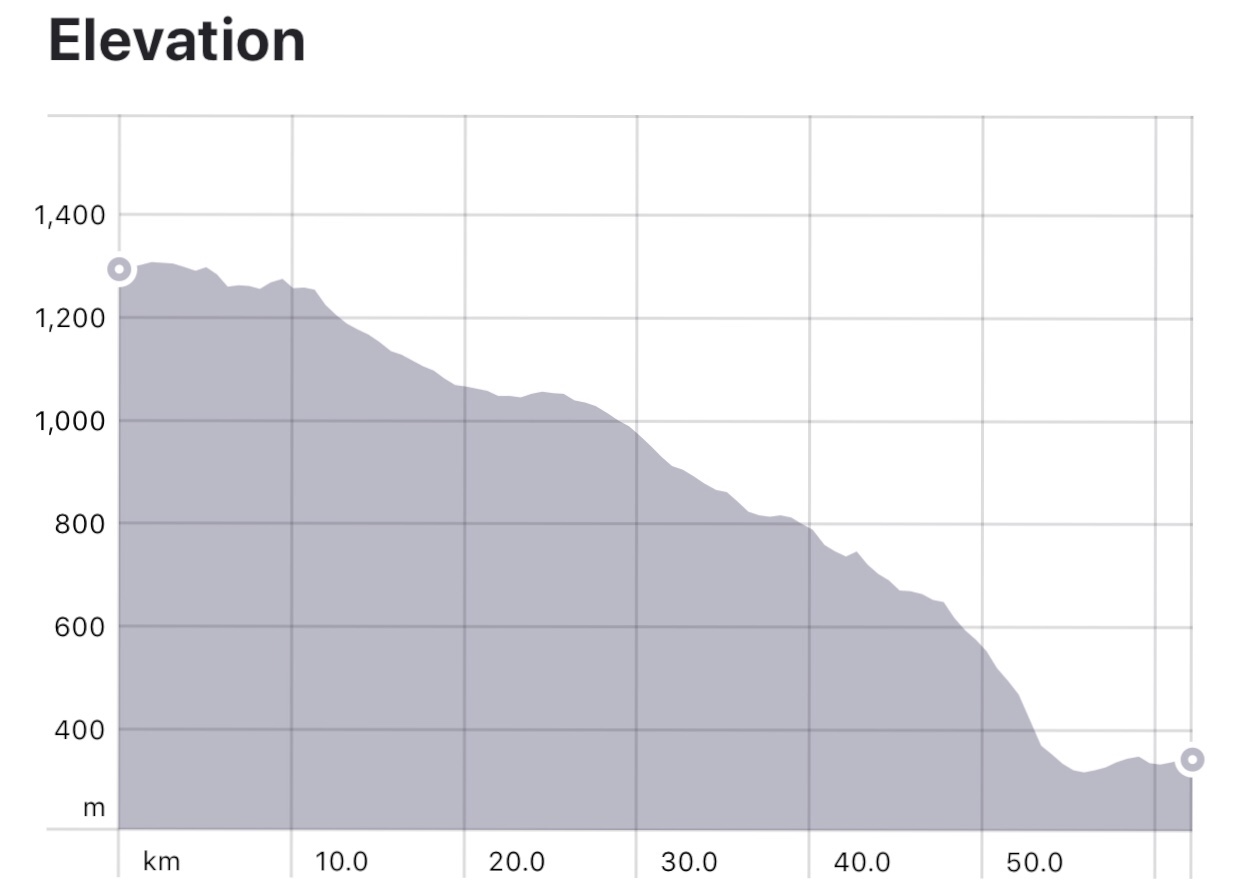
From Champasak, we changed plans and decided to cycle up to Paksong on the Bolaven Plateau, 1300m above sea level and famous for it’s waterfalls and it’s coffee plantations.

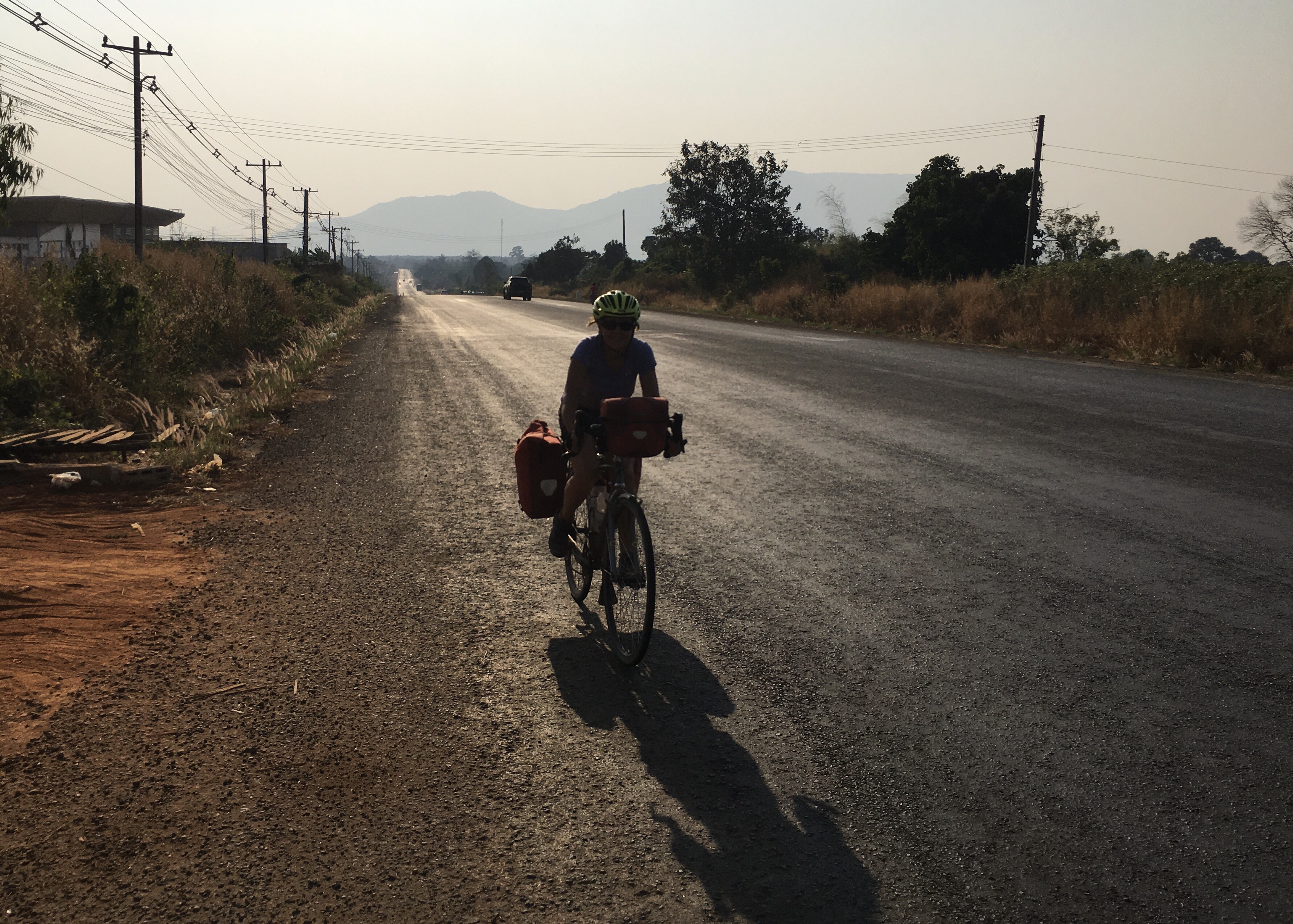
Why did we do it? Well, it wasn’t for the coffee. It wasn’t for the waterfalls. It wasn’t even to experience some cooler temperatures. No … the attraction was the promise of a whole day of descending, a whole day of cruising gently downhill.

img_1985
Cycling up to the Bolaven Plateau

In the event, Andy very nearly messed it up!

The road he’d planned to go down was the wrong road. Very wrong indeed. It quickly disintegrated into a very rough, very dusty stone track.

For about an hour, we bumped and banged our way down it almost killing our bikes and ourselves in the process. Andy was ever hopeful it would improve on the other side of the next ridge despite Clare’s increasingly frantic protestations. Eventually he had to admit that it was physically impossible for us to go any further.

We turned around and slowly climbed back up.

By the time we got back to the top, we’d run out of time and daylight so were forced to find some emergency accommodation and try again the next morning.

img_1984
The Bolaven Plateau is a market garden

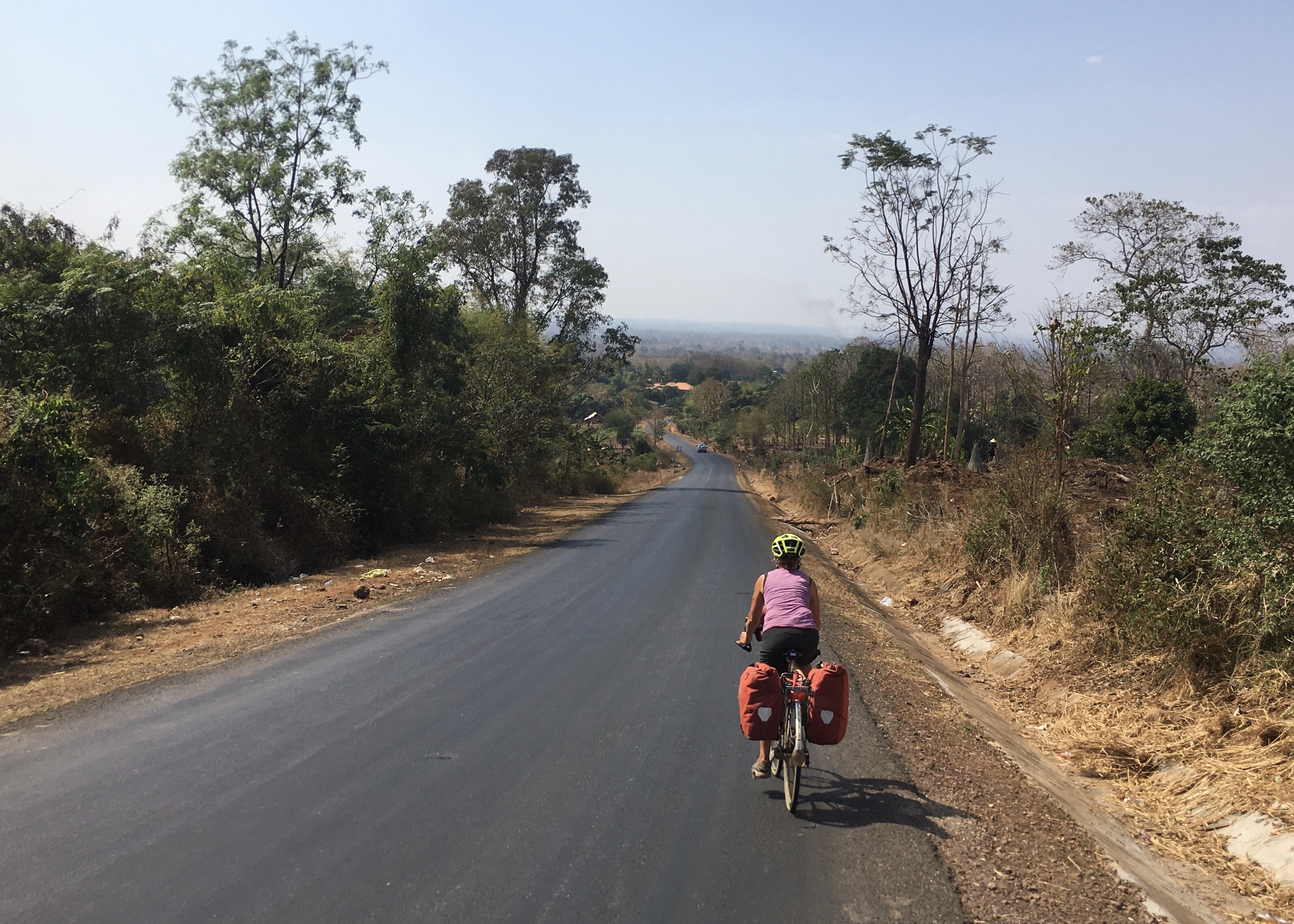
This time we found the right road … and it was glorious! Just what we’d dreamed of. Even when crossing the Pyrenees or the Andes we have never cruised down such a long descent, the gradient gently taking us through coffee plantations, past mango groves and fields of cassava. For 50km!!

img_2053
Cruising down … all day long!

img_2057

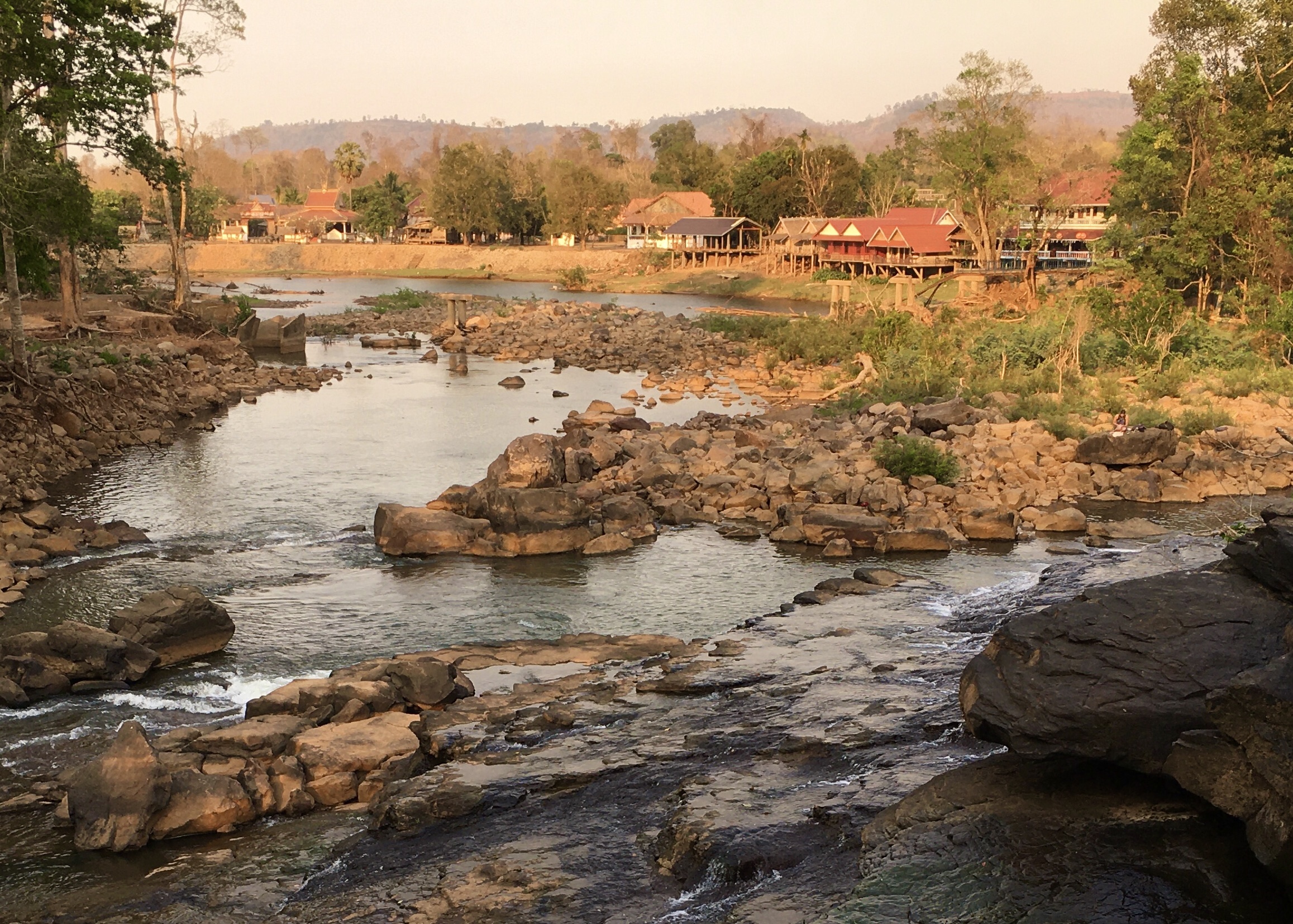
It ended in a serene little village called Tat Lo. In recent years, this has become a quiet retreat on the backpacker trail, nestled in a river valley full of forest trails, small waterfalls and swimming holes. It’s location is remote enough for the small guesthouses and cafes selling banana pancakes to sit alongside normal village life, not to overwhelm it.

We stayed in a simple, stilted room in a lovely guesthouse called Palamei, owned by Poh and Tim and named for their daughter.

We’ve enjoyed a wide range of accommodation on this trip, including a couple of luxury hotels as the coronavirus scare has made everything so cheap … but this was one of our favourites.

img_2080
Tat Lo Village

We always knew that getting back into Vietnam from this part of Laos was going to be the greatest challenge of our trip.

We looked at various options, including cycling back to Pakse and taking a long sleeper bus ride north to Savannakhet and onto Hue in Vietnam via the main border crossing at Lao Bao. A journey of over 700km this was not a fun prospect for two aging touring cyclists.

We also knew that cycling up to the remote border at Lalay (only 170km away) was beyond our cycling capabilities. It would mean three days of riding over some very steep hills with few towns or villages along the way. A great ride for proper (young) adventure touring cyclists … but not for us!

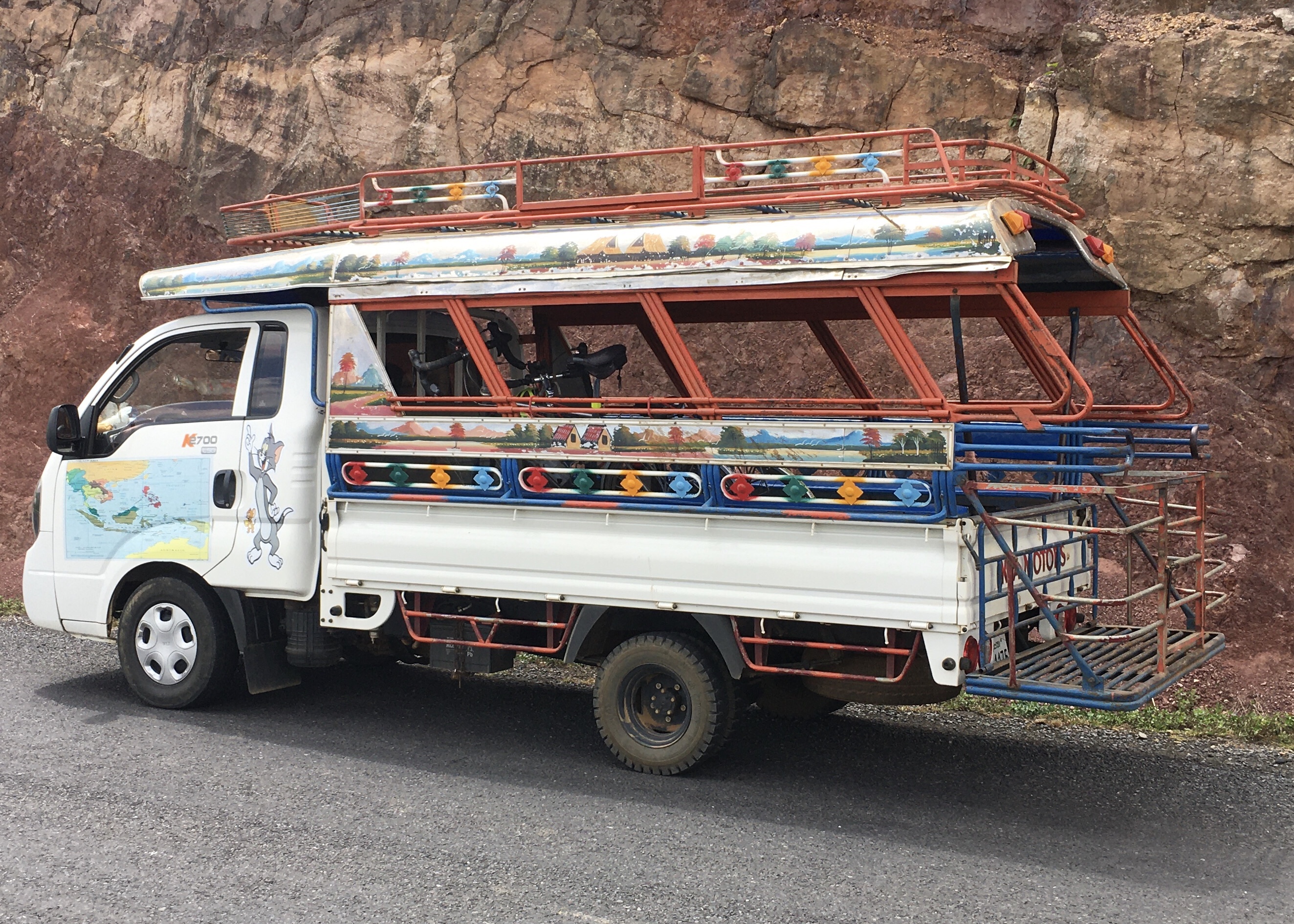
Poh asked which day we planned to leave. When we told him it was Sunday his face lit up. His van normally serves as the local school bus but Sunday meant no school.

img_2094

So that’s what happened. It turned out to be a fascinating journey through a dramatic mountain landscape, the school bus struggling to make it up some of the steeper inclines as we gave grateful thanks to the cycling gods that we weren’t pushing our bikes up instead.

img_2086

During the drive up to the border and over a bowl of noodle soup, Poh shared some stories of his life. Born into desperately poor circumstances, he spent several years as a child living in the village temple as his mother had died when he was just two years old. With only rudimentary schooling, he recognised his one good fortune was to be born in a village that was starting to attract tourists, so he worked 16 hour days in a nearby lodge to learn both the business and how to speak English. Eventually he was able to set up his own guesthouse.
Poh and Tim, his wife, have three children but they have also adopted five more, all from the same tough circumstances he knew as a child. Now he is giving back to his community, one small part of which is providing the local school bus.

img_2101
Clare and Poh

The journey passed quickly and before long, we found ourselves at the border to be greeted by the smart Vietnamese guards and the medical team.

It’s just as well we didn’t cycle … we’d have been so hot and bothered we’d have failed the temperature test. Then they’d never have let us back into Vietnam!

Clare and Andy

From Hamburgers to Noodle Soup

Dong Ap Bia (the Mountain of the Crouching Beast) stands 14 kilometres west of A-Luoi, a small town nestled in the central highlands of Vietnam. Officially called Hill 937 by the US army, it was the site of one the most famous battles of the Vietnam War in May 1969 … known thereafter as ‘Hamburger Hill’.

“Have you ever been inside a hamburger machine? Well we just got cut to pieces by extremely accurate machine-gun fire.”

Sergeant James Spears, 19 years old

For some people, Hamburger Hill became a symbol of the bravery of both the attacking American infantry and the North Vietnamese defenders.

For others it epitomised the futility and waste of this long war.

img_2168

On the day we crossed back into Vietnam from Laos we stayed overnight in A-Luoi.

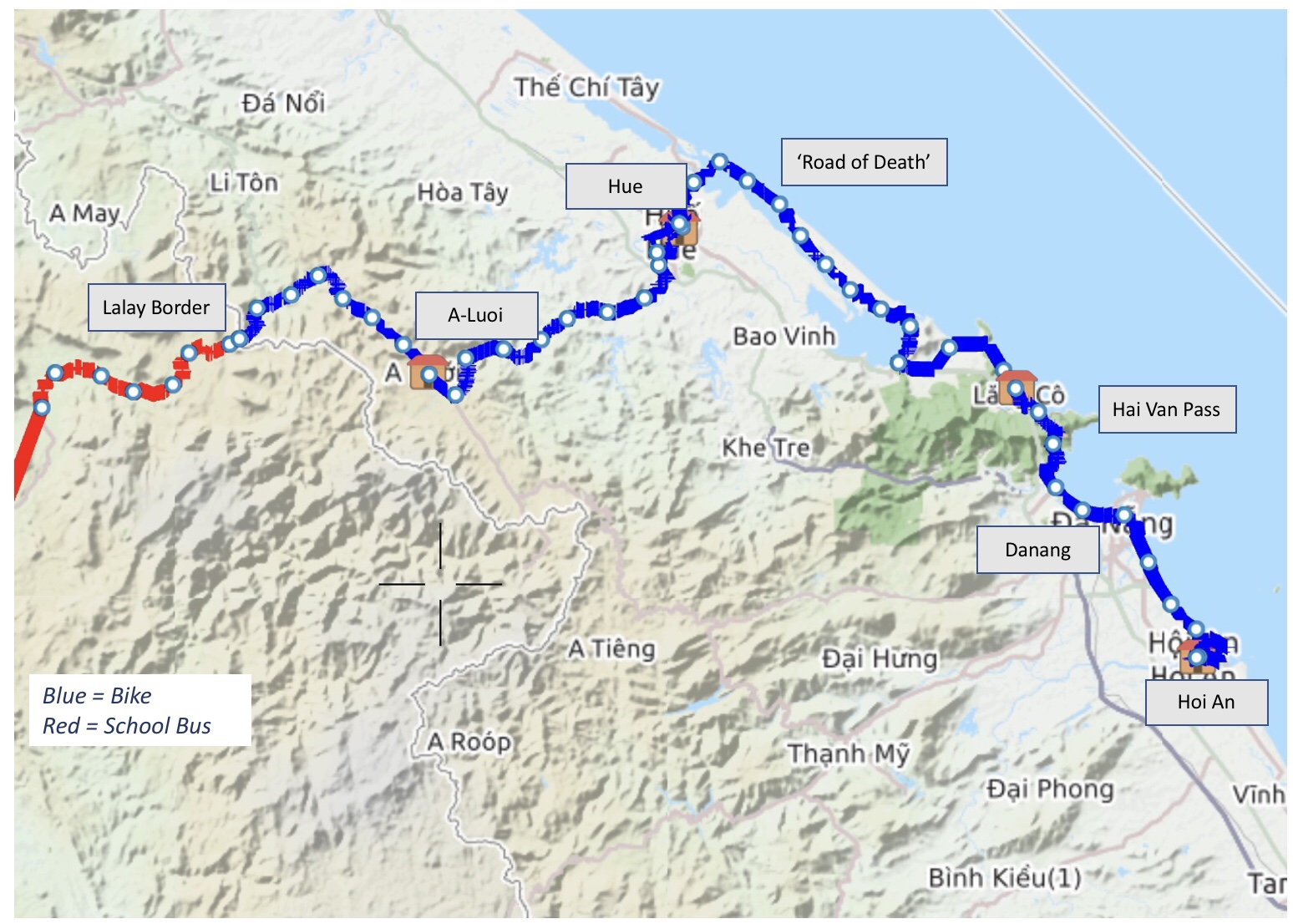
Waving goodbye to Mr Poh and his school bus we had spent the afternoon cycling down through high jungle to join the Ho Chi Minh Highway. This road follows the route of the famous Ho Chi Minh Trail, a network of mountain footpaths that were used to supply and reinforce Vietcong fighters in the south. The attack on Hamburger Hill was part of a campaign to stop this supply.

img_2121
Just over the border from Laos

The ‘Rakkasans’ from the 101st Airborne (one of the US Army’s most decorated units) fought their way up the steep slopes battling with triple canopy jungle and waist high elephant grass as well as the machine gun fire. They were repelled again and again by the ‘Pride of Ho Chi Minh’, the elite North Vietnamese 29th regiment.

After dropping more than 1000 tonnes of bombs, 140 tonnes of napalm, 31000 rounds of 20mm shells and 500 tonnes of teargas, the Americans eventually prevailed and took control of the ‘moonscape’ that was left of the summit. 72 Americans lay dead with 370 wounded. Estimates of North Vietnamese losses vary, but at least 600 were killed.

The Americans only stayed for a couple of days before they abandoned Hamburger Hill. A few months later the North Vietnamese were back in their original positions.

It was the apparent futility of this battle that whipped up the anti-war sentiment that was then building a strong head of steam in America. Senator Edward Kennedy reflected the view of many people when he called the battle “senseless and irresponsible”.

At the time of Hamburger Hill, America had over 500,000 troops in Vietnam but this turned out to be the high water mark of their involvement. By the end of 1969 US troops had begun to withdraw and their focus had switched to training the South Vietnamese army to bear the brunt of the fighting. This eventually led to the North Vietnamese victory in 1975.

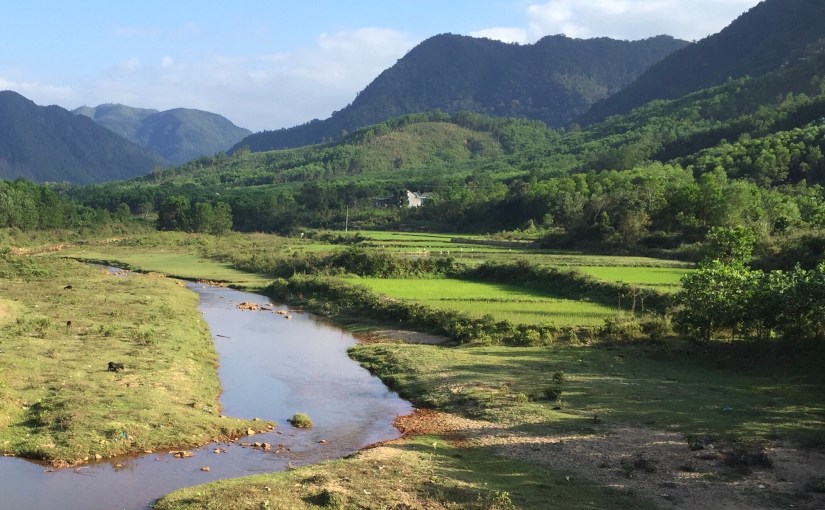
Today both the hill and the whole area is very peaceful, mountain rice growing in the valleys and birdsong replacing the sound of gunfire in the hills.

It’s difficult to imagine the horror that both sides endured. Except that the landscape is very familiar to anyone who has watched a few Vietnam War films. So familiar that you almost expect to see an Apache attack helicopter appearing over the next ridge.

img_0587
The tank that marked the end of the war

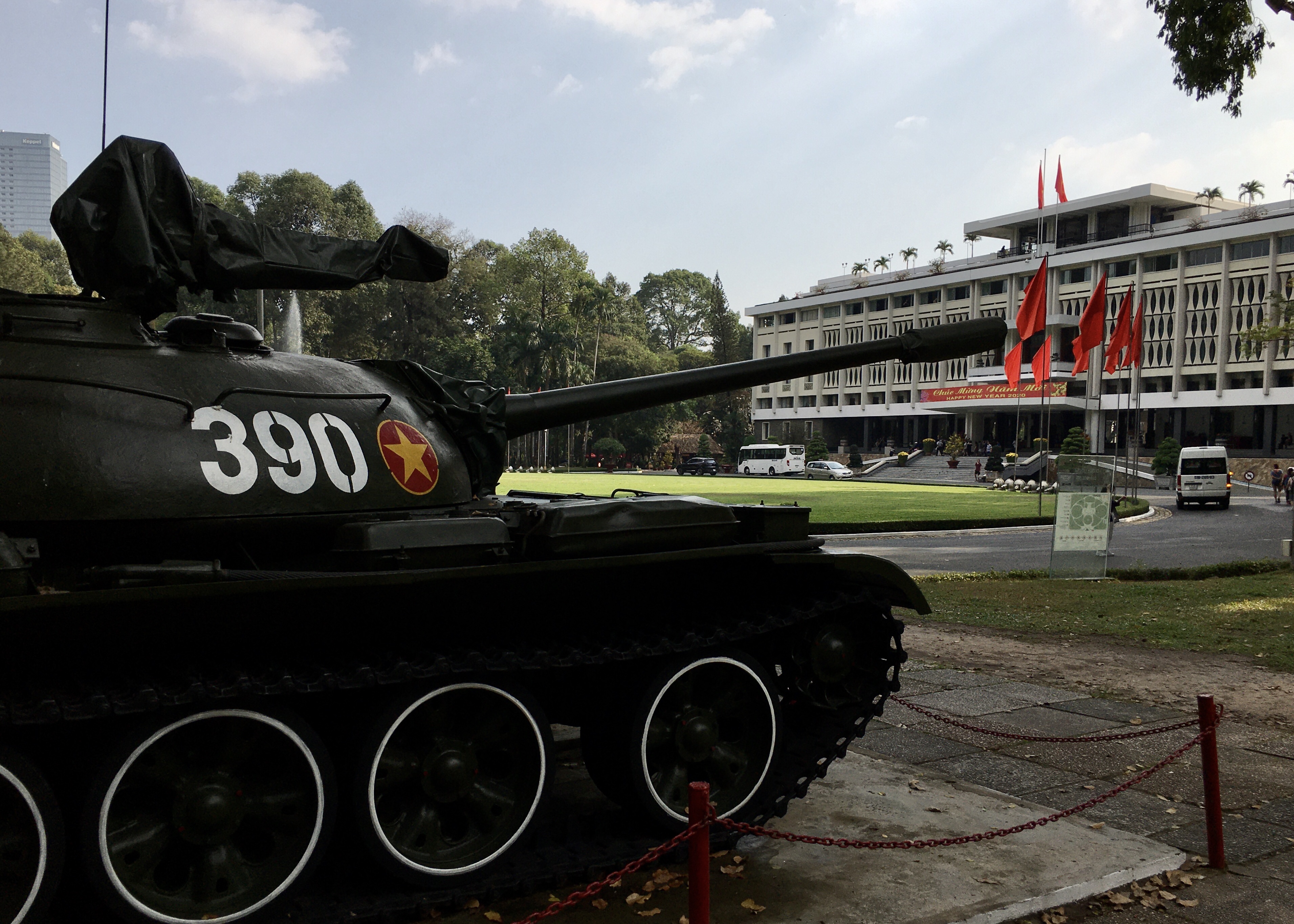
As we cycled around the country, we enjoyed learning a little about the ‘American War’ (as it’s known in Vietnam) from their perspective. The War Remnants Museum in Saigon is a stark reminder of the hardships and atrocities faced by ordinary people. The tours to the complex multi-level network of tunnels at Cu Chi show off the ingenuity of the Vietcong and the difficulty the Americans had in facing an enemy that kept melting away. And Tank 390 still guards the grounds of the presidential palace, having crashed through the gates on April 30th 1975 to end the war.

Ultimately though, we have been left with a feeling that this war of attrition became senseless. For everyone involved.

img_0692
Emerging from the Cu Chi tunnels

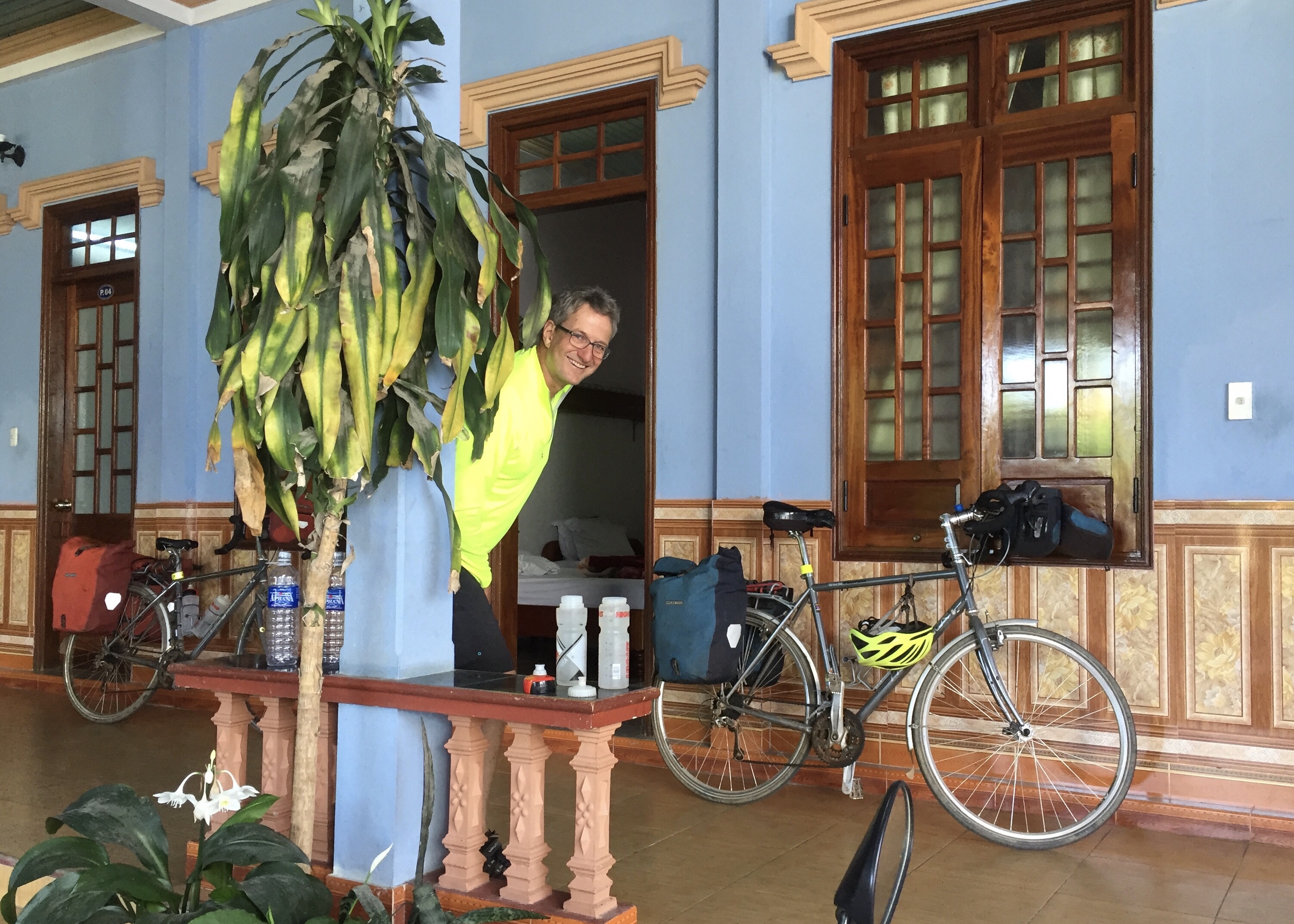
A-Luoi was the most undiluted Vietnamese town we visited. We stayed in a motel style guesthouse, no-one we met spoke English and it was tricky to find somewhere to eat. We walked past lots of beer gardens and coffee shops but no restaurants.

img_1681
At the guesthouse in A-Luoi

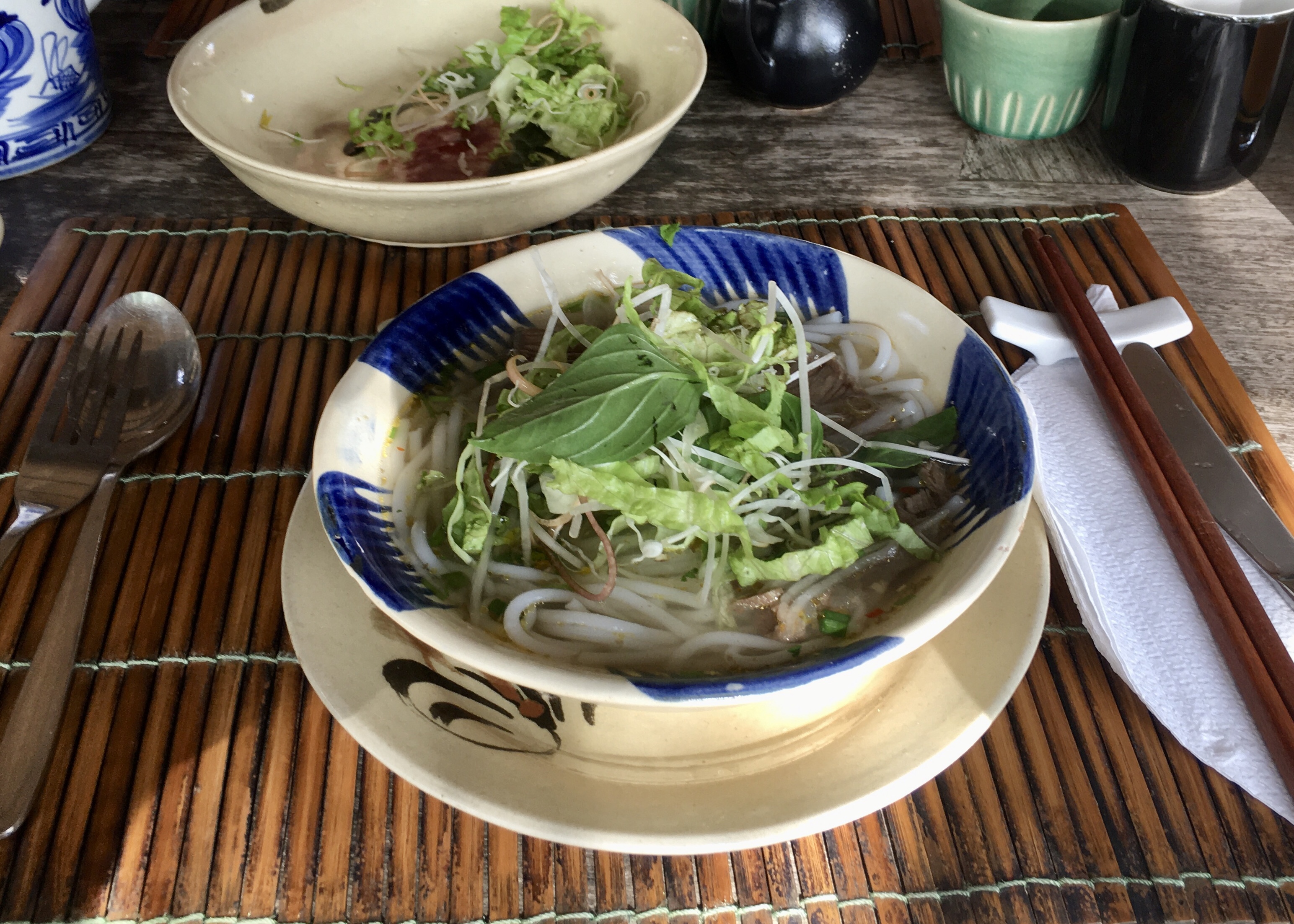
Eventually we managed to find a large bag of pistachio nuts and headed into a family run café to enjoy them with a beer. The family had just finished their own dinner so, more in hope than expectation, we made eating signs to the lady. She must have seen our faces drop as she shook her head because she disappeared, returning fifteen minutes later with a big smile and two steaming bowls of noodles, packed with chicken, vegetables and fresh salad.

img_2489
Noodle Soup

It was one of the most delicious meals we had in Vietnam. Much better than the hamburgers we’d been hoping to find … in tribute to the nearby hill!

To her obvious delight we gave her half our remaining pistachios. It seemed only right. The bag had cost us more than she insisted on charging for the meal.

img_0502

The next day’s ride down to Hue was one of best days we’ve ever had on a bicycle. Under a cloudless sky we wound our way down through stunning jungle canopy, up over a pass then down again into the wide fertile valley of the Perfume River (named for the flowers that drop into its clear waters).

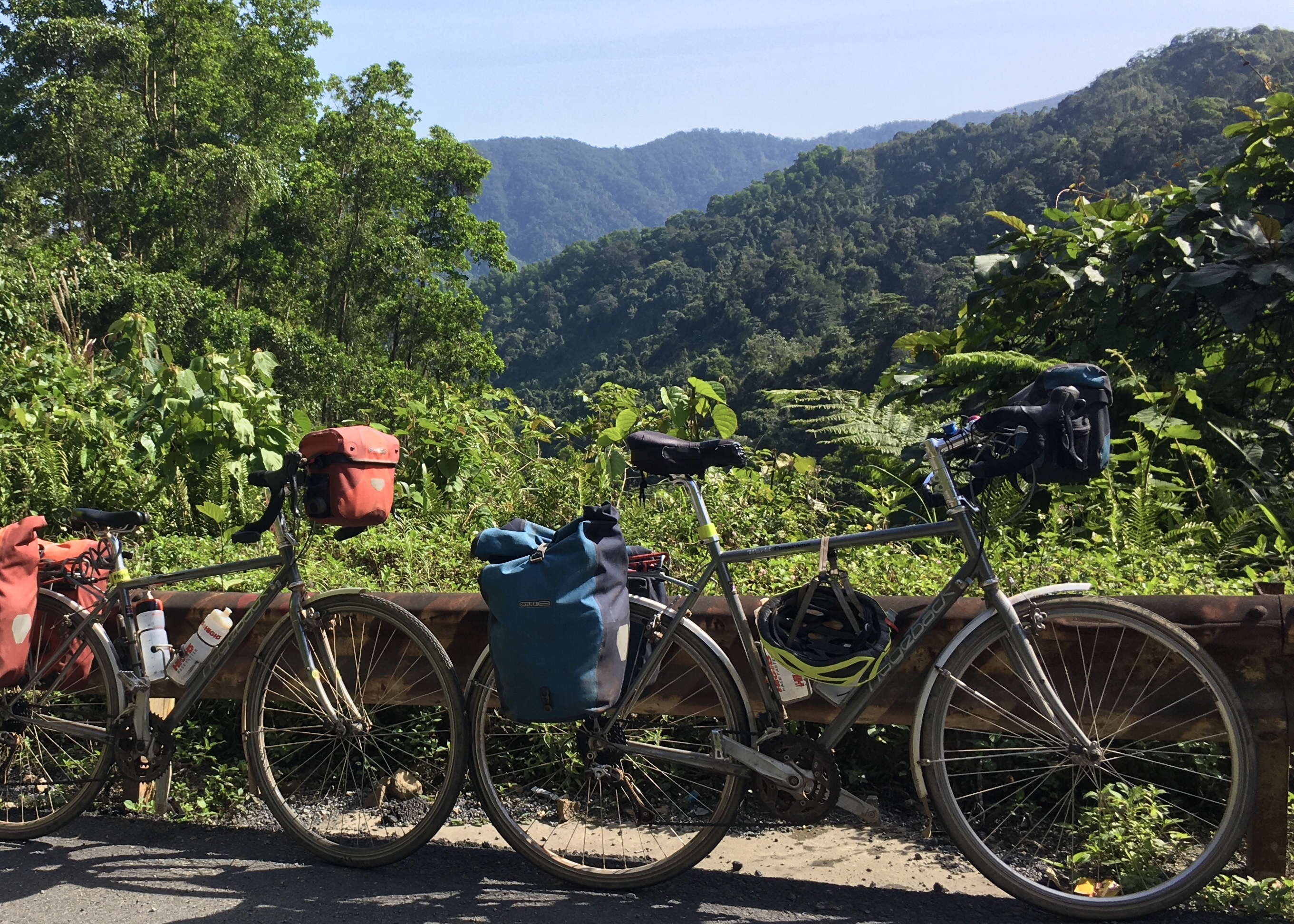
It was the kind of day that reminds you that the simplicity of bicycle touring is one of the best experiences in the world.

“It is by riding a bicycle that you learn the contours of a country best, since you have to sweat up the hills and coast down them.”

Ernest Hemingway

img_2202
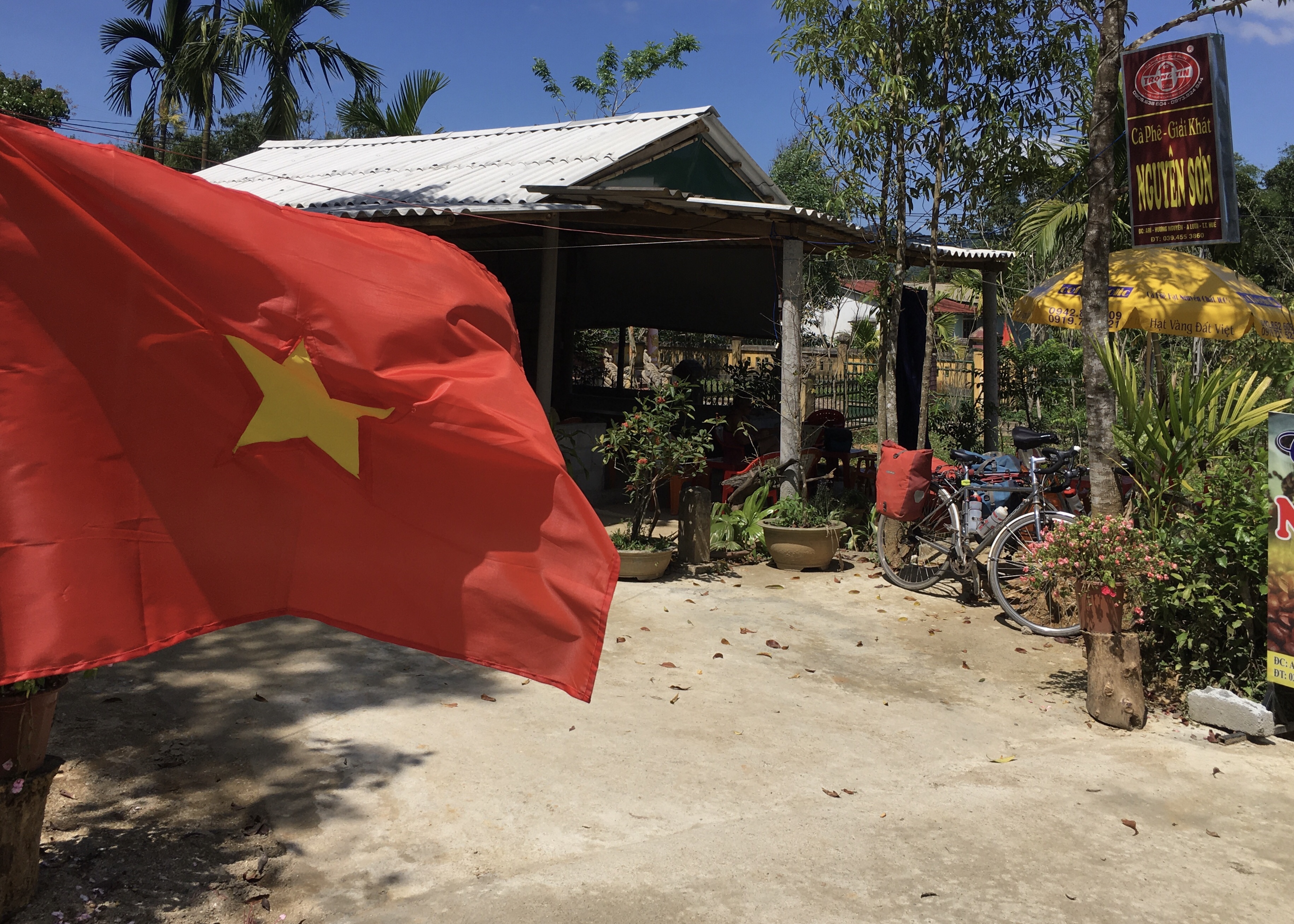
Coffee break on one of our best ever biking days

People we’d met on our travels had told us that Hue was a bit of a disappointment. Well we beg to differ, we loved it.

It was the imperial capital of the last emperors of Vietnam, the Nguyen dynasty that ruled from 1802 to 1945. Today it is a vibrant, bustling city that blends old and new, wide embankments on both sides of the river giving it an air of calm.

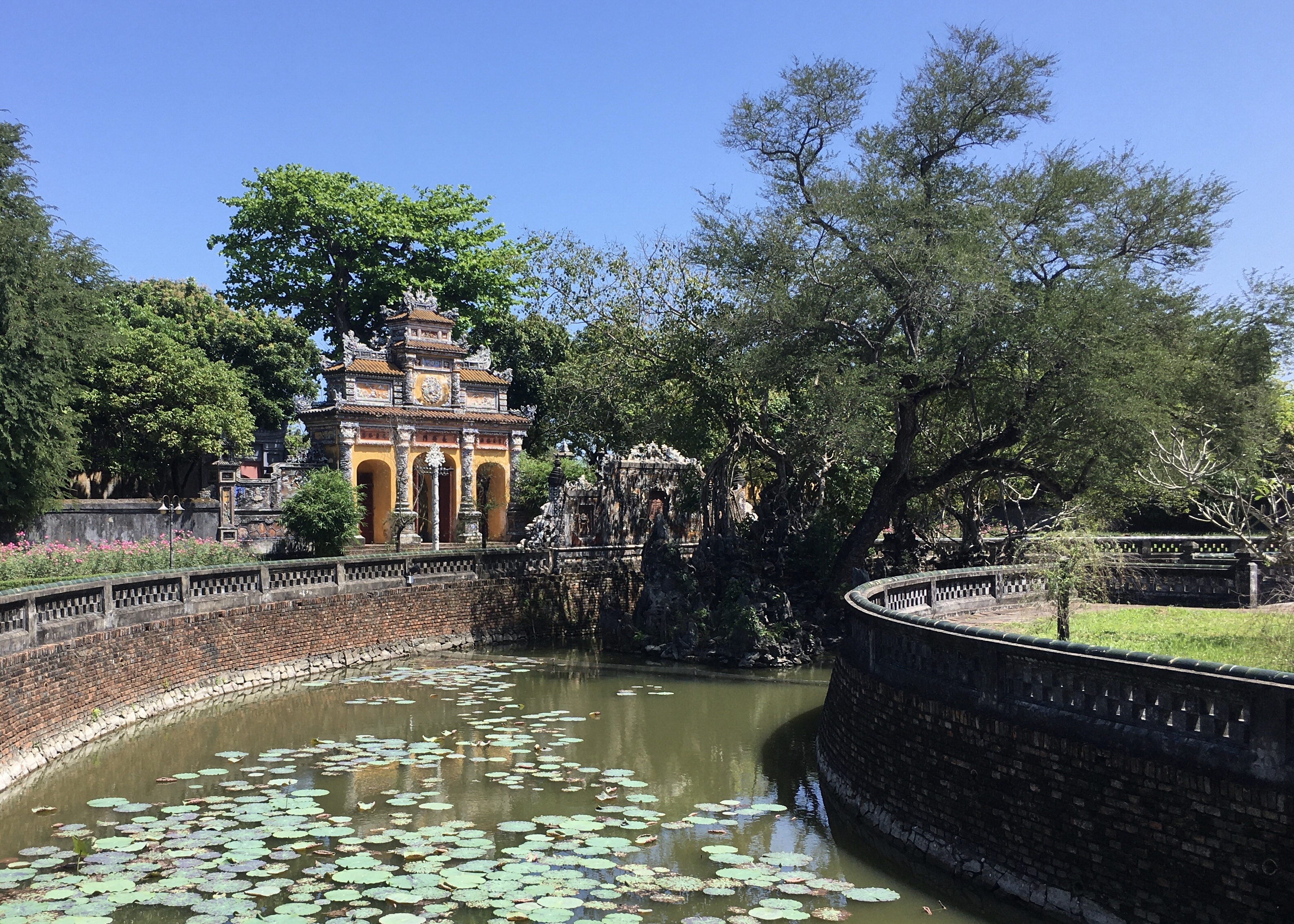
The main attraction is the citadel, home to the Nguyen emperors and their seat of government. Several walls are pockmarked with bullet holes as an evocative reminder of the major battle that raged here in 1968 during the Tet offensive.  Most of the buildings were destroyed but they are now being lovingly restored to their former glory. It’s a huge site and a wonderful place to get a little lost in, roaming through tree-lined boulevards, ceremonial reception rooms and ornate gardens.

img_2216
The Citadel at Hue

img_2224

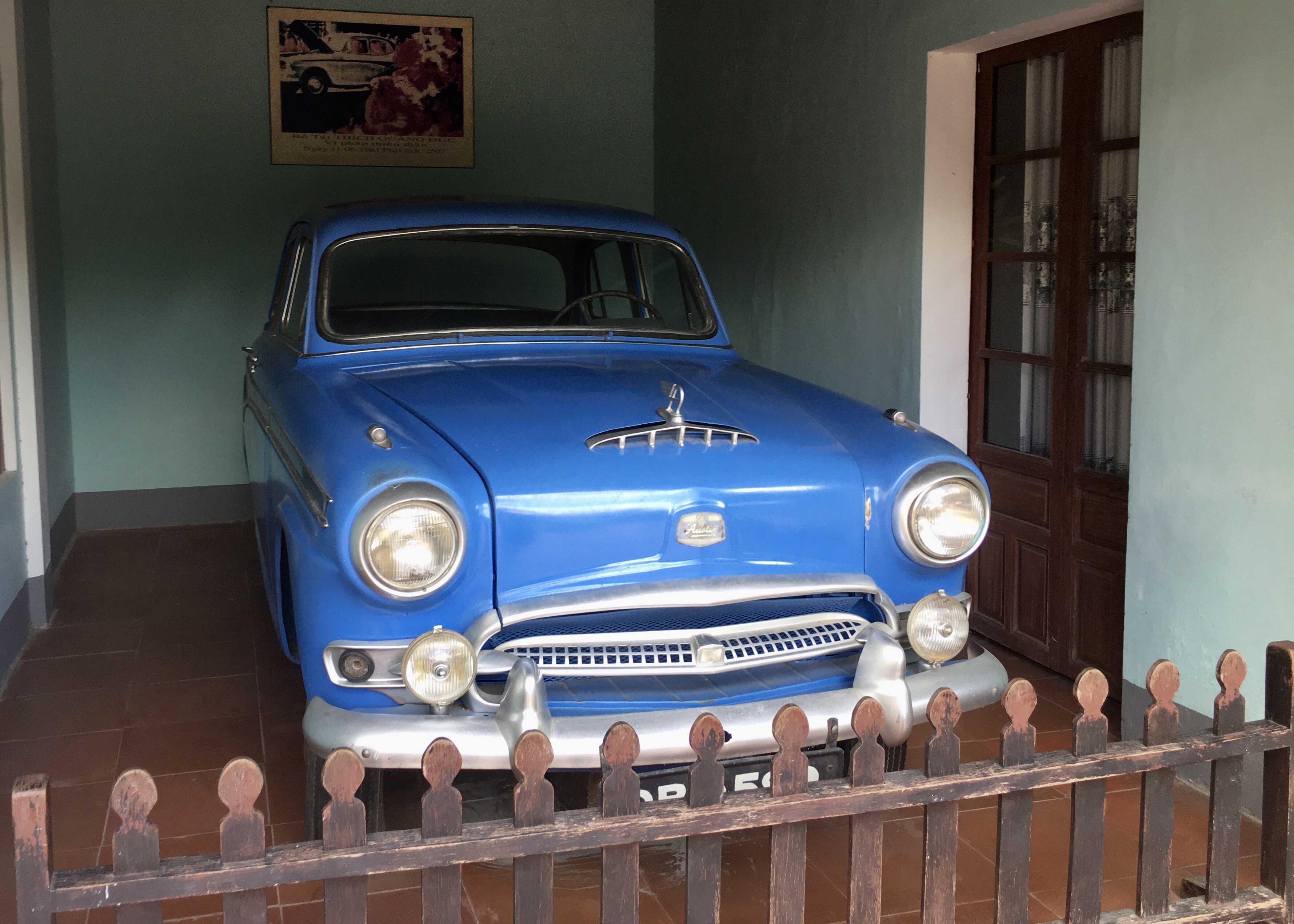
A few kilometres upriver from the Citadel is another poignant reminder of the conflict. Tucked away in a corner of the Thien Mu Pagoda complex is an old 1956 Austin saloon car that transported a monk called Thich Quang Duc to Saigon, where he calmly set himself on fire as a protest against the policies of the South Vietnamese regime. Captured by an American film crew it became one of the most emotive images of the war.

img_2236

We also enjoyed the tomb of Tu Duc, emperor at the time of the French invasion in 1883 and a man who lived a life of imperial luxury and carnal excess (104 wives, countless concubines but no offspring). Just 5 foot small he decreed that the statues of the mandarins guarding his tomb had to be even smaller than he was.

But he wasn’t buried here. Instead he was interned at a secret location where the 200 servants who helped with the burial were beheaded to stop the location and its treasures being discovered. It worked … the site has never been found.

One entertainment enjoyed by Tu Duc were the fights between tigers and elephants at Ho Quyen, a mini Romanesque amphitheatre that now sits in the middle of a quiet suburb. The tigers had their claws and teeth removed so that the elephants, a symbol of the emperor’s power, could triumph every time!

img_2247
Elephants, horses and mini-mandarins guarding the tomb for Tu Duc

From Hue, we cycled 160km down the coast to the graceful and historic town of Hoi An, full of preserved merchant houses, ancient tea warehouses and Chinese temples.

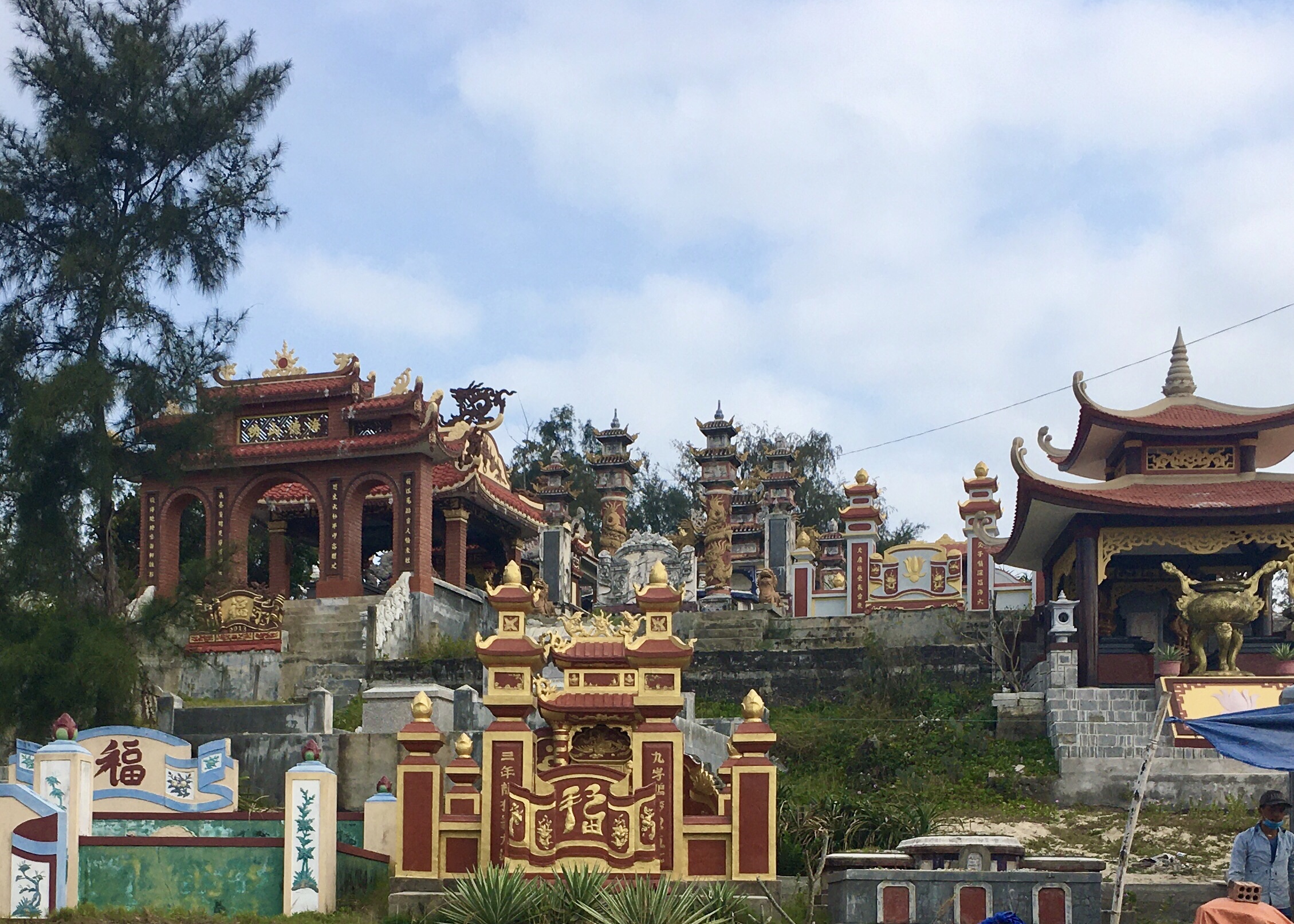
At first, the road took us past miles and miles of sand dunes all filled with thousands of graves and elaborate private family mausoleums. These are the final resting places of Viet Kieu (overseas Vietnamese), all seeking to be buried in their homeland.

Ancestors are worshipped in Vietnam and the majority of people are buried, often in large tombs on the family small holding. Given that the population has doubled to 99 million since the end of the war in 1975 (it’s now the world’s 15th most populated country), the density of tombs of this ‘road of death’ did make us wonder whether the rest of the country would look the same in future, such will be the demand for graves.

img_2256
Graves in the dunes on the ‘road of death’

img_2279
Some very elaborate

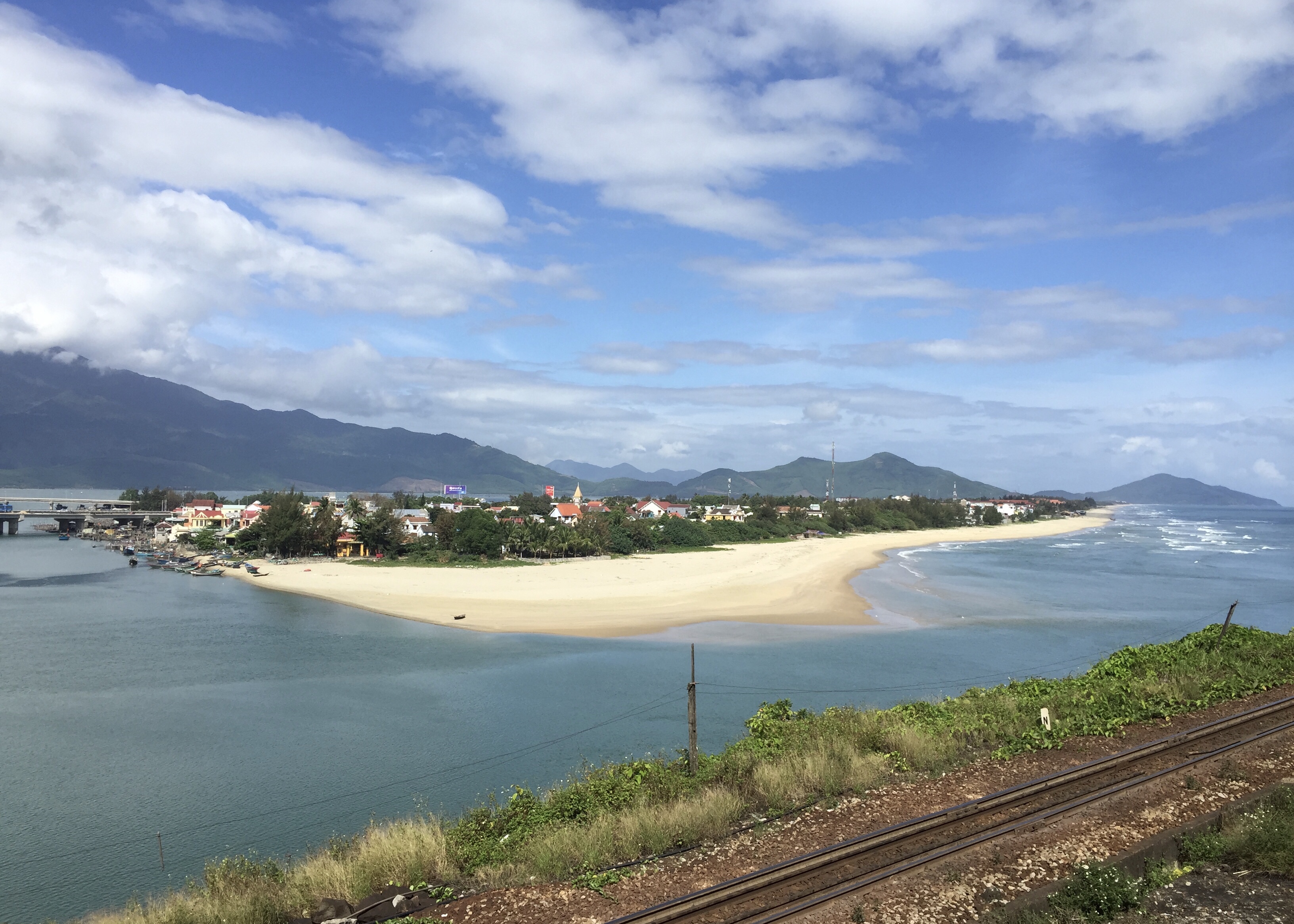
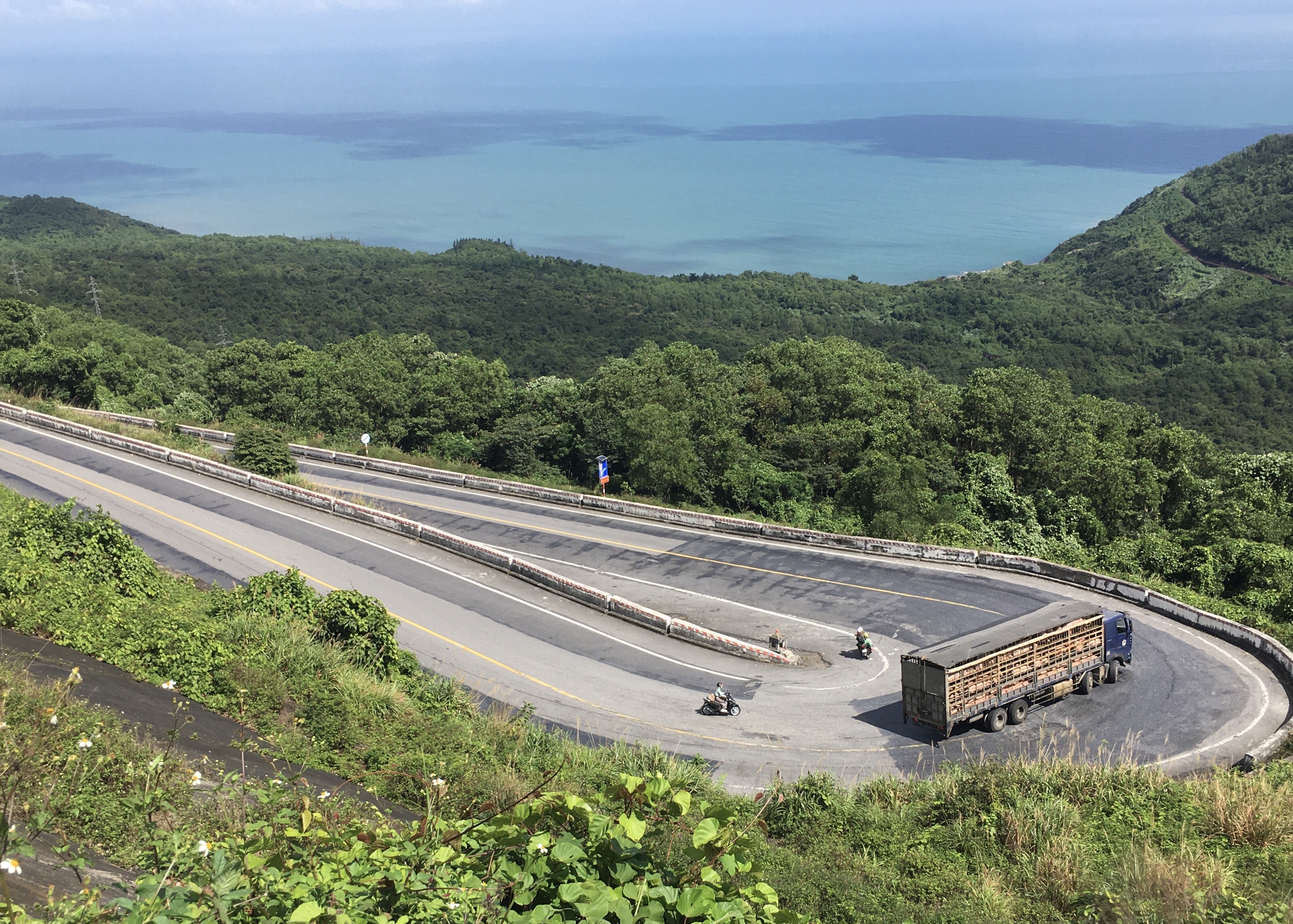
Just north of the large coastal city of Danang is the Hai Van (Sea Cloud) pass, a mountain spur than runs down to the sea and a sizeable cycling challenge at 496m high. It’s an important North-South divide both strategically and geographically, protecting Danang from the fierce ‘Chinese’ winds that sweep in from the north east.

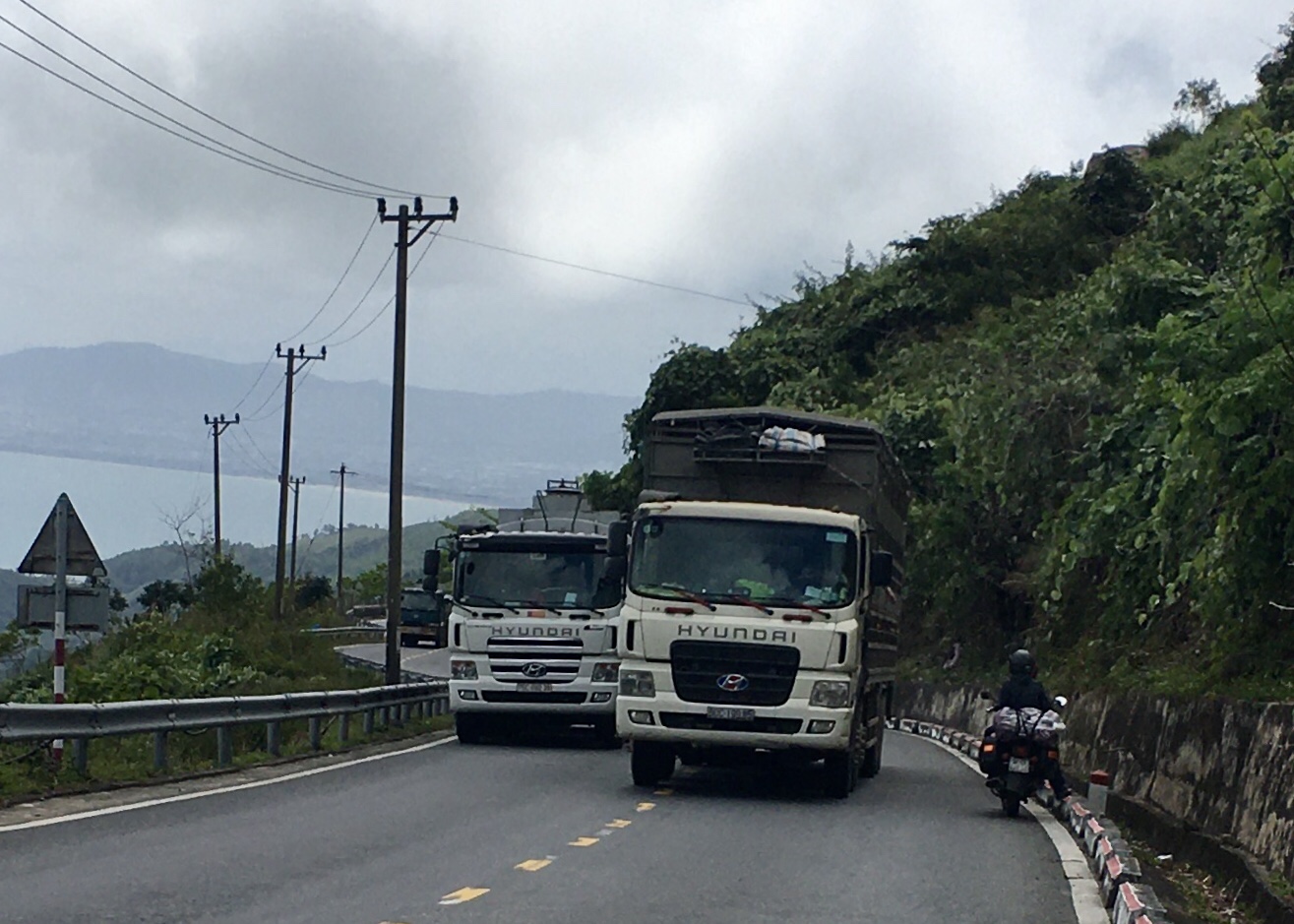
The main artery of Vietnam, Highway 1, used to run over this pass but today there is a 6.3km long tunnel. Unfortunately, neither livestock nor fuel are allowed through the tunnel so we had to stop frequently to avoid the trucks full of pigs and petrol, recklessly overtaking each other on the hairpin bends.

img_1700
Looking back from the lower slopes of the Hai Van pass

img_2294
A pig truck on a hairpin bend

img_2313
A narrow escape for this motorbike (and us!)

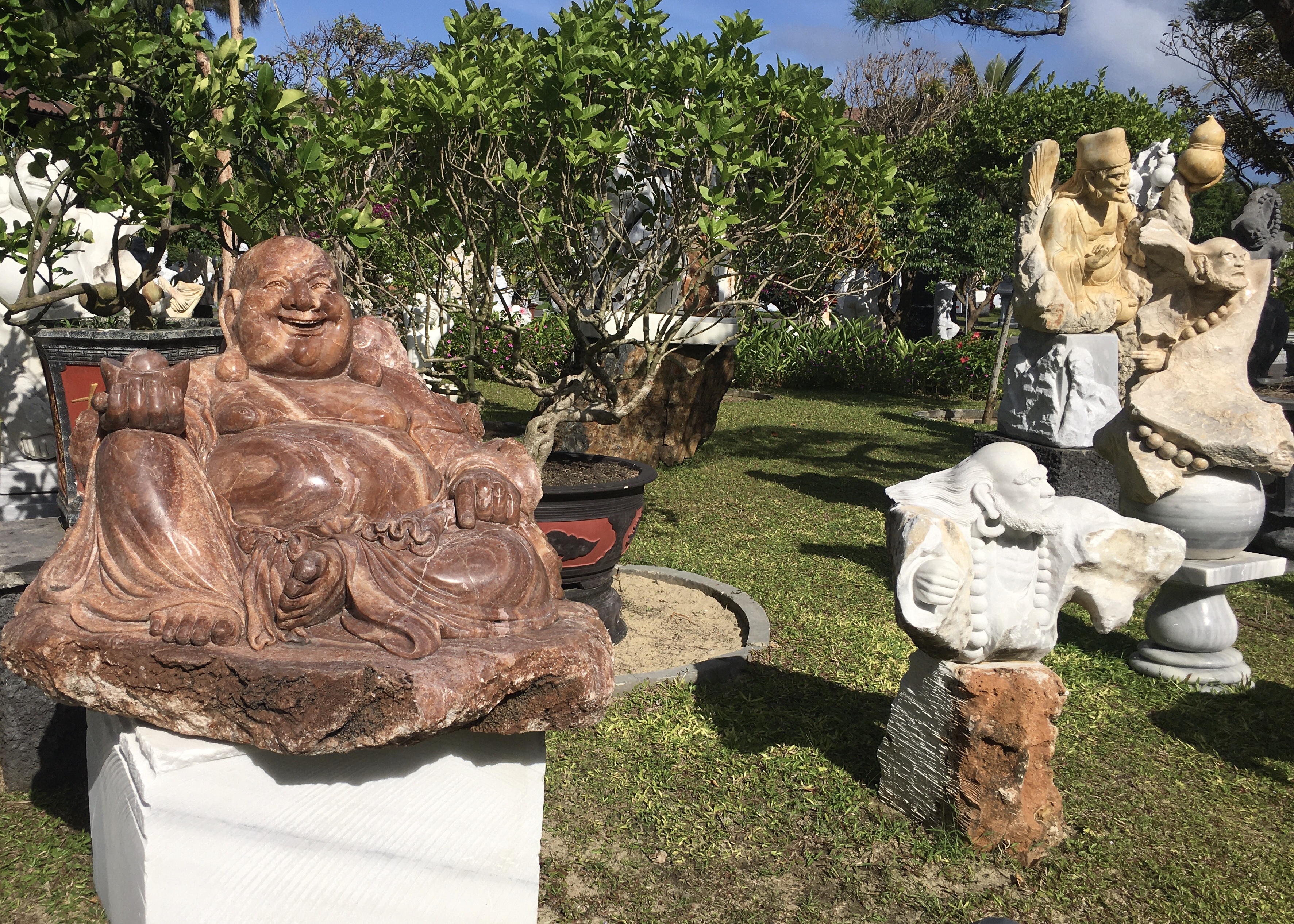
Further entertainment was to be found at the Marble Mountains south of Danang, five craggy marble outcrops named for the five natural elements (water, wood, fire, metal and earth). Each one has an army of statues for sale at their base – from the ever-popular Laughing Fat Buddha to replicas of the Venus de Milo. The actual marble in the mountains is now exhausted … so it’s imported from China instead.

img_2317
Anyone fancy a fat buddha for their garden?

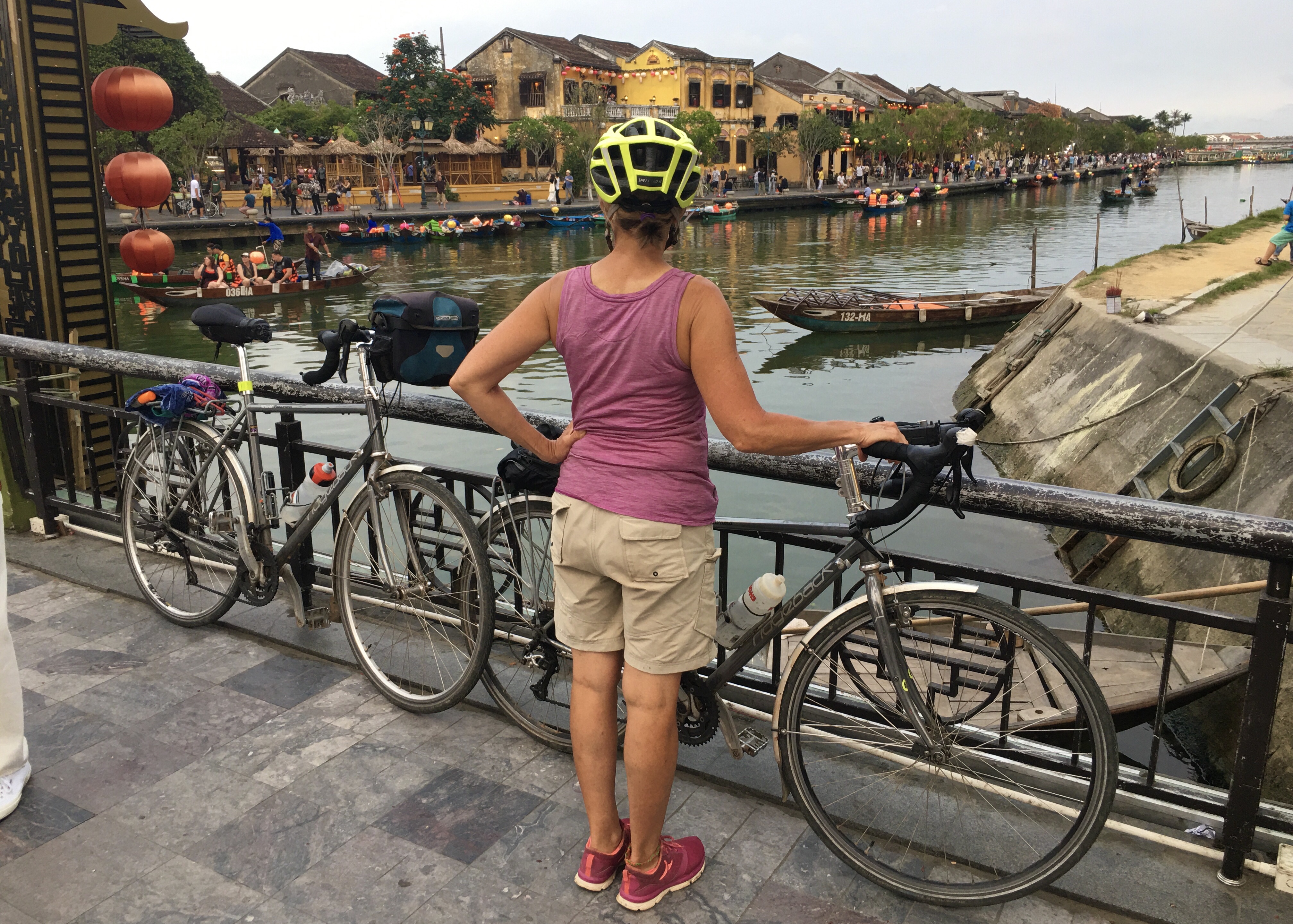
In Hoi An we were suddenly surrounded by tourists. Not surprising as it’s a delightful place, especially at night when the roads are closed to traffic and the town is lit up by thousands of lanterns. This makes it feel slightly like a Disneyland version of itself … but creates a fun atmosphere.

img_2392
The old buildings of Hoi An

img_1736
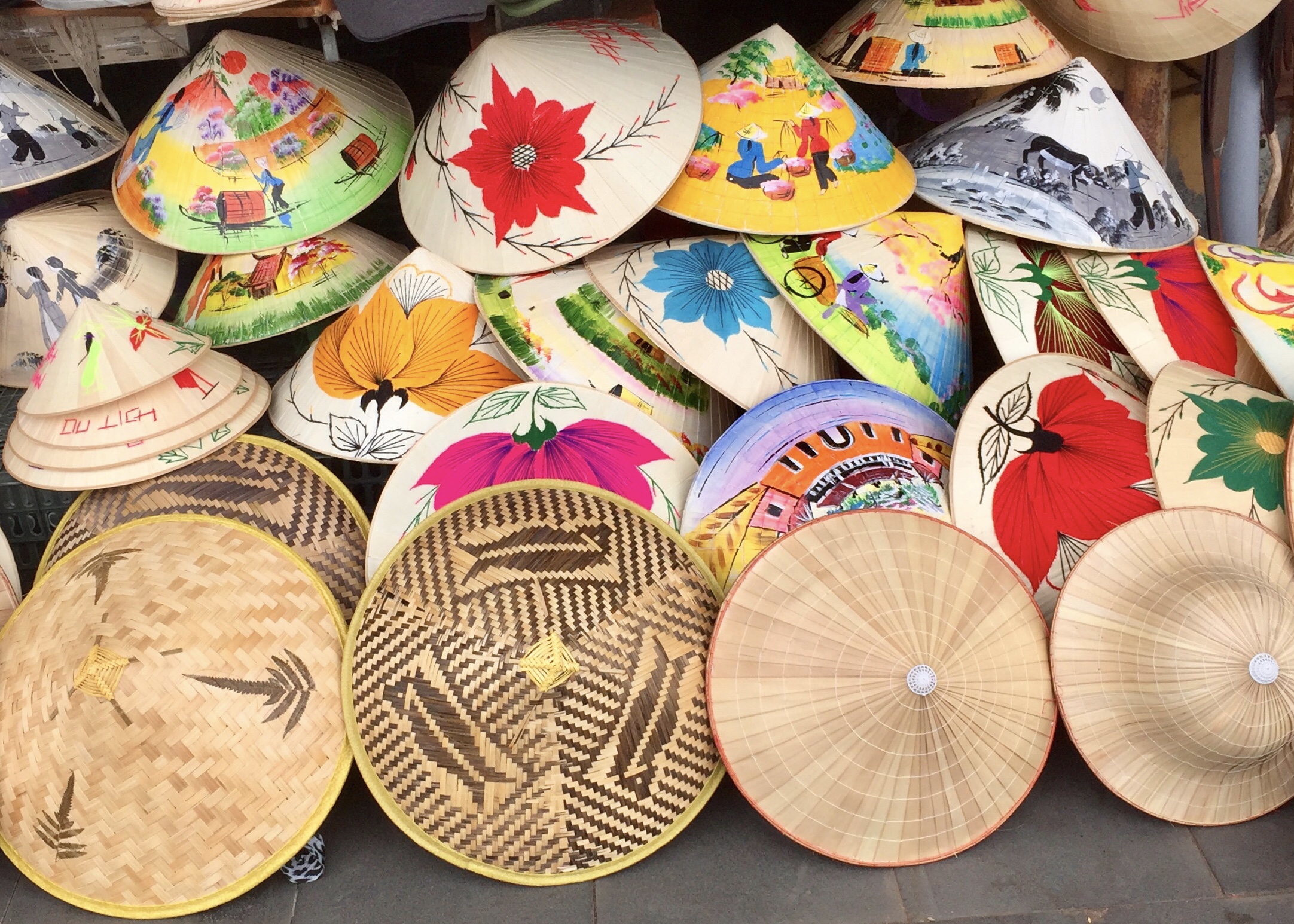
Traditional Vietnamese Nón Lá’ … Leaf Hats

As well as a few of the 800 historic buildings we enjoyed traditional Vietnamese food, traditional music and dance and traditional water puppets. Much to our amusement each show was wrapped up by a rendition of Auld Lang Syne, sung in English. And no, they didn’t know the words either!

img_1783
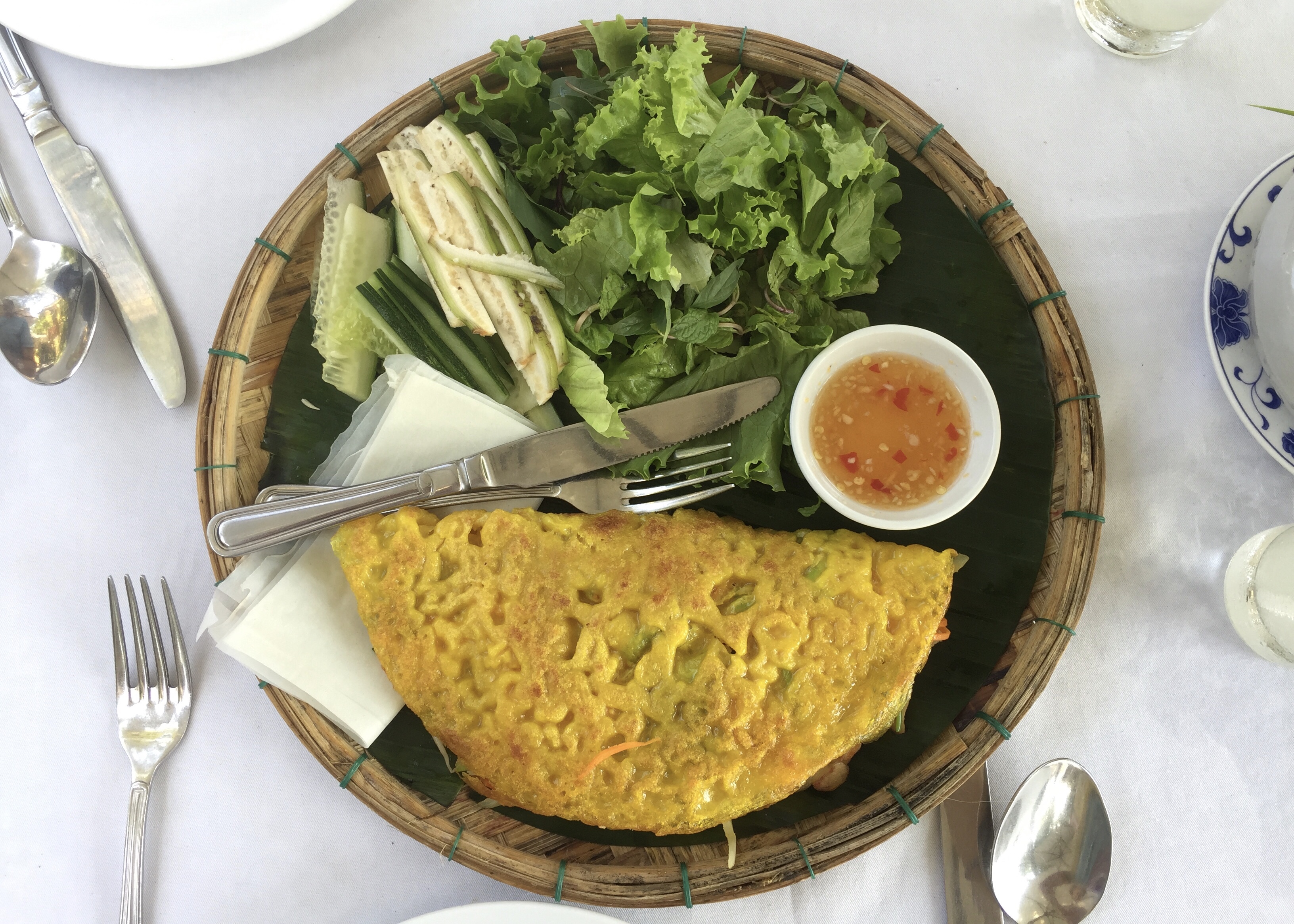
Our favourite: Bánh Xèo … crispy pancakes filled with shrimps and fresh vegetables

Perhaps our most magical moment in Hoi An came early one evening as we cycled around the paddy fields that encircle the town. A light sea breeze had blown up and several groups of grandparents (who would have known the horrors of the war) emerged onto the pathways that criss-cross the fields to enjoy flying kites with their grandchildren.

The air was filled with colour and laughter. It was a bewitching scene and one that made the American War seem like a very long time ago.

Clare and Andy

From the frying pan into the fire

This is now an old story. But it’s still a story worth telling.

Much has happened since we left Vietnam on Tuesday March 10th. The coronavirus pandemic has taken over the world with many countries in lockdown. At the time of writing, the UK has sadly suffered more deaths from Covid-19 than any other European country. The government estimates that around 7% of the population or 4.7 million people have caught the virus with over 300,000 confirmed by a positive test.

In contrast, Vietnam has had 355 official cases, Cambodia 141 and Laos just 19. So far, none of these countries have recorded a single death linked to Covid-19. Indeed, Vietnam is now cited by many experts as having one of the best epidemic control programs in the world, alongside Taiwan and South Korea.

It seems that the Vietnamese authorities learnt a lot from previous viral outbreaks, including Sars in 2003 and Avian Flu in 2010. They took fast, decisive action as soon as the first case arrived from Wuhan on January 23rd.

The border with China was immediately closed, schools remained shut after the New Year Tet holiday and strict quarantines were placed around any local outbreaks. Most impressively, every single case was individually recorded and all the people they’d been in contact with were traced, tested and isolated. Then they traced the contacts of the contacts … and so on.

img_2608
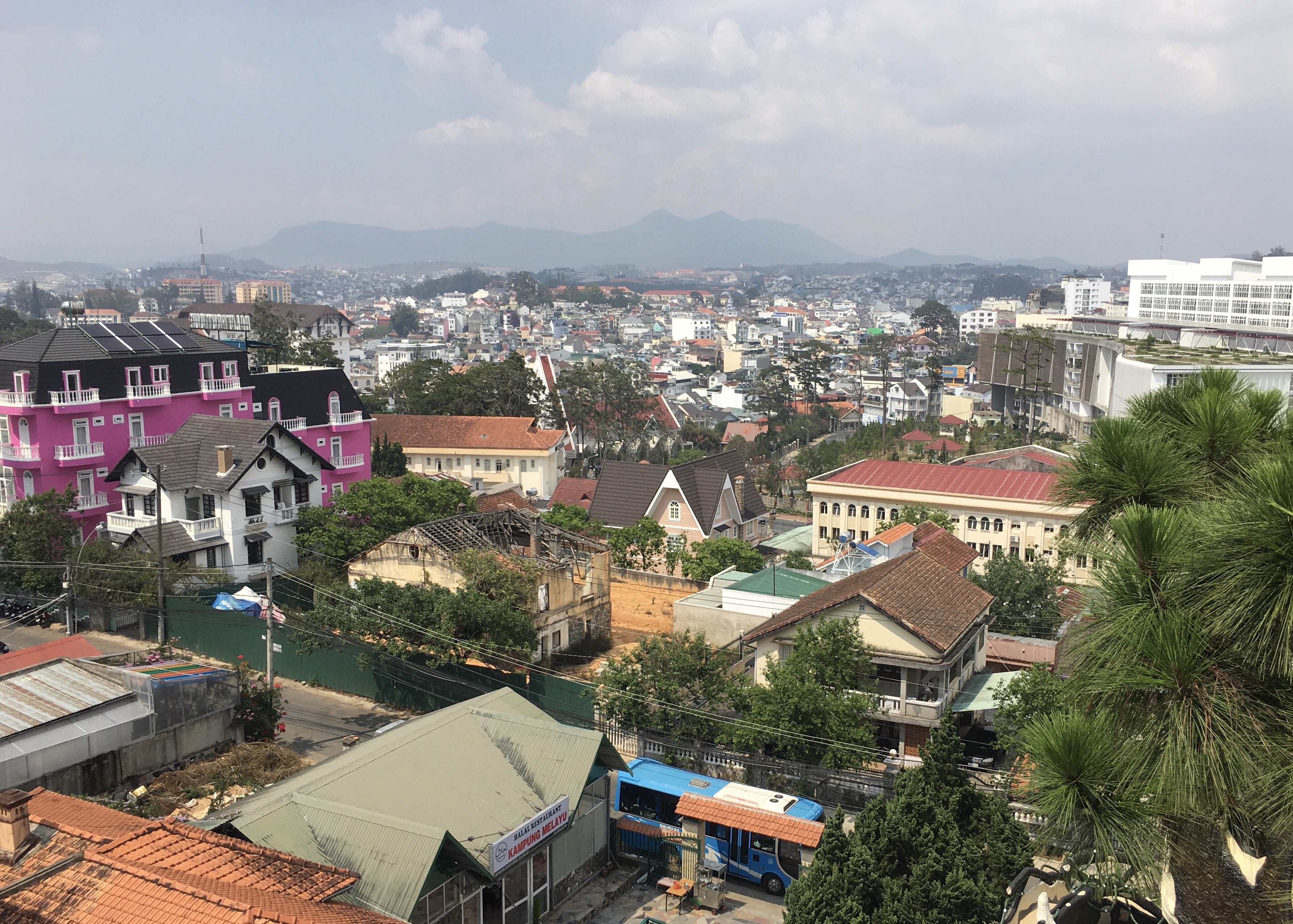
Dalat

On Sunday March 8th we were enjoying a pizza in the old French hill station of Dalat, excited about our final 4-day bike ride back to Saigon and completing a round trip of over 2000km.

Another long cruise downhill would take us through some beautiful but remote mountain countryside, before reaching the outskirts of the city. Accommodation for the first two nights had been difficult to find, but eventually we’d managed to book a small guesthouse by a pretty lake about 10km off our route.

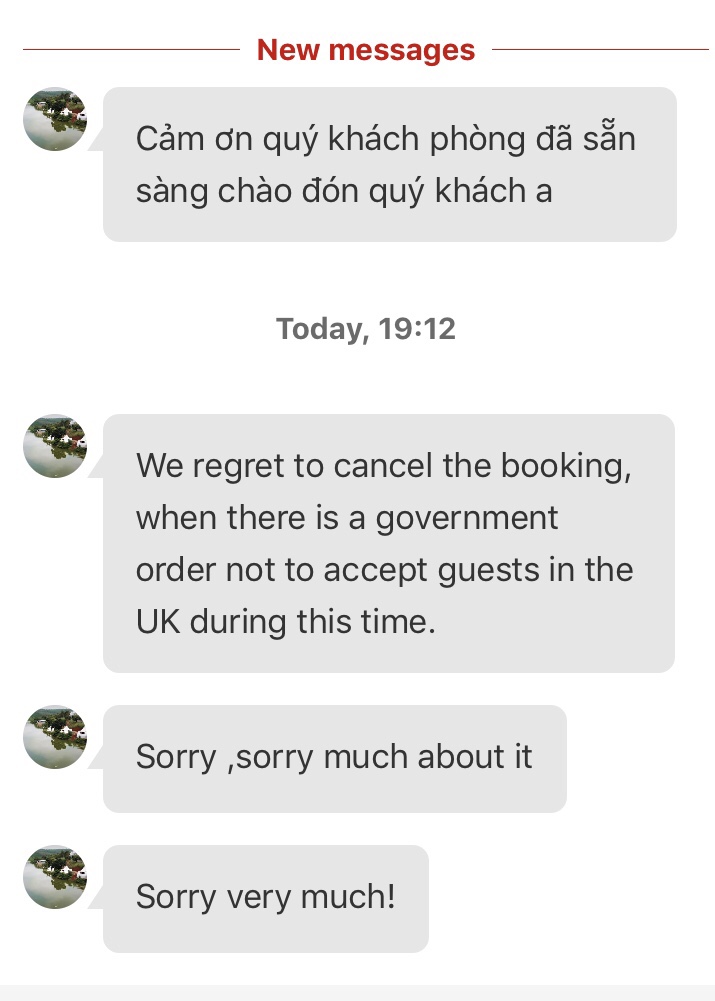
We were really looking forward to the ride. Until that is, we received this message from the guesthouse …

img_2005

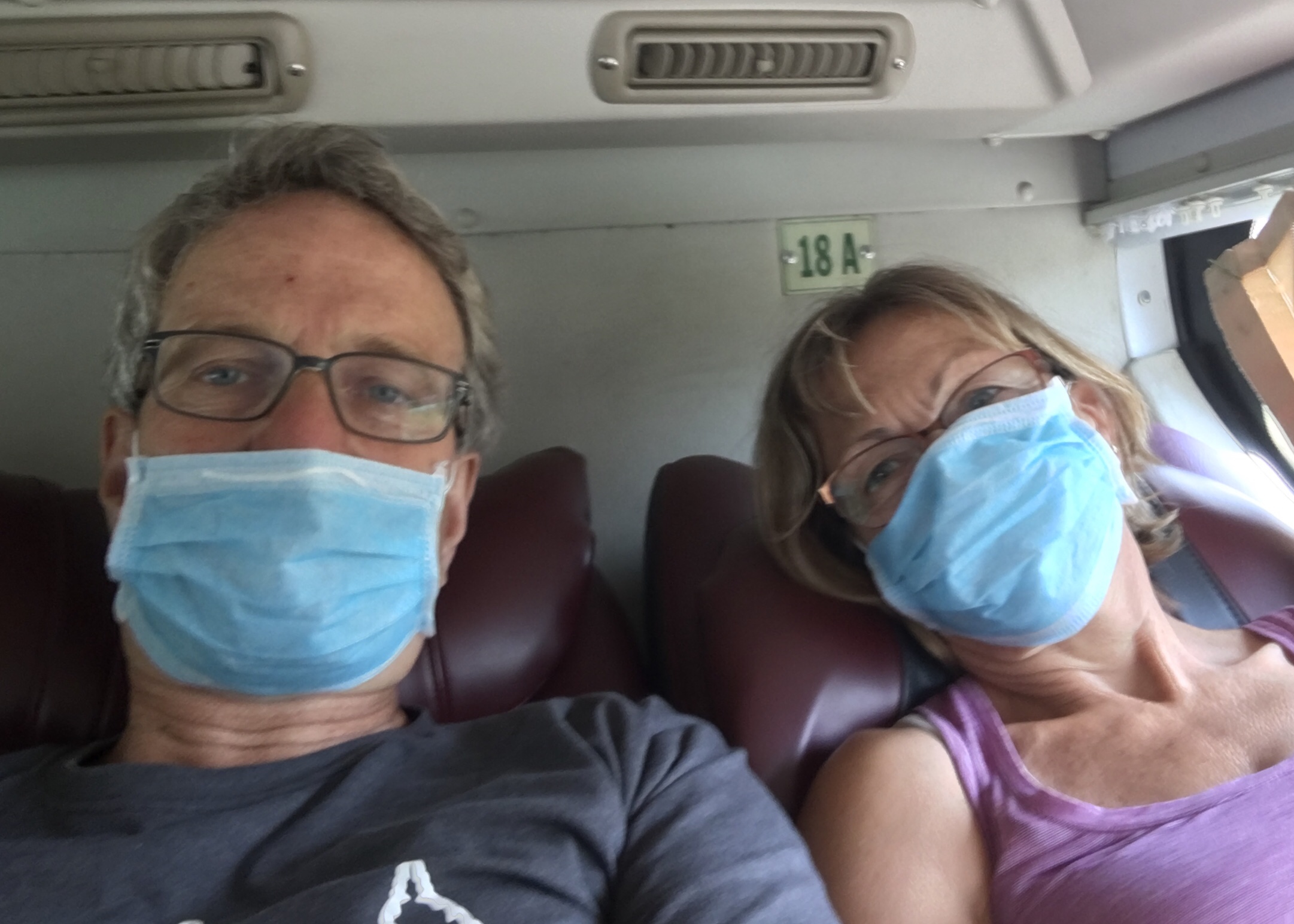
We’d noticed that concern about Covid-19 had grown significantly in Vietnam over the previous few days. Most people were now wearing masks and our temperature was taken at every hotel, restaurant and museum. This had surprised us a little, as the country only had 16 cases at that time and were proud to have gone 22 days without anyone testing positive.

After a little googling, we soon found out why visitors from the UK were suddenly less welcome. A Vietnamese ‘socialite’ had flown back to Hanoi from London, after visiting the Milan Fashion Show. She turned out to be a super-spreader, infecting all the people around her on the plane. Most of them were British tourists heading to Vietnam for a special holiday.

This meant that the headlines in the local news were full of the danger of any contact with Brits. And any other Europeans for that matter. On Instagram we learnt that other bicycle tourists were suddenly being turned away from guesthouses, restaurants and even shops.

We could see that people were becoming a bit wary of us. Smiles were replaced with nervous glances. Perhaps we were not quite as welcome as we had been? Maybe it was time to leave?

img_2012

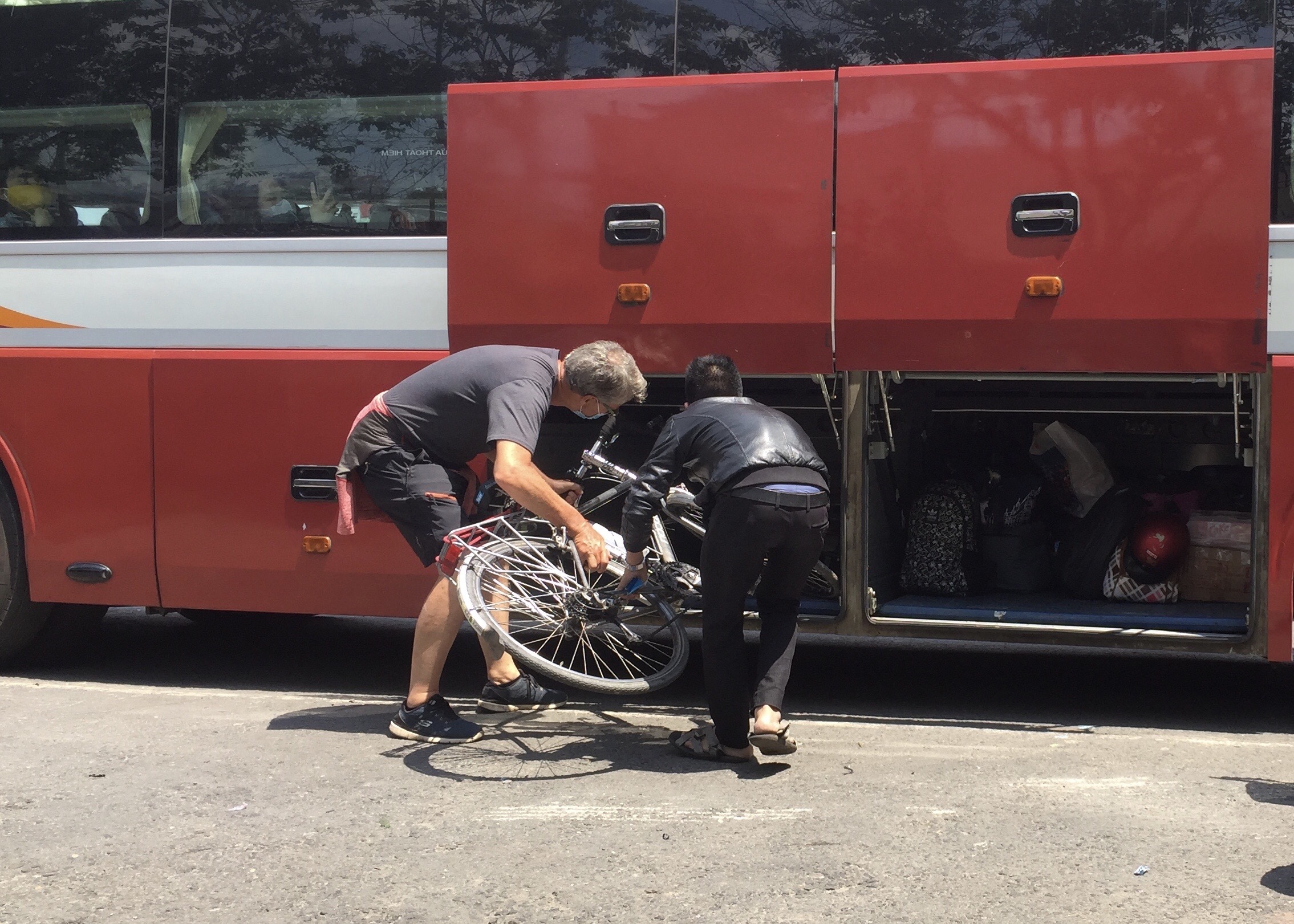
Instead of cycling back to Saigon, we jumped on a bus. Once there, we rode through the busy traffic in the dark to find a travel agent and change our flights. 48 hours after finishing that pizza in Dalat, we were on the plane home … a week ahead of schedule but pleased to be getting back to our families.

As things turned out we were leaping from the frying pan into the fire, leaving a safe country behind us and returning to a country where the number of coronavirus infections were accelerating quickly.

img_2630

It was disappointing to leave Dalat by bus as we’d also arrived by car … not really the point of a bicycle tour!

The bike ride up to Dalat from the coast is beautiful but brutal. 150km and over 3500m of climbing with little along the way to break the journey. No lodgings, no restaurants, not even any small shops selling water. Many young adventurous bicycle tourists have had great fun going down … very few have tried to cycle up.

It was clearly beyond our capabilities!

Dalat itself is the cheesy-music love-capital of Vietnam, hugely popular with honeymooners and hen parties. A few dollars to one of the many street karaoke busking groups buys you a great night out. You get a backing band and an appreciative audience of several hundred like-minded romantics as you belt out “Killing me softly with his song … ” or “I-e-ii-ee-iiiii will always love yooouuuu … “

img_2614
Snacks in Dalat

Our journey from Hoi An to Dalat had begun with yet another bus (we know … this is turning into a troubling theme). There was not enough time to cycle the rest of the way down the coast, so we picked a section that promised ‘a spectacular mix of craggy wind-lashed capes, fishing villages and pretty coves.’ Just as importantly, it also promised plenty of backroads away from the trucks rumbling down Highway 1.

This time it was one of the dreaded night buses, infamous with young backpackers. Built for small Vietnamese people, not for tall foreigners, Andy had to squeeze so tightly into his seat that he appeared to be trapped in an old-fashioned fairground ride!

img_2415

After eight sleepless hours, the bus dropped us off at 3am on the outskirts of a sprawling and rather soulless city called Tuy Hoa. We didn’t particularly fancy cycling in the dark so looked around for a hotel to hang out in for a couple of hours. They all looked a bit seedy, with big neon signs advertising 24-hour massages. Sure enough, as we locked up our bikes, a lady-of-the-night tottered out, presumably on her way home.

The night manager then followed her out to find out what we were up to.  Once he understood our situation, he couldn’t have been any nicer, offering drinks, power for our phones and a quiet lie down on the lobby sofa.

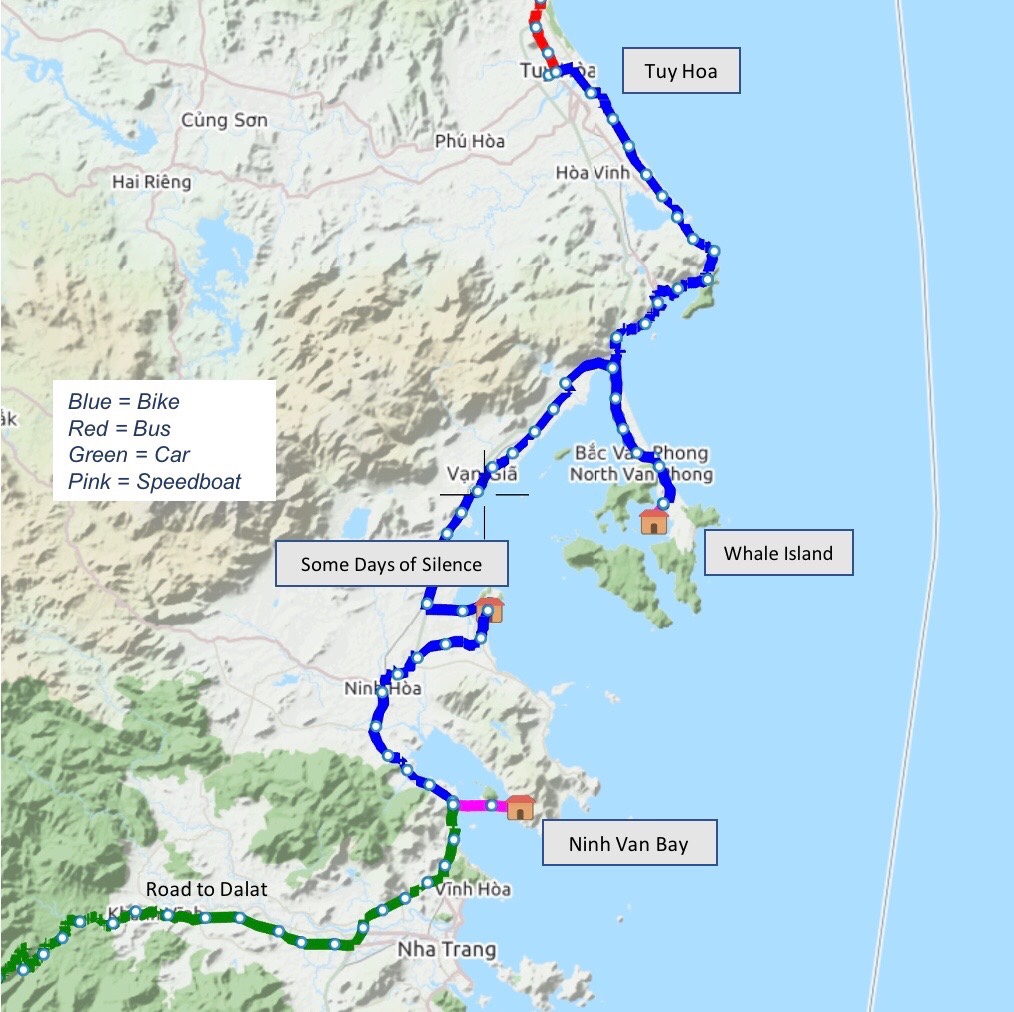
vietnam south east coast

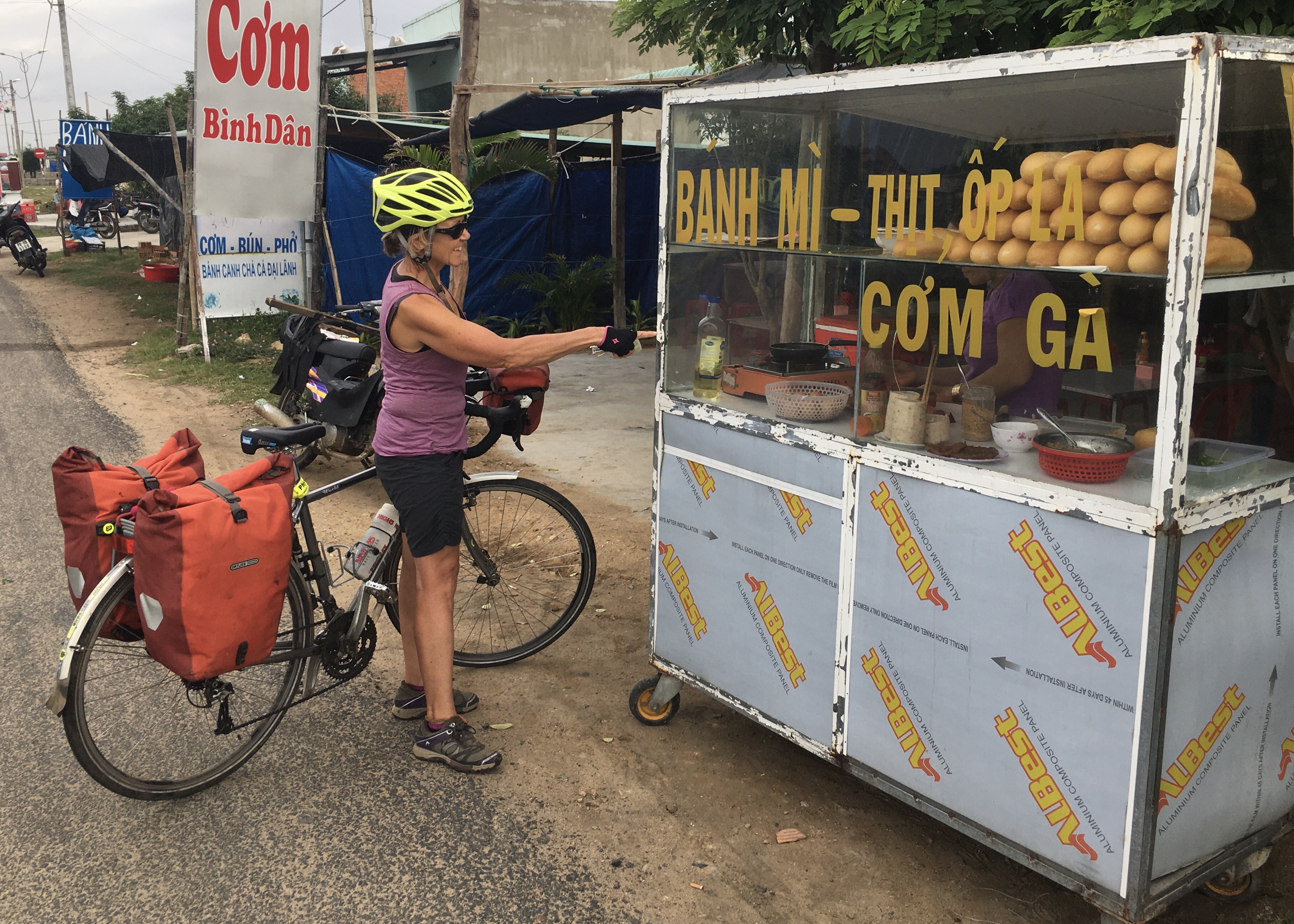
Just before dawn we waved him goodbye and headed off in search of the coast road, some strong coffee and breakfast. Everything was closed but eventually we came across a street stall offering delicious Bánh Mì (Omelette Baguettes), just the right energy boost for the 75km ahead of us.

img_2422

This part of the Vietnamese coast is a land of contrasts.

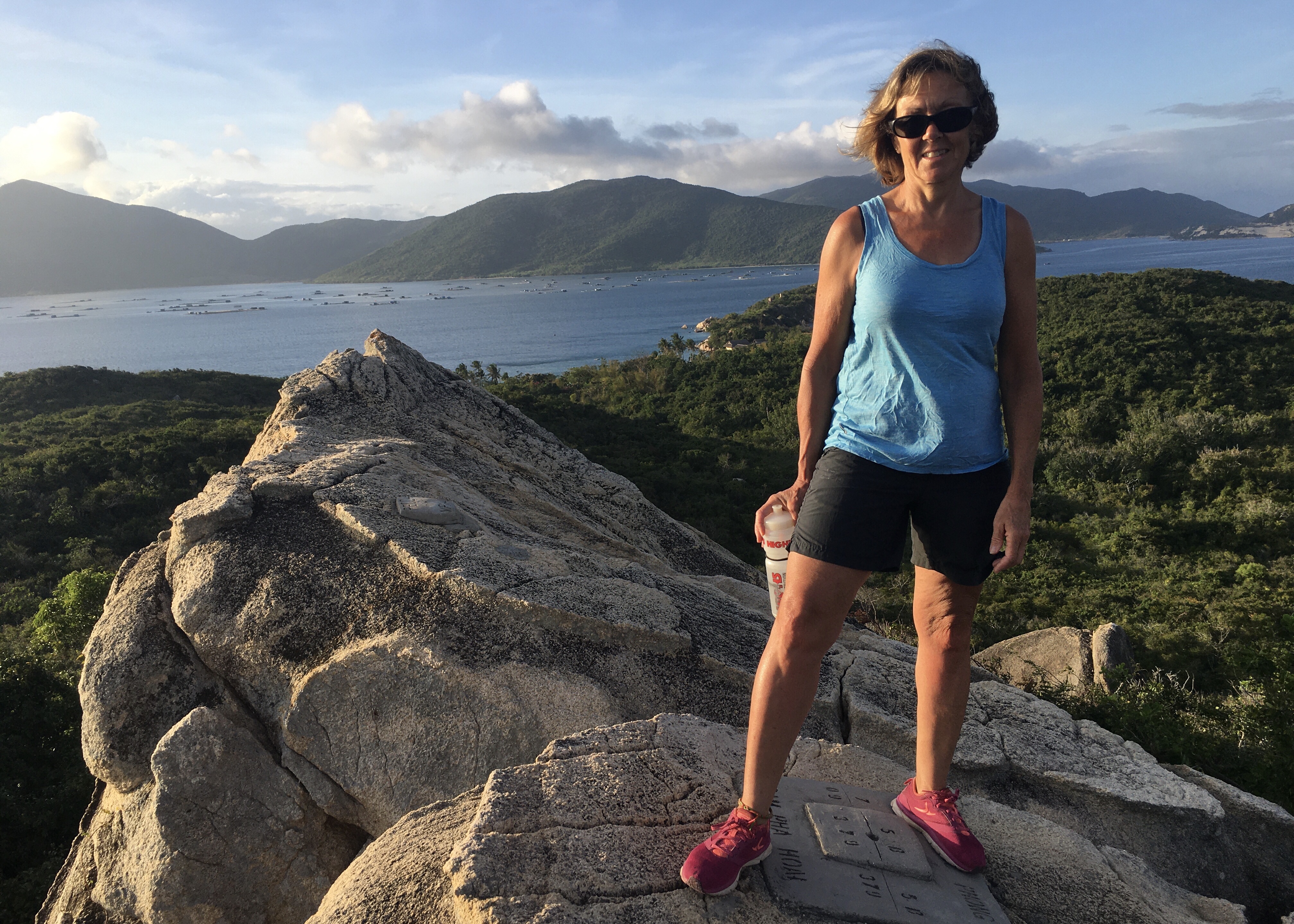
Some parts of it are indeed very pretty … craggy capes, secluded coves, chalk-white beaches and small islands nestled in a turquoise sea. But there’s also a lot of industry here with oil refineries and giant ports dotting the horizon.

img_2464

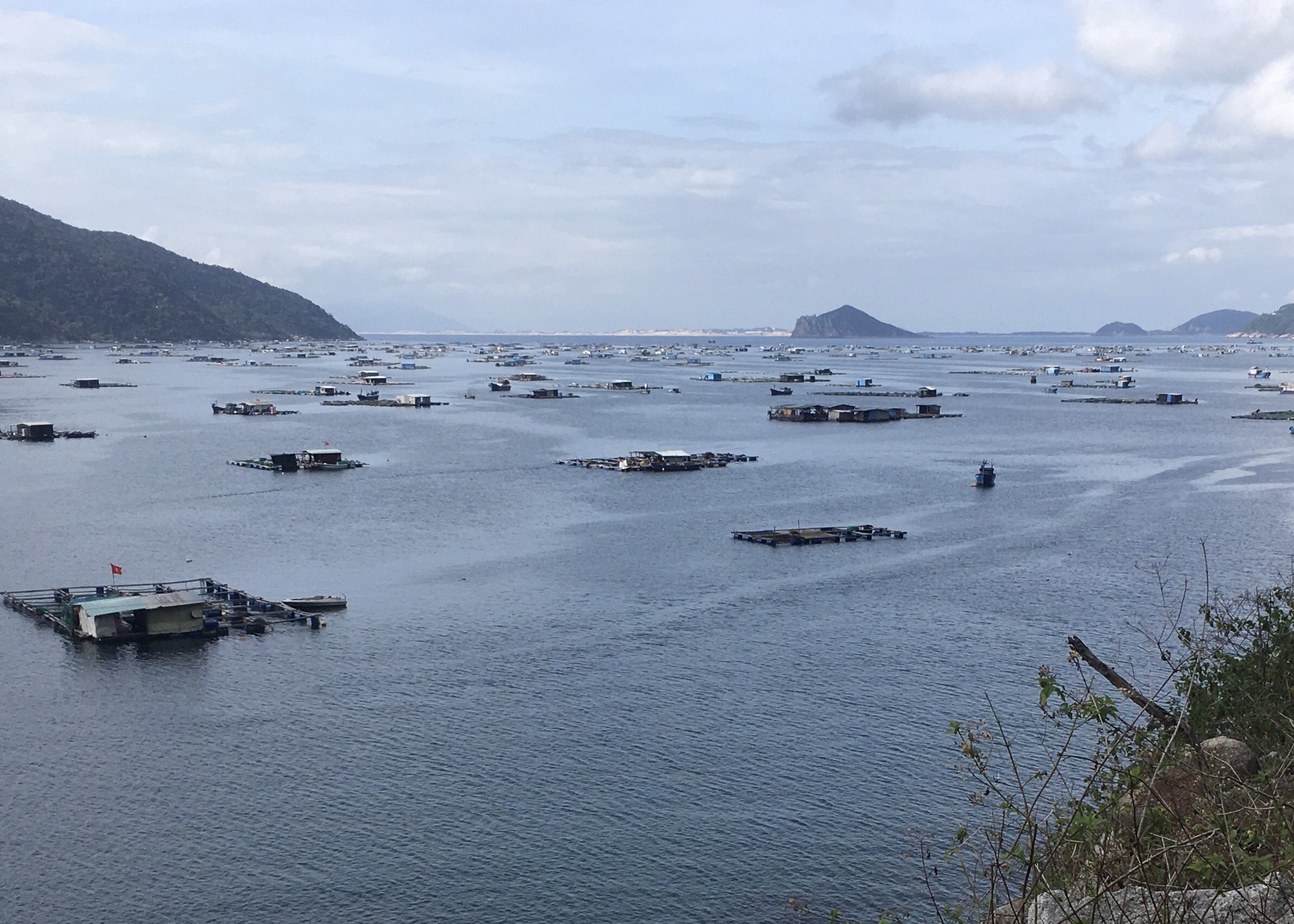
Most striking are the multitude of fish farms which stretch out across the bays as far as the eye can see. Farmers and their families live on the floating houses, growing fish, shrimp and crab to serve the incessant demand from city markets with their ever-expanding population.

img_2426
Fish farms

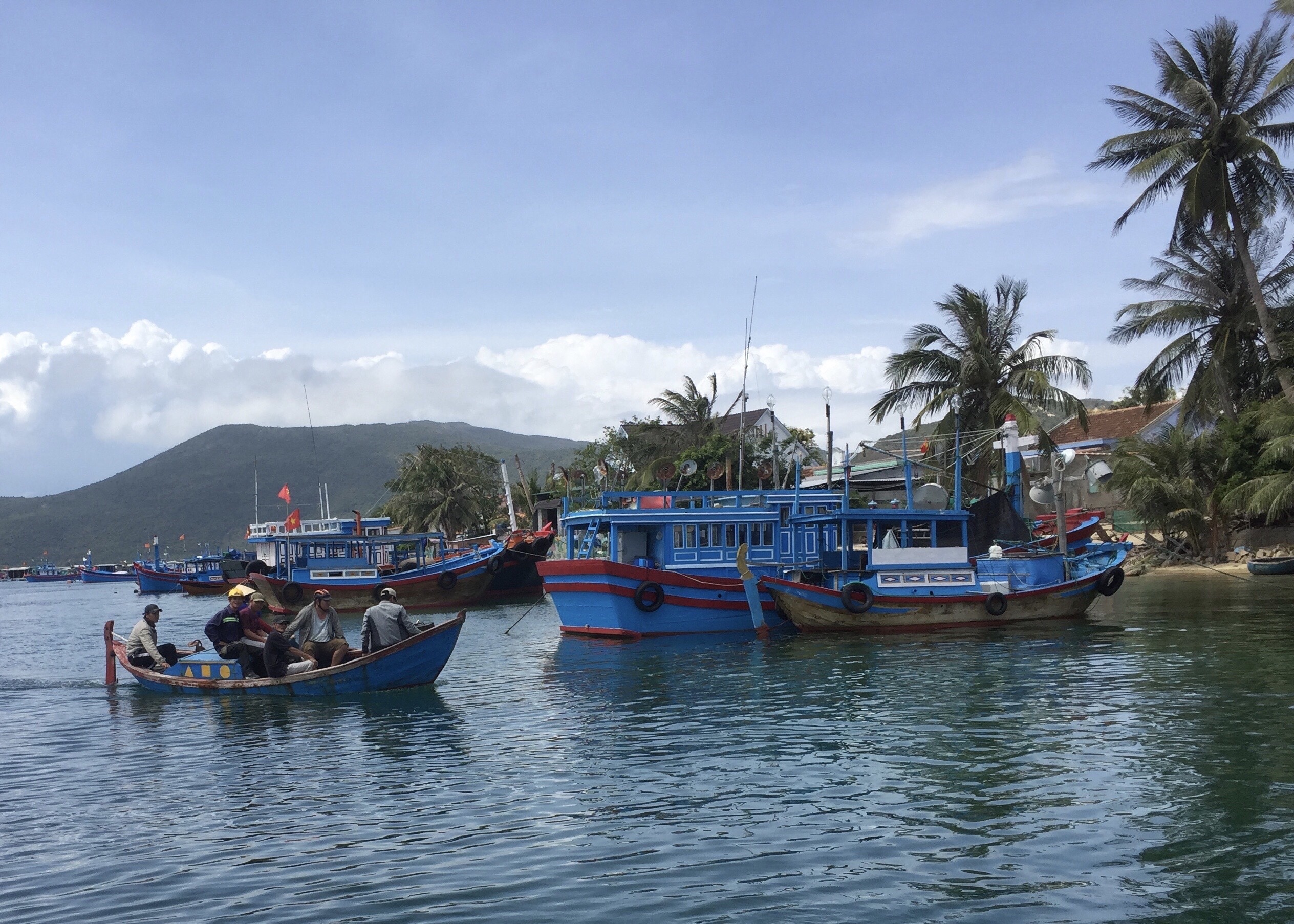
Traditional fishing boats, each painted blue with a red trim, potter between the farms and head out at night in search of the wild tuna and bream.

img_1819

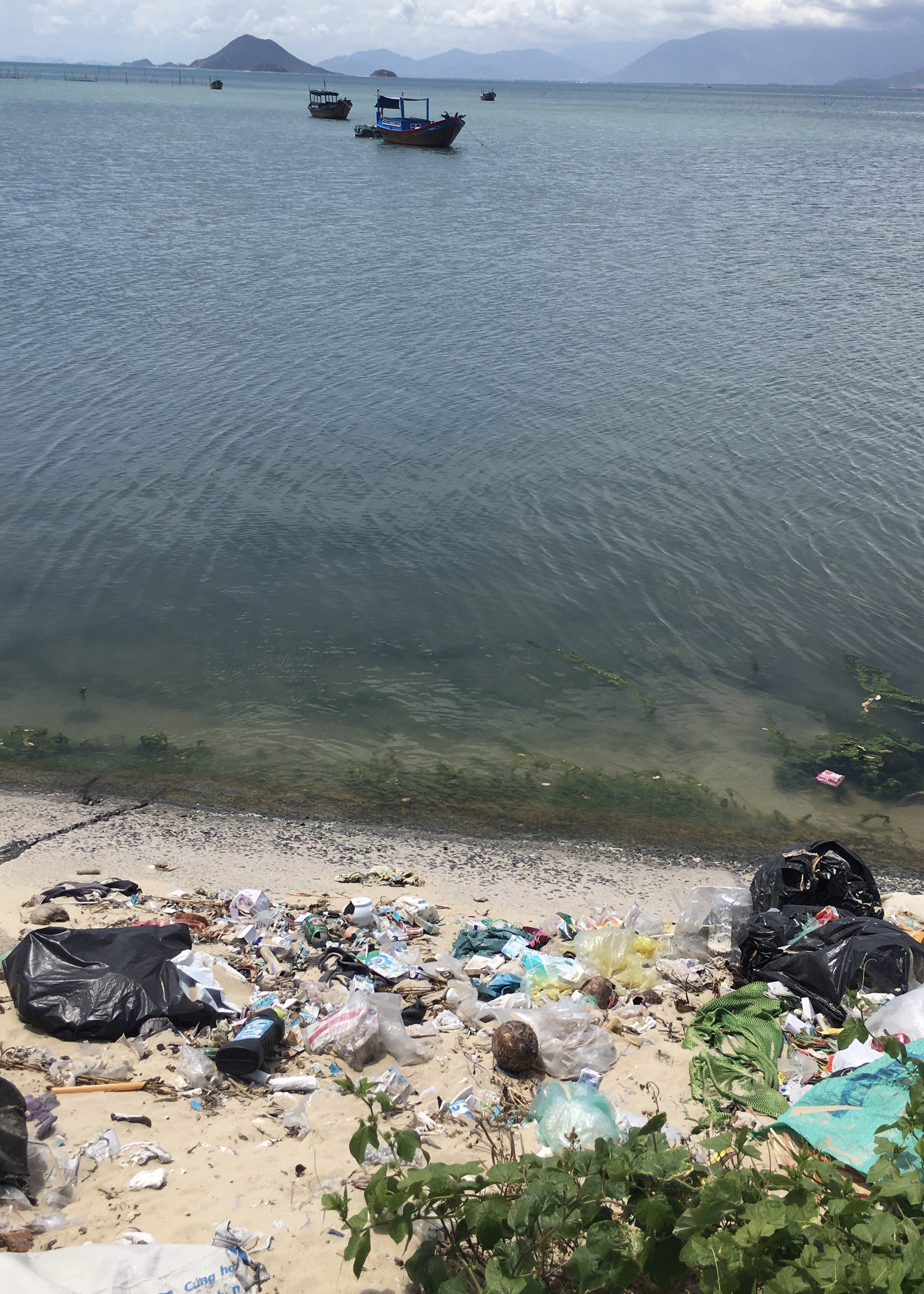
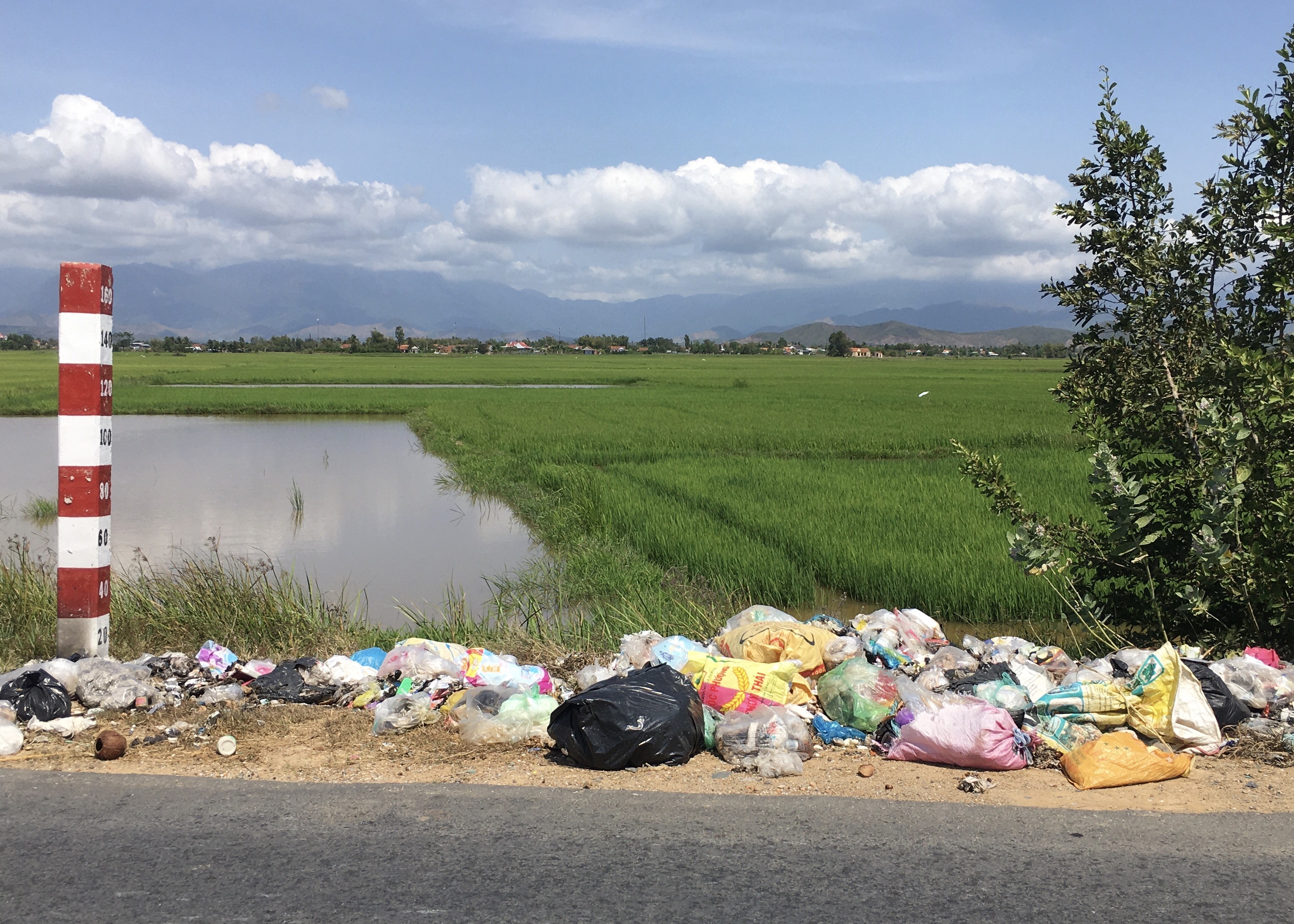
The fish farms are an arresting site. Less attractive are the piles of rubbish that build up by the side of the road. Managing single-use plastic waste is global issue that is brought into sharp focus in this part of the world.  People simply discard their leftovers on the ground as their forefathers have done for centuries. Unfortunately, unlike the waste of previous generations, plastic doesn’t degrade … so it just sits there waiting to be burnt every few months.

Occasionally as we cycled along a quiet road a bus would drive past us with empty bottles and cans literally raining out of the windows. It would be comical, if it wasn’t so sad.

img_2443
Beauty spoiled

This is a representative of a wider problem that applies to all three countries but especially to Vietnam, with its higher population density and rapid economic development.

Vietnamese people are rightly optimistic about the future. But many are also worried that their natural resources are being quickly exhausted to fuel the economic growth. Forests are being burnt down, cities rapidly enlarged, waterways polluted. They know that their country will need to nurture its natural resources much better in future for the good times to be sustainable.

img_2496

Trying not to notice the piles of rubbish, we meandered down the coast at a gentle pace, pausing for a couple of nights on Whale Island and at a quiet beachside retreat called ‘Some Days of Silence.’ There was no need to hurry.

img_1826
Whale Island

For our last night on the coast, we treated ourselves to a taste of luxury at one of the upmarket resorts that grace Ninh Van Bay and can only be reached by speedboat. Described in the guidebook as an ‘alternative reality populated by European royalty, film stars and the otherwise rich and secretive’, we were not sure what they would make of two sweaty cyclists.

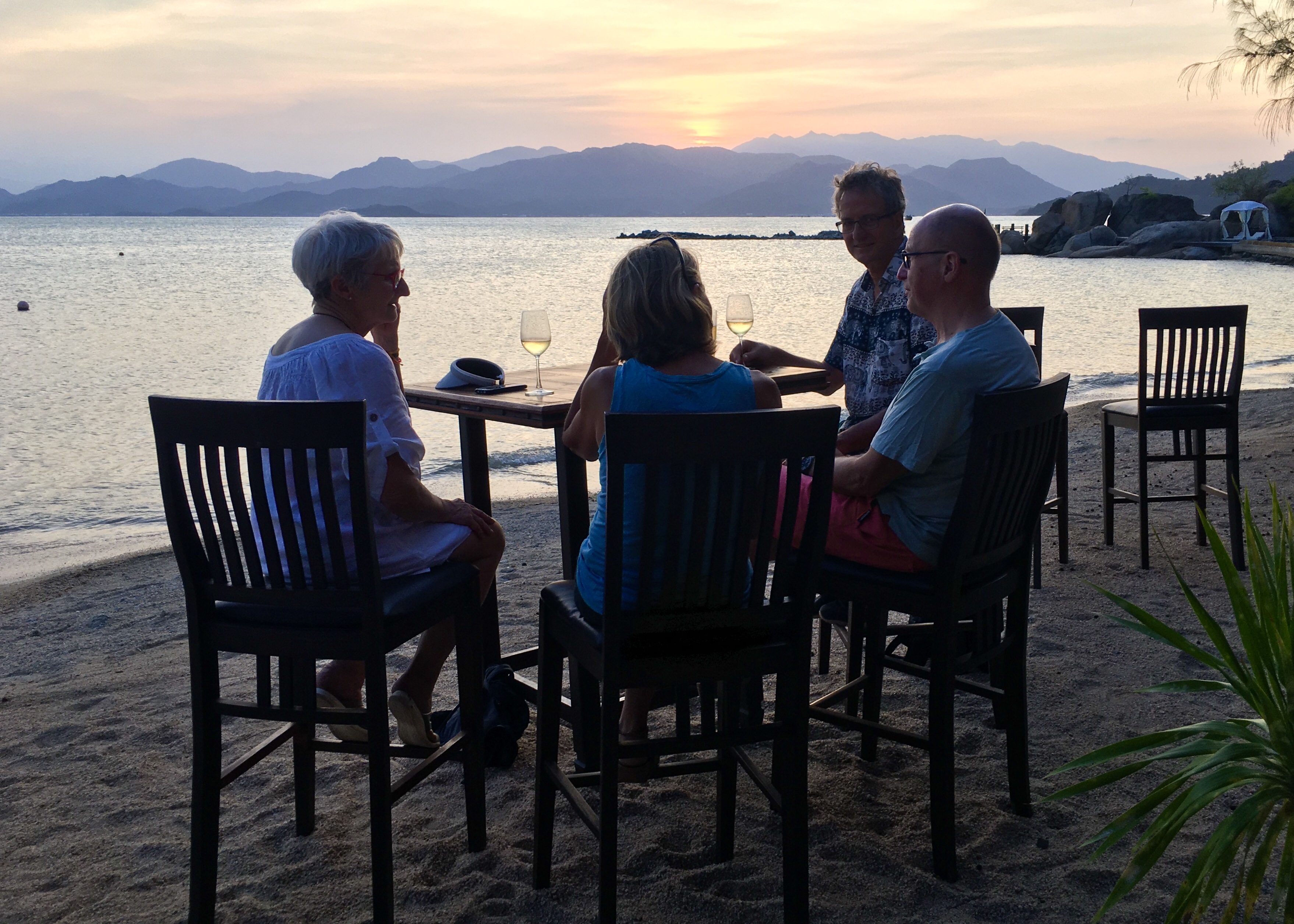
Here we’d arranged to meet up with Richard and Sue, the friends from home that we’d bumped into by surprise back in Champasak. As the sun set over the hills that lead up to Dalat, we toasted both our trips with some very welcome crisp white wine.

We didn’t know it at the time, but it was to be the end of this particular cycling adventure. A perfect celebration!

img_2512-1

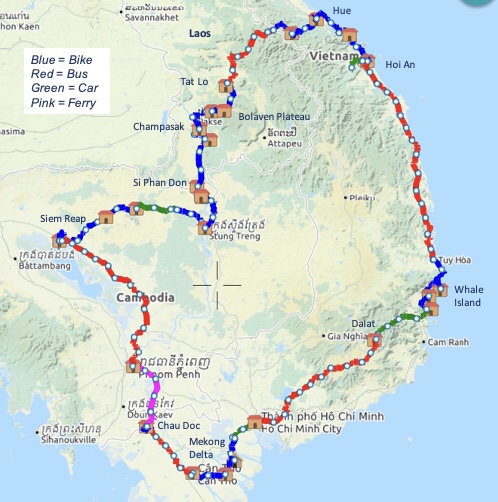
Here’s the map of our whole trip around Vietnam, Cambodia and Laos:

se asia map 1 whole trip

We have to admit that there are a lot more red lines (for buses), green lines (for cars) and pink lines (for boats) on this map than usual.

But we still pedalled 1712km, climbed 18,629m and spent 126 hours in our saddles. That’s slightly more kilometres than our trips to Chile or to Australia.

And we only had two mechanical problems, both punctures to Andy’s rear wheel.

img_2519

Laos, Cambodia and Vietnam are three very different countries, but they’re all great places to tour around by bicycle.

The scenery is spectacular … from the green rice carpets of the Mekong Delta to the rough red clay roads of Northeast Cambodia … from the temples of Angkor to the tranquillity of the Four Thousand Islands in landlocked Laos … from the cassava and coffee plantations of the Bolaven Plateau to the thick, high jungle of the Ho Chi Minh highway.

img_1548

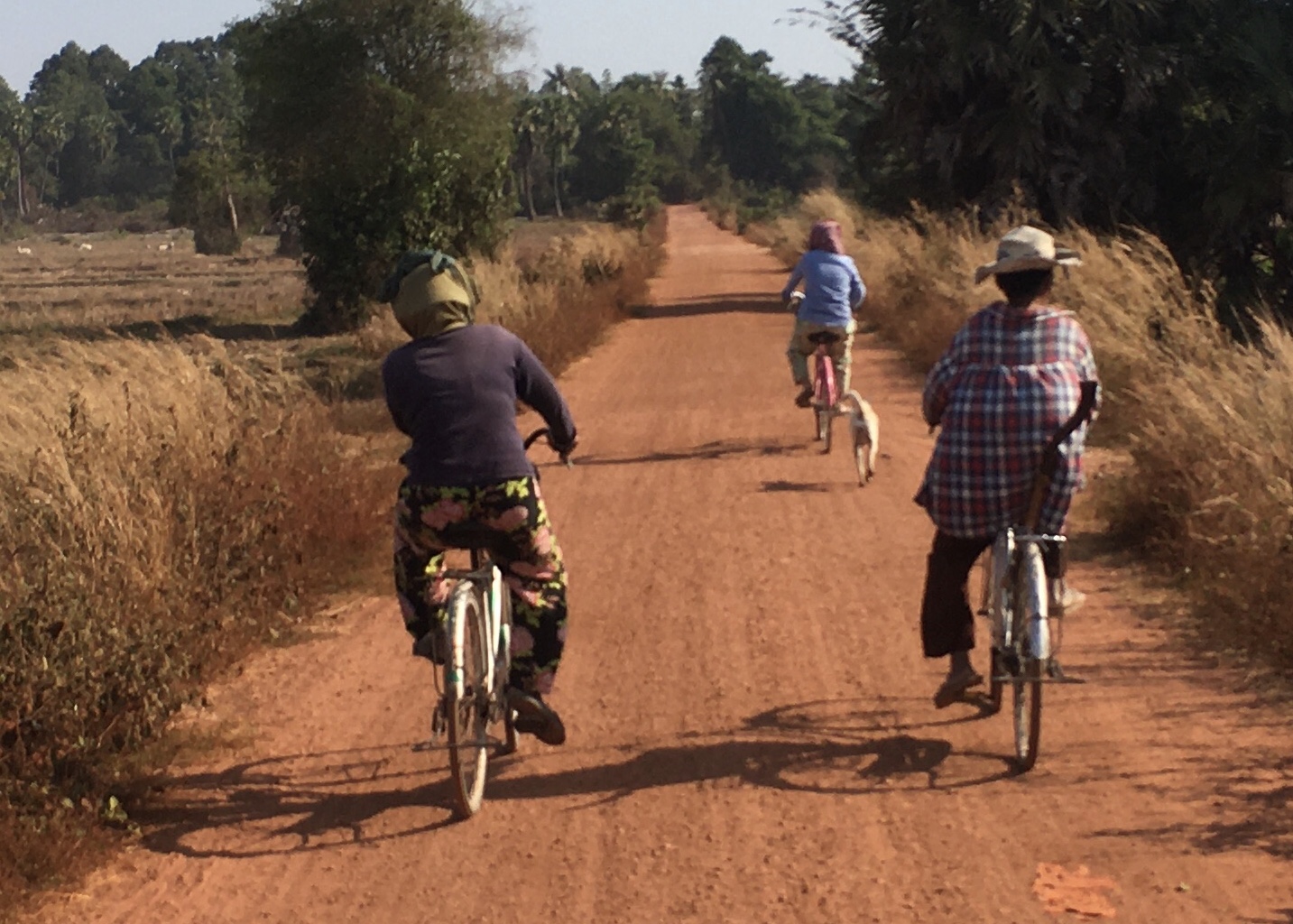
As you set out at sunrise in the cool morning air there are endless scenes of everyday life to entertain you … families cooking noodles for breakfast under their house, hawkers selling dried fish, women slowly pedalling back from the market in brightly coloured pyjamas topped with conical leaf hats.

Once you get used to the rules of the road it’s even fun to cruise through town, scooters buzzing past in every direction.

But four months after coming home, it’s still the sound of children’s voices that we remember most …  “Heyoooo … Heyoooo mister … Heyoooo mummy … Heyoooooo!!!”

img_1660

Whilst the world fights back against this terrible virus, we can conjure up this soundtrack to lull us off to sleep … and start dreaming about where to go next.

Until then …

Clare and Andy

Goodbye Galway Girls & Danny Boys

The Irish have a great talent for making a lot out of a little.

As we drove to Rosslare to catch our ferry back home, we couldn’t help but smile at a sign announcing ‘President Obama’s Ancestral Village’. This is Moneygall where a young man called Falmouth Kearney lived before he emigrated to the United States in 1850. He was Obama’s maternal great-great-great-grandfather.

Now this might seem like a distant connection to you and me but for Moneygall it’s enough for a visitor centre called the Barack Obama Plaza and the preservation of a terraced house as his ancestral home.

We found a similar story when we stayed in New Ross on our first night in Ireland. Birthplace of John F Kennedy’s great-grandfather, it now boasts a Kennedy homestead, Kennedy museum, Kennedy arboretum, Kennedy summer school and Kennedy hotel.

As far as we know, there isn’t a Trump visitor centre in Ireland yet … just an ostentatious golf course and luxury hotel that took us a long time to cycle past.

img_1033
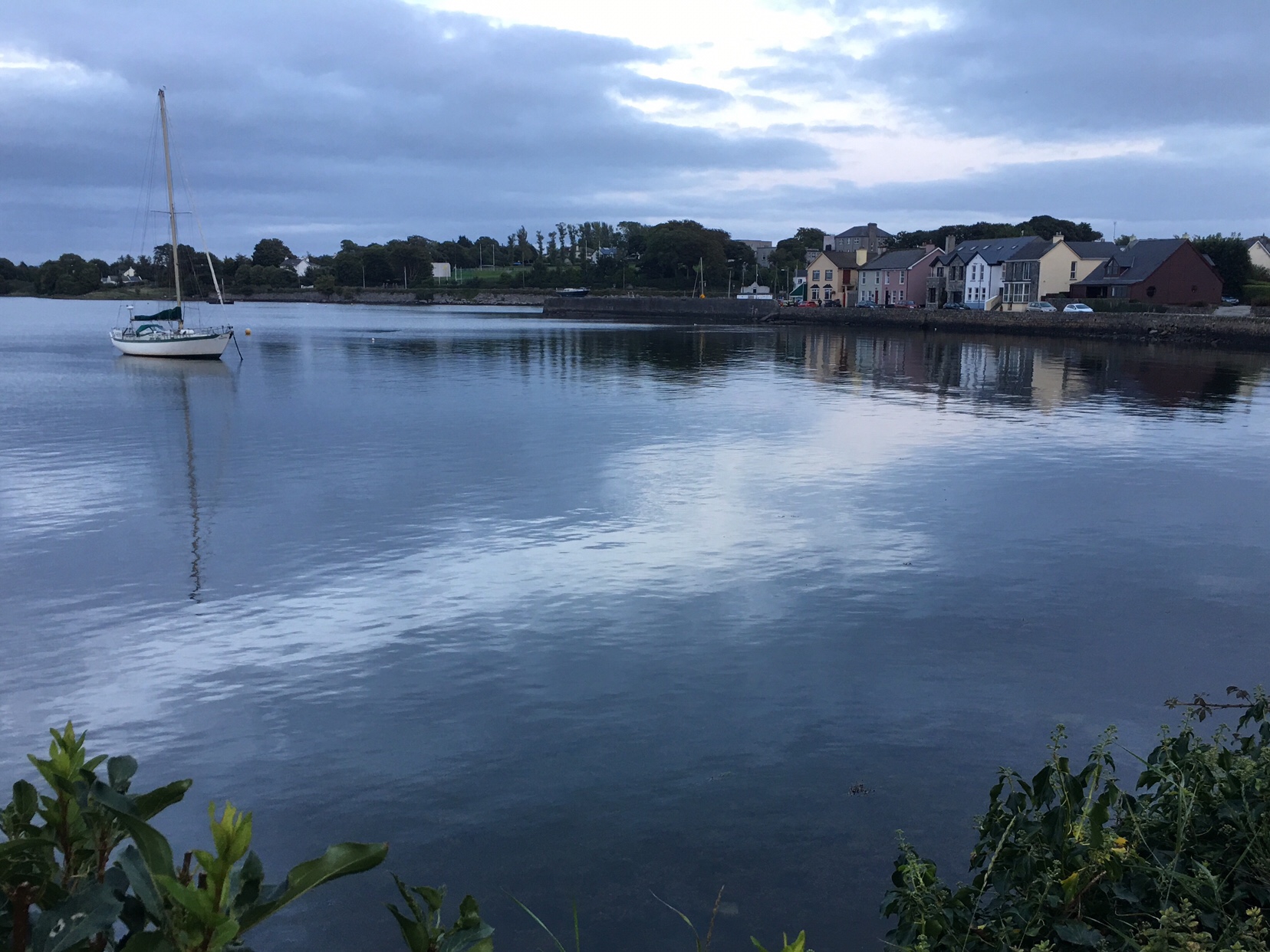
Kinvara

During our last two days on the Wild Atlantic Way, we cycled from Doolin to Galway, staying overnight in the lovely small town of Kinvara.

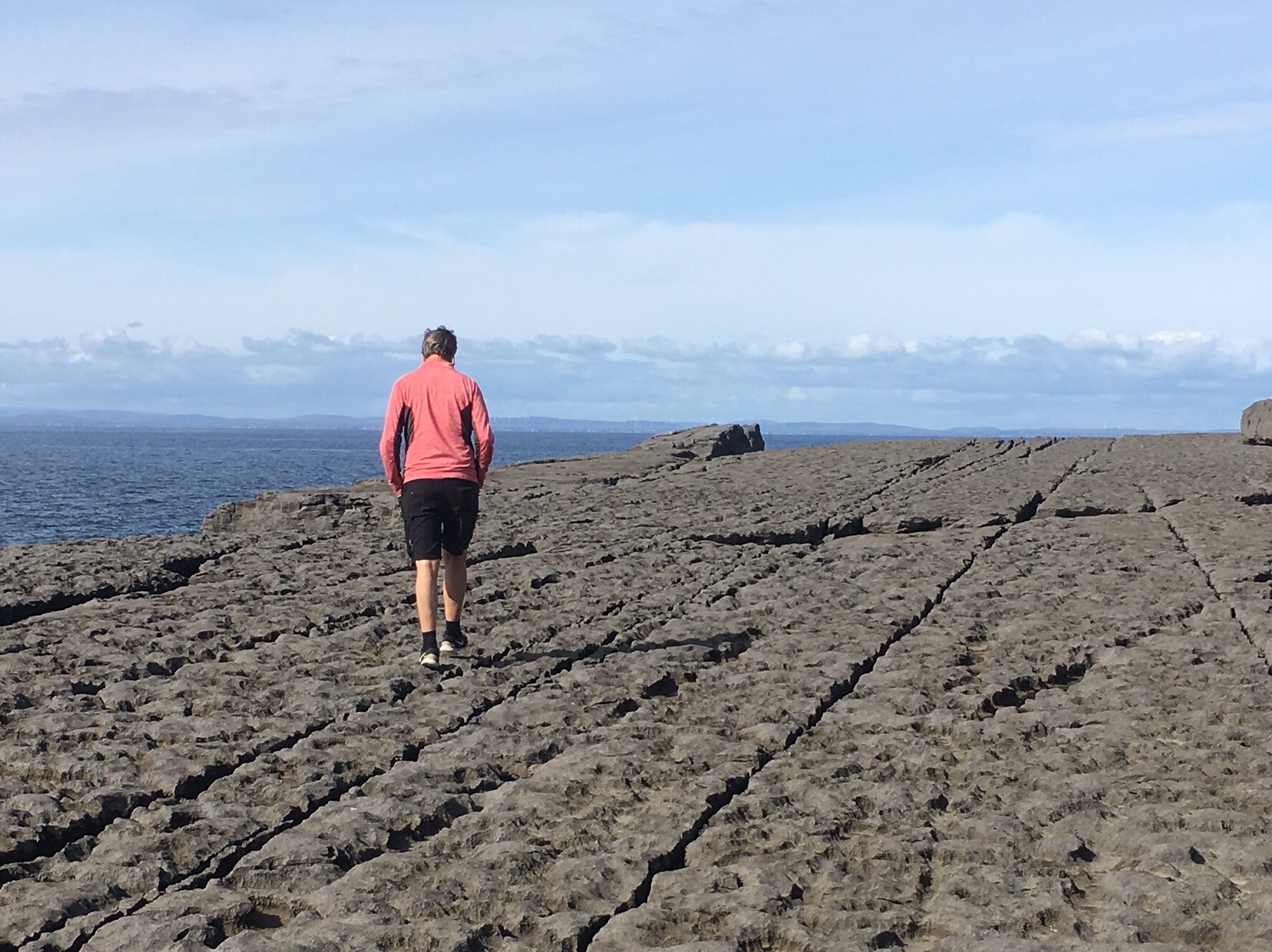
This took us through the Burren, one of the finest examples of a glacio-karst landscape in the world. Huge limestone sheets have been eroded by glaciers and then by rainwater which gets into any cracks and crevices.

img_0920
Limestone pavements

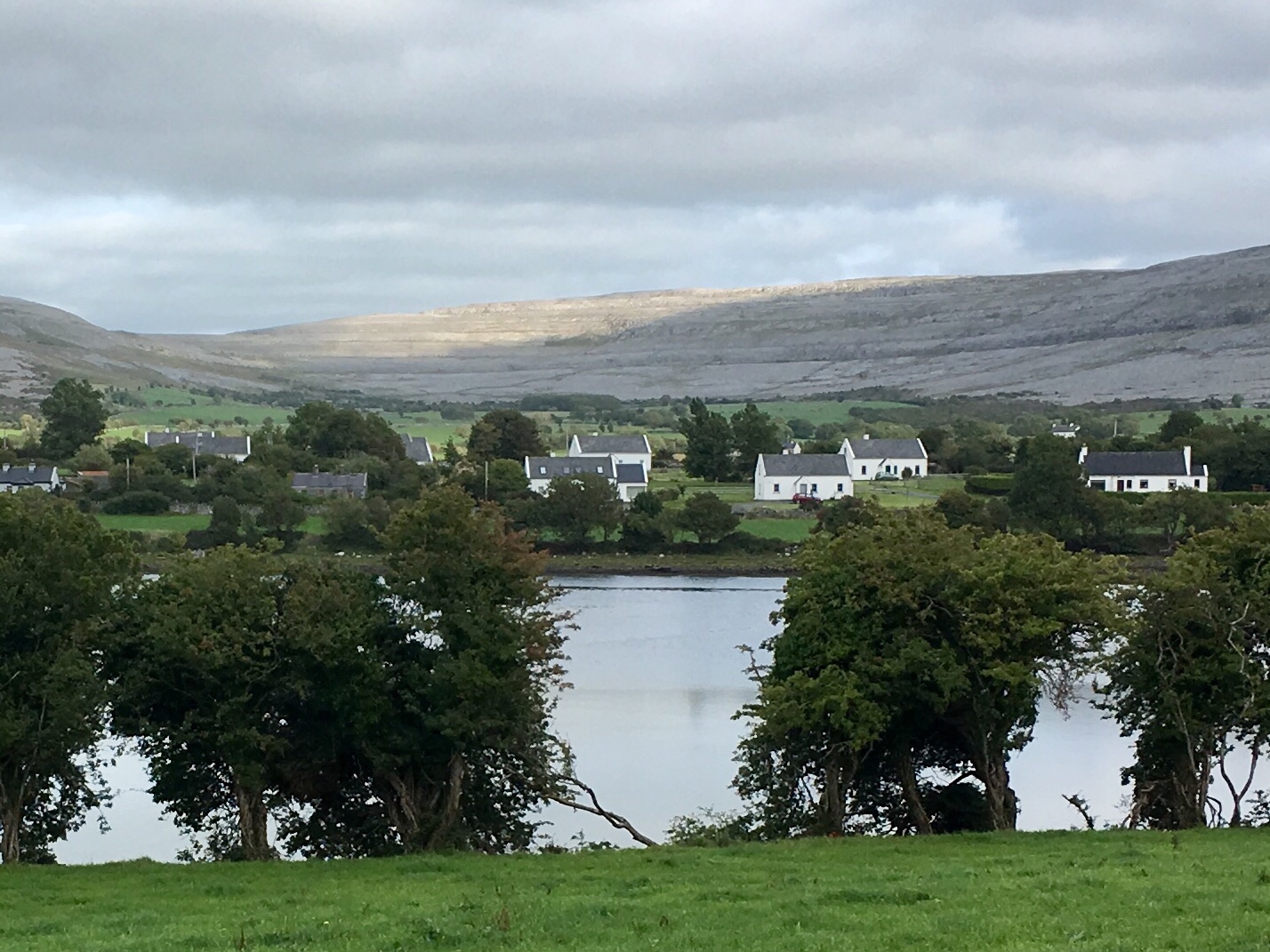
The effect is dramatic. Limestone pavements with perfect parallel lines sit beneath smooth hills that are strewn with so many rocks that they appear from a distance to be sugar coated with snow.

img_1023
A light covering of snow in August? 

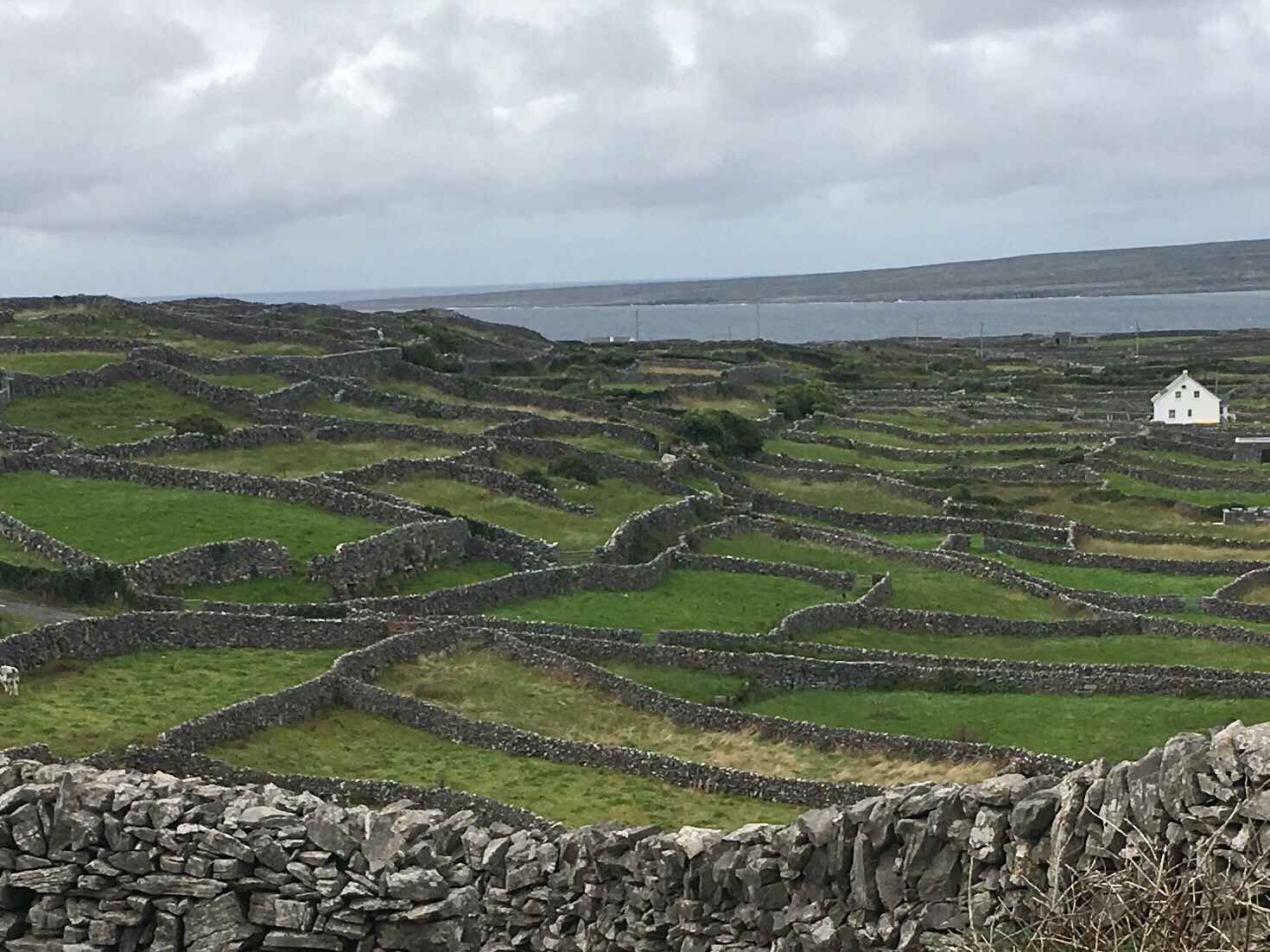
The name Burren comes from the Gaelic Boíreann which simply means a rocky place. Many years ago, farmers cleared all the rocks from the fields, piling them into a striking mosaic of dry stone walls.

The walls go right down to sea, sometimes running across vast limestone pavements. Cattle were brought down onto the flat rocks for winterage, as they held onto the summer heat for longer encouraging the grass in the crevices to keep growing.

img_0962

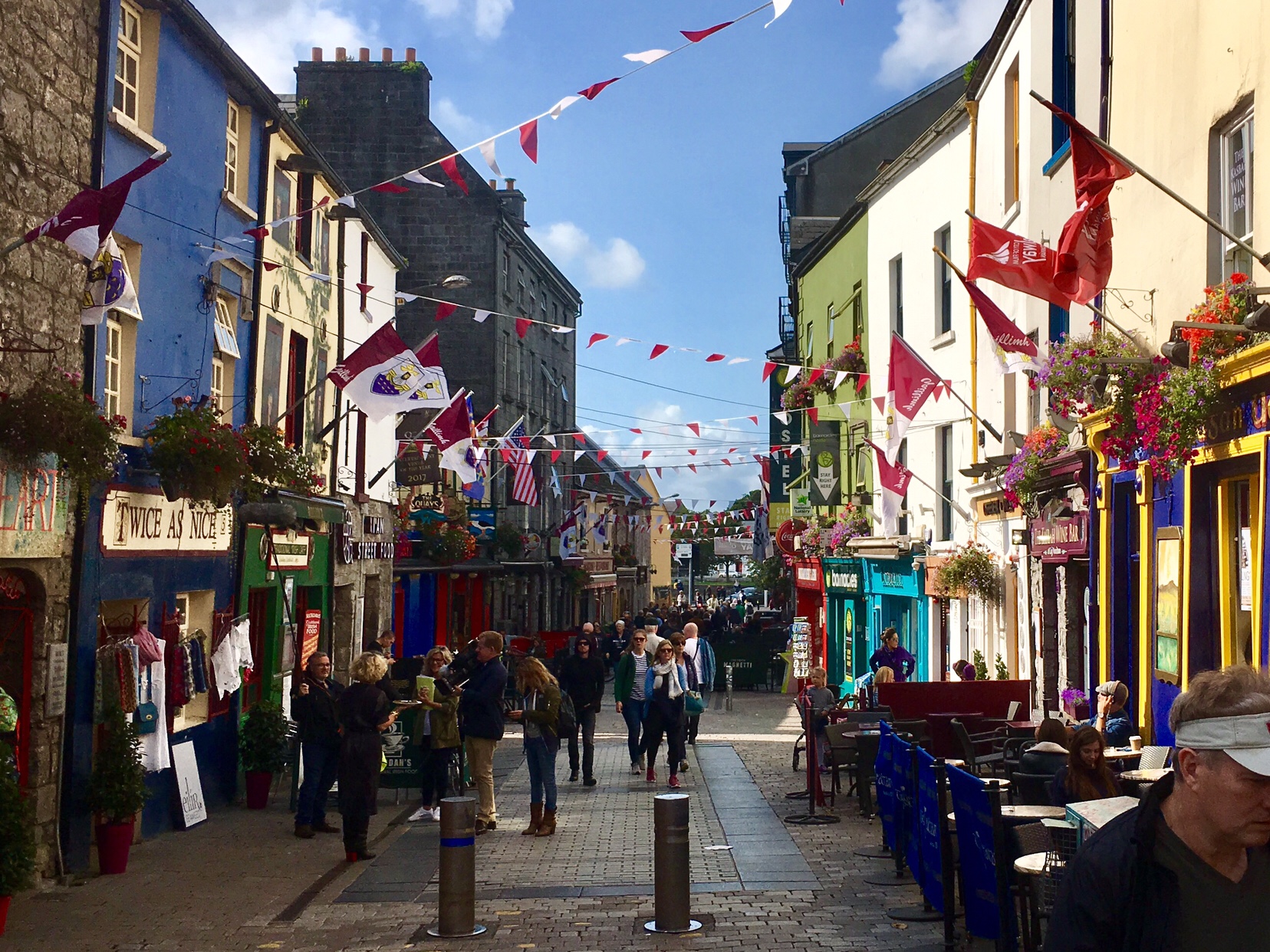
Galway turned out to be a vibrant city with a lively centre full of small shops, restaurants and music bars, all buzzing with people chatting away in Gaelic. So much so that it’s often referred to as the bilingual capital of Ireland.

img_1045

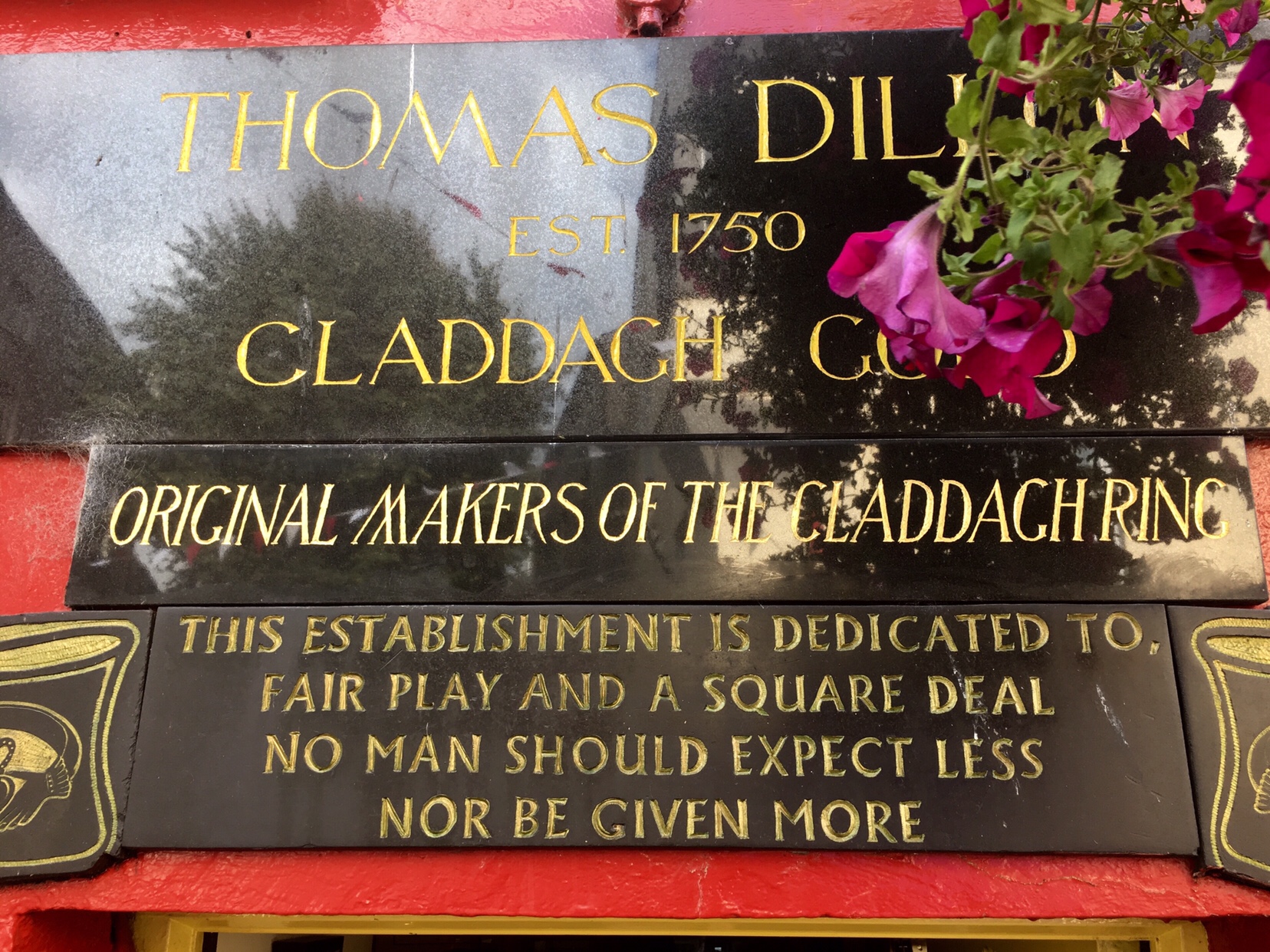
There were lots of amusing shop signs, including a trading notice outside this jewellers…

img_1046

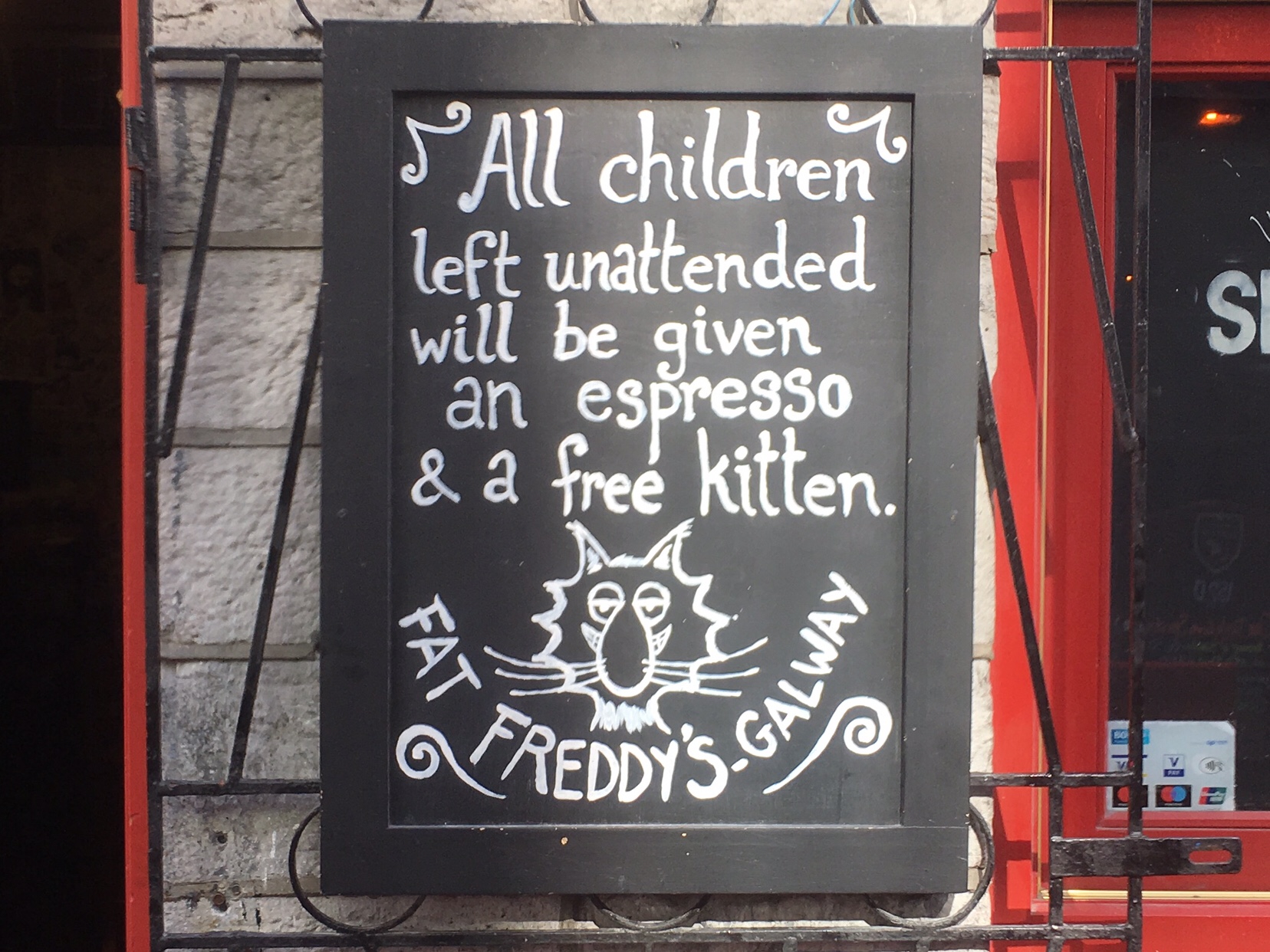
And a special offer from this café…

img_1048

To our surprise, the highlight of our visit to Galway was an extraordinary show that’s been entertaining tourists for the last fourteen summers.

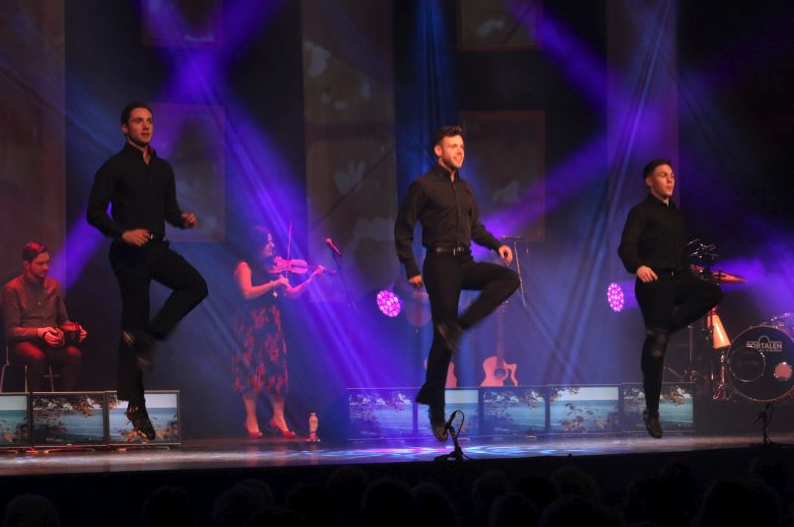
Trad on the Prom is an evening of traditional Gaellic music and dance presented by some of the creators of big, famous shows such as Riverdance or Lord of the Dance. Despite taking place in the unlikely surroundings of a leisure centre sports hall, it was magical and captivating as the quality of the musicians and dancers was so high. Indeed, many of them were world champions.

Trad on the Prom
Credit: Trad on the Prom

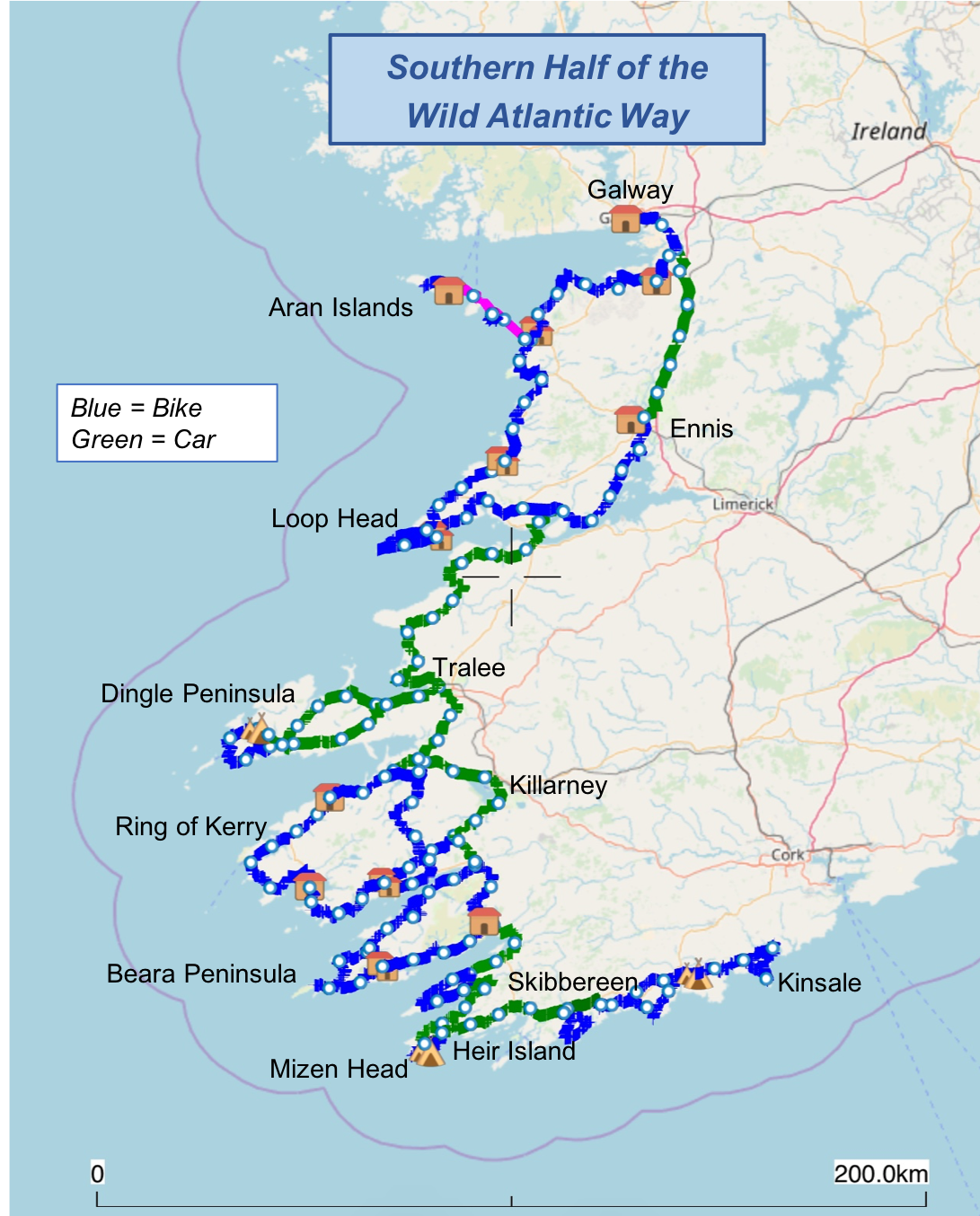
As we caught the train back to Ennis to pick up our car, we added up the distance we’d cycled on the Wild Atlantic Way.

It came to 961km cycling and 438km driving*.

This means we did fulfil our carbiking promise to cycle more than we drove. But we missed our 1000km target … defeated by the weather on the Dingle.

Southern Route Full

So how was our first experience of carbiking?

There are lots of good things:

  • It’s really easy to get to the place you plan to cycle from. You don’t have cram your bikes onto public transport.
  • It’s more versatile. You can take a detour, stay in different places or get to a remote restaurant.
  • You can miss out those parts of the route with lots of main roads or boring scenery.
  • If you need to, you can check out a mountain pass in the car before you ride over it.
  • You can drive on rainy days.
  • For day rides, the panniers can stay in the car.
  • It means you can bring loads more stuff such as heavy camping gear, a box of food or even that all important hairdryer!

And a few less good things:

  • You always have to get back to your car, which can mean cycling in a circle.
  • The comfort of the car makes it feel less adventurous, less of a journey.
  • It makes it too easy to bring loads more stuff!

We thought it worked out surprisingly well especially as there were so many peninsulas to loop round on this trip. We’d definitely recommend it.

img_0631

Now … we’ve heard some people say that the Wild Atlantic Way is one example of the Irish making-a-lot-out-of-a-little.

It is a clever way of joining all the small roads together and claiming that it’s the longest coastal touring route in the world’.

But … the southern half is so beautiful, so varied and, yes, so wild that we think it’s actually making-a-lot-out-of-a-lot!

Now we can’t wait to return and explore the northern half from Galway to Malin Head.

Clare and Andy


Southern Half of the Wild Atlantic Way: Kinsale to Galway
By bike: 961km, 11825m climbed
By car: 438km*

* If we cycled and drove along the same roads, we only counted the cycling distance.
* We didn’t include driving to Ireland and back.
* Which is not cheating!

Getting Ready

“Give a man a fish and feed him for a day. Teach a man to fish and feed him for a lifetime. Teach a man to cycle and he will realise fishing is stupid and boring.”
Desmond Tutu

We are not real cyclists. We’ve managed just two weekend cycling trips in the last two years to get ready for this trip. Both were memorable, around the Isle of Wight (75m/120km) and a return trip to Cheddar (70m/112km) which included a spectacular ride up the Cheddar Gorge. We packed lightly both times. So lightly in fact that Andy forgot to include any trousers on the Cheddar trip and had to sneak into the restaurant in his new padded cycling shorts. From both weekend trips we returned utterly exhausted.

We’ve managed just one cycling ‘Sportive’ (63m/101km). These are excellent and increasingly popular mass riding events, full of impressively fit looking MAMILs (middle-aged-men-in-lycra). But we decided they weren’t for us as we trudged in well behind the pack in the evening gloom.  And we’re not that keen on lycra anyway!

We’ve not yet tried cycling with full panniers. We’ve not yet had to fix a puncture by the roadside. We’ve not yet cycled out of reach of a coffee shop.

We have been on lots of 20-30 mile bike rides over the last two years and feel very fortunate to live in Bath where there are many beautiful cycle tracks in the surrounding countryside. It’s also quite hilly so we are used to going up modest gradients. Feeling we should get better prepared last weekend, we packed some heavy books (A Complete Guide to Family Health, Art of the 20th Century, The Gardeners Encyclopedia of Plants and Flowers etc.) into our panniers and set off. The hills felt a lot harder.

img_4746
Practising with heavy books instead of luggage

We have also got used to much of our gear. The trickiest things to get used to were the cleated shoes. For a cyclist there is nothing more alarming than the split second of realisation that with cleats firmly stuck in the pedals, there is now nothing you can do to avoid toppling over sideways. Apart from swear loudly! Andy learnt this lesson within 500m of our house, when he first tried cleating in. Coming to a busy junction he forgot all about his feet being stuck to the pedals and toppled over taking Clare down with him. As we untangled arms, wheels, legs and handlebars the window of the nearest 4×4 slid down and a female voice shouted to Clare that “you’ve got a right one there, haven’t you love!”

We learnt a similar lesson when climbing steeper hills – never change gear on the front derailleur or you instantly grind to a halt with painful consequences. After kissing the tarmac several times Clare now only clips on one side on any hill. This causes our real cycling friends to cry out in horror at the waste of uphill climbing power.

img_0507
Tuning the gears on the back of the car

We attended an excellent bike maintenance course at Bristol Bike Project, a local charity that provide bikes to people who can’t otherwise afford them. We learnt to replace tyres, inner tubes, chain links, cables and to tune our gears and set our brakes correctly. It was brilliant!

This recently came to good use when we took our bikes into the local bike shop for a service. On a ride that same evening they purred like a finely tuned sports car.  We absolutely whizzed along. Until that is we got lost, took a narrow bumpy path and had to haul the bikes over a barbed wire fence. We all survived but the gears were completely out of sync again.

Rather than offload another 50 quid we decided to give it a go ourselves and spent two hours working on the gears the next day. After the first hour  we were ready to give up and head back to the shop as the chains crunched and jumped around. Then something clicked and the bikes started to purr and hum again. All the more satisfying for doing it ourselves – we’ll see whether our maintenance skills are up to scratch all the way to Barcelona?

Shopping for some nice new gear, here are some of the things we’ve bought or been given:

  • Some padded lycra cycling gear – yes we’ve succumbed
  • Lightweight travel towels made of polyester and nylon
  • Bright yellow helmets – so car drivers can see us
  • Chamois cream – to protect our groin and buttock areas
  • Lube – for the bikes
  • Spare spokes, brakepads and inner tubes
  • Super strong Gorilla tape – the guy in the bike shop assured us this will sort any problem


p1010757
No danger of missing Eastenders

Andy’s friend, Digital Dave, is responsible for many of the better bits of kit. Dave is a font of all knowledge – bikes, apps, outdoor stuff etc. etc. We have a Quad Lock fitting system to put our phones right where we want them on our handlebars, View Ranger mapping software and Andy has a (rather expensive) special moisture wicking cycling shirt.

That just leaves the one luxury item we’re each allowing ourselves. Clare’s taking a hairdryer to get rid of the dreaded ‘helmet hair’ look. Andy’s contemplating a pillow, having had bad nights with the hard cylindrical rolls favoured by cheaper French hotels.

We’ll let you know if it makes the cut.

Clare and Andy

As we cycled out one Autumnal morning

All the advice told us to take it easy the first day. So we decided to cycle 76km (47m) with 800m of hill climbing, riding with heavy panniers for the first time!

A journey of a thousand miles must begin with a single step (pedal turn). 
Lao Tzu

We were late leaving of course. The planned time was 10am, allowing for a relaxed coffee stop in Frome. The actual time was 12.30, which meant a quick sandwich stop instead. Packing, clearing up, faffing, locking up, checking, faffing, hovering, arguing, rechecking. It will be a familiar pre-holiday ritual to our children.

But the sense of freedom as we cycled down the familiar country lanes on a misty early Autumn afternoon was worth it. A rare moment much dreamed of that lived up to it’s promise.

We were able to stay on the pathways and quiet country roads of the Sustrans National Cycle Route 24 all day and for the most part it was well signposted and well maintained. First, it took us to Radstock and down the Colliers Way to Frome. This follows the path of the old Somersetshire Coal Canal, then railway, now a gentle, leafy track.

After lunch in Frome, the route took us through the centre of Longleat Safari Park where we enjoyed the solitude and unusual deep roars of lions mixed with the more familiar sound of sheep. For the final 25km we cruised down the Wylye Valley, gently descending with the river to the welcome sight of our inn on the edge of Salisbury, arriving just before dark.

image
Longleat House

3 things we learnt today:

  1. Chamois cream is surprisingly tingly.
  2. It’s difficult to take a picture while balancing a fully loaded bike.
  3. Cycle at dusk near a river with your mouth open and you swallow a lot of flies.


Finally, we have a question…

Clare is carrying 14kg, Andy 15kg. But Andy weighs 95kg and Clare only weighs 55kg. Should Andy take more weight?