Wild Atlantic Way

“Ahhh … don’t you be worrying yourself. This is Ireland … the sun will be out at five o’clock … you’ll see if it isn’t”

It was 4pm and this seemed a little optimistic, even for a local expert.

The three of us peered into the gloom from the top of a tower at Old Head, trying to catch a glimpse of the sea just 30 metres below. But it was impossible, the thick fog wasn’t going anywhere.

We were standing on one of 81 watch towers built between 1804 and 1806 to look out for Napoleons ships. It’s now a memorial to the 1198 people that sank with the Lusitania when it was torpedoed during the First World War.
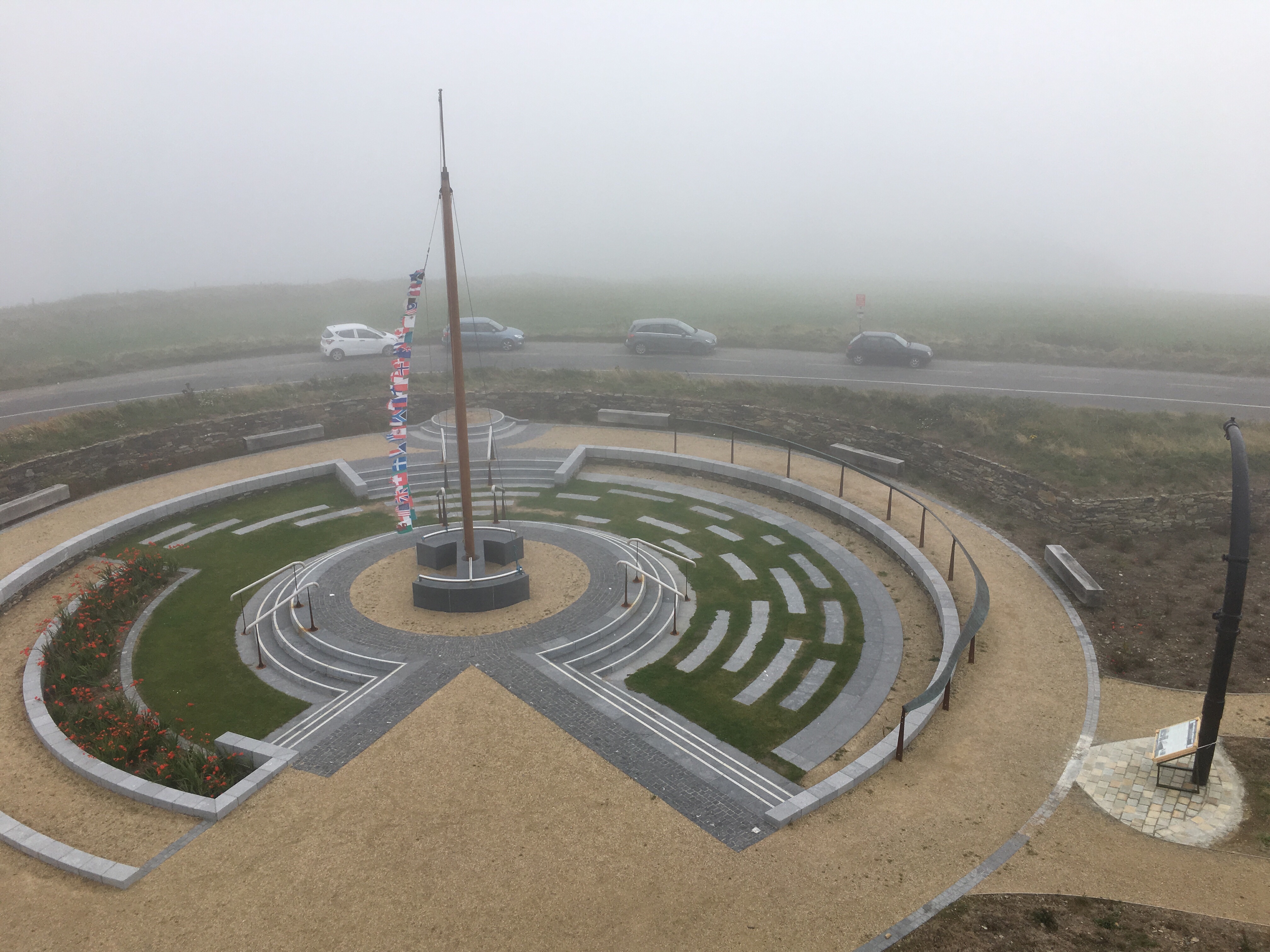
img_0218
The Lusitania memorial shrouded in fog

Of course, our local weather expert was right. Just one hour later we found ourselves rolling into the pretty town of Kinsale in picture perfect evening sunshine.
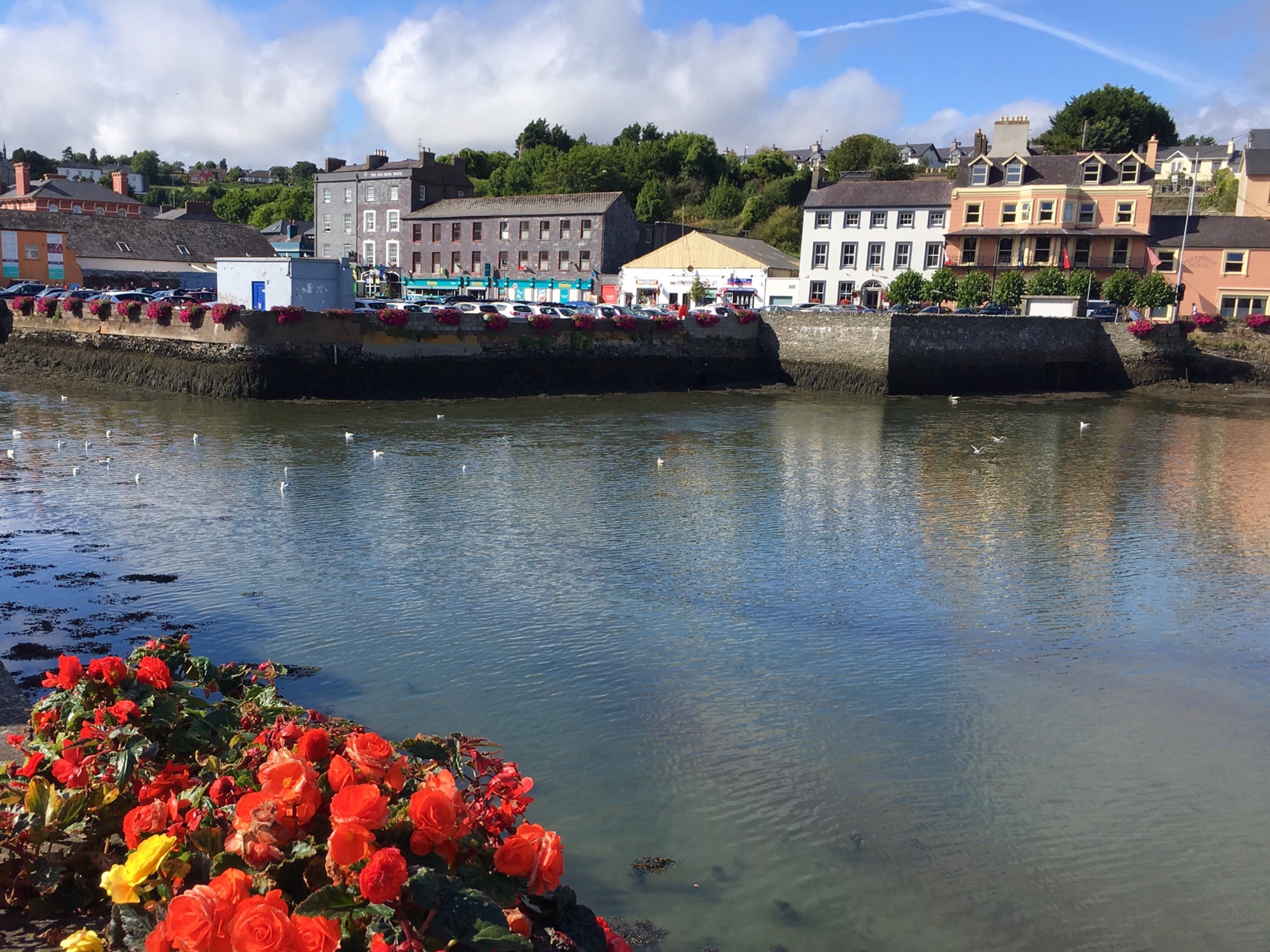
img_0226
Kinsale in the evening sunshine

With a stroke of good fortune we arrived just in time for the final of the ladies pillow fighting competition. This major sporting event had drawn a big bank holiday crowd to cheer on the winner as she sent her unfortunate opponent plunging into the harbour.
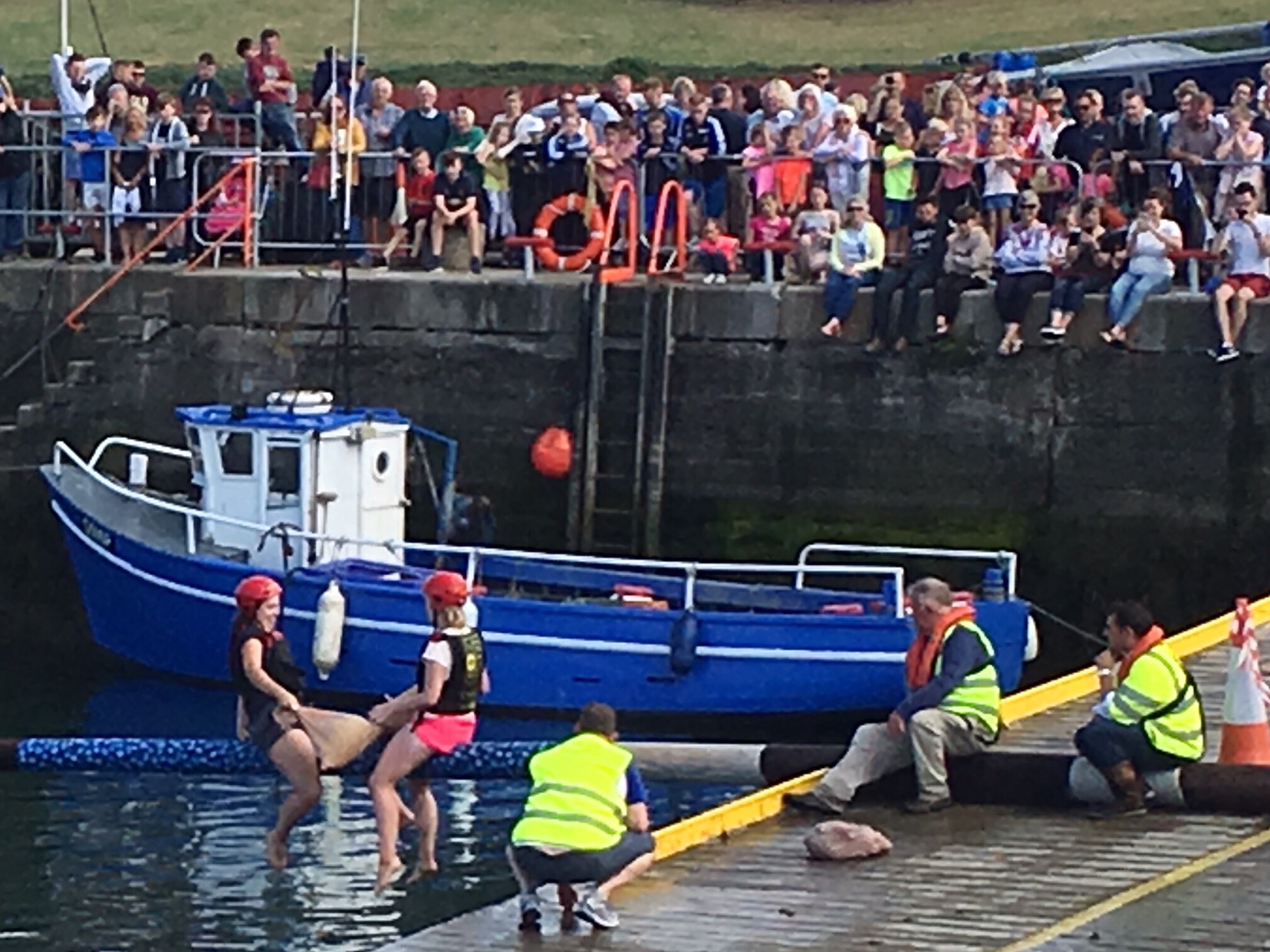
img_0224
Battle about to commence … the lady in the pink shorts won

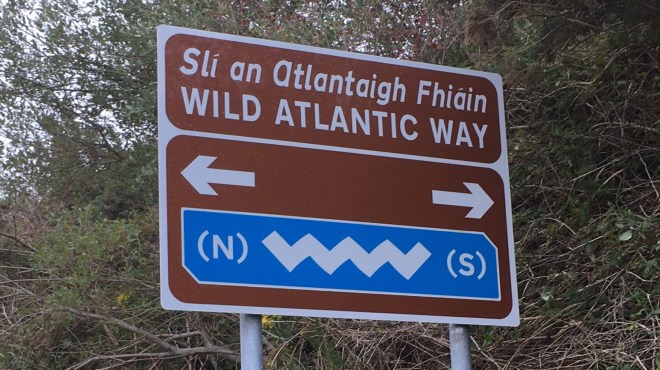
Kinsale is at the southern end of the Wild Atlantic Way, the longest coastal touring route in the world and well known as an epic bike ride. From Kinsale, it winds its way 2500km up the west coast of Ireland to Donegal in the far north.
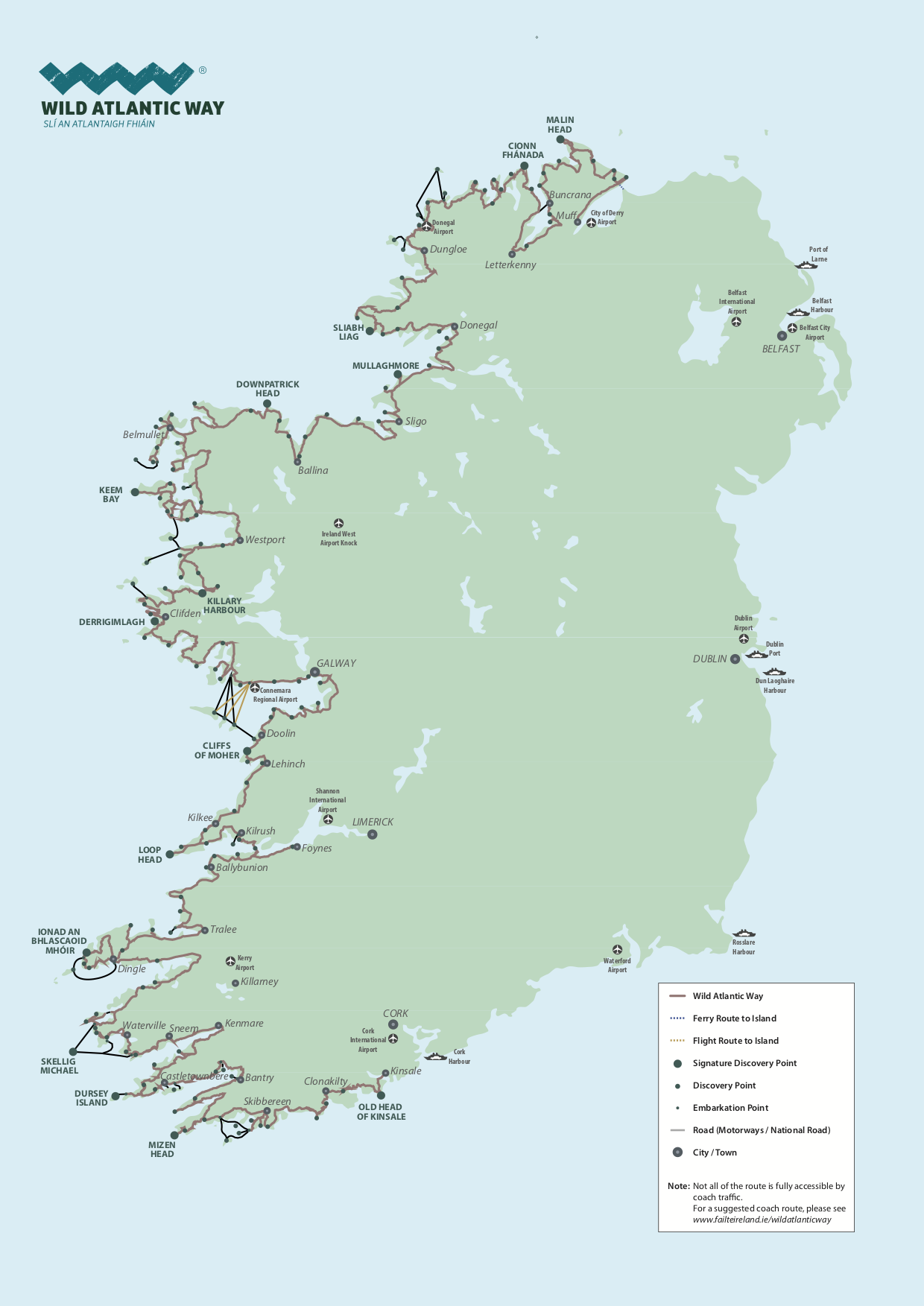
Wild Atlantic Way Map

Our plan for the next 4 weeks is to cycle the southern half as far as Galway and hopefully come back to complete the northern section another time.

To be honest, we’re not only cycling this time. We have our car with us which means we can drive along the main roads and then cycle around each peninsula.

Is this cheating?

Well perhaps it is … a bit. But we will be cycling more kilometres than we drive. And we still have our panniers with us as some of the rides will last three days or more.
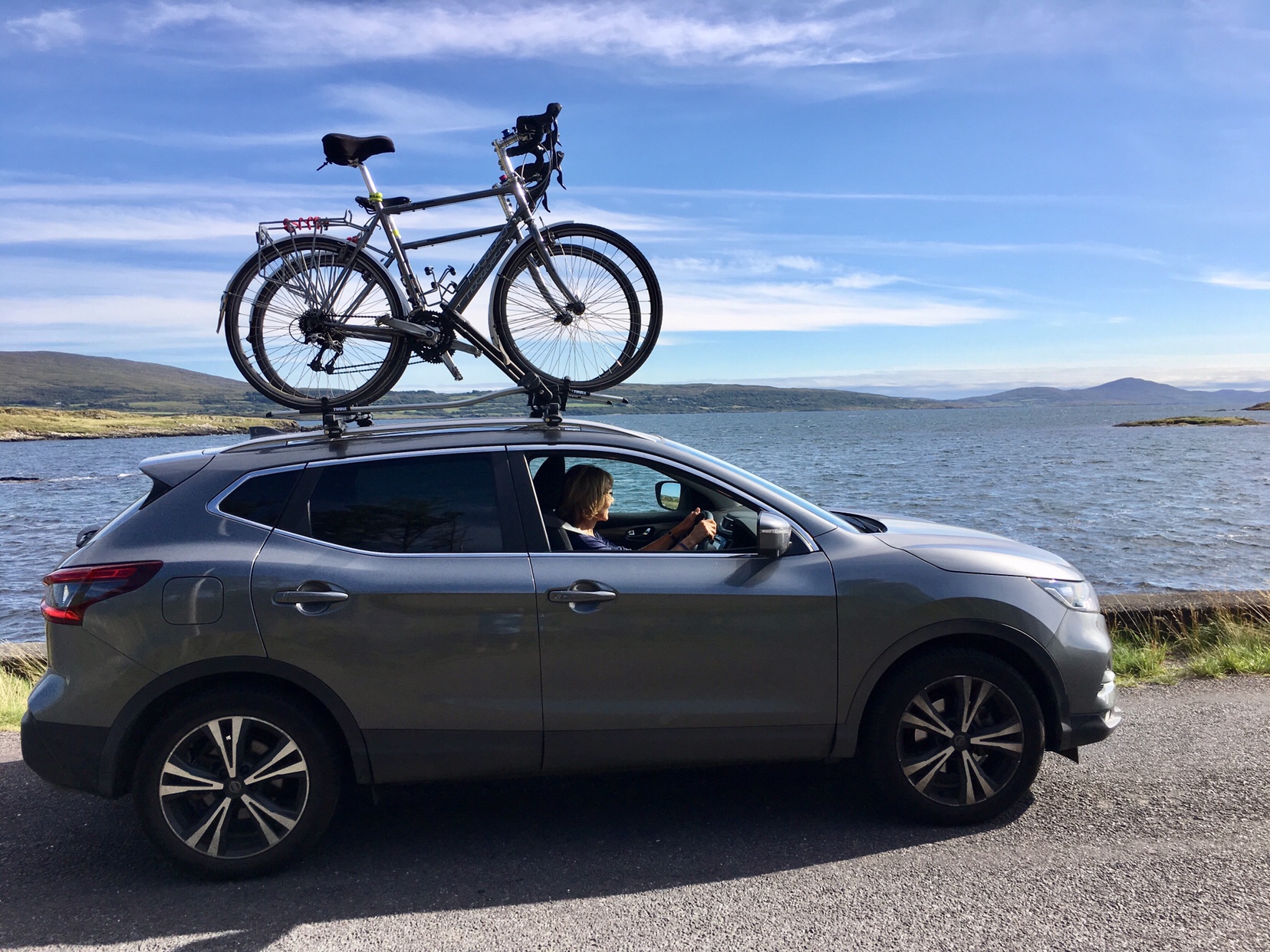
img_0427
The bikes get the best view

We’ve been searching for the name for this type of bicycle-touring-with-a-car but haven’t been able to find one. So here are a few suggestions:

Car-cycling as in “They really enjoyed their car-cycling holiday in Italy.”’

Bikedrive Touring “I’ve just come back from a great bikedrive across Canada.”

Or a French one: Velo-en-Voiture (bicycle by car) “He always goes for a long velo-en-voiture through France in August.”

What do you think? Which one works best? Does anyone have any other suggestions? Maybe this is a chance to create a new word.
img_0173
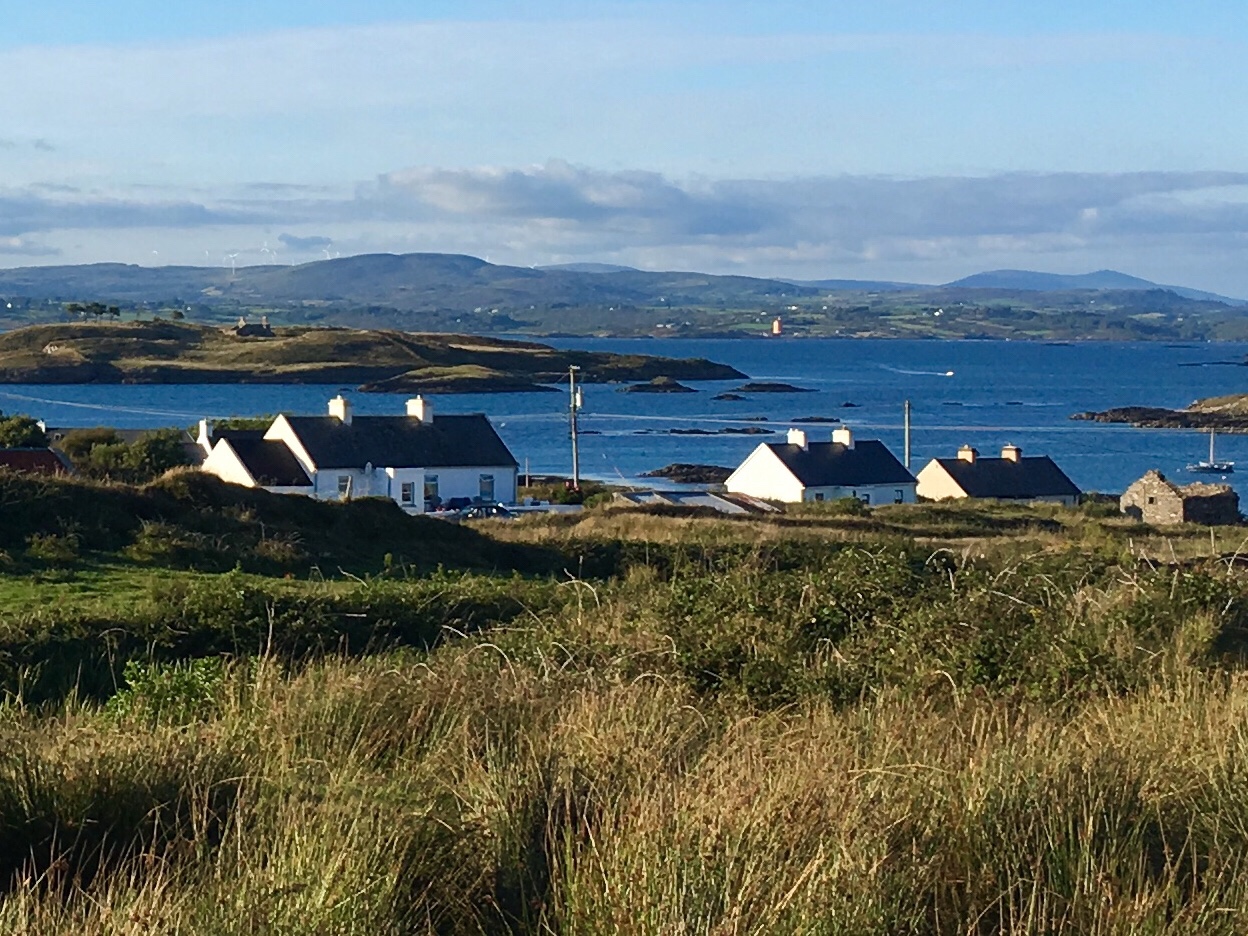
Heir Island

Before setting out we enjoyed three days on Heir Island near Skibbereen staying with some old friends, Helen and Dave, in their lovely cottage.

It’s a wonderful place to dinghy sail, walk, canoe, make music, drink wine and chat.
img_0131
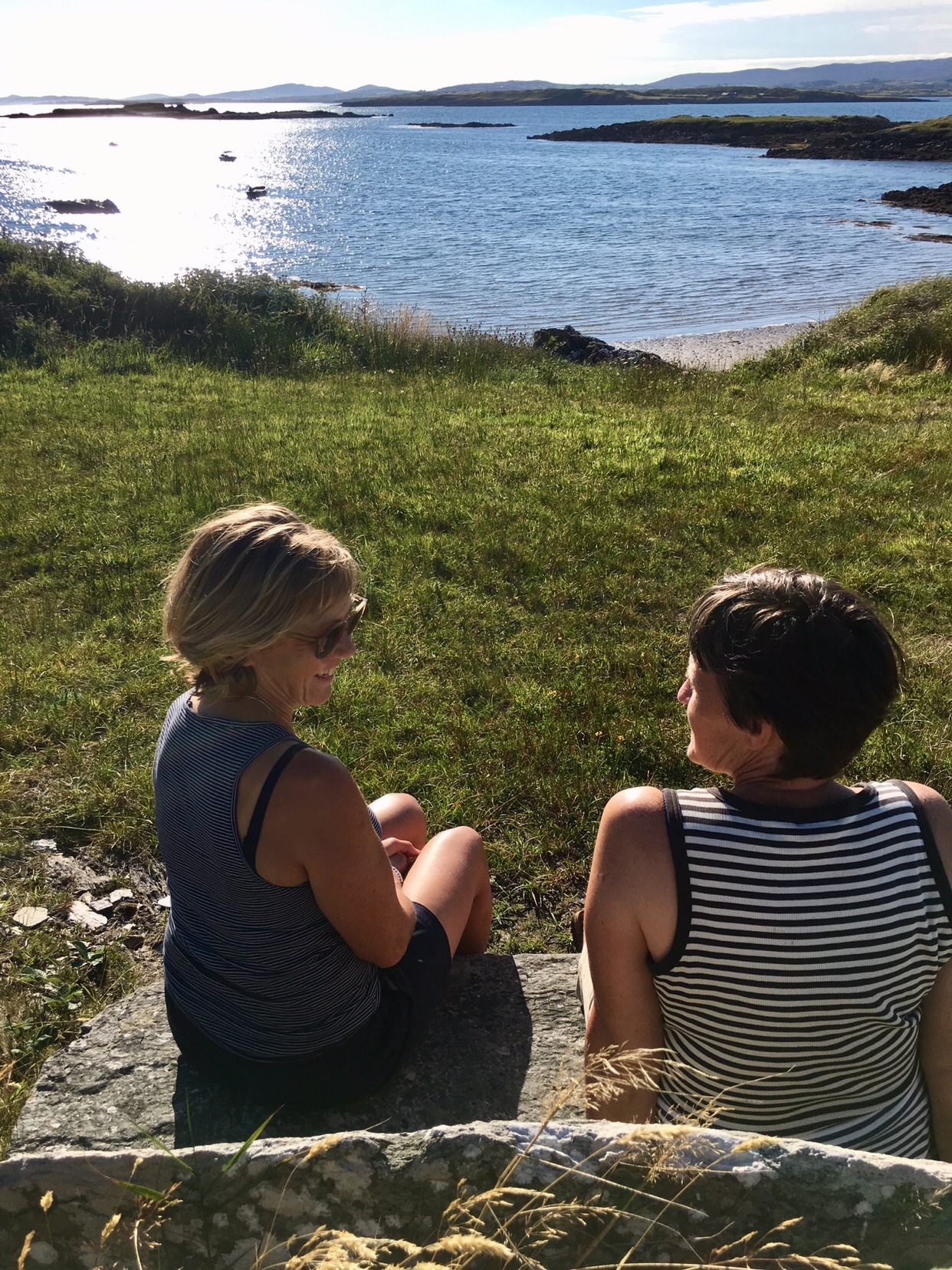
Clare and Helen enjoying a chat in the evening sunshine

There was, however, one unfortunate incident while we were there!

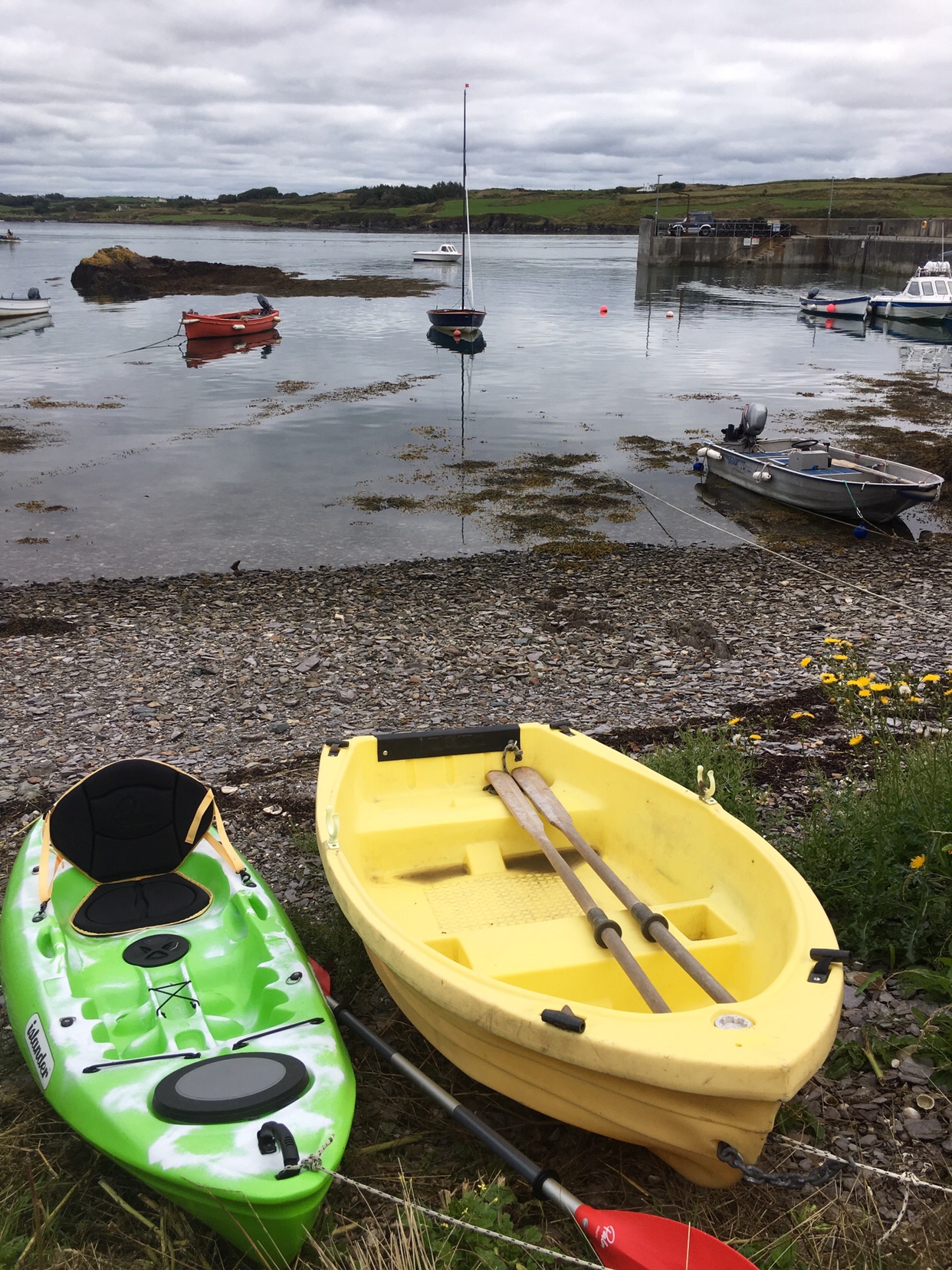
On the first day Andy (who is not known for his agility) capsized this little yellow boat in just one foot of water, tipping Clare and more importantly her phone into the cold, murky sea. Clare survived but her phone was not so lucky. Despite leaving it in rice and blasting it with the hairdryer it has stubbornly refused to work.

Oops! This was not the best start to a few weeks cycling around Ireland as a happy couple!
img_0081
Scene of the crime

Since waving goodbye to Helen and Dave, we’ve enjoyed five delightful one-day circular rides around the Haven Coast, the most southerly section of the Wild Atlantic Way.

  1. Clonakilty to Kinsale (69km)
  2. Clonakilty to Union Hall (58km)
  3. Skibbereen to Castletownshend (29km)
  4. Crookhaven to Mizen Head (31km)
  5. Sheeps Head Peninsular (37km)
Haven Coast
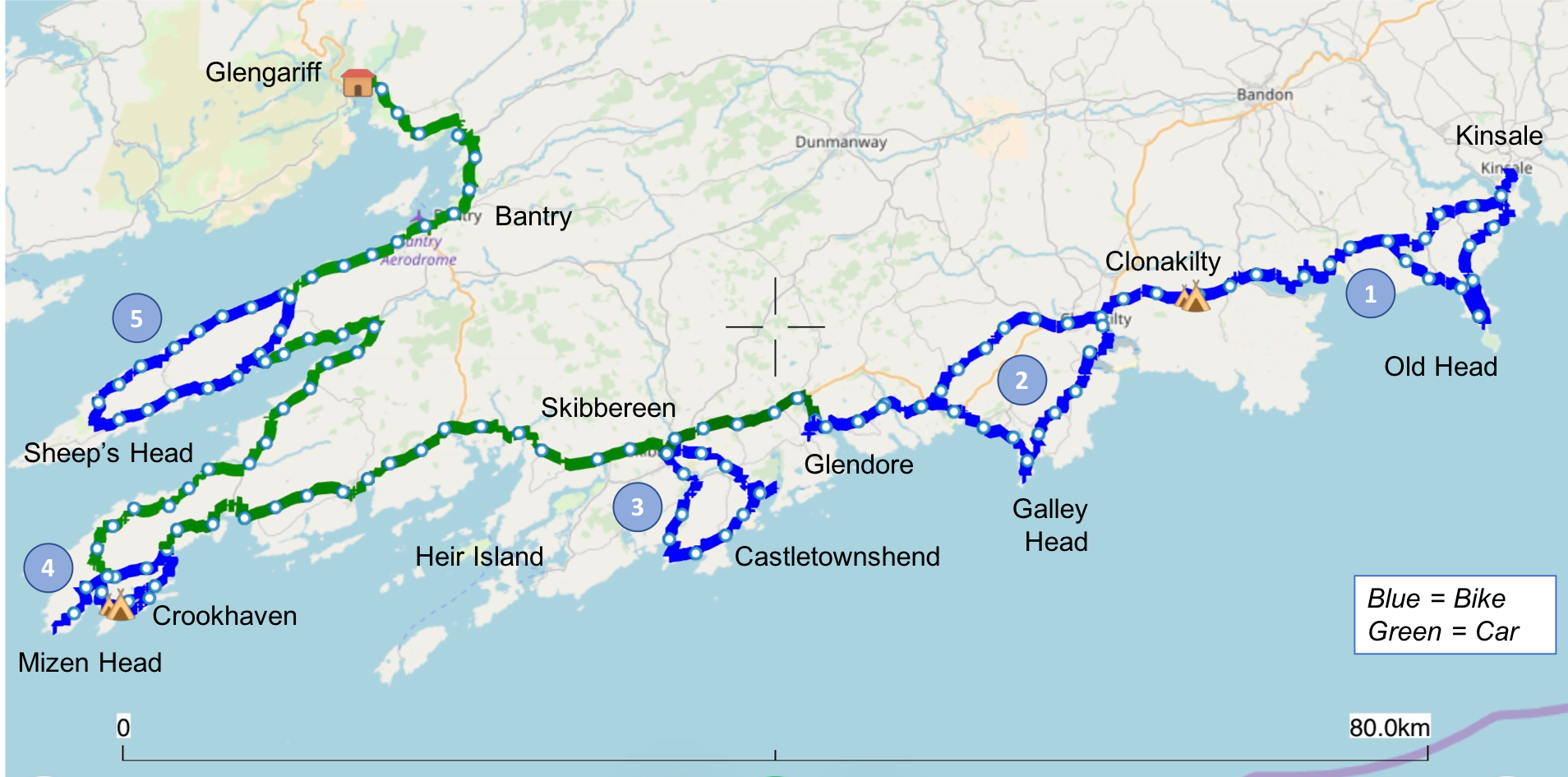
Our route around the Haven Coast

There have been many highlights.

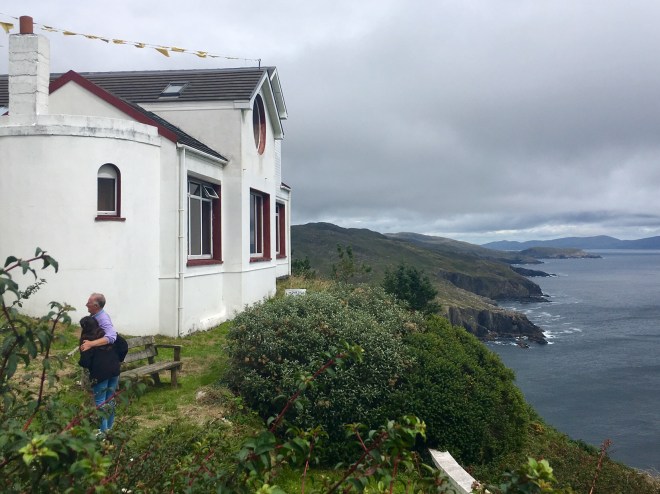
Pedalling around a corner to discover a remote, unspoilt cove. Learning about life as a lighthouse keeper on the Fastnet Rock. Visiting lively bars in quirky towns. Coffee and cake in beautiful places like this castle at Castletownshend.
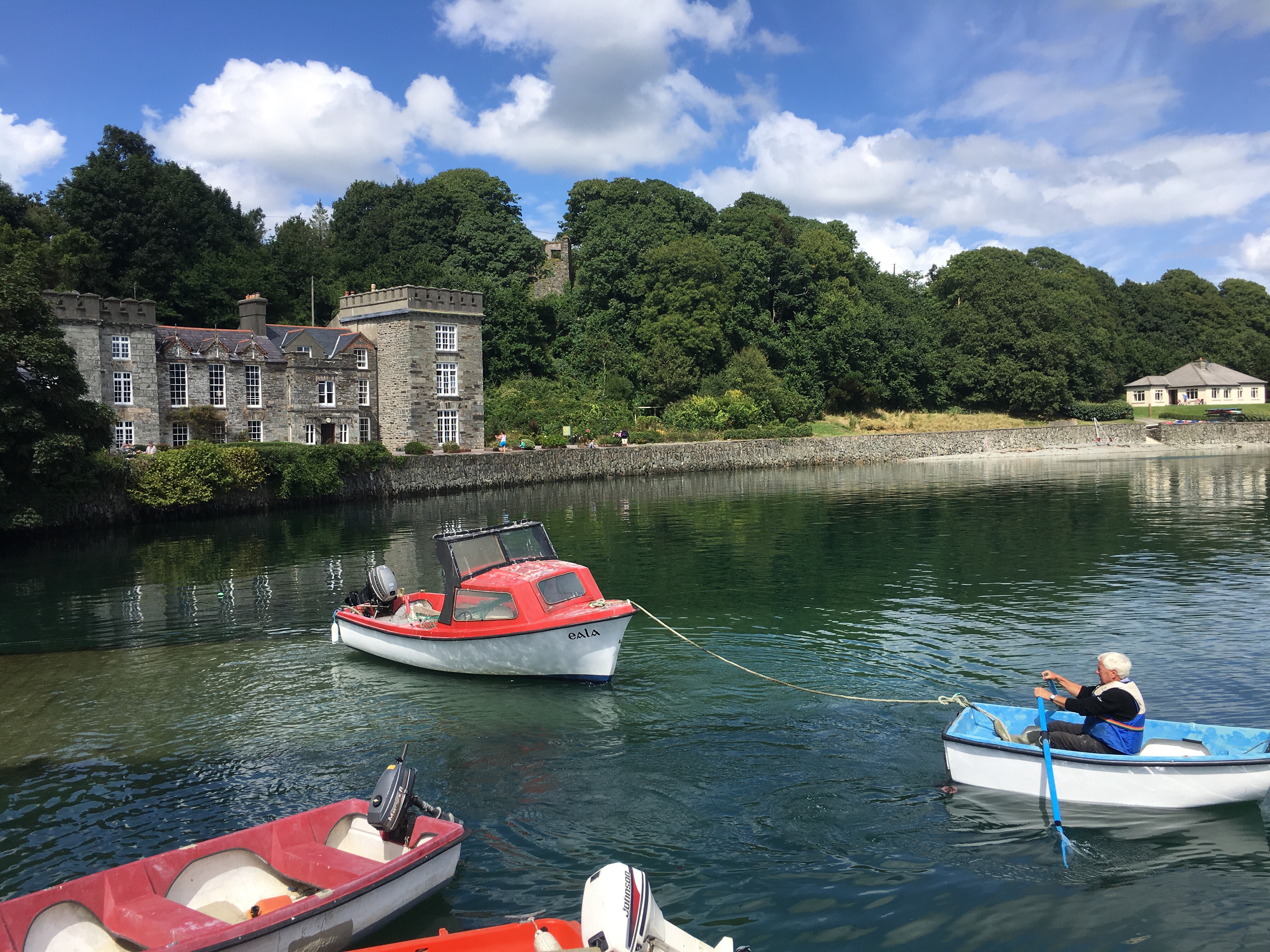
img_0298
Getting ready for a fishing trip in Castletownshend

Most spectacular was our ride around Sheeps Head, the least visited of all the peninsula’s.

A walkers paradise, it has a raw, rugged beauty especially on the north coast which has a spectacular view of Bantry Bay.
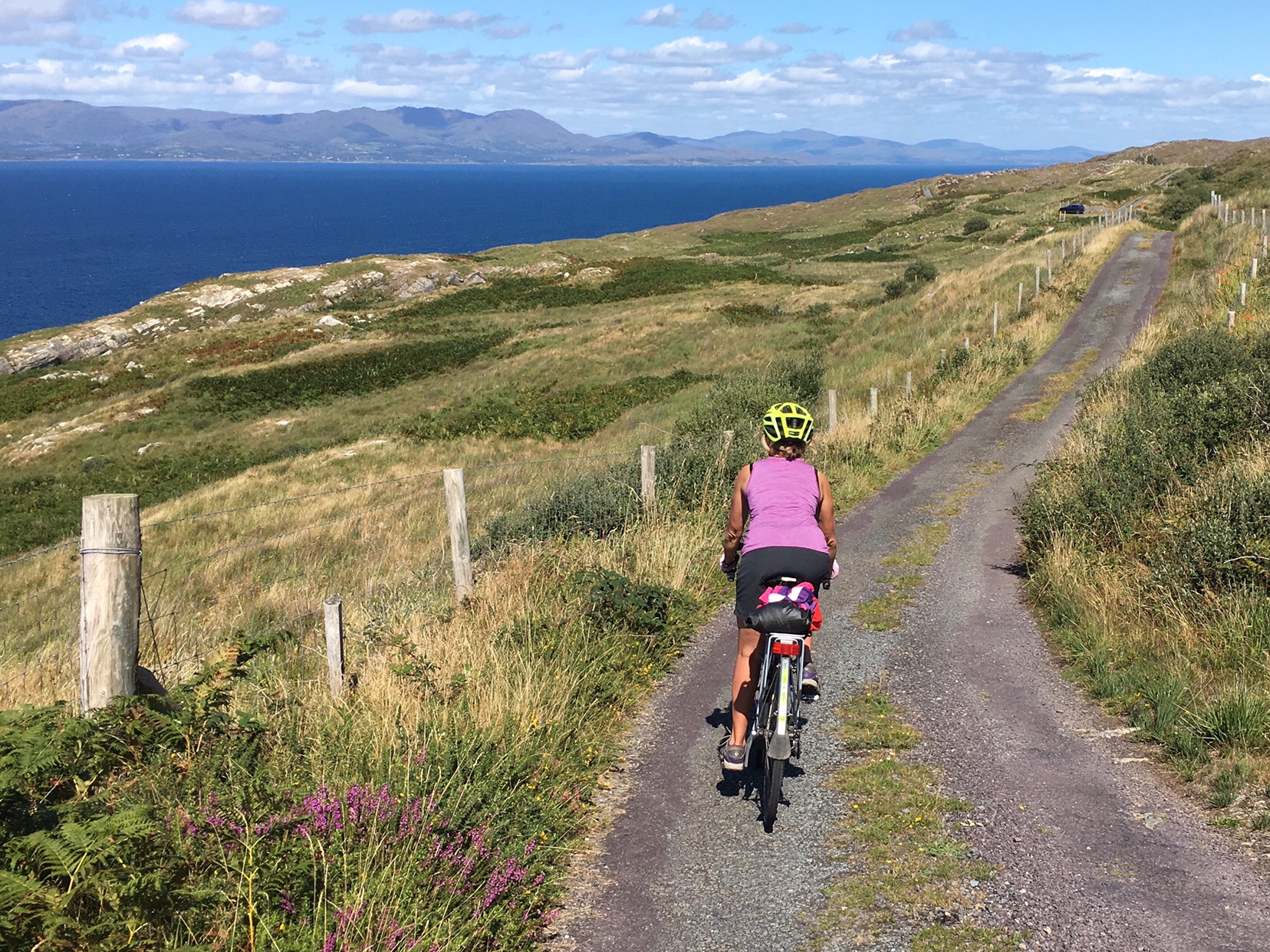
img_0405
Sheeps Head

But beauty always comes with a price and we paid ours on the way back over a big hill to our car. The road went in a straight line up a series of steep ramps with brief flat sections in between. It was like interval training!
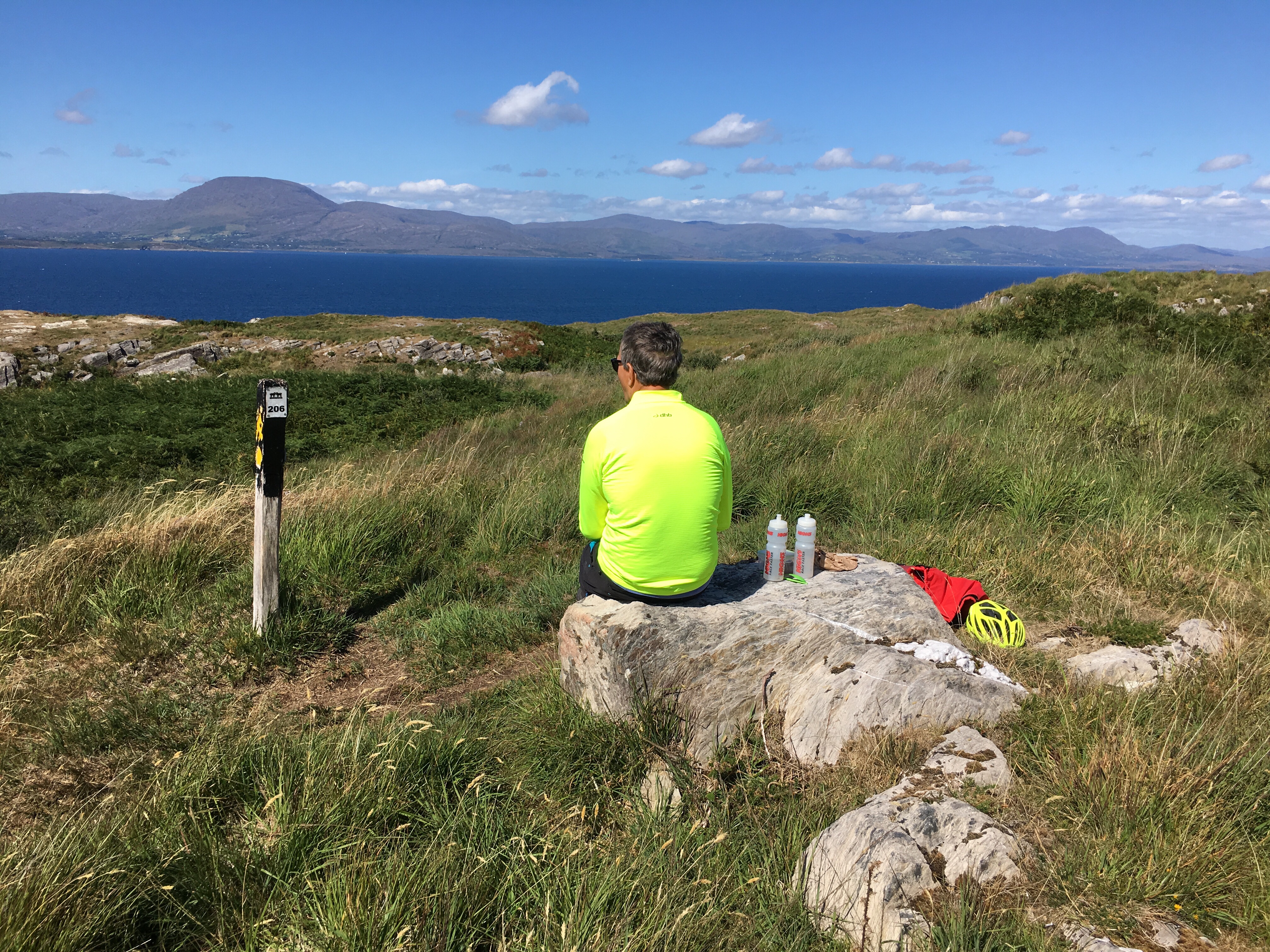
img_0407
Lunch stop overlooking Bantry Bay

So far, cycling in Ireland is even better than we thought it would be.

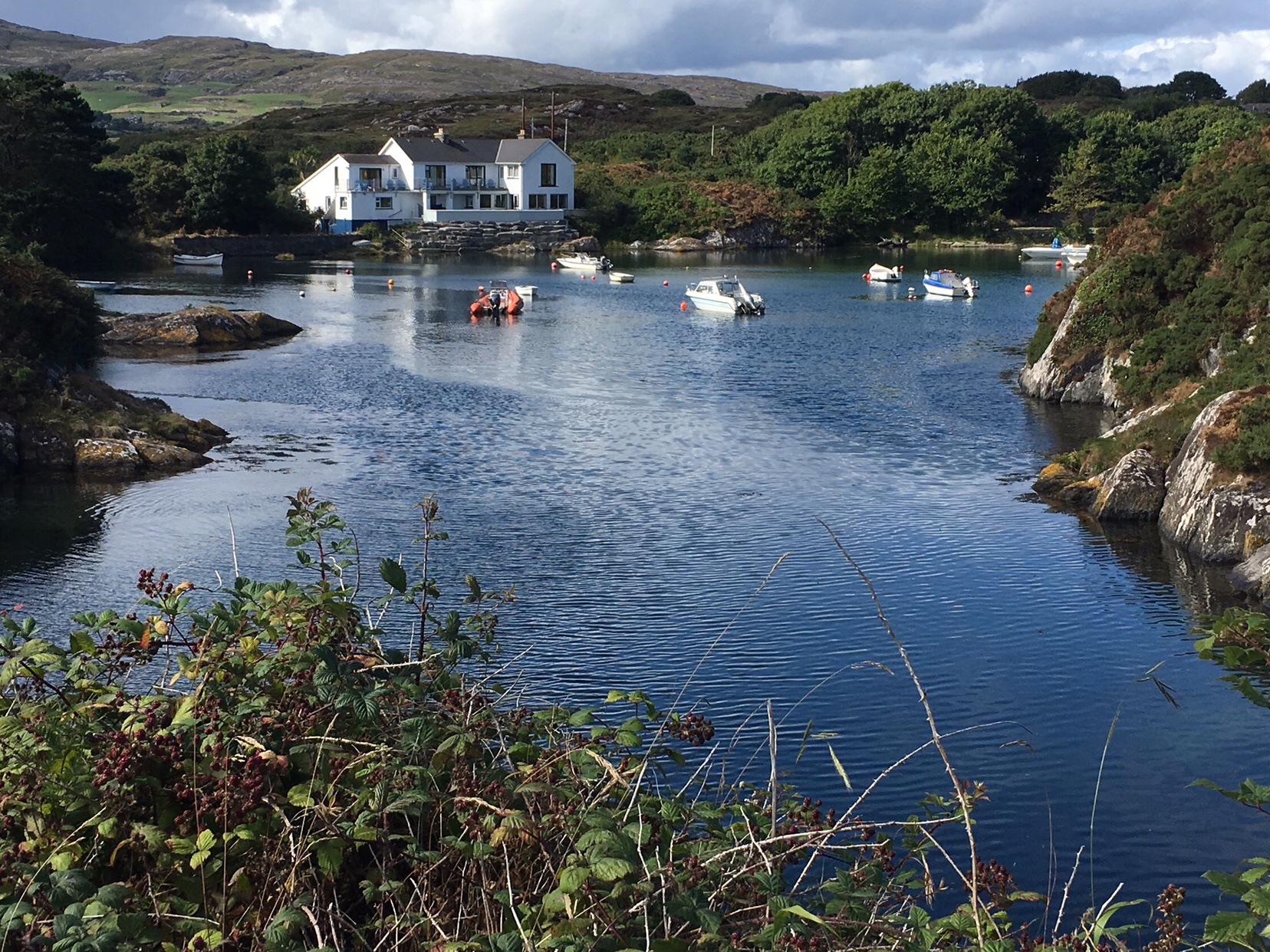
The scenery literally takes your breath away at times. From soft pastural farmland and gentle rolling hills, to rough craggy heaths and rugged coastline. From wide estuaries full of wading birds to azure blue harbours dotted with colourful dinghies.

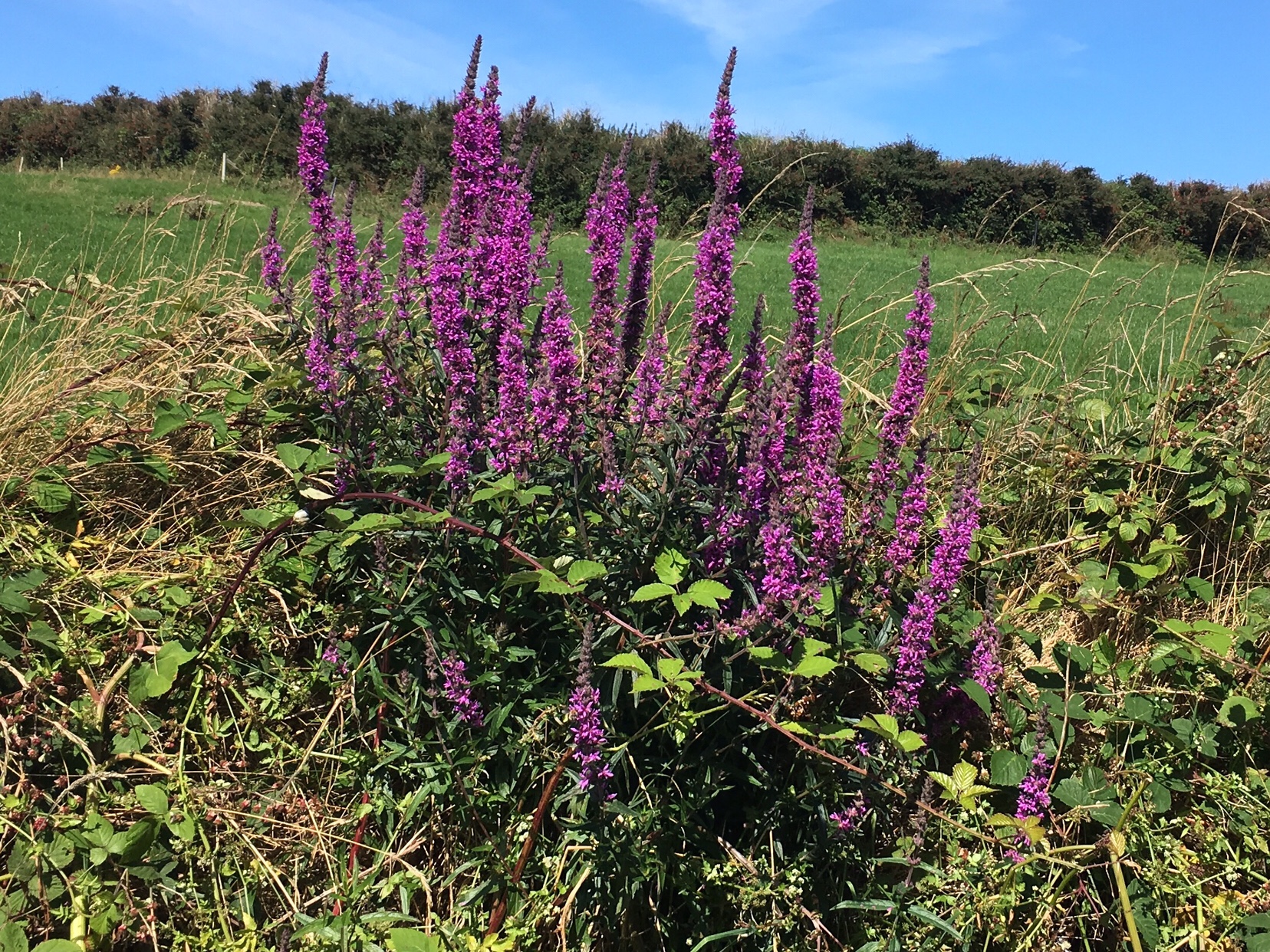
At this time of year, the hedgerows form long avenues of wild flowers. Orange montbretia, red fuchsia, purple loosestrife all set against a backdrop of lush, green ferns.
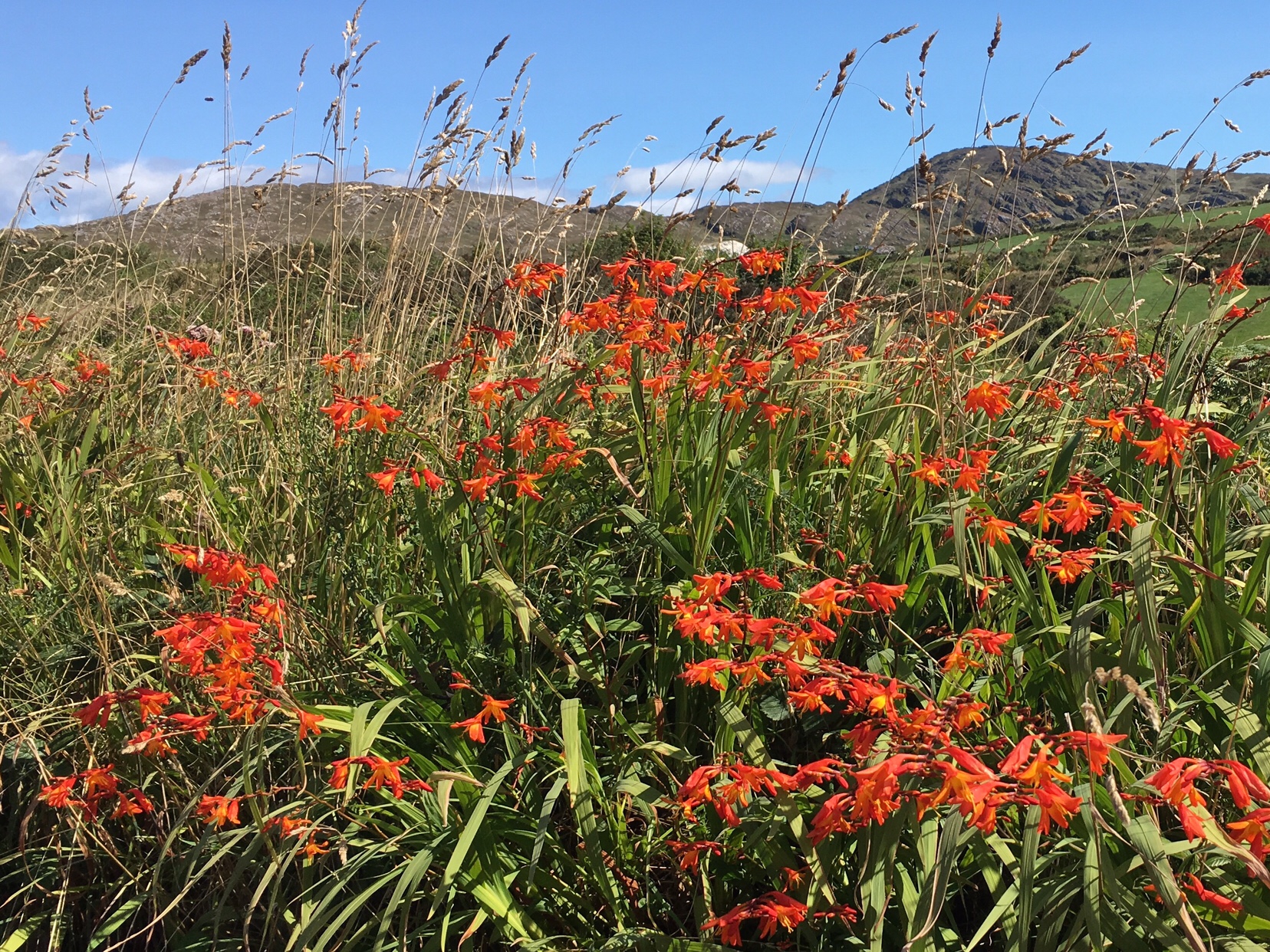
img_0370
Montbretia
img_0373
Loosestrife

We’ve had the normal mixed bag of weather with lots of cloudy days but also plenty of sunshine. The wind has often been brisk but it blows in fresh Atlantic air that cleans our lungs. On a well-planned route it also blows us home at the end of the day.

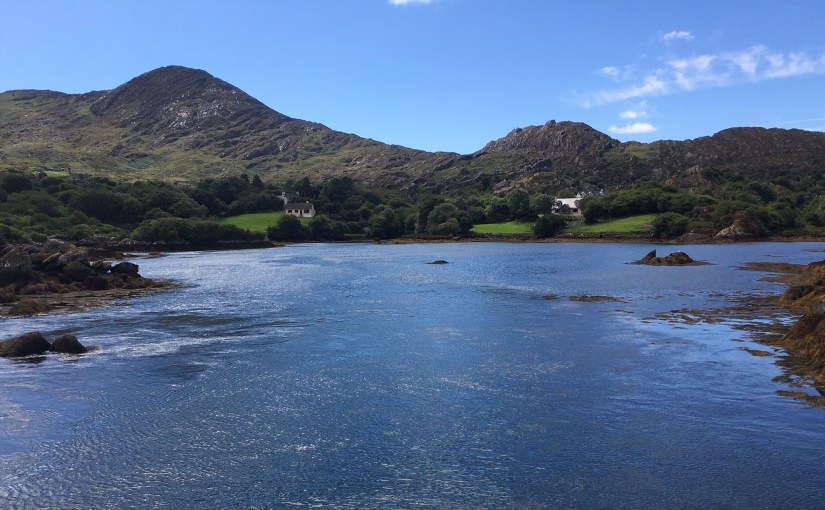
It is quite hilly. We always seem to be going up or down, but they are not too steep nor too long. This is fortunate as we were very unfit when we arrived. It turns out you can’t get fit for cycling simply by lying on the sofa and cheering on Geraint Thomas to win the Tour de France!
img_0348

The quality of the backroads is very good and there aren’t too many potholes to avoid. Less than England, more than France. Irish drivers are particularly considerate to cyclists, hanging some distance behind and being very patient about overtaking. I guess Irish people are famous for never being in a hurry!

They’re also famous for their friendliness and we’ve been lucky enough to enjoy the soft embrace of Irish hospitality on many an evening.

We’re now looking forward to exploring more of the Wild Atlantic Way over the next few weeks.

Clare and Andy

By bike:  223km
By car: 116km
 

Great Beer on the Beara

In April 1999 the late Pete McCarthy, born in England but of Irish parents, visited the Beara peninsula as part of a quest to understand a country he found so familiar and at the same time so unfamiliar.

As he travelled through Ireland, he made a point of never passing a bar with his name on.

This led him through the door of Adrienne MacCarthys Bar in Castletownbere. It was her birthday and the celebrations slowly turned into one of those spontaneous nights that only finish with bacon sandwiches at dawn.

It was such a memorable evening that he put the pub on the cover of his funny, poignant and insightful book which went on to become a surprising best seller. I can vividly remember staring at this book cover dreaming of long evenings of Irish craic.

img_0521

This photo is a poor effort to replicate that cover. Those of you who are familiar with it will note that there are some vital elements missing from Pete’s version … no hat, no dog and no nun drinking a pint.

Today, there are few signs that this is the same bar. No neon signs or banners in the window. It was only when we spotted a small poster in the back room, that we realised it was the same pub.

Like many Irish bars, it’s a quirky place.

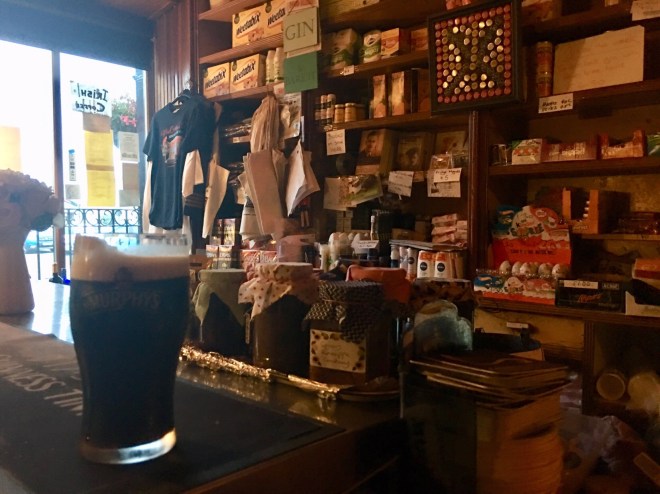
The front half is a grocer’s shop stocked with Weetabix, spam, baked beans and toilet roll although we didn’t notice a single purchase.

img_0531
Weetabix anyone?

The back half is more familiar as a bar and is decorated with a wide variety of memorabilia including a range of gifts from visiting European fisherman. It’s chaotic, homely, warm and welcoming.

img_0469

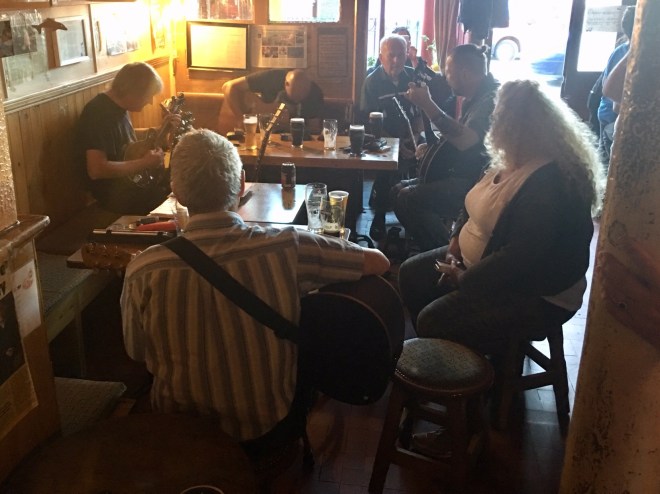
We spent two happy evenings there, singing along with the local folk club and chatting to Adrienne, listening to her tales of life in this small town which has grown to become the biggest white-fish port in Ireland.

She told us of the mobile cinema that came with the latest blockbusters complete with authentic faded red velvet seats; of Zumba dancing classes in the bar in the winter; of brides pouring pints for their wedding photos and of the homesick Spanish fishermen pouring out their hearts.

All this while drinking my favourite Irish beer … Murphy’s. It’s like Guinness, but silkier, lighter, smoother. Pure nectar! Only in Ireland though … I tried it once in London and it doesn’t travel well.

img_0468

As well as drinking we did manage some cycling.

Leaving our car in Kenmare, we took three days to pedal around the beautiful coastline, travelling about 60km each day.

Beara 3

The Beara Peninsula was named for Princess Beara, Spanish wife of Eoghan Mor the legendary King of Munster. It has a wild, raw, authentic quality with less tourist trappings than its more commercial cousins further north.

We rode up and down to Dursey Island at the far end of the peninsula, where the narrow channel is too dangerous for boats to cross, so an ancient cable car takes visitors across. Once a Viking holding camp for slaves before they were shipped to Scandinavia, the island is now a gentler place, mainly attracting hikers.

Cable Car to Dursey Island

The Dzogchen Beara Buddhist meditation centre serves delicious coffee and apple pie to go with their many interesting retreats. They’re building Ireland’s biggest Buddhist temple at this beautiful site and hope the Dalai Lama himself will come to consecrate it.

A wonderful view for meditation

The beautiful, rugged stretch of road that links the colourful villages of Allihies and Eyeries was one of the most exciting rides we’ve ever had. It felt like being on a roller coaster, full of switchbacks and short sharp climbs.

The rugged coast around the tip of Beara

These two old copper mining villages really stand out (even in the mizzle) as most of the houses have recently been repainted in bold, vibrant colours. Once drab and ordinary, they now attract visitors to their coffee shops and bars. It’s a clever way to entice people to get out of their cars.

Colourful houses in Eyeries

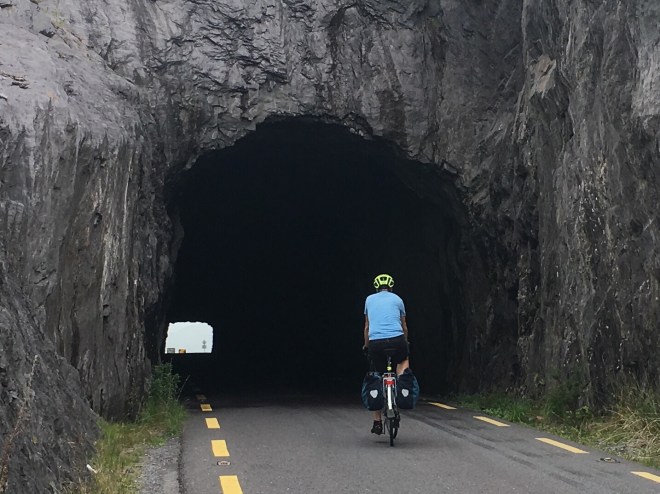
To get back to our car we had to tackle our first serious Irish hill. At 320m high, the Caha pass isn’t as high as our rides through the Andes or Pyrenees but it offered some spectacular mountain views, an interesting tunnel and the thrill of an 18km descent down to Kenmare.


The tunnel at the top

Overall, we really enjoyed the Beara – both for the cycling and for the beer!

Thank you for your thoughts on the best word to describe bicycle touring with a car. Bikedriving was popular but carbiking just came out on top.

So carbiking it is, except that we didn’t go carbiking around the Beara. We cycled all the way!

Clare and Andy

Beara Peninsula
By bike: 180km, 2634m climbed
By car: 0km

Wild Atlantic Way (so far)
By bike: 403km, 6097m climbed
By car: 116km
Inside the Ring of Kerry

Everyone warned us that the Ring of Kerry is far too commercial. Full of visitor attractions, souvenir shops, cafes, galleries, even pubs serving all-day breakfasts!

And the coaches! Scores of them carrying tourists anti-clockwise around the ring every day from Killarney. “They’ll knock you off your bikes, so they will!”

“If you must go by bicycle, go anti-clockwise but start in the afternoon when the coaches have gone.”

“You should always cycle clockwise, against the traffic. It’s for your own safety.”

img_0586

With these warnings ringing in our ears, we decided to drive around the peninsula by car before setting out on our bikes. We were especially curious to check out the mountainous middle, inside the famous ring.

It turned out to be spectacular.

Big country. Untamed. Full of lakes, woods, rugged mountain passes, hill farms and brightly coloured sheep. And it was empty – there were very few people and no coaches.

We couldn’t wait to cycle through it!

img_0651

We drove up to Moll’s Gap and ‘Ladies View’ which announces itself as ‘the finest view in Ireland’.

img_0555
The finest view in Ireland?

Feeling inspired, I thought it would be fun to cruise downhill on my bike to the quaint little village of Sneem, about 20km away, while Clare drove ahead in the car. I imagined freewheeling through beautiful countryside in golden early evening sunshine.

It didn’t quite turn out like that.

The wind was so strong that my bike almost stopped whenever I tried to freewheel and I ended up pedalling furiously however steep the descent. It was also a bit of a shock to come across a fairly substantial climb half way down.

This meant it was a red faced and bedraggled cyclist that limped into Sneem some time later to find Clare chuckling into her cappuccino.

img_1040
I wasn’t expecting the hill!

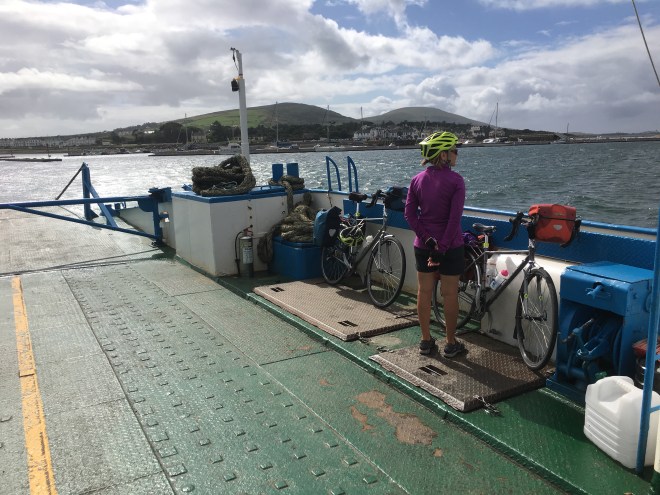
We left our car in Waterville, near the end of the peninsula, for the start of our three day tour around the Ring of Kerry. A small backroad took us (clockwise) across to Valentia Island in the far north-west.

Ring of Kerry

img_0617
Ferry to Valentia Island

Too small for coaches, this road featured several switchbacks that were so steep we both had to climb off and push our bikes.

But it was worth it. From the top of the ridges, there were great views out to the remote Skellig islands which have featured prominently in two Star Wars films (The Force Awakens and The Last Jedi) due to their other-worldly appearance.

img_0589
View out to the Skellig Islands

The human story of these islands is arguably more extraordinary than a Star Wars plot.

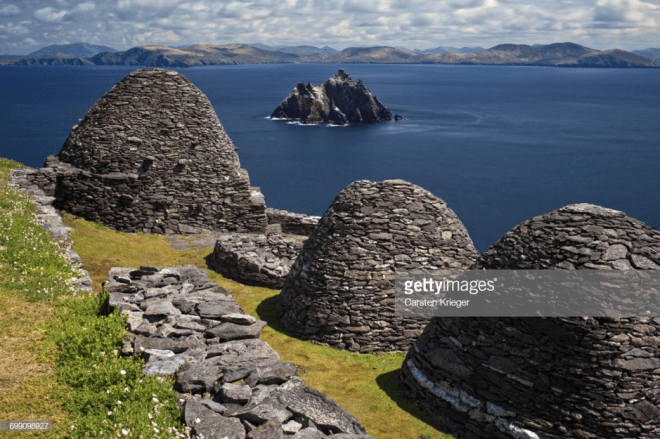
Monks arrived in the 7th century looking for places where they could get closer to God through isolation and extreme hardship. They built a church at the wild and windy summit and then cut 670 stone steps to scramble up to it. Sleeping in small stone beehive huts, they lived off fish, birds and rainwater. Despite being raided fairly regularly by Vikings, they continued in this way for about 600 years.

Getty Skellig
Beehive huts on the Skellig Islands   Credit: Gettyimages

That evening we stayed at Kells House & Gardens, a botanical oasis nurtured by a succession of gardening enthusiasts for almost 200 years. It includes an extraordinary ‘Primeval Forest’ of huge tree ferns, mostly imported from Australia in the 19th century and still thriving today in the mild local micro-climate.

img_0620
Tree fern forest at Kells

Day two was the big one, venturing inside the ring to climb the Ballaghbeama Pass on our longest cycle so far at 82km with 855m of climbing.

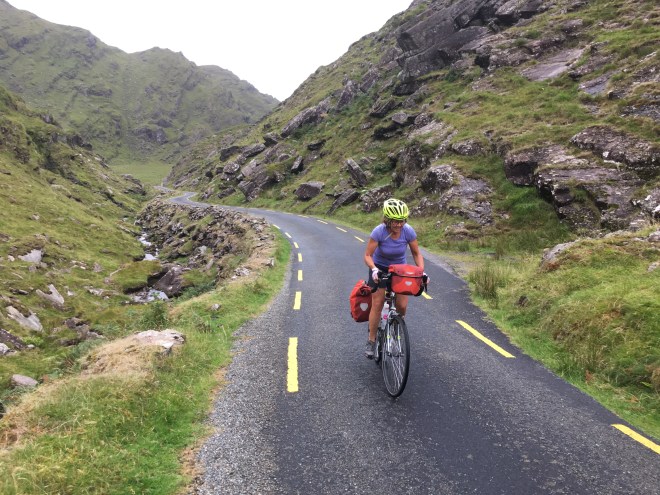
Despite cloudy, mizzly weather it was one of the most memorable rides of this Irish carbike tour. The road snaked up through a narrow, rocky gorge then opened out into a much wider valley as we cruised down the other side. Wild and remote, yet still and peaceful.

img_0658
Climbing the Ballaghbeama Pass
img_0670
Cruising down the other side

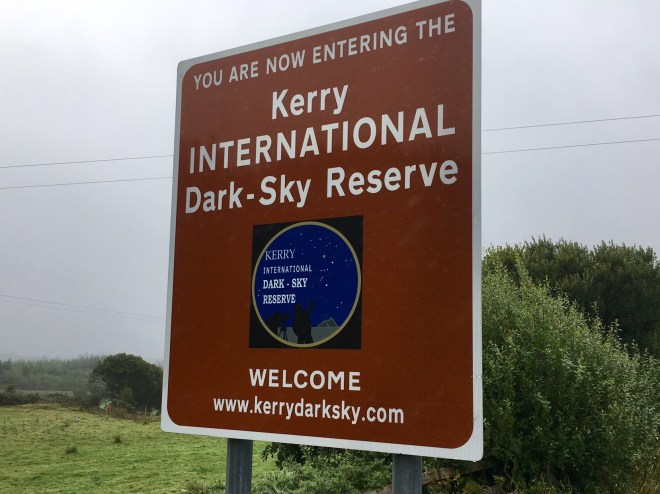
This part of Kerry is an International Dark Sky Reserve as there is so little light pollution. Apparently, on clear moonless nights the sky is revealed in all its glory. (If there are any clear, cloudless nights that is!)

That means stricter controls on development, so the raw, untamed quality of the land inside the ring should never change.

img_0676

On the final morning, we only had 35km to ride back to Waterville over the Coomakista pass which has, yes … ‘the finest view in Ireland!’

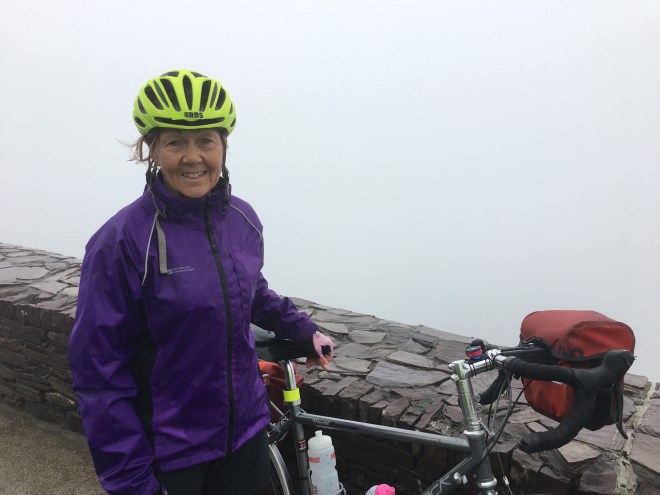
But we couldn’t see a thing, as the cloud had come right down to kiss the sea, enveloping everything it touched in fog and drizzle.

img_0677
Anyone there?
img_0682
Where’s the view gone?

Luckily for us, we’d already seen this view in its full glory from the car a few days before!

img_0576
There it is … the finest view in Ireland?

Whilst not as authentic or untouched as the Beara peninsula, we didn’t find the Ring of Kerry as commercial as we’d been warned. It’s a lovely place and a great day out for all the people who jump in a coach in Killarney and then spend the day touring around it, enjoying the sights and the all-day breakfasts!

But we were grateful for the warnings. Without them, we would never have discovered the high country inside the ring.

If you’re seeking unspoilt beauty that’s different to the normal tourist routes, then this is the place for you. By bicycle or by car.

Just please don’t tell anybody …

Clare and Andy

Ring of Kerry
By bike: 197km, 2241m climbed
By car: 70km

Wild Atlantic Way (so far)
By bike: 600km, 8338m climbed
By car: 186km
Defeated by the Dingle

On Saturday 21st May 1927 Charles Lindbergh peered down from the cockpit of the Spirit of St Louis on his historic solo transatlantic flight to see the Three Sisters, small coastal peaks at the end of the Dingle peninsula. At last he had reached Europe!

The weather must have been better that day.

We pitched our tent in a full-on gale at Europe’s most westerly campsite, advertising a ‘view’ across to those same Sisters.

img_0698
Clouds obscuring the Three Sisters

We used to love camping and have many fond memories of family holidays under canvas when our children were small. Mostly in the warmth of France. But we hadn’t tried it for 10 years.

So why are we camping now?

Because real touring cyclists camp. Because we think it might be magical. Because it will certainly be cheaper.

Before investing in a super-lightweight-cycle-touring tent, we decided to give it a go in Ireland with some of our old, heavy gear.

We imagined waking to a beautiful, calm dawn in a gorgeous bay refreshed from a full night of sleep and listening only to the sea gently lapping against the shore.

The reality was that we woke to another wet and windy day in a field full of campervans, sleep broken by our air-mat deflating and listened to the kids next door squabbling over their Coco Pops.

We managed seven nights, but it wasn’t an unqualified success. Camping is not that popular in Ireland … probably because it can be a teeny bit wet.

img_0685

The Dingle Peninsula is said to be one of the most beautiful in Ireland. But we didn’t really see it.

Heavy cloud had settled languidly over this part of the country, putting its feet up and refusing to move on. And with the clouds came the gentle Irish rain that feels so soft and seeps into every fold of clothing.

Not the best weather for cycling.

So instead, we headed into the town of Dingle to see what it had to offer. It turned out to be a lot.

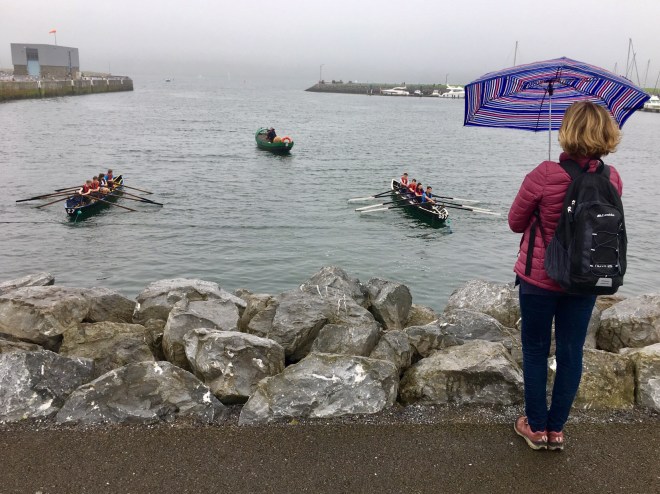
The Dingle regatta was in full swing, with rowers braving the rain to race naomhóg, traditional boats made of tarred canvas stretched over a wooden lattice.

img_0716

In the evening, we saw a one-man play about the life of a local fisherman and his deep connection to a dolphin that appeared off the coast and never left.

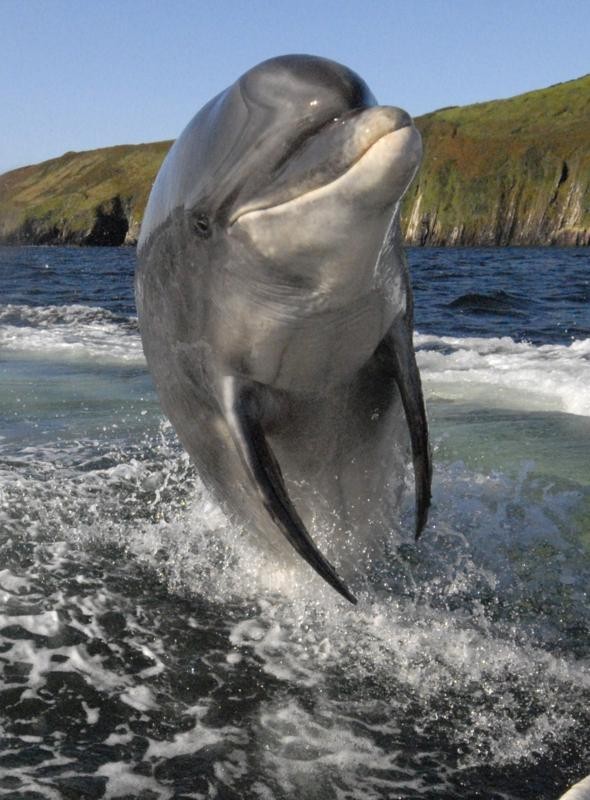
This is based on a truth … there is a bottlenose dolphin in Dingle harbour called Fungie who has been entertaining visitors for 32 years.

Fungie the Dolphin
Fungie      Photo Credit: Dingle Dolphin Boat Tours

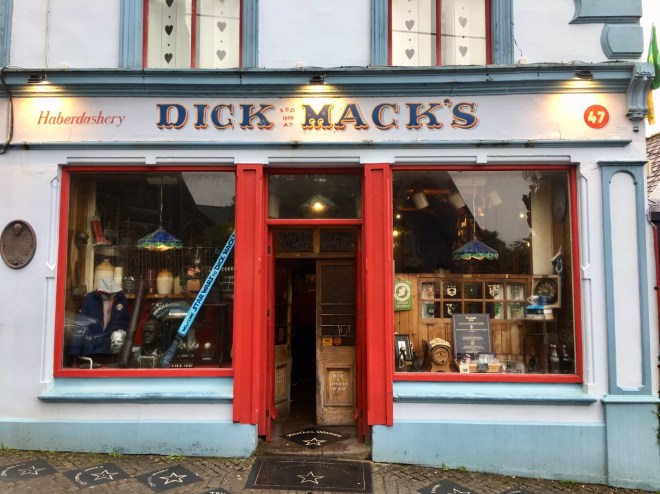
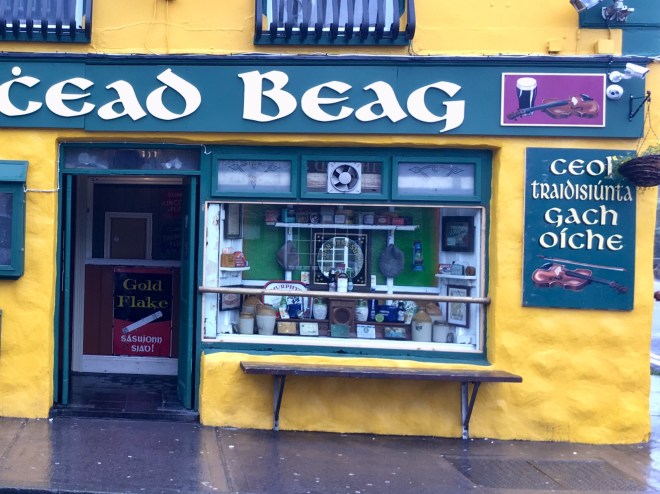
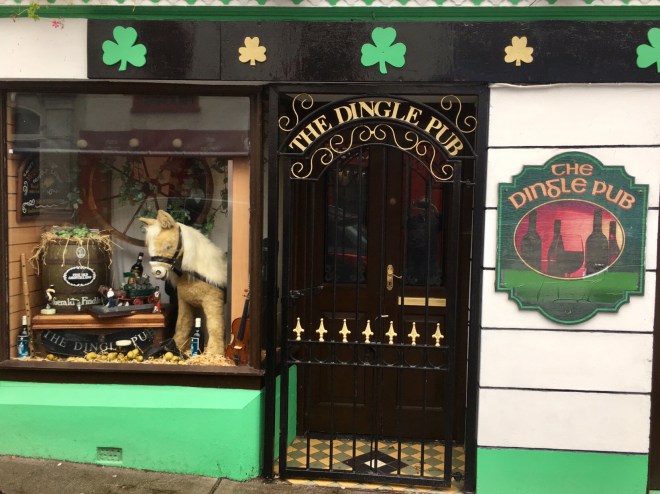
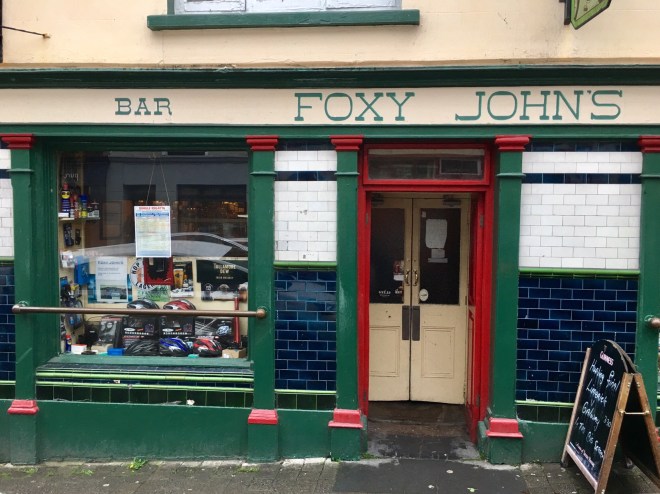
The pubs of Dingle are famous for their music, their character and their window displays.

img_0740
Dick Macks: Probably the most famous pub in Dingle

img_0735

img_0738

img_0744
Foxy Johns is also a hardware & bicycle store

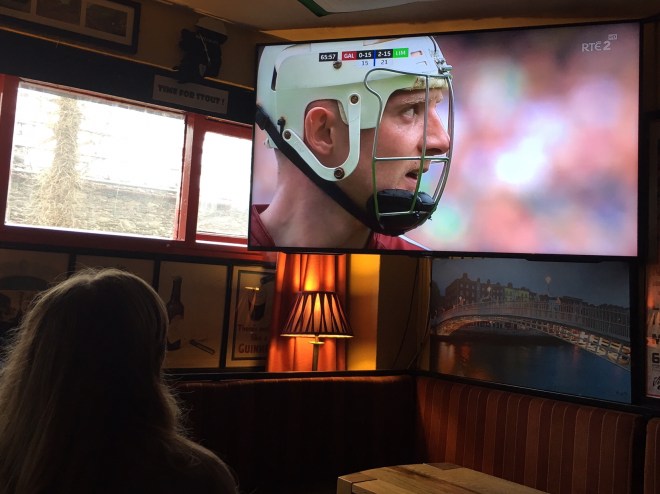
They were all full on this Saturday afternoon for one of the sporting occasions of the year – the All Ireland Hurling Final.

So we became sons and daughters of nearby Limerick for a day cheering on their team against Galway, the defending champions. Making the final was a very big deal for Limerick as it is 45 years since they last won.

Hurling players use a wooden stick called a hurley to hit a small ball called a sliotar between the opponents goal posts. These look like a football goal with two rugby posts on top. Hit it in the net for a 3 point goal, hit it over the bar for 1 point.

At the end of normal time Limerick were leading by 8 points, a huge margin. But as the referee indicated eight minutes of injury time, the green shirted fans around us started muttering about the curse of ’94 when they had lost to Offaly from just as strong a winning position.

img_0725
A Galway player lining up a free hit

Surely it couldn’t happen again!

It could … in injury time Galway roused themselves to score again and again and again. Limerick wobbled but to tears of relief all round, they managed to score the single point they needed to cling on and win.

Cue raucous celebrations!

img_0732
Limerick are Champions after 45 years

Hurling is an incredibly fast, tough and skilful sport. It’s a sport that almost makes us wish we were Irish.

Dingle

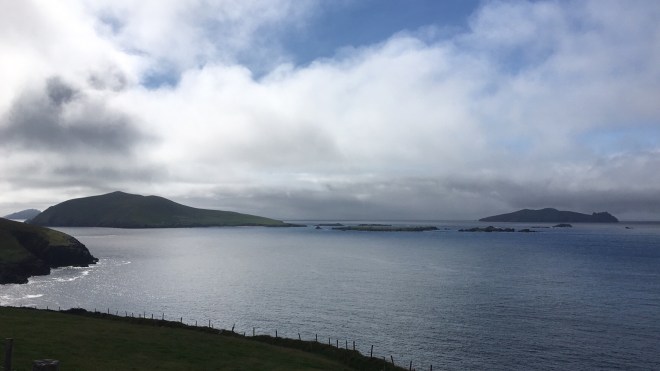
We only managed one 40km bike ride around the end of the peninsula but it was just as beautiful as we were promised with views out over the Blasket Islands and lots of fascinating local history to discover.

img_0761
Looking out to the Blasket Islands

We especially liked the moodiness of Brandon Creek where St Brendan and 14 monks are reputed to have set off in a small boat sometime around AD 535 to cross the Atlantic and eventually reach Newfoundland, stopping at islands along the way (Hebrides, Faroe Islands, Iceland etc.)

img_0707
Brandon Creek

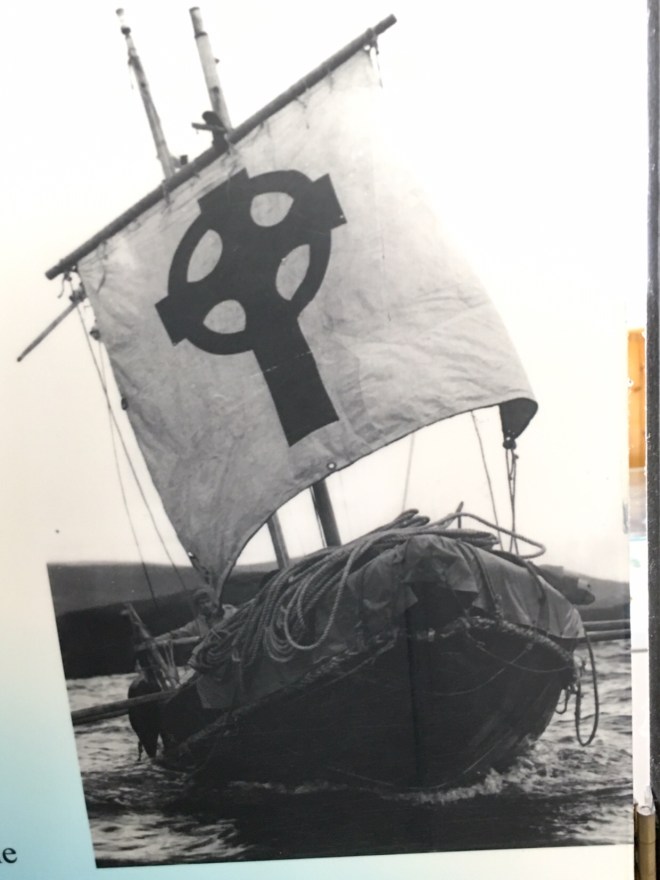
To prove it was possible, this journey was repeated  in 1976 by Oxford graduate, Tim Severin, who made the journey in a replica boat made out of wood, flax, oak bark and wool grease.

img_0747
Tim Severin and his replica boat

Not made of such stern stuff, we have to admit we were defeated by the Dingle.

We drove more that we cycled. And we failed to ride over Conor Pass, Ireland’s highest, as it was blowing a gale in thick cloud at the time.

img_0786
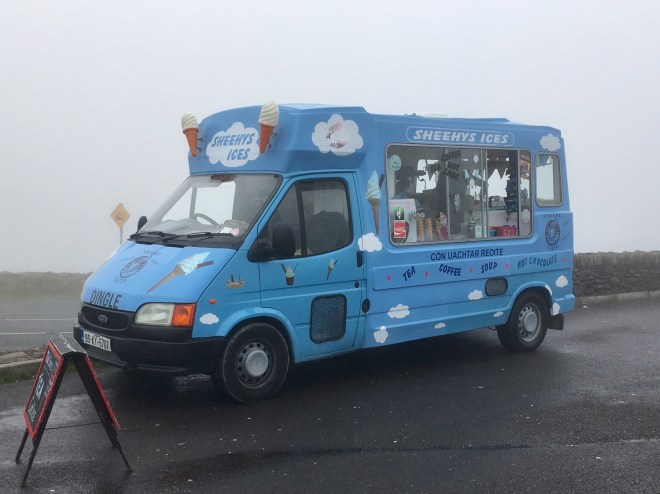
An optimistic ice-cream van at the top of Conor Pass

On the last morning the sun came out at last. We woke up to see the Three Sisters in all their glory through the flap of our tent. As we sat on the lush grass, drinking coffee and listening to birdsong it almost felt like a moment of magic.

So we hope to come back one day to see the Dingle properly in the sunshine.

And we might rediscover the joy of camping after all. The jury’s still out on that one.

Clare and Andy

Dingle Peninsula
By bike: 40km, 540m climbed
By car: 101km

Wild Atlantic Way (so far)
By bike: 640km, 8878m climbed
By car: 287km

Clare goes to County Clare

Heritage is important to Irish people. They’re always proud to say which county they’re from whether it’s Wicklow, Cork, Kerry, Galway.

I don’t have any Irish heritage but I like it that my name is spelt the same way as County Clare, without the ‘i’.

Whilst cycling in Clare we came across another way that the Irish celebrate their heritage. The final of the Rose of Tralee competition was broadcast live on RTE1 (the main TV channel) for two consecutive nights, attracting the biggest TV audience of the year.

It’s a competition to crown a young lady who embodies the qualities set out in the famous Victorian poem and becomes an ambassador for Ireland.

She was lovely and fair as the rose of the summer,
Yet ’twas not her beauty alone that won me;
Oh no, ’twas the truth in her eyes ever dawning,
That made me love Mary, the Rose of Tralee.

Definitely not a beauty pageant, it’s open to all young women of Irish heritage from home and abroad. They might be a nurse, teacher or lawyer but to the girls lining the streets of Tralee for the annual parade, they’re rock stars!

rose-of-tralee-2018
The 2018 winner from Waterford    Credit: Stay in Kerry

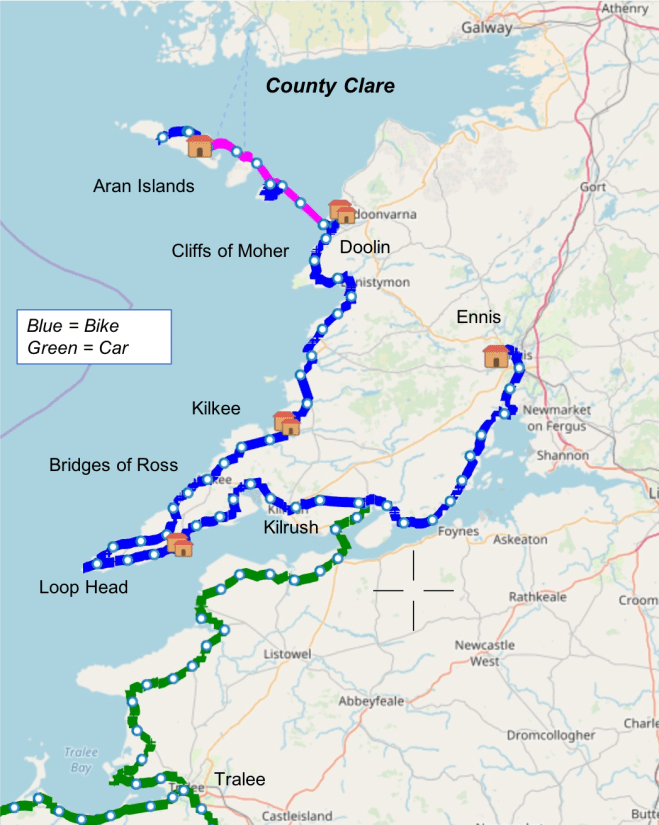
Defeated by the Dingle and with wet camping gear happily packed away, we left the Southern Peninsulas, parked our car in the medieval town of Ennis and set off with our panniers for a week. It felt good to be back on our bikes.

Andy wanted to see the Shannon, Ireland’s longest and widest river, which meant pedalling an additional 50kms away from the Wild Atlantic Way.

It wasn’t worth it!

The views of the muddy estuary were unremarkable and long stretches of undulating country roads were unrelenting. I’m sure other parts of the 360km long Shannon are far more beautiful.

County Clare Full

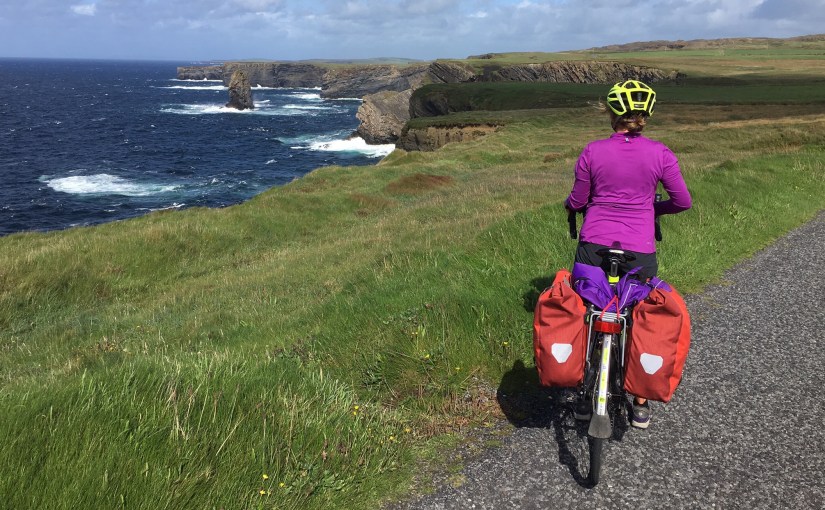
Re-joining the Wild Atlantic Way at Kilrush, the scenery became more interesting again but strong headwinds were now the challenge.

This part of Clare is notorious for wind as it faces the open Atlantic and there are no trees to break it up. We quickly learnt that the local rule is ‘whichever way you go, the wind will always be ahead of you!’

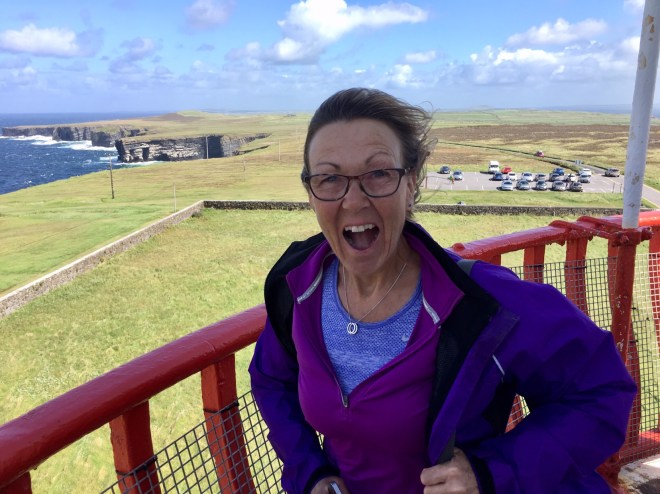
As we cycled towards Loop Head Lighthouse the gusts increased to over 40mph. When I stopped pedalling, I was quickly forced to a standstill or even sent backwards!

img_0818

Built in 1845 the lighthouse was the first of many interesting sights along the Clare coastline. In World War II a big ‘EIRE’ sign was laid out in stones on the headland, to warn Allied and German pilots that this was a neutral country.

Thankfully we left the lighthouse with the wind behind us so enjoyed the luxurious feeling of being pushed along. For those of you familiar with sailing, it was like being on a broad reach.

The Bridges of Ross were originally a trio of natural sea arches until two of them fell in to the sea, leaving just one remaining arch today. As we peered over the cliff ledge we saw a very amusing sight – over 20 photographers huddled together, all pointing huge lenses out to sea.

Perched on stools, clothed in waterproofs with flasks at their sides they seemed to be waiting for something special to happen. Whales, dolphins, seals? No, they were a group of birdwatchers trying to capture the ultimate photo of a puffin, guillemot or kittiwake!

img_0848

Continuing northwards we were suddenly surrounded by a flurry of coaches all heading to the Cliffs of Moher, a major tourist attraction.

The climb up Moher Hill was both steep and again into a headwind. As we fought our way up we were drenched by a sudden downpour which meant we arrived at the Visitor Centre looking like drowned rats.

We were rewarded with some early evening sunshine and free entry (8 Euro’s each), offered to all cyclists for the making the effort to climb up the hill.

img_0877

By contrast to the crowds at Moher, the major attraction on the Aran Islands was understated but seemed to us to be even more dramatic.

Dun Aonghasa is a spectacular pre-historic stone fort on Inishmore, the largest of the 3 Aran Islands. It stands in a semi-circle on the highest point of the cliffs facing directly out to the Atlantic beyond.

img_0975

No-one is quite sure why it is there.

There was no guard rail to protect you from the sheer drop 100m down to the waves crashing below. I felt terrified, staying well away from the edge, not looking as Andy leant over the side to take photos!

img_0984

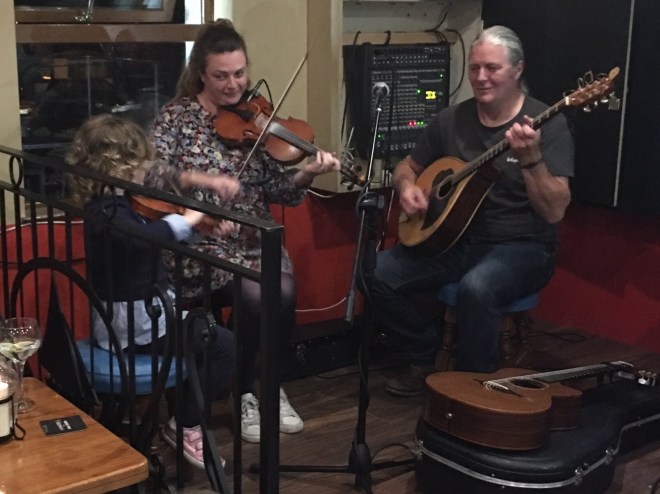
After listening to lots of accordions, Andy was desperate to find an Irish band with a good fiddle player. In Jack’s Bar that evening his wish came true.

We were listening to a dreary male singer when a young mum and her small daughter suddenly got up from their dinner and pulled out their fiddles. She was fabulous and got the whole bar clapping along to her traditional jigs and reels.

img_0999

Leaving the island the following morning we had an amusing incident as we patiently joined the queue for our ferry. This is the boat we thought we were getting.

img_1002

But our ticket was the wrong colour. Green, not pink. That meant we had to get this ferry instead!

img_1004

Despite being called the ‘Happy Hooker’ (a hooker is a traditional West Ireland fishing boat), the passage back wasn’t a happy one as she rolled heavily from side to side in the huge swell.

img_0856

There are highs and lows with every cycling trip.

From a female perspective cycling in Ireland is lots of fun. Distances are manageable, there are lots of comfortable places to stay and the food is great.

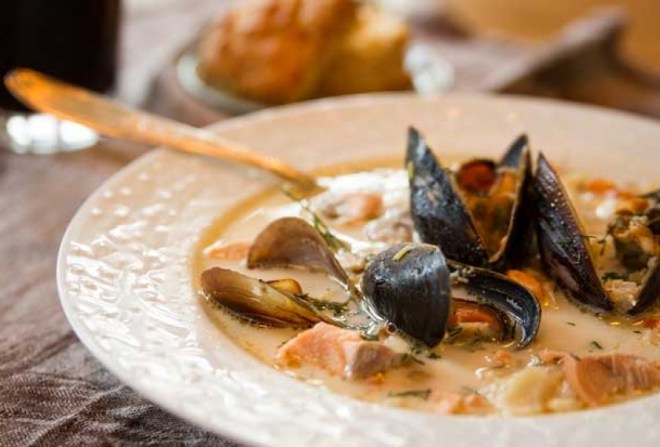
The fish and seafood are particularly good, served in generous portions. Seafood Chowder is on every menu, taken so seriously that an All-Ireland Seafood Chowder competition is held every year.

carrygerry-seafood-chowder
Credit: Good Food Ireland

The delicious cakes at every coffee stop haven’t helped reduce our waistlines but then cakes are one of the great pleasures of cycling touring. And pedalling into a headwind doubles the amount of energy you use, so why hold back?

The biggest challenge in Ireland is the weather although we have probably had just as much sunshine as rain and wind.

It changes so often, we now call it ‘on-again-off-again-weather’.

No sooner do I stop to take a top off, I needed to put it on again. My rain jacket is continually kept at the ready and my glasses are always being swapped for sunglasses … and back again.

So if you do come to Ireland, my advice is to leave your hairdryer at home and bring an umbrella … and some sunscreen!

Clare

County Clare
By bike: 237km, 2316m climbed
By car: 95km

Wild Atlantic Way (so far)
By bike: 877km, 11194m climbed
By car: 382km

Goodbye Galway Girls & Danny Boys

The Irish have a great talent for making a lot out of a little.

As we drove to Rosslare to catch our ferry back home, we couldn’t help but smile at a sign announcing ‘President Obama’s Ancestral Village’. This is Moneygall where a young man called Falmouth Kearney lived before he emigrated to the United States in 1850. He was Obama’s maternal great-great-great-grandfather.

Now this might seem like a distant connection to you and me but for Moneygall it’s enough for a visitor centre called the Barack Obama Plaza and the preservation of a terraced house as his ancestral home.

We found a similar story when we stayed in New Ross on our first night in Ireland. Birthplace of John F Kennedy’s great-grandfather, it now boasts a Kennedy homestead, Kennedy museum, Kennedy arboretum, Kennedy summer school and Kennedy hotel.

As far as we know, there isn’t a Trump visitor centre in Ireland yet … just an ostentatious golf course and luxury hotel that took us a long time to cycle past.

img_1033
Kinvara

During our last two days on the Wild Atlantic Way, we cycled from Doolin to Galway, staying overnight in the lovely small town of Kinvara.

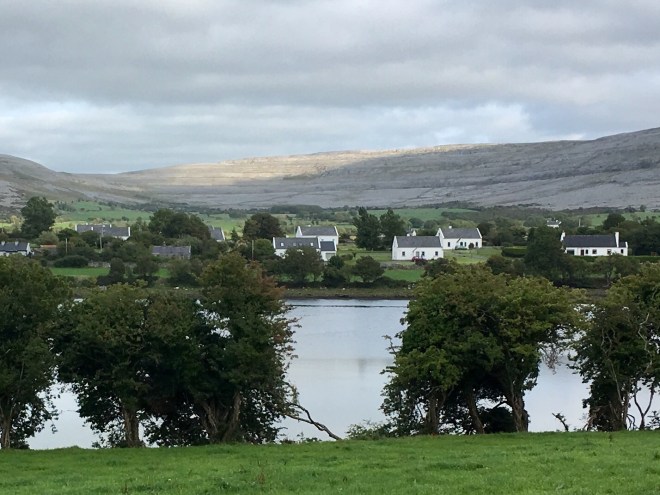
This took us through the Burren, one of the finest examples of a glacio-karst landscape in the world. Huge limestone sheets have been eroded by glaciers and then by rainwater which gets into any cracks and crevices.

img_0920
Limestone pavements

The effect is dramatic. Limestone pavements with perfect parallel lines sit beneath smooth hills that are strewn with so many rocks that they appear from a distance to be sugar coated with snow.

img_1023
A light covering of snow in August? 

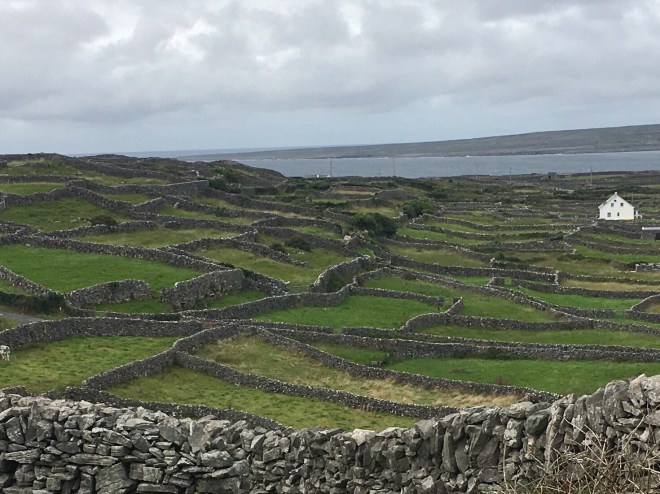
The name Burren comes from the Gaelic Boíreann which simply means a rocky place. Many years ago, farmers cleared all the rocks from the fields, piling them into a striking mosaic of dry stone walls.

The walls go right down to sea, sometimes running across vast limestone pavements. Cattle were brought down onto the flat rocks for winterage, as they held onto the summer heat for longer encouraging the grass in the crevices to keep growing.

img_0962

Galway turned out to be a vibrant city with a lively centre full of small shops, restaurants and music bars, all buzzing with people chatting away in Gaelic. So much so that it’s often referred to as the bilingual capital of Ireland.

img_1045

There were lots of amusing shop signs, including a trading notice outside this jewellers…

img_1046

And a special offer from this café…

img_1048

To our surprise, the highlight of our visit to Galway was an extraordinary show that’s been entertaining tourists for the last fourteen summers.

Trad on the Prom is an evening of traditional Gaellic music and dance presented by some of the creators of big, famous shows such as Riverdance or Lord of the Dance. Despite taking place in the unlikely surroundings of a leisure centre sports hall, it was magical and captivating as the quality of the musicians and dancers was so high. Indeed, many of them were world champions.

Trad on the Prom
Credit: Trad on the Prom

As we caught the train back to Ennis to pick up our car, we added up the distance we’d cycled on the Wild Atlantic Way.

It came to 961km cycling and 438km driving*.

This means we did fulfil our carbiking promise to cycle more than we drove. But we missed our 1000km target … defeated by the weather on the Dingle.

Southern Route Full

So how was our first experience of carbiking?

There are lots of good things:

  • It’s really easy to get to the place you plan to cycle from. You don’t have cram your bikes onto public transport.
  • It’s more versatile. You can take a detour, stay in different places or get to a remote restaurant.
  • You can miss out those parts of the route with lots of main roads or boring scenery.
  • If you need to, you can check out a mountain pass in the car before you ride over it.
  • You can drive on rainy days.
  • For day rides, the panniers can stay in the car.
  • It means you can bring loads more stuff such as heavy camping gear, a box of food or even that all important hairdryer!

And a few less good things:

  • You always have to get back to your car, which can mean cycling in a circle.
  • The comfort of the car makes it feel less adventurous, less of a journey.
  • It makes it too easy to bring loads more stuff!

We thought it worked out surprisingly well especially as there were so many peninsulas to loop round on this trip. We’d definitely recommend it.

img_0631

Now … we’ve heard some people say that the Wild Atlantic Way is one example of the Irish making-a-lot-out-of-a-little.

It is a clever way of joining all the small roads together and claiming that it’s the longest coastal touring route in the world’.

But … the southern half is so beautiful, so varied and, yes, so wild that we think it’s actually making-a-lot-out-of-a-lot!

Now we can’t wait to return and explore the northern half from Galway to Malin Head.

Clare and Andy


Southern Half of the Wild Atlantic Way: Kinsale to Galway
By bike: 961km, 11825m climbed
By car: 438km*

* If we cycled and drove along the same roads, we only counted the cycling distance.
* We didn’t include driving to Ireland and back.
* Which is not cheating!

On the Road Again

As we shared a Mote con Huesillo at a street cafe beneath a beautiful warm blue sky, it finally sunk in that we’re back on the road again ready to set off for another adventure.

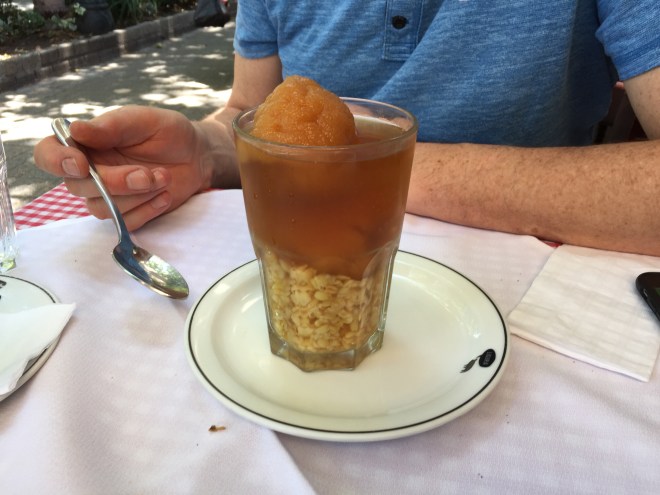
We enjoyed this popular summertime dessert yesterday at a cafe in Santiago, Chile. Made by soaking peaches and fresh husked wheat in a sweet nectar of water, honey and cinnamon, it’s unique to this country.

Mote con Huesillo

Our plan is to cycle south from Santiago through Chile, then climb over the Andes into Argentina and back again finishing in Puerto Varas in the Chilean Lake District.

Over the next 6 weeks our route will take us roughly 1900 km (1200 miles) through wine country, down the wild Pacific Coast, past snow-capped volcanoes and along the Camino de los Siete Lagos (Road of the Seven Lakes) considered to be one of the great bike rides of the world.

We’re a bit nervous to be honest … the more research we do, the more we realise how bike touring in South America will be different compared to Europe. Big distances between places, big changes in climate, lots of rough gravel tracks.

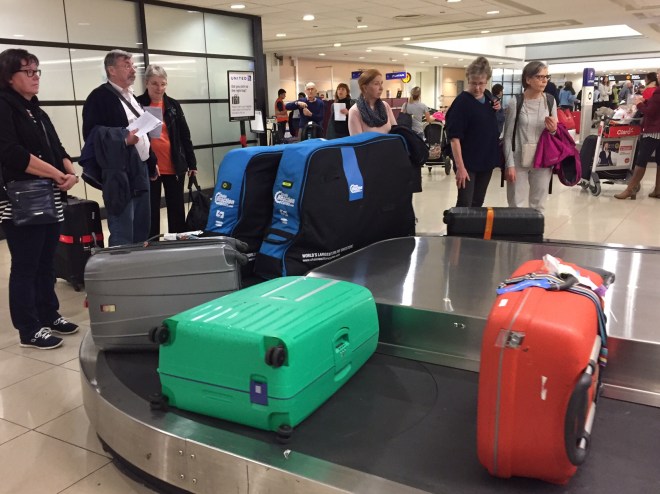
Our bikes have come with us packed safely in proper bike bags. Andy has spent many hours giving them new tyres, new brake pads, new chains, new sprockets (back gears) and new cables. After lots of swear words and as many cut fingers, they now look ready for whatever Chile might throw at them.

The bike bags arriving together at Santiago airport

This time, we’ve cut out the luxury items making our panniers several kilos lighter. Those of you that followed our blog to Barcelona might be surprised to hear that this time there’s no pillow, no pilates ball and most controversially of all, no hairdryer! Our good friend, Ginny, lent Clare the perfect alternative – a pink hair roller for her fringe!

Here are our clothes for the trip. Can anyone spot the difference?


A few days acclimatising in Santiago has helped to ease our nerves a little. Not known as a great tourist destination but it does seem to be a lovely city to live in. Spotlessly clean, lots of trees and parks, easy to get around, plentiful bars and restaurants and full of friendly people.

View across Santiago
Fish and chips in the middle of the fish market
Leafy streets

Now it’s time to climb on our bikes and pedal off, starting with the Casablanca wine valley and the vibrant old port town of Valparaiso.

Clare and Andy


“On the road again

Goin’ places that I’ve never been

Seein’ things that I may never see again

And I can’t wait to get on the road again”

Willie Nelson

The Joy of Messed up Hair

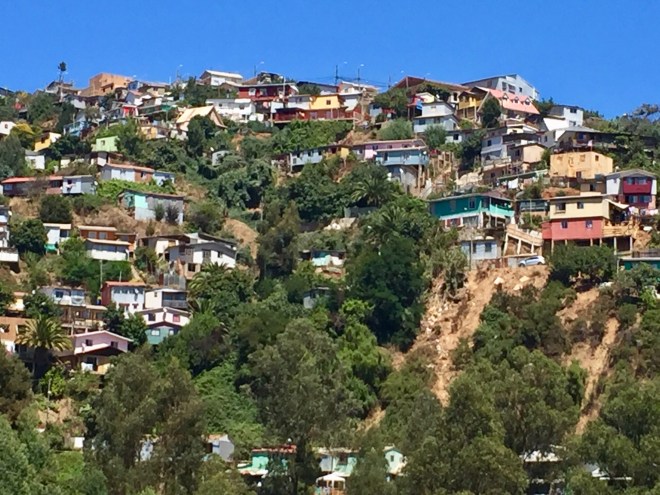
Tumbling down precipitous mountain slopes to the sea in a mass of uncontrolled curls, it’s fair to say that the city of Valparaíso has never needed a hairdryer.

“Valparaíso, how absurd you are … you haven’t combed your hair, you never had time to get dressed, life has always surprised you.”
Pablo Neruda, Chilean poet and Nobel prize winner

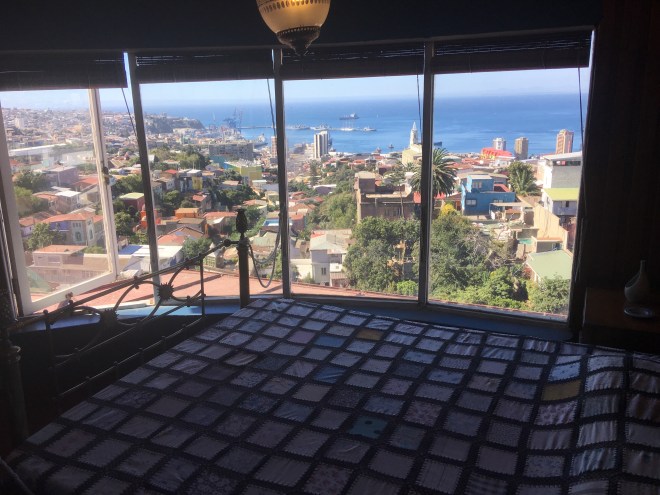
img_1761
View of Valparaisa from Pablo Neruda’s bed

Valpo is one of the most extraordinary places we have ever visited.

It grew as a welcome rest stop for 19th century steamers on their way to the California Gold Rush and was built by the passengers that loved it so much, they decided to stay. But the boom was short lived as it was almost destroyed by a devastating earthquake in 1906 and worse, by the opening of the Panama Canal.

img_0215
Houses hanging to the cliff face

Today the good times are back with the city regenerated into a bohemian tourist destination and a major port once again, exporting fruit from Chile’s fertile agricultural interior.

img_1726

img_0236

A maze of steep sinuous streets, escalares (stairways) and ascensors (short funicular railways) connect crumbling mansions to shanty dwellings in a chaotic, democratic jumble. In technicolor too, for Valpo has embraced the Latin American passion for street art and graffiti more that any other city. Few buildings are spared a vibrant mural.


To be honest, cycling the route from Santiago to Valparaíso was a little tougher that we expected.

Cruising out of the city was easy and pleasant as we negotiated several cycle paths all the way out to the industrial outskirts. Here we were pleasantly surprised to find it a bike repair shop to tighten Andy’s back axle that had come loose on the flight.

img_0171

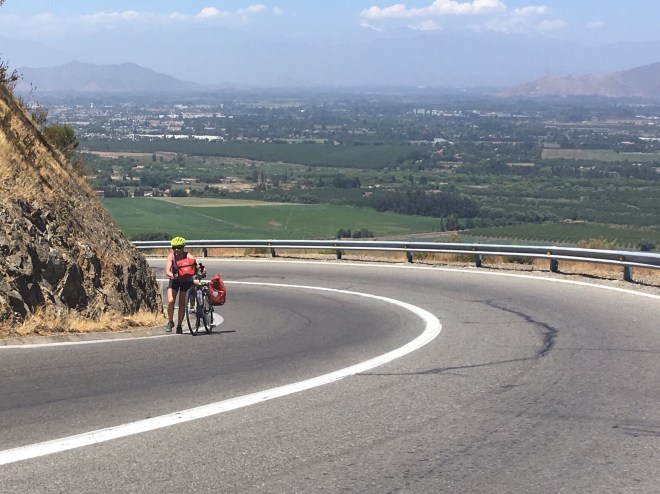
Then came a steep 300m climb in the searing midday heat. At over 12% gradient in parts we were both forced to walk, watching our arms turn red as the sun burned down on us through the Antarctic ozone hole.

img_1662

We were very relieved to reach our Cabinas (cabins) set amongst gorgeous orange groves and run by an eccentric French chef. The only accommodation for 20 miles, and the best meal for 50!

img_0188
A lovely Cabinas

Sorting out the axle had put the gears totally out of sync. Tuning them the next morning took a lot longer than expected and this meant we had to tackle the two climbs that act as a gateway to the Casablanca wine valley in the hottest part of the day yet again.

img_1670

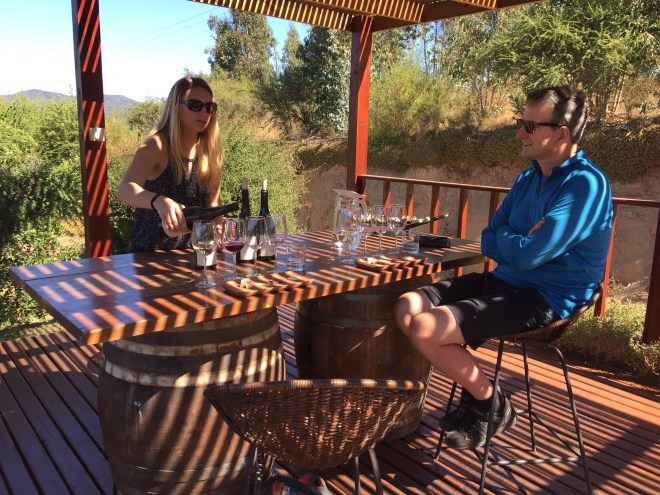
But it was OK as we had an incentive. We’d booked a wine tasting at a small family vineyard and even had time to check into our Hostal (B&B) first.

Unfortunately when we arrived in Casablanca, the Hostal didn’t exist. The address was correct (Chacabuco Street), the Google blue dot was exactly where we were standing but there was no hostel, no welcoming shower.

It turned out there are several Chacabuco streets. This one was actually in Valparaíso, 40km away and the little blue dot was simply in the wrong place. In a car this would be fine, a small mistake … but on bikes, in 35 degrees heat, hot and bothered after a long day it was definitely, unquestionably, 100% NOT fine!!

The only alternative accommodation was 10km away. Typically, the winery was 5km in the opposite direction. It was a tough decision.

Of course the prospect of a chilled glass of fine Chilean Sauvignon followed by a spicy Syrah won the day. This meant it was much, much later in the day that we peddled the 15km to our new hostel, both a little wobbly!

img_0193-1
Keep pouring!

The early Sunday morning ride across to Valparaíso was lovely, gently pedalling along quiet country roads in the cool morning air. We bumped into Raphael and Emilie, two young French cyclists who had ridden all the way from Ushuaia (near Cape Horn) and are now on their way to Lima in Peru. It was fun to share the ride down through the vertiginous cobbled streets all the way to the port … but genuinely scary!

As Emilie said halfway down … “this is nice, but how are we going to get back up?!” A problem for another day.

img_1692
Raphael and Emilie loaded up for a long trip

Valporaisa does not need a hairdryer and neither does Clare.

The small hotels and hostels we’re staying in are not the sort of places that supply one, so she’s been making good use of her pink roller instead.

img_1714

And just like Valpo, it’s liberating!

img_1769

Clare and Andy

Ups and Downs

What do you pack in only two panniers?

That was the most difficult task I had before we left for Chile. The main difference between my kit and Andy’s (apart from a lot of pink & purple) is that a woman does actually need more clothes and toiletries than a man.

So far everything I packed has been used many times but that extra warm top that Andy wouldn’t let me sneak in at the last minute has been sorely missed!

The most useful bits of clothing have been my fleece, jeggings and a multi-purpose sarong. Surprisingly my most useful piece of bike kit has been a red bungee. It makes a great washing line!

img_0545
Bungee washing line

The weather here has been one of real extremes.

Inland temperatures regularly reach 38 degrees and the UV rays are so powerful that we’ve already run out of suncream.

img_2044
Hot but not bothered

In contrast, the Pacific coast was surprisingly chilly and windy for high summer. The cold Humboldt current which surges up from Antarctica dramatically reduces both land and sea temperatures.

img_0416
A good catch

The coastline south of Valparaiso is rough and raw with huge Pacific rollers attracting more surfers than sunbathers. Some local women even lie on the beach in sleeping bags!

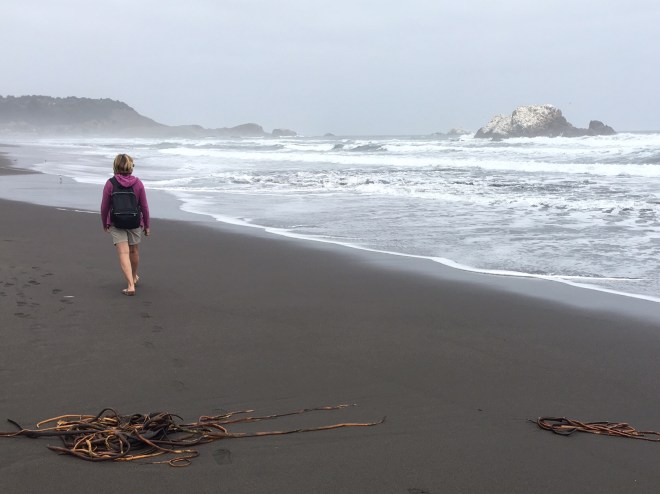
Sitting on a foggy black sand beach a few days ago looking out over the rough Pacific Ocean I realised that New Zealand is the next nearest landmass. Physically, culturally and mentally I felt a long way from home.

img_1917

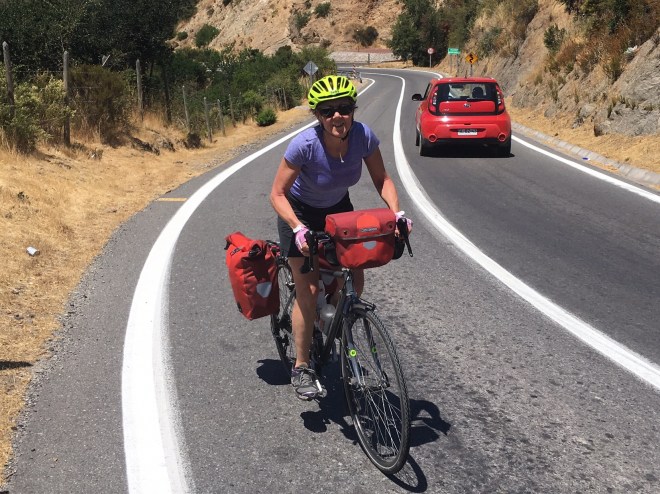
Cycling has been a real challenge, especially on hot days. Big distances between accommodation have meant that we’re doing a lot more miles than we normally ride at home. But we’ve enjoyed both the physical challenge (well … most of the time) and the beautiful scenery.

img_2065
Near the top of a long, hot hill

However, Andy has really helped me by carrying all the spare bike parts and other heavy stuff so my panniers weigh in at just under 10kg.

img_0509
Maybe that spare bike chain was a mistake?

We’ve also enjoyed the simple, fresh food of Chile.

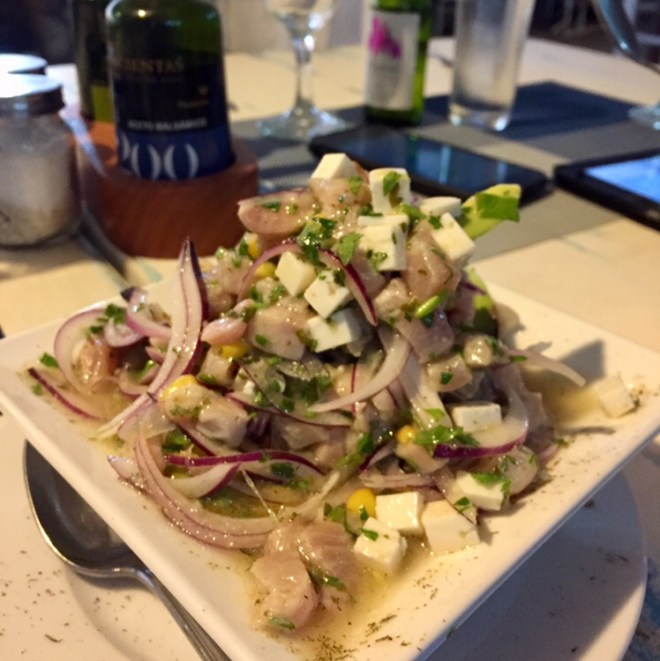
Ceviche is a delicious local speciality made with raw fish marinated in citrus juices and spiced with chilli peppers, onions, salt and coriander. Fish along the coast is plentiful, served in big portions, simply fried or grilled.

img_0372
Ceviche … yum!

We really like a local white fish called Reineta that often features on a Menu del Dias (daily lunch menu). Our favourite meal was in a small family cafe on the beach where reineta, chips and salad together with a bottle of good Chilean Sauvignon set us back only £10 each.

img_0424
A very popular cafe

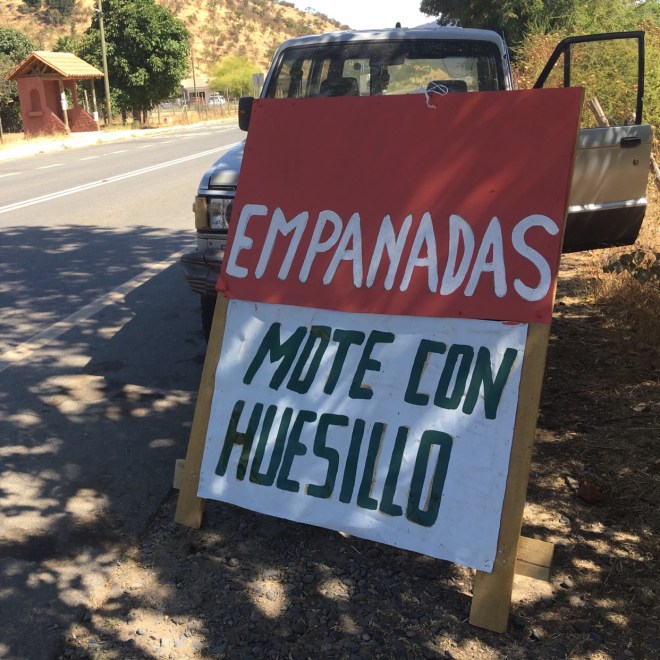
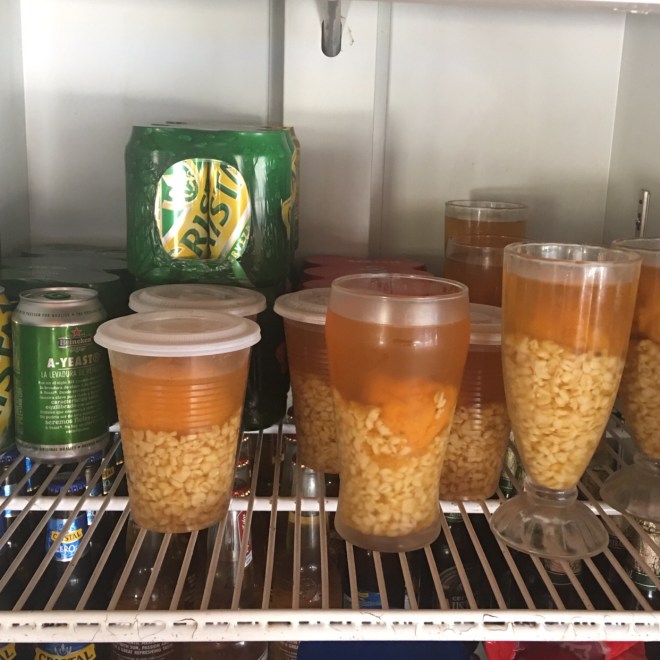
Every roadside stall we cycle past sell Empanadas (pastie style pies) and Pan Amasado (homemade bread), staple foods in Chile. And that Mote con Huesillo (peach and husked wheat drink) we tried in Santiago is everywhere!

img_2051
The two essentials for a Chilean road trip
img_2054
Empanadas
img_1838
Mote con Huisillo in the beer fridge

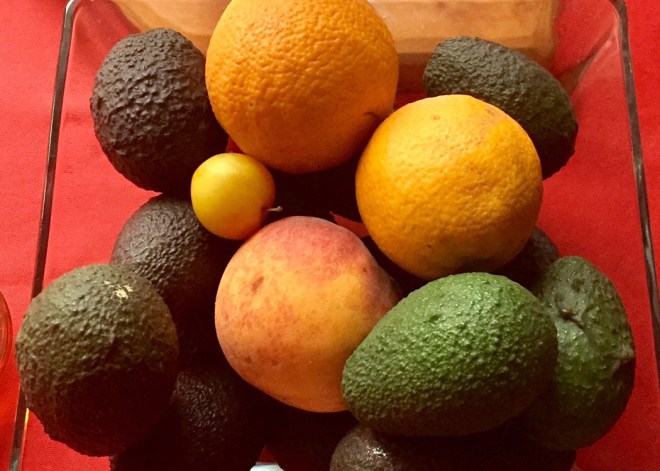
Fresh fruit is so plentiful. Look at the label on your blueberries, strawberries and avocados and there’s a very good chance they’ll be imported from Chile at this time of year.

Adios
Clare

img_0437

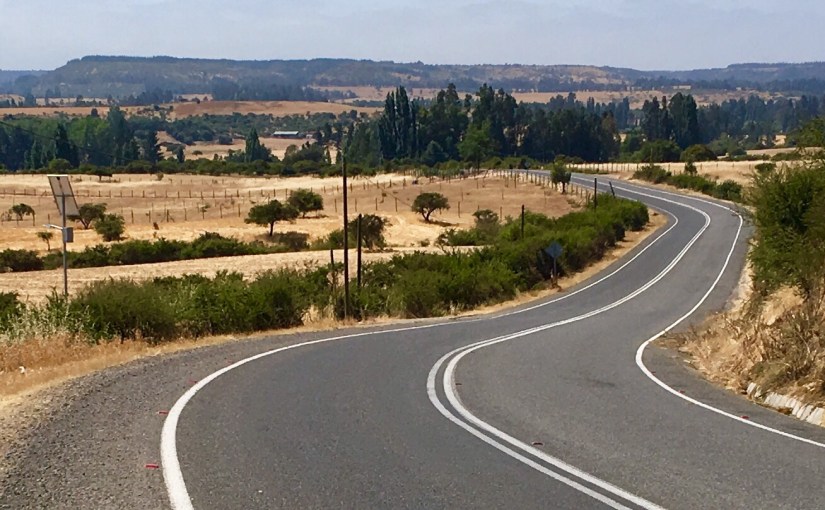
The Long and Winding Road

Hurtling down steep cobbled streets and stairways, the world’s best mountain bike racers will compete for the Redbull Valparaíso Cerro Abajo this Sunday 11th February, leaping over obstacles in their race against the clock.

We faced the problem of climbing the 20-25% gradient up those very same streets with our fully loaded touring bikes. Of course we cheated and found a very nice taxi with a bike rack.

img_1826

This made for a very pleasant 70km cycling day down the coast to the small seaside town of El Quisco.

img_1845
Our bikes are thrilled to see the Pacific Ocean for the first time

Refreshed from a fish supper straight out of the sea, we cruised through several more seaside towns the next day, watching families enjoy all the traditional activities. With cool air temperatures from the cold sea and a rocky coastline it felt a bit like Whitby!

img_1871
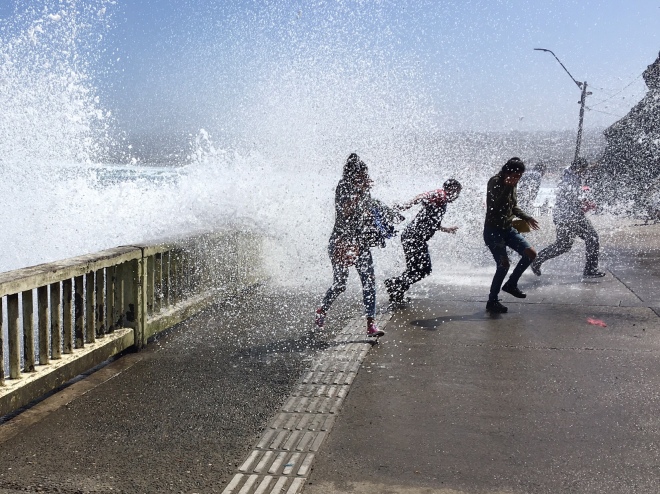
Playing dare with waves

From the port of San Antonio we climbed slowly up the brilliantly named Ruta de la Fruta (Fruit Road) which brings a procession of fruit trucks from the interior to the ports laden with all our winter strawberries and blueberries.

These trucks are huge. Fortunately we could hear them coming from a long way off, roaring like dragons until they showered us with dust as they whooshed past. After an hour we were glad to turn off onto a side road and head back to the coast.

img_1880
At the top of the Ruta de la Fruta (the wrist protectors are for sunburn)

I’d warned Clare that this would be a long and winding 100km day. I hadn’t warned her about the sting in the tail … mainly because I didn’t have a clue it was coming.

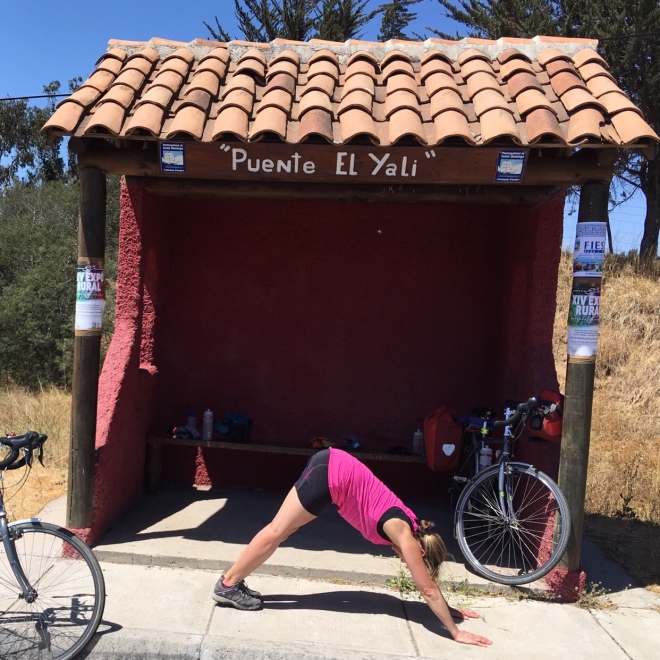
Needing to recharge for the final 20km, we stopped for peaches, bananas and yoga in a shady bus stop. There are lots of these in Chile, all identical and they are fast becoming our favourite picnic spots. As Clare completed her sun salutations to help ease her back, I studied the map and elevation charts … and almost choked on my lemon soda!

img_1890
Yoga in a bus shelter

Ahead of us were 7 … SEVEN!!! … Bath sized hills to climb before we got to our destination, the surf village of Matanzas.

I decided to soften the blow a little so told her there were “just a few small hills” ahead. At the bottom of the second hill I then pretended to look hard at the map before announcing there might be a “few more”. I only admitted to the full horror of the situation at the 5th peak.

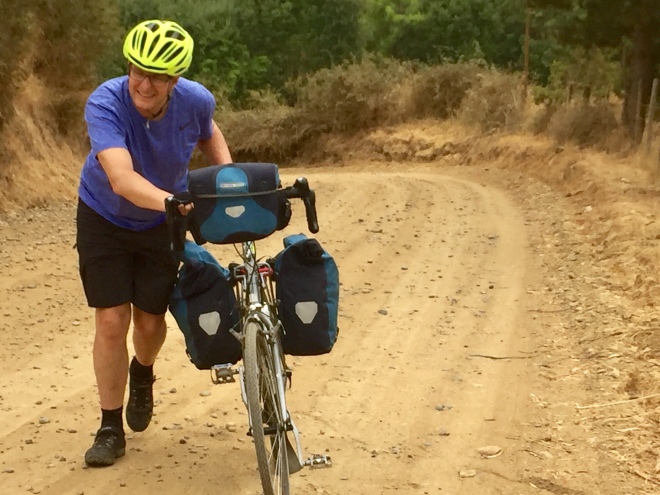
To be fair, Clare was an absolute trooper even as we pushed our bikes up the 10% gradient into a strong headwind on the last climb … well and truly knackered.

img_1898
Reaching 101.6km just ahead of the last climb

Looking again at the map that evening it seemed that the terrain for the rest of the coastroad was going to be much the same … lots and lots of ups and downs. Time for a) an unscheduled rest day and b) a new plan.

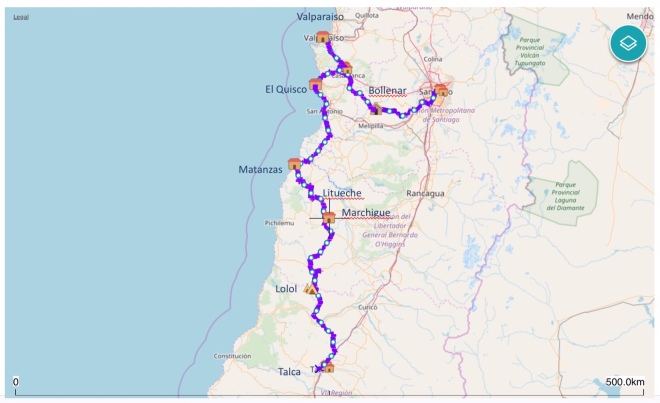
After a very pleasant day on this strange, wild, foggy coast we decided to head inland through what looked like wide undulating valleys. The only problem was that there were hardly any hotels or casas on the way … so the daily mileage was still going to be big.

Passing lots of signs for rodeos, we were clearly in cowboy country as we wound our way past small wooden homesteads each with a tiny field overflowing with produce.

img_1937
Can we hitch a ride?

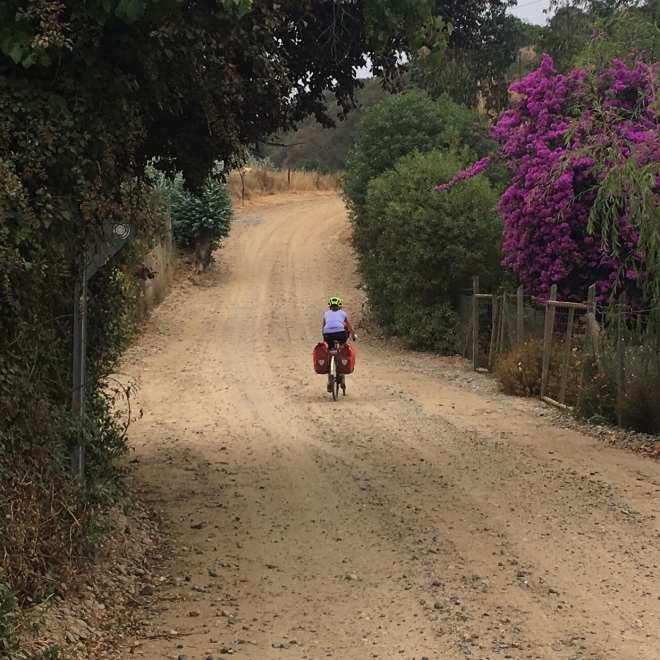
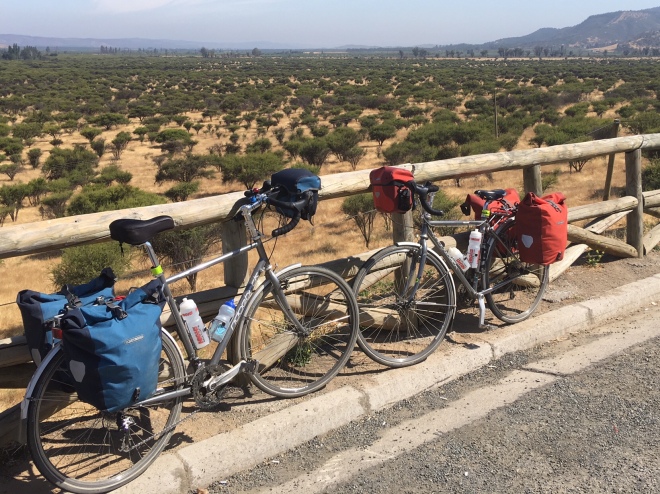
The smooth paved road then abruptly ended and we had our first taste of the legendary Camino de Ripio (gravel roads) that criss-cross Chile. These become corrugated on the flat, loose and sandy uphill so they are not at all the ideal cycle path. Not bad on a mountain bike, impossible on a road bike they were just about manageable on our touring bikes.

img_1953

img_0452

Two hours and 30km later, we were very relieved to get back to a normal road at Litueche.

img_1992

“As God looked at the world he had created in seven days, he realised that there were still some things left over: volcanoes, virgin forests, deserts, fjords, rivers and ice. So he ordered the angels to dump all these things behind a long mountain range. The mountains were the Andes and so Chile was born. The most diversified country in the world!”

Anon

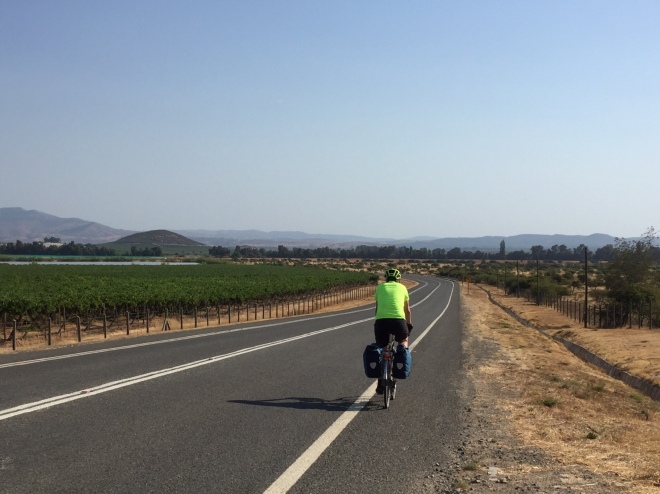
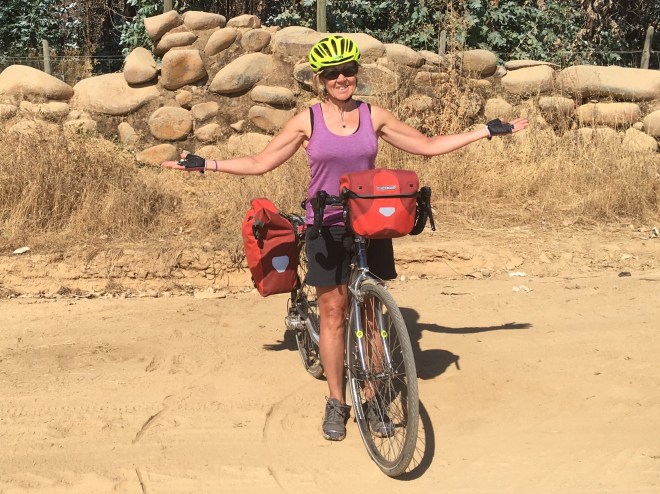
From Litueche the cycling was magnificent as we swept through the wide Colchagua Valley on the smoothest of roads. This is big, beautiful, earthy country with wide horizons across farms and scrubland dotted with rocky outcrops.
img_2047

It seems that Chile is adopting all the best trees from across the world. Australian eucalypts, American giant cacti, Scandinavian pine, Caribbean palms, European poplars make for an eclectic mix. We often looked out at beautifully nurtured vineyards on one side of the road, acacia bushes on the other. France to the left, Africa to the right.

img_0479
France to the left, Africa to the right

One night we stayed in an old Jesuit Hacienda (estate) at Marchigue. The next in a glamping pod set high above vineyards south of the old colonial village of Lolol. Both were the only accommodation within a 50 mile radius, both lovely in very different ways.

img_2005
Hacienda
img_0499
Glamping

Now we’re further inland the days are hotter. On the day we reached Talca, we both drank seven litres of water … and it was still a long time until we needed to pee!

Perhaps it was heat and dehydration, perhaps it was the last steep hill or perhaps it was the stress of having to use the main highway to cross two rivers … but we were both very, very tired when we staggered into the city. Consecutive days of 90km across hill country had proved too much for us.

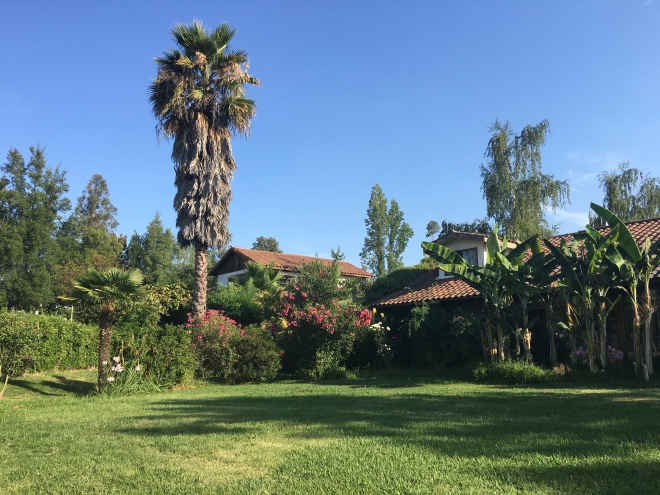
Fortunately we found a lovely German oasis, Casa Chueca (the wobbly house), set in beautiful grounds with many quirky features that include an outdoor bath, a go karting track and an arboretum. A bell is rung at 7pm each night for delicious vegetarian meals that are served at a communal table.

img_2072
Casa Chueca

img_2119

img_2083
It really is an outdoor bath!

“I don’t want to leave” says Clare, “I’m not ready to get back on my bike.”

Perhaps we’ll stay an extra night … or two?

Andy


Our route so far …

img_0320