A few people have asked me for some tips on how to stay safe, healthy and happy while cycling with your husband in a place like South East Asia.
I’ve had plenty of time to think about this whilst peddling across rural NE Cambodia and, in the last few days, pushing my bike up a seemingly endless 1200m climb in Laos (we’ll tell this story in our next blog post).
So here are my tips:
Tips to say safe
Follow Andy’s rules of the roads. This has surprised me as my natural instinct is to stop whenever I sense danger. Here, I’ve become a road warrior, maintaining speed and direction … and never ever stopping.
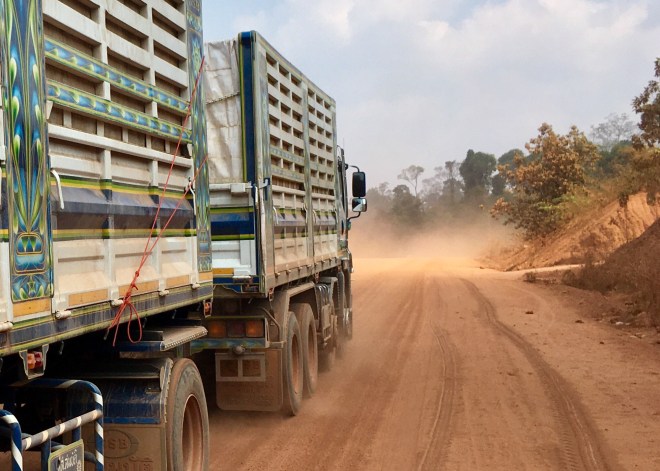
Don’t let him take side roads unless you can see tarmac. They’ll either be rocky and bottom-pummelling or sandy and dusty. A passing truck will inevitably cover you in a gritty cloud of red dust.
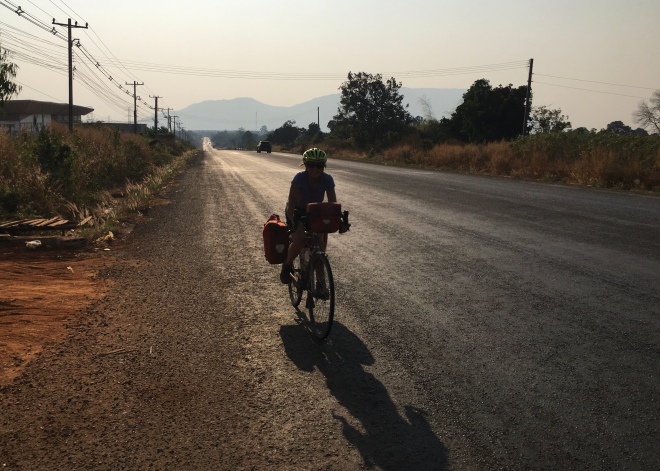
Start cycling at sunrise to avoid the midday sun. So far, the intense heat has curdled my shampoo and heated my water bottle enough to brew a decent cup of tea. It’s also a beautiful time of day and there’s usually far less traffic on the road.
Use suntan lotion sparingly. It was impossible to buy more in rural Cambodia as the locals don’t use it. I’m not even sure they know what it is as people found it very funny when we put some on.
Respect local customs. Covering up your shoulders and knees in rural areas and at temples is polite, even when it’s 33 degrees.
Make him ride in-between you and any dogs. I was chased 3 times before he realised it was his manly duty to protect me.
Or just get some new wheels …
Tips to stay healthy
Persuade him to take a rest. A few days pottering around the 4000 Islands in southern Laos on the mighty Mekong was restful, replenishing and reflective.
Don’t expect to always get a perfect coffee. Sometimes it comes with condensed milk that sits at the bottom of the cup. Just be grateful you’re having a coffee break at all.
Drink lots of water. Tap water is not safe and whilst refillable water stations are becoming more popular, they’re not yet freely available. Sadly, plastic waste is a real and obvious problem. It feels weird buying a big bottle of water and immediately pouring it into our cycling bidons.
Drink fresh coconut water whenever it’s available … it’s delicious and refreshing! Bottled fruit drinks are usually sticky and very sweet but Japanese green tea flavoured with honey & lemon has become another favourite.
Eat bananas. They’ve become our staple cycling snack. You can only buy them in big bunches … but he can manage the extra weight in his panniers.
Eat well … today’s food is tomorrow’s fuel. We’ve found the food in all three countries to be really good. Local family-run places offering home cooked meals are often better than bigger (more expensive) restaurants.
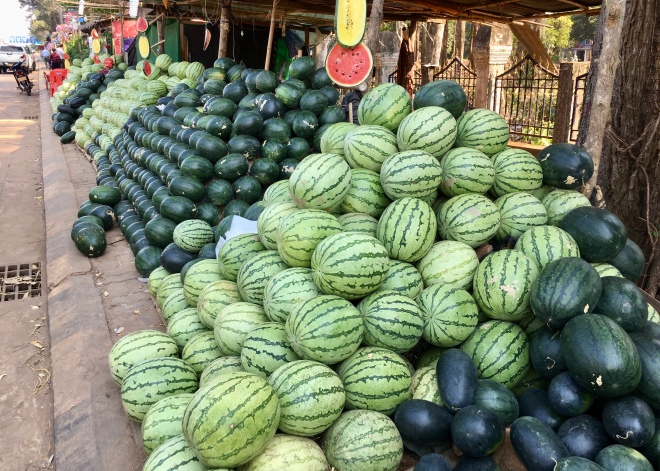
50 cents a bunch
Tips to stay happy
Mentally add at least 20% extra to the distance and elevation he’s suggesting for the days ride. That way you won’t have a meltdown when there’s still 10km uphill or off-road to go.
Take public transport if the distance and elevation he’s suggesting is too much.
Sadly there was no room on this one
Get to know the currency. There are no coins in Vietnam, Cambodia or Laos and the notes look very similar especially when they’re well worn. The 50,000 Laos Kip note (about £4.50) looks almost the same as the 5000 Kip note (45p). Andy has got it embarrassingly wrong a few times!
Stick on your headphones when the going gets tough. Gazing out at beautiful scenery is wonderful, but it’s not beautiful all the time. When it becomes less interesting or your backside starts aching, you need a distraction. A podcast or talking book works for me.
Make sure there’s a decent shower to get rid of the dust wherever you stay. We’ve slept in a wide variety of places from homestays to luxurious hotels (very good value at the moment because of the coronavirus). Often the cheapest is the best … right now we’re in a typical Laos room on stilts in a lovely guesthouse for £7/night.
Our room at Palamei Guesthouse, Tad Lo
Travel light. A good thing about travelling in warm climates is that your clothes dry really quickly. I’m getting used to wearing the same things again and again so next time I’ll try to bring even less. A hotel hairdryer remains a nice surprise but is no longer a necessity – my pink hair roller still does the job well!
And finally … join your husband for a cold beer at the end of the day. It’s tastes great here and is usually the cheapest drink on the menu!
After all … there’s no gain without pain. And he’s still the best cycling buddy a wife could want!
We only started to get worried when the border guards summoned the bossman to examine our passports for a third time, all stern and officious in his crisp green Vietnamese army uniform.
Quite reasonably, they were on high alert for the coronavirus.
Our temperatures had already been checked and two masked officers had carefully scrutinised our passports, checking and double checking each stamp to make 100% sure we hadn’t recently been to China.
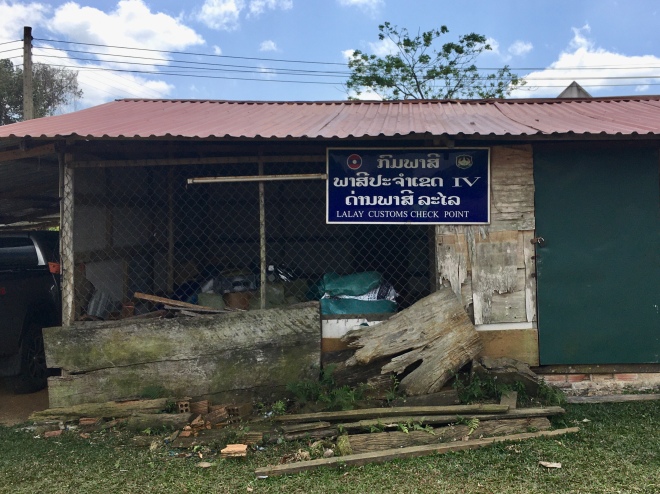
A few days before, we’d read that some travellers had been turned away from remote borders (such as this one at Lalay) if they had a Chinese visa in their passport, no matter how out of date it was. Andy has three Chinese visas (a legacy from his old job), the most recent of which expired in 2015.
Part of the Lalay Border Post
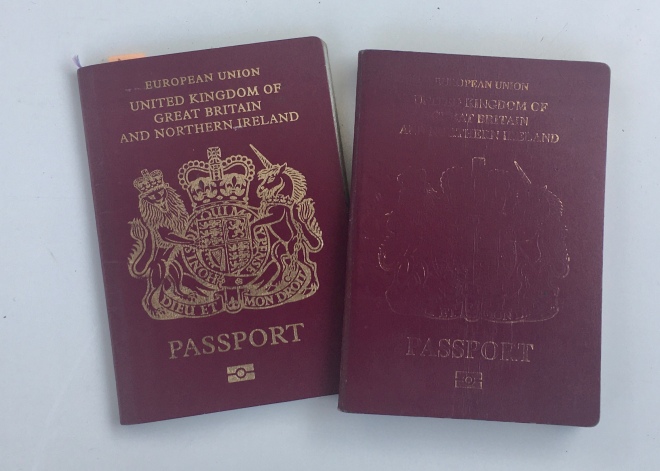
First the bossman studied the front of Andy’s passport to make sure of his nationality. This was quite amusing as most of the lettering had worn away and become impossible to read. He was only satisfied when we persuaded him that, honestly, it was the same type of passport as Clare’s and therefore came from the same country.
You can see his problem
Then he painstakingly examined every single entry and exit stamp whilst his junior colleagues gathered around pointing and shaking their heads. Andy has 94 stamps in his passport, so this took quite a while.
Eventually and with enormous relief, as much for him as for us, he looked up and smiled … “Welcome to Vietnam!”
It’s not that we wanted to leave Laos. It’s that we’d like to head home in a few weeks time and crossing back into Vietnam makes that a whole lot easier. Plus … we really felt like we were in the middle of nowhere!
On the way up to the border
The people of southern Laos are amongst the most laid back individuals we have ever met.Guided by Theravada Buddhism which emphasises ‘the cooling of human passions’, they don’t get too worked up about the future, considering it to be determined by karma rather than by devotion or hard work. They also believe that ‘too much work is bad for your brain’ and feel sorry for people who ‘think too much’.
The people we’ve met in Vietnam and Cambodia appear to be quite driven by comparison. It’s neatly summed up by a French saying:
‘The Vietnamese plant the rice, the Cambodians tend the rice and the Lao listen to it grow.’
But they also come across as a happy bunch. Unless any activity, work or leisure, contains an element of fun, it’s not worth pursuing.
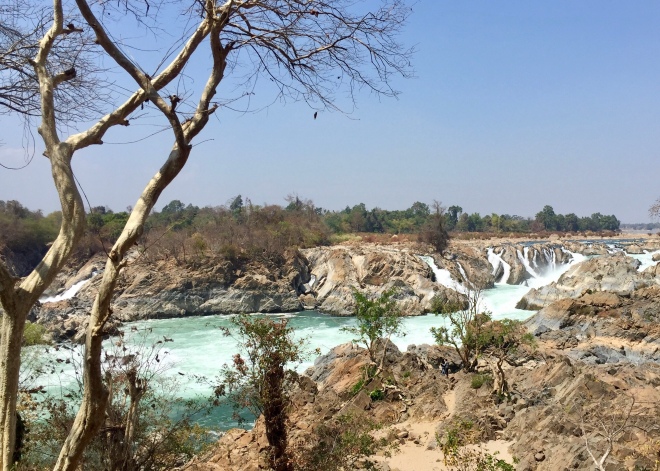
It was very easy to be seduced into the laid back life of Si Phan Don, literally meaning ‘Four Thousand Islands’. Here the Mekong bulges to a breadth of 14km, slowly easing it’s way past a few large inhabited islands and many islets and sandbars, then rushing down a series of rapids and waterfalls.
This natural barrier gives the Mekong it’s special charm – it’s one of the world’s great rivers meandering 4350km from the Tibetan Plateau to the South China Sea, but it can never become a shipping super-highway.
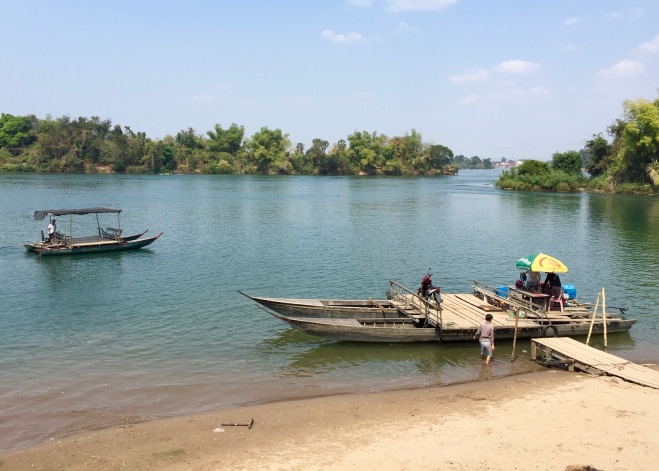
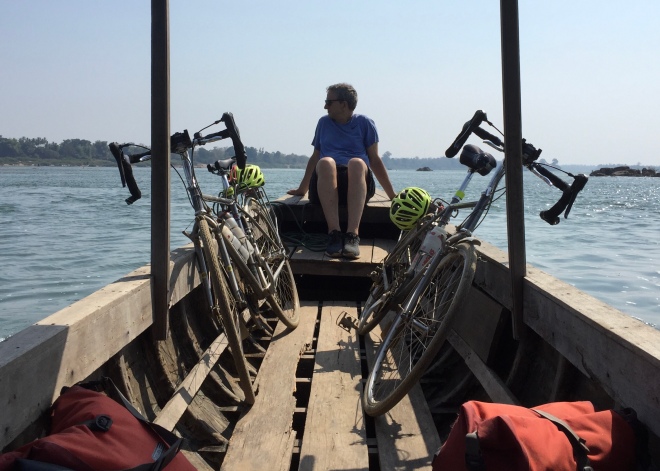
We enjoyed some gentle days pottering around the three main islands of Si Phan Don (Don Det, Don Khon and Don Khong), gradually becoming more proficient at manoeuvring our bikes on and off the small longtail boats and more chilled about doing so.
We came to love the Mekong so much we even made our own tribute to it. Late one afternoon, Andy dived into the refreshing cool water without realising he had some cash tucked in the pocket of his swimming shorts, never to be seen again.
From Don Khong it was a sweaty and dusty ride 110km up river to Champasak where we enjoyed two lovely surprises.
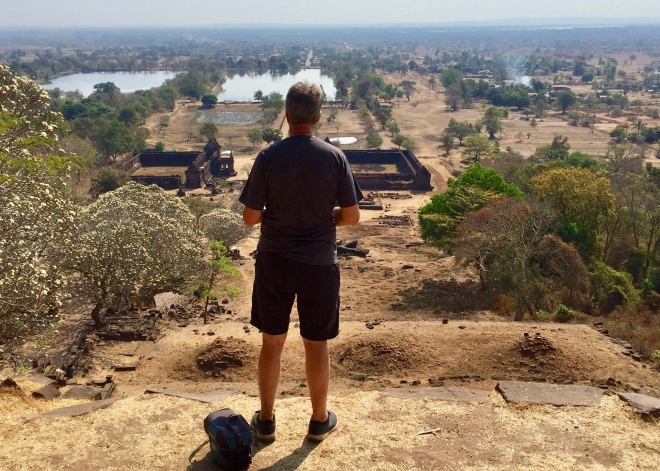
The first surprise was Wat Pho (meaning Mountain Temple), a contemporary of Angkor which stretches up the slopes of Phu Pasak, a sacred mountain known locally as Mount Penis. It’s a quirky, tumbledown place with attractions that include a crocodile stone carving allegedly used for human sacrifice and a sacred spring that cows now clamber up to for a holy drink.
Looking down on Wat Pho
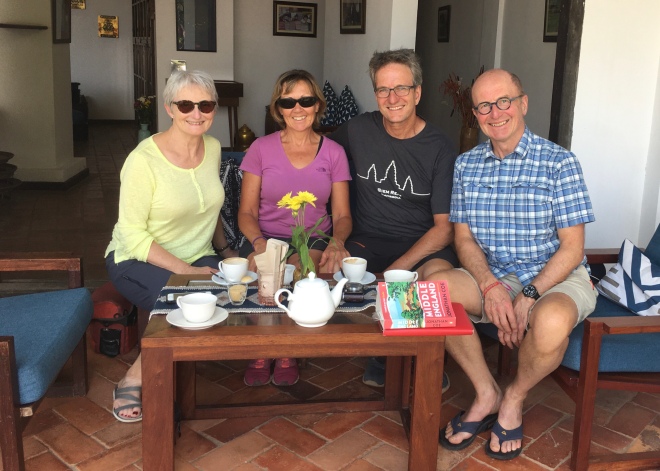
The second surprise was to hear our names being bellowed out as we cycled back to Champasak. Unbelievably it was Richard and Sue, good friends from home. We’d planned to meet up in Vietnam in a few weeks time but neither of us had any idea that we’d both be in this part of Laos at the same time. It was really good to see them and to spend an evening of easy conversation over beer and pizza.
From Champasak, we changed plans and decided to cycle up to Paksong on the Bolaven Plateau, 1300m above sea level and famous for it’s waterfalls and it’s coffee plantations.
Why did we do it? Well, it wasn’t for the coffee. It wasn’t for the waterfalls. It wasn’t even to experience some cooler temperatures. No … the attraction was the promise of a whole day of descending, a whole day of cruising gently downhill.
Cycling up to the Bolaven Plateau
In the event, Andy very nearly messed it up!
The road he’d planned to go down was the wrong road. Very wrong indeed. It quickly disintegrated into a very rough, very dusty stone track.
For about an hour, we bumped and banged our way down it almost killing our bikes and ourselves in the process. Andy was ever hopeful it would improve on the other side of the next ridge despite Clare’s increasingly frantic protestations. Eventually he had to admit that it was physically impossible for us to go any further.
We turned around and slowly climbed back up.
By the time we got back to the top, we’d run out of time and daylight so were forced to find some emergency accommodation and try again the next morning.
The Bolaven Plateau is a market garden
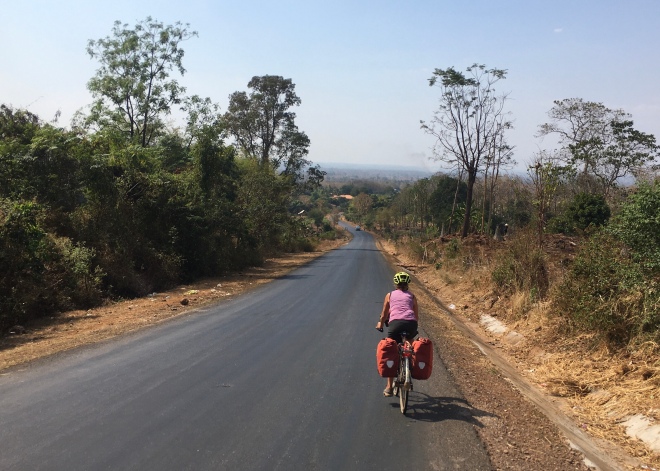
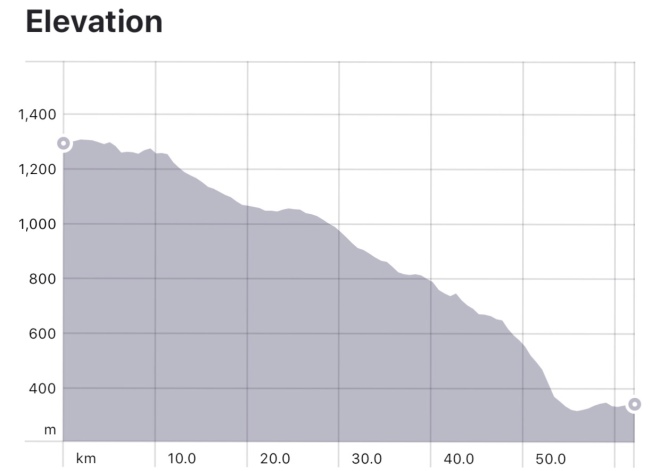
This time we found the right road … and it was glorious! Just what we’d dreamed of. Even when crossing the Pyrenees or the Andes we have never cruised down such a long descent, the gradient gently taking us through coffee plantations, past mango groves and fields of cassava. For 50km!!
Cruising down … all day long!
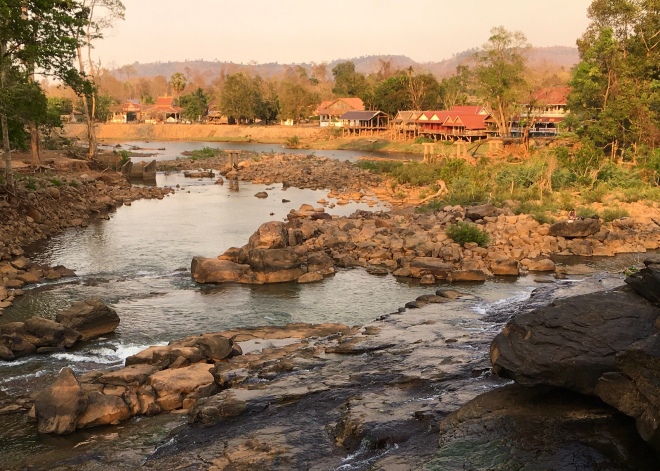
It ended in a serene little village called Tat Lo. In recent years, this has become a quiet retreat on the backpacker trail, nestled in a river valley full of forest trails, small waterfalls and swimming holes. It’s location is remote enough for the small guesthouses and cafes selling banana pancakes to sit alongside normal village life, not to overwhelm it.
We stayed in a simple, stilted room in a lovely guesthouse called Palamei, owned by Poh and Tim and named for their daughter.
We’ve enjoyed a wide range of accommodation on this trip, including a couple of luxury hotels as the coronavirus scare has made everything so cheap … but this was one of our favourites.
Tat Lo Village
We always knew that getting back into Vietnam from this part of Laos was going to be the greatest challenge of our trip.
We looked at various options, including cycling back to Pakse and taking a long sleeper bus ride north to Savannakhet and onto Hue in Vietnam via the main border crossing at Lao Bao. A journey of over 700km this was not a fun prospect for two aging touring cyclists.
We also knew that cycling up to the remote border at Lalay (only 170km away) was beyond our cycling capabilities. It would mean three days of riding over some very steep hills with few towns or villages along the way. A great ride for proper (young) adventure touring cyclists … but not for us!
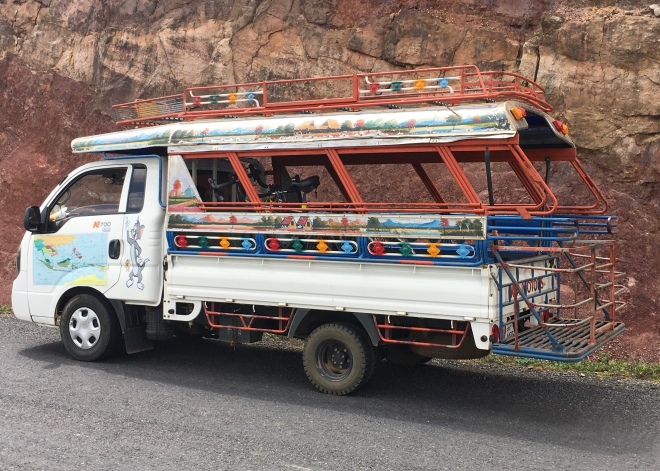
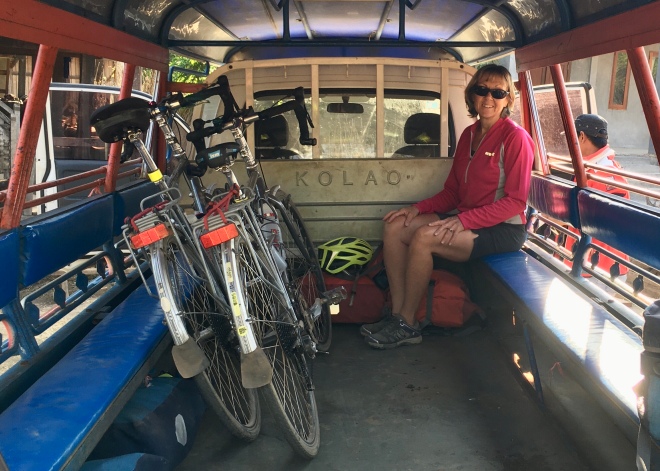
Poh asked which day we planned to leave. When we told him it was Sunday his face lit up. His van normally serves as the local school bus but Sunday meant no school.
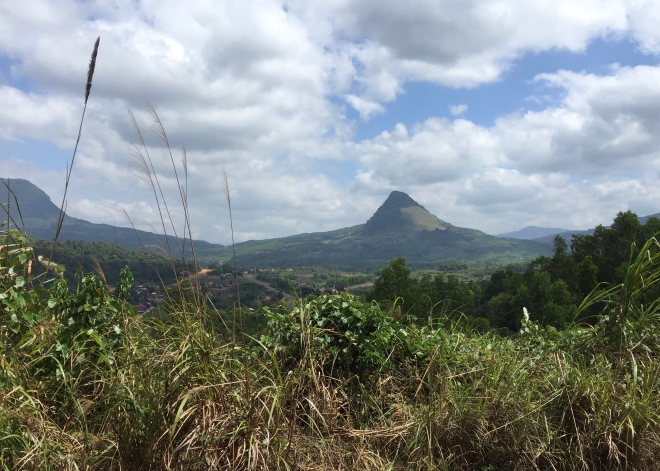
So that’s what happened. It turned out to be a fascinating journey through a dramatic mountain landscape, the school bus struggling to make it up some of the steeper inclines as we gave grateful thanks to the cycling gods that we weren’t pushing our bikes up instead.
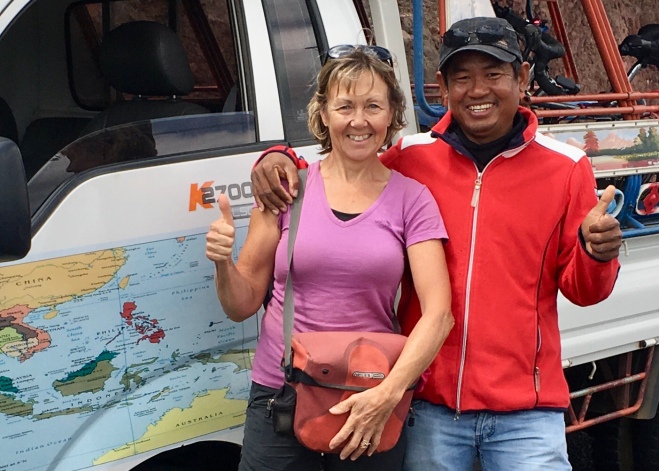
During the drive up to the border and over a bowl of noodle soup, Poh shared some stories of his life. Born into desperately poor circumstances, he spent several years as a child living in the village temple as his mother had died when he was just two years old. With only rudimentary schooling, he recognised his one good fortune was to be born in a village that was starting to attract tourists, so he worked 16 hour days in a nearby lodge to learn both the business and how to speak English. Eventually he was able to set up his own guesthouse.
Poh and Tim, his wife, have three children but they have also adopted five more, all from the same tough circumstances he knew as a child. Now he is giving back to his community, one small part of which is providing the local school bus.
Clare and Poh
The journey passed quickly and before long, we found ourselves at the border to be greeted by the smart Vietnamese guards and the medical team.
It’s just as well we didn’t cycle … we’d have been so hot and bothered we’d have failed the temperature test. Then they’d never have let us back into Vietnam!
Dong Ap Bia (the Mountain of the Crouching Beast) stands 14 kilometres west of A-Luoi, a small town nestled in the central highlands of Vietnam. Officially called Hill 937 by the US army, it was the site of one the most famous battles of the Vietnam War in May 1969 … known thereafter as ‘Hamburger Hill’.
“Have you ever been inside a hamburger machine? Well we just got cut to pieces by extremely accurate machine-gun fire.”
Sergeant James Spears, 19 years old
For some people, Hamburger Hill became a symbol of the bravery of both the attacking American infantry and the North Vietnamese defenders.
For others it epitomised the futility and waste of this long war.
On the day we crossed back into Vietnam from Laos we stayed overnight in A-Luoi.
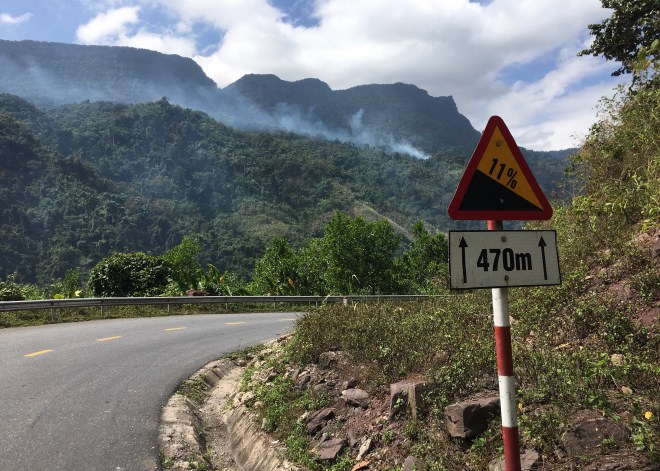
Waving goodbye to Mr Poh and his school bus we had spent the afternoon cycling down through high jungle to join the Ho Chi Minh Highway. This road follows the route of the famous Ho Chi Minh Trail, a network of mountain footpaths that were used to supply and reinforce Vietcong fighters in the south. The attack on Hamburger Hill was part of a campaign to stop this supply.
Just over the border from Laos
The ‘Rakkasans’ from the 101st Airborne (one of the US Army’s most decorated units) fought their way up the steep slopes battling with triple canopy jungle and waist high elephant grass as well as the machine gun fire. They were repelled again and again by the ‘Pride of Ho Chi Minh’, the elite North Vietnamese 29th regiment.
After dropping more than 1000 tonnes of bombs, 140 tonnes of napalm, 31000 rounds of 20mm shells and 500 tonnes of teargas, the Americans eventually prevailed and took control of the ‘moonscape’ that was left of the summit. 72 Americans lay dead with 370 wounded. Estimates of North Vietnamese losses vary, but at least 600 were killed.
The Americans only stayed for a couple of days before they abandoned Hamburger Hill. A few months later the North Vietnamese were back in their original positions.
It was the apparent futility of this battle that whipped up the anti-war sentiment that was then building a strong head of steam in America. Senator Edward Kennedy reflected the view of many people when he called the battle “senseless and irresponsible”.
At the time of Hamburger Hill, America had over 500,000 troops in Vietnam but this turned out to be the high water mark of their involvement. By the end of 1969 US troops had begun to withdraw and their focus had switched to training the South Vietnamese army to bear the brunt of the fighting. This eventually led to the North Vietnamese victory in 1975.
Today both the hill and the whole area is very peaceful, mountain rice growing in the valleys and birdsong replacing the sound of gunfire in the hills.
It’s difficult to imagine the horror that both sides endured. Except that the landscape is very familiar to anyone who has watched a few Vietnam War films. So familiar that you almost expect to see an Apache attack helicopter appearing over the next ridge.
The tank that marked the end of the war
As we cycled around the country, we enjoyed learning a little about the ‘American War’ (as it’s known in Vietnam) from their perspective. The War Remnants Museum in Saigon is a stark reminder of the hardships and atrocities faced by ordinary people. The tours to the complex multi-level network of tunnels at Cu Chi show off the ingenuity of the Vietcong and the difficulty the Americans had in facing an enemy that kept melting away. And Tank 390 still guards the grounds of the presidential palace, having crashed through the gates on April 30th 1975 to end the war.
Ultimately though, we have been left with a feeling that this war of attrition became senseless. For everyone involved.
Emerging from the Cu Chi tunnels
A-Luoi was the most undiluted Vietnamese town we visited. We stayed in a motel style guesthouse, no-one we met spoke English and it was tricky to find somewhere to eat. We walked past lots of beer gardens and coffee shops but no restaurants.
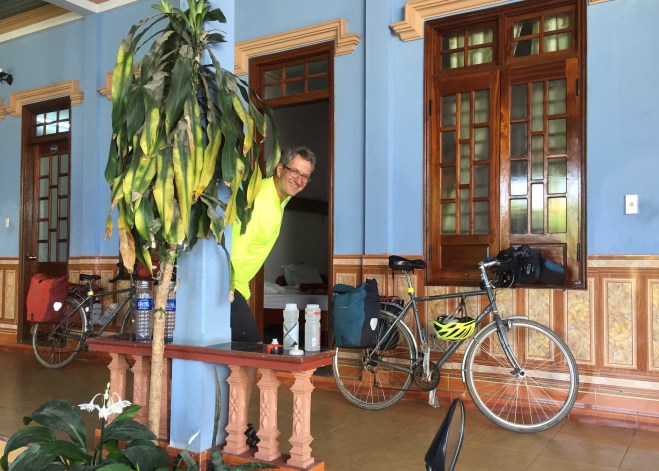
At the guesthouse in A-Luoi
Eventually we managed to find a large bag of pistachio nuts and headed into a family run café to enjoy them with a beer. The family had just finished their own dinner so, more in hope than expectation, we made eating signs to the lady. She must have seen our faces drop as she shook her head because she disappeared, returning fifteen minutes later with a big smile and two steaming bowls of noodles, packed with chicken, vegetables and fresh salad.
Noodle Soup
It was one of the most delicious meals we had in Vietnam. Much better than the hamburgers we’d been hoping to find … in tribute to the nearby hill!
To her obvious delight we gave her half our remaining pistachios. It seemed only right. The bag had cost us more than she insisted on charging for the meal.
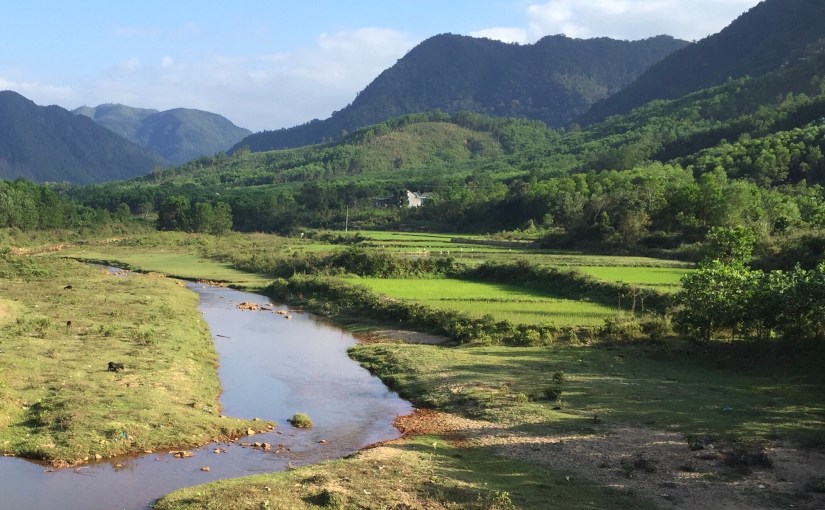
The next day’s ride down to Hue was one of best days we’ve ever had on a bicycle. Under a cloudless sky we wound our way down through stunning jungle canopy, up over a pass then down again into the wide fertile valley of the Perfume River (named for the flowers that drop into its clear waters).
It was the kind of day that reminds you that the simplicity of bicycle touring is one of the best experiences in the world.
“It is by riding a bicycle that you learn the contours of a country best, since you have to sweat up the hills and coast down them.”
Ernest Hemingway
Coffee break on one of our best ever biking days
People we’d met on our travels had told us that Hue was a bit of a disappointment. Well we beg to differ, we loved it.
It was the imperial capital of the last emperors of Vietnam, the Nguyen dynasty that ruled from 1802 to 1945. Today it is a vibrant, bustling city that blends old and new, wide embankments on both sides of the river giving it an air of calm.
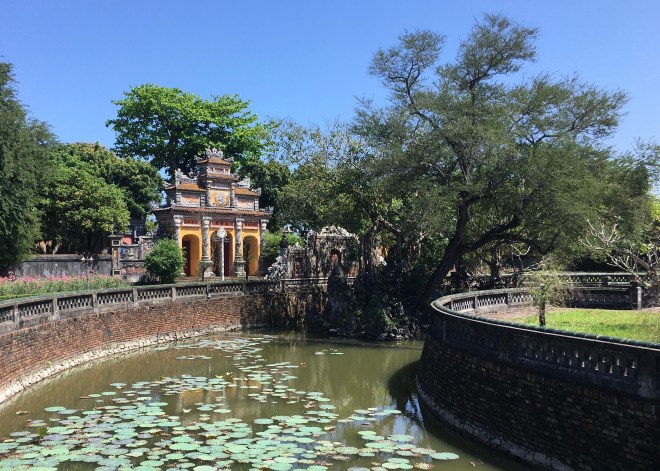
The main attraction is the citadel, home to the Nguyen emperors and their seat of government. Several walls are pockmarked with bullet holes as an evocative reminder of the major battle that raged here in 1968 during the Tet offensive. Most of the buildings were destroyed but they are now being lovingly restored to their former glory. It’s a huge site and a wonderful place to get a little lost in, roaming through tree-lined boulevards, ceremonial reception rooms and ornate gardens.
The Citadel at Hue
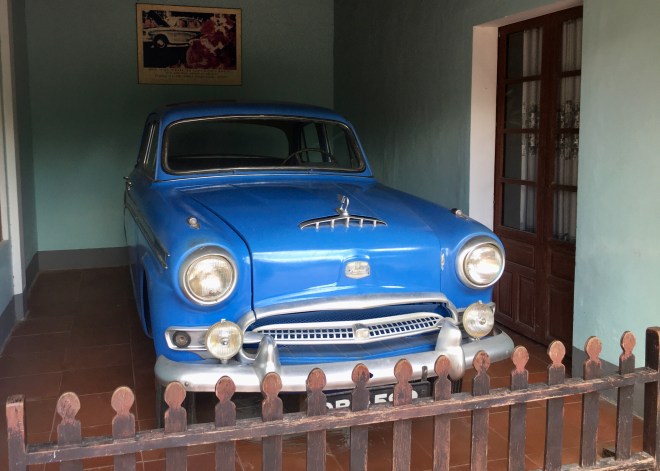
A few kilometres upriver from the Citadel is another poignant reminder of the conflict. Tucked away in a corner of the Thien Mu Pagoda complex is an old 1956 Austin saloon car that transported a monk called Thich Quang Duc to Saigon, where he calmly set himself on fire as a protest against the policies of the South Vietnamese regime. Captured by an American film crew it became one of the most emotive images of the war.
We also enjoyed the tomb of Tu Duc, emperor at the time of the French invasion in 1883 and a man who lived a life of imperial luxury and carnal excess (104 wives, countless concubines but no offspring). Just 5 foot small he decreed that the statues of the mandarins guarding his tomb had to be even smaller than he was.
But he wasn’t buried here. Instead he was interned at a secret location where the 200 servants who helped with the burial were beheaded to stop the location and its treasures being discovered. It worked … the site has never been found.
One entertainment enjoyed by Tu Duc were the fights between tigers and elephants at Ho Quyen, a mini Romanesque amphitheatre that now sits in the middle of a quiet suburb. The tigers had their claws and teeth removed so that the elephants, a symbol of the emperor’s power, could triumph every time!
Elephants, horses and mini-mandarins guarding the tomb for Tu Duc
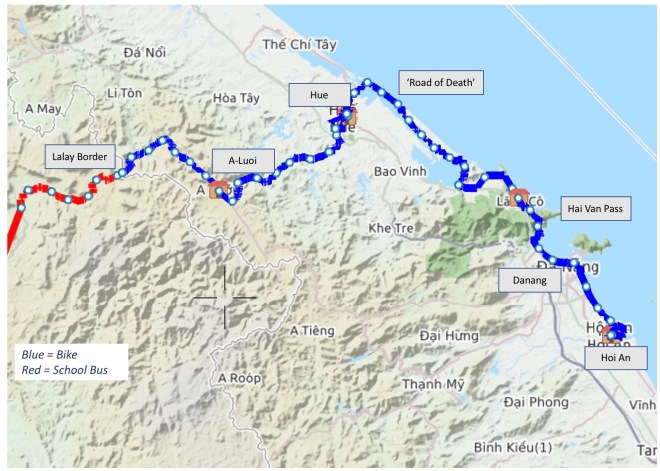
From Hue, we cycled 160km down the coast to the graceful and historic town of Hoi An, full of preserved merchant houses, ancient tea warehouses and Chinese temples.
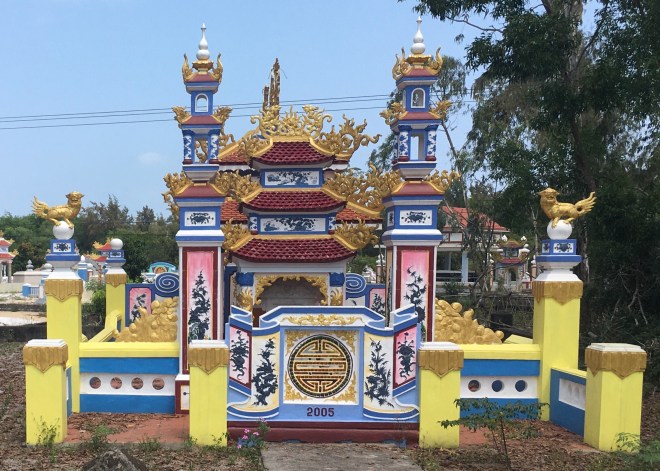
At first, the road took us past miles and miles of sand dunes all filled with thousands of graves and elaborate private family mausoleums. These are the final resting places of Viet Kieu (overseas Vietnamese), all seeking to be buried in their homeland.
Ancestors are worshipped in Vietnam and the majority of people are buried, often in large tombs on the family small holding. Given that the population has doubled to 99 million since the end of the war in 1975 (it’s now the world’s 15th most populated country), the density of tombs of this ‘road of death’ did make us wonder whether the rest of the country would look the same in future, such will be the demand for graves.
Graves in the dunes on the ‘road of death’Some very elaborate
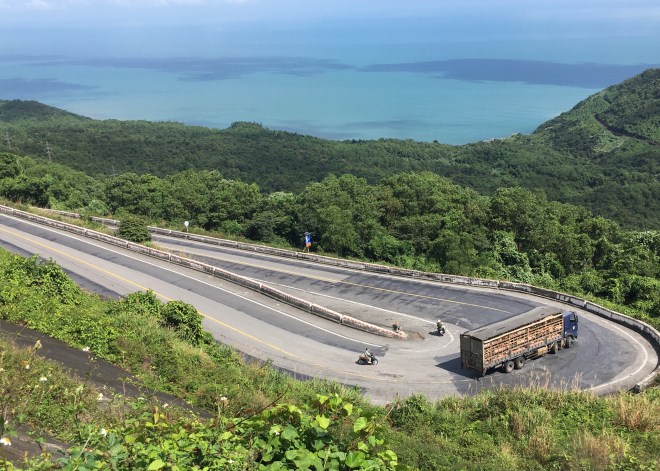
Just north of the large coastal city of Danang is the Hai Van (Sea Cloud) pass, a mountain spur than runs down to the sea and a sizeable cycling challenge at 496m high. It’s an important North-South divide both strategically and geographically, protecting Danang from the fierce ‘Chinese’ winds that sweep in from the north east.
The main artery of Vietnam, Highway 1, used to run over this pass but today there is a 6.3km long tunnel. Unfortunately, neither livestock nor fuel are allowed through the tunnel so we had to stop frequently to avoid the trucks full of pigs and petrol, recklessly overtaking each other on the hairpin bends.
Looking back from the lower slopes of the Hai Van passA pig truck on a hairpin bendA narrow escape for this motorbike (and us!)
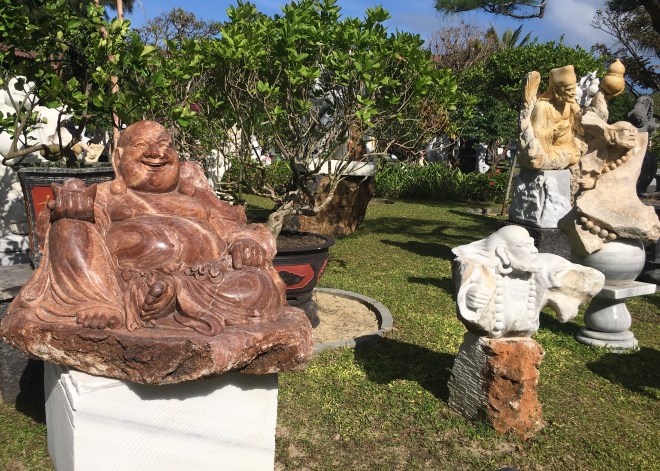
Further entertainment was to be found at the Marble Mountains south of Danang, five craggy marble outcrops named for the five natural elements (water, wood, fire, metal and earth). Each one has an army of statues for sale at their base – from the ever-popular Laughing Fat Buddha to replicas of the Venus de Milo. The actual marble in the mountains is now exhausted … so it’s imported from China instead.
Anyone fancy a fat buddha for their garden?
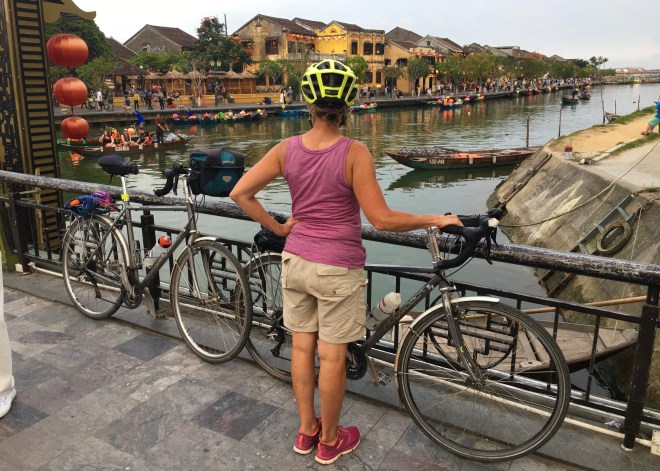
In Hoi An we were suddenly surrounded by tourists. Not surprising as it’s a delightful place, especially at night when the roads are closed to traffic and the town is lit up by thousands of lanterns. This makes it feel slightly like a Disneyland version of itself … but creates a fun atmosphere.
The old buildings of Hoi AnTraditional Vietnamese Nón Lá’ … Leaf Hats
As well as a few of the 800 historic buildings we enjoyed traditional Vietnamese food, traditional music and dance and traditional water puppets. Much to our amusement each show was wrapped up by a rendition of Auld Lang Syne, sung in English. And no, they didn’t know the words either!
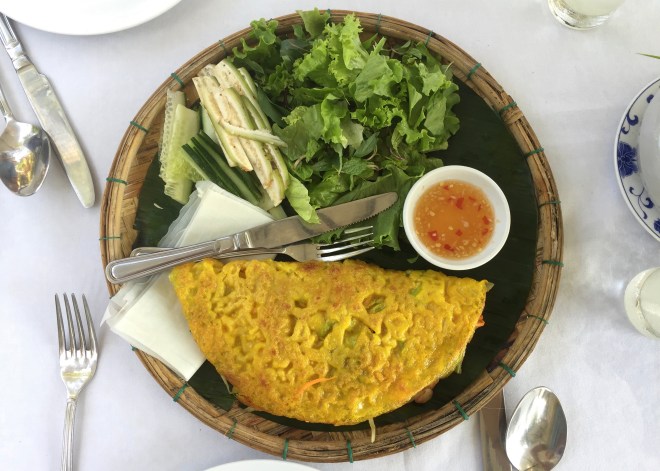
Our favourite: Bánh Xèo … crispy pancakes filled with shrimps and fresh vegetables
Perhaps our most magical moment in Hoi An came early one evening as we cycled around the paddy fields that encircle the town. A light sea breeze had blown up and several groups of grandparents (who would have known the horrors of the war) emerged onto the pathways that criss-cross the fields to enjoy flying kites with their grandchildren.
The air was filled with colour and laughter. It was a bewitching scene and one that made the American War seem like a very long time ago.
This is now an old story. But it’s still a story worth telling.
Much has happened since we left Vietnam on Tuesday March 10th. The coronavirus pandemic has taken over the world with many countries in lockdown. At the time of writing, the UK has sadly suffered more deaths from Covid-19 than any other European country. The government estimates that around 7% of the population or 4.7 million people have caught the virus with over 300,000 confirmed by a positive test.
In contrast, Vietnam has had 355 official cases, Cambodia 141 and Laos just 19. So far, none of these countries have recorded a single death linked to Covid-19. Indeed, Vietnam is now cited by many experts as having one of the best epidemic control programs in the world, alongside Taiwan and South Korea.
It seems that the Vietnamese authorities learnt a lot from previous viral outbreaks, including Sars in 2003 and Avian Flu in 2010. They took fast, decisive action as soon as the first case arrived from Wuhan on January 23rd.
The border with China was immediately closed, schools remained shut after the New Year Tet holiday and strict quarantines were placed around any local outbreaks. Most impressively, every single case was individually recorded and all the people they’d been in contact with were traced, tested and isolated. Then they traced the contacts of the contacts … and so on.
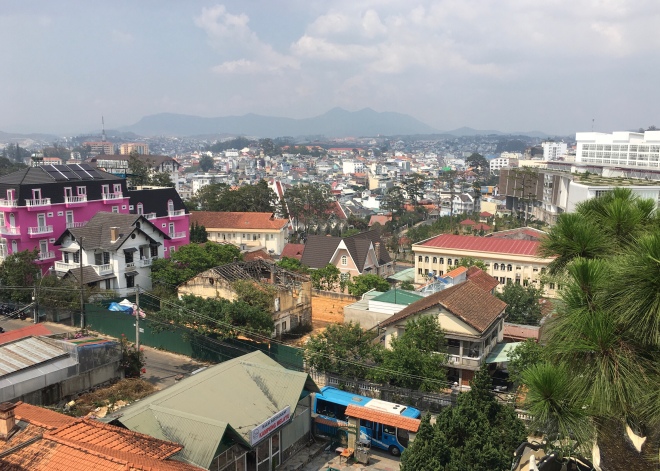
Dalat
On Sunday March 8th we were enjoying a pizza in the old French hill station of Dalat, excited about our final 4-day bike ride back to Saigon and completing a round trip of over 2000km.
Another long cruise downhill would take us through some beautiful but remote mountain countryside, before reaching the outskirts of the city. Accommodation for the first two nights had been difficult to find, but eventually we’d managed to book a small guesthouse by a pretty lake about 10km off our route.
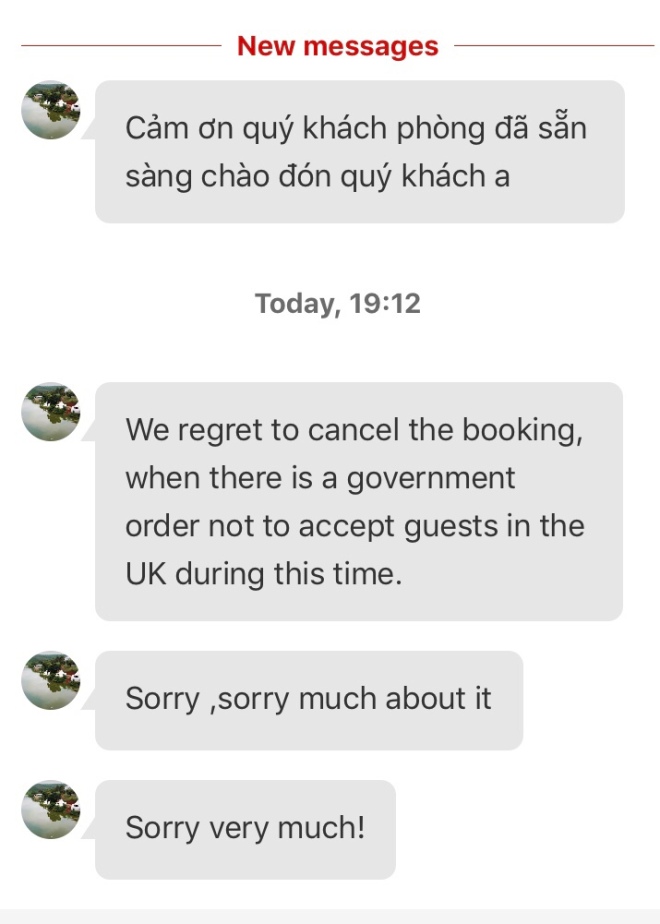
We were really looking forward to the ride. Until that is, we received this message from the guesthouse …
We’d noticed that concern about Covid-19 had grown significantly in Vietnam over the previous few days. Most people were now wearing masks and our temperature was taken at every hotel, restaurant and museum. This had surprised us a little, as the country only had 16 cases at that time and were proud to have gone 22 days without anyone testing positive.
After a little googling, we soon found out why visitors from the UK were suddenly less welcome. A Vietnamese ‘socialite’ had flown back to Hanoi from London, after visiting the Milan Fashion Show. She turned out to be a super-spreader, infecting all the people around her on the plane. Most of them were British tourists heading to Vietnam for a special holiday.
This meant that the headlines in the local news were full of the danger of any contact with Brits. And any other Europeans for that matter. On Instagram we learnt that other bicycle tourists were suddenly being turned away from guesthouses, restaurants and even shops.
We could see that people were becoming a bit wary of us. Smiles were replaced with nervous glances. Perhaps we were not quite as welcome as we had been? Maybe it was time to leave?
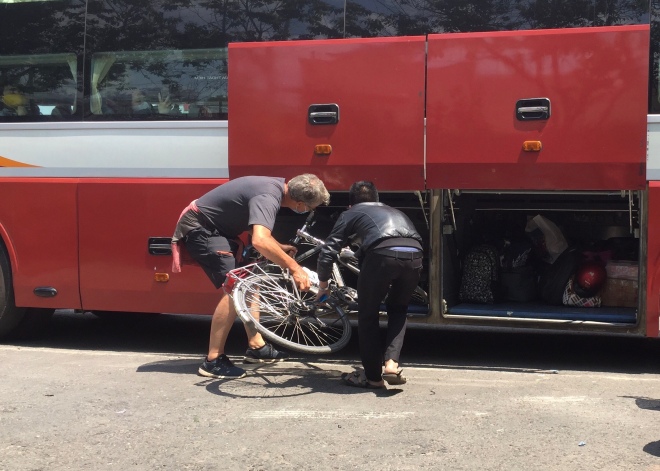
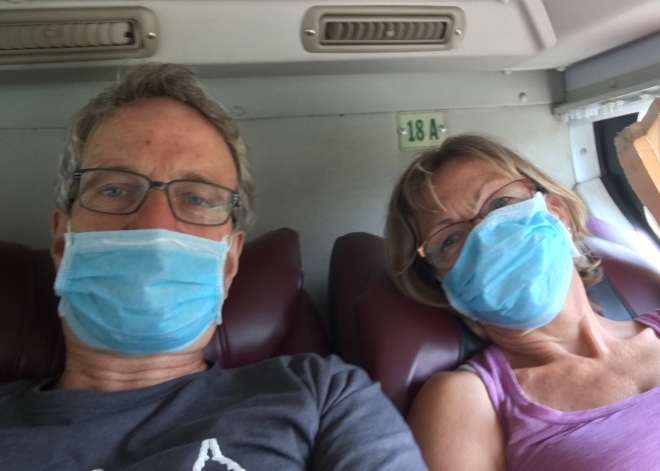
Instead of cycling back to Saigon, we jumped on a bus. Once there, we rode through the busy traffic in the dark to find a travel agent and change our flights. 48 hours after finishing that pizza in Dalat, we were on the plane home … a week ahead of schedule but pleased to be getting back to our families.
As things turned out we were leaping from the frying pan into the fire, leaving a safe country behind us and returning to a country where the number of coronavirus infections were accelerating quickly.
It was disappointing to leave Dalat by bus as we’d also arrived by car … not really the point of a bicycle tour!
The bike ride up to Dalat from the coast is beautiful but brutal. 150km and over 3500m of climbing with little along the way to break the journey. No lodgings, no restaurants, not even any small shops selling water. Many young adventurous bicycle tourists have had great fun going down … very few have tried to cycle up.
It was clearly beyond our capabilities!
Dalat itself is the cheesy-music love-capital of Vietnam, hugely popular with honeymooners and hen parties. A few dollars to one of the many street karaoke busking groups buys you a great night out. You get a backing band and an appreciative audience of several hundred like-minded romantics as you belt out “Killing me softly with his song … ” or “I-e-ii-ee-iiiii will always love yooouuuu … “
Snacks in Dalat
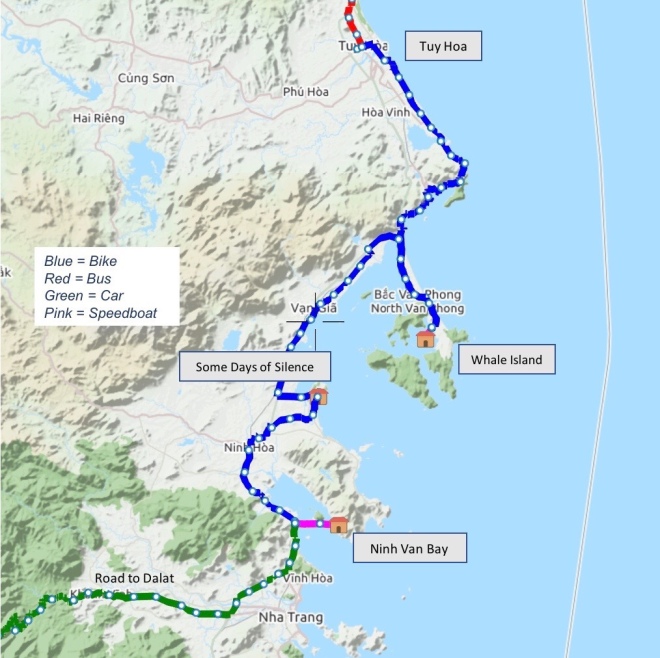
Our journey from Hoi An to Dalat had begun with yet another bus (we know … this is turning into a troubling theme). There was not enough time to cycle the rest of the way down the coast, so we picked a section that promised ‘a spectacular mix of craggy wind-lashed capes, fishing villages and pretty coves.’ Just as importantly, it also promised plenty of backroads away from the trucks rumbling down Highway 1.
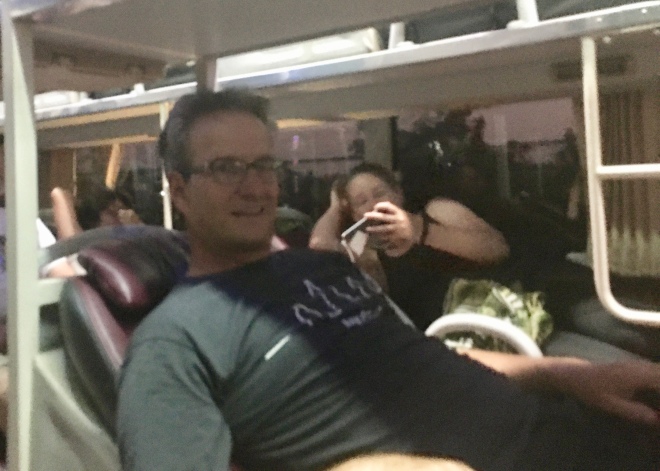
This time it was one of the dreaded night buses, infamous with young backpackers. Built for small Vietnamese people, not for tall foreigners, Andy had to squeeze so tightly into his seat that he appeared to be trapped in an old-fashioned fairground ride!
After eight sleepless hours, the bus dropped us off at 3am on the outskirts of a sprawling and rather soulless city called Tuy Hoa. We didn’t particularly fancy cycling in the dark so looked around for a hotel to hang out in for a couple of hours. They all looked a bit seedy, with big neon signs advertising 24-hour massages. Sure enough, as we locked up our bikes, a lady-of-the-night tottered out, presumably on her way home.
The night manager then followed her out to find out what we were up to. Once he understood our situation, he couldn’t have been any nicer, offering drinks, power for our phones and a quiet lie down on the lobby sofa.
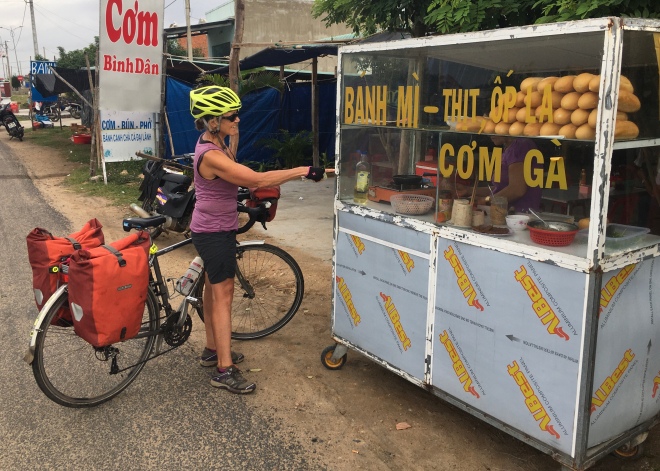
Just before dawn we waved him goodbye and headed off in search of the coast road, some strong coffee and breakfast. Everything was closed but eventually we came across a street stall offering delicious Bánh Mì (Omelette Baguettes), just the right energy boost for the 75km ahead of us.
This part of the Vietnamese coast is a land of contrasts.
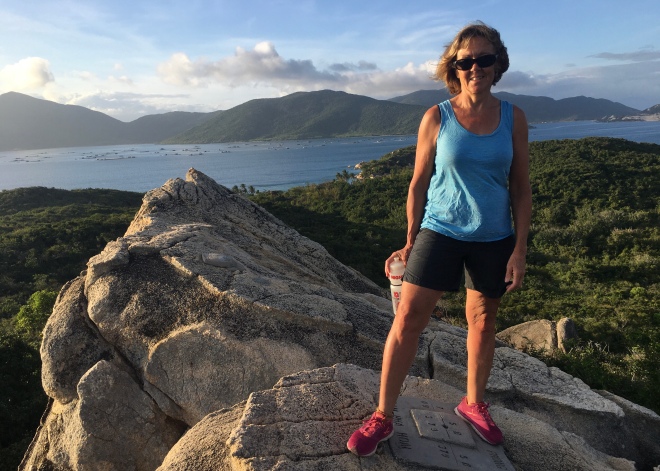
Some parts of it are indeed very pretty … craggy capes, secluded coves, chalk-white beaches and small islands nestled in a turquoise sea. But there’s also a lot of industry here with oil refineries and giant ports dotting the horizon.
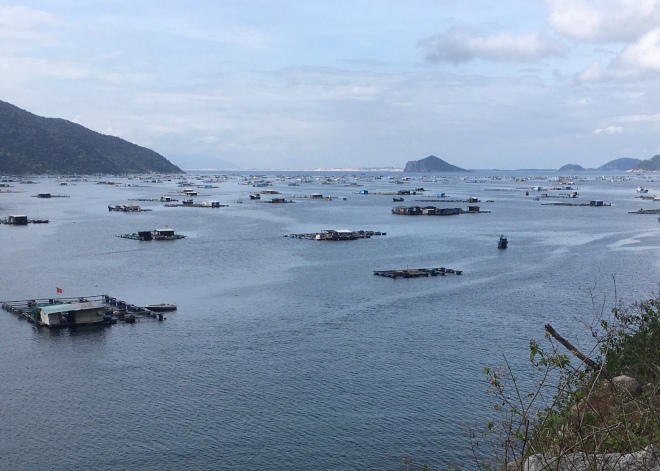
Most striking are the multitude of fish farms which stretch out across the bays as far as the eye can see. Farmers and their families live on the floating houses, growing fish, shrimp and crab to serve the incessant demand from city markets with their ever-expanding population.
Fish farms
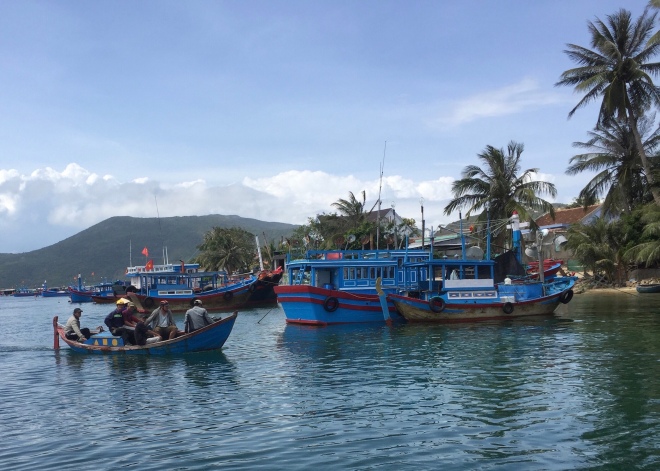
Traditional fishing boats, each painted blue with a red trim, potter between the farms and head out at night in search of the wild tuna and bream.
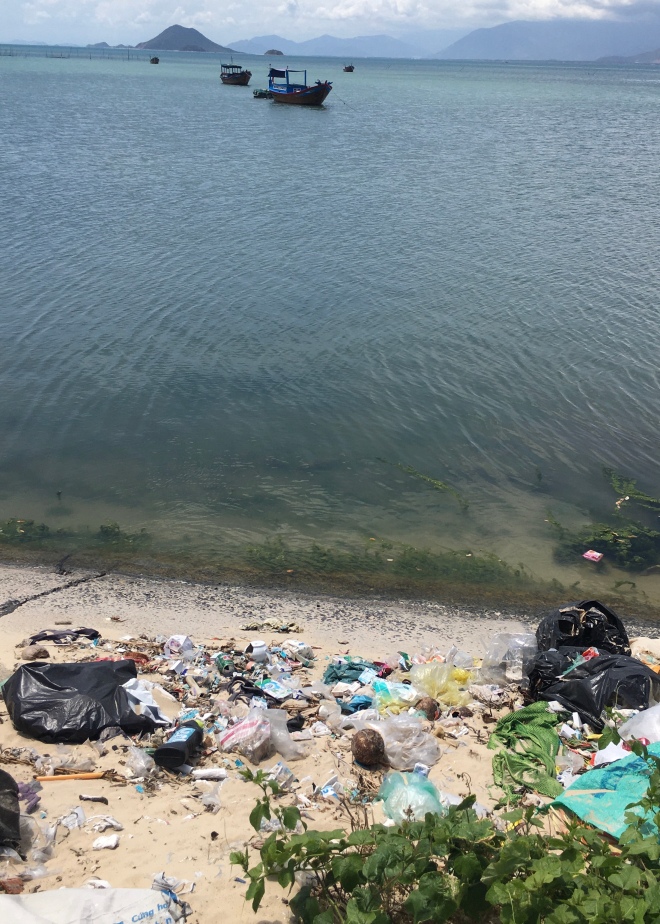
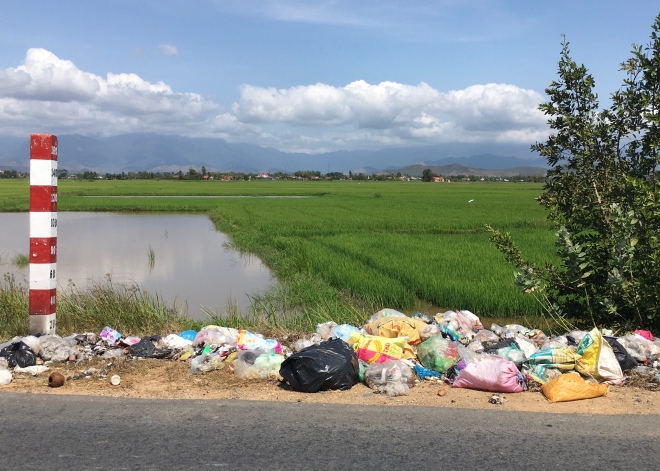
The fish farms are an arresting site. Less attractive are the piles of rubbish that build up by the side of the road. Managing single-use plastic waste is global issue that is brought into sharp focus in this part of the world. People simply discard their leftovers on the ground as their forefathers have done for centuries. Unfortunately, unlike the waste of previous generations, plastic doesn’t degrade … so it just sits there waiting to be burnt every few months.
Occasionally as we cycled along a quiet road a bus would drive past us with empty bottles and cans literally raining out of the windows. It would be comical, if it wasn’t so sad.
Beauty spoiled
This is a representative of a wider problem that applies to all three countries but especially to Vietnam, with its higher population density and rapid economic development.
Vietnamese people are rightly optimistic about the future. But many are also worried that their natural resources are being quickly exhausted to fuel the economic growth. Forests are being burnt down, cities rapidly enlarged, waterways polluted. They know that their country will need to nurture its natural resources much better in future for the good times to be sustainable.
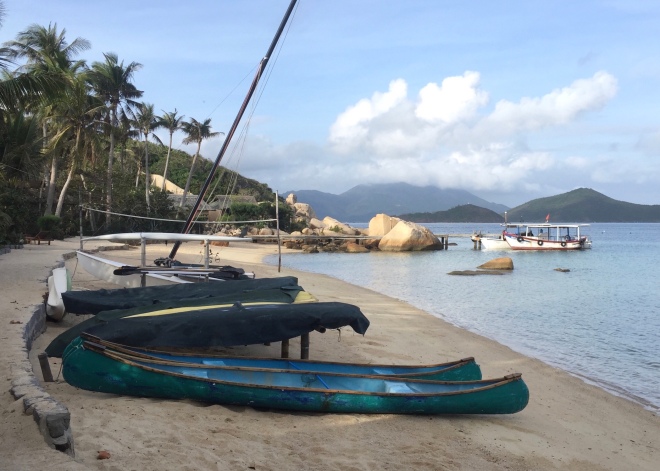
Trying not to notice the piles of rubbish, we meandered down the coast at a gentle pace, pausing for a couple of nights on Whale Island and at a quiet beachside retreat called ‘Some Days of Silence.’ There was no need to hurry.
Whale Island
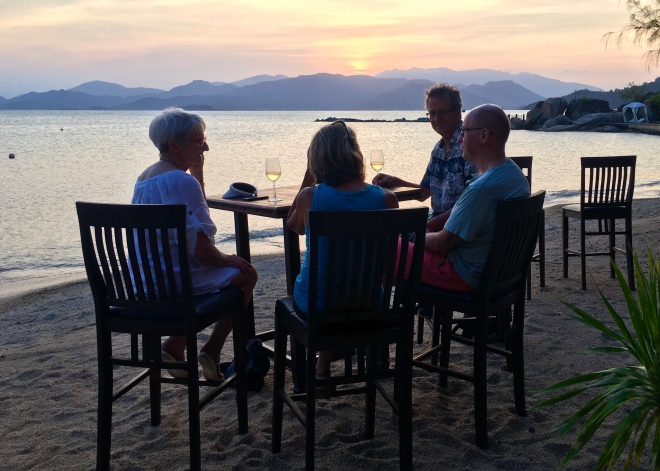
For our last night on the coast, we treated ourselves to a taste of luxury at one of the upmarket resorts that grace Ninh Van Bay and can only be reached by speedboat. Described in the guidebook as an ‘alternative reality populated by European royalty, film stars and the otherwise rich and secretive’, we were not sure what they would make of two sweaty cyclists.
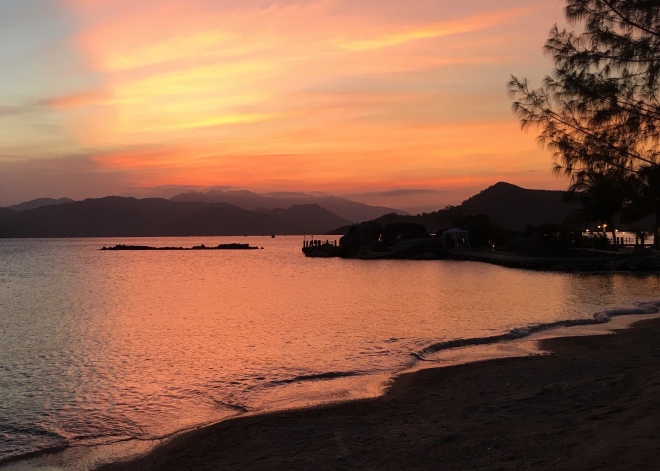
Here we’d arranged to meet up with Richard and Sue, the friends from home that we’d bumped into by surprise back in Champasak. As the sun set over the hills that lead up to Dalat, we toasted both our trips with some very welcome crisp white wine.
We didn’t know it at the time, but it was to be the end of this particular cycling adventure. A perfect celebration!
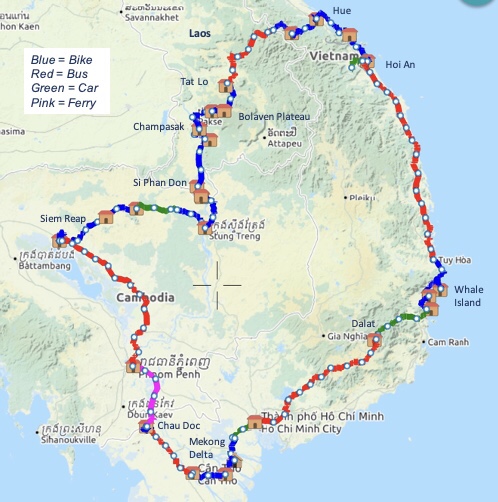
Here’s the map of our whole trip around Vietnam, Cambodia and Laos:
We have to admit that there are a lot more red lines (for buses), green lines (for cars) and pink lines (for boats) on this map than usual.
But we still pedalled 1712km, climbed 18,629m and spent 126 hours in our saddles. That’s slightly more kilometres than our trips to Chile or to Australia.
And we only had two mechanical problems, both punctures to Andy’s rear wheel.
Laos, Cambodia and Vietnam are three very different countries, but they’re all great places to tour around by bicycle.
The scenery is spectacular … from the green rice carpets of the Mekong Delta to the rough red clay roads of Northeast Cambodia … from the temples of Angkor to the tranquillity of the Four Thousand Islands in landlocked Laos … from the cassava and coffee plantations of the Bolaven Plateau to the thick, high jungle of the Ho Chi Minh highway.
As you set out at sunrise in the cool morning air there are endless scenes of everyday life to entertain you … families cooking noodles for breakfast under their house, hawkers selling dried fish, women slowly pedalling back from the market in brightly coloured pyjamas topped with conical leaf hats.
Once you get used to the rules of the road it’s even fun to cruise through town, scooters buzzing past in every direction.
But four months after coming home, it’s still the sound of children’s voices that we remember most … “Heyoooo … Heyoooo mister … Heyoooo mummy … Heyoooooo!!!”
Whilst the world fights back against this terrible virus, we can conjure up this soundtrack to lull us off to sleep … and start dreaming about where to go next.
“How about a cycling adventure on every continent?”
“What, even the really cold ones?”
“No, no … of course not. We’ve cycled in Europe and South America. How about Asia, Australasia, Africa, North America? Think how amazing that would be.”
We were sitting in a restaurant in Puerto Montt last March, at the end of our 1,478km trip through the centre of Chile and across the Andes to Argentina.
To be completely honest, Clare’s new found adventurous spirit came as a bit of a shock. It was only the week before that, after hours of grinding along the famous South American ripio (gravel roads), she’d emphatically declared that she was NEVER EVER going on a bike tour again!
It’s amazing what a large glass of wine and a sense of achievement can do.
Melbourne
So here we are in Australia, in Melbourne to be precise.
Our plan is to cycle to Sydney through 1600km (1000 miles) of remote countryside and coast roads.
Why have we chosen Australia?
Because our son, Chris, is studying in Melbourne for a year so it’s a great opportunity to visit him and tick off another continent at the same time. Our daughter Sarah was able to join us for a couple of weeks and the four of us had great fun together exploring the Great Ocean Road, the Barossa Wine Valley, the Grampians and Adelaide … travelling in the relative comfort of a huge motorhome.
Sarah & Chris12 Apostles on the Great Ocean RoadCamping with Kangaroos in the GrampiansAdelaideFringeFestival
Now it’s time for the cycling … and the camping. You may recall that we experimented with camping during our car-biking trip to Ireland in August using some heavy, old gear.
It wasn’t an unqualified success as it was very cold and windswept. Andy barely slept as every airbed he had pulled out of the corner of the garage deflated during the night.
But we’ve taken the plunge and invested in some super-lightweight camping gear. A lightweight tent, 2 lightweight mats, 2 lightweight sleeping bags plus a lightweight stove, pots and pans, plates etc. etc.
It turns out that super-lightweight equals super-expensive so we will have to camp at least half the nights, just to make our investment worthwhile.
We’llmissourbigmotorhome
Does a plan to complete a bike ride on every continent make us proper touring cyclists? There’s no getting away from it … proper touring cyclists camp.
The biggest challenge has been squeezing all this extra gear into two panniers each. There’s a lot less room for the other stuff. Clare has found this particularly frustrating but she has reduced and reduced and then reduced some more … even decanting a few toiletries into tiny bottles and spices into small bags.
Regular readers of this blog will be pleased to hear that some old favourites are still with us. Andy’s favourite cycling shorts have been carefully repaired so no longer need safety pins to hold them up and Clare has bought a new, smaller hair roller … although it’s still a poor substitute for the lightweight solar powered hairdryer that she’d really like.
Before we came here, lot’s of people warned us that it can be difficult to bring bikes into the county. The government are rightly cautious about the risk of soil diseases entering Australia on dirty bike tyres. We heard horror stories of bikes being stripped down in customs and each part being soaked in a powerful detergent.
This meant that we were more than a little nervous when we picked up our bikes at the airport and headed for customs. But no worries! Just a cheery … “Have you given them a wash then mate?” … and we were waved through.
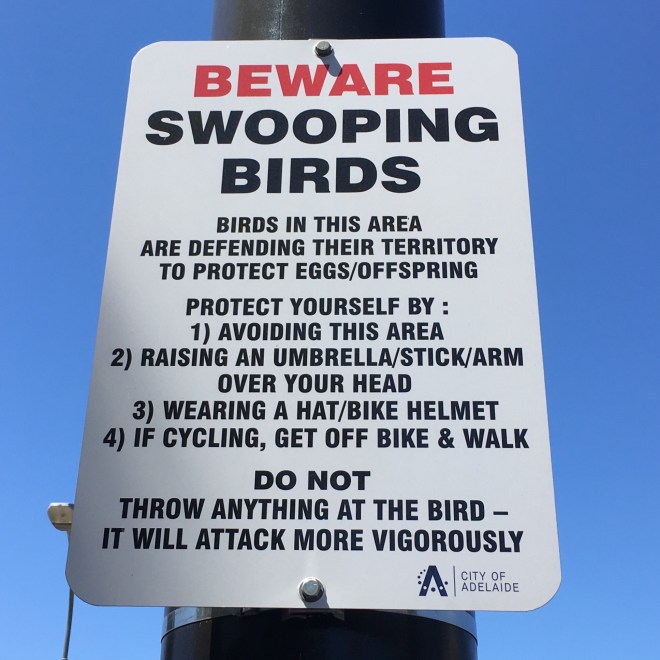
We’ve also been warned about the notorious creepy crawlies, especially camping in remote places.
Apparently the whole country is writhing with highly venomous snakes that harbour a particular hatred for both cyclists and campers. And poisonous spiders that love to lurk under a saddle waiting for a juicy bottom.
It’s true … Australia is home to 21 of the world’s 25 most venomous snakes and a whole range of poisonous spiders. Andy has promised to shake out the shoes and check under the saddles every morning.
It’snot only snakes and spiders that are dangerous
Since arriving in Melbourne, we’ve noticed that people talk about the weather almost as much as we Brits do. They proudly tell us that it changes so often, they regularly experience all four seasons in a single day.
Right now we’re enjoying perfect blue skies every day. But with huge changes in temperature. One day it’s a pleasant 24°C (75°F), perfect for late summer. The next day the mercury shoots up to a sweltering 38°C (100°F)!
That’s really hot, for mad dogs and Englishmen!
Melbourne beach huts
Apparently, the high pressure that’s sitting over this part of Australia nudged over a bit towards New Zealand. This caused the winds to switch around. Instead of drifting up from the cool southern ocean they blew down from the red hot centre.
It’s set to stay that hot for the next few days which means we’ll be cycling out of Melbourne towards Philip Island and Wilsons Promontory in a furnace.
Maybe the heat will do us in before the deadly critters?
True … it’s not quite on the scale of Fletcher Christians Mutiny-on-the-Bounty, but it is a mutiny just the same.
After months of researching the route from Melbourne to Sydney, of downloading vast numbers of maps from ViewRanger, of checking how many climbs, how many kilometres each day … Clare has suggested we might cycle 1200km (750 miles) around Tasmania instead.
And we’ve even cycled towards Sydney for a couple of days!
Credit: Discovery Holiday Parks
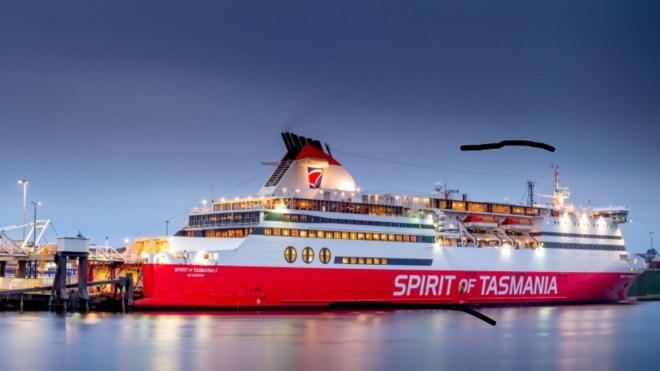
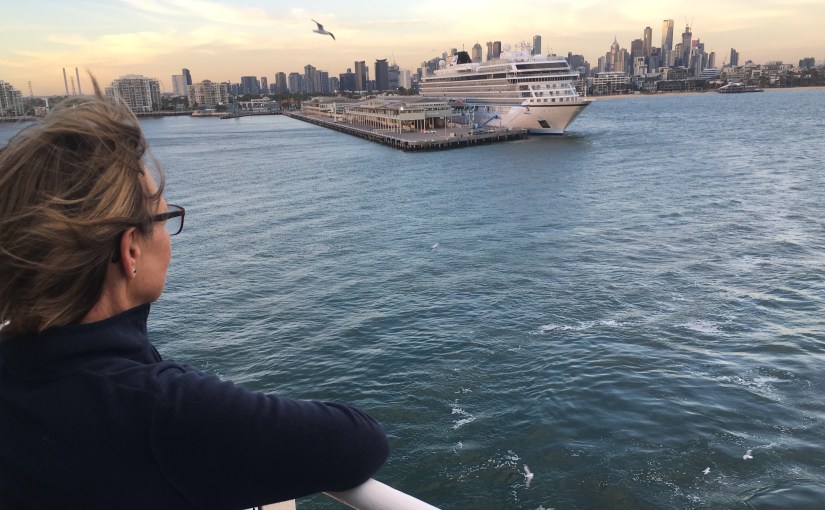
Like many people before her, Clare was inspired by a boat. It was the sight of TheSpiritofTasmania ferry chugging out of Melbourne harbour that got her thinking …
It’s a bloody long way to Sydney … and she’s not training for an Ironman.
People telling us that Tasmania is their favourite part of Australia.
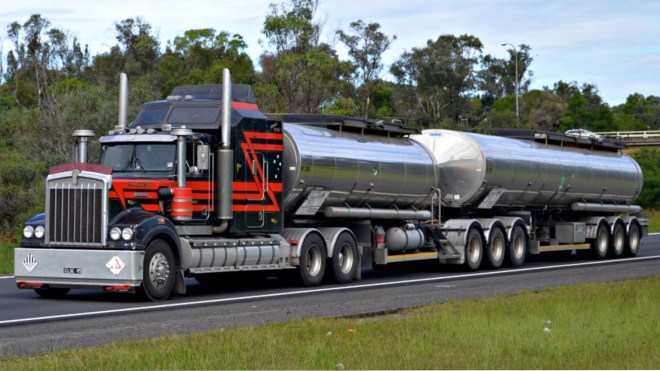
Andy’s near miss with a ‘road-train’ truck.
The road-train incident was genuinely scary. On a narrow country road, one of these massive beasts passed within a few inches of Andy at extremely high speed, causing him to wobble dangerously in it’s wake.
Had the driver bothered to look at the angry cyclist in his rear view mirror, it’s fair to say he would have had no doubt about how Andy felt.
A ‘Double’ Road Train. Credit: Scott Bourne
Cycling in Australia seems to be more challenging than other countries we’ve toured through.
Cities are brilliant with loads of dedicated cycling lanes. But outside the cities there’s often only one busy main road between distant towns. There isn’t the network of quiet country roads that cyclists love.
On our travels, we’ve found the Irish to be the most patient drivers with cyclists. So far I’m afraid we’ve found Australians to be amongst the least tolerant, often seeing no need to slow down or deviate even slightly.
This is particularly true of truck drivers … they ‘own the road’ and they know it. To be fair, they don’t pass many foolhardy touring cyclists on their long, dull journeys.
But it seems that snakes and spiders are not our biggest danger after all.
It’s the truck drivers!
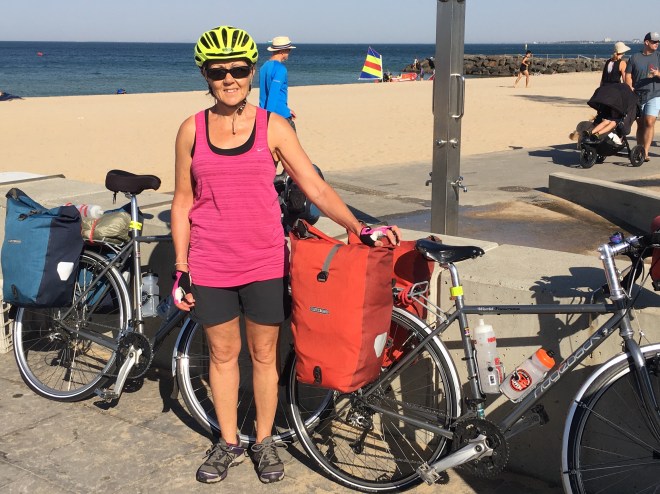
Riding out of Melbourne was beautiful, gliding around Port Phillip Bay on a lovely coastal cycle path. It was easily the hottest day we’ve ever experienced on a bike, peaking at over 40°C (104°F). We both drank more than 6 litres of water but still didn’t need to pee for 24 hours. When we stopped for lunch we just wanted to rub ourselves down with towels and ice cubes.
After 70km of sweaty peddling, we were very happy to board the small, local ferry across to Phillip Island and cool down in the gentle sea breeze.
On the ferry to Phillip Island
Phillip Island is home to the nightly Penguin Parade. Hundreds of Little Penguins, just one foot tall, commute back to their burrows at dusk after a busy day fishing. It was delightful to see these cute little creatures tumbling out of the sea and waddling back to their mates.
Little Penguins Credit: Phillip Island Nature Parks
As we rode along the coast the next day, we began to appreciate how big anddry Australia is. We noticed a huge cloud forming inland. It turned out this was caused by a number of bushfires merging together. They are often started by lightening strikes from the dry storms (no rain) that build up in the intense heat.
It’s an increasing and dangerous problem across Australia.
Credit: The Guardian
One such lightening strike had hit Wilson’s Promontory National Park, one of the most spectacular parts of the Victorian coastline and a highly anticipated highlight on our ride to Sydney.
The resulting bushfire meant that 300 campers had to be evacuated. It’s serious enough to keep the park closed for two weeks but we’re glad to say that the fire looks like it will be controlled before it causes to much damage to this pristine wilderness.
Sunset across the estuary at Inverloch
Instead, we stayed an extra night at a lovely campsite in Inverloch, just metres from a beautiful, empty beach that led out to a wide estuary.
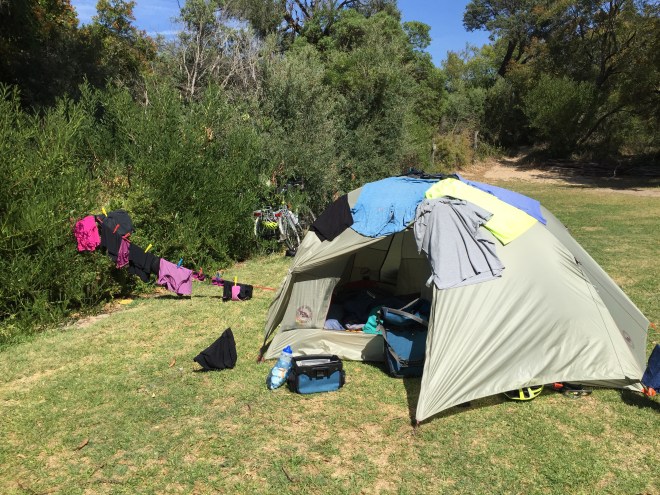
The camping has been great. The equipment is working well and we’re relishing the outdoor life that we miss when we only stay in hotels or B&B’s.
Camping just behind the sand dunes
Because of the bushfire, we’re now no longer going to Wilsons Promontory. But where are we going? Sydney or Tasmania?
Here are Clare’s arguments for a tour around Tasmania:
It’s one of the great cycling destinations … lots of people cycle around Tasmania and very few cycle from Melbourne to Sydney (there must be a reason for that!)
The scenery is stunning
We’ve never been there
We’ll have two trips on an iconic ferry
It’s great for camping
It won’t be as hot and sweaty for cycling
There are less long, dull roads
There are less big trucks
There are less snakes and spiders
The bushfire on Wilsons Promontory was a bad omen
And here are Andy’s arguments for cycling to Sydney:
It’s the original plan
It’s a proper journey (not a circle)
It might be a bit cold in Tasmania
What do you think we should do? Should we stick or twist?
Thanks to you we’ve twisted and are now safely in Tasmania. Phew!
I loved all your comments, many thanks for your support. Much to my surprise the vote was almost unanimous, with just one (male) exception! I can’t agree more that we should get away from those long roads and huge trucks. It was also great to hear about the highlights of Tasmania from those of you who have already been here.
Let’s twist again Like you did last summer Yeah, let’s twist again Like you did last year Well, around and round and up and down We go again Come on baby make me know you love me so again ChubbyChecker
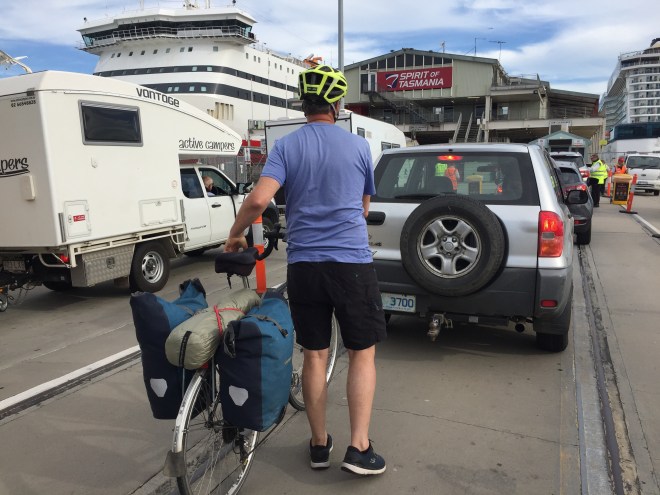
By the time we boarded the ferry Andy was genuinely excited about going to Tasmania and our new adventure ahead.
We’ve been arguing about what constitutes a journey. The English Oxford Dictionary says it’s ‘travelling from one place to another’ and this is Andy’s argument too … you have to go from A to B.
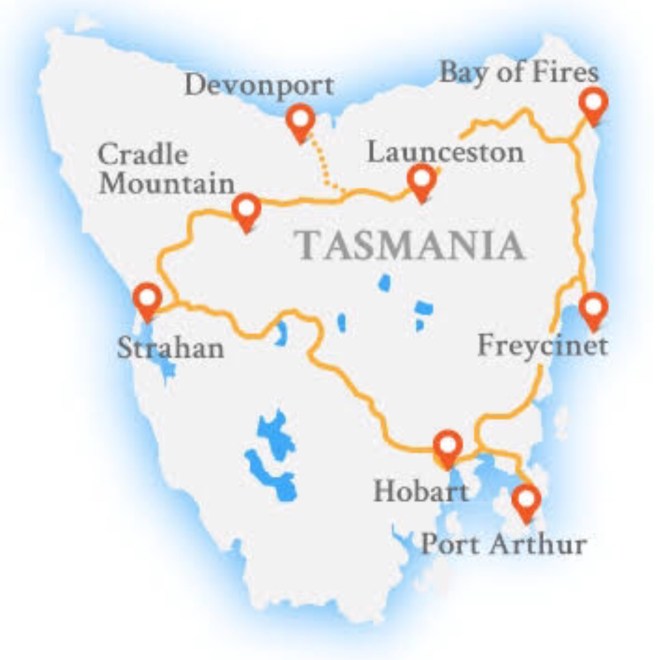
But in my opinion it’s just as valid to go ‘aroundandround’ from A to A. If you lay out a piece of string along our route through Tasmania it looks like a circle. But if you pull that string tight it becomes a straight line which makes it a journey!
We’ll be going clockwise
What have I let myself in for? Tasmania is actually a much bigger challenge than Melbourne to Sydney. Mountains dominate the western side of the island but there are some serious hills in the North East too.
Lots of ‘upanddowntogoagain’!
I honestly don’t think Andy realised how difficult it was going to be. He kept telling me that Tasmania was “only about the same size as Wales”. I was so confident it was bigger that I made a bet with him … and even upped the stakes.
It turns out TASMANIA IS OVER 3 TIMES BIGGER THAN WALES!
Last day in Melbourne
What turned out to be our warm-up ride out of Melbourne and back again took us 380km with over 4000m of climbing. And due to the bush fires we never did make it to Wilsons Promontory so took an inland route instead.
We reached the point of no return in a tiny village called Koonwarra, which lies on the 72km Victoria Southern Rail cycling trail. If we’d turned right down the trail we’d have gone to Sydney. Left to go back to Melbourne.
Thankfully it had one of the nicest cafes we’ve ever cycled past so at least we had good coffee to help make the decision.
We turned left and were soon heading west along this quiet and delightful trail.
The Southern Rail cycle track
Sadly, it didn’t last!
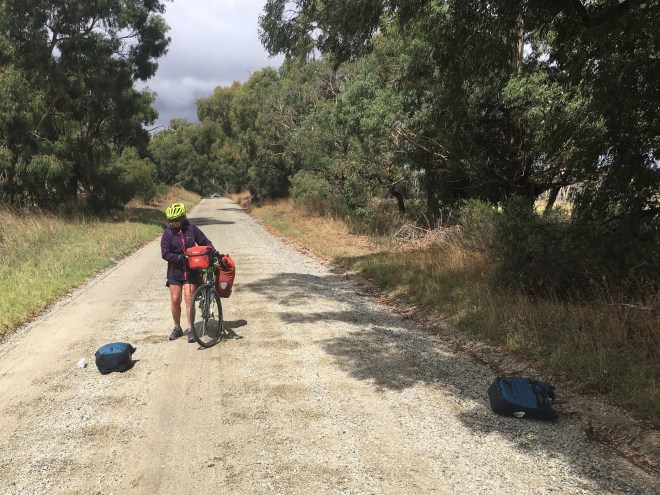
In his efforts to avoid the main highway, Andy took us cross-country on some quieter country roads that he’d spotted on ViewRanger. Some of these were nice but others turned out to be the dreaded gravel ripio, built for the remote Victorian faming community. It was a nasty reminder of some parts of Chile.
They were so corrugated that at one point both Andy’s panniers crashed off the back of his bike as he careered over some bumps too quickly.
While he was picking them up, a lovely local lady in a big 4×4 stopped to ask me “what on earth we were doing there?”She’d never seen anyone trying to ride a bike on these roads before.
In contrast to the searing temperatures of a few days earlier, the weather that day was decidedly cool and very windy.
Storms blew up out of nowhere. One minute, we were happily cycling along. A few seconds later we’re sheltering in a hedge from gale force winds and scarily large hail stones. The storms passed quickly but did not add to the fun in any way.
They were big hailstones, honest
During our tour of Victoria, I’d noticed that so many places are named after English towns. We’ve been to Brighton, Sandringham, Cheltenham, Hampton, Hastings and Shoreham to name but a few. Phillip Island must have originally been settled by folk from the Isle of Wight … Cowes, Rhyll and Ventnor.
Now we’re in Tasmania, I’m looking forward to visiting Launceston, Exeter, Derby, St Helens and Swansea.
Clare
Clare is often right and she certainly was this time! Already I’m loving Tasmania and looking forward to exploring this fascinating island.
Thanks for helping me see that it’s more important to relax and have fun than to complete a journey!
Tasmania is a gem … Clare was right! It’s a simply stunning island to cycle around.
As David, our B&B host in Launceston said … “your first few days in the North East will take you through some of the most spectacular scenery on the island. No … some of the most spectacular scenery in Australia. After that it just gets better and better!”
He was not wrong.
The ever changing cinematic view from our handlebars has been both varied and delightful.
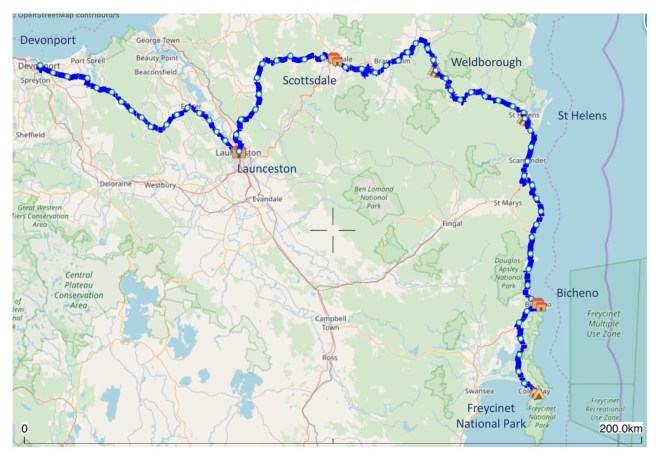
We rolled off the ferry in Devonport at 6am on a misty Friday morning and were relieved to find a bakery serving coffee and huge Aussie croissants. Three hours later and slightly over-caffeinated we decided we couldn’t put off climbing onto our bikes any longer.
Within a few minutes we were out into big open farmland and wide horizons, the road gently undulating as we headed towards the hills in the distance.
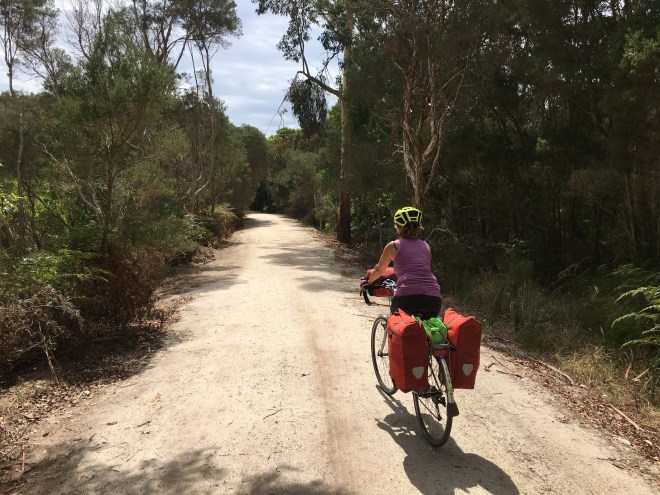
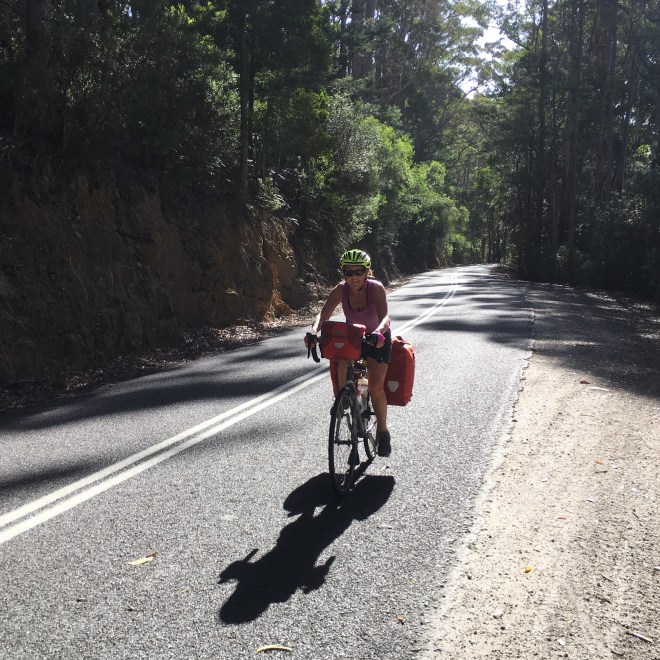
As most of the heavy traffic takes the highway through the centre of the island, there were very few trucks (hooray!). Some even slowed down a little to pass us.
These roads are for locals and for tourists, which means lots of caravans and motorhomes. It’s ideal motorcycling country and there are large groups of bikers touring the island, all zooming past with a throaty roar and a cheery wave.
The road then took us down the Tamar valley to Launceston through the heart of Tasmanian wine country, famous for its Pinot Noir and Pinot Gris.
At Scottsdale we picked up the old North East Railway, now a cycling trail that winds its way gently up to Billycock Hill, 342m above sea level. Sweeping bends never exceed 2.8%, the maximum gradient for a steam train, as the trail climbs through a beautiful eucalyptus forest.
The North East Rail Trail
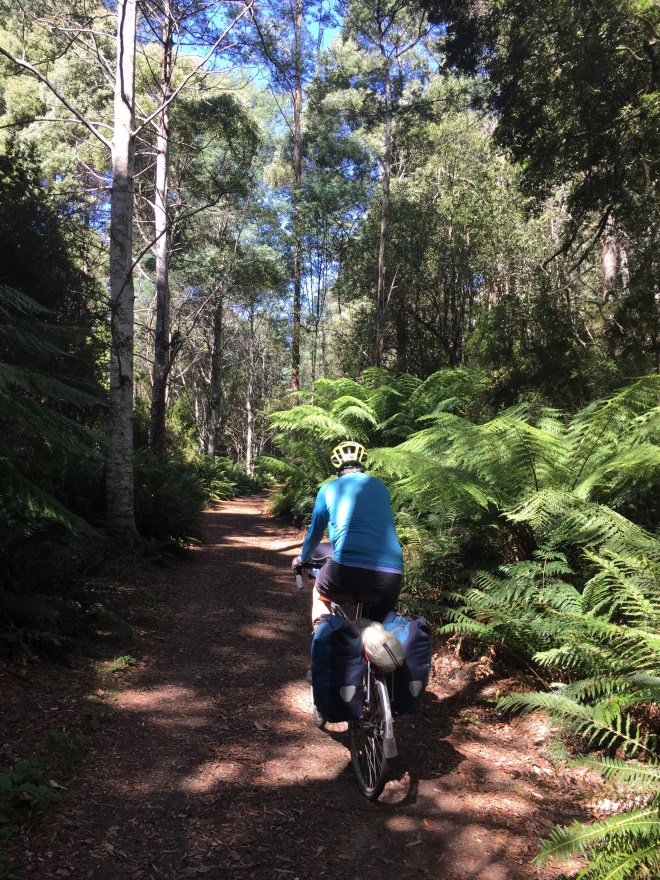
Later that same day we climbed again to Weldborough. This time more steeply through rich, verdant rain forest thick with tree ferns and gnarled, ancient trees.
Up through the rain forest
After a wet but fun evening with a group of bikers in the Weldborough Tavern, we descended through cattle country until we reached the coast at St Helens. From there it was mile after mile of beautiful coast road, climbing across granite headlands, then cruising down to deserted white sand beaches, each lapped by a gin-clear sea.
Small fishing communities break up this part of the coast offering a good choice of places to stay. But it’s a coast that will forever stay sea-salted and under-developed as it’s protected by a crystal clear, but very cold, sea.
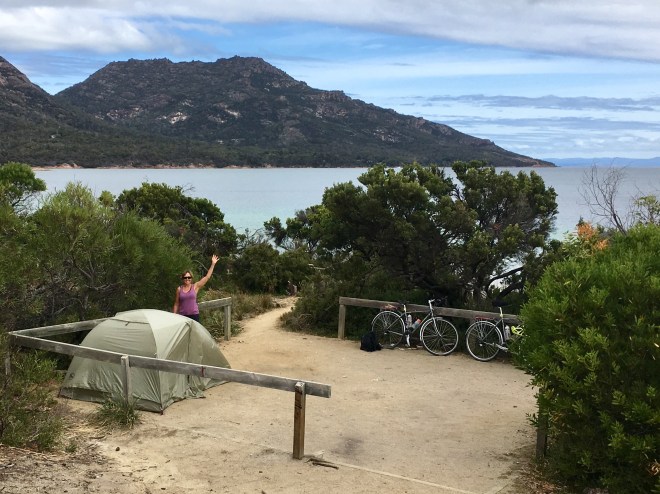
After a week and 400km of pedalling, we reached the jewel in the crown … the unspoilt peninsula of Freycinet National Park at Coles Bay. Here, we were lucky enough to find a camping spot at Richardson’s beach (so popular in the school holidays that they’re allocated by a ballot), where we threw off our sweaty cycling gear, ran down some private steps to a picture perfect oval beach and plunged into the water.
Then gasped … and quickly ran back out again!
Camping at Richardson’s BeachWineglass Bay in Freycinet National Park
The cycling has been quite challenging. Anyone who says the East Coast of Tasmania is flat is not telling the whole story!
The land folds itself down to the sea, creating all those pretty bays and headlands but this means that the roads either roll up or roll down. Each small hill enhances the view. But it also means a four hour ride feels a bit like four hours of interval training.
Clare interval training to music
Not all our camping sites have been as pleasant as Richardson’s beach. At Weldborough it rained hard all night. Then in St Helens we came into much closer contact with nature than we’d bargained for.
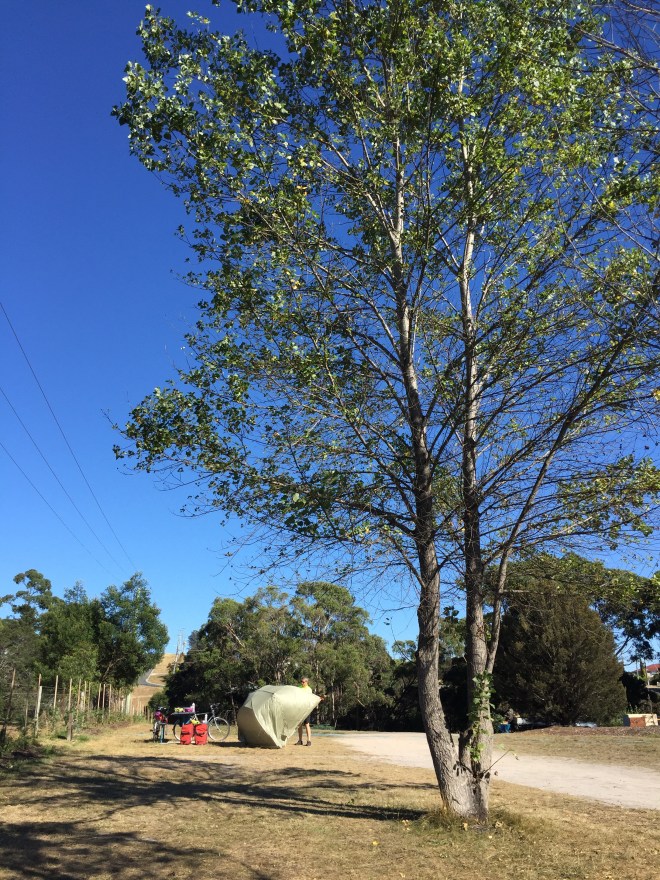
We camped in a field under a lonely tree and returned from our harbour-side fish supper to find a brushtail possum hanging upside and feasting on it’s lower branches, just inches from our tent.It stayed there munching for several hours … and was not a quiet eater.
During the night we noticed a spattering noise, like the sound of gentle rain. This was confusing as it was a dry clear night … but, in the morning our tent was covered in water droplets. We thought it must be dew and left the tent to dry out in the sun.
Just as we noticed that the droplets were hardening into a kind of resin, the wasps arrived. Ten … twenty … forty … all greedily feasting on these lumps of nectar that now covered the entire tent.
Was it sap from the tree?
No … it turns out the tree was infested by aphids and this was honeydew … the sugary, sticky liquid that aphids excrete as they chew the leaves.
To wasps it is the milk of paradise and they were having a party!
Two of many feasting waspsTrying to shake the wasps off
We’re not sure whether Samuel Coleridge was referring to wasps or not in his famous poem, Kubla Khan, but it feels like he might have been …
And all who heard should see them there,
And all should cry, Beware! Beware!
Their flashing eyes, their floating hair!
Weave a circle round them thrice,
And close your eyes with holy dread,
For they on honeydew hath fed,
And drunk the milk of Paradise. Kubla Khan by Samuel Coleridge (slightly modified)
We didn’t stop to weave any circles. We just stuffed the tent in its bag and pedalled out of there as fast as we could.
When we got the tent out the next day, to soak away the honeydew in warm water, half a dozen wasps fell out. All alive, they were now miles from home but they had such a satisfied expression on their faces … we knew that they didn’t care.
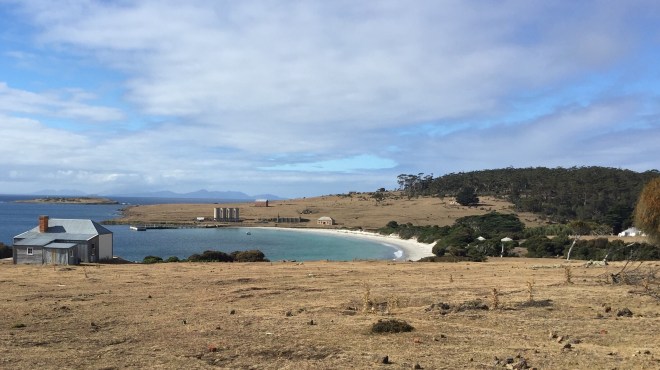
Leave ordinary life behind … that’s all they ask of visitors to Maria Island. And it’s an easy thing to do.
Maria Island is a Unesco World Heritage site. It’s a carefree, car-free haven for walking, biking, camping and watching wildlife with not a single shop, cafe or ice-cream kiosk in sight.
We loved leaving ordinary life behind so much that we decided to camp on for a second night … stretching out the pasta, chicken, cereal and red wine that we’d brought with us.
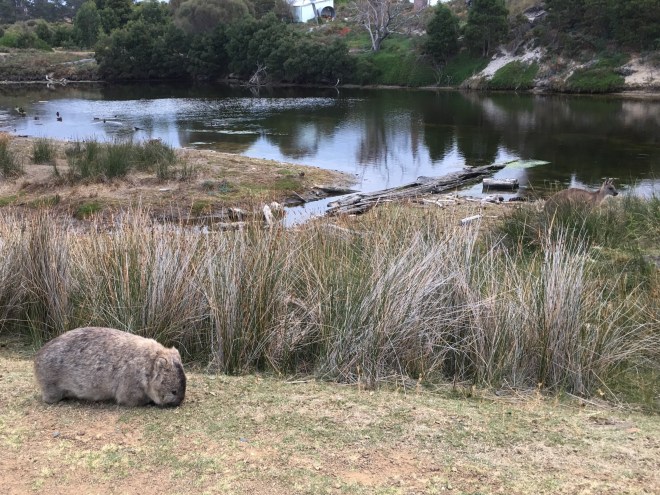
A wombat, yes … but can you spot the kangaroo?
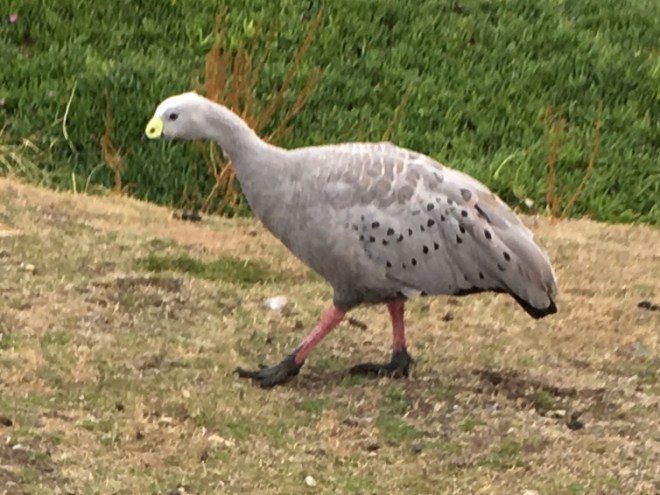
We loved watching wallabies, wombats and the strange looking Cape Barren geese grazing around our tent as we cooked. And we absolutely loved stumbling across a herd of over 50 kangaroos quietly grazing on a headland against the setting sun.
Cape Barren goose
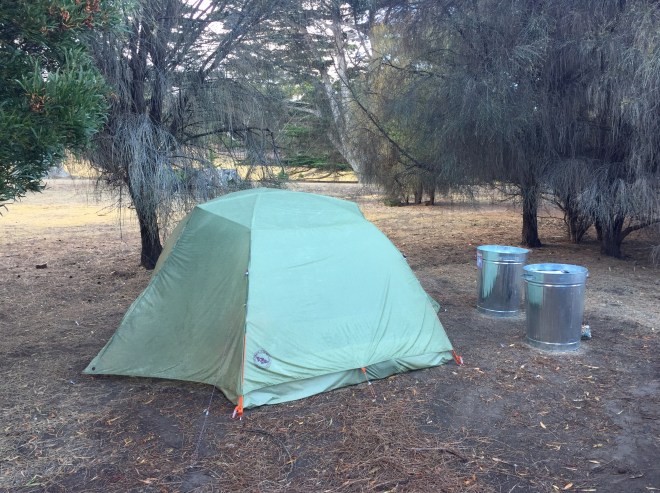
We heard (but didn’t see) Tasmanian devils shrieking at night. It was fortunate that they weren’t too close, as the rangers had told us to cover up our bike saddles so the little devils couldn’t eat them.
The bins are devil protectors
The island has a colourful human history too. It endured two brief periods as a penal colony for re-offenders but, after repeated escapes, was closed in favour of the more secure Port Arthur.
An ill-fated attempt by a colourful Italian entrepreneur called Diego Bernacchi to develop industry, agriculture and tourism didn’t last long either. His large cement works once supported over 500 people with hotels, shops and a tramline. It never came close to break-even and collapsed in the 1930’s Great Depression.
This has left an eclectic mix of ruined buildings on the island.
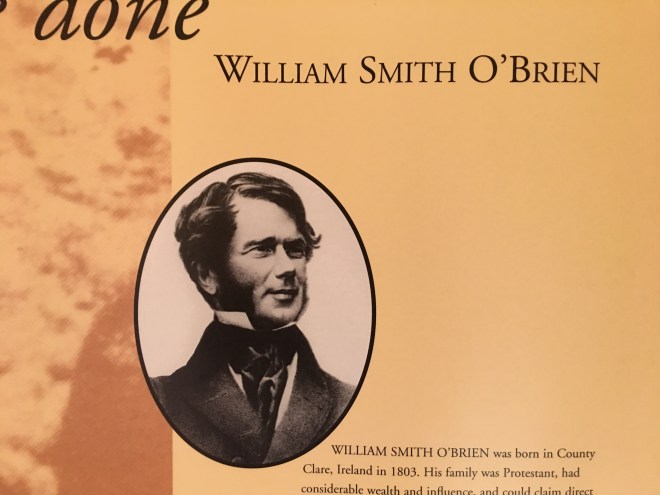
A small museum vividly brings to life the experiences of all the people who lived there, both the incarcerated and the free. One diarist was William Smith O’Brien, an Irish MP and a leader of the Young Irish movement that fought against the potato famine amongst other injustices. He was imprisoned here in 1849, before being sent to Port Arthur and eventually pardoned some 7 years later.
As well as describing a failed escape attempt on a whaling boat, he laments his fate to be cast so far away from his loved ones. So far away, that he was on a small island, off the coast of an island, which was itself off the coast of Australia.
We could sense his isolation.
These were our last few nights camping, as we’re sending our stuff back to Melbourne before we head to the colder mountains in the west.
Camping on Maria Island has made buying and carrying all that gear worthwhile. The tent is a great design and the sleeping bags are warm and cosy. But the air mattresses are seriously embarrassing in the stillness of the night. They squeak so loudly whenever we roll over or so much as move a muscle.
As a man of a certain age, Andy is forced to go to the loo once or twice a night. Not known for his agility, this becomes quite a performance, especially with the noisy mattresses. It’s no wonder the devils stayed away from us!
Painted Cliffs
Fortunately on clear moonless nights the stars have added to his relief. The night sky seems so much more intense down here … especially the Southern Cross and the wide sweep of the Milky Way, a pearly rainbow from one horizon to the other.
We recently learnt the reason for this. In the southern hemisphere you look down into the centre of the Milky Way, whereas in the north, you’re looking out to it’s edge.
Saying goodbye to Maria Island on the early ferry, we headed south across country to the small village of Dunalley. This turned into one of those cycling days that are more than we bargained for.
We were warned!
It was actually over 50km of cycling on ’ripio’ gravel roads! And the road went uphill! And it rained! And Clare got stung by a wasp (presumably one that had followed us expecting yet more honeydew)!
But … she stayed impressively cheerful as you can see from these pictures, just very relieved to be back on firm, black tarmac.
Clare at the beginning of the ‘ripio’Clare at the end of the ‘ripio’
The wildlife surprised us yet again. We turned one corner and disturbed a large flock of bright green and red parrots who launched themselves up into the sky in a colourful, noisy, irritable carnival. Later it happened again, this time with scores of white cockatoos swirling in front of us like confetti.
A sadder feature of this road was that there was even more roadkill than usual, in various states of decay … small kangaroos, wallabies, possums and (just once) a snake. It made for a pretty stinky ride!
Roadkill is much more noticeable on Tasmanian roads than on the ‘mainland’, but the locals tell us that this also proves the populations are healthy.
Another feature of country roads are the house numbers. Anyone fancy living at number 29762? The next house a few kilometres down the road might be 25640. This seems confusing until you discover that a new number is allocated every 10 metres.
This house is therefore 297.62km from the end of the road in Hobart … a handy way of measuring our progress.
At the end of this particular gravel road was a welcome B&B in a lovely old colonial house. We’ve noticed a few interesting touches that seem to be particular to Tasmania B&B’s … heating lamps in the bathroom ceilings, washing machines and a complimentary decanter of sherry and port to “help you sleep”.
From Dunalley we rode along the coast to Richmond, a pretty town famous for being the site of Australia’s oldest bridge (convict built of course). Then onto Hobart where our son Chris has joined us for a few days rest and recreation.
Richmond bridge
Next up is the challenge of the mountainous, wet n’wild West Coast and the road up to Cradle Mountain, the highest point on our circuit.
The weather has turned and there’s a storm on the horizon. Winter is coming!
It doesn’t look like life for the next two weeks will be ordinary at all.
The challenge of cycling from Hobart over the mountains to the West Coast is well summed up in ‘Discover Tasmania: A Cycle Touring Guide’, a small leaflet that has become our bible:
“The West Coast is vastly different to the East Coast. It’s rugged, mountainous, beautifully wild and has a temperamental climate.
The remoteness of this route can be daunting for many and you must be well equipped to tackle the terrain.
The road from Hobart to Strahan is winding and brutally hilly at times. But it’s also beautiful and deserving of the challenge.
The climbs are not insurmountable but the descents are breathtaking!”
Our route from Hobart to Strahan
Our first bit of ‘temperamental climate’ was the strongest headwind we’ve ever encountered. It became so windy that we were repeatedly blown to a standstill or knocked sideways into the road, as we dragged ourselves up the River Derwent. Taking sanctuary in a bus shelter, we seriously considered turning around and sailing back downwind to Hobart.
After much debate and googling things like ‘long distance buses’ or ‘large taxis’ or ‘weather forecast’, we decided to struggle on, at least to the small town of New Norfolk where we gratefully came across the Badgers Bike Cafe for a very welcome coffee.
A bit windy
To his horror, Andy then discovered he’d left our ‘dongle’ 15km back down the road in the bus shelter. This is an important bit of kit … it’s an old mobile phone fitted with an Aussie sim card that we use to ‘hotspot’ to all our devices as a sort of wifi server.
Arrgghhhh … and lots of other expletives!
While Clare happily enjoyed a second cappuccino, Andy found a taxi to take him back to the bus shelter and recover the dongle, still on the bench where he’d left it.
Phew!
Then on the taxi ride back to New Norfolk, he casually used the dongle to re-check the weather forecast for the 100th time.
Not phew! The opposite of phew!
The first cold front of winter, full of even fiercer wind and rain stirred up from the Southern Ocean, had spookily sped up and was now going to cross our path much, much, much earlier than we’d expected.
We’d have to ride very fast across the hills to make it to Hamilton before it struck.
Or … we could take a taxi?
Yes … our friendly driver, John, would be very happy to take us to Hamilton. But … his back seats didn’t fold down so he could only fit one small lady-sized bike in his boot. And yes … he was the only taxi in town.
Ten minutes later, before she’d quite realised quite what was happening, Clare had been bundled into the taxi and driven the 40km to Hamilton. Somewhat surprised at her early arrival and dishevelled state, the elderly B&B owner took pity on her and lit a lovely warm fire.
Andy had no choice but to get back on his bike.
To start with all was sunny and calm as he climbed into the hills away from the river. He took off his rain jacket, put on his sun glasses and started humming tunelessly on what (surprisingly) seemed like a lovely ride.
The calm before the storm
Then only 10km from Hamilton, the sky suddenly darkened as the cold front hit, hurling down rain and small piercing hailstones fired horizontally by 60kph winds. This was the same weather system that would later destroy a concrete bridge when it rammed into New Zealand.
That 10km took Andy well over two hours, mainly because he spent most of it sheltering in trees. However, it gave him plenty of time to contemplate an important rule of bicycle touring … never get delayed by losing your dongle!
Fish and chips by the harbour in Hobart
Hobart had turned out to be a very pleasant place for a city-break, especially as our son Chris flew over from Melbourne to join us. We poked around the impressive Salamanca market, enjoyed fresh fish and chips on the harbourside, and hired a car to visit the haunting ruins of Port Arthur, a penal colony set up for repeat offenders.
Port ArthurOne of the convicts at Port Arthur
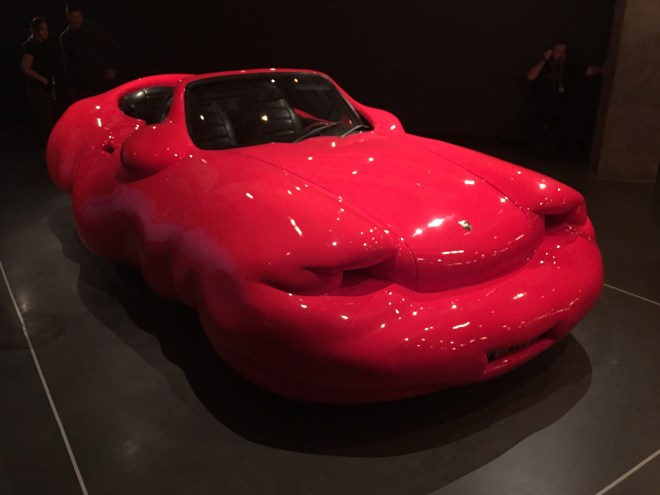
Best of all we went to MONA, the Museum of Old and New Art.
MONA was set up by self-made gambling billionaire, David Walsh, as a ‘subversive, adult Disneyland’. It’s provocative, compelling, disturbing, shocking, enticing. We found ourselves drawn in by each exhibit with increasing curiosity. All three of us agreed … it’s worth coming to Hobart just to see MONA.
Fat CarHuman Art – he meditates there all dayNot sure we’d have got far on this bike?
After a restful night in Hamilton we rode uphill to Tarraleah in much better weather and then onto Lake St Clair, the deepest glacial lake in Australia.
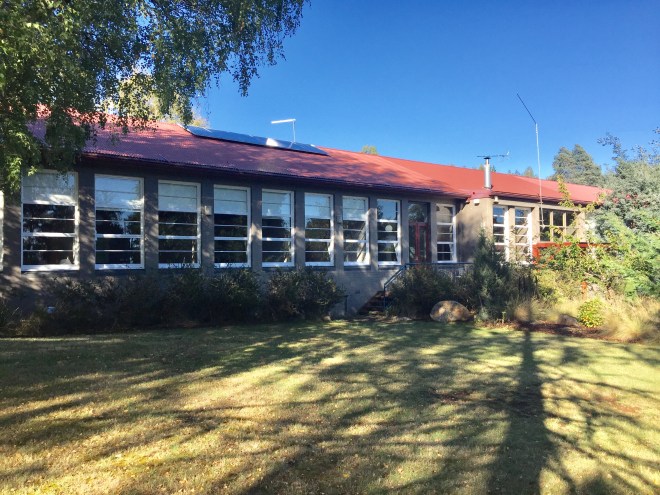
We slept in an old school that served the children of workers building a massive hydro-electric project in Tarraleah. Built in the 1930’s the village once boasted 100 houses, a police station, a town hall, shops, a church, a golf course and a school.
Hydro-electricity was and is vital for Tasmania not only for power but also for the identity and confidence of the state. But once the construction workers left, Tarraleah became a ghost town and was almost reclaimed by the bush until another entrepreneur rescued it and turned it into an activity centre and hotel.
The hotel in a schoolHydro-electric pipes
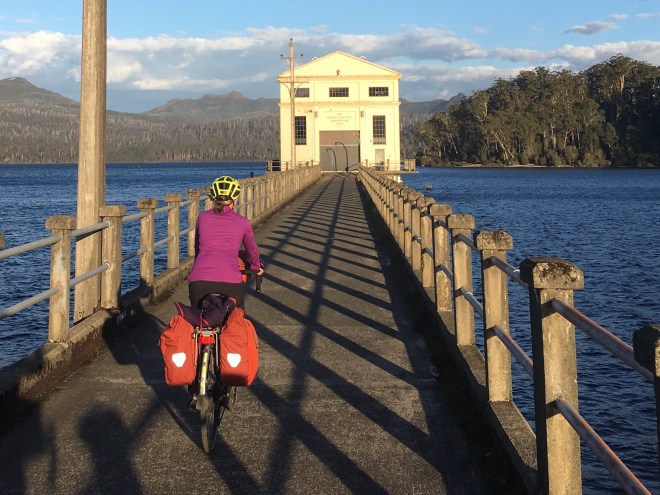
Good friends from Sydney suggested we stay at Pumphouse Point on Lake St Clair, an even more unusual hotel converted from a water pumping station that was built at the end of a pier.
Our friends were right, it was a lovely treat.
The hotel in a pumphouse
It felt to us that we’d already been riding through the wilderness for several days, but the actual ‘Wilderness Road’ starts at Lake St Clair and meanders across the vast Franklin Gordon Wild Rivers National Park to Queenstown.
We left early to try and avoid the heavy downpours that were forecast for the afternoon.
Riding across this world heritage area genuinely felt like a wilderness experience. There were no shops, no cafes, no petrol stations … just some of the most magnificent scenery we’ve ever cycled through.
It was remote, raw and wild. And brutally hilly at times.
Along the Wilderness Road
We crossed the ‘Great Divide’ halfway along the 85km ride, moving from the relatively dry eastern side to the much wetter west.
Weather systems from the southern ocean deposit over 2m of rainfall a year on the west coast, creating perfect conditions for thick temperate rain forest. Many of these ancient trees are only found in Tasmania … Huon Pine, Leatherwood, Celery Top, Whitey Wood, Sassafras, King Billy Pine.
The downpours duly arrived and we got completely drenched just 5km away from Queenstown. It was like the taps being turned on.
Brewing up before the downpour
A last breathtaking descent the following day took us down to the remote town of Strahan on the banks of MacQuarie Harbour which, surprisingly, is six times bigger than Sydney Harbour.
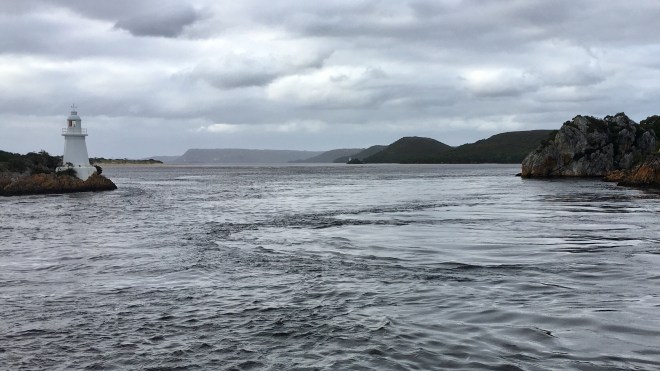
One of the reasons that tourists come to Strahan is the extraordinary boat trip through the narrow ‘Hells Gates’ harbour entrance and then up the Gordon River, deep into the rain forest.
Hells Gates
The boat tour also stops at Sarah Island.
On this tiny strip of land, seemingly at the end of the earth, around 500 of the worst offending convicts endured some of the toughest weather conditions imaginable, together with a brutal regime of hard labour and vicious punishments.
Sarah Island
They had to build a wooden fence wall to stop the ‘Roaring Forties’ blowing the whole place away.
They had no fresh water, it had to be shipped in, so was heavily rationed.
The convicts had little shelter. Many slept where they worked.
Much of that work was sawing huge tree trunks to make ships. The saw was operated by two men, a ‘top dog’ sawing down and an ‘underdog’ sawing up. The underdogs were often waste deep in sea water and wore a hood to prevent the sawdust falling in their eyes.
The prisoners successfully protested that no underdog should have to work if the water was less than 8°C. Which means that 9°C was OK!
This put our minor inconveniences with the west coast weather somewhat in perspective.
The old penitentiary on Sarah Island
Sarah Island only operated as a penal colony for 9 years until Port Arthur was built. Remarkably in the last 5 years, a more enlightened regime persuaded these hardened men to manufacture 96 boats, known throughout Australia for their quality. All built from local Huon Pine which is prized for both its buoyancy and its natural waterproofing.
This included several large ships, the last of which was unsurprisingly pinched by the ten convicts left behind on the island to finish it. They escaped by sailing all the way across the Pacific to Chile.
This is brought to life each evening in a pantomime called ‘The Ship That Never Was’, now Australia’s longest running play.
A dodgy cast member
Five days of cycling across the Great Divide from Hobart to Strahan took us 366km with 5271m of climbing. Now we find ourselves back down at sea level. To get to Devonport we’ll need to do it all over again, this time via Cradle Mountain.
Clare has decided that this is a thankless task and that Strahan makes a perfect end-point to her Tasmanian bike tour.
To her delight, she’s discovered a daily bus service from Strahan to Burnie on the north coast. There, she’s planning to rent a car for a few days and enjoy becoming Andy’s support team.
In total she’s cycled over 1500km and climbed more than 17,000m.
Sometimes enough is enough!
This means that Clare has completed a ‘journey’ by travelling A to B from Devonport to Strahan. If Andy makes it back to Devonport he will merely have ridden a ‘round trip’!



























 As most of the heavy traffic takes the highway through the centre of the island, there were very few trucks (hooray!). Some even slowed down a little to pass us.








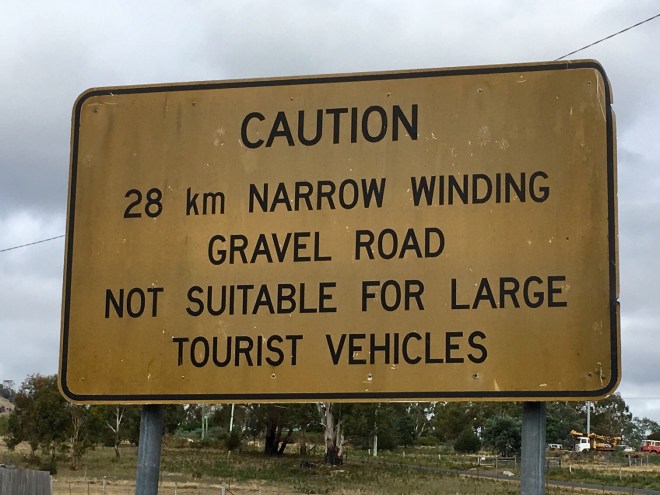
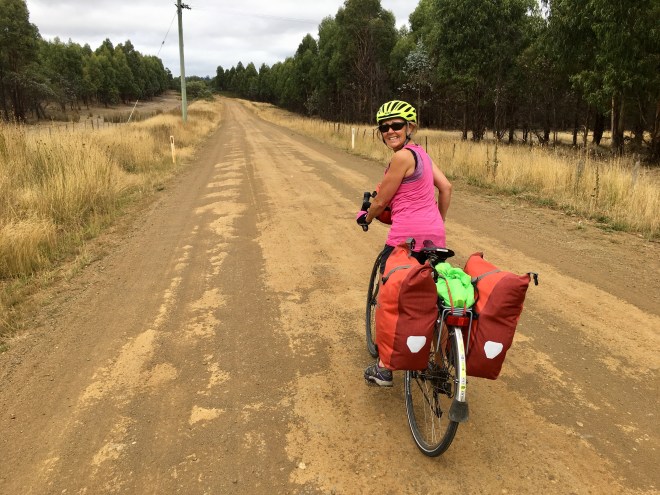


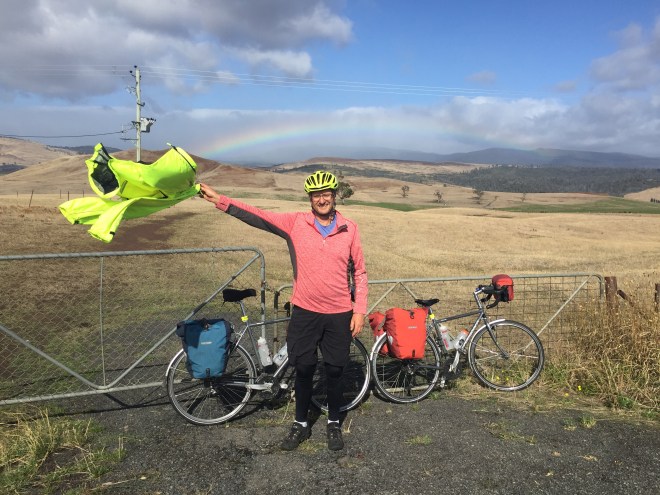












 Avoiding Potholes