Cycle Touring Super Highway

It was just 50km outside Vienna that the young couple overtook us … cruising serenely past with their matching e-bikes and small, lightly packed panniers. “Grüß Gott” they beamed in greeting “Guten Morgen!”

And why not? It was a beautiful day and they were nearing the end of a wonderful holiday, enjoying this most popular of adventures … the Danube Cycle Path from Passau to Vienna.
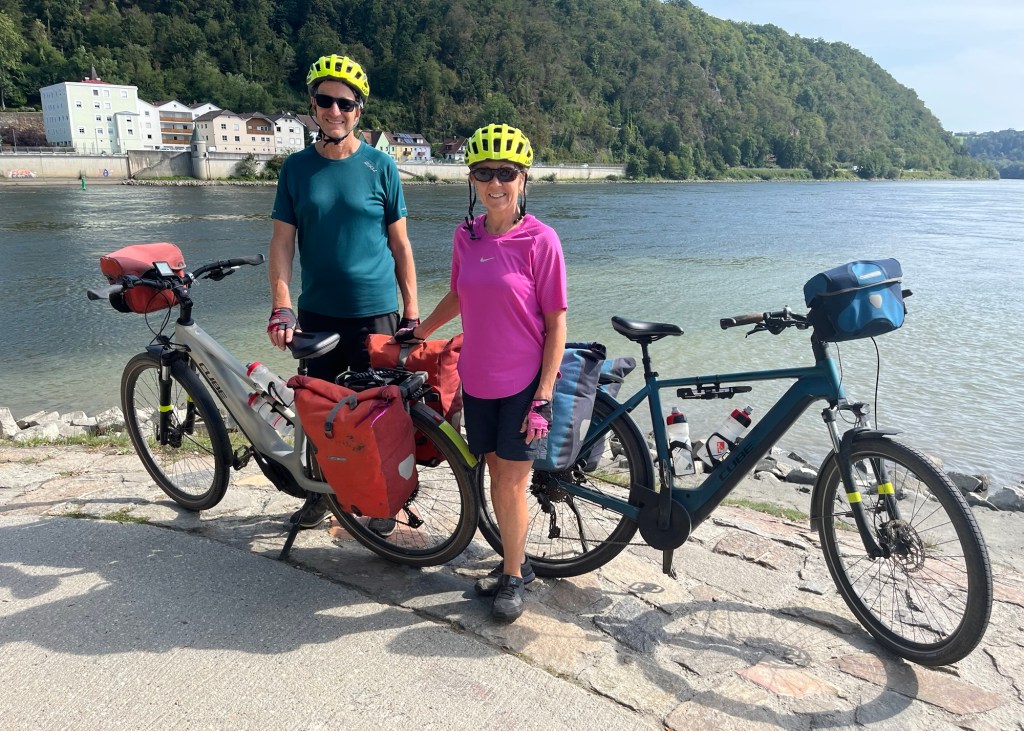
Setting off from Passau

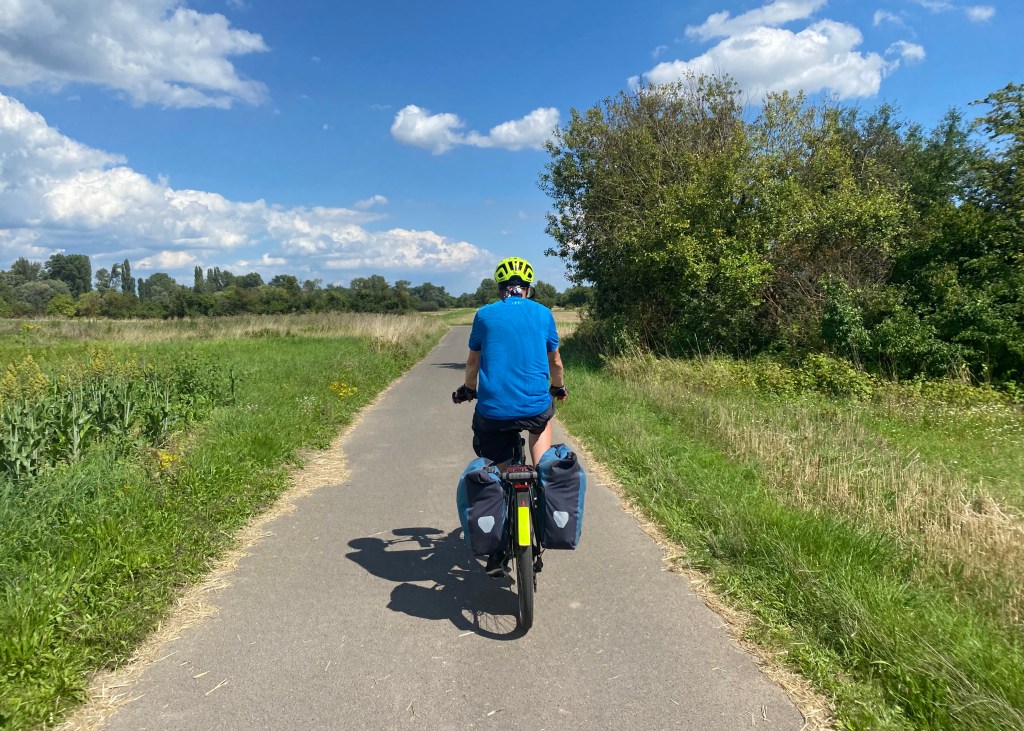
Over 30,000 cyclists enjoy riding this section of the Donau Trail every summer, making it the busiest bicycle path in Europe. It’s a true Cycle Touring Super Highway.

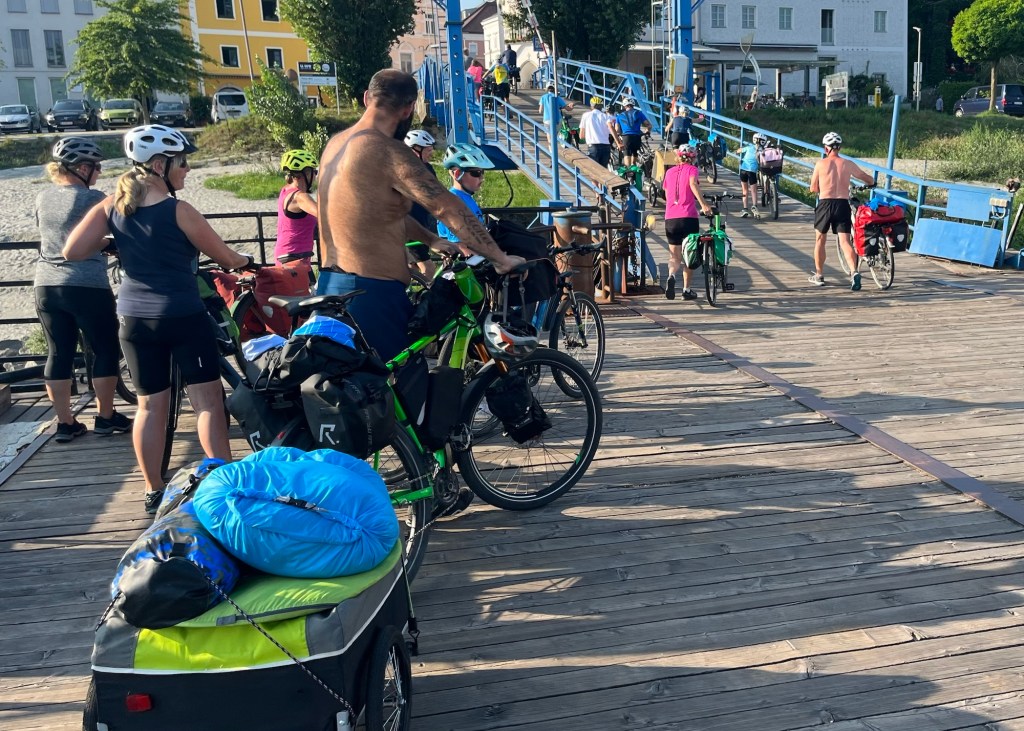
Most cyclists with panniers had read the same instructions as us and were cycling downstream from west to east.

They were a mixed bunch. 

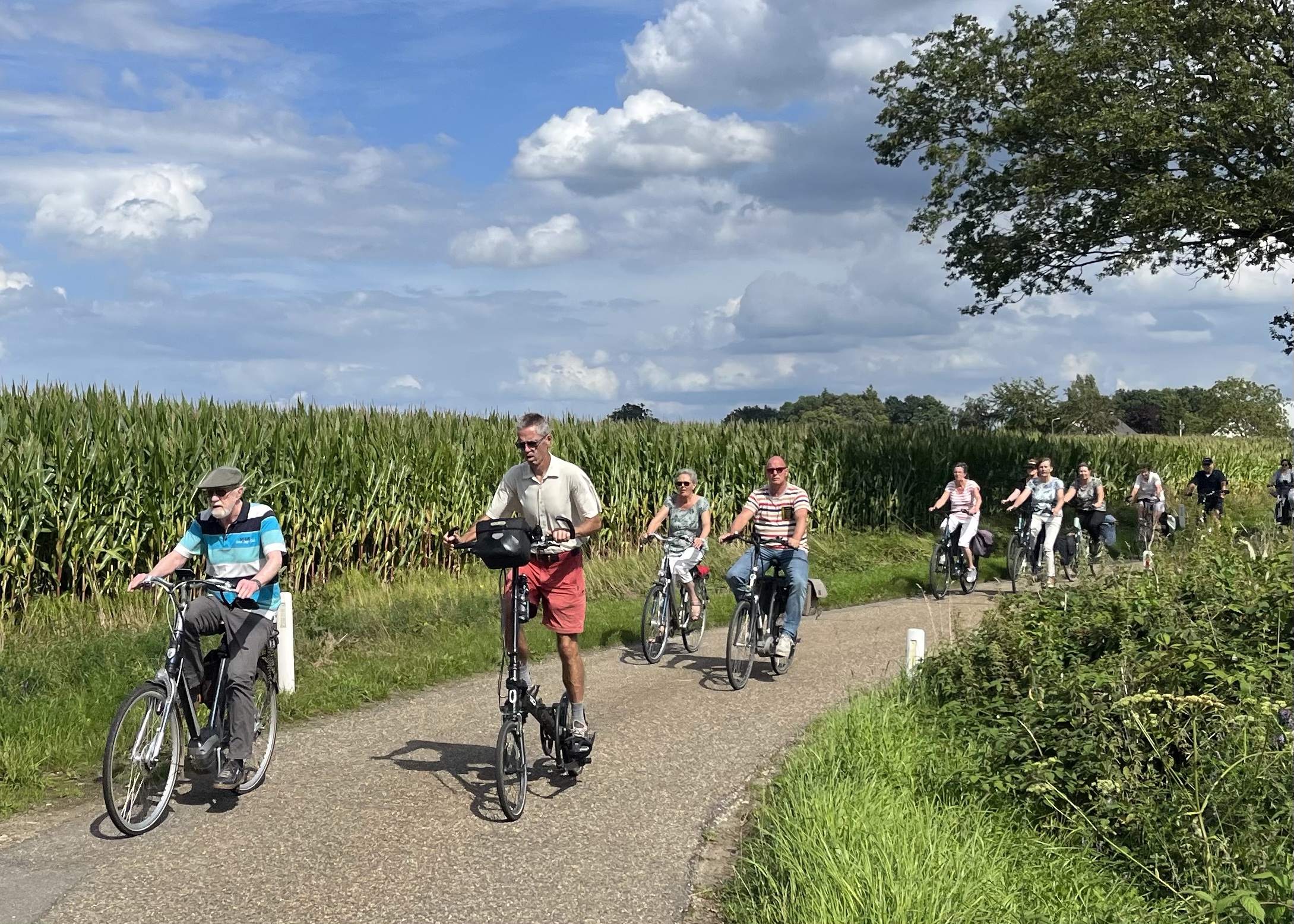
Older couples on e-bikes were in the majority.  But there were also plenty of young families, often towing the family dog along for the ride. We also saw several large organised tours, all with matching bikes, matching panniers and sometimes even matching t-shirts.  

Mum had the luggage, Dad the younger child, Daughter the dog

Once or twice we came across a bare chested e-bike warrior gamely pulling a mountain of camping gear on his trailer and racing ahead of the rest of his group.
E-bike warrior

On the super smooth surface we were able to ride happily along at our new e-bike cruising speed of 24-25 km/hour, just below the point at which the motor cuts out. At this speed we reeled them all in … the oldies, the families, the groups, even the e-bike warriors … effortlessly passing by with a cheery “Guten Morgen” or some such annoying greeting.

Until now!

Humph, we muttered to each other … nobody overtakes us on on e-bikes!

We put in a tiny bit of extra effort and managed to overtake the young couple back, pretending of course that we weren’t trying.

They came past us again.

An e-bike race almost happens in slow motion. All our motors are limited to the same speed and it’s a huge effort to cycle consistently above that cut out point.

The path veered inland so we tucked in behind them, swooping as a pack around hairpin bends, just missing a wiry old gentleman on a rusty black bike.

Then it opened up onto another long straight. Carefully holding the pace we eventually inched past them and held our position for another exhausting four or five kilometres. They were on our back wheels the whole time, like sinister shadows.

As this race was only really happening in our heads … we could decide where the finishing line would be. Feeling pretty knackered, we quickly decided it was the footbridge just ahead.

We pulled over breathing deeply.

They rode on with a grin and a cheery wave. They probably thought it was just the end of the first lap.
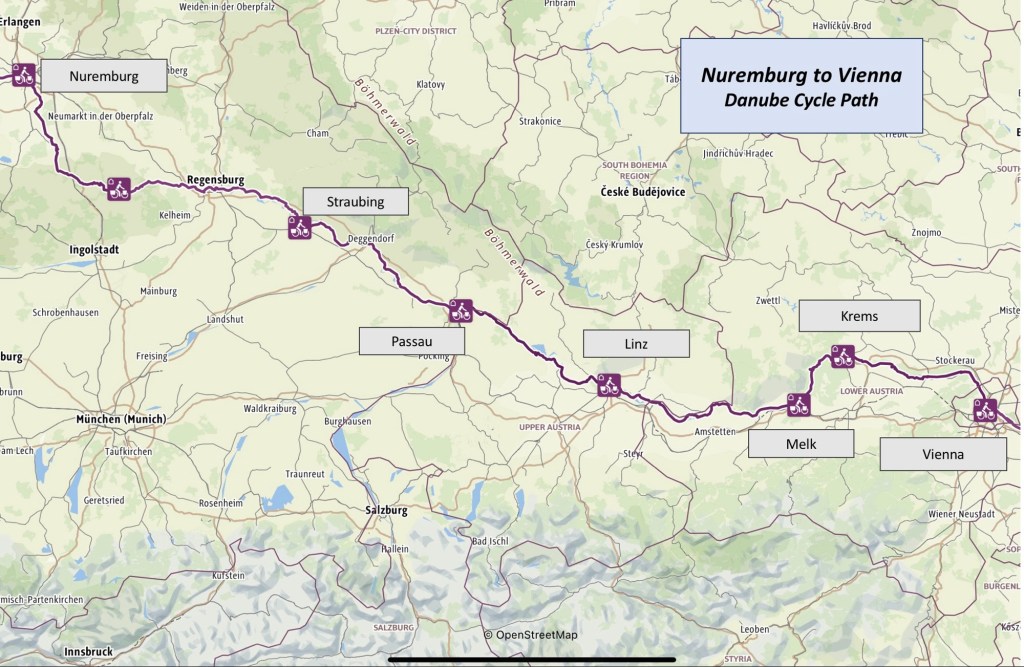
Riding at this e-bike touring speed means that we can cover longer distances for our preferred 4-5 hours of pedalling each day. From Nuremberg to Straubing to Passau to Linz to Melk we leapt down the Danube in 90-100km stages.

The prize for all this effort was a proper tourist cycling day of just 45km, cruising through the beautiful Wachau valley between Melk and Krems.

We started at the stunningly beautiful Melk Abbey, rebuilt in the Baroque style in the early 1700’s and surviving the dissolution of the monasteries that destroyed many of its peers later in the same century.
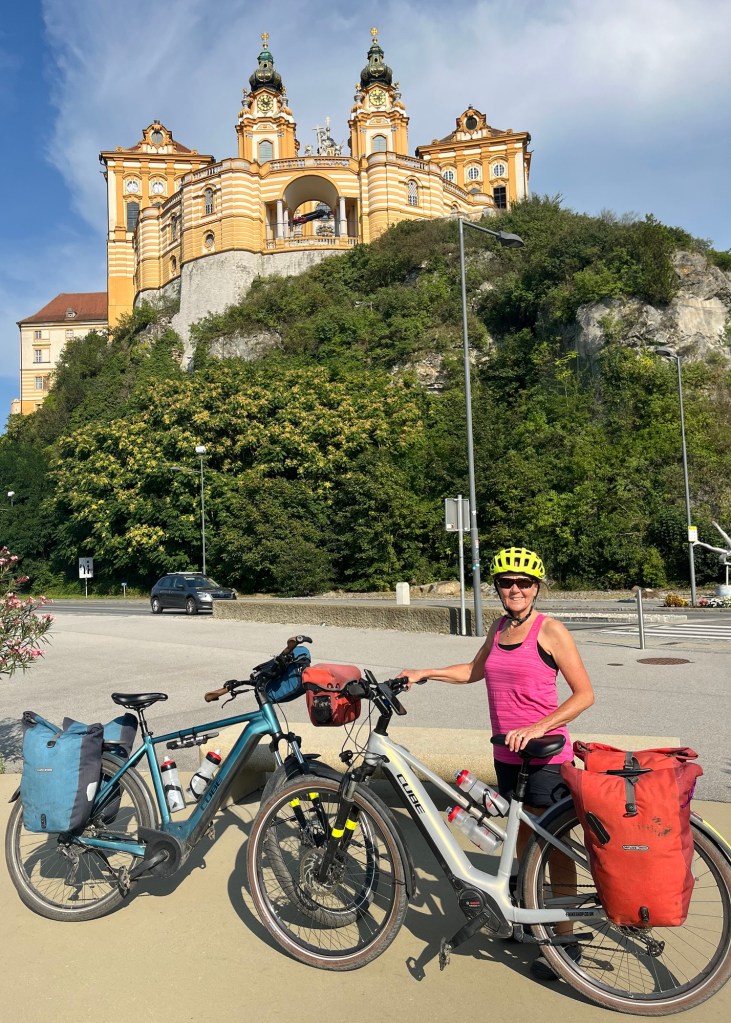
Melk Abbey

This makes it one of the best preserved Baroque buildings in the world. So well preserved that photography is not allowed inside the abbey itself which was great news for us as it meant we could enjoy the building without looking through a sea of camera phones.

But it also means we can’t show you what it looked like. 

So here’s a picture of the cafe instead …
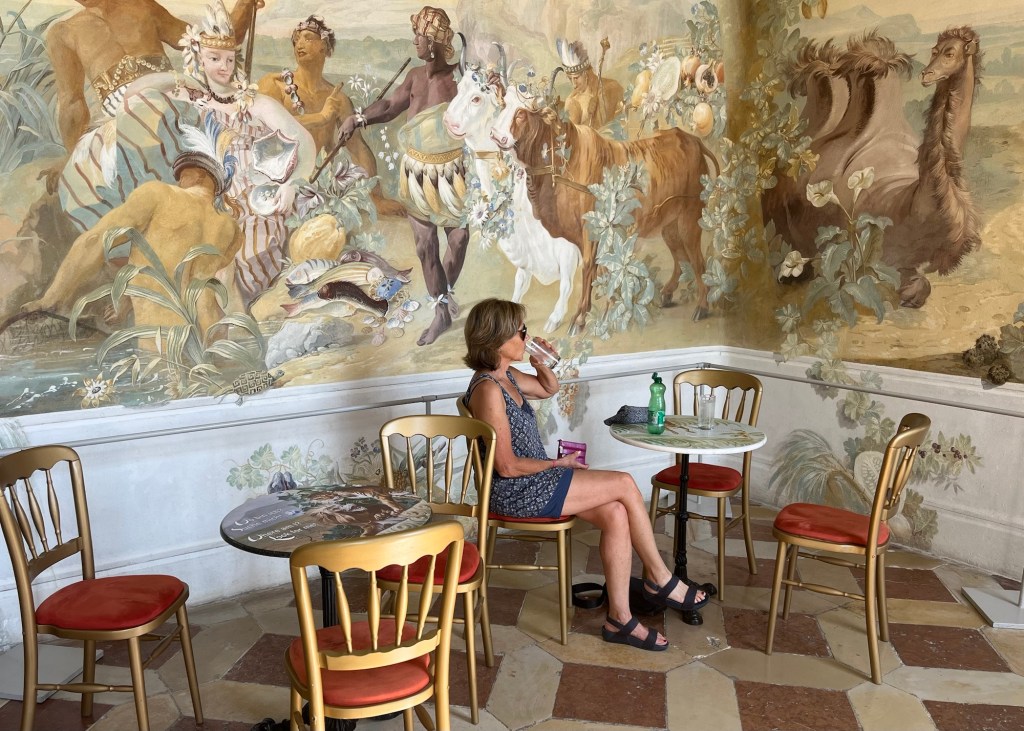
No doubt you can tell from the cafe that the abbey itself was not understated!

Just 6km downstream was another fairytale gem, the 12th century Schloss Schönbühel. No need for camera phones here either as the castle was temporarily closed.

Schloss Schönbühel

The guy at the ticket office was very pleased with his joke, which he must have said a thousand times already … “Das Schloss ist geschlossen!” Ho, ho, ho!

No matter, there was still plenty more fun to be had in the rest of the Wachau. But we had barely pedalled a few kilometres before we discovered the next surprise … the Danube Bike Path was blocked by a landslide.

No way through

That meant for an unexpected treat … a free Danube River Cruise. We’d seen plenty of pleasure boats cruising up and down the river, so imagined we’d be transported in something that looked like this …
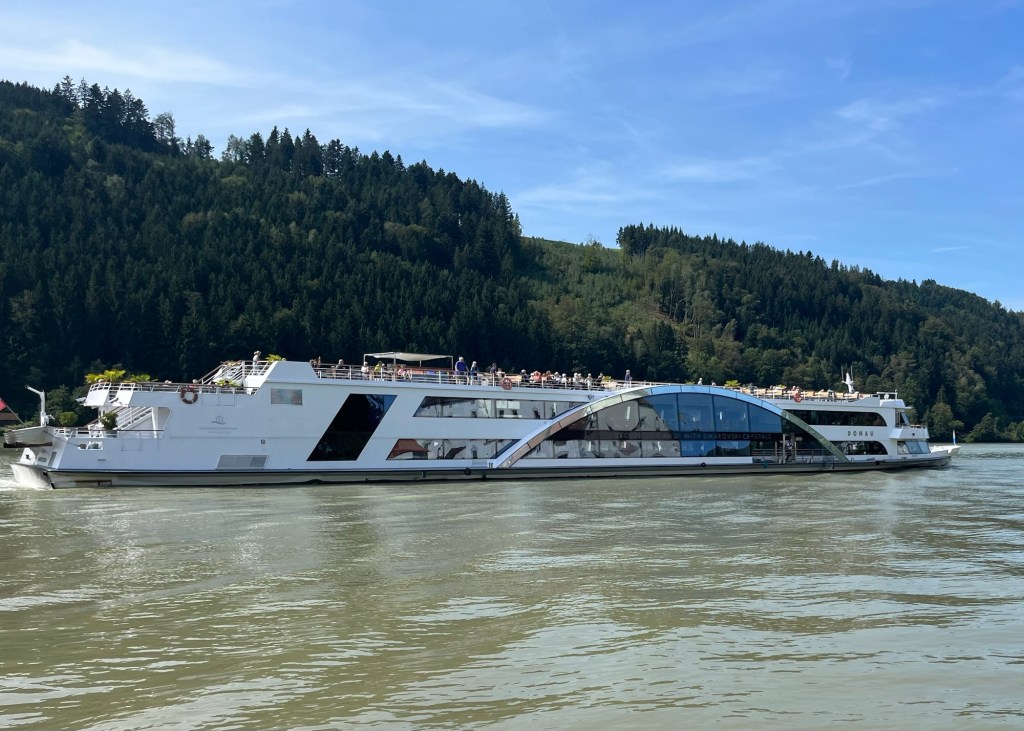
What we got was this …
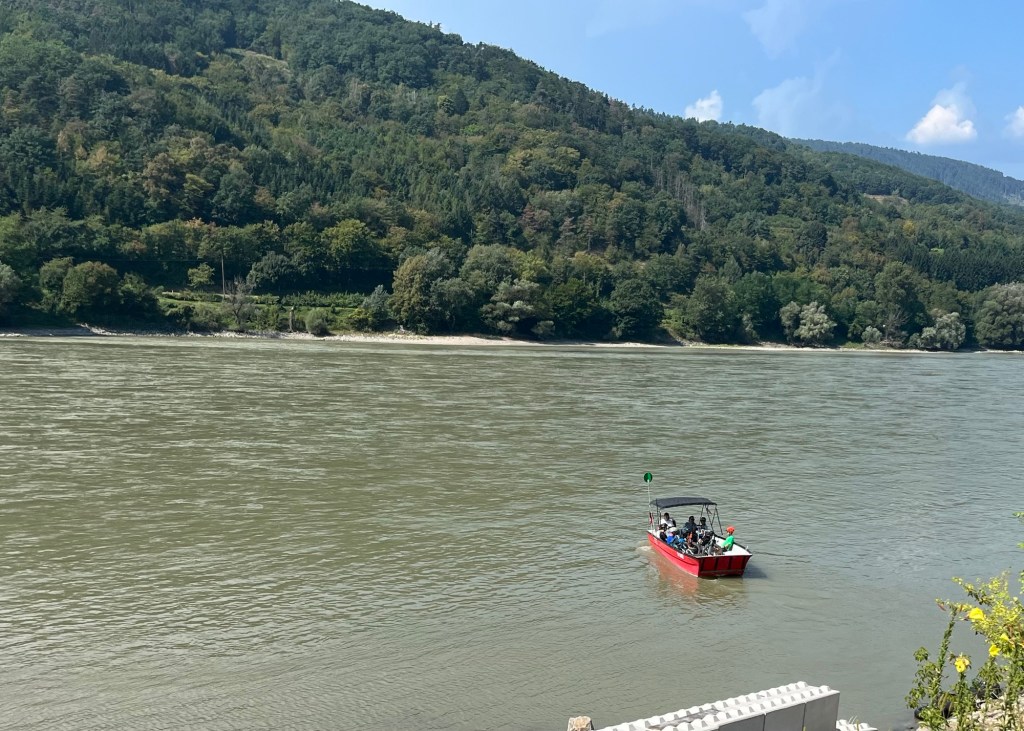
It was still good fun to get out onto the river, if a little bumpy! There was so much wash from the proper river cruisers that our young skipper excitedly declared that these were the biggest waves he’d ever seen on the Danube. EVER!

He seemed to be loving it a lot more than we were.

We were back on the river again as soon as we reached Spitz, this time on a calmer, more familiar vessel. Ancient cable ferries have been taking people and their stuff backwards and forwards across the Danube since the 13th century.
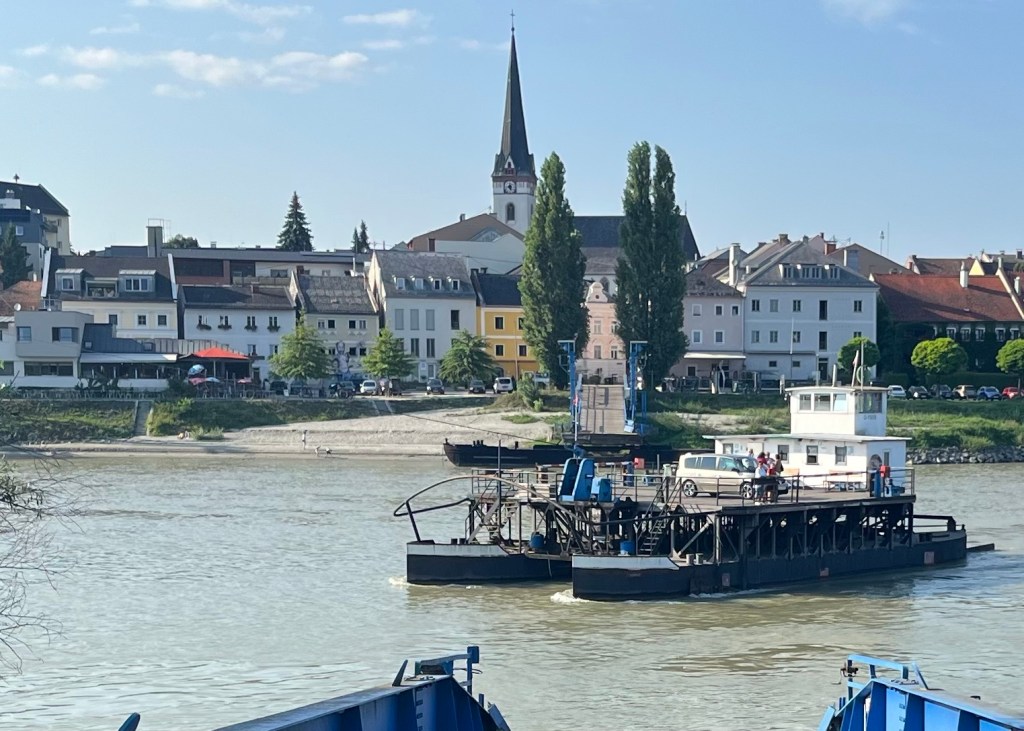
Cable Ferry

They’re simple but very clever. Secured to a cable fixed high above the river a few metres upstream, they just need to angle their twin bows into the current to glide silently across. Perfect eco-friendly transport!
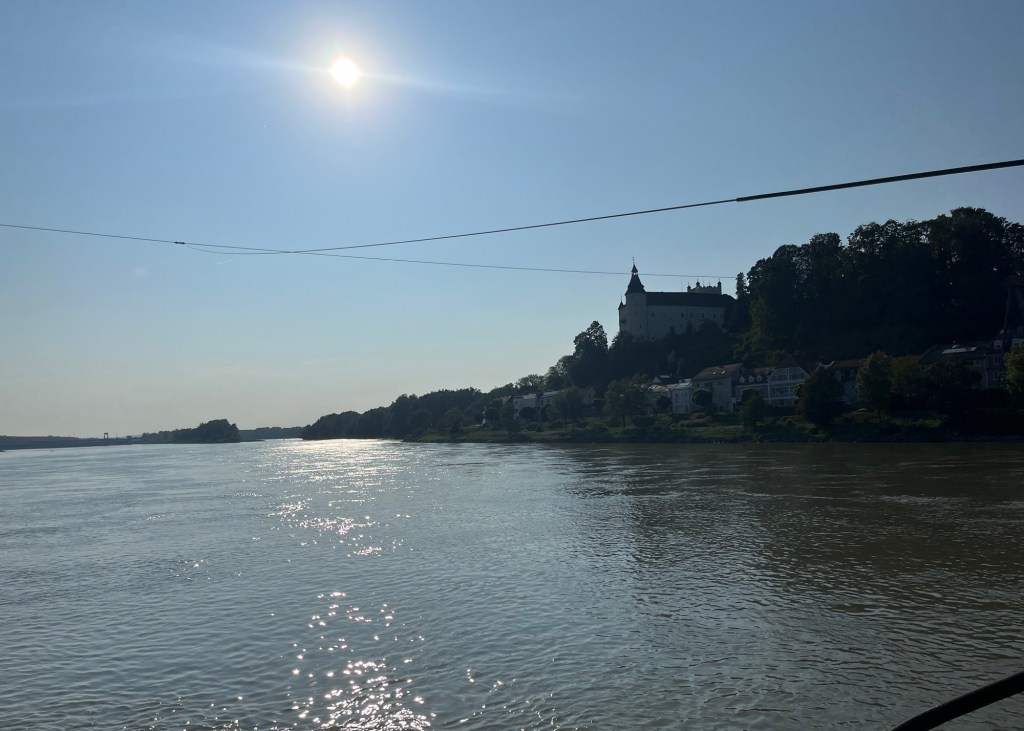
The cable

After spending so much time on the river we fancied a view so we cycled up to the ruins of Hinterhaus Castle. It was the second time we’d gone off piste to get some height and both occasions have required some serious mountain-bike skills to navigate the steep, rocky bike paths.
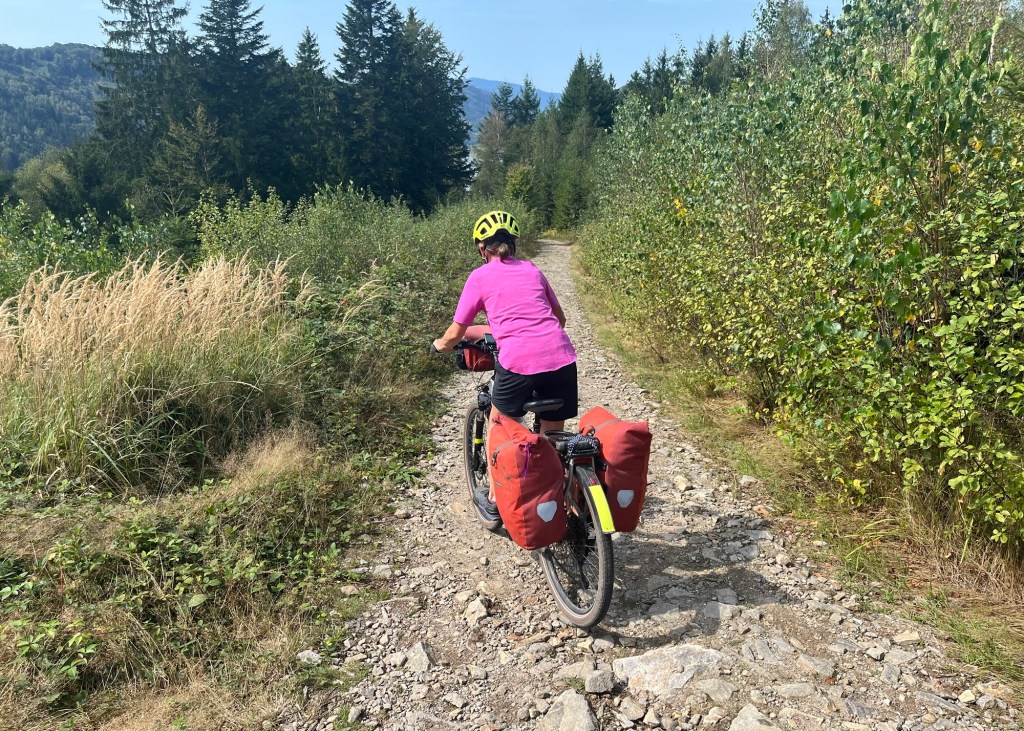
Feeling like Tom Pidcock

The first occasion was an even more rugged climb to enjoy the iconic view of the Schlögener loop between Passau and Linz where the river is forced make a series of 180 degree bends. Tough … but we’re sure you’ll agree the view was worth the effort!

Schlögener Loop

From Hinterhaus castle, we not only had a great view of the Danube, but also of the vine terraces that make the Wachau valley famous. The abundant grapes turn into some of Austria’s finest wines, notably Grüne Veltliner and Riesling. 

Wachau Valley vineyards

As the late afternoon sun mellowed, a ride down through the vineyards and apricot orchards made for a glorious end to a perfect cycling day.

As did sampling both a delicious home made apricot ice-cream and, of course, a glass or two of Wachau’s finest. It would be rude not to!

A week earlier it hadn’t looked so rosy.

We’d arrived at Frank’s bike shop in Nuremberg after an incident free journey and left our car in the capable hands of his team. It was exactly a year since we’d abandoned the ride to Istanbul and it felt quite emotional to be back on exactly the same spot.

We rode off to our hotel literally shrieking with pleasure and relief, much to the alarm of the people who happened to be passing by.

Leaving Frank’s shop

Once again we were on the road. Once again we were heading towards Istanbul.

Once again it didn’t quite turn out like that.

Andy woke up at 5am the next morning with a nasty dose of sickness and diarrhoea. We’ll spare you the details but suffice to say a stomach bug is not a good fit with a bicycle tour! Andy was beginning to feel he had the Nuremberg curse. 

Fortunately it only lasted three days and was gone by the time we reached Passau.
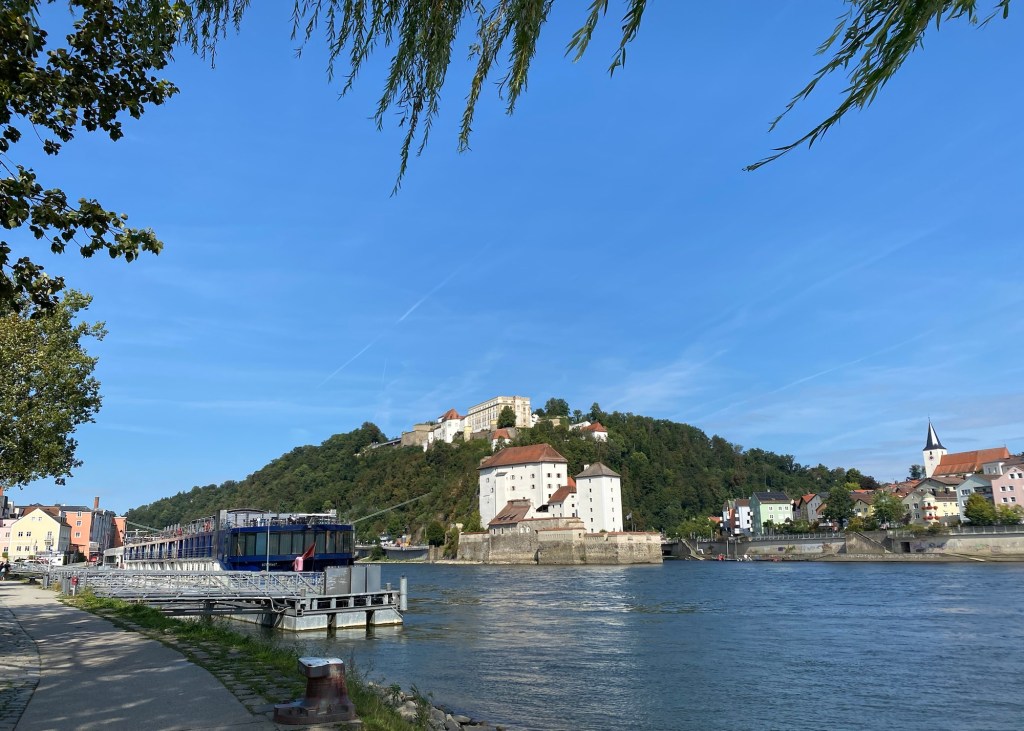
Passau

Our friend, Judith, once made a very insightful comment on this blog about the dubious pleasure of riding down canal paths, something we’ve endured many times. 

“Canal paths are like fish and chips, nice to start with but then too much and rather boring.”

By comparison the Danube River is a royal banquet, a smorgasbord of delights. 

As you cruise down the super smooth cycle path the river swirls gently by, milky jade mixed with cinnamon and ochre undertones … never still, always changing. The trees lining the banks seem to lean forward slightly as if lazily dipping their toes in the water. 
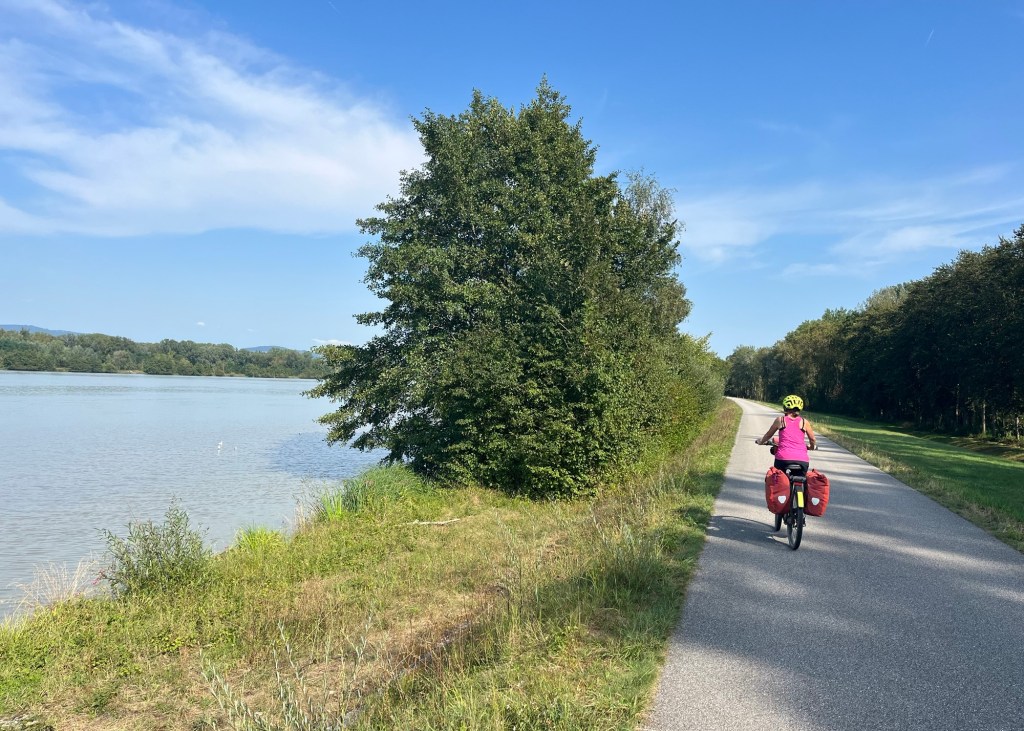
Then to break things up, the path will meander away from the river, up through a wood or around a village. Sometimes it accompanies a railway line, sometimes a road. Sometimes it climbs a little for a broader perspective.

If you wander off the main path it’s not too difficult to find your way back to the river. There are plenty of signs. The Danube is your constant and reliable companion.

Easy to find your way

And the Austrian authorities do love a sign!

One particular sign that kept popping up every few kilometres was to warn us of the danger of a Treppelweg. What could it be? These nasty Treppelwegs were everywhere.

A dangerous current in the river to watch out for? Some kind of vicious animal? The Danube River Monster?

Sometimes the signs were crossed out, helpfully telling us the Treppelweg danger was over. Phew! Then around the corner there lurked another one.
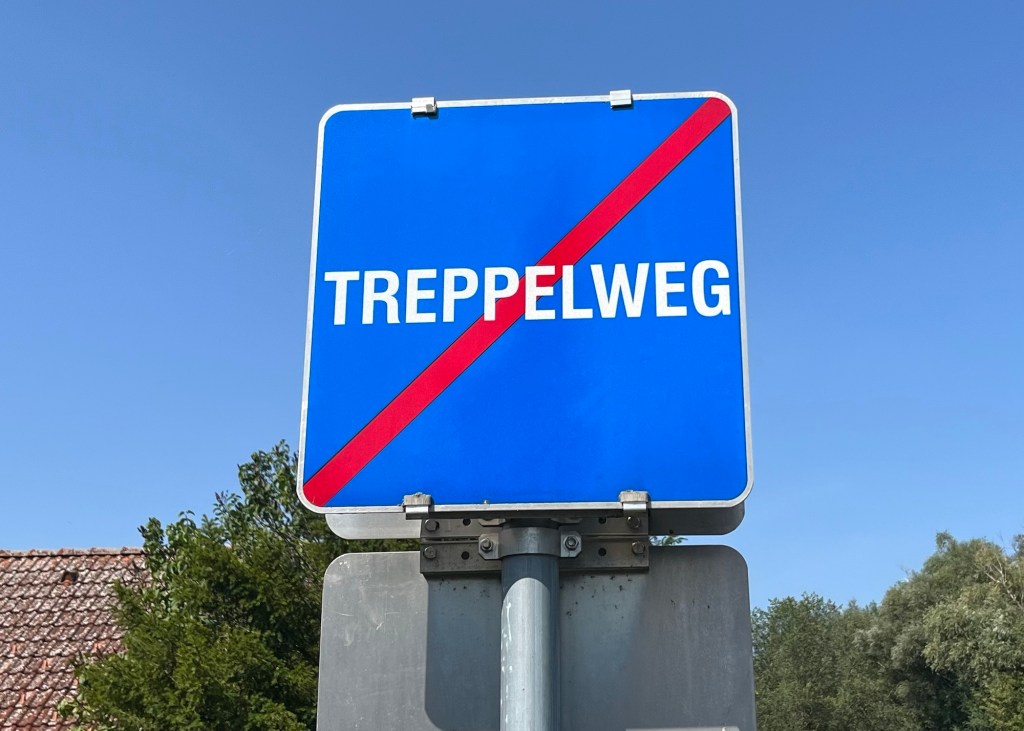
In the end we had to look it up … a Treppelweg is a slope.

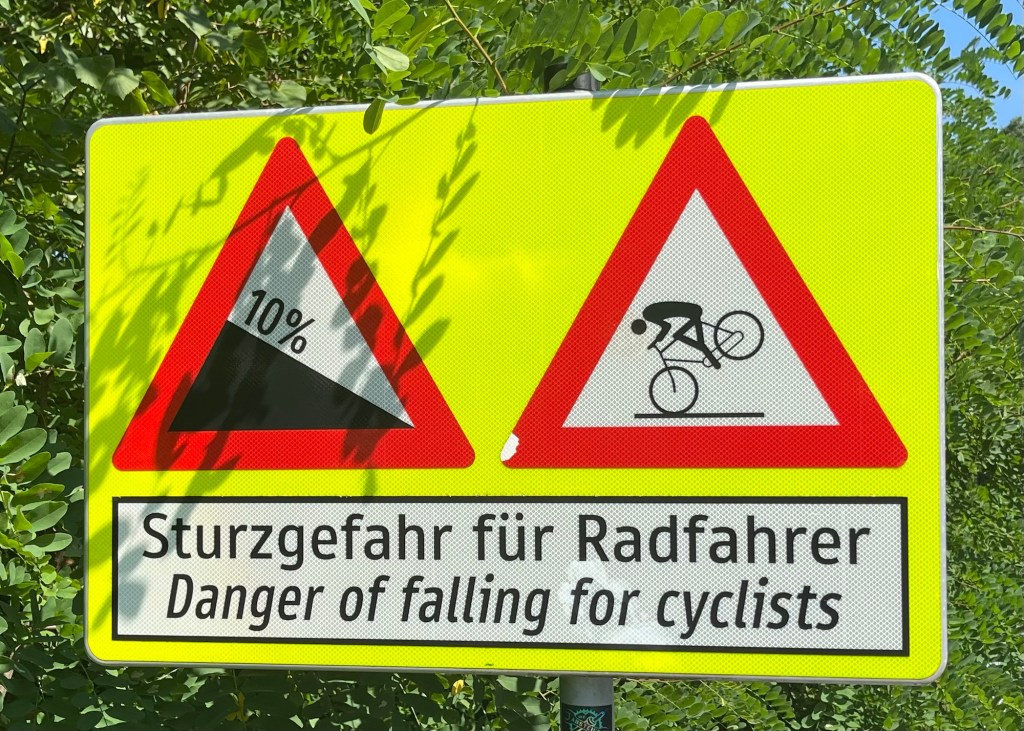
Now this is the very, very, VERY flat Danube Cycle Path, not the Alps, so if there was a slope it was barely perceptible. A gentle dip at most. But thanks for alerting us to the danger Austria!

The warnings became catastrophic the only time there was a proper slope …
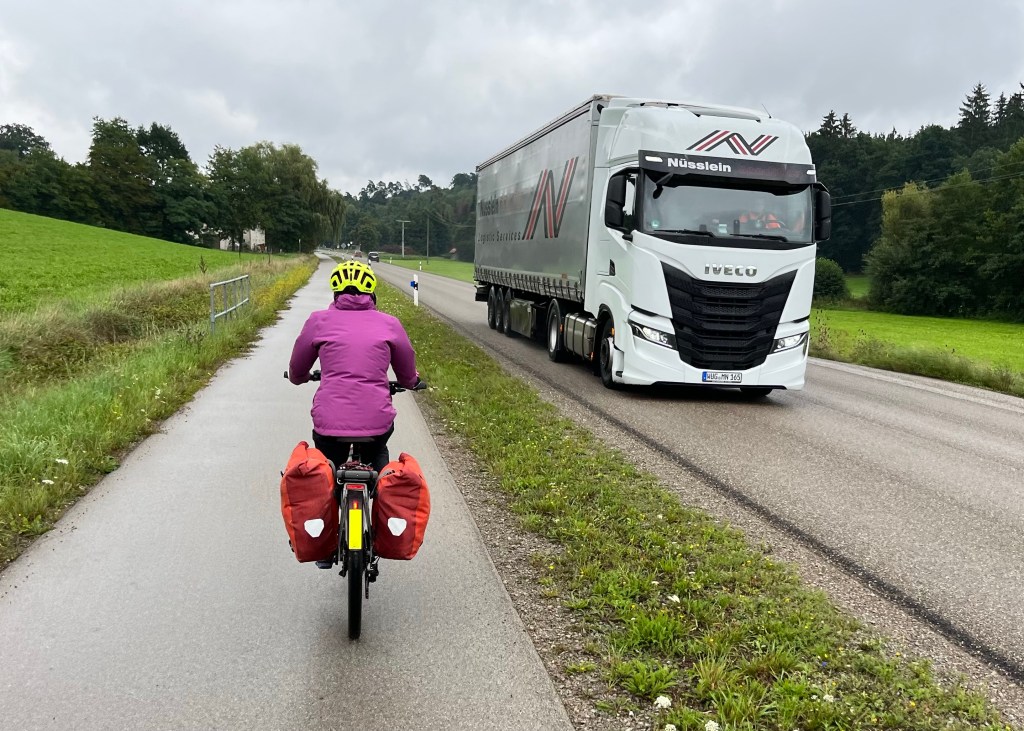
The Danube Cycle Path is not perfect though. Sometimes the path turns to gravel … although it’s very smooth gravel. Once (shock horror) we found ourselves on a road. A proper road with trucks and fast cars zooming past. On this occasion the signs were sadly lacking, making our presence quite a surprise for both cyclists and motorists.

That’s probably because it was flat, if only there had been a Treppelweg there would have been loads of signs!
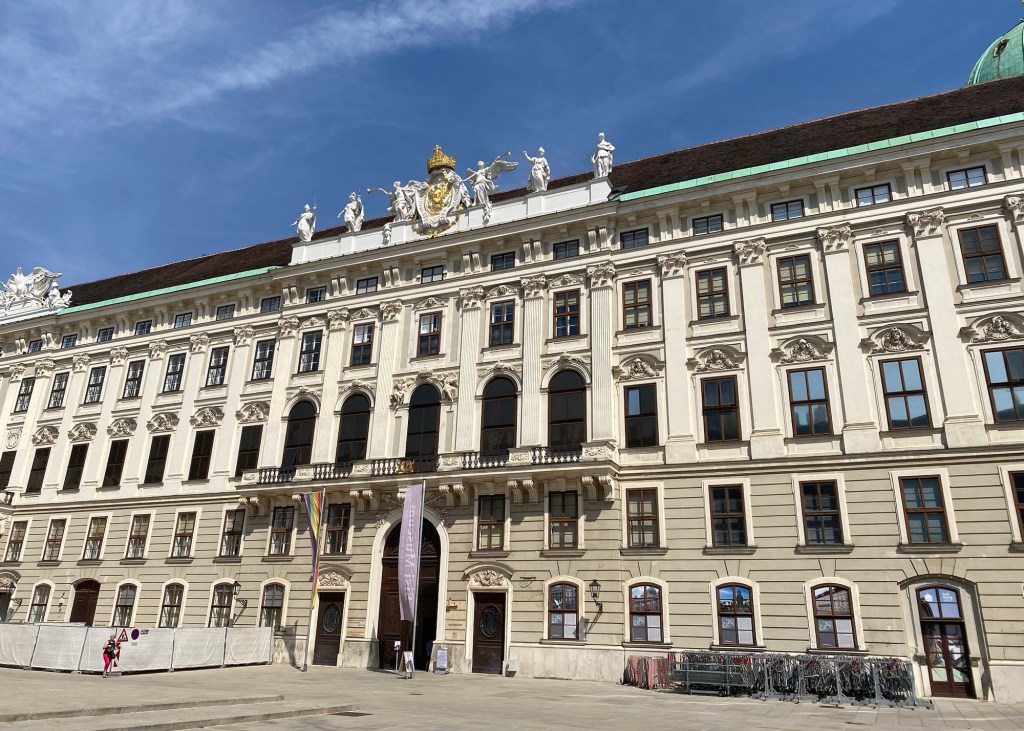
Hofburg Palace, Sisi’s apartments

The destination for most people holidaying on the Danube Cycle Path is Vienna and it’s a real treat, a fantastic city break.

Two people dominated our weekend there … the Empress Elizabeth of Austria and Wolfgang Amadeus Mozart.

Both of them are everywhere. 

Elisabeth, better known as Sisi, is easily Austria’s favourite Empress. She did have an unusual and interesting life. Some of the  highlights that stood out to us include:

She enticed the emperor away from her older sister at the tender age of 15.

She played a pivotal role in negotiating the creation of the Austro-Hungarian empire.

She did gymnastics every morning in her bedroom (you can still see the equipment).

She slept with cloths soaked in cider vinegar to preserve her slim waist and bathed in olive oil to preserve her skin tone.

She fell into a deep depression after her son killed his 17 year old mistress and then shot himself. 

Mozart is Austria’s favourite composer having lived in the city for many of his most productive years, achieving fame but sadly, not fortune.

We listened to an excellent string quartet at the Sala Terrana, the very room in which the maestro himself (allegedly) played.

They were very good

We then ate at the city’s oldest restaurant, the Greichenbeisl (Greek Inn) the very place where maestro (allegedly) enjoyed many a convivial evening. 

His signature is on the ceiling, together with those of Beethoven, Strauss, Schubert, Pavarotti and Phil Collins … so it must be true!

Dinner beneath Mozart’s signature

Empress Sisi once said … “Destination’s are only desirable because a journey lies in-between.”

She could have been summing up the joy of bicycle touring … on the Danube Super Highway or anywhere else. 

Our journey to Budapest is back on that Super Highway.

But we promise not to use it as a race track anymore. After all, we’re not e-bike warriors … well not yet!

Clare and Andy

As we’re continuing the journey from last year, we’ve decided to combine the stats starting from Bath.

Bath to Vienna:

1,938km pedalled (1,204 miles)

10,514m climbed

102 hours in the saddle

This means we’re now about half way from Bath to Istanbul.

Ticker Test Ticked

It’s now twelve months since we abandoned our pan-European e-bike tour due to the havoc that e-biking was playing with Andy’s heart. Fortunately he had a successful catheter ablation for his Atrial Fibrillation (AF) in October and has been healthy ever since.

Now the smooth, silky surface of the Danube cycle path is calling us back. Our e-bikes are desperate to get back onto the most popular bike ride in Europe and to once again point their handlebars in the direction of Istanbul.

And who are we to deny them that pleasure?

Our plan is to drive the bikes back to Nuremberg to exactly the same car park that we stopped in last year, just outside Frank’s bike shop. As the nicest man in the e-bike world, he’s promised to keep an eye our car while we’re away. Having a car in the centre of Europe will certainly make getting home a lot easier at the end of the trip.

We will enjoy the Danube for a couple of weeks as it winds its way through Germany, Austria, Slovakia and northern Hungary before saying goodbye to the river in Budapest. We’ll then head south east to see how far we can get … hopefully all the way across Hungary, Romania, Bulgaria and onto Istanbul!

There’s one thing that’s a little trickier this year though.

In March, both Romania and Bulgaria joined the Schengen Zone for free movement across the EU which only leaves Turkey (of the countries on our route) that’s still outside the bloc. After Bloody Brexit, Brits are only allowed to stay in Schengen countries for a rolling 90 days in every 180 and we’ve already used up some of our allowance with a holiday to Greece in June. This means we’d better not outstay our welcome … or we’ll be facing a difficult discussion with a French customs official on the way home!

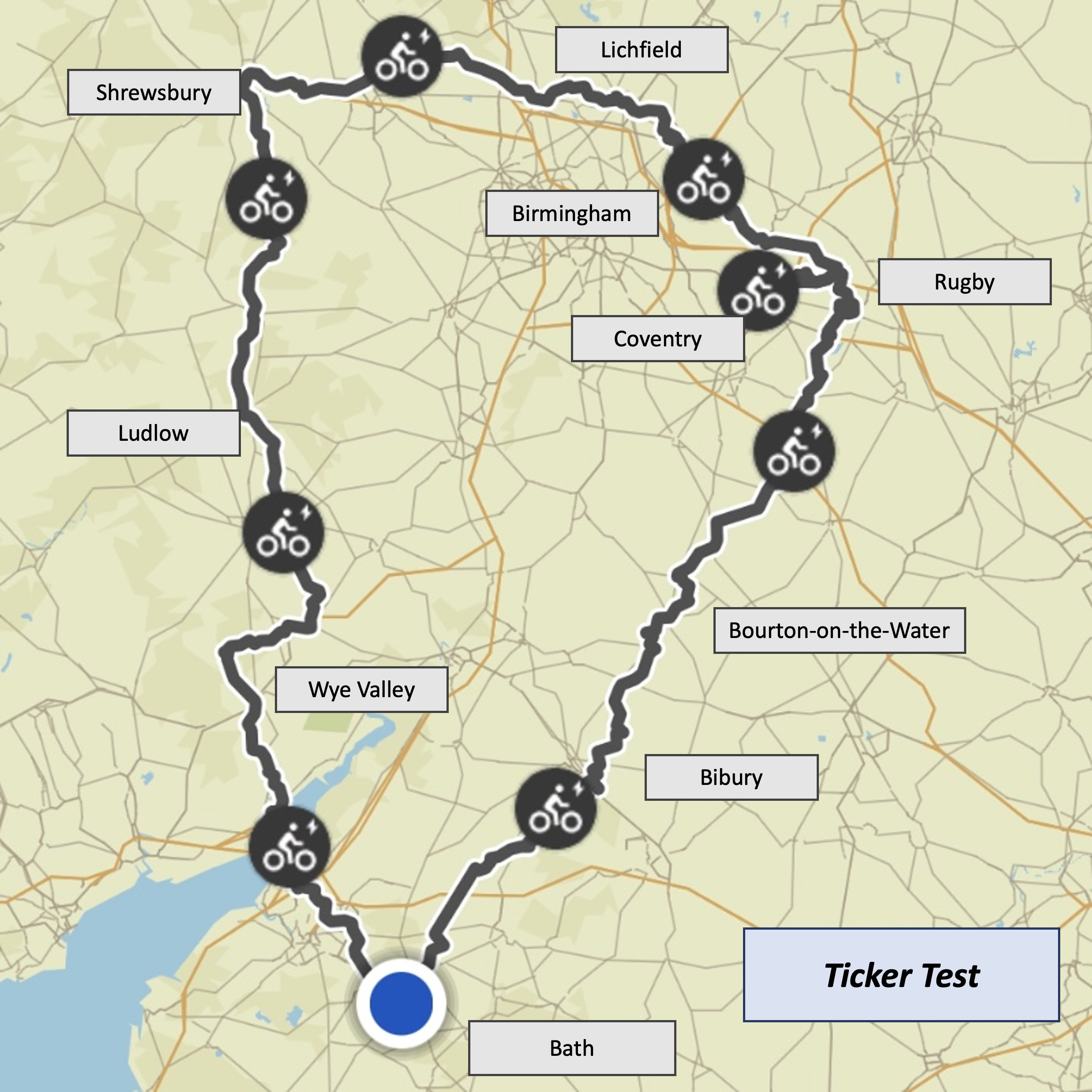
To find out whether the gentle exercise of bicycle touring might re-start Andy’s AF, we went on a ‘Ticker Test’ ride in April, cycling north through the Cotswolds, around the top of Birmingham and back south down the Wye Valley. To make for a proper test we pushed it a bit by riding over 80km a day for eight days straight.

Andy passed with flying colours … not a murmur!

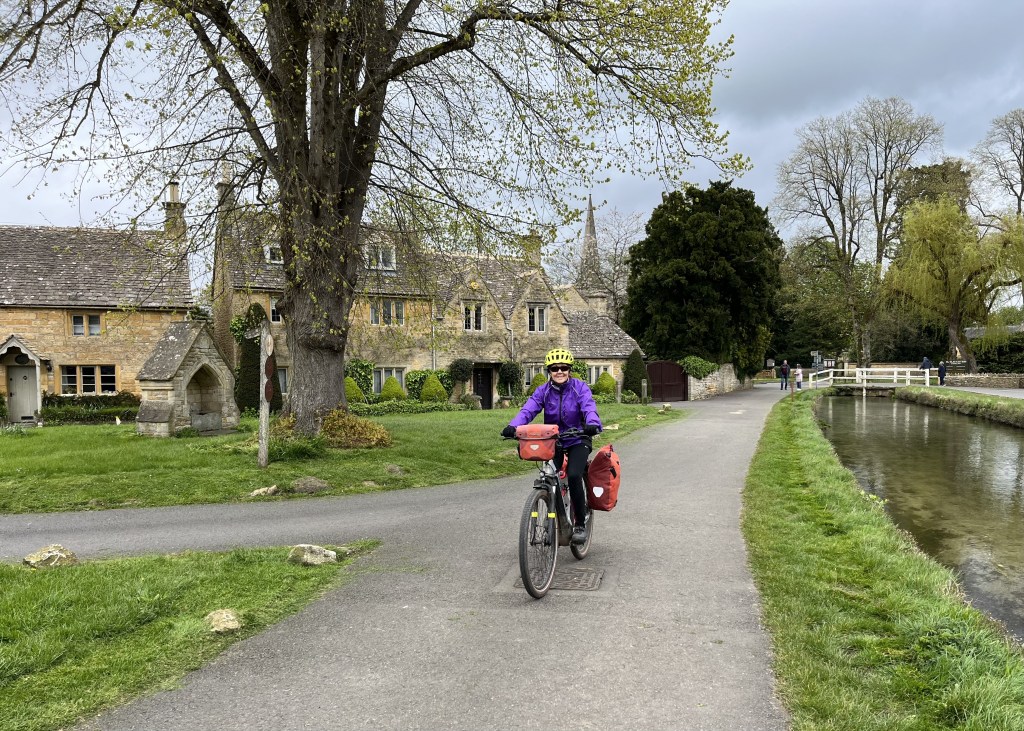
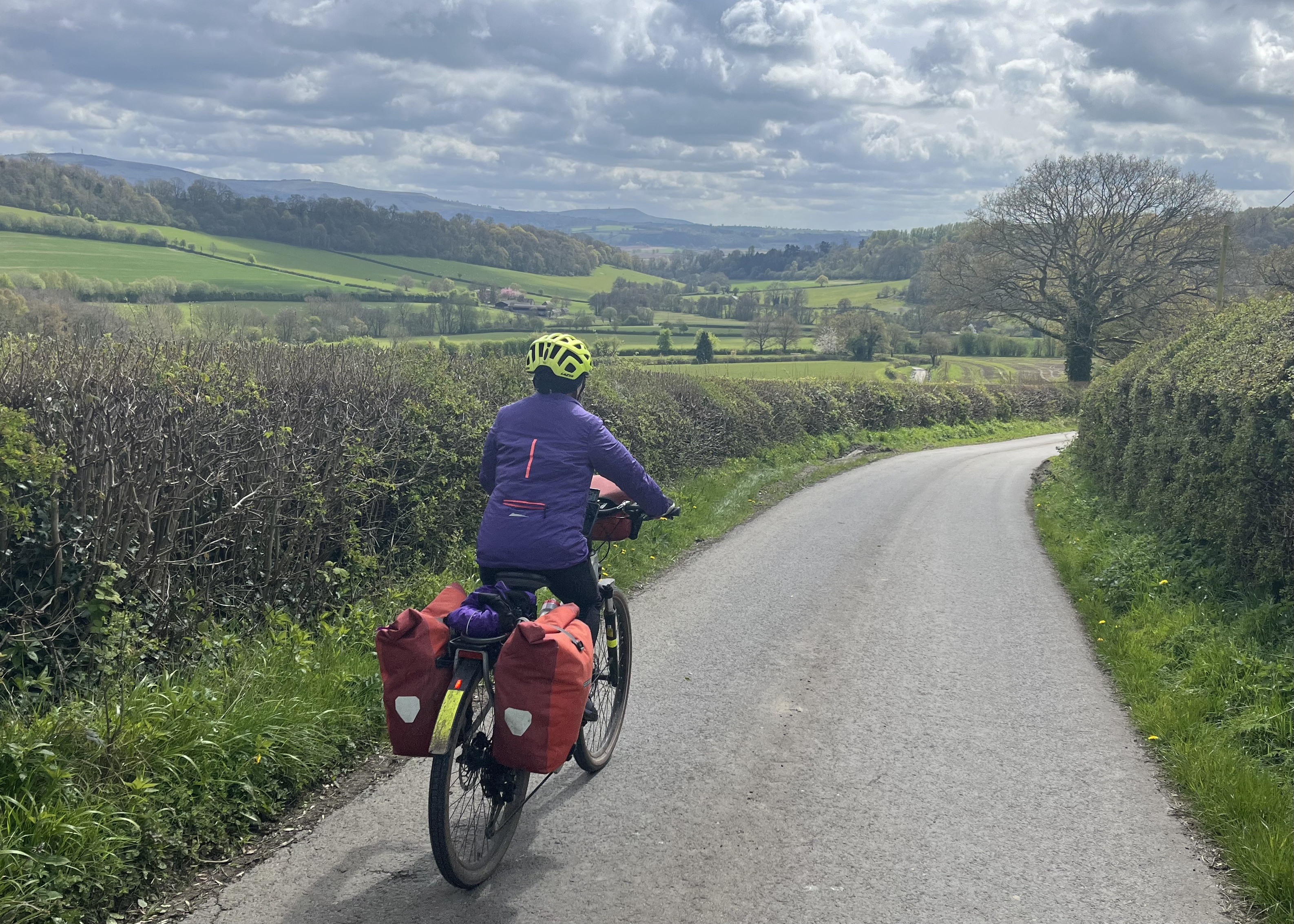
Despite the chilly April weather, it was a lot more enjoyable to be cycling in the UK than we’d expected. Once we left behind Somerset and Wiltshire, both notorious for deep potholes, we found the roads to be smooth and the countryside delightful. From the pretty Cotswold villages of Bibury and Lower Slaughter to the border towns of Shrewsbury and Ludlow in the Welsh Marches it was a green and pleasant land that stretched out ahead of us in the view from our handlebars.

Lower Slaughter

We kept telling each other that we really must go on a long bicycle tour across our own country sometime instead of always heading off to foreign climes. An idea for next year, perhaps?

Cycling through a green and pleasant land

Staying with good friends Jane and David near Rugby, we joined them for a detour into Coventry to visit the ‘new’ Cathedral, completed in 1962 as a symbol of peace and reconciliation after the second world war. It’s a building we’ve wanted to see for a very long time.

The tapestry dominating Coventry Cathedral

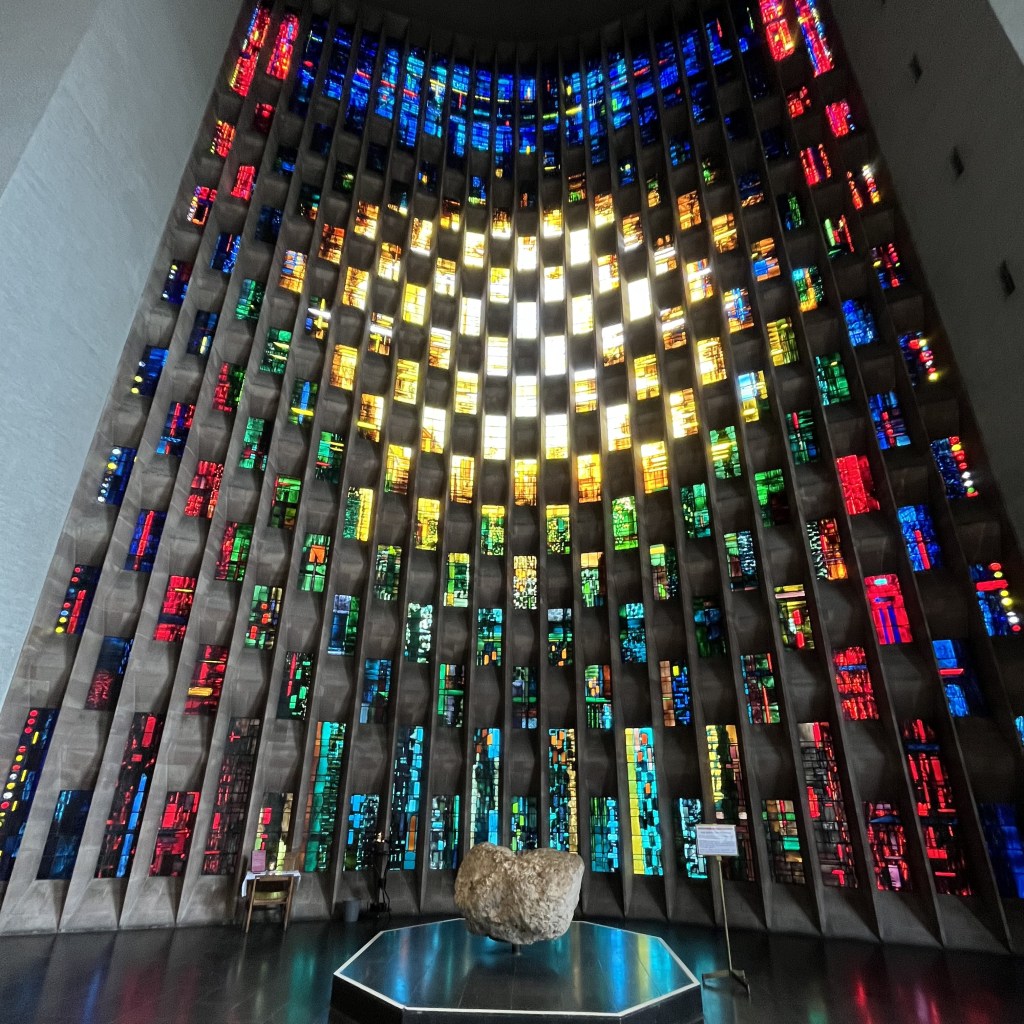
The modernist design of the interior is both striking and peaceful, dominated by Graham Sutherland’s vast tapestry of Christ and by John Piper’s colourful Bapistry Window.

Bapistry Window

When asked whether the window symbolised anything in particular, Piper is reported to have replied “No not really … other than a burst of glory!”

Just a day later, we were sitting outside another remarkable cathedral in Lichfield, famous for the carved figures of kings, queens and saints that adorn the exterior. We arrived just in time for Sunday evensong, made even more special as the choristers were accompanied by an organ that Clare’s grandfather used to regularly play.

Remembering her Grandfather at Lichfield Cathedral

In Ludlow we were surprised when our guest house hosts urged us to be sure to book a restaurant for the evening, even though it was only a Wednesday. Undeterred we took our chances and were lucky to get the last two seats in an Indian restaurant where the chef and the staff travel out from Birmingham every evening to serve up their famous Birmingham ‘Balti’ curries to the people of Shropshire.

It was only when some friends messaged to say how fortunate we were to stay in Ludlow and enjoy its famous fine dining scene that we understood the need to book ahead. We could only reply that “it was a very fine Balti” … and indeed it was!

Ludlow, famous for fine dining

Keen to make up for it, Andy suggested a detour the following afternoon when we reached Ross-on-Wye, turning right and riding for 25km out of our way just over the border into Wales. We’d be surprised if many people go so far out of their way for the simple pleasure of a meal in Wales but this one was well worth the extra kilometres. Both the meal and the overnight stay at the Bell in Skenfrith ended up being a highlight of the whole trip!

Crossing the border … just for dinner

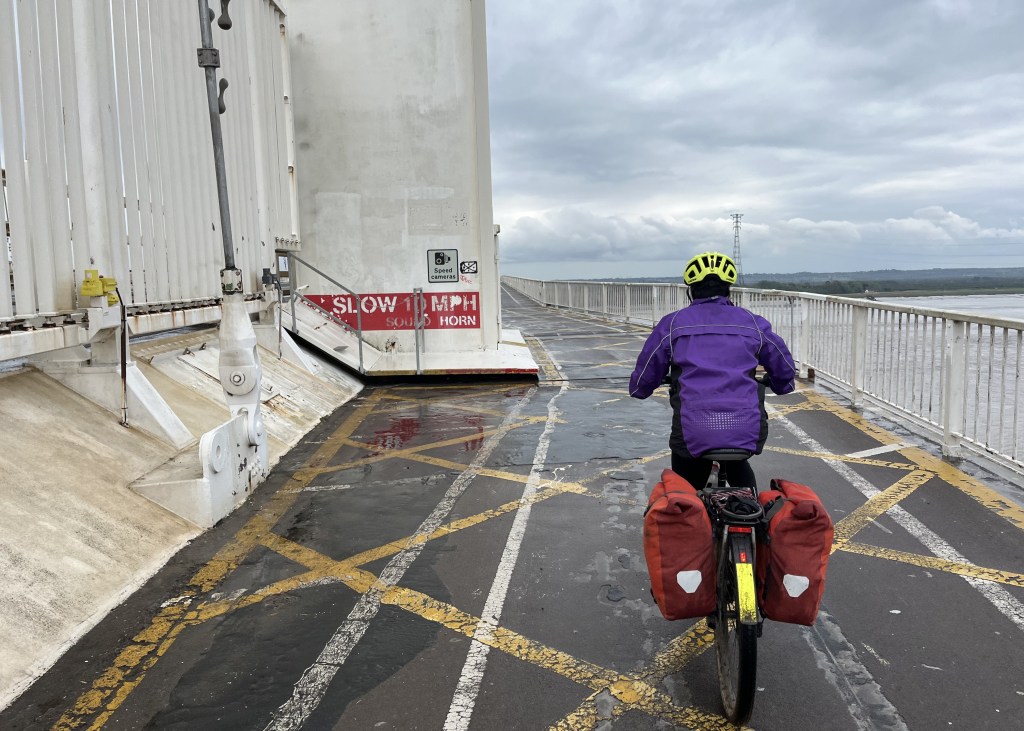
From there we had the fun experience of crossing the old Severn Bridge back into England, but were surprised to find speed cameras on the cycle path and a leisurely speed limit of just 10mph. Fortunately, after all that food, it wasn’t too difficult for us to pedal so slowly!

Can anyone sound a horn on a bike?

So the Ticker Test was well ticked back in April. The e-bikes are now chomping at the bit to get going and we’re now all set to head back to the Danube in a few days time.
But to prepare properly, Andy has been taking every precaution with another vital part of his bicycling anatomy … his bottom.

As well as the AF, Andy suffered from some painful saddle sores for the first time last year, probably because his new e-bike had a slightly different set-up to his trusty old Ridgeback, on whose saddle he’d ridden for over 14,500 km without the merest hint of an annoying pimple.

Firstly, he’s invested in a big tub of Sudocrem, a UK brand of nappy rash cream beloved by babies and new parents alike.

Secondly, he’s been for a specialist bike fit to make sure his position on the bike is as comfortable as possible … something he now wishes he’d done years ago. If any of our Bath based friends fancy giving it a try, we would thoroughly recommend Jasper at Physio Impulse. As an Osteopath he’s unusual amongst bike fitters at being more focused on comfort than on power and performance.

It’s amazing how much difference some small adjustments can make

And thirdly, Andy’s found some new touring cycling shorts and undershorts. After much research he’s bought them from Corinne Dennis, a small company based in Cornwall. Their clothing may not be the most fashionable but it’s specifically aimed at touring cyclists seeking maximum comfort over long distances, on and off the bike. No lycra, no tight leg grips and padding made from soft, supple fleece.

New cycling shorts mean that Andy’s last piece of clothing from our first bicycle tour to Barcelona in 2016 has eventually bitten the dust … his favourite old shorts once held up by safety pins, frequently repaired but still missing a working fly zipper for several years.

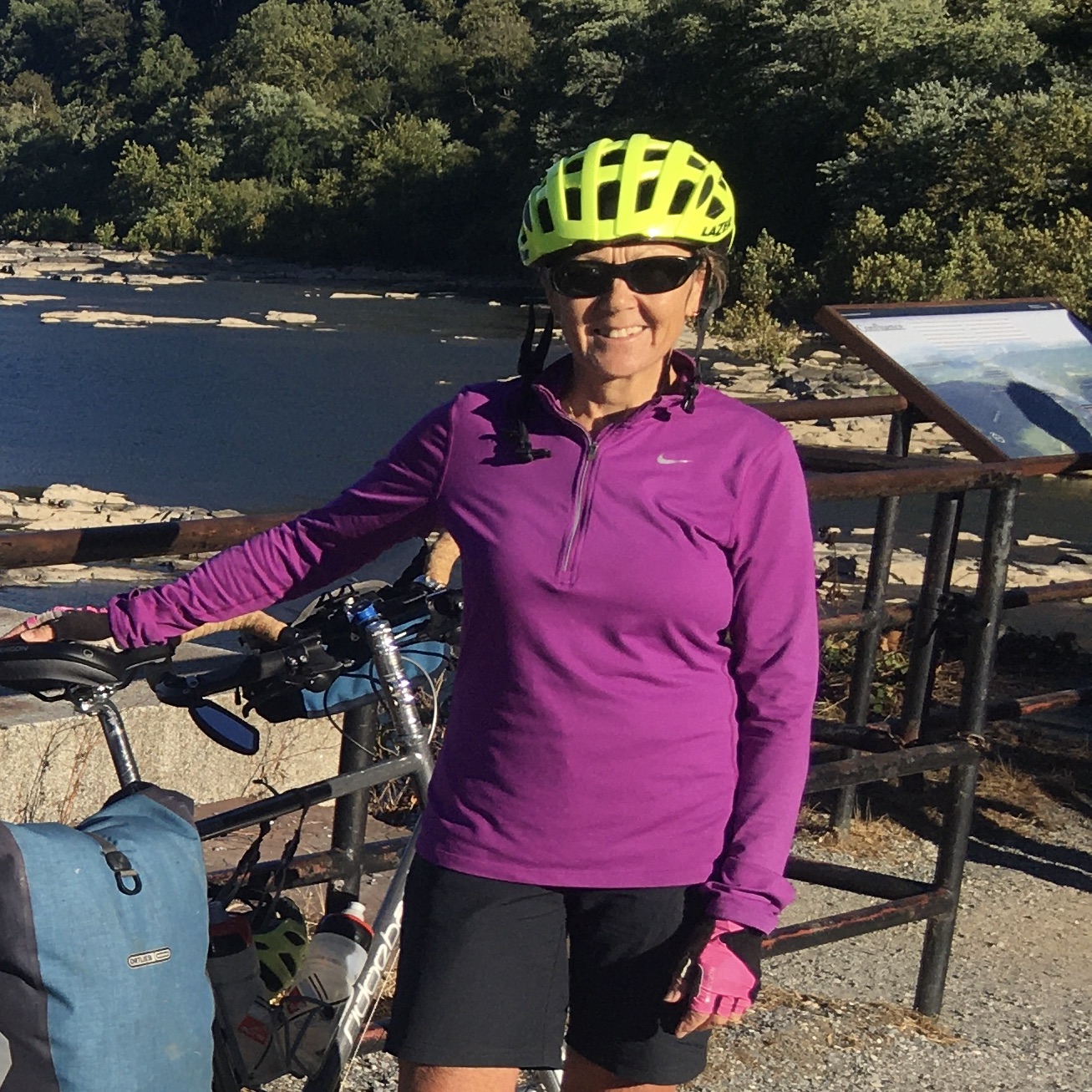
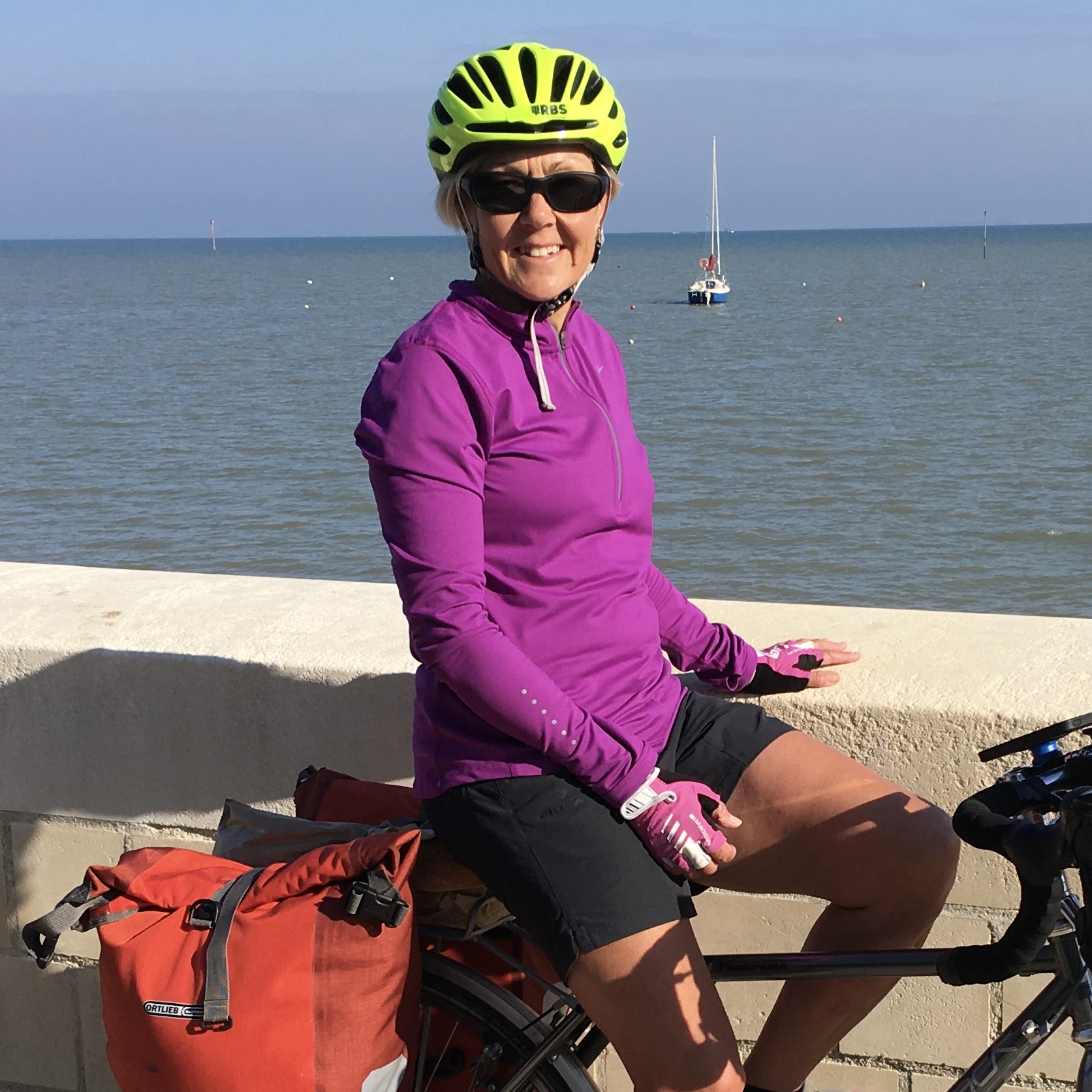
This means that Clare has empathically won the make-your-kit-last-a-long-time competition. She might have ditched the hairdryer a long while ago but she’s still wearing the same cycling tops, shorts and sunglasses that she wore to Barcelona.

One of these photos is from 2016, the other is from 2022. Can you tell which is which? Answers on a postcard please … or in the comments below.

Clare and Andy

By the Rivers of Germany

It’s a calm, sunny afternoon and we have just reached the river Rhine. We’re cruising along on a beautifully smooth radweg (cycle path), slowly overtaking an aak (river barge) and gazing up at a schloss (castle) on the hillside above.

Two touring cyclists are coming towards us. Slowing down, we beam at them, wondering if they fancy a chat. “Schöne morgen!” (lovely morning) we call out … but only receive a cursory nod in return.

No bother … another couple of well-panniered cyclists are just behind them. “Hallo!” (hello) we smile. Again, just a nod.

Then another couple and another and another. All enjoying this gorgeous curve of the Rhine on this gorgeous day. All just nodding or staring silently ahead.

Everywhere else we’ve travelled, it’s been an event to come across another touring cyclist, a cause for celebration, a chance to stop and swap tales of the road or at the very, very least to smile, wave and call out “Bonne Route” or “Happy Travels” or some such.

Except for here.

And before you think it, it’s not because they’re German.

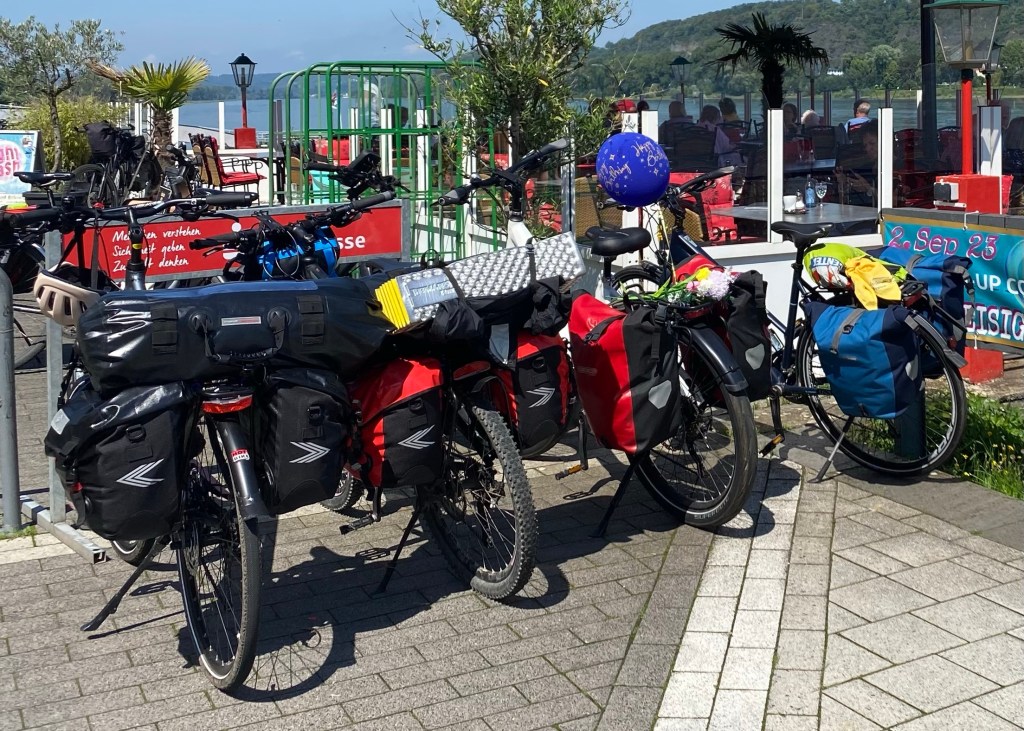
Lots of touring bikes

It’s simply because there are so many people pedalling down the Rhine that it’s impossible to greet everyone. For us too … by the time the fifteenth couple had cruised past us we had become nodding dogs. By the end of the day we wondered if our heads would still be attached to our shoulders.

We were the odd ones out. Cycling from north to south. Upstream. Very, very slightly uphill.

Most people prefer to ride downstream so we had a lot more touring cyclists to greet … sorry, nod to … sorry, stare silently ahead.

Practising the stare

This part of the river from Koblenz to Mainz is known as the ‘Romantic Rhine’. So picturesque, it inspired many an early 19th century romantic, most notably the painter William Turner who used it as the subject for many of his greatest landscapes.

We’ve both fallen in love with e-bike touring and are now fully embracing the ‘E’ in e-bike!

No more do we say that we “only ever use Eco”. In fact, we haven’t seen the Green Eco (level 1) light for weeks!

Instead we cruise along in Blue (level 2) and help ourselves to generous dollops of Purple (level 3). There are many good reasons for a Purple Boost … the incline increasing … the merest hint of gravel … feeling slightly tired at the end of the day. It’s a wonderful feeling … like being given a little push.

And a more serious hill? Bang it straight into Red (level 4)!

Enjoying the Red Zone

A good trick on flat river paths is to cruise along at 25km/hour, just below the speed at which the power cuts out. It’s easy to maintain momentum without working too hard.

So far we’ve averaged 82km a day, which means we’re riding for between 4 and 5 hours. Both of us love the amount of exercise this gives us. It’s a moderate but sustained effort but we’re never out of breath.

To compare it to normal bikes, let’s say regular bike touring exercise is on a scale of 1 to 5 where 1=pottering through a village looking at the sights, 3=riding at a good speed on the flat and 5=climbing a steep hill in the hot sun.

E-bike touring is always between 1 and 3, whatever the conditions. Clare does not miss the 4’s and 5’s!

Before reaching the Rhine we cycled through the old forests of the Eifel National Park … a very different experience. As an 87km day with 1340m of climbing it was a good test, both for us and for our batteries.

The Eifel

The bikes give you lots of information including a remaining range indicator but we prefer to keep an eye on how much of the battery we’ve used v how far we’ve travelled.

On flat days we get over 2km for every 1% of battery. On that hilly day through the Eifel, Andy got just under 1km for every 1%, which still gave him a range of over 90km.

So he wasn’t worried when his battery almost ran out near the end of the ride. As we pulled up outside our guest house in Bad Munstereifel, he had just 4% left!

Well judged, thought Andy, a good test.

Just as well there wasn’t a dreadful detour, thought Clare.

An orange light is bad news

As long as the e-bikes keep working!

Clare’s motor suddenly stopped as we were leaving Mainz, displaying an alarming error code.

The UK shop we bought the bikes from told us it was a software issue and that we couldn’t fix it ourselves. We did all the normal computer things … turning it on and off again, pulling the lead out and pushing it in again.

No luck!

Spirits sinking, we slowly rode back towards an e-bike shop we’d seen in town when Clare decided to try one last thing. She turned it on and off whilst the bike was actually moving.

Miraculously it worked and it’s been working ever since!

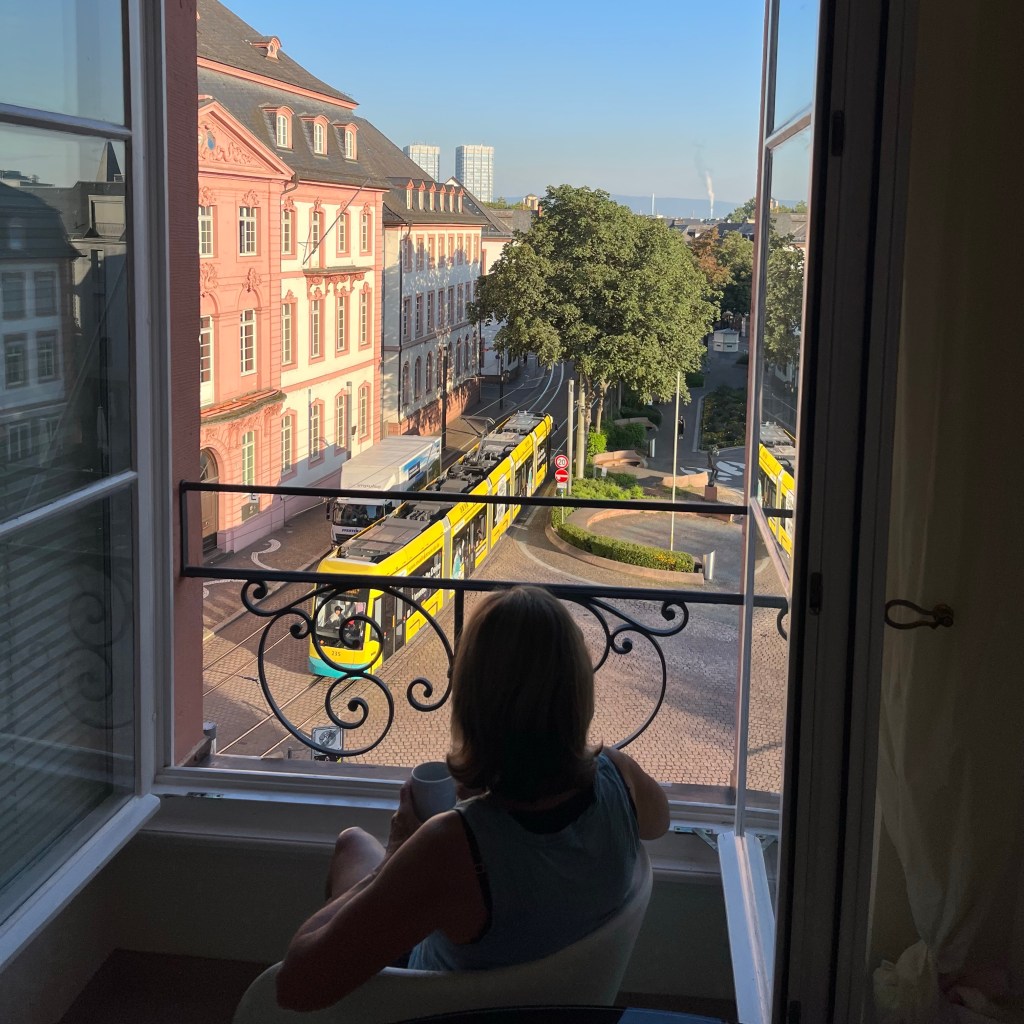
Early morning coffee in our Mainz apartment

From Mainz we headed cross country, first to Heidelberg and then through Franconian Bavaria to Rothenburg ob der Tauber and on to Nuremburg.

It was joyful. Proper bicycle touring in rolling hills, through lush meadows, along forests trails and down winding country backroads that led us from one chocolate box village to another. Secretly we were both delighted to get away from the river for a while.

We began to properly appreciate what a superb country Germany is for Radwandern (literally bicycle wandering) with more than 70,000km of well-signposted long-distance cycle trails criss-crossing the country.

One of many Radwegs

On the rare occasions we found ourselves on the road it was usually because we hadn’t spotted the radweg!

Even country roads have a dedicated cycle track alongside

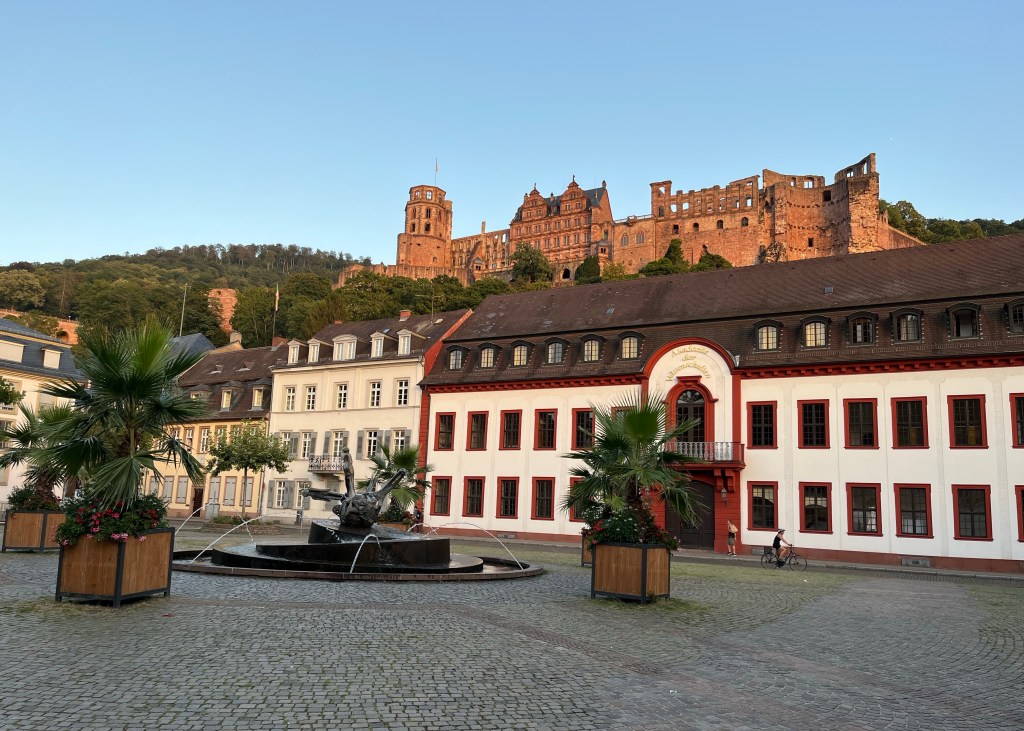
Heidelberg is as beautiful as it’s reputation, a real highlight.

Surrounded by forest and on a beautiful riverside setting beside the Neckar, it’s Germany’s oldest and most famous university town, renowned for its baroque Altstadt and evocative half-ruined hilltop castle.

Heidelberg Castle

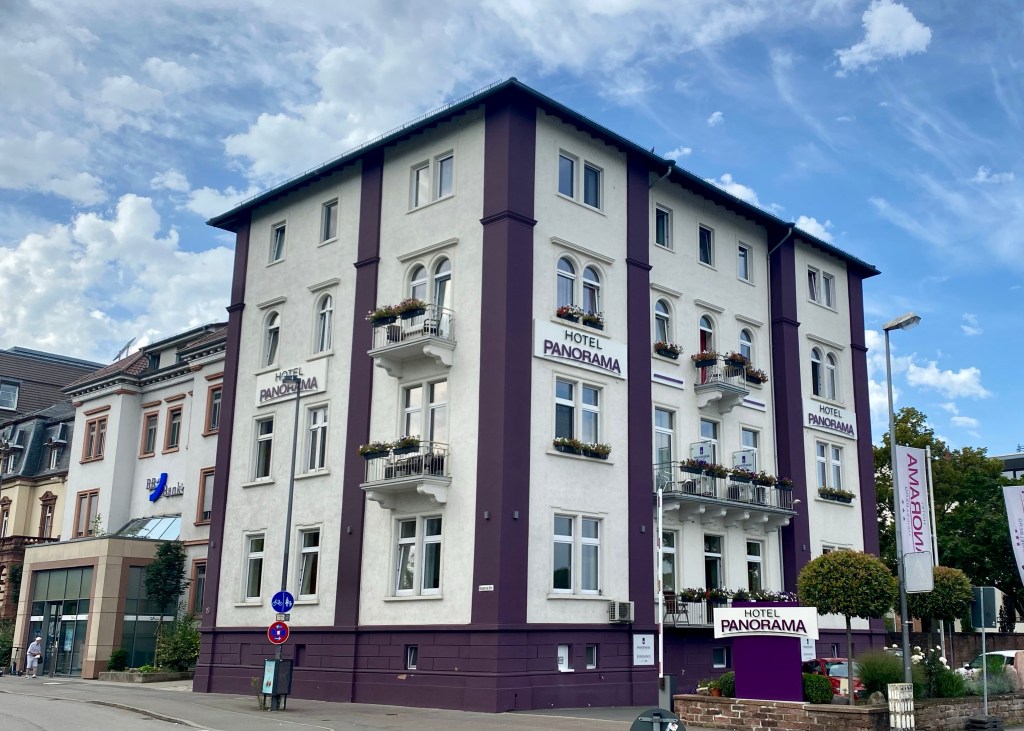
We stayed in one of our favourite ever hotels, the 3-star Panorama. Not much to look at from the outside, it’s a friendly family run place with comfortable rooms, a superb breakfast and a safe, comfortable cellar for our bikes.

Hotel Panorama

In general, the accommodation has been very good in Holland and Germany. We’ve alternated between pensions/small hotels and apartments which allow us to cook for ourselves. Wherever we’ve stayed, the bikes have been reassuringly well looked after and it’s been easy to recharge the batteries.

Mind you, we weren’t so impressed by our stay in the little village of Sindringen, the night after leaving Heidelberg, as the church bells kept us awake all night, chiming every 15 minutes right outside our window. We must remember to check out how close we are to churches in the future.

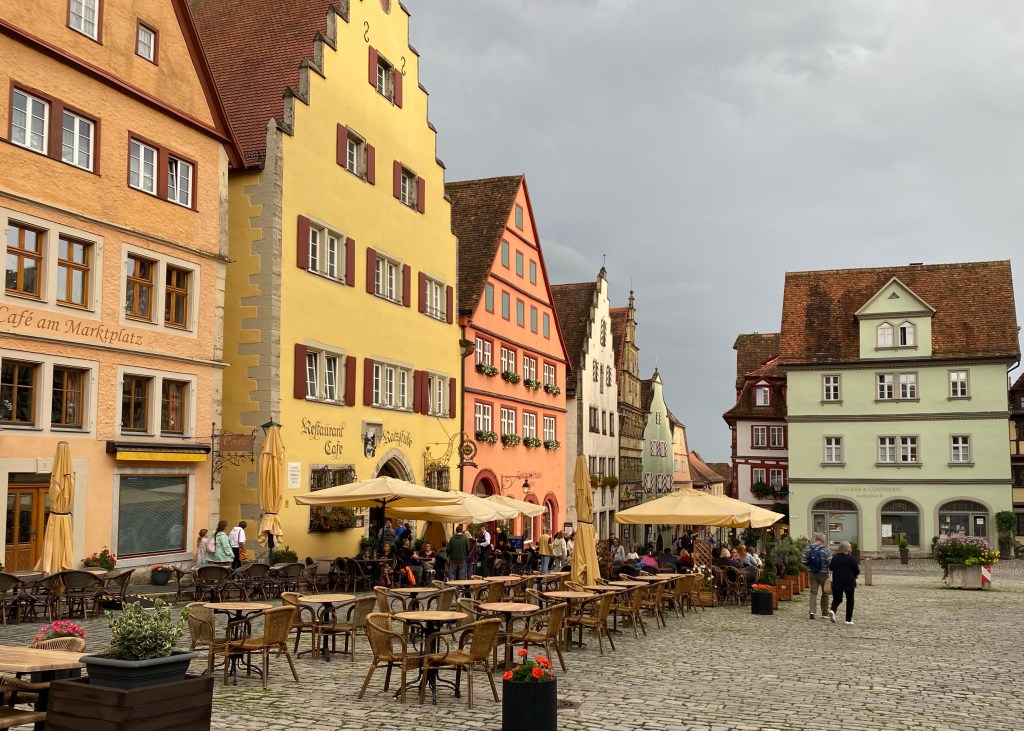
Rothenburg ob der Tauber

To reach Rothenburg ob der Tauber, we cruised downhill for miles on quiet country roads before Clare led us up a steep cobbled backstreet to enter the walled town. Suddenly, we were surrounded by brightly coloured half timbered houses and lots of tourists. It felt as if we’d been teleported into the middle of Chitty Chitty Bang Bang.

Which we had!

This was indeed the location for the Vulgarian village scenes in the 1960’s classic. We glanced around nervously, half expecting to see the Child Catcher disappearing down an alley.

A surprising arrival into Chitty Chitty Bang Bang land

That thought became more sinister when we learnt that Rothenburg odT held a special significance for Nazi ideologists. It was hailed as the ‘most German of German towns’ and was being developed by Nazi nationalists as an ‘ideal’ Nazi community full of ‘ideal’ Nazi families.

Made the place feel a bit uneasy.

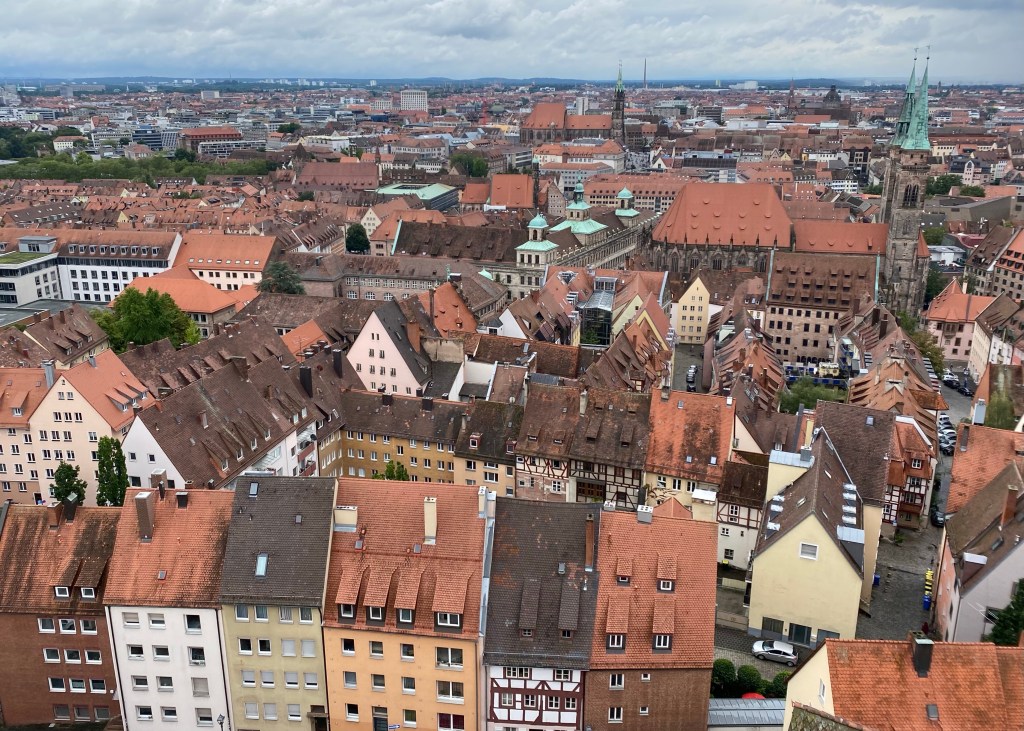
Nuremberg

As always there are plenty of idiosyncrasies to enjoy in any country. A few that struck us in Germany are:

There are still cigarette machines everywhere (very surprising).

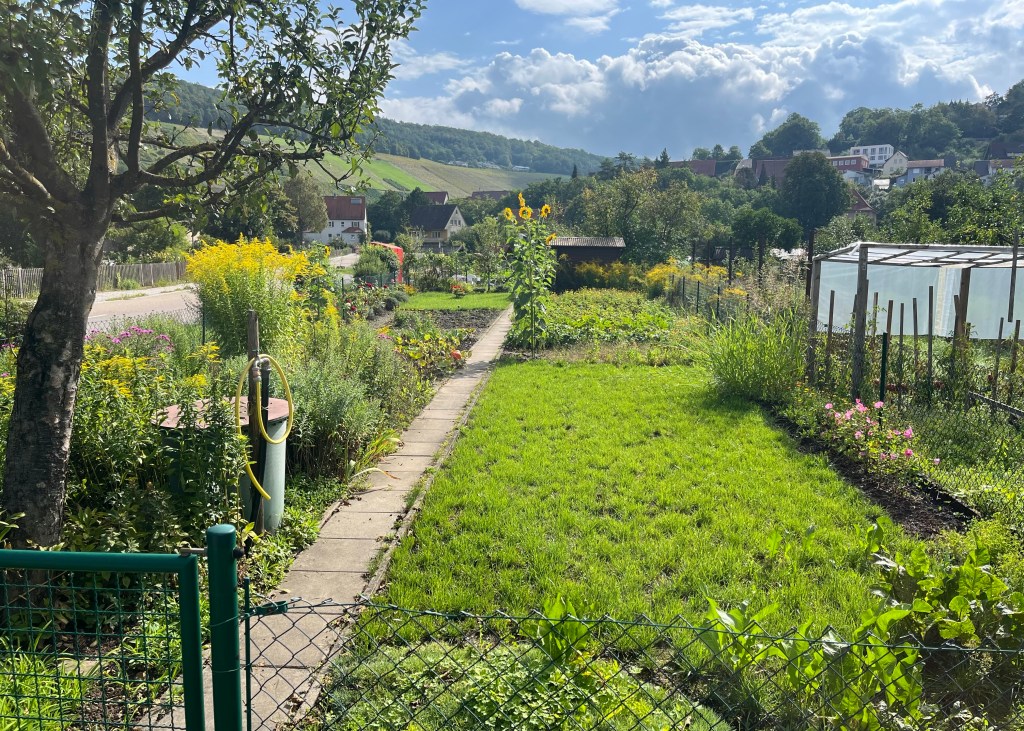
Gardens fill the the edges of every town. Called Schrebergarten these are family spaces as well as allotments. Many have lawns, swings and slides, animals.

Schrebergarten

It’s still a cash society. Many restaurants and shops don’t take credit cards as they don’t like the charges.

And we came across our fair share of unusual food and drink …

Some we really enjoyed … Apfelstrudel with cream, Schnitzel and of course a German Bier at the end of the day. Andy hasn’t drunk any alcohol since February but the choice and quality of Alkoholfrei Bier is so good it didn’t matter.

Nothing like a beer garden after a ride, even Alkoholfrei

Some we weren’t sure about … Spätzle (a type of noodle), Kartoffelknödel (potato dumplings) and the Mainz speciality Handkäse mit Musik (Hand Cheese with Music). This is a hand moulded cheese soaked in vinegar and onions. As the locals say, the musik comes later, a few hours after you’ve eaten it!

Handkäse mit Musik

From Nuremberg we planned to spend a week or so cruising beside the Danube, another great river that starts in the Black Forest. The section between Passau and Vienna is the most popular bike ride in Europe attracting over 38,000 cyclists a year, 300 each day in the summer.

That’s a lot of nodding if you go against the flow.

But we’ve learnt our lesson. We’re going downstream with everyone else!

Clare and Andy

… but that’s not how things turned out …

The Danube will have to wait for another year as we have now decided to abandon the trip and go home.

It took 5 days of cycling for Andy’s Atrial Fibrillation (AF) to kick in, with episodes starting the first night we stayed in Holland. Since then it’s become a lot more pervasive, coming every 3 nights, then every other night, then every night, then several times day and night.

Feeling like a group of gremlins are throwing a wild party in his chest, AF triples his pulse, saps his energy and voraciously eats up his sleep time. Not the best ingredients for a bike tour.

Andy cut out everything he thought might be triggering it, even foregoing the alkoholfrei bier (as it still has trace elements of alcohol in Germany).

In the end we could only conclude that the moderate but sustained exercise of e-bike touring was the problem. Exercise induced AF is not uncommon amongst elite athletes … but e-bike touring is a long way short of that.

Two retired doctor friends kindly gave us the same helpful advice. “It’s only a bike ride,” they said, “the roads will still be there next year after your ablation.”

Which is true. There are AF suffering professional cyclists who have resumed their careers after a successful catheter ablation, a treatment which prevents the electric pulse in the heart from getting out of sync.

We can’t deny it … we’re very, very disappointed … but stopping is the right thing to do. It’s the only thing to do.

Time to stop!

After wondering for a long time how we’d get two heavy e-bikes (that are not allowed on an aeroplanes) home from wherever we finished, we simply called the best bike shop in Nuremberg and asked them to do it.

We were lucky to find Frank, one of the nicest men in the whole of the e-bike world. Sure … he’d pack them up and ship them for us and for a very reasonable price.

So with some emotion we said goodbye to the bikes, leaving them in Frank’s tender care.

It couldn’t have been easier … or so we thought.

Two days later a worried Frank called back. “Big problems,” he said, “the carriers can’t ship to the UK. I can send them anywhere you want in Europe but not to the UK.”

All because of Bloody Brexit!

So we asked SendBike, a specialist UK based agent to organise it instead. Apparently we have to declare them as personal goods, already purchased in the UK and ship them to ourselves. We can’t use a third party like Frank’s bike shop to send them.

Not a happy selfie, outside Frank’s shop

Before returning home, we decided to hire a car for a few days to explore the Bavarian Alps. This took us to Passau where we sat by the Danube, watching the many touring cyclists head east to Vienna and promising each other that we’ll do everything possible to come back next year and complete our journey.

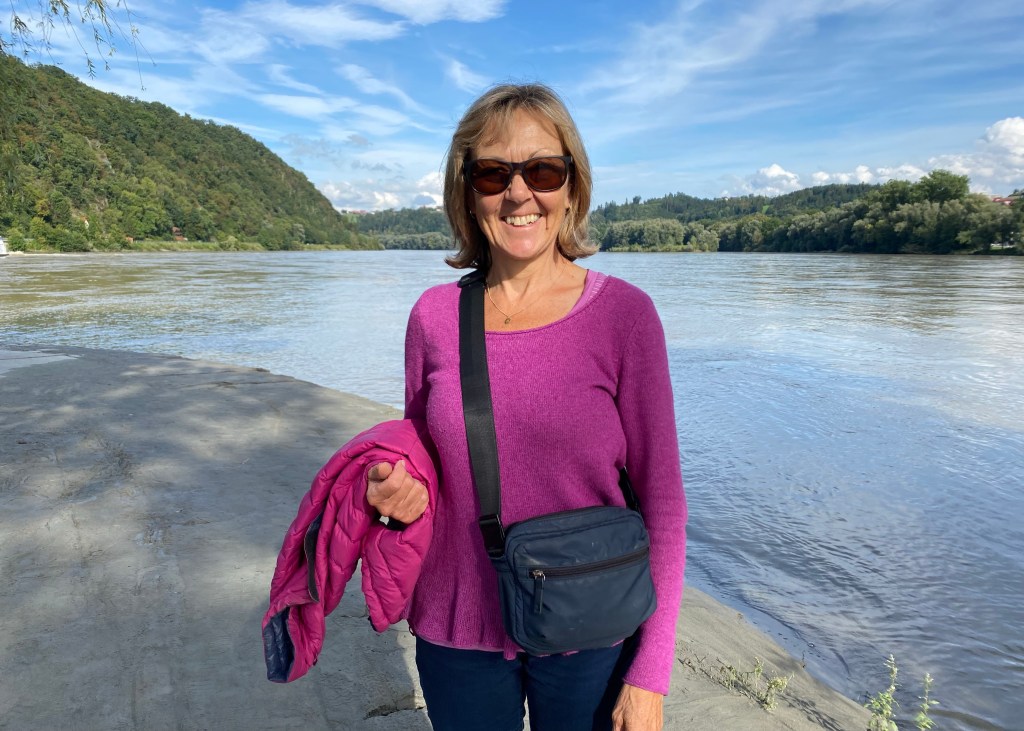
On the Danube in Passau (surprisingly smiley)

The roads will still be there. So will the many bike paths. The Danube will be flowing the same way.

We’ll continue to embrace the ‘E’ in e-bikes.

We’ll swoop through rolling hills.

We’ll visit amazing towns and cities.

We’ll eat strange food.

We’ll drink great beer at the end of each day.

And we’ll still go downstream with everyone else!

Clare and Andy

1325km pedalled (823 miles)

7585m climbed

70 hours in the saddle

The Bavarian Alps – always a silver lining

A Two Wheeled Wonderland

It’s easy to see why Holland is known as a two-wheeled paradise.

It’s flat, of course. Dutch Pancake flat in fact. The first place we’ve ever been where flat properly means flat.

And cycling tracks are everywhere. 

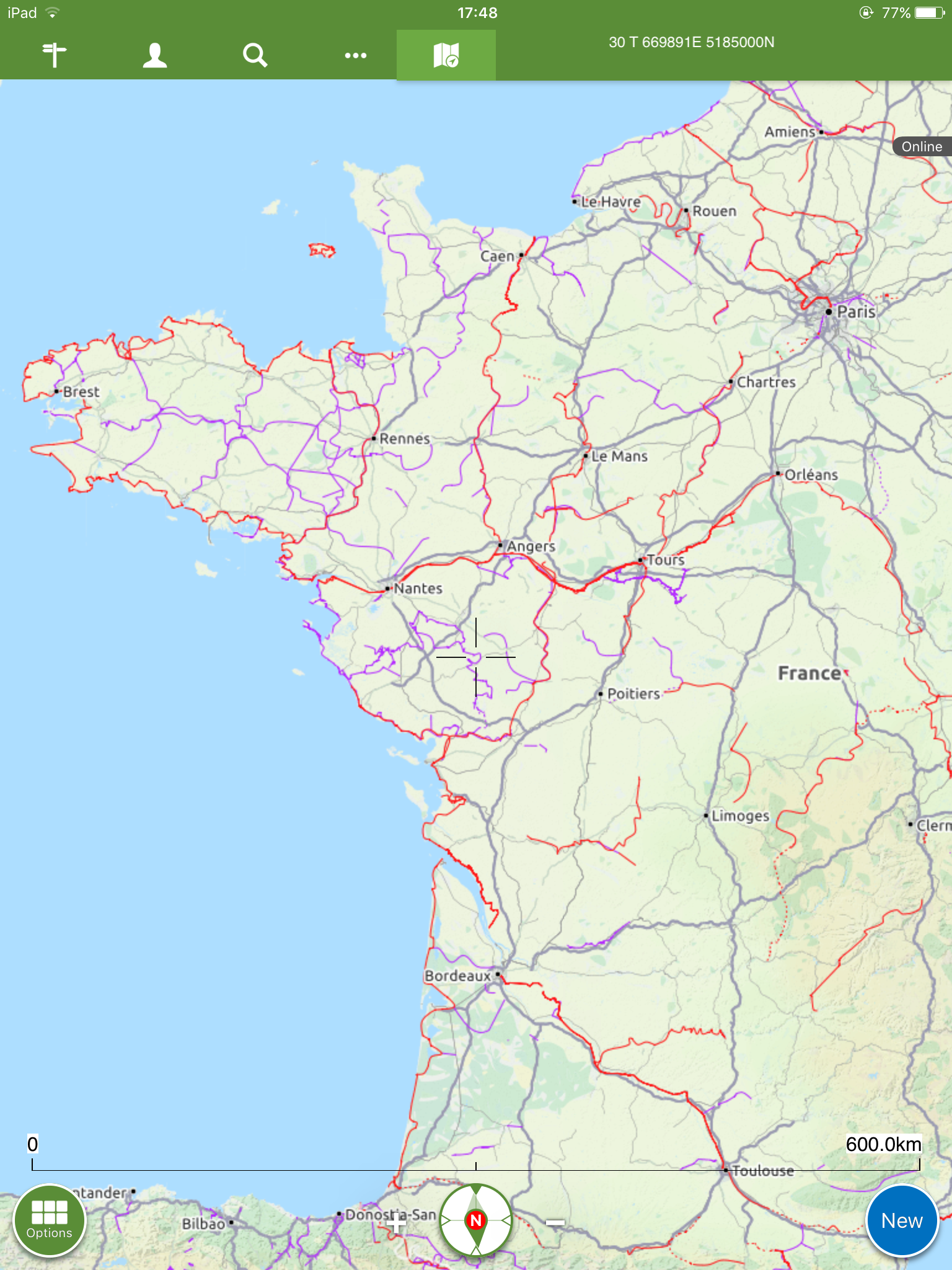
Everywhere? Really? Yes! … take a look at these maps …

Here’s a map of the national and regional cycling routes in England and Wales …


Not bad! And the same for France …


But this is what it looks like for Holland!


Everywhere!

Many of these cycling routes are on smooth, dedicated bicycle paths with no motorised traffic allowed. They’re cleverly designed too, often offering the most direct way to travel between two villages, making a bike journey much quicker and easier than the same trip by car.

This might explain why there are more bicycles than people in Holland! 13 bikes for every 10 people, the highest ratio for any country in the world.

Or why more than a quarter (28%) of all trips are made by bicycle … especially commuting, shopping or visiting friends. Again, the most in the world!

It follows that most car drivers also ride bicycles, which is probably why they’re so polite to cyclists. Giving way every time a cycle path crosses a road, patiently waiting to let us on to a roundabout.

In fact they’re so polite, they go straight to the top of the Clare & Andy Driver Courtesy League, pushing the Irish down into second place.

Just for bicycles


Holland is so well set up for cycling, it sometimes doesn’t feel quite real. It’s almost too easy, too nice. It can feel a bit like a cycling theme park or a bicycle-touring version of The Truman Show!
Adding to the theme park impression, we found Dutch people to have similar characteristics to the staff of a well known company, famous for its mouse and princesses.

Extremely friendly but also a little formidable. 

The Dutch pride themselves for telling it straight, no beating about the bush, and not minding at all when others do the same to them.

This can come as a surprise to those of us who live in a country where people will skirt apologetically around any difficult request with “I’m sorry but would you mind…” or “Excuse me but I’m going to have to ask you to…”

Take this exchange.

Having checked out of our hotel, we’re sitting in the hotel cafe for a few minutes waiting for the rain to clear before we set off. Suddenly we hear a rather severe voice behind us … 

“People, you have to leave!”

“Oh, OK”

“No, you have to leave now.”

We gather up our things. “Thats no problem, we’re going”

“We need to clean up. We have to close. You can’t stay here. You have to go.”

We scuttle out and shelter in the hotel reception instead.

Fifteen minutes later, after the rain has stopped, the same lady comes up to us in the street all smiles and chattiness. She wants to know where we’re going, tells us about her years living in Turkey and is genuinely interested in how we are finding the trip.

She’s so friendly, we might have been best buddies!

A Full Crossing

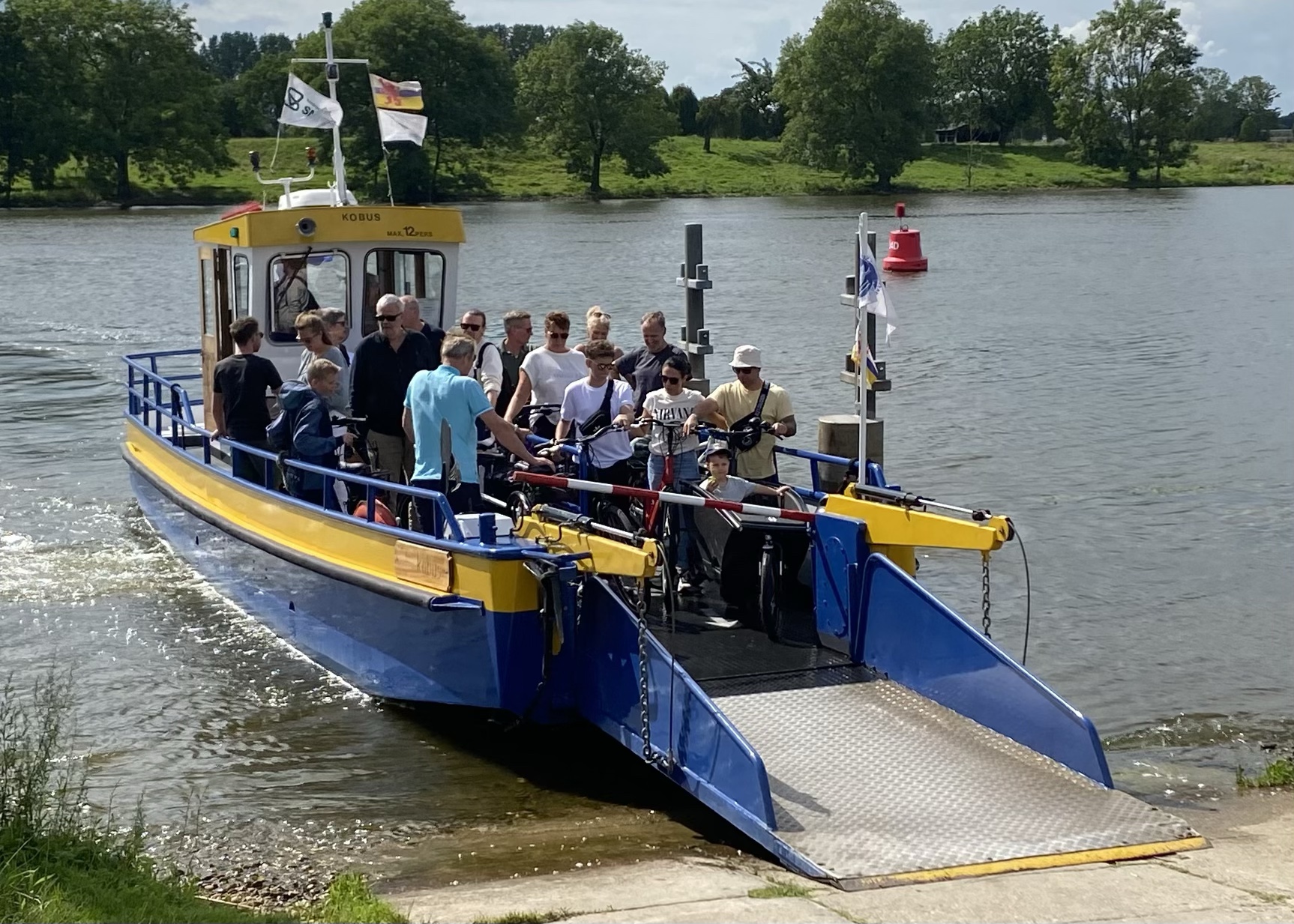
Another part of the fun of cycling in Holland is jumping on and off the water buses that ferry you across the many waterways.

Join the queue

Over the five days we spent cycling through the country, we roughly followed the route of the River Meuse so must have enjoyed at least a dozen of these boat rides.

But they’re not always busy

Another interesting thing about cycling through different countries is discovering their individual quirks. In Holland for example, many cafes don’t open until 10am in the morning which might work well for sleepy locals but is not so good when you’ve arrived early on an overnight ferry and really need a coffee to get your legs going.

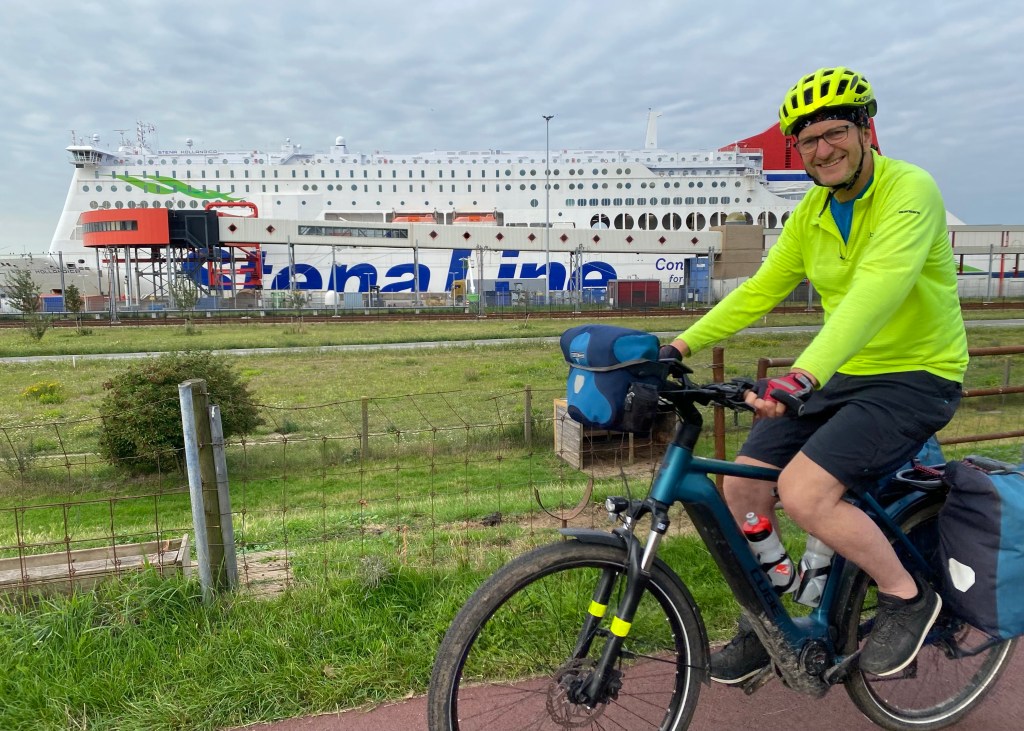
The announcements on the ferry had told us many times that we had to use the cycle paths in Holland and should never ride on roads unless there was absolutely no alternative. We tried our best to stick to these rules on the long caffeine-free ride through the centre of Rotterdam but became so confused by the sheer number of cycle tracks that we often went wrong, collecting several straight-talking telling offs along the way.

Leaving the ferry with no coffee

When we eventually did sit down for breakfast, we were so hungry we added a traditional Dutch snack … deep fried bitterballen. It’s a type of croquette that became popular in the 1800’s as the perfect way to transform yesterday’s leftovers into today’s lunch. Yum … but not necessarily for breakfast!

After escaping Rotterdam, our first day became a lot more scenic. We pedalled through the famous windmills of Kinderdijk, the island town of Dordrecht and the Biesbosch nature reserve before pausing for a couple of days in Gorinchem, described officially as ‘the most beautiful fortified town in the Netherlands!‘

Gorinchem

It was strange to think we were sometimes cycling across reclaimed fields that are below the level of sea water. Fields that are incredibly verdant and vivid green from all the rich fertile soil and water, protected by strong dykes on all sides. It’s a unique agricultural landscape.

Biesbosch Nature Reserve

Much of this land was reclaimed in the 16th and 17th centuries using a state-of-the-art technology for the time, the windmill. Having literally created much of the country, windmills are rightly celebrated across The Netherlands, many beautifully restored and still operational. Using a range of intricate mechanisms, they cleared the land of water, milled grain into flour, cut timbers and made gin.

Kinderdijk

Visiting the mill in Gorinchem, we enjoyed a lovely experience thanks to the miller who demonstrated the sails and showed us its inner workings. It didn’t matter that he was the only Dutch person not to speak a word of English as we communicated happily using gestures, grunts and laughter.

Inner Workings

Somehow he must have sensed our interest as he stopped the sails by pulling hard on a thick rope like a human break and beckoned us through a locked hatch to visit the very top of the mill. We climbed a precipitously steep ladder with the help of a supporting rope and clambered around the rafters to watch him grease the mechanism with some animal fat that hung like vines from nearby hooks.

He then invited Clare to climb onto the sails for a quick spin. Only joking, it was just for a picture.

From Gorinchem, we followed the river south, stopping overnight in Oss, Grubbenvorst and Heerlen before coming across some surprising hills in the far south of the country, just before we crossed into Germany. 

As always it was fascinating to cross a border and see the immediate differences between the two countries.

Suddenly there were a lot more Mercedes cars around, the typical Dutch gable roofs had been replaced by a more functional triangle and for bicycle tourists there were less cycle paths, more potholes to avoid and the drivers had become much more impatient.

Coming from England, it felt normal!

But we missed the two-wheeled-wonderland we’d been cocooned in for the previous five days. Unlike Truman Burbank (Jim Carey’s character) … we didn’t really want to escape.

But our time in this bicycle touring paradise was up, so as he would say … “Good afternoon, good evening and good night!”

Clare and Andy

685km pedalled (426 miles)

3235m climbed (mainly in England!)

37 hours in the saddle

It’s Electrifying


We clearly remember the moment the idea first flashed through our minds … Mallorca, November 2017, on our way back from a ride out to Cap Formentor. 

Struggling up a steep slope, legs burning, sweat dripping into our eyes, lungs gasping for air, we were surprised by an older lady serenely cruising past us, shortly followed by her husband.  She was riding a sit-up bicycle with a wicker basket on the front and looked as if she was pottering down to the local market.

At first we couldn’t believe it and pushed harder, standing up on our pedals. But the older couple simply glided away from us.

Then we realised … they were riding electric bikes!

The idea started to grow. Should we go electric too? Would it make bicycle touring even more enjoyable?

With the passing of the years the physicality of climbing hills on fully loaded bikes gradually became less enjoyable and more challenging. On the toughest days, the thought that we could be doing this on e-bikes got louder  – the Seven Lakes Road in Argentina, the Wilderness Road in Tasmania, through the Badlands of southern Spain. By the time we rode the Blue Ridge Mountains of Virginia last October, it was screaming at us.

Now we’ve taken the plunge and have just set off for our latest adventure on two Cube e-bikes with Bosch batteries and motors. Our trusty old Ridgebacks are left behind in the garage, trying to console themselves with happy memories from the journeys they’ve taken us on over the last few years, but probably realising their time is up.

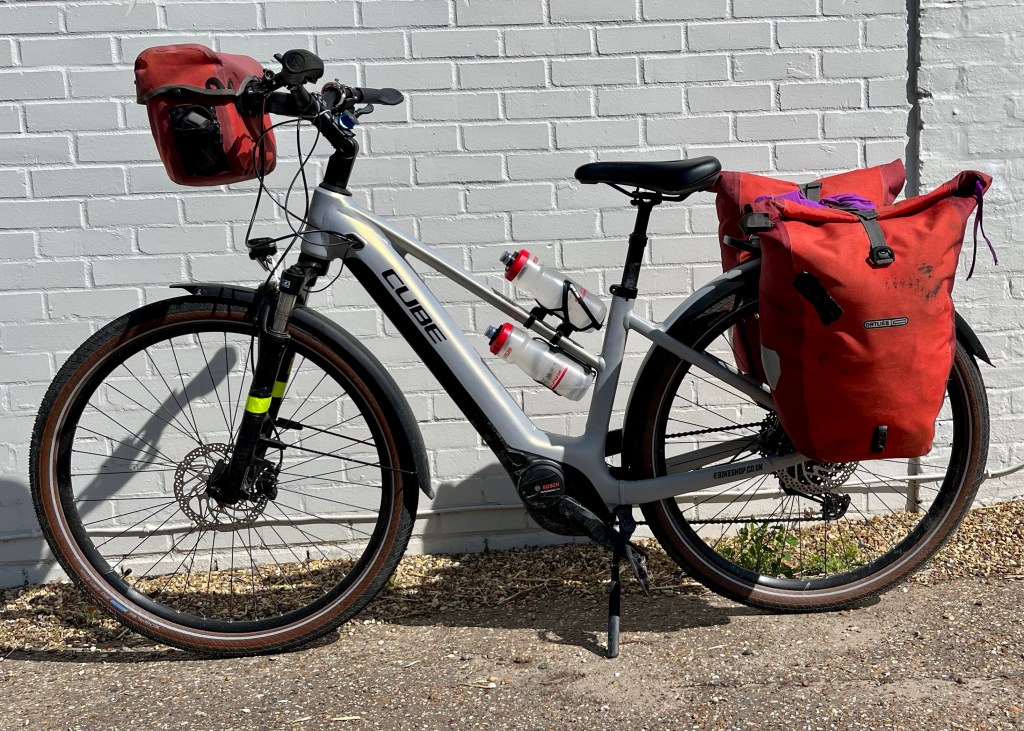
Clare’s Cube Touring Pro

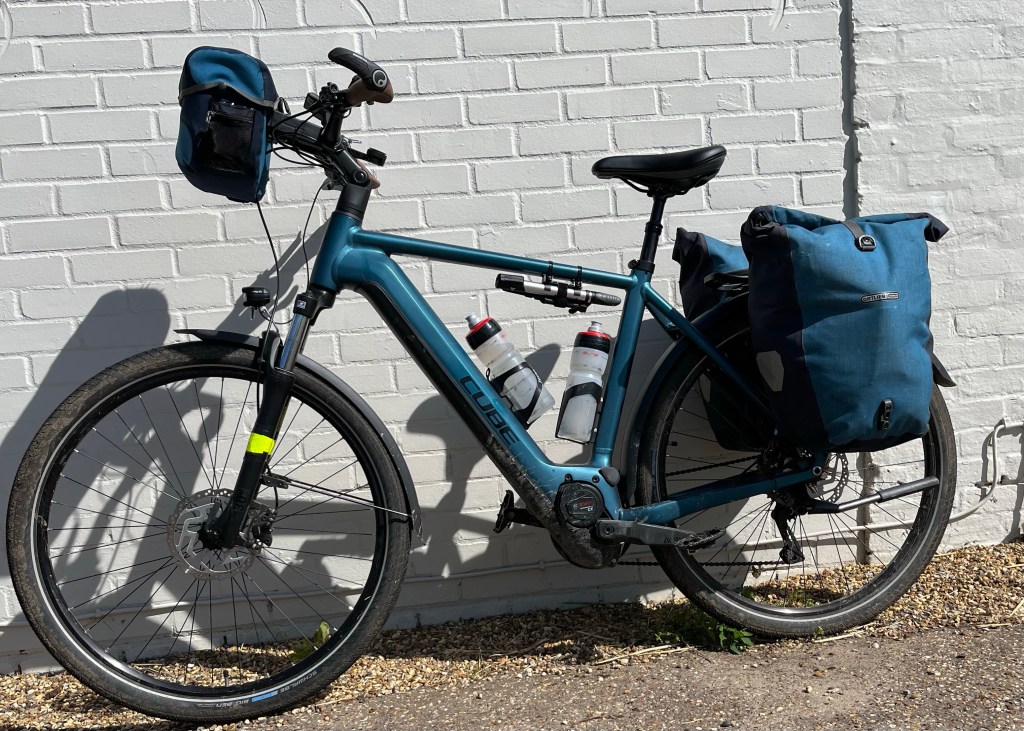
Andy’s Cube Kathmandu One


As many of you know, our dream has always been to cycle across Europe from Bath to Istanbul so we’re heading in that direction and waiting to see how far we get. Our rough route takes us 3800km through Holland, Germany, Austria, Slovakia, Hungary, Romania, Bulgaria and Turkey but we know we might have to turn around at any time.

We’ve always enjoyed keeping our plans flexible but it’s a bit more complicated this year.

Not only is Istanbul much further than we’ve ever pedalled before but Andy was diagnosed with a heart arrhythmia (atrial fibrillation) shortly after we got back from America last year. His AF is not too serious and it’s well controlled with meds but it could get in the way if the episodes become too frequent. The good news is that Andy’s cardiologist has given his blessing to the trip, especially when he realised we would be on e-bikes.

Our route across England

Stage 1 meant four days of cycling through seven counties of undulating English countryside from Bath to Harwich and then boarding a ferry to Holland.

Friends had joked that we would need to be extra vigilant at ‘avoiding potholes’ in the UK, but we found the road surfaces to be pretty good overall, getting better the further East we went.

There were some familiar bike-touring experiences … diving down a muddy track on a dreadful detour, a stand up lunch outside a village convenience store, sheltering from a sharp shower under a tree.

Emerging from a Dreadful Detour

Despite the mixed weather it was lovely to pedal in familiar countryside past fields of golden wheat and barley, through quaint picture postcard villages, up tree-lined lanes to the top of gentle hills.

But we nearly didn’t make it out of England alive!

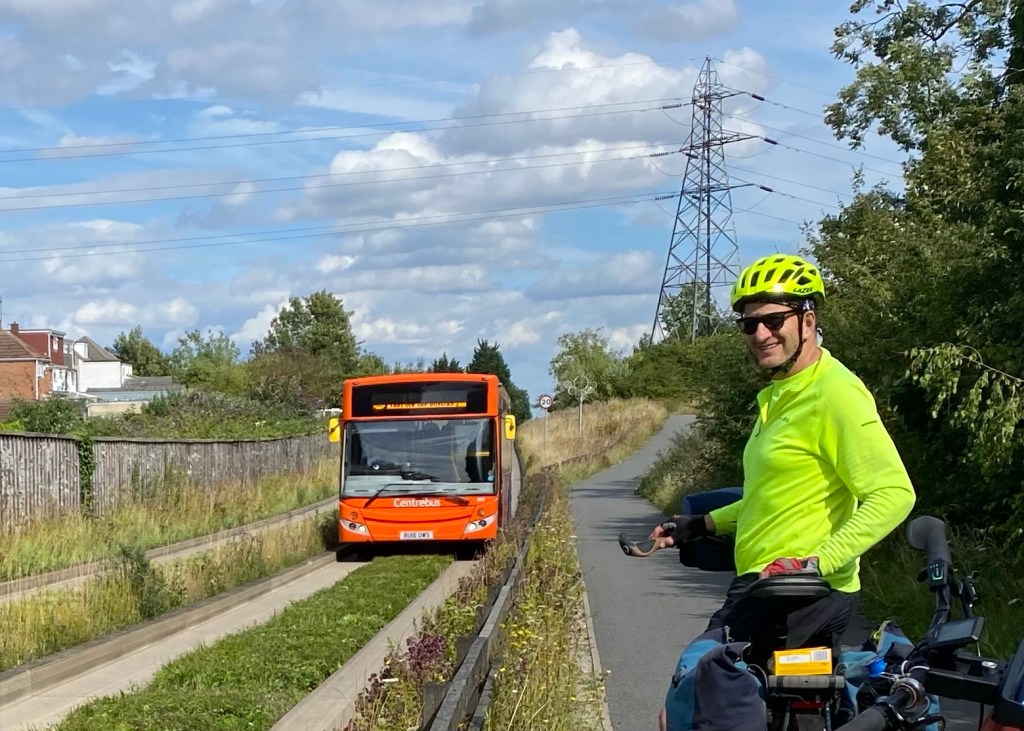
In Luton there is a ‘Busway’ that crosses the town on dedicated concrete tracks, a bit like a railway for buses. A cycle path runs alongside it. Having never seen this ingenious public transport system before, we mistook the Busway for the cycle path.

Once on there was no way off. Concrete sides blocked our escape and our heavy bikes would take too long to turn around. All we could do was to put our heads down and race to the next station, much to the surprise of the local commuters. Our luck was in, we made it out … just ahead of the number 23!

A lucky escape from the Busway in Luton

So how have we found the e-bike bicycle touring experience so far?

It’s early days but the two big differences seem to be speed and effort.

We go faster which means we can go further each day.  Travelling across England we managed three consecutive days of 100km or more, something we would have thought was completely barmy on our old bikes.

And whilst we have to pedal, giving  plenty of exercise, we don’t get the exhaustion that used to come from tackling long or steep hills. We simply flick on a higher power setting and serenely pedal up them … just like that lady in Mallorca!

A perfect surface in Essex

Bosch offers 4 power settings:

  • Eco (Green) – low level support for the longest range
  • Tour (Blue) – consistent, smooth support for long rides
  • eMTB (Purple) – dynamic acceleration for rough tracks and hill starts
  • Turbo (Red) – maximum power for steep ascents

More power means less battery range … and we definitely don’t want to run out of battery, not once, not ever.

But any range anxiety we might have felt has now completely disappeared.

After the first day, Andy’s knee was sore, sore enough to hobble down the stairs. Not a good sign with well over 3000km still ahead! To ease it, he made some micro adjustments to his saddle position and increased his cadence (speed of pedal strokes) to cut down the force he had to press onto the pedals.

But the best medicine came from riding at a much higher power level using blue or purple with gay abandon and even throwing in some extended blasts of red. On that second day we rode for 108km … and at the end of it Andy still had a quarter of his battery left and a knee that was beginning to feel much better.

E-bikes also come with several features that are useful for bicycle tourers such as built in lights and a stand … but there are a few downsides.

They are really, really heavy, weighing in at 28kg or around 46kg fully loaded. This makes them difficult to manoeuvre in tight spaces. Lifting them up stairs is a no-no and even turning them around is hard work … we’re getting used to 3-point turns and wide circles.

They’re more attractive to thieves so we’ve invested in strong locks and insurance. Bosch also offers a phone app that immobilises the motor and sets off an alarm if they’re moved.

They’re banned from aeroplanes because of the size of the batteries. That raises the question of how we’re going to get back from Istanbul if we get that far. A question we don’t have an answer to yet!

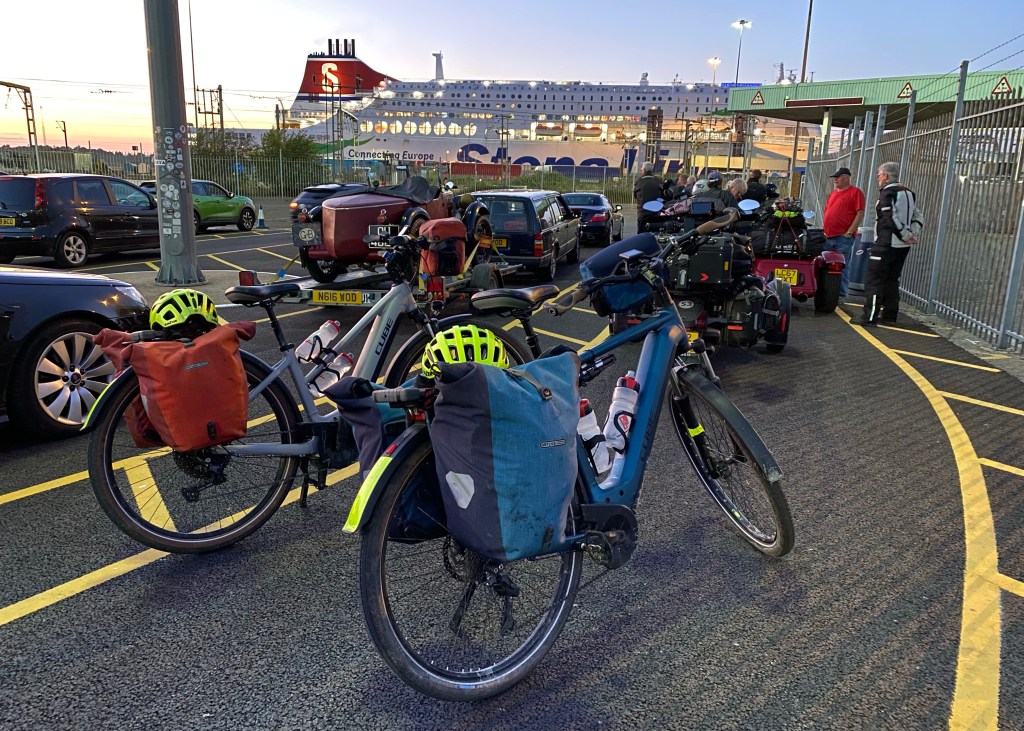
Waiting for then ferry to Holland

It did take us several days to get used to the day-to-day mechanics of an e-bike tour … the way the panniers fit, recharging the batteries, the different pieces of equipment etc. On the second morning Clare rode off without her plastic battery cover which is important to stop rain and mud ruining the electronics.

Fortunately, we had enjoyed a lovely stay near Oxford the night before with our good friends, Neil and Gill. Realising the cover would be difficult to replace, Neil drove out of his way to to reunite her with it before any dampness got inside.

We’re now settling into the rhythm of both our new machines and of being back on the road. The panniers are going on smoothly, the 3-point turns are working well and recharging has become easier. 

Andy’s knee is now fully recovered. However after more long days on our saddles in a row than we’re used to, we can’t say the same about our bums! 

So with apologies to the makers of Grease …

“We’ve got pains, they’re multiplying

And we’re losing control

‘Cause the power Bosch are supplying

It’s electrifying!”

We’d better shape up!

Clare and Andy

Crossing the Delaware

On Christmas night in 1776, George Washington famously led part of his army across the icy Delaware river in a surprise attack against the British.

Coming just six months after the Declaration of Independence was signed in Philadelphia, it was a bold and desperate act from a desperate general.

After many defeats including the loss of New York, the morale of Washington’s ragged army was at an all time low as the harsh Pennsylvania winter set in. Without food or warm clothing numbers were shrinking fast, he was losing more men to disease and desertion than to battle.

But, in a heavy snowstorm, he surprised the British troops enjoying their Christmas festivities and scored an important victory. His daring raid revitalised the patriot army and gave new life to the American Revolution that would eventually lead to Washington himself being declared the first president of the United States.

We too had to cross the Delaware river to start our American cycling adventure, heading east out of Philadelphia and into New Jersey.

It was perhaps a little easier … we had the huge Benjamin Franklin bridge to carry us across instead of flimsy boats, the weather was a lot better and we weren’t carrying any heavy artillery (not even a hair dryer!)

But it was still a little daunting.

Like the rest of our cycling experience in America so far, it turned out to be much easier than we expected. A path dedicated to pedestrians and cyclists kept us well above the busy road and rail track, and gave us some great views back to the city.

Cycling towards City Hall, Philadelphia

Did we say “cycling”?

It turns out that no one in America understands what that means … so what we really mean is “biking”. In the States we are bikers!

And the biking has been great. There are plenty of quiet roads or bike lanes to choose from. Even on busier roads, motorists are very courteous, waving us across at junctions, letting us go through lights first and giving us a wide berth as they pass. In urban areas cars seem to glide gently along … no horns, no hurry.

In fact American drivers are so polite that they go straight to the top of our ‘Car Courtesy League’ pushing the Irish down into second place. Let’s hope it continues!

We learnt about Washington’s crossing of the Delaware from the Museum of the American Revolution museum, one of many excellent museums and art galleries in Philly. It even features Washington’s perfectly preserved war tent, a tent so famous that it has its own high tech multi-media show.

The Liberty Bell, in front of Independence Hall

Other visitor attractions include important symbols from the struggle for freedom from the British … the Liberty Bell, Independence Hall and the Benjamin Franklin Museum.

Inside Independence Hall

As the most favourite of favourite sons, you can’t miss Ben in Philly. As well as the bridge there’s a highway, a borough, a park, a science museum, a football stadium, a gentleman’s club and several schools all named after him.

Benjamin Franklin

To be fair he did have quite a life … founding father, printing entrepreneur, newspaper publicist, diplomat and inventor. His many inventions include bifocal glasses, the lightening rod and kite surfing. It’s true … as a keen swimmer, he created a kite that pulled him backwards and forwards across his pond!

The Glass Armonica, a musical instrument invented by Franklin. It uses the same principle as rubbing a finger around the edge of a glass.

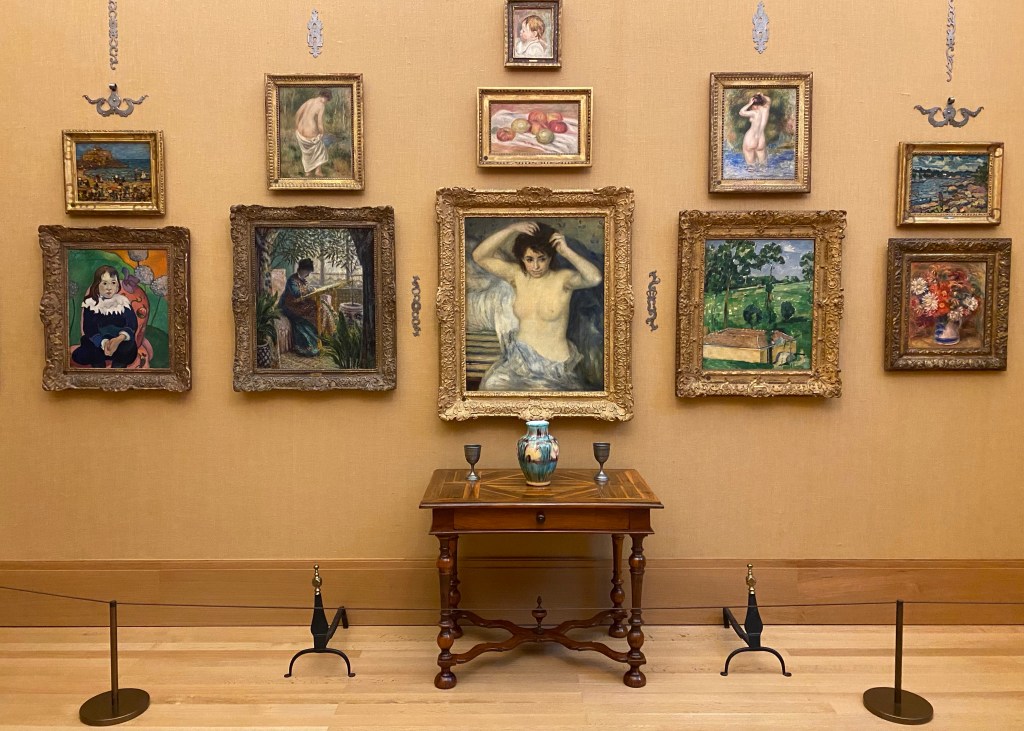
Despite these many achievements, Benjamin Franklin was not the highlight of our visit to Philadelphia. The highlight was the Barnes Foundation and its extraordinary collection of impressionist art.

Promenade with Child, Pierre-August Renoir

Having made his money inventing and marketing a disinfectant that became popular for treating venereal disease, Albert C. Barnes started collecting modern art in the 1920’s at a time when Impressionism was nowhere near as popular as it is today.

Le bonheur de vivre, Henri Matisse

Once overhead saying to a friend that … “I am convinced I cannot get too many Renoirs” … he stayed true to his word, eventually hovering up a collection of 181 Renoir paintings. To that extraordinary number he added 69 by Cézanne, 59 by Matisse, 46 by Picasso and several more by Van Gogh, Rousseau, Modigliani and others.

The Postman, Vincent Van Gogh

The Barnes Foundation is unlike any art gallery we’ve ever been to.

We were very lucky. This is a quiet time in the visitor cycle, allowing us to wander through the small, intimate rooms almost alone.

They are left exactly as Albert Barnes arranged them at the time of his death in 1951. The paintings are not displayed chronologically or by artist, but by theme or colour. Interspersed with African masks, native American jewellery or Victorian iron doorknobs, Barnes believed that art, like life, should not be segregated.

The effect is astonishing. Breathtaking.

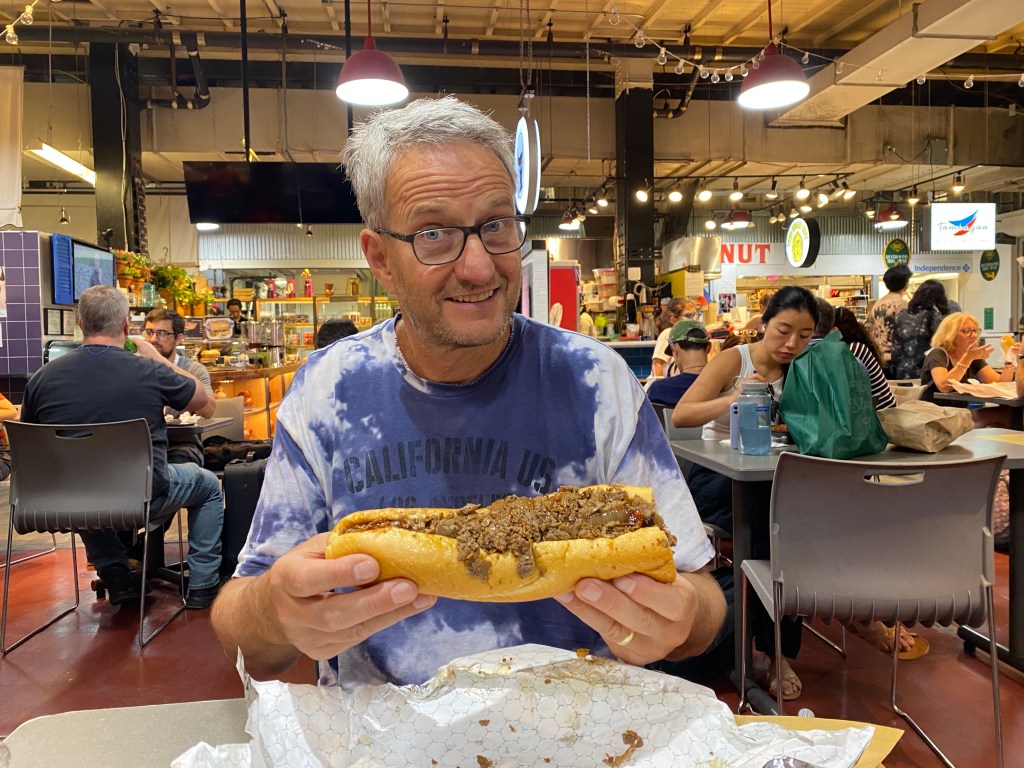
And for the cheesesteaks!

This famous local delicacy is a long, crusty roll filled with thinly sliced, freshly sautéed ribeye beef and melted cheese … with just the right amount of drip.

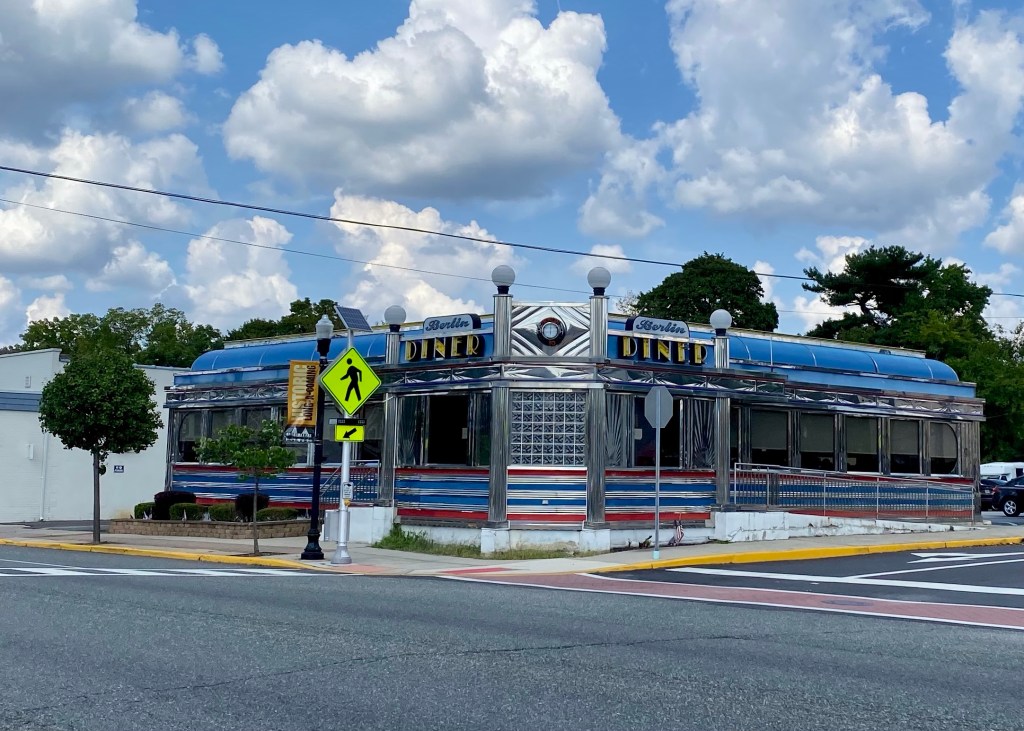
As we cycled (sorry … biked) towards Atlantic City we soon came across another slice of Americana. New Jersey is the spiritual home of the great American Diner, with more diners than in any other state. They are perfect places to refuel … sitting at a counter, munching our way through an enormous portion, letting the ketchup run down our chins.

After a lunch or breakfast like that, it’s a wonder that we are able to pedal on at all!

Altlantic City itself was disappointing, much faded from its glory days as the prime East Coast beach resort and city of bootleggers. Today it’s dominated by cheap candy stores, kiss-me-quick arcades and casinos.

At this time of year, we’re expecting a few enforced rest days to shelter from the rain. The first one came sooner than we hoped … after just two days of cycling we were itching to move on.

It doesn’t rain gently here … this is proper rain. Big, strong American rain!

Our mini-storm in Atlantic City

Not having the fortitude of Washington and his men, we were glad to be safely tucked up inside our hotel, watching it pour down across the parking lot.

On the boardwalk

But there was a bonus.

The following day the tail end of the storm created a strong tailwind that swept us down the Jersey Shore to Cape May, a beautiful preserved Victorian seaside resort that boasts one of the top 10 most beautiful beaches in the country.

19th Century House, Cape May

It was as we crossed back over the Delaware by ferry that we heard the Queen had passed away. It was a moment of mixed emotions … joy at her long life well lived, sadness that she’s gone. She has been ever present in all our lives and a such a strong, calming influence.

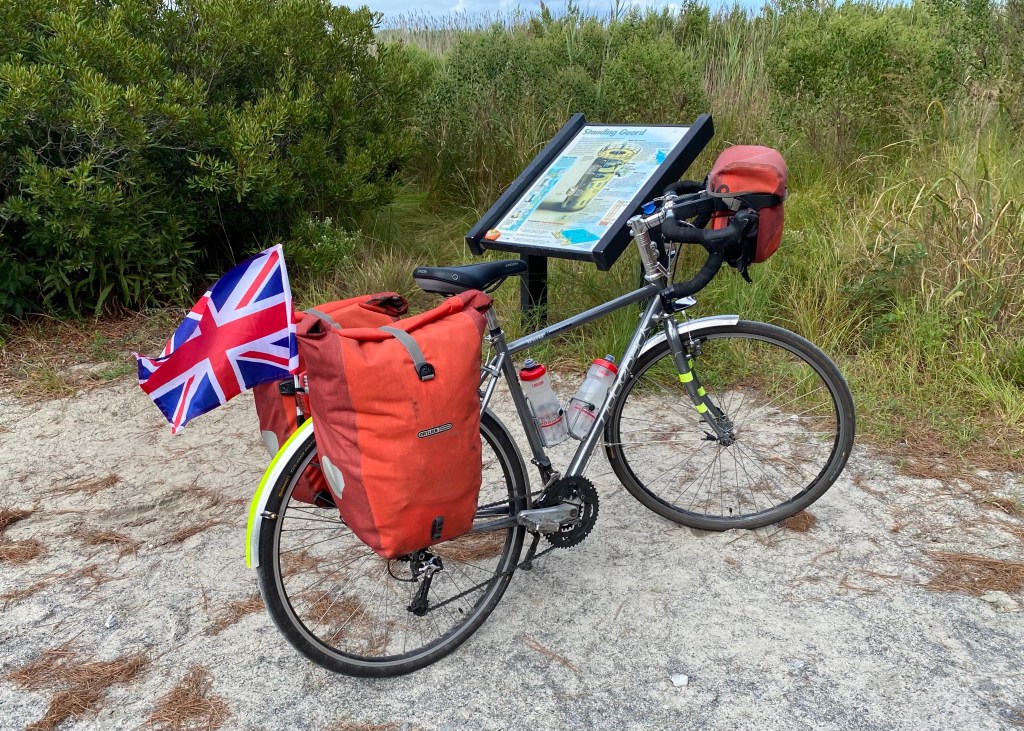
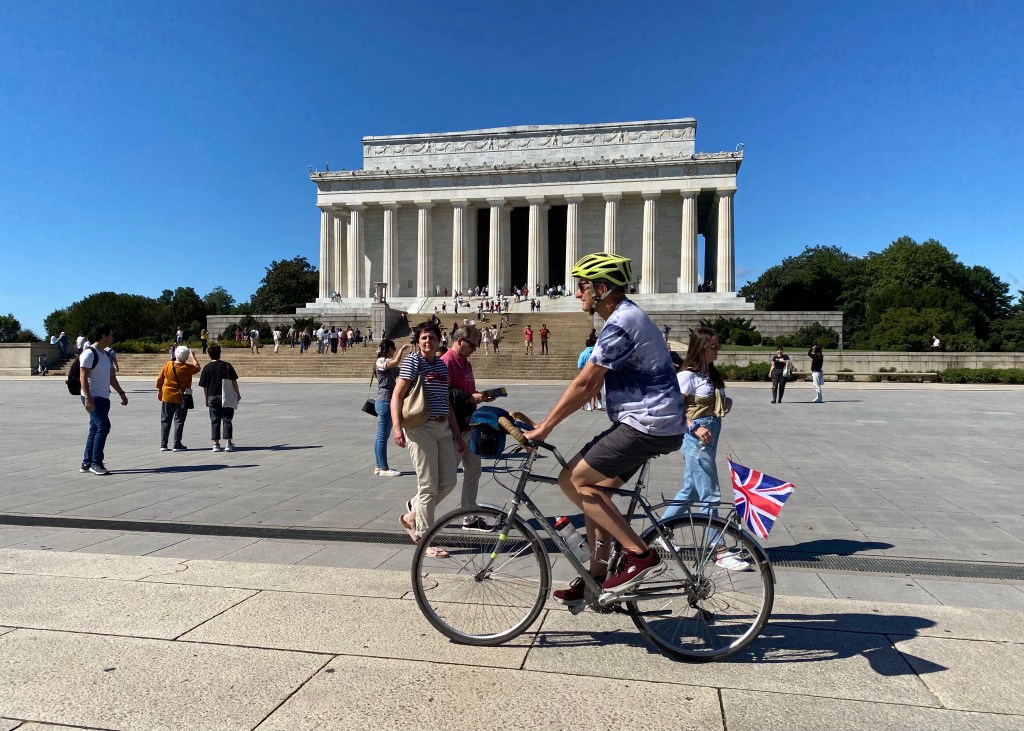
Knowing that Americans love their flags, we’ve attached a couple of small Union Jacks to the back of our bikes. We were amazed to see how many people flagged us down to ask us if we’d heard the news that our Queen had died and to tell us how sad they were feeling.

So whilst Washington famously crossed the Delaware to score a symbolic victory that led to pushing the British out, we British Bikers have been a lot more fortunate.

We’ve crossed the Delaware to a very warm welcome.

Clare and Andy

Same Same but Different

On cresting the top of a small hill, an Amish horse and cart suddenly pulled out right in front us.

Pausing to enjoy this unusual sight, we swept down the hill behind them. It was easy to catch them up, then cruise past with a wave and a polite nod in return. But the road turned sharply upwards and our legs soon became no match for their horsepower.

Once again we overtook them on the next descent, once again they easily passed us on the next climb. Did we see the hint of a smile? Probably not, the self styled plain people don’t believe in gloating!

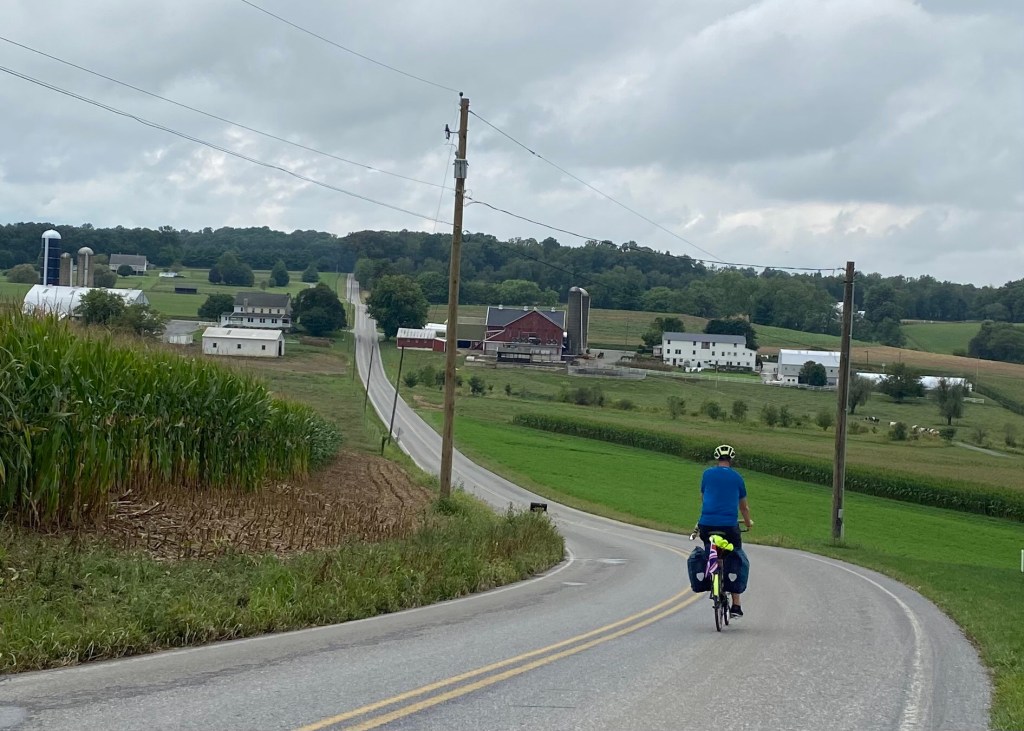
We were cycling on the backcountry roads of Lancaster county in Pennsylvania, between the small towns of Oxford and Strasburg. This is the beating heart of Amish country with a community of around 43,000 living and farming here, the largest group in America.

Typical family transport

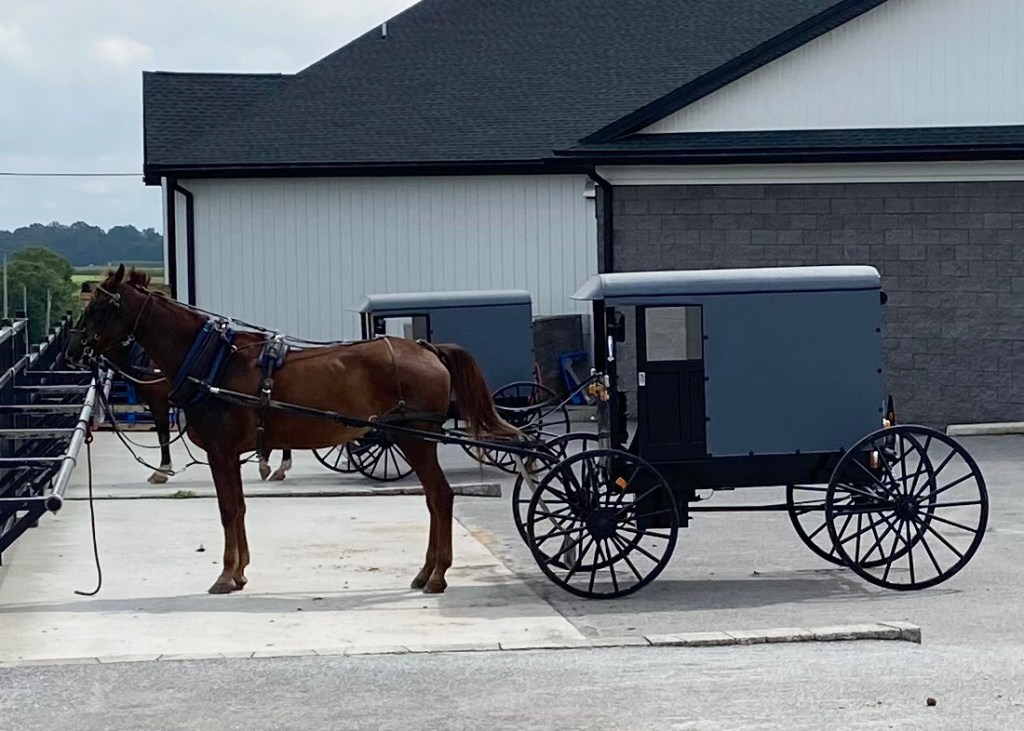
Horse drawn buggies are the family saloon of the Amish world. They are normally enclosed grey boxes with enough space for mum, dad, a few kids and the weekly shop.

Parked outside the local grocery store

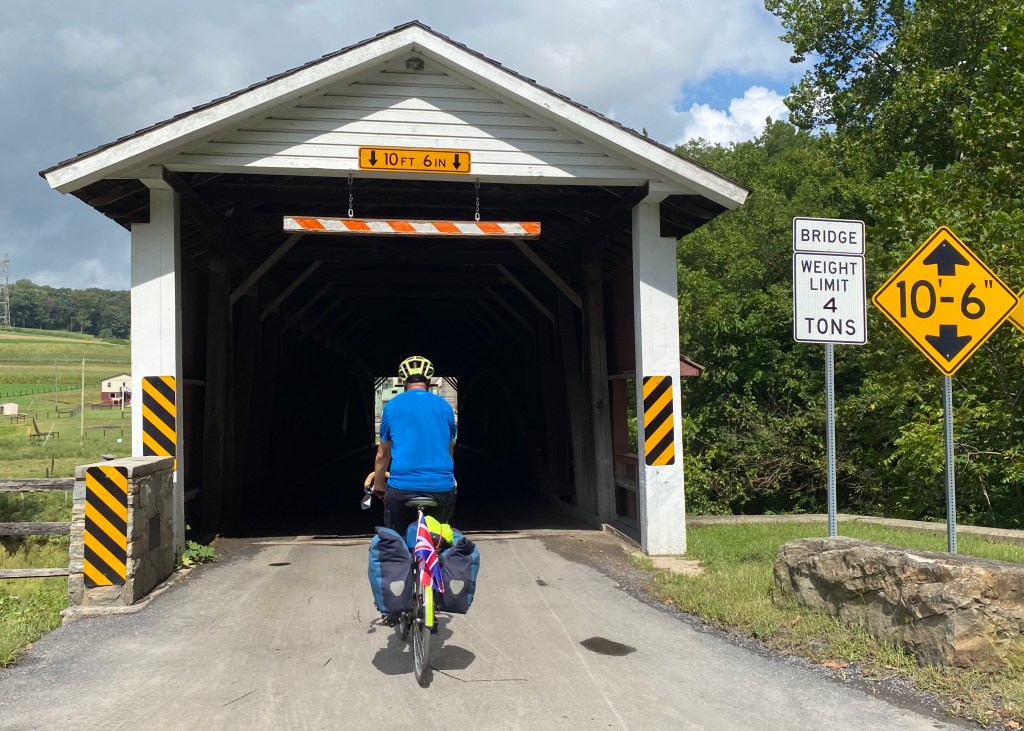
The open cart we tried and failed to race is a traditional 16th birthday present given to a young man to take his sweetheart out for rides through the local covered bridges. Not for nothing are they known as ‘date buggies’ and ‘kissing bridges’.

No chance of a kiss on a bike!

We passed scores of identical farms each with a weatherboard house, a barn, a grain silo or two and a washing line full of simple, old fashioned clothing swaying in the breeze.

Typical Amish farm

No cars, no motorbikes and no other ‘English’ people (all outsiders are known as ‘the English’ to the Amish.)

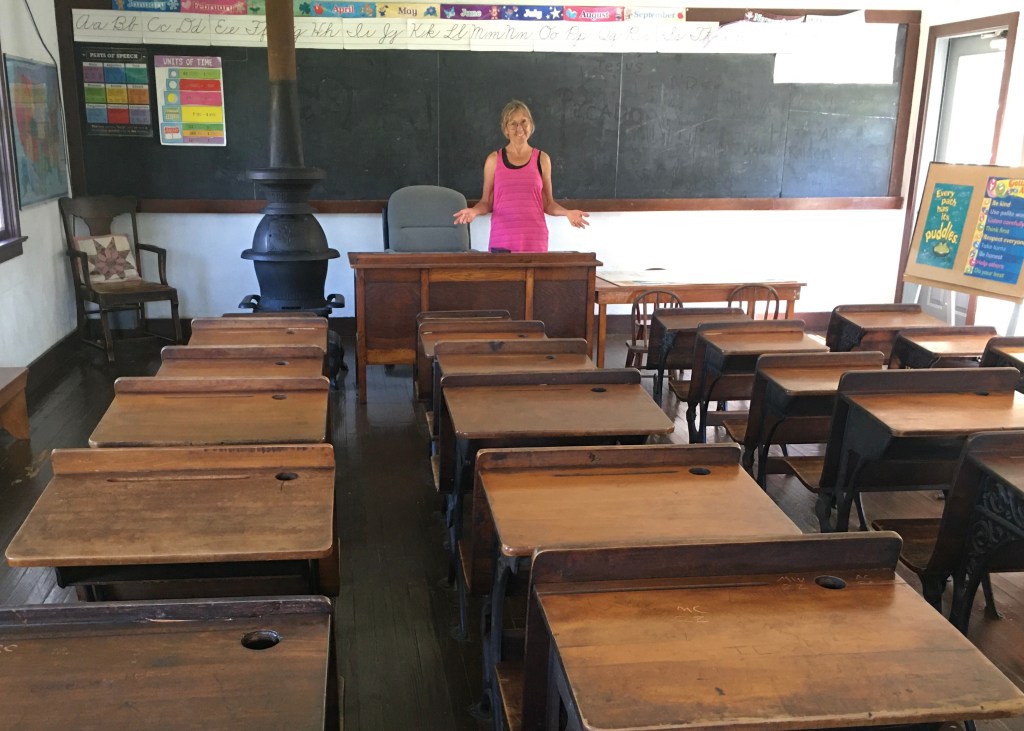
After a while buggies became so common they were unremarkable. More striking were the traditional single room schoolhouses, a young female teacher bravely managing a single class of 6-14 year olds. As were the horses ploughing the fields or carrying away newly cut corn.

Inside a single room schoolhouse

It was a magical experience. A peep into another world.

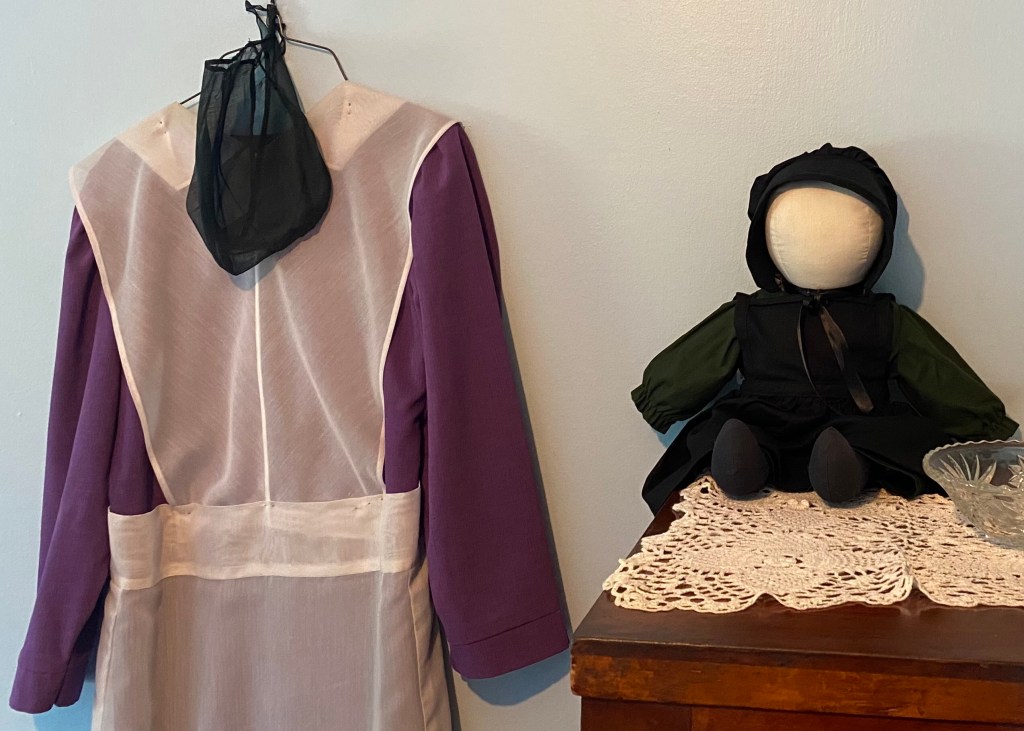
Amish wedding dress and faceless doll

Locals tell us the Amish are a happy community, living at peace with themselves and with their ‘English’ neighbours. Few young people are leaving and the population is increasing quickly.

But they do have many idiosyncrasies.

Take their attitude to bicycles!

The Amish are famous for rejecting most forms of modern technology, although it’s a little more nuanced than that. New technological innovations are carefully considered by the elders of each community, both for the value to their way of life and the potential disruption.

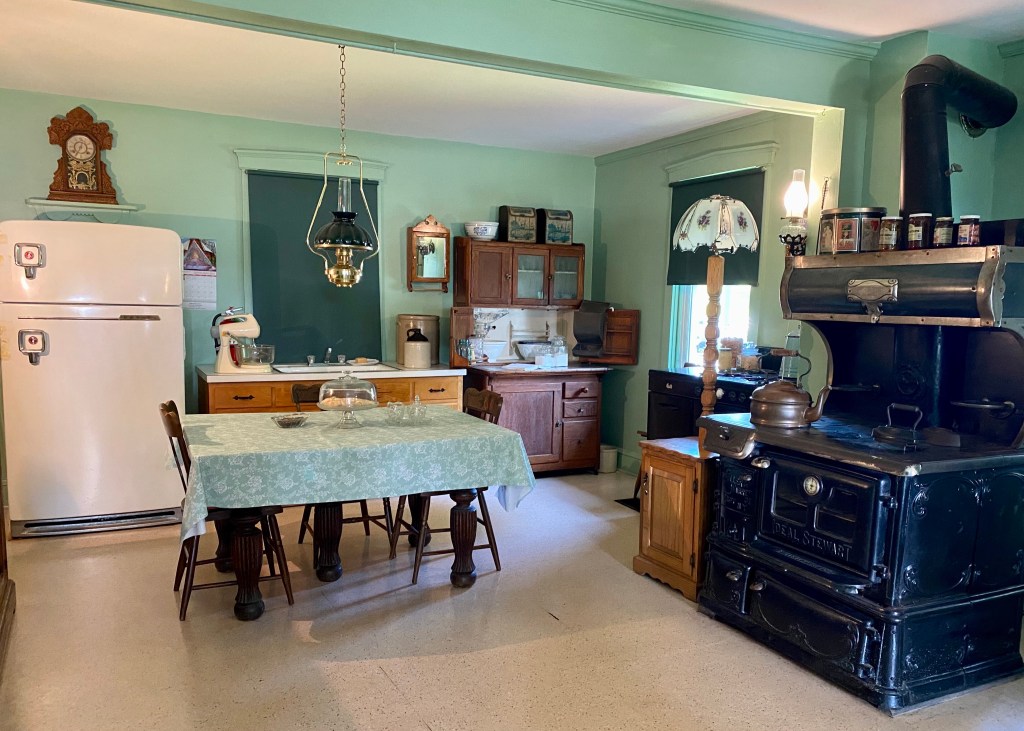
Tractors are generally banned, 1950’s style washing machines are allowed, mobile phones are only permitted for business phone calls.

Typical Amish kitchen

On the face of it, bicycles are a perfect low tech mode of transport. Indeed, they are used extensively by Amish communities in Illinois and Indiana. There’s even a group in Ohio who have embraced e-bikes.

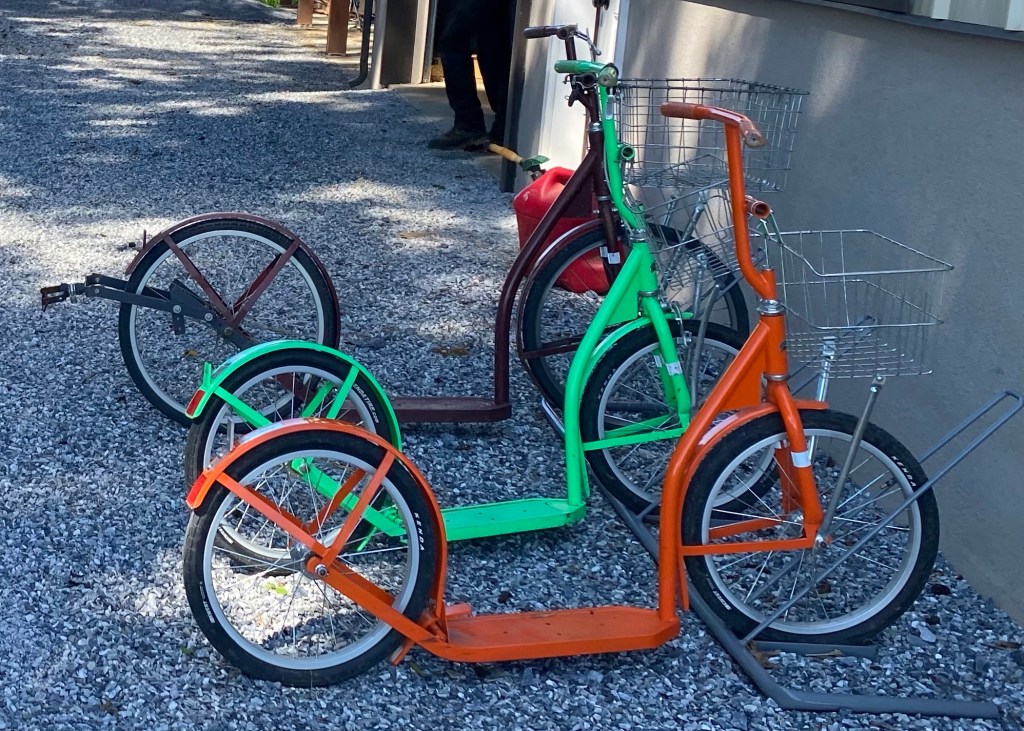
But in Lancaster County, bikes are banned. Instead both children and adults get around on specially designed scooters.

It’s difficult to find out why this is …

Some say the decision was made in the late 1800’s when the bicycle was first invented. At the time they were expensive and impractical for the rough 19th century country roads. Once a decision has been made here, it’s hard to get it overturned. Precedent is a powerful thing!

Others say that the bicycle has the potential to take young people too far away from home.

And others that the humble scooter has now become an enduring symbol of Amish life in Lancaster County, together with beards, buggies and bonnets. It’s much too symbolic to be superseded by bicycles.

We’ve decided to stick with our bikes!

After crossing the estuary from Cape May, we stayed in Rehoboth Beach, home to President Biden’s ‘Summer White House’. We then cycled for three days through the sorghum, sweetcorn and pigeon-pea fields of rural Delaware before heading up to Lancaster. It all felt green and clean, gentle and well organised.

Most of the ride was in delightful early fall weather … sunny days, not too hot, a softness to the air.

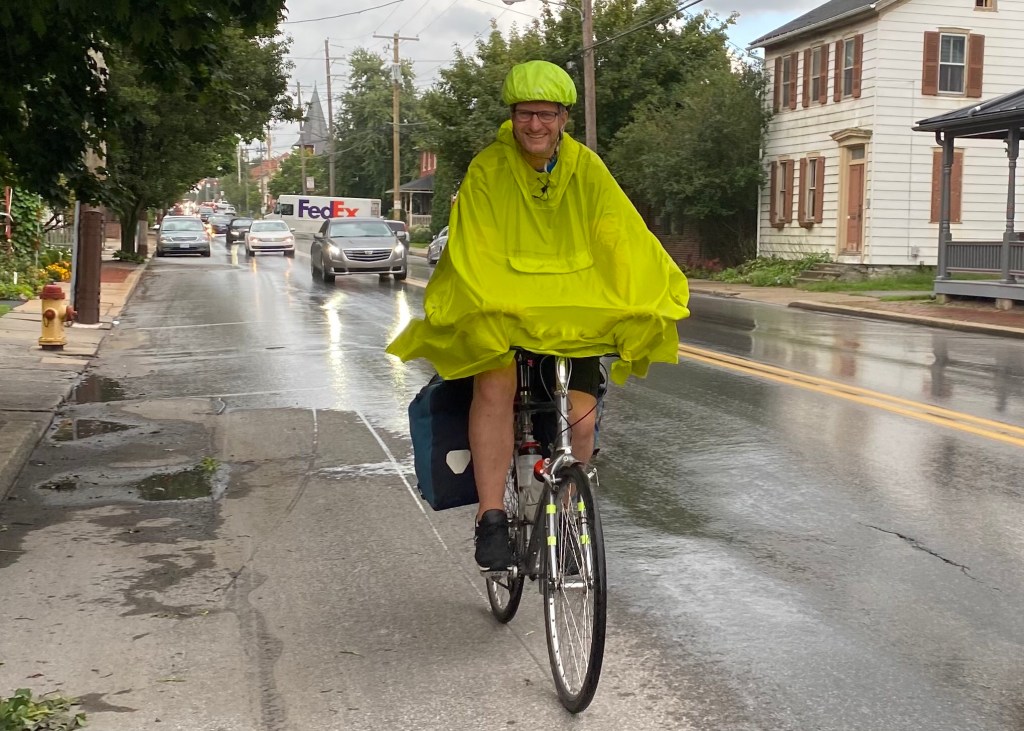
But we did get a complete soaking in northern Delaware and had to take cover in a small copse of trees for an hour or so. This also gave Andy an opportunity to try out his new piece of kit … a bright yellow rain cape, ideal for proper American rain.

Clare says he looks like the worst touring cyclist she’s ever seen, especially as the cape inflates like a balloon from behind.

He might look like an idiot … but at least he’s dry!

Andy has also experimented with a major change to his bike … some trekking or butterfly handlebars.

Over the years, he has cast many an envious glance at the proper adventure touring cyclists who often put these handlebars on their proper adventure touring bikes.

Andy thinks they’re a winner … lot’s of different hand positions, easy gear changes and a more upright riding position to enjoy the view.

Trekking or Butterfly Handlebars

Clare thinks they look like antlers!

She’s decided to stick with her drops … and her rain jacket. Once she finds something that works for her she doesn’t much like change (which Andy secretly thinks is just as well.)

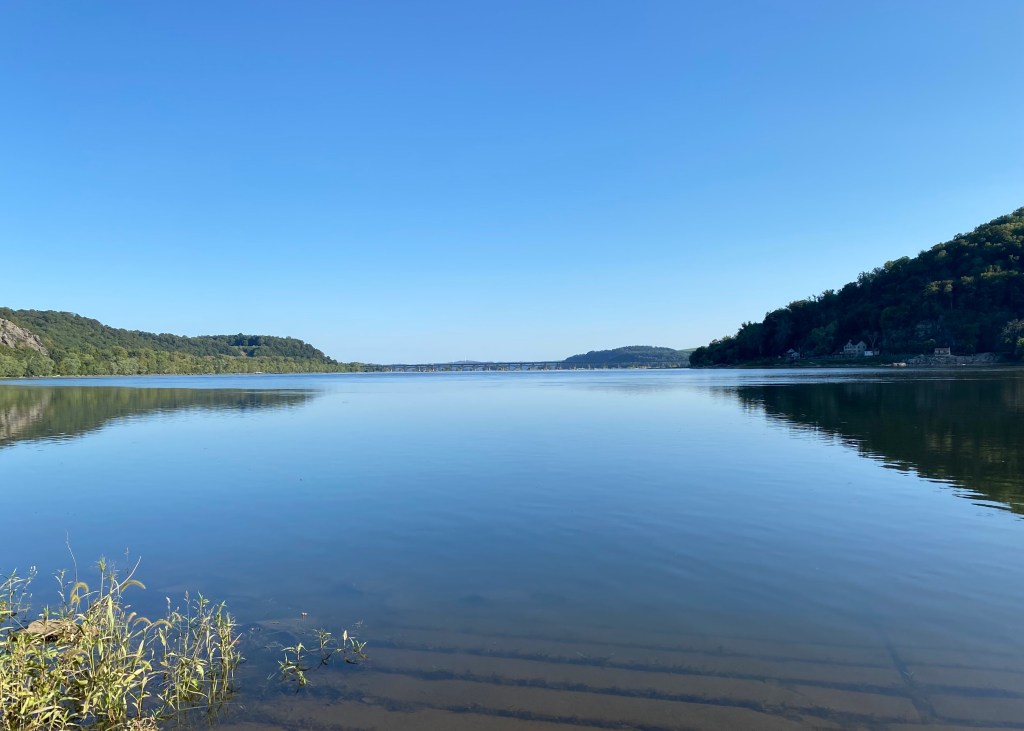
Susquehanna River

We left Lancaster and the Amish to cycle up the Susquehanna River into industrial, upcountry Pennsylvania. Close to Harrisburg, we passed the haunting remains of Three Mile Island, the site of America’s worst nuclear accident in 1979. Now closed, the decommissioning process should be completed by 2079!

Three Mile Island

We popped into McCleary’s pub in Marietta, and ended up staying all evening, talking politics at the bar and then dancing to some classic American tunes from a great live band.

New Friends in Marietta

Pennsylvania is a ‘swing state’ often switching back and forth between Republicans and Democrats. The senate race for the upcoming mid-term elections in November could even decide the overall balance of power.

Perhaps because it’s election time, we’ve found that lots of people here are keen to talk about politics and the divisions they see in American society today. Over the last few days we’ve heard the full range of political opinion … from Trump supporters to mainstream Republicans to Democrats and some Independents.

Whilst there’s little agreement on how things should be done, we’ve noticed that what people want is often much the same. The list of things people reel off usually includes fair rewards for hard work, a safe and peaceful place to live, opportunities for their children etc.

But most people here do seem worried that political differences are increasing and becoming more divisive.

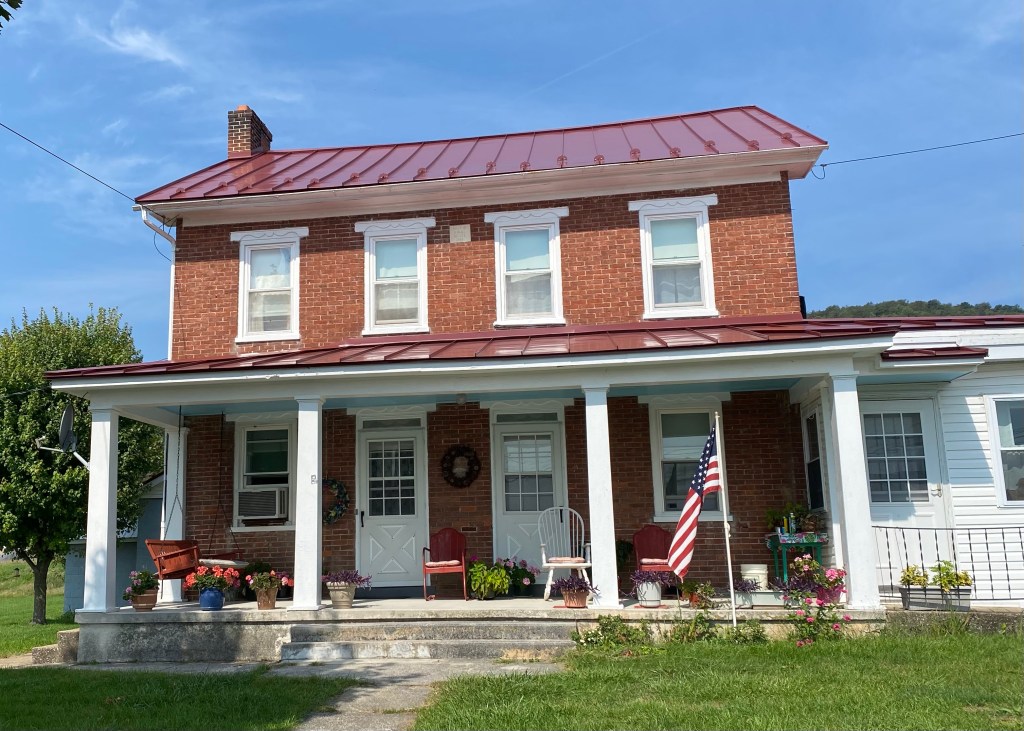
Typical Pennsylvania Home

We’ve now arrived in Gettysburg, one of the most famous symbols of the American Civil War. Sometimes called the ‘Brothers War’ (as friends or even family members found themselves on opposite sides), it was a time when political differences led to a brutal, bloody conflict.

Gettysburg was a humbling place from which to watch Queen Elizabeth’s funeral. Amongst her many other virtues, she was known for listening and trying to understand a range of different opinions.

Gettysburg

Perhaps the Amish can also teach us something about resolving conflict.

In 2006 an ‘English’ neighbour killed five little girls at an Amish school just a few kilometres east of the area we cycled through, before turning the gun on himself.

It was the Amish community’s response that astonished everyone. Within hours they reached out to the gunman’s family offering forgiveness and compassion, realising that they were suffering too.

So same same but different can be OK, at least in Lancaster County.

Clare and Andy

725km pedalled (450 miles)

3,501m climbed

29 hours in the saddle

Land of the Free

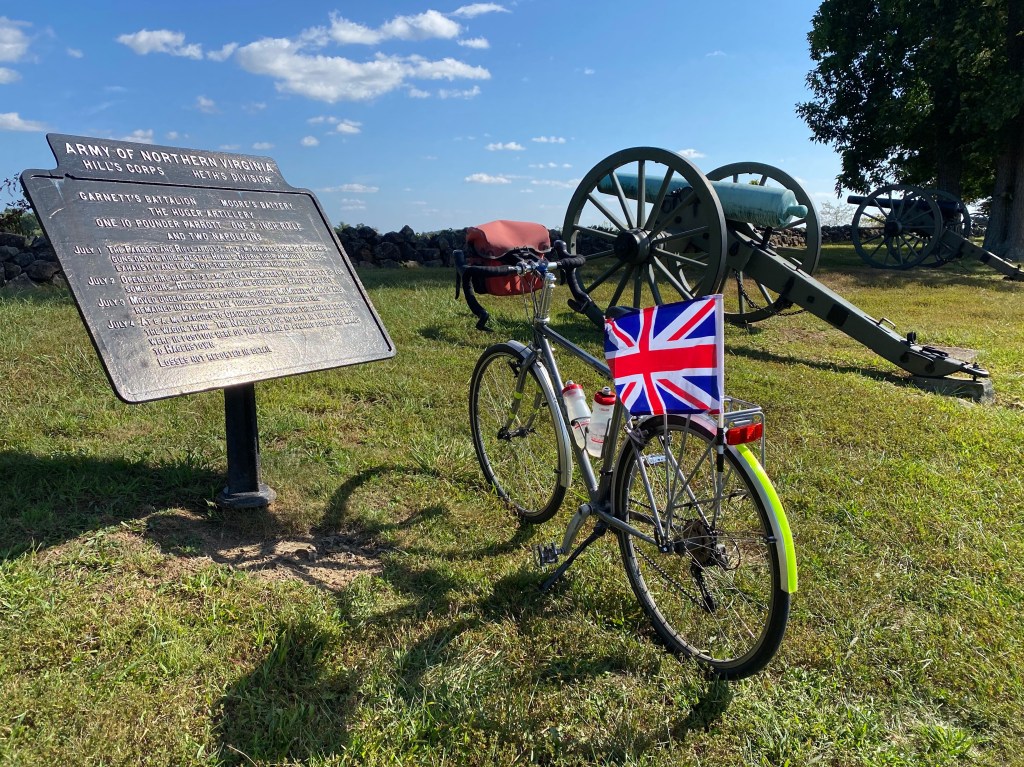
Riding a bicycle is a great way to explore a battlefield.

And Gettysburg is a wonderful battlefield to explore.

Beautifully preserved as a national treasure, the site is littered with memorials to the men who fought to a standstill there over three brutal days in July 1863, at the height of the American Civil War.

The Pennsylvania Memorial at Gettysburg

Some places that saw the worst of the fighting are legendary … Little Round Top, Pickett’s Charge, the Wheatfield.

The Wheatfield

We stood alone in the Wheatfield at sunset, having cycled around the park after the crowds and tour buses had left for the day.

It’s now a peaceful and beautiful spot but it was impossible not to be moved by the imagined horrors of that day.

This small field changed hands four times in a series of confused attacks and counterattacks. By the time they had finished, over 6000 men lay dead and injured on the ground.

Two days later, we came across an even deadlier crop … the Cornfield at Antietam.

Nine months earlier, in September 1862, twenty five thousand men fought backwards and forwards through this field, firing at point blank range through the thick, high stalks of corn.

The corn is ready to harvest as it was in September 1862

It seems we picked some of the most brutal civil war sites to visit. Gettysburg was the bloodiest battle of the war. Antietam was the bloodiest single day. Both were important as they fended off Confederate invasions of the north.

Antietam had a wider impact as it gave Lincoln the ‘victory’ he needed to issue the Emancipation Proclamation, extending the objectives of the war to free the slaves as well as to preserve the union.

Cycling through Antietam

That proclamation meant that John Browns body was probably spinning in his grave. Spinning with delight that is.

A fireball abolitionist, John Brown led an ill feted raid on the weapons store at Harpers Ferry a few years before the war, hoping to incite a slave rebellion. The raid failed miserably and he was strung up for his trouble but it proved to be one of the catalysts for the war … and for the eventual freedom for the slaves.

The Shenandoah and Potomac rivers meet at Harpers Ferry

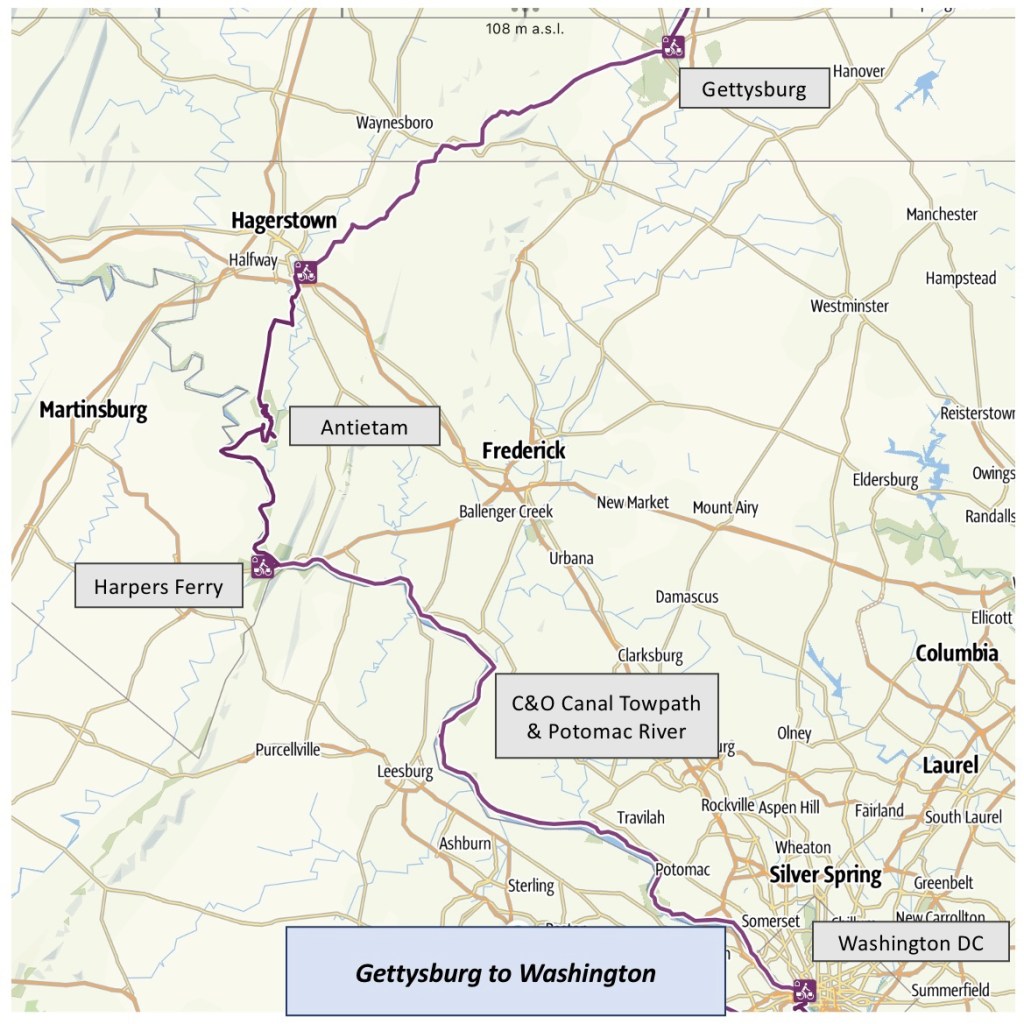
Today, Harpers Ferry is one of the main stopovers on the C&O Canal Towpath, a bucket list trip for many American touring cyclists as it’s part of a bike trail that goes all the way to Pittsburgh.

We hadn’t seen a single touring cyclist on the winding roads of New Jersey, Delaware, Maryland or Pennsylvania … but now it became impossible to miss them. On a pleasant Sunday in September the C&O transformed into a pannier clad bicycle super-highway!

A Lock Keeper’s Cottage – popular for overnight stays

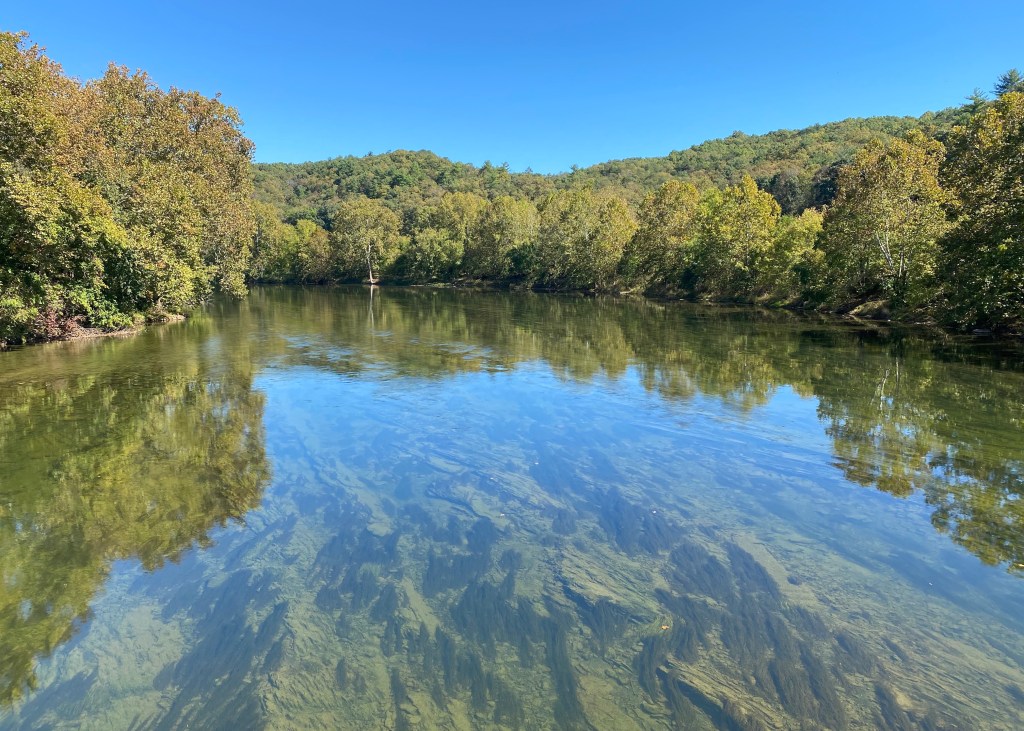
Beautifully maintained as a National Park, the canal path led us through an old lowland forest full of American Sycamore, Silver Maple and Box Elder, so thick their branches only offered the occasional tantalising glimpse of the lazy Potomac river beyond.

Most of the trail is made from small pieces of ‘crush and run’ gravel which are then covered in stone dust. It’s smooth as silk.

Canal to the left, river to the right

Closer to Washington the trail became a bit rougher, full of sharp stones and tree roots. We were happy that our new German engineered Ergon saddles kept their promise to dampen down the vibrations.

Bumpier tracks

After a 100km our bottoms were ready to stop, so we were also very happy when the canal dropped us off right in the centre of downtown Washington DC.

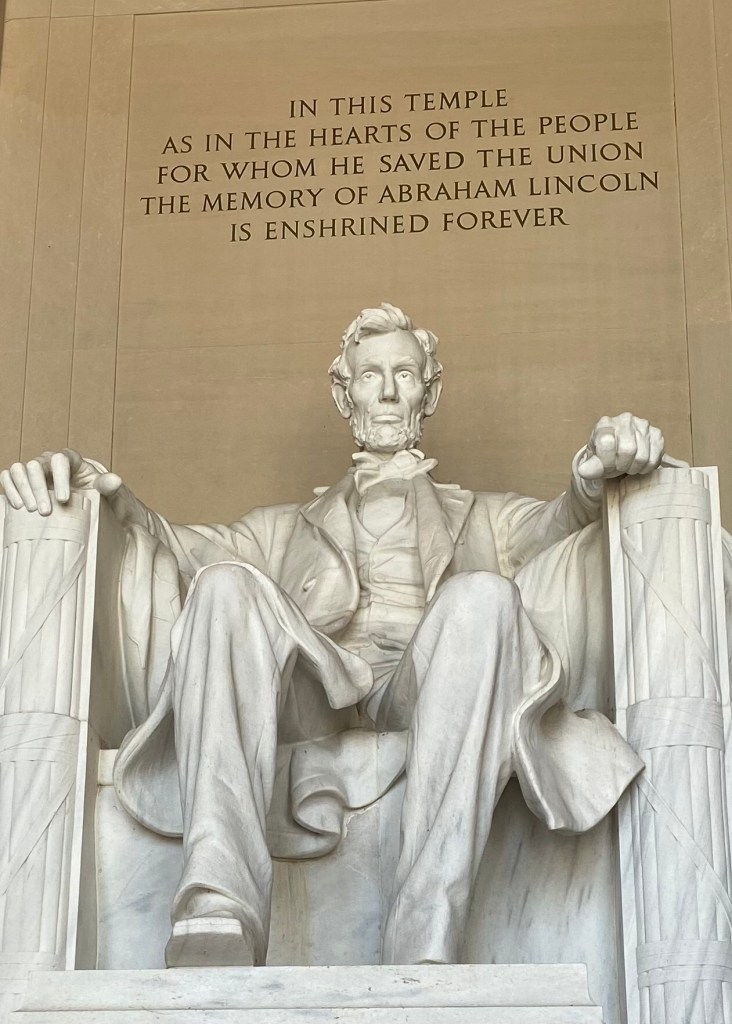
Lincoln Memorial

Washington is justly famous for many reasons … the White House, the Lincoln Memorial, Capitol Hill. But for tourists it has simply become famous as the capital of “Free-Stuff-To-Do”.

The Capitol

This is mainly down to an English chap called Smithson who died in 1829, leaving some money in his will “to found at Washington, under the name of the Smithsonian Institution, an Establishment for the increase & diffusion of knowledge among men.”

He’d never even set foot in the United States so why he did this remains a mystery. To create a legacy? Or from a chip on his shoulder at his treatment by the class-obsessed English?

Whatever the reason, the American President was naturally curious to find out how much dosh was involved, so he sent a diplomat to London who duly returned with 105 sacks stuffed with 104,960 gold sovereigns.

It was worth about half a million dollars at the time, roughly $13bn today. That’s enough for a few museums!

Today the Smithsonian Institute is the worlds largest education and research complex.

The excellent Museum of African American History & Culture

Including government buildings, we visited the following …

Capitol Hill, the Library of Congress, the White House Visitor Centre, the Museum of American History, the Museum of African American History & Culture, the US Holocaust Memorial Museum and the Museum of the American Indian.

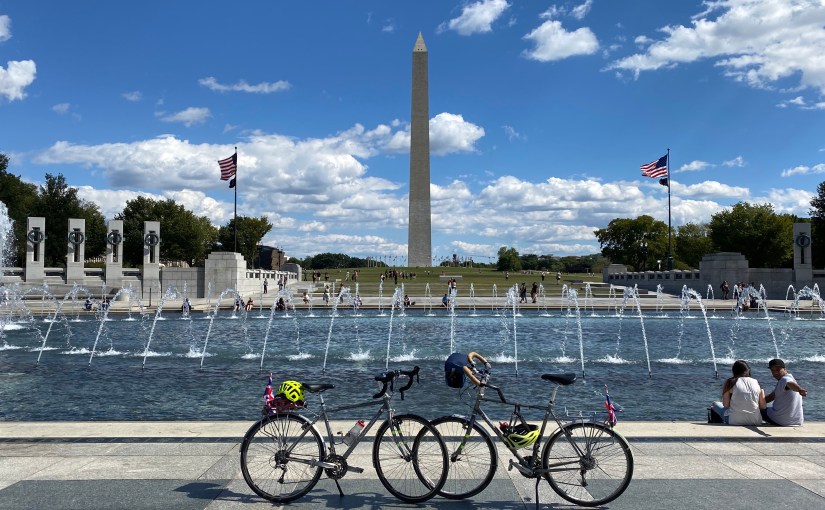
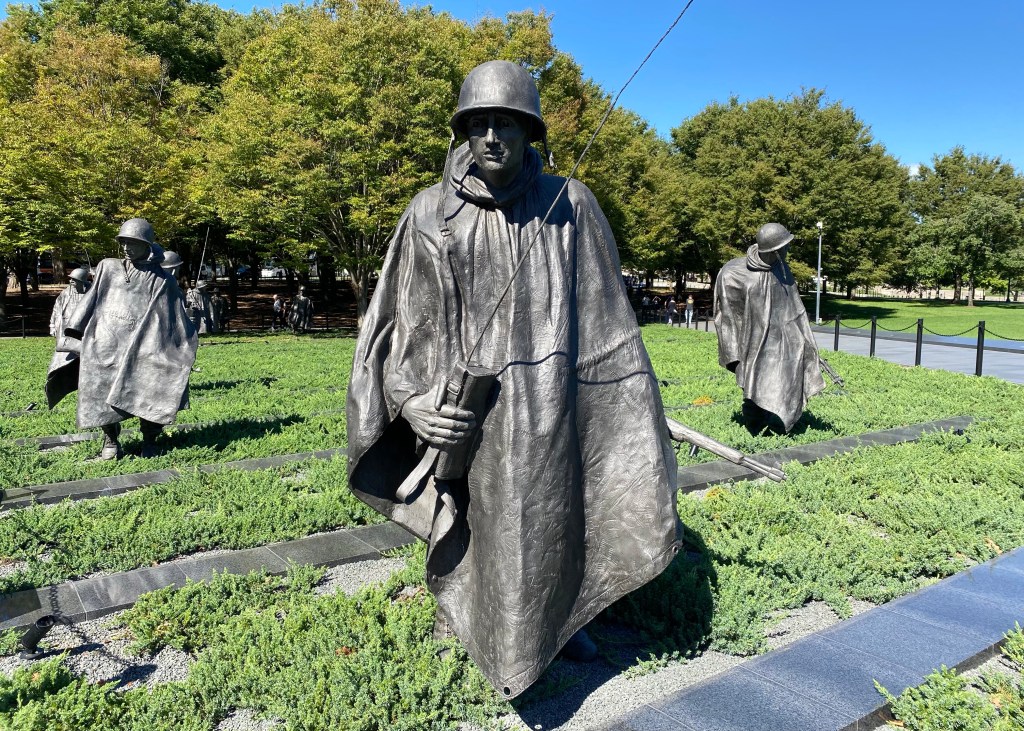
Plus memorials to Vietnam, Korean and WWII veterans, to Martin Luther King, Thomas Jefferson, Abraham Lincoln, Ulysses S. Grant and of course to George Washington himself.

Phew!

Korean War Veterans Memorial

Clare began to think that sightseeing was even more exhausting than cycling.

Enough!

On Capitol Hill we were lucky enough to see the Senate Chamber in session and to hear them debate the issues of the day. They didn’t hold back … the issues we heard were related to Iran, the war on drugs and abortion.

It was all free! And all a bit mind blowing!

Martin Luther King Memorial

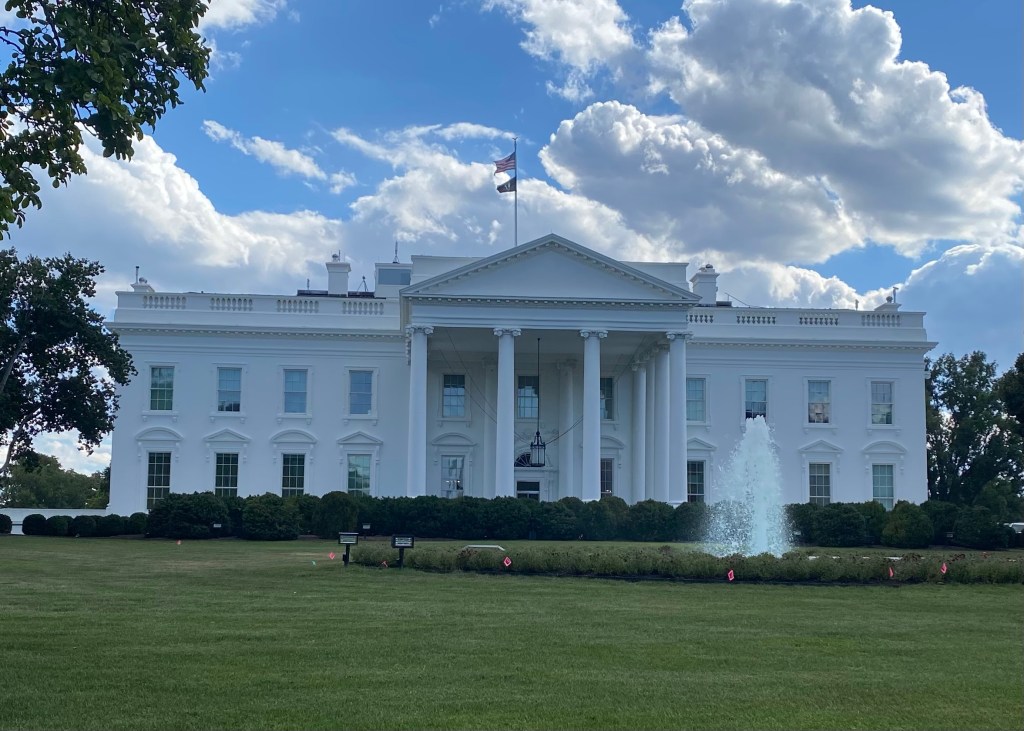
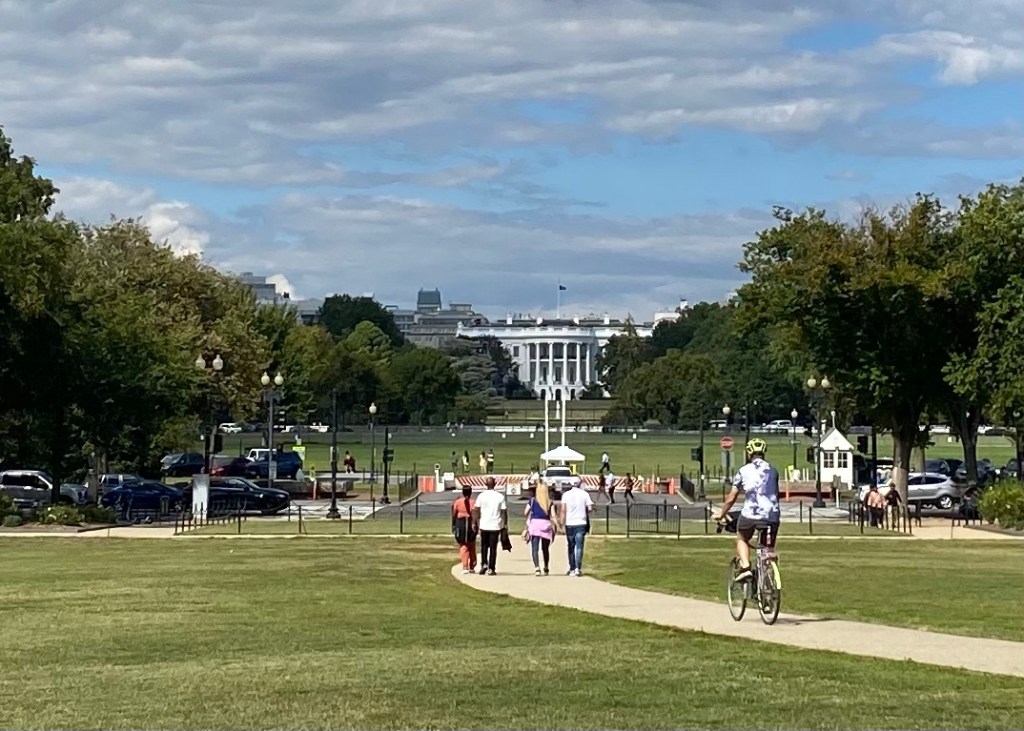
A little exhausted, we cycled each evening past the White House just hoping for a chance to personally thank Joe or Jill.

Sadly, they were busy.

Anyone home?

It’s just as well there is so much free stuff to do in Washington DC as America in general is much more expensive than any other country we’ve cycled in.

This is partly due to our $ to £ exchange rate. But we’re also finding the things that cycle tourists typically spend money on (accommodation, food & drink, entrance fees etc) are pretty expensive in $ too.

Fortunately the most important staple of any bike tour, bananas, are still affordable … at about 20 cents each.

George Washington Memorial at night

Washington is another US city that is super-easy to get around by bike. The streets are quiet and very wide, so traffic isn’t a major problem.

The pavements (sorry, sidewalks) are also wide with cyclists encouraged to use them … which did feel a bit odd at first.

But it’s the National Mall that makes Washington so good for visitors on two wheels … it’s a two-mile bike-friendly paradise that contains all the main attractions.

Apart from legally riding on the sidewalk, there are a few other rules of the road we’ve had to get used to in the US of A …

4-way All Stop Junctions: Cars from all directions have to stop, then they politely take turns. At first we kept stopping too, but most of the drivers waved us through even when it wasn’t our turn. Now we slow down and cruise through, just checking to make sure it’s safe. It seems to work!

Right Turn Lanes: On major roads an extra lane often pops up for traffic that’s about to turn right. This means that we have to hold our breath and move across to the middle lane if we’re going straight ahead. A bit scary!

Right Turn on Red: Cars and bikes are allowed to go through a red light in order to turn right when there’s space. As long there isn’t a sign saying they can’t. Until we learnt about this one, we got tooted at quite a bit while we waited for green. We’re used to it now!

Cycling rules can also be different in each state … so we must remember to check before we ride on the sidewalk in Virginia.

While we were in Washington, we saw the original “Star-Spangled Banner”, carefully preserved in a darkened room. It’s the flag that flew steadfastly over Fort McHenry in Baltimore whilst British warships were pounding it in 1814 and has since become a legendary icon.

A young man called Francis Scott Key witnessed the bombardment, becoming so moved by the defiance and symbolism that he wrote it down in a poem. 117 years later this poem became the American national anthem. You probably know the last few lines …

“O say, does that star-spangled banner yet wave

O’er the land of the free

And the home of the brave?

Ironically it’s set to the tune of a popular 18th century English drinking song!

In Gettysburg, an old injury in Clare’s knee began to get quite painful. We decided to stay on for a couple of days to rest it and it seemed much better on the ride down the canal path to Washington DC.

But now we’re turning our handlebars towards Virginia, she has to choose whether to test it again in the hilly country roads of the Blue Ridge Mountains and the Shenandoah Valley as planned. Or to cruise gently down the flat lands of the coast instead?

After enjoying the land of the free, she has of course opted for the home of the brave!

Mountain mama!

Clare and Andy

1006km pedalled so far (450 miles)

5,370m climbed

45 hours in the saddle

Country Roads and Rail Trails

We hold this truth to be self-evident. When cycling the country roads of Virginia it’s essential for the pursuit of happiness to find some authentic country music.

And we found ours right in the heart of the Shenandoah valley … at the Grottoes Bluegrass Festival in the midst of the Blue Ridge mountains.

Headlined by ‘Seth Mulder & Midnight Run’ and by ‘The Bluegrass Brothers’ (check them both out on Spotify, they’re very good), it’s a small local festival … perfect for a sunny Saturday afternoon in October.

The crystal clear water of the Shenandoah River

Clare’s personal pursuit of happiness was going very well as her knee injury had now recovered. A few days of extra rest in Alexandria, sheltering from the after effects of Hurricane Ian, had worked its magic and she felt strong and fit again.

Both of us had really enjoyed the three and a half days it took us to climb up through the hills to this little music spot in Grottoes.

We settled down to watch the support bands, happily drinking coffee, eating muffins and jigging along to the music.

After a while, Clare wandered off to take some photos. Smiling, she stepped aside to let some people past … and suddenly, surprisingly … found herself flying backwards through the air.

She had back-flipped over a guy rope that was holding up a large gazebo and landed heavily on her coccyx, the whiplash then banging her head on the ground.

It hurt! A lot!

And the pain was not in a good place for sitting on a bike … with half a day of hilly riding still ahead of us.

Taken just before the fall

It turns out that an injured lady at a bluegrass festival is something of a man-magnet. By the time Andy arrived at the scene he had to join the queue. Ice-packs were applied, painkillers offered, a rug to lie down on.

She was in good hands … one of her rescuers was a retired cowboy from Montana, still very lean and strong!

We stayed on to see the headline acts from the back, no longer jigging. Then Clare bravely declined the multiple offers of pickup truck lifts and got back on her horse to painfully pedal the 30km to our hotel in Staunton, arriving well after dark.

Seth Mulder & Midnight Run

The next morning her bum was very, very sore.

Amazingly, in this hour of need we were rescued by the kindness of strangers, now firm friends.

Way back in Rehoboth Beach in Delaware we had chatted to two lovely people, Maura & Jerry, for about fifteen minutes and made vague arrangements to maybe meet up in Maryland where they live. In the end we didn’t cycle close enough … but we had stayed in touch.

As Clare was listening to more steer wrestling stories from the cowboy (the steers getting bigger and bigger), her phone rang. It was Jerry … they had some good friends, Marian & Paul, in Staunton … would we like to meet them?

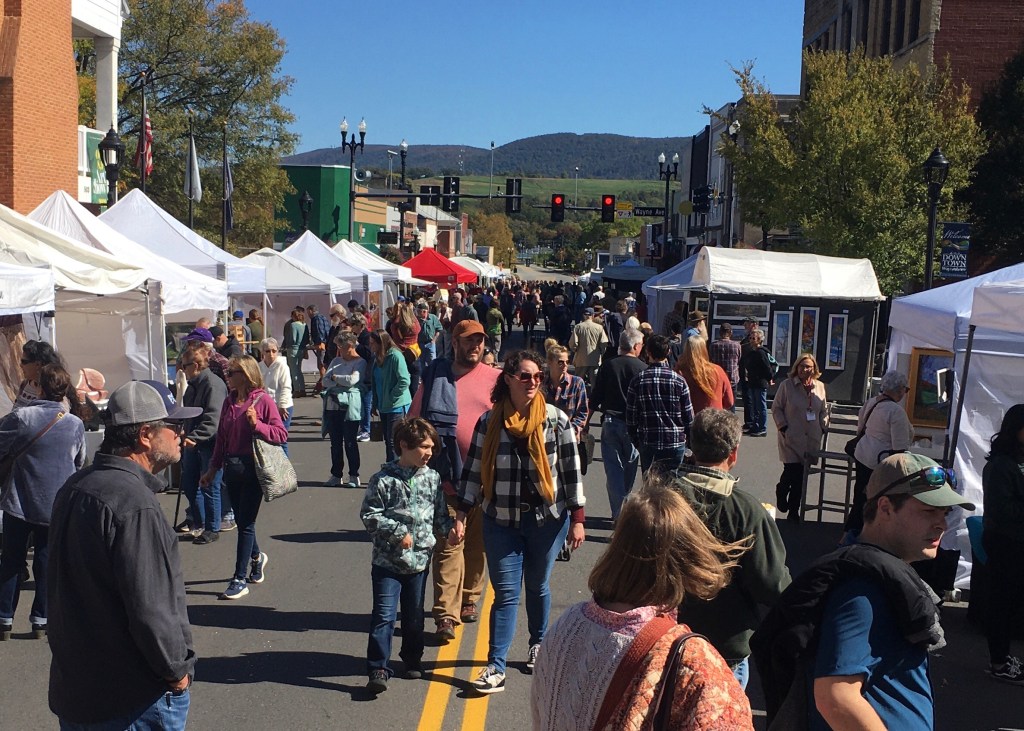
So on Sunday morning we found ourselves heading to an art festival in nearby Waynesboro, then onto a country craft brewery, then back to their beautiful home for dinner.

Waynesboro Art Festival

They introduced us to their neighbours, Tammie & Howard, who invited us back for more delicious food the following evening.

We enjoyed two warm and fun evenings. It was a real privilege to share stories with people who live in this beautiful part of the world and know it so well.

New friends

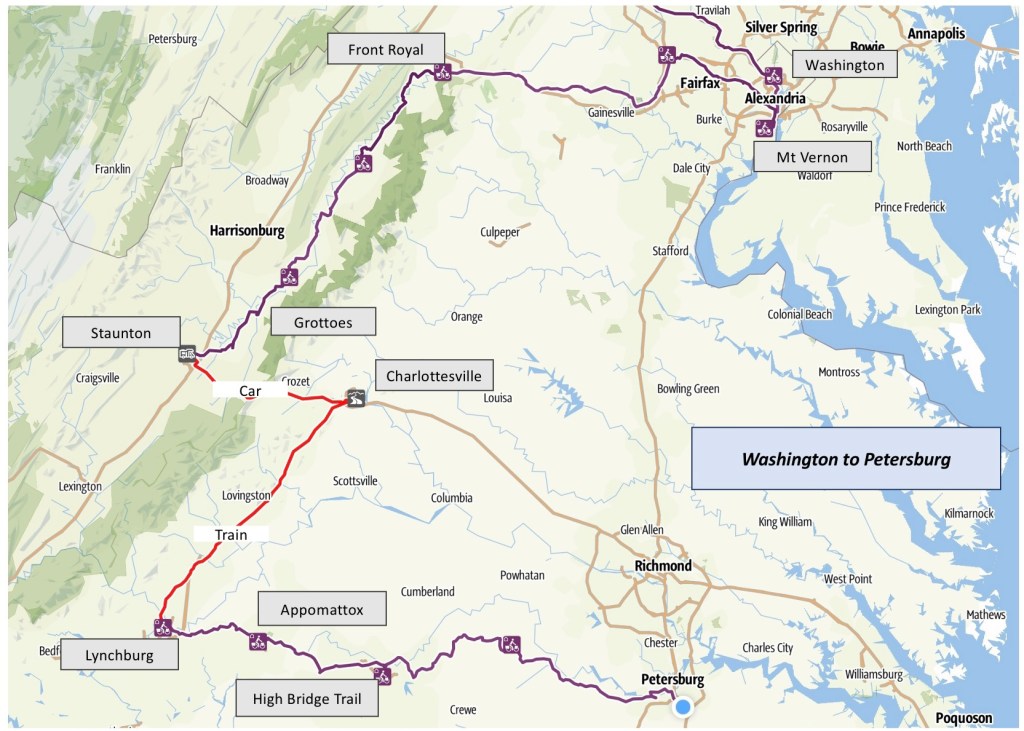
But we still had to find a way back over the Blue Ridge, as there was no way Clare could cycle over the mountains. We tried the local train (no daily service), bus (no space for bikes) and car rental (no cars available).

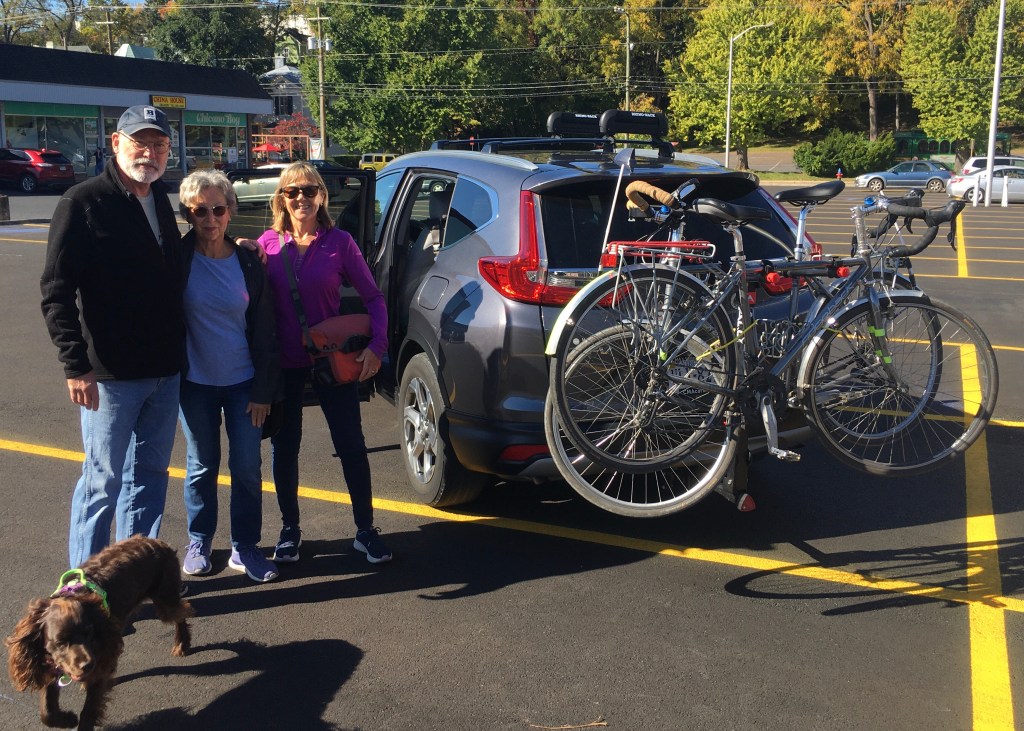
Once again we were rescued by our new friends. Marian & Paul stuck our bikes onto the back of their car and drove us over to Charlottesville.

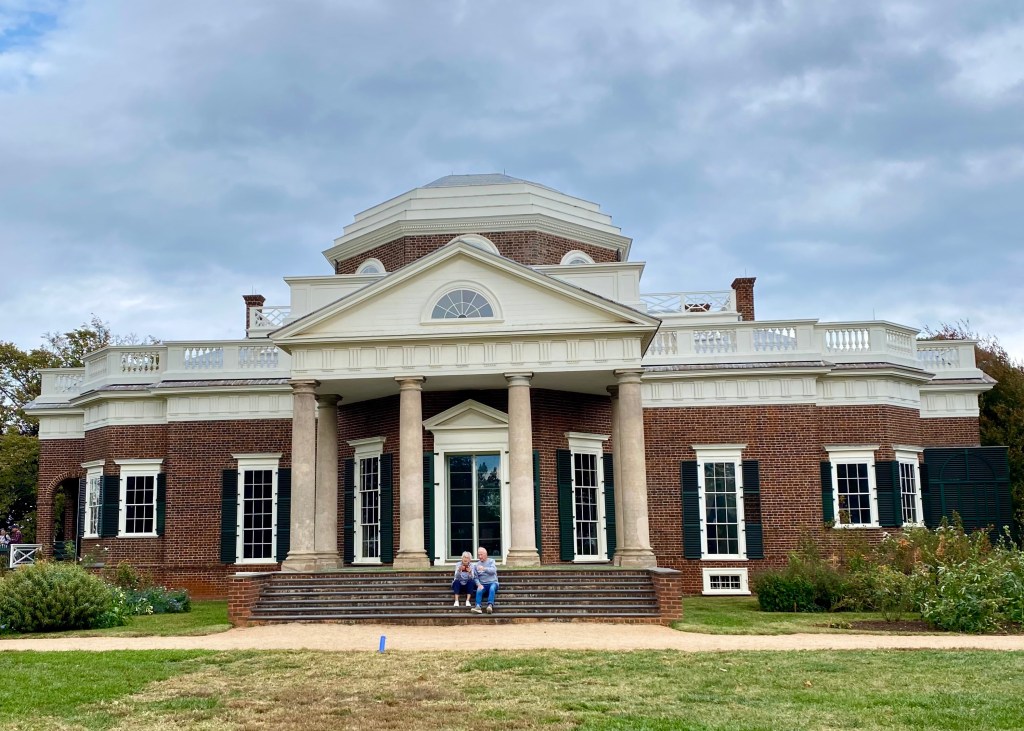
Charlottesville is mainly known as the location of Monticello, the home and plantation of Thomas Jefferson, 3rd President of the United Stares and the main author of the Declaration of Independence that, of course, includes these famous lines …

“We hold these truths to be self-evident, that all men are created equal, that they are endowed by their Creator with certain unalienable Rights, that among these are Life, Liberty and the pursuit of Happiness.”

Monticello

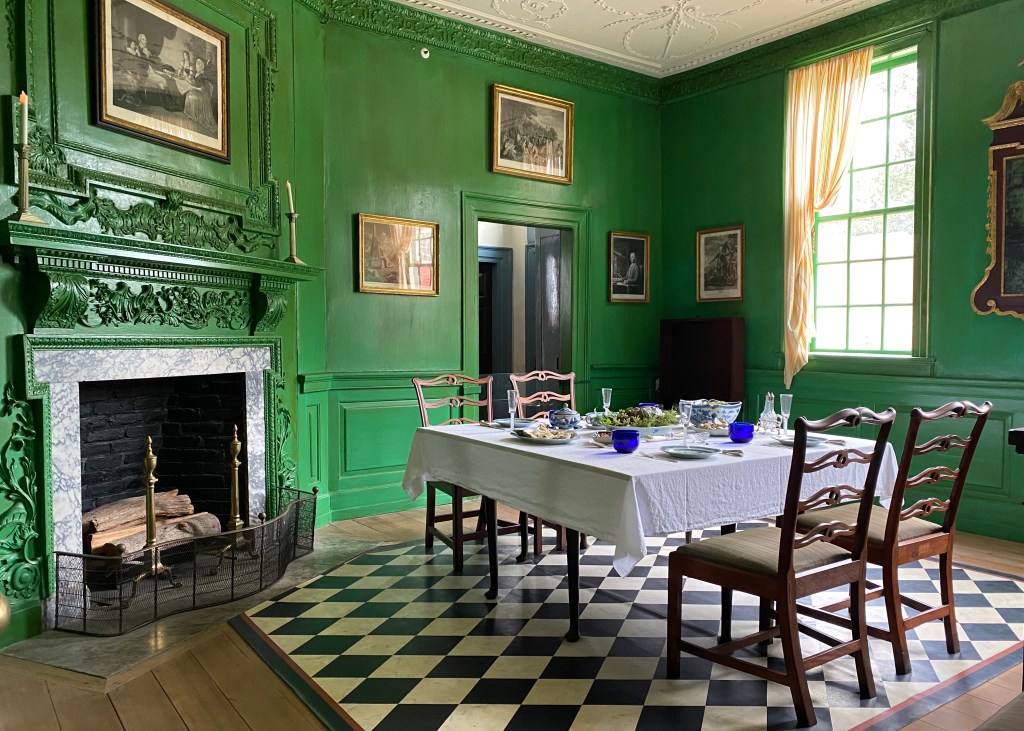
A week or so earlier we’d also visited Mount Vernon, the home and plantation of George Washington the 1st President.

Dining room at Mt Vernon (this shade of green was very fashionable in the 18th century)

Both men come with some baggage and contradictions that America is still wrestling with today:

  • As well as being revered founding fathers, both of them were large slave holders.
  • It’s now generally acknowledged that Jefferson fathered six children with Sally Hemings, an enslaved women living on his plantation who was 30 years his junior.
  • And many people think the Declaration of Independence only really refers to the equality, liberty and happiness of land-owning white men.

But Monticello and Mount Vernon are very interesting places to visit, not least because the organisations that run them are refreshingly open and honest about both the good and the bad sides of these famous men and of the challenges that were faced by the enslaved people who worked for them.

This openness and criticism is true of many of the museums and historic sites we’ve visited in America, a trend we’re told that has developed mainly in the last decade or so.

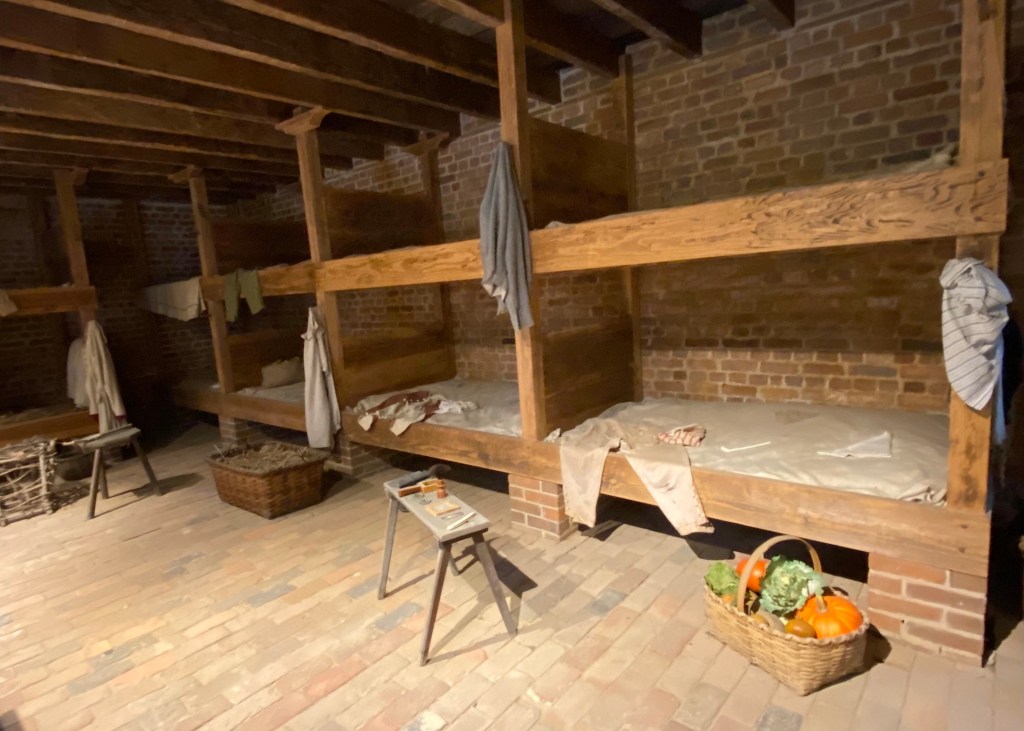
Living space for enslaved men at Mt Vernon (two to a bed)

From Charlottesville we took a train 100km (62 miles) southwest to Lynchburg, partly to find out how well Amtrak manages bicycles as we’re planning a longer train journey to the south next week.

Bikes on Amtrak is fairly easy. Take off the front wheel and hang her up.

But mainly it was because we knew we could pedal from Lynchburg to Petersburg in four relatively short days, without too many ups and downs and too much strain on Clare’s sore posterior.

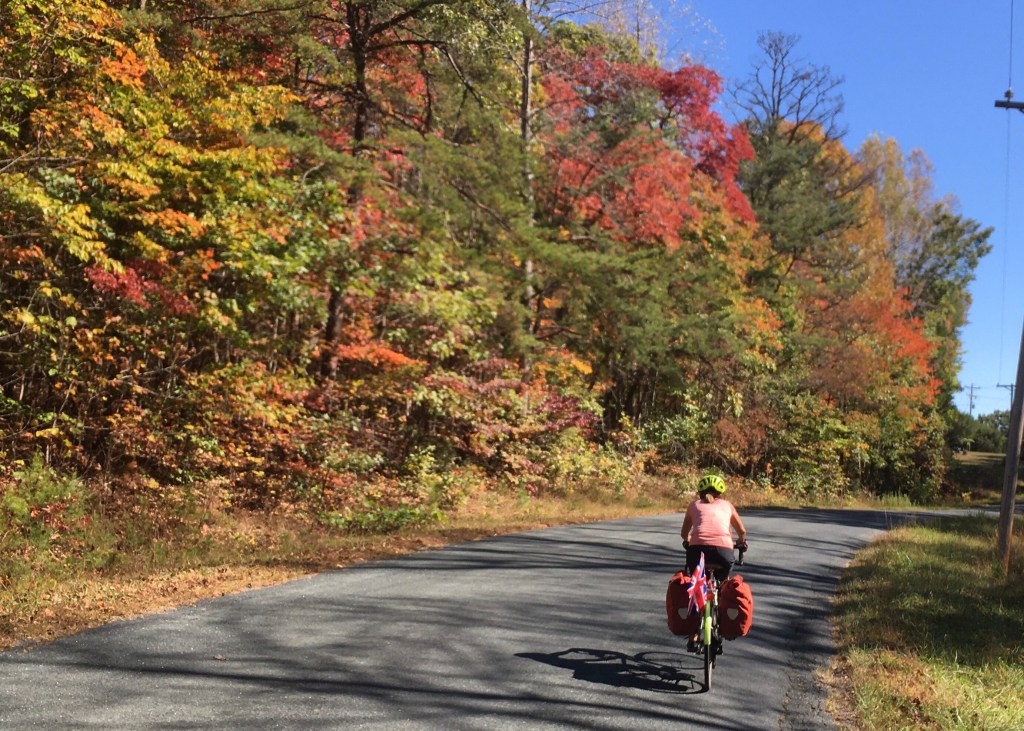
For the most part, these four days were a series of lovely bike rides … on smooth, quiet back country roads … beneath dappled sunshine … in ‘just right’ Goldilocks temperatures … past endless oak, hickory and maple trees that were transforming before our eyes into their fall colours.

We were accompanied by the continuous pop-pop noise of acorns hitting the ground, like the sound of toy guns … an echo perhaps of the soldiers who marched and fought here in the last days of the civil war.

By chance, we had chosen to follow (in reverse) the route of ‘Robert E. Lee’s Retreat’ in April 1845, the final march of a starving Confederate Army as they tried to escape back to the south.

Relentlessly and ruthlessly pursued by the Union Army of Ulysses S. Grant, they eventually surrendered in the tiny village of Appomattox, marking the beginning of the end of the conflict. Today it’s a humbling place to visit, quite different to other civil war sites, full of pathos and quiet dignity.

The room at Appomattox where the surrender was signed

From Appomattox we rode for 35km (22 miles) along the High Bridge Rail Trail, one of many such ‘rail-to-trails’ that now criss-cross America.

The High Bridge Trail

In the industrial ‘Gilded Age’ of the late 19th century thousands and thousands of miles of rail track were built across America, often by competing companies. Many quickly fell out of use and are now being gradually turned into biking and walking trails.

According to the Rails-to-Trails Conservancy over 40,000km (25,000 miles) of track has already been converted nationwide, with another 14,500km (9,000 miles) in the pipeline.

We also enjoyed leaving Washington on this rail trail

Most American touring cyclists we’ve met have told us that they try to stick to these trails as much as possible. Having now experienced some of the busier country roads of Virginia, we can see why that is.

The country roads can become very scary!

The problem is that these busy roads are narrow and the cars are big and wide, especially the ever popular pickup trucks.

Most drivers are very courteous but there is a sizeable minority (usually in pickups) that are pretty aggressive … overtaking us on a blind bend or before the crest of a hill. We’ve seen many a near miss on this trip … but fortunately we’ve only had to jump off the road ourselves once.

No pictures from busy roads … but we’ve seen a few ‘interesting’ signs

Thinking back, we haven’t seen any other cyclists braving the country roads of Virginia over the last couple of weeks.

Not a single one!

No other touring cyclists, not even someone out for a pleasant weekend ride.

A park ranger on the High Bridge Rail Trail was so surprised to see us that he flagged us down. He told us that he used to see lots of people touring Virginia by bicycle, but that we were the first he’d spotted for many years.

Why?

“Because it’s become too dangerous!”

Oh?!

“Y’all stay safe now.”

OK (gulp).

Taking refuge for a picnic in a church BBQ area

Well … if you can’t beat them, join them!

As soon as we got to Petersburg, we rented a car and drove back into the mountains to see the fall colour in all its glory. As the leaves were at their finest at slightly higher altitudes, we chose to drive further south into the Highlands of North Carolina.

It didn’t look that far on the map but it turned out to be a 1000km (640 miles) round trip. To see a few leaves? We’d never do that at home!

But it was definitely worth it!

Blowing Rock, North Carolina

As we drove along the famous Blue Ridge Parkway a tapestry of colour spread out before us … vibrant yellows, burnt orange, dark red and the blue green for which the mountains are named. The sea of trees rippled down towards the coast like waves on a shallow beach.

It was awe inspiring!

Best of all though … there wasn’t a single cyclist to slow us down!

Clare & Andy

1,692km pedalled so far (1,051 miles)

12,100m climbed

90 hours in the saddle

A taste of southern comfort

We knew we’d reached the deep south when the menu changed … Shrimp and Grits, Spicy Southern Fried Chicken, Crab Cakes, Corn Bread with Marmalade and Fried Green Tomatoes.

Fried Green Tomatoes

Best of all was the southern breakfast classic … Biscuits and Gravy. A light scone made from buttermilk, then smothered in a thick, creamy sausage sauce.

Comfort food at its finest!

Biscuits and Gravy

We’d arrived in Charleston, South Carolina on an Amtrak train … the fabulously named ‘Silver Meteor’ that takes 28 hours to trundle down the 1,389 miles of track from New York to Miami every day.

It was our first experience of taking our bicycles aboard a long-distance train and it turned out to be surprisingly easy. They were safely tucked away in the baggage car whilst we happily watched the world go by from huge, comfortable seats … even in economy ‘Coach Class’.

Between handing back our rental car in Petersburg and boarding this train from Richmond to Charleston, you might be relieved to know that we did actually do some pedalling … a 300km (186 mile) loop around the Virginia Peninsula to visit the famous ‘historic triangle’ of Williamsburg, Jamestown and Yorktown.

Many of you will also be relieved to hear that Clare’s backside was feeling much better by now and she could enjoy cycling again, especially as the roads were flattening out the closer we got to the coast.

Ironically, the historic triangle saw both the beginning and the end of British colonial history in America, neither giving great cause for national pride.

Jamestown marks the beginning of the colony. Three ships arrived there in 1607, carrying 104 men and boys to establish the first permanent settlement in the New World.

Those early years were characterised by infighting, starvation and disease; by broken promises and ill treatment of the local Powhatan Indians; by the introduction of slavery and indentured labour; and by the development of tobacco as a cash crop.

Surrounded by swamps and mosquitoes and without a good supply of water it must have been an extremely tough life.

Graves from ‘the starving time’ at Jamestown

Today it’s a fascinating and peaceful place to visit, right on the banks of the James River. The site itself is an archaeological national park but there’s also an excellent recreation of the original ships, the fort and a local Powhatan village.

Statue of John Smith at Jamestown

If Jamestown is the beginning of the British colonialism, then Yorktown just 20 miles away, is the beginning of the end. In 1781, a large British army under General Cornwallis became trapped there between the American patriots and the French navy. After a short siege they were forced to surrender, setting in motion a chain of events that confirmed full American sovereignty two years later.

An American Patriot firing at the British

Halfway between them is a place with a more respectable history for us Brits.

Williamsburg was the first substantial town built by the British, on higher land and with a good water supply. It’s now a charming ‘living history museum’ of eighty-eight original 18th century buildings, the town brought to life by daily displays of fife and drum, costumed actors debating the issues of their day and demonstrations of all manner of historic trades … from wheelwrights to shoemaking.

Virginia’s Capitol building in Williamsburg

Much to our surprise, we found ourselves enjoying the comfort of a time-share property during our stay in Williamsburg.

A self-catering apartment had popped up as a last-minute option online and was 1) a great deal; 2) near the town centre and 3) not a motel … so it was impossible to turn down.

Only as we pedalled up to it did we realise that it wasn’t the small, anonymous apartment block we’d expected … but was actually a large holiday village full of vacation homes and condos.

Predictably Clare got the hard sell as she checked in … would we come to a presentation? 

The more she refused, the better the enticement got … until eventually they offered to pay for our entry into all the local attractions and to buy us dinner at a local fish restaurant. Oh … okay then … thank you very much!

Bruton Church, Williamsburg

Dutifully we attended the presentation but it didn’t take too long for the salespeople to realise that time-shares … (sorry, “vacation ownership”) … and bicycle touring don’t really fit together.

The apartment was great though, a perfect base to explore the area. In fact, it became our favourite accommodation of the whole trip!

As we ended up staying for a week, we needed to get some stores in, Andy volunteering to do the supermarket run a few miles away.

He couldn’t resist a few extras, just managing to stuff all the shopping into his panniers. But he’d taken so long it was now pitch dark and starting to rain. The bike was incredibly heavy … probably all those vegetables … or maybe too much wine, beer and chocolate!

Finding decent accommodation at a reasonable price has been one of the challenges of bike touring in America. Self-catering apartments worked well in big cities but the choice in smaller towns and rural areas was much more limited.

B&Bs in America tend to be historic houses, very expensive, usually full and … to be honest, not always that comfortable.

This historic B&B had a quirky museum in the basement

So we ended up staying in a lot more hotel and motel chains than normal. The rooms are big and the beds are both huge and comfortable, with a choice between an extra-wide (6 foot) king bed or a ‘double double’ … two queens. Many of them also have that ultimate cycle touring luxury, a guest laundry.

Perfect after a smelly day in the saddle!

In all our travels through Europe, South America, Asia and Australia we’ve only taken our bicycles into our room a couple of times. Normally they sleep in a garage, shed or in a meeting room. But in America, we’ve been encouraged to bring them into our room most nights … which means they’ve been extremely happy and comfortable.

Almost purring with pleasure!

But … and it’s a big but … most of the affordable places to stay are aimed at long distance car drivers so they’re usually several miles outside a town, clustered on a strip next to the nearest highway.

Stumbling along the grass verge of a busy road for something to eat at a Taco Bell, Ruby Tuesday or Denny’s in the middle of an American strip mall is not quite as charming as wandering around the streets of a quaint little European town.

Heading out for dinner

That said Denny’s, a chain of diners, has become a bit of a favourite.

We’ve enjoyed plenty of great meals out, often finding that the best food comes from the least inviting looking places.

Best sandwiches!

America is famous for its large portion sizes … but most restaurants seem happy when we share a main course. Occasionally we’ve said yes to the polystyrene take out box to turn one half of tonight’s fried chicken into tomorrow’s roadside sandwich.

One thing that shocked us was the massive amount of single-use plastic still used in the States. A plastic cup wrapped in a plastic bag. Plastic cutlery and plates for every breakfast … each knife, fork and spoon wrapped in their own plastic. Coffee from a trendy café served in take-out cups, even when you’re drinking in.

Plastic from a typical lunch!
Even lunch with the lawmakers at the Capitol building in Washington came in single use plastic

In Charleston, hotels in the historic centre were at a significant premium so we stayed on the other side of a huge bridge that crosses the Cooper River. At 4 kilometres long it was quite a daily commute to see the sights!

Apart from eating plenty of shrimp and grits, we really enjoyed wandering around the tidy streets of Charleston, visiting historic houses and gazing out across the harbour to Fort Sumter where the first shots of the civil war rang out.

Streets of Charleston

Charleston is also home to the USS Yorktown, a famous old aircraft carrier where you can scramble up to bridge, lose yourself in the maze of narrow corridors below deck and marvel at some real Top Gun planes.

This was the second time we’d seen some aeronautical wonders as we’d previously visited the Air and Space Museum near Washington where we saw the space shuttle, Discovery … a proper bucket list tick for Andy.

The Space Shuttle Discovery

Plenty of tour companies offer cycling holidays between Charleston and Savannah … “through picturesque countryside imbued with southern charm on a journey you will never forget.” This route is also part of the East Coast Greenway … a “safe walking and biking route that runs from Maine to Florida.”

It was enough to seduce us into the romantic notion that we would be gently cycling for three days on back country roads lined with ancient evergreen Southern Live Oak, each tree dripping with Spanish Moss.

And for much of the time it was just like that … magical!

This whole area is a low country gem. A diverse habitat of forested wetlands, tidal marshes, creeks, barrier islands and beaches. But the marshes and islands mean that there are not that many connecting roads. And we had made the rooky error of not checking it out thoroughly enough.

It turns out that the East Coast Greenway follows busy highways for roughly half of its journey between Charleston and Savannah … including the notorious (for bike tourers) or historic (for everyone else) Route 17 Coastal Highway. And the bicycle tour companies ferry their guests around the main roads in vans … so that they can concentrate on the best bits.

For the first two days, we kept away from Route 17 by heading inland to Waltersboro then back down to the charming, sea-island town of Beaufort, an extra 70km (44 miles) for two of the longest rides on this trip.

But on the third day, an 85km (53 mile) ride into Savannah it was impossible to avoid the highways. There was simply no way around them. We put our heads down, tried to ignore the trucks and played dodgems with the debris at the side of the road.

Dodging the debris

After 25km (15 miles) we pulled into a small maritime museum to draw breath.

As the two volunteers that worked there enthusiastically described the unique marine environment of the area, we might have vented our frustrations at just how difficult it was to cycle through it.

Before we quite knew what was happening, Tim (one of the volunteers) had strapped our bikes to his car, bundled us inside and was driving us the rest of the way to Savannah.

His shift was just finishing anyway, he explained.

It was only half-way there that we discovered he actually lived in the opposite direction!

Rescued by the kindness of strangers (again!)

If Charleston is a precious gem, then Savannah is even more stunning. Smaller but richer in colour. A lush green emerald of a city covered in oaks, magnolias and cabbage palm trees, highlighted by colourful and elegant townhouses.

Some of these are found on Jones Street, often described as the prettiest in America. In fact, this street is so desirable it’s the origin of a famous saying … “Keeping up with the Joneses”.

Jones Street

Like all the other US cities we visited, Savannah was a great place to cycle around. Our self-guided tour took us through historic squares and past antebellum mansions, before finishing at a quite remarkable church.

The First African Baptist Church dates back to 1773 and is the earliest church in America to be organised for enslaved people. Amazingly, the building was constructed at night after long days of hard labour in the plantations and often a long walk into town.

First the walls went up to keep out suspicious eyes. Then as the rest of the foundations were dug out, they secretly added tunnels leading down towards the river and a basement that eventually became the first stop on the ‘underground railroad’, a support network for slaves who were escaping north.

It’s an extraordinary testament to the skill and perseverance of these people and an important story to tell.

Not that the terrible experience endured by the enslaved people of Georgia or South Caroline is that visible. Amongst all the beautifully preserved houses there are relatively few memorials to African Americans … a notable difference to the brutal honesty we found in museums further north.

Having enjoyed the Silver Meteor Amtrak train so much, we rode to the outskirts of Savannah early one morning before dawn to load our bikes back in baggage car and sink once again into those luxurious seats.

This time the train took us all the way to West Palm Beach and a final couple of days of cycling down the warm Florida coast to Miami and our flight home. We were blown along by the growing winds of what became Hurricane Nicole, only the third hurricane to hit Florida in November since records began.

To be fair, it was only upgraded from a tropical storm to a hurricane for a few hours … but it was windy and rainy enough for us!

The coming storm

On our last day the winds died down and the sun came out again so we could relax on Miami’s South Beach, reflecting back on a what a great experience we’ve had. Surrounded by art deco hotels, it was a small taste of the exuberant yet chilled lifestyle that Miami is famous for.

Overall, we’ve cycled 2,527 kilometres or 1,570 miles on our USA East Coast adventure, enough to get a feel for a small part of this vast country.

How did the cycling compare to other trips?

We’ve had some amazing views from our handlebars and met lots of lovely people … helped by our flags, as we hoped.

The quality of the roads has been so good that we haven’t had a single puncture. Even the gravel bike trails are smooth and beautifully groomed.

It’s been easy to pedal around some amazing cities.

But sometimes more challenging to cycle on busy roads in the countryside.

Bike touring in America is not quite the same as cycle touring in Europe and it’s not just the difference between ‘biking’ and ‘cycling’.

Most Americans go long distance biking on specific trails or known routes … they don’t make it up as they go along like we do. (We did meet one couple from Montana who also made up their own routes but that was on a train … as they were escaping from Route 17 at the time.)

This seems to be because there simply isn’t the same extensive network of small, quiet country roads to cycle on in the States as there is in Europe … so you find yourself on busy main roads more often than you’d like. And because drivers are not used to seeing bikers, those roads can be a bit scary!

Drive Thru Cashpoint

It’s often said that America is a ‘car society’. Everything made easy to get to in cars.

As we found ourselves pedalling away from another charming town centre to yet another motel by another highway, we decided that really and truly … we were the odd ones out. We were the ones that didn’t have a car.

But we’re very glad that we’re odd. If we weren’t, we would have missed out on this wonderful experience.

Thank you America … hope to see y’all again!

Clare and Andy

2,527 km pedalled (1,570 miles) … our 2nd longest ride so far

14,965 m climbed … easily the flattest

139 hours in the saddle … with 41 days of cycling